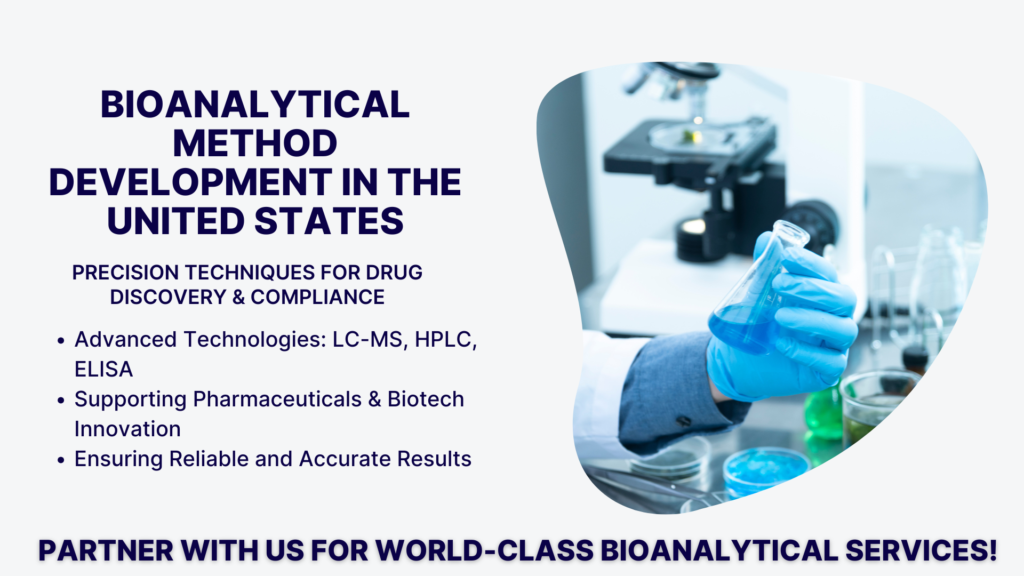
Bioanalytical method development plays a crucial role in drug development, biotechnology, and other industries requiring precise analysis of drugs, metabolites, and biomarkers. The United States, with its advanced regulatory framework and innovative research ecosystem, leads the way in bioanalytical advancements. This comprehensive guide explores the key techniques, applications, and services driving bioanalytical method development in the United States.
What is Bioanalytical Method Development?
Bioanalytical method development is the process of designing, validating, and applying analytical techniques to quantify drugs, metabolites, and biomarkers in biological matrices such as plasma, serum, and tissue. This process ensures accurate, reliable, and reproducible results critical for drug discovery, clinical trials, and regulatory submissions [1].
Importance in the Pharmaceutical Industry
Bioanalytical method development ensures compliance with FDA and EMA guidelines while supporting drug efficacy and safety evaluations. Its applications span drug metabolism, pharmacokinetics, and toxicokinetics studies.
Key Techniques in Bioanalytical Method Development
Several advanced techniques are employed to achieve precision and reliability in bioanalytical testing:
1. Liquid Chromatography-Mass Spectrometry (LC-MS)
LC-MS is widely used for its high sensitivity and specificity in detecting and quantifying small molecules, peptides, and metabolites. It is often the method of choice for pharmacokinetics and bioavailability studies [2].
- Applications: Quantification of drugs in plasma, metabolite identification, and protein analysis.
- Advantages: High throughput, minimal sample preparation, and robust performance.
2. High-Performance Liquid Chromatography (HPLC)
HPLC remains a cornerstone technique in bioanalytical labs. It separates compounds based on their physicochemical properties, making it versatile for various applications [3].
- Applications: Stability testing, impurity profiling, and biomarker analysis.
- Advantages: Broad compatibility with biological matrices and excellent reproducibility.
3. Enzyme-Linked Immunosorbent Assay (ELISA)
ELISA is a robust method for quantifying proteins, antibodies, and biomarkers in biological samples. It is particularly valuable for immunogenicity studies and protein therapeutic quantification [4].
- Applications: Biomarker discovery, therapeutic protein analysis, and vaccine development.
- Advantages: High sensitivity, ease of automation, and cost-effectiveness.
4. Gas Chromatography-Mass Spectrometry (GC-MS)
GC-MS is utilized for volatile and semi-volatile compound analysis. It is highly effective in pharmacokinetics and environmental monitoring studies [5].
- Applications: Analysis of volatile metabolites, drugs, and environmental contaminants.
- Advantages: Exceptional resolution and quantification accuracy.
5. Capillary Electrophoresis (CE)
Capillary electrophoresis offers high-resolution separation for charged molecules. It is increasingly used for peptide, protein, and nucleic acid analysis [6].
- Applications: Characterization of therapeutic proteins, DNA/RNA analysis, and quality control.
- Advantages: Minimal sample consumption and high-resolution capability.
Applications of Bioanalytical Method Development
Bioanalytical method development extends across numerous industries and applications:
1. Drug Discovery and Development
Accurate bioanalytical methods ensure reliable pharmacokinetic and pharmacodynamic studies, accelerating drug discovery timelines. Key focus areas include:
- Lead compound optimization
- Preclinical and clinical trials
2. Regulatory Compliance
Bioanalytical testing ensures adherence to regulatory standards from agencies such as the FDA, EMA, and ICH, thereby facilitating smooth drug approvals [7].
3. Therapeutic Monitoring
Bioanalytical methods are essential for measuring drug concentrations in patients, enabling dose optimization and minimizing adverse effects.
4. Biomarker Discovery
Identifying and quantifying biomarkers supports precision medicine, allowing tailored therapeutic interventions.
5. Environmental and Food Safety
In addition to pharmaceuticals, bioanalytical methods are employed in detecting contaminants and ensuring safety in food and environmental samples.
Challenges in Bioanalytical Method Development
Despite advancements, bioanalytical method development faces several challenges:
1. Matrix Interference
Biological matrices such as plasma and urine often contain interfering substances, making it difficult to achieve accurate quantification.
2. Sensitivity and Specificity
Detecting trace levels of analytes requires ultra-sensitive techniques, which can be resource-intensive.
3. Regulatory Hurdles
Adhering to rigorous validation standards, such as FDA’s Bioanalytical Method Validation Guidance, adds complexity to method development [8].
4. Technological Limitations
Rapid advancements in analytical technologies require continual investment in equipment and training.
Services Offered by Bioanalytical CROs in the United States
Contract Research Organizations (CROs) play a pivotal role in bioanalytical method development. Key services include:
1. Method Development and Validation
CROs offer tailored method development and validation services, ensuring methods meet regulatory guidelines.
2. Sample Analysis
High-throughput analysis of biological samples using advanced instrumentation.
3. Pharmacokinetics and Toxicokinetics Studies
CROs provide comprehensive PK/PD studies to support drug development programs.
4. Biomarker Analysis
From discovery to validation, CROs support biomarker-driven studies essential for precision medicine.
5. Regulatory Support
Expert consultation and support for regulatory submissions ensure compliance and expedite approval processes.
Why Choose the United States for Bioanalytical Method Development?
The United States offers several advantages for bioanalytical method development:
1. Regulatory Expertise
The FDA’s stringent standards foster innovation and ensure high-quality bioanalytical methods.
2. Access to Advanced Technologies
U.S.-based labs have access to cutting-edge technologies and highly skilled professionals.
3. Thriving Pharmaceutical and Biotech Ecosystem
Home to global pharmaceutical leaders, the U.S. provides an ecosystem conducive to bioanalytical advancements.
Conclusion
Bioanalytical method development is a cornerstone of modern drug discovery, precision medicine, and regulatory compliance. The United States continues to lead in innovation, offering unparalleled expertise and technologies. With services ranging from method development to biomarker analysis, bioanalytical testing remains indispensable for pharmaceutical, biotech, and related industries.
Quick Enquiry
References
- Food and Drug Administration (FDA). Bioanalytical Method Validation Guidance.
- ICH. Guidelines on Bioanalytical Method Validation

GC-MS vs. GC-MS/MS: When Do You Need Tandem Mass Spectrometry for Your Samples?
Introduction: When analyzing volatile and semi-volatile compounds, choosing between GC-MS vs GC-MS/MS can significantly impact…

Peptide Characterization of Ganirelix Generic Project Submission to USFDA
Summary of Key Insights ✅ Comprehensive overview of the Peptide Characterization of Ganirelix Generic Project…

Peptide Characterization of Lanreotide Generic Project Submission to USFDA
Summary Lanreotide peptide characterization is the most critical analytical component in generic project submissions to…

PLGA Polymer Characterization for Generic Drug Development: What Innovators Don’t Disclose
Introduction: PLGA polymer characterization for generics represents one of the most challenging aspects of developing…

Development of Nitrosamine-Free Manufacturing Processes: A Step-by-Step Technical Framework
Introduction Ensuring a Nitrosamine-Free Manufacturing Process is no longer optional for pharmaceutical companies. Regulatory agencies…

Nitrosamine Testing in Emerging Drug Classes: Peptides, Oligonucleotides, and Novel Modalities
Introduction: Why Nitrosamine Testing for Peptides and Oligonucleotides Matters Now Nitrosamine Testing for Peptides and…