
Introduction
Securing approval under section 351(k) of the Public Health Service (PHS) Act requires Biosimilar Analytical Similarity Services that extend beyond routine physicochemical testing. These services must provide an audit-ready, risk-ranked comparative analytical assessment (CAA) that aligns with the FDA’s September 2025 final guidance. Under the statutory “totality of the evidence” framework, analytical studies are generally more sensitive than clinical trials for identifying structural or functional differences between a proposed therapeutic protein and its US-licensed reference product. Therefore, a contract development and manufacturing organization (CDMO) or specialized analytical partner must generate comprehensive orthogonal structural, functional, and statistical evidence. This evidence must be sufficiently robust to support a selective, targeted clinical program and withstand regulatory scrutiny.
Explore comprehensive biosimilar analytical characterization services to support your 351(k) development program.
The regulatory expectations governing 351(k) Chemistry, Manufacturing, and Controls (CMC) packages underwent substantial changes throughout 2025 and 2026. In September 2025, the FDA finalized Development of Therapeutic Protein Biosimilars: Comparative Analytical Assessment and Other Quality-Related Considerations (Docket No. FDA-2019-D-2102), officially replacing both the April 2015 quality guidance and the May 2019 draft guidance. Subsequent developments in 2026, including the March 2026 Revision 4 draft Q&As concerning non-US comparator bridging and the October 13, 2026 final guidance on postapproval manufacturing changes, further increased the importance of conducting rigorous analytical assessments at the initial development stage. Since industry reviews identify manufacturing and analytical deficiencies as major contributors to biologics Complete Response Letters (CRLs), specialized analytical laboratories such as ResolveMass Laboratories Inc. structure their workflows around regulatory traceability. This ensures that every lot characterization result, statistical interval, and method validation contributes to a scientifically justified and defensible 351(k) submission.
Share via:
Quick Summary:
- Why analytics matter: A 351(k) biosimilar approval rests on a comparative analytical assessment (CAA), because lab studies detect structural and functional differences more sensitively than clinical trials. FDA’s September 2025 final CAA guidance replaced the 2015 quality guidance and the 2019 draft.
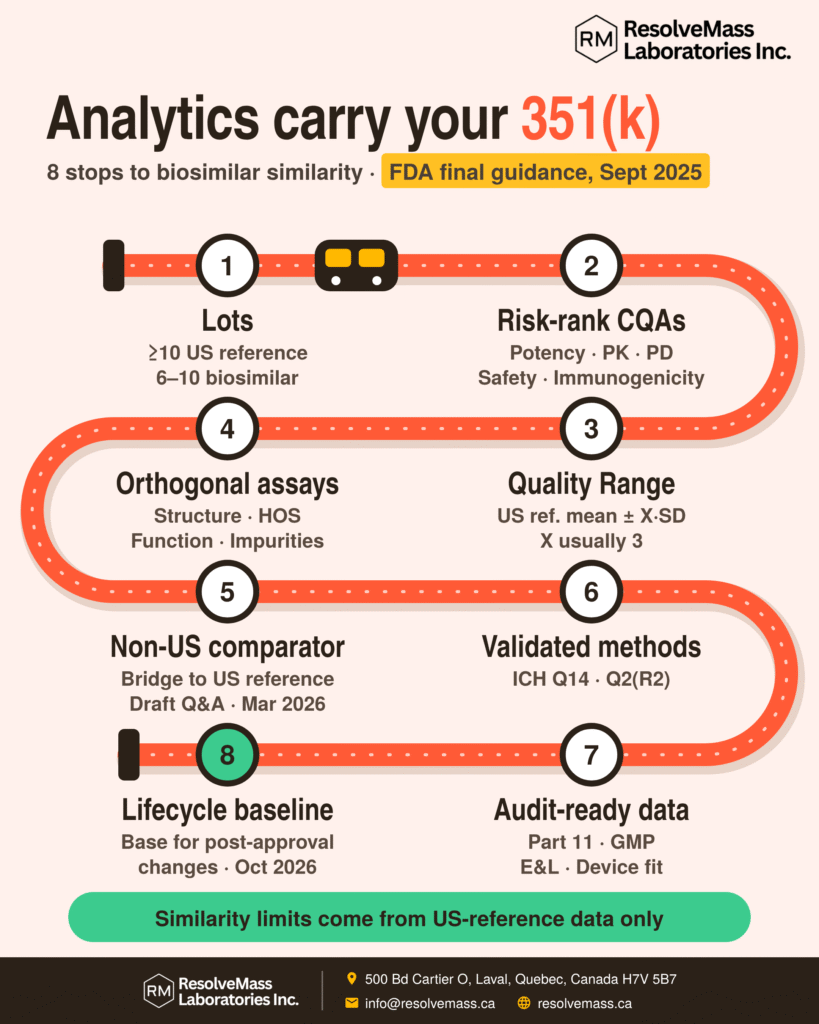
- Lots to test: FDA recommends at least 10 US-licensed reference lots spanning several expiry dates, plus 6–10 biosimilar lots that represent the commercial process. Every lot needs full documentation, and all clinical-study lots must be included.
- Risk-ranking CQAs: Quality attributes are ranked by their potential impact on potency, PK, PD, safety and immunogenicity. An attribute that is high risk in any one category is treated as high risk overall, and uncertainty pushes an attribute to a higher risk rank.
- Statistics: Quantitative high- and moderate-risk attributes are judged with a Quality Range (US reference mean ± X·SD, with X usually 3 and tighter for higher-risk attributes). A sufficient share of biosimilar lots, for example about 90%, should fall inside it. The limits come only from US reference data, and the older three-tier approach was withdrawn in 2018.
- Orthogonal testing: Primary structure, PTMs, higher-order structure, biological function, impurities and forced degradation are each tested with methods based on different principles. Methods should be developed and validated under ICH Q14 and Q2(R2).
- Non-US comparators: FDA’s March 2026 draft Q&As (Revision 4) would let sponsors use clinical data generated with a non-US comparator, often without a three-way PK study. This depends on a strong analytical bridge to the US reference product.
- Avoiding CRLs and planning ahead: Part 11 data integrity, GMP inspection readiness, and E&L and device-compatibility testing reduce the risk of Complete Response Letters. Under FDA’s October 2026 final guidance, the original CAA dataset also serves as the baseline for post-approval manufacturing changes, including for interchangeable products.
What Regulatory Deliverables Define FDA-Compliant Biosimilar Analytical Similarity Services
FDA-compliant Biosimilar Analytical Similarity Services must provide four essential deliverables for the CMC section of a 351(k) Biologics License Application (BLA). These include a patient-centric Critical Quality Attribute (CQA) risk assessment, a fully documented multi-lot orthogonal characterization dataset, Quality Range (QR) statistical evaluations based on direct testing of the US reference product, and traceable raw analytical records. Unlike innovator biologics licensed under section 351(a) or internal comparability assessments conducted under ICH Q5E, biosimilar developers do not have direct access to information about the reference product’s cell line, raw materials, equipment, or manufacturing process controls. Consequently, their analytical partners must evaluate variability across multiple commercial batches of the reference product and demonstrate a high degree of similarity in physicochemical structure, biological function, impurities, and degradation profiles.
Understand how critical quality attributes influence biosimilar development and regulatory assessments.
Read more about Critical Quality Attributes (CQAs) in biosimilars
Importantly, the FDA applies identical analytical similarity and product quality standards to sponsors seeking either standard biosimilarity or an interchangeable designation. Additionally, the FDA’s October 13, 2026 final Q&A guidance on Postapproval Manufacturing Changes to Biosimilar and Interchangeable Biosimilar Products (Docket No. FDA-2024-D-2581) establishes a direct connection between the initial 351(k) comparative analytical dataset and post-licensure lifecycle management. The guidance clarifies how sponsors can use comparative analytical assessment data from their original 351(k) BLA to support postapproval ICH Q5E comparability conclusions. It also formally extends these principles to interchangeable biosimilars. As a result, the initial baseline dataset generated by your CDMO becomes a long-term regulatory asset that can support future manufacturing changes.
| 351(k) Analytical Deliverable | Core CDMO Execution Requirement | Governing Regulatory Anchor |
|---|---|---|
| Multi-Lot Reference & Biosimilar Matrix | Characterize ≥10 US reference lots and at least 6–10 independent biosimilar lots, with complete documentation and lot accounting. | CAA Final Guidance (Sept 2025; Docket FDA-2019-D-2102) |
| Patient-Centric CQA Risk Ranking | Evaluate attributes across potency, PK, PD, safety, and immunogenicity, giving higher priority to attributes associated with clinical uncertainty. | CAA Final Guidance (Sept 2025) |
| Quality Range (QR) Statistical Evaluation | Calculate intervals using direct testing of US reference product lots and verify sufficient biosimilar lot concordance, typically ≥90%. | CAA Final Guidance (Sept 2025) |
| Non-US Comparator CMC Bridge | Perform three-way pairwise comparisons without combining reference product and comparator datasets. | CAA Final Guidance (2025) & Draft Q&A Rev. 4 (Mar 2026) |
| Method Lifecycle & QbD Validation | Develop and validate analytical procedures using enhanced QbD and risk management principles. | ICH Q14 / ICH Q2(R2) (2024) & ICH Q8(R2)–Q11 |
| Postapproval Baseline Comparability | Retain baseline CAA datasets and reference materials to support future ICH Q5E manufacturing change assessments. | Postapproval Changes Final Guidance (Oct 2026; FDA-2024-D-2581) |
How Must Your CDMO Structure Lot Procurement, Lot Accounting, and Comparator Bridging
Your CDMO must procure and characterize at least 10 US-licensed reference product lots representing different expiration periods, together with at least 6 to 10 proposed biosimilar lots obtained, wherever possible, from independent drug substance batches. Selecting reference batches across a broad range of expiration dates helps capture natural manufacturing variability between lots and prevents the establishment of artificially narrow acceptance intervals. For the proposed biosimilar, the analytical sample pool should include clinical study lots, commercial-scale process lots, and validation lots. Engineering batches or lots manufactured at different scales may also be included, provided they adequately represent the intended commercial manufacturing process. In cases where rare or orphan indications limit the availability of commercial reference product lots, your analytical partner should identify this limitation early. This allows the sponsor to consult the FDA and discuss a flexible comparative analytical strategy before proceeding.
Each batch included in the analytical program must have complete and traceable documentation within the 351(k) BLA. In particular, the CDMO must maintain a comprehensive lot-accounting ledger covering every reference product, proposed biosimilar, and non-US-licensed comparator lot procured and characterized throughout development. This record must connect each batch with the specific physicochemical, functional, and clinical studies in which it was used. It should also document both the analytical testing date and product expiration date, along with a clear scientific explanation whenever a particular lot is included in or excluded from an individual assay. Importantly, all lots administered during clinical pharmacokinetic (PK), pharmacodynamic (PD), or clinical comparative studies must be incorporated into the comparative analytical assessment without exception.
Executing Three-Way Analytical Bridging Under the March 2026 FDA Framework
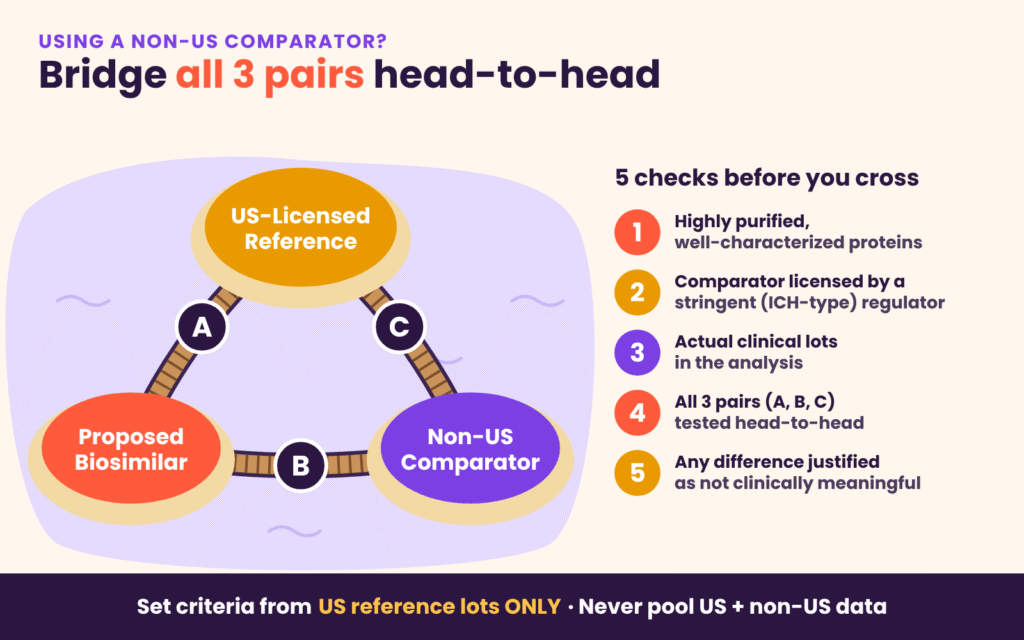
When a clinical development program involves a non-US-licensed comparator, the CDMO must conduct head-to-head analytical testing across all three possible pairwise combinations. Similarity acceptance criteria must be established exclusively using direct analytical characterization of the US-licensed reference product. As explained in regulatory analyses of the FDA’s March 2026 draft guidance, New and Revised Draft Q&As on Biosimilar Development and the BPCI Act, Revision 4, sponsors may be able to support biosimilarity using clinical data generated with a non-US comparator. Under appropriate circumstances, this approach may also eliminate the need for conventional three-way clinical PK bridging studies, provided that the required CMC and analytical bridging conditions are adequately fulfilled. Published literature cannot replace direct head-to-head analytical testing. Similarly, combining data from the US-licensed reference product and a non-US comparator to calculate acceptance criteria is explicitly unacceptable.
Strengthen your analytical bridging strategy with appropriate biosimilar comparability studies.
To comply with both the September 2025 CAA guidance and the bridging requirements described in the March 2026 draft guidance and related industry regulatory commentary, a CDMO must incorporate five essential steps into its analytical bridging workflow:
- Confirm product suitability: Confirm that the proposed biosimilar, US-licensed reference product, and non-US comparator are highly purified therapeutic proteins that can undergo comprehensive analytical characterization. Their inactive ingredients should be identical or have only minor differences.
- Verify regulatory oversight: Establish that the non-US comparator is licensed and manufactured under the supervision of a regulatory authority with quality oversight comparable to that of the FDA, such as an ICH-aligned regulatory authority.
- Include actual clinical lots: Include the actual clinical lots of both the proposed biosimilar and the non-US comparator directly in the comparative analytical assessment.
- Conduct all three pairwise comparisons: Perform head-to-head analytical testing for all three combinations: proposed biosimilar versus US-licensed reference product, proposed biosimilar versus non-US comparator, and non-US comparator versus US-licensed reference product.
- Provide scientific justification: Provide a scientifically supported justification, preferably following early consultation with the FDA before clinical execution, demonstrating that any analytical differences identified between the comparison groups do not have clinical significance.
How Should Your CDMO Execute CQA Risk Ranking and Statistical Similarity Testing
A CDMO must establish priorities for molecular attributes using a scientifically justified, patient-centric risk assessment tool and conduct Quality Range (QR) statistical evaluations for all quantitative high- and moderate-risk attributes. The clinical relevance of individual CQAs depends on the specific therapeutic modality. For example, glycosylation represents an important CQA for monoclonal antibodies produced in mammalian cell systems, whereas it is absent in proteins expressed through prokaryotic hosts such as Escherichia coli. Therefore, the risk assessment framework must be designed according to the characteristics and biological properties of the therapeutic protein being evaluated.
Under the FDA’s CAA guidance, an attribute identified as high risk in even one performance category, including biological activity, PK, PD, safety, efficacy, or immunogenicity, must receive an overall high-risk classification. Furthermore, if there is uncertainty about the potential clinical consequences of an attribute initially considered low risk, the FDA recommends assigning it a higher CQA risk classification. Industry analyses also highlight that an inadequately developed CQA list can create regulatory concerns and increase the likelihood of deficiency letters. On the other hand, including an excessive number of attributes without sufficient scientific justification can increase development costs and direct resources toward testing with limited regulatory value.
Statistical Deliverables Within Biosimilar Analytical Similarity Services: Quality Ranges vs. Historical Tiers
Modern Biosimilar Analytical Similarity Services must establish quantitative similarity acceptance criteria using the FDA’s Quality Range (QR) framework rather than depending exclusively on the previously withdrawn 2017 three-tier statistical approach. In 2018, the FDA withdrew its 2017 draft guidance, which had categorized analytical attributes into three statistical tiers. Tier 1 required Two One-Sided Tests (TOST) equivalence testing, Tier 2 relied on quality ranges, and Tier 3 involved visual comparisons. Following this withdrawal, the FDA moved toward descriptive Quality Ranges based on sponsor-generated reference product characterization data in its 2019 draft guidance and September 2025 final guidance.
Although certain sponsors have included supplementary TOST equivalence analyses alongside QR assessments for highly critical assays, as reflected in historical FDA chemistry reviews such as BLA 761201, the current FDA guidance primarily emphasizes the Quality Range approach for quantitative similarity evaluations.
Discover analytical approaches for impurity profiling of biosimilars.
According to the FDA’s QR methodology, the acceptance interval for each quantitative high- or moderate-risk attribute must be calculated exclusively from the sponsor’s direct characterization of US-licensed reference product lots using the following formula:
[ μ̂R − X × σ̂R , μ̂R + X × σ̂R ]
Quality Range (QR) = Reference Mean ± X × Reference Standard Deviation
In this expression, μ̂R represents the sample mean, while σ̂R represents the sample standard deviation of the reference product lots. A multiplier of X = 3 standard deviations (SDs) generally produces an appropriately constrained interval. For instance, an FDA product quality review of insulin glargine (MYL-1501D) reported that 100% of the lots fell within the mean ± 3 SD interval established using US-Lantus.
However, attributes classified as high risk may require narrower acceptance intervals, with multipliers below 3 SD. For example, a 2026 FDA chemistry review (BLA 761439) assessed high- and moderate-risk attributes using a multiplier of X = 2.00 SD. Similarly, a peer-reviewed post-change comparability study involving an omalizumab biosimilar (CMAB007) applied mean ± 1.5 SD for Tier 1 bioactivity and binding attributes. In contrast, any proposal to use a multiplier greater than 3 SD should be discussed with the FDA before implementation.
Analytical similarity is generally supported when a sufficient proportion of proposed biosimilar lots, such as 90%, fall within the established QR. The FDA specifically discourages the use of tolerance intervals because generating statistically meaningful tolerance intervals generally requires approximately 30 product lots.
| Attribute Risk Tier | Primary Statistical Method | Decision Criteria and Formula | Representative Analytical Assays |
|---|---|---|---|
| High-Risk Quantitative Attributes (MoA, Potency, Target Binding) | Quality Range (QR), with optional supplementary TOST equivalence testing. | Reference Mean ± X × SD, with X ≤ 3 (for example, 1.5–2.0 SD in stringent bioactivity assessments). Typically, ≥90% of biosimilar lots should fall within the QR. Supplementary TOST: α = 0.05, with the 90% CI within ±1.5 × σR. | Cell-based potency bioassays, ADCC assays, SPR target receptor and FcγRIIIa binding. |
| Moderate-Risk Quantitative Attributes (PK, Clearance, Stability, Immunogenicity) | Quality Range (QR). | Reference Mean ± X × SD, typically with X = 2 to 3 SD. At least 90% of biosimilar lots should fall within the QR. | Size-Exclusion Chromatography (SEC), Cation Exchange (CEX), NP-HPLC/LC-MS glycan profiling, FcRn and C1q binding. |
| Lowest-Risk or Non-Quantitative Attributes | Raw Data & Graphical/Visual Comparison. | Side-by-side visual assessment and summary statistics demonstrating structural equivalence. | Primary amino acid sequence, disulfide bridging, qualitative conformational overlays. |
What Orthogonal Analytical and Functional Assays Must Be Integrated Into the Characterization Package
Your CDMO must incorporate orthogonal analytical methods, which operate using different physicochemical or biological principles, to characterize primary structure, post-translational modifications (PTMs), higher-order structure (HOS), biological activity, impurities, and forced degradation profiles. Depending on only one analytical technique can result in the failure to identify subtle product variants that may influence pharmacokinetics or immunogenicity.
According to the FDA’s September 2025 guidance, every orthogonal assay targeting the same attribute does not necessarily require an independent Quality Range analysis. Instead, the most sensitive analytical method for identifying product differences should undergo QR evaluation. Other complementary orthogonal techniques assessing the same attribute may be evaluated through graphical comparisons, provided that the sponsor supplies an appropriate scientific justification for this approach.
Additionally, when physicochemical analytical methods cannot conclusively establish the integrity of higher-order conformational structures, the CDMO must use sensitive biological activity assays to obtain supporting evidence of HOS integrity. Combining multiple analytical approaches allows sponsors to develop a more comprehensive understanding of molecular characteristics and identify differences that might otherwise remain undetected.
| Molecular Domain | Critical Quality Attributes Evaluated | Orthogonal Analytical & Functional Techniques |
|---|---|---|
| Primary Structure & Sequence | Amino acid sequence, N/C-terminal integrity, disulfide bond linkages. | LC-MS/MS peptide mapping, peptide sequencing, high-resolution mass spectrometry (HRMS), MALDI-TOF. |
| Post-Translational Modifications & Size/Charge Variants | Conserved glycosylation (e.g., EEQYNSTYR peptide), fucosylation, C-terminal lysine truncation, glycation, oxidation, deamidation, phosphorylation, dimer/aggregate content. | NP-HPLC/LC-MS glycan profiling, Size-Exclusion Chromatography (SEC), Cation Exchange (CEX), MALDI-TOF. |
| Higher-Order Structure (HOS) | Secondary, tertiary, and quaternary conformational structure. | Nuclear Magnetic Resonance (NMR), Differential Scanning Calorimetry (DSC), Circular Dichroism (CD), Dynamic Light Scattering (DLS), intrinsic fluorescence, FTIR, supplemental cryo-EM. |
| Functional & Immunological Activity | Target neutralization/bioactivity, Fc effector function, neonatal Fc recycling, complement binding. | Cell-based potency bioassays, ADCC assays, Surface Plasmon Resonance (SPR) across target, FcγRI/IIa/IIb/IIIa/IIIb, FcRn, and C1q. |
| Impurities & Forced Degradation | Process/product impurities, stress degradation pathways, absence of novel degradants. | Head-to-head forced-degradation stress studies paired with orthogonal LC-MS impurity profiling. |
Learn how native mass spectrometry supports biosimilar characterization.
Aligning Analytical Method Validation With ICH Q2(R2), ICH Q14, and QbD Design Spaces
Analytical methods used to support a 351(k) filing must be developed and validated according to enhanced Quality by Design (QbD) principles. These principles integrate ICH Q14 (Analytical Procedure Development) and ICH Q2(R2) (Validation of Analytical Procedures) with the pharmaceutical development frameworks established under ICH Q8(R2), Q9(R1), Q10, and Q11.
Sensitive comparative analytical procedures frequently identify minor molecular differences between the proposed biosimilar and its reference product. Examples include variations in fucosylated biantennary oligosaccharides or reduced C-terminal lysine truncation relative to the reference product. Therefore, every analytical method must demonstrate appropriate sensitivity and specificity to determine whether the observed differences have any potential clinical consequences.
Explore the proteomics approach for biosimilars to understand its role in comprehensive molecular characterization.
Industry CMC guidance commentary also emphasizes the long-term operational benefits of establishing a scientifically justified QbD design space during analytical method development. When manufacturing process adjustments remain within an approved design space, sponsors may reduce the need for Prior Approval Supplements following licensure. This approach supports greater manufacturing flexibility while maintaining established product quality requirements and regulatory compliance.
How Do Data Integrity, GMP Readiness, and Combination Device Testing Prevent 351(k) CRLs
Preventing Complete Response Letters requires a CDMO to combine comprehensive analytical characterization with GMP inspection readiness, 21 CFR Part 11 data integrity controls, and combination device compatibility assessments. Industry analyses indicate that biosimilar applications may experience a disproportionately high rate of regulatory deficiencies compared with novel BLAs. One industry review of biosimilar rejections reported that manufacturing deficiencies, commonly identified during pre-approval inspections, were present in more than half of all CRLs affecting biologics and biosimilars.
Other documented regulatory challenges include inadequate EU-to-US reference product bridging and insufficient device compatibility data for prefilled syringes and autoinjectors. In these cases, sponsors must demonstrate that prolonged contact between the drug product and delivery system components throughout the shelf life does not adversely affect product quality. They must also establish that no harmful compounds are introduced through leachables or other material-related interactions.
Before finalizing a 351(k) submission, sponsors should evaluate prospective CDMOs and specialized analytical partners against five important operational safeguards:
- 21 CFR Part 11 Digital Systems: The laboratory must operate validated Laboratory Information Management Systems (LIMS) that maintain complete electronic audit trails, secure encrypted data backups, and project-specific access controls. These systems should ensure that electronic records remain protected, traceable, and accessible to authorized personnel throughout the analytical program.
- Multi-Level QA & Raw Data Review: Independent quality assurance teams must review and verify raw chromatograms, mass spectra, calibration procedures, and statistical variance models before releasing analytical reports. This additional review process helps identify inconsistencies, documentation gaps, and potential data integrity concerns before submission.
- Pre-Approval Inspection Readiness: Structured mock inspections should be conducted across all CMO/CDMO testing facilities approximately 18 to 24 months before the planned 351(k) submission. These assessments must be supported by documented Corrective and Preventive Action (CAPA) implementation and verifiable evidence that identified deficiencies have been appropriately addressed.
- Extractables, Leachables & Device Compatibility: Dedicated E&L and shelf-life stability programs must confirm that prefilled syringes and autoinjectors do not release harmful compounds or negatively influence drug product quality. These assessments should establish compatibility between the drug product and its delivery system throughout the intended shelf life.
- Unified R&D-to-GMP Analytical Transfer: A consistent quality management system should connect early-stage analytical characterization, GLP bioanalysis, and GMP release testing. Maintaining this continuity helps minimize external handoff complications, reduces documentation gaps, and supports reliable analytical data transfer throughout development.
Integrated North American laboratory facilities demonstrate how specialized analytical infrastructure can help reduce these CMC-related risks. Operating from Quebec and serving Canadian and US markets, ResolveMass Laboratories Inc. holds a Health Canada GMP Drug Establishment Licence (3-002945-A), FDA laboratory registration (Establishment Identifier 3042696771), and ISO 9001:2015 certification. Its operational framework also incorporates GLP-, GCP-, and ISO 17025-aligned workflows supported by 21 CFR Part 11 digital platforms.
Explore specialized aggregation analysis in biosimilars to support comprehensive product quality evaluation.
According to company disclosures, its PhD analytical scientists have contributed to more than 300 regulatory submissions and 150 method validations. The organization combines high-resolution mass spectrometry, NMR, hybrid LBA-MS, E&L profiling, and Quality Range statistical modeling to support the analytical characterization of monoclonal antibodies, bispecifics, antibody-drug conjugates, and peptides. These capabilities operate within a unified quality management system, supporting analytical consistency, regulatory documentation, and data traceability across different stages of biologics development.
Conclusion
Providing FDA-ready Biosimilar Analytical Similarity Services for a 351(k) BLA requires considerably more than performing individual laboratory tests. A qualified CDMO partner must manage multi-lot procurement, maintain comprehensive lot accounting, conduct three-way non-US comparator bridging when required, establish patient-centric CQA risk rankings, and perform Quality Range statistical evaluations in accordance with the FDA’s September 2025 and October 2026 regulatory frameworks.
When supported by orthogonal analytical characterization, ICH Q14/Q2(R2) method validation, E&L and device compatibility testing, and comprehensive 21 CFR Part 11 GMP traceability, the resulting analytical package can help streamline clinical development requirements and support indication extrapolation. It also strengthens the scientific justification for biosimilarity, reduces the risk of costly CRLs, and preserves an essential baseline dataset for evaluating future postapproval manufacturing changes.
Explore an end-to-end biosimilar analytical package for regulatory submissions to support your 351(k) development and submission requirements.
To align your biosimilar characterization, statistical similarity modeling, or GMP analytical method validation strategy with current FDA 351(k) expectations, connect with the scientific team at ResolveMass Laboratories Inc. for specialized analytical and regulatory support.
Contact the scientific team at ResolveMass Laboratories Inc.
Frequently Asked Questions
The FDA’s September 2025 final guidance places greater emphasis on Quality Ranges established through direct testing of US-licensed reference product lots. These ranges are recommended for evaluating quantitative attributes classified as high or moderate risk. Although sponsors may provide additional statistical analyses, such as TOST for primary bioassays, Quality Range assessments form an important part of the current comparative analytical approach.
No. Data from non-US-licensed comparators should not be combined with US-licensed reference product results to establish Quality Ranges or define analytical acceptance criteria. The ranges should be based on direct characterization of US-licensed reference product lots. Non-US comparator data may be relevant to separate bridging evaluations, but it should not replace the required reference product assessment.
The March 2026 Revision 4 draft Q&As indicate that certain sponsors may be able to justify an alternative to the traditional three-way clinical PK bridging approach. This depends on strong CMC bridging evidence, direct analytical comparisons involving the proposed biosimilar and relevant reference products, and adequate documentation of foreign regulatory oversight. Sponsors should seek early FDA feedback and provide a scientifically supported justification before relying on this approach.
A high-similarity conclusion may be supported when a substantial proportion of biosimilar lot measurements fall within the established reference product Quality Range. For example, approximately 90% of the proposed biosimilar measurements may fall within the range when an appropriate statistical multiplier is applied. The selected SD multiplier, such as X ≤ 3, should be scientifically justified, and any wider range should be discussed with the FDA.
Tolerance intervals are generally not preferred for establishing analytical similarity acceptance criteria because they require a sufficiently large number of product lots to produce reliable estimates. Approximately 30 lots may be needed to develop meaningful tolerance intervals, which can be difficult to obtain in therapeutic protein development programs. Quality Ranges provide a more practical approach for evaluating reference product variability.
The FDA applies the same analytical similarity and product quality expectations to biosimilars and interchangeable biosimilars. Interchangeability requirements involve additional considerations, but they do not establish a separate or stricter analytical quality standard. The October 13, 2026 final postapproval guidance also applies ICH Q5E-aligned manufacturing change principles to both categories.
No. Using multiple orthogonal analytical methods can provide a more complete understanding of a critical quality attribute (CQA), but every method does not necessarily require a separate Quality Range assessment. Statistical evaluation should generally focus on the assay most capable of detecting meaningful product differences. Other supporting methods can be assessed through graphical comparisons, provided the sponsor explains the scientific rationale.
Manufacturing-related deficiencies are frequently identified in Complete Response Letters (CRLs), particularly when problems arise during pre-approval facility inspections. Other important reasons for regulatory concerns include insufficient CMC documentation, inadequate bridging of non-US comparators, and incomplete drug-device compatibility assessments. These issues highlight the importance of maintaining manufacturing controls and comprehensive analytical evidence throughout biosimilar development.
The FDA’s October 13, 2026 final guidance aligns postapproval manufacturing change assessments for biosimilars and interchangeable biosimilars with ICH Q5E principles. It also explains how analytical comparability information generated during the original 351(k) development program can support future manufacturing change assessments. Establishing a comprehensive baseline dataset and retaining suitable reference materials can therefore help sponsors demonstrate comparability and manage product lifecycle changes.
Reference:
- U.S. Food and Drug Administration. (2025, September). Development of therapeutic protein biosimilars: Comparative analytical assessment and other quality-related considerations: Guidance for industry. https://www.fda.gov/regulatory-information/search-fda-guidance-documents/development-therapeutic-protein-biosimilars-comparative-analytical-assessment-and-other-quality
- Brahme, N., Skibinski, S., & Ikenberry, S. (n.d.). FDA drug topics: Biosimilars—A review of scientific, regulatory, and clinical considerations for health care providers. U.S. Food and Drug Administration. https://www.fda.gov/media/169599/download
- Nupur, N., Joshi, S., Gulliarme, D., & Rathore, A. S. (2022). Analytical similarity assessment of biosimilars: Global regulatory landscape, recent studies and major advancements in orthogonal platforms. Frontiers in Bioengineering and Biotechnology, 10, 832059. https://doi.org/10.3389/fbioe.2022.832059
- Oliva, A., & Llabrés, M. (2021). New quality-range-setting method based on between- and within-batch variability for biosimilarity assessment. Pharmaceuticals, 14(6), 527. https://doi.org/10.3390/ph14060527
- U.S. Food and Drug Administration. (2021). Chemistry review: Biologics license application (BLA) 761201. https://www.accessdata.fda.gov/drugsatfda_docs/nda/2021/761201Orig1s000ChemR.pdf
Get In Touch With Us
About The Author