
Introduction
Formal Biosimilar Biological Product Development (BPD) Meetings serve as an essential regulatory bridge between sponsors and the United States Food and Drug Administration (FDA), helping establish alignment under Section 351(k) of the Public Health Service (PHS) Act. Participating in Biosimilar Biological Product Development (BPD) Meetings enables drug developers to reduce the risks associated with biosimilarity programs by obtaining targeted regulatory advice on comparative analytical similarity, nonclinical assessments, and clinical trial designs. Following the issuance of updated FDA procedural guidance aligned with the Biosimilar User Fee Amendments (BsUFA III), navigating the formal meeting framework requires a detailed understanding of meeting formats, strict briefing package submission deadlines, and analytical requirements.
Demonstrating biosimilarity requires advanced bioanalytical characterization, including primary sequence verification, post-translational modification profiling, higher-order structure evaluation, and functional bioassays. Regulatory alignment depends on the quality and strength of the comparative analytical data presented during these meetings, with analytical laboratories providing the scientific rigor necessary to establish analytical similarity. This comprehensive analysis examines the structure and purpose of each meeting type, submission schedules, user fee requirements, and briefing package expectations for all FDA BPD meeting categories under current regulatory standards.
To strengthen the scientific foundation of a biosimilar development program, explore our biosimilar characterization services for comprehensive analytical support.
Share via:
Quick Summary:
- Purpose: Formal BPD meetings let biosimilar sponsors get FDA advice under Section 351(k) on analytical similarity, nonclinical work and clinical study design, which lowers development risk.
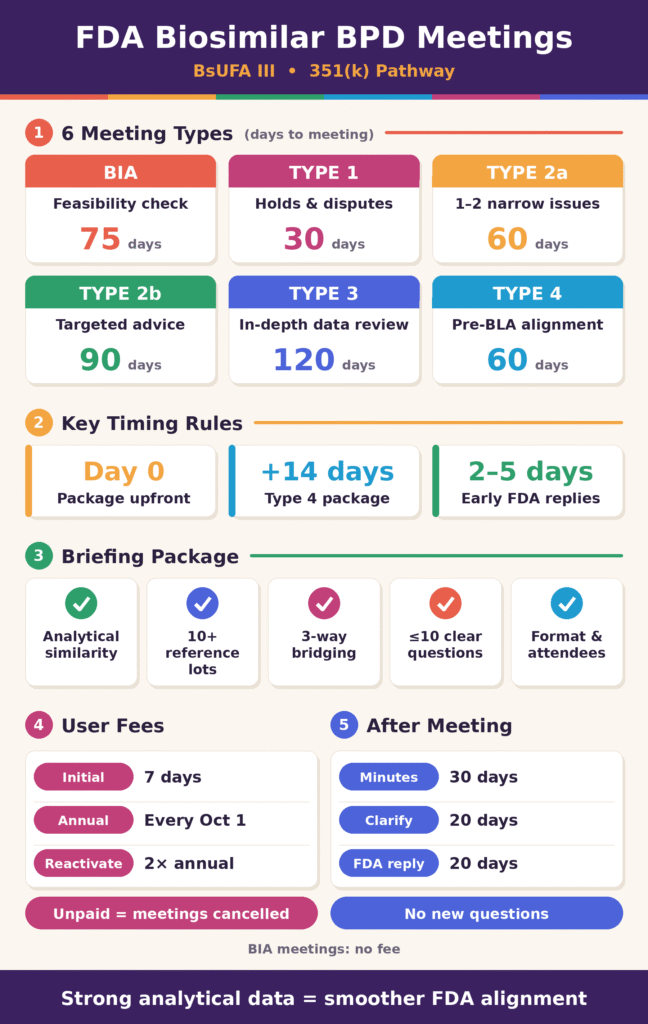
- Six meeting types under BsUFA III: BIA (an early feasibility check, one per product), Type 1 (clinical holds, disputes and other urgent issues), Type 2a (one or two narrow issues), Type 2b (advice on plans and summary data), Type 3 (in-depth review of full data packages), and Type 4 (pre-BLA alignment on format and content).
- Timelines: Meetings take place 30 to 120 days after the request, depending on type. For BIA through Type 3, the briefing package must be submitted with the request or the request may be denied. Type 4 allows 14 extra days. The FDA sends preliminary responses 2 to 5 days before the meeting.
- Briefing package essentials: Comparative analytical similarity data, characterization of at least 10 reference product lots, three-way bridging when a non-U.S. reference product is used, no more than about 10 focused questions, and the requested meeting format with an attendee list.
- User fees: There is a one-time initial BPD fee, due within 7 days of the first granted meeting or the IND submission, whichever comes first. An annual fee is charged every October 1, and restarting a discontinued program costs a reactivation fee of twice the annual fee. BIA meetings are free, but unpaid fees lead to cancelled meetings and possible clinical holds.
- After the meeting: The FDA issues minutes within 30 days. Sponsors then have 20 days to request clarification, limited to points already discussed, and the FDA replies within 20 days.
- Key takeaway: Strong bioanalytical characterization and well-organized analytical similarity data are the foundation for successful FDA alignment and an efficient path to approval.
Core Types of Biosimilar Biological Product Development (BPD) Meetings
Under the Biosimilar User Fee Amendments (BsUFA III), the FDA organizes formal regulatory interactions into six distinct meeting categories: Biosimilar Initial Advisory (BIA) and BPD Types 1, 2a, 2b, 3, and 4. Each category is designed to address specific developmental milestones, ranging from preliminary assessments of pathway feasibility to alignment before submitting a Biologics License Application (BLA).
Biosimilar Initial Advisory (BIA) Meeting
A Biosimilar Initial Advisory (BIA) meeting provides an initial assessment restricted to general discussions about the feasibility of obtaining licensure for a proposed product under Section 351(k). Under the updated BsUFA III guidelines, sponsors may request only one BIA meeting per product, and the submission of preliminary comparative analytical data against the U.S. reference product is no longer strictly required for the request to be granted. The BIA meeting allows developers in the early stages of product development to discuss the general scope of anticipated clinical and nonclinical programs before committing substantial financial resources to analytical benchmarking.
BPD Type 1 Meeting
A BPD Type 1 meeting is intended for biosimilar development programs that have encountered significant obstacles because of regulatory holds, formal disputes, or critical safety concerns. These meetings address urgent development challenges, including clinical holds, dispute resolution, refusal-to-file actions, and Special Protocol Assessments (SPA). Given the urgency associated with stalled development programs, the agency prioritizes BPD Type 1 meetings and follows accelerated scheduling timelines.
BPD Type 2a Meeting
A BPD Type 2a meeting addresses a narrow and clearly defined set of issues requiring input from no more than three review disciplines or divisions. Sponsors can request a Type 2a meeting only after they have already had a BIA or another BPD meeting with the FDA. Type 2a sessions typically focus on one, and no more than two, issues along with their associated questions. Examples include an immunogenicity testing strategy that follows prior FDA feedback, an updated study design based on earlier FDA recommendations, or defined post-approval chemistry, manufacturing, and controls (CMC) commitments. Because of their limited scope, the FDA may decide that a Written Response Only (WRO) is the most appropriate format for a Type 2a meeting, even when a sponsor requests a live meeting.
BPD Type 2b Meeting
A BPD Type 2b meeting provides targeted regulatory advice on specific components of an ongoing development program, including study designs, clinical endpoints, and summary analytical data. Unlike Type 3 meetings, which involve more comprehensive scientific assessments, Type 2b meetings focus on summary data packages rather than complete study reports. Sponsors use these meetings to obtain feedback on analytical similarity assessment plans, confirm their proposed approaches, or discuss the design of Phase 1 comparative pharmacokinetic/pharmacodynamic (PK/PD) study protocols.
BPD Type 3 Meeting
A BPD Type 3 meeting involves an in-depth review of data and scientific consultation concerning an active biosimilar development program. This meeting format enables the FDA to review complete study reports, complex mass spectrometry characterization data, and extensive comparative analytical similarity packages. During a Type 3 meeting, the FDA can also advise on whether additional studies are needed and on the justification for extrapolation across indications. Type 3 meetings are particularly relevant before deciding whether a comparative clinical study is necessary or before submitting a marketing application. Under the FDA’s October 2025 draft guidance, many therapeutic protein biosimilars may not require a comparative efficacy study when comparative analytical and pharmacokinetic data are sufficiently robust.
For a deeper understanding of the evidence needed to demonstrate analytical similarity, review our guidance on biosimilar comparability studies.
BPD Type 4 Meeting
A BPD Type 4 meeting is a pre-submission meeting intended to discuss the format and content of a complete 351(k) Biologics License Application (BLA) or supplement. The FDA generally grants one BPD Type 4 meeting for each original application or supplement. During this meeting, sponsors identify the studies supporting biosimilarity or interchangeability, discuss potential review issues, confirm the status of pediatric assessments, and agree on the best approach to presenting and formatting data in the marketing application.
Timelines and Submission Schedules for Biosimilar Biological Product Development (BPD) Meetings
The FDA’s response periods and meeting schedules for Biosimilar Biological Product Development (BPD) Meetings follow the commitment goals established under BsUFA III. Depending on the meeting category, these timelines range from 14 to 120 calendar days. Compliance with these regulatory schedules is essential because background briefing packages must generally accompany the meeting request at the time of submission.
| Meeting Type | FDA Request Response Window | Scheduled Meeting Window (from Request) | Background Briefing Package Deadline | Preliminary FDA Responses Issued |
|---|---|---|---|---|
| Biosimilar Initial Advisory (BIA) | 21 Calendar Days | 75 Calendar Days | Concurrent with Meeting Request | 2 Calendar Days Prior |
| BPD Type 1 | 14 Calendar Days | 30 Calendar Days | Concurrent with Meeting Request | 2 Calendar Days Prior |
| BPD Type 2a | 21 Calendar Days | 60 Calendar Days | Concurrent with Meeting Request | 2 Calendar Days Prior |
| BPD Type 2b | 21 Calendar Days | 90 Calendar Days | Concurrent with Meeting Request | 5 Calendar Days Prior |
| BPD Type 3 | 21 Calendar Days | 120 Calendar Days | Concurrent with Meeting Request | 5 Calendar Days Prior |
| BPD Type 4 | 21 Calendar Days | 60 Calendar Days | Within 14 Days AFTER Meeting Request | 2 Calendar Days Prior |
An important procedural change under BsUFA III concerns the timing of background briefing package submissions. For BIA and BPD Types 1, 2a, 2b, and 3, meeting requests are considered incomplete and may be denied immediately if the complete background briefing package is not attached when the initial request is submitted. In contrast, BPD Type 4 meetings allow sponsors a 14-calendar-day period after submitting the meeting request to provide the final briefing package. This additional time enables development teams to complete and organize pre-BLA documentation before submission.
The FDA issues written preliminary responses approximately 2 to 5 calendar days before the scheduled meeting, depending on the meeting category. If these written responses adequately address all the sponsor’s questions, the sponsor may choose to cancel the meeting and use the preliminary responses as the agency’s feedback on the submitted questions.
What to Bring: Essential Contents of the Briefing Package for Biosimilar Biological Product Development (BPD) Meetings
A comprehensive briefing package for Biosimilar Biological Product Development (BPD) Meetings should include comparative analytical similarity data, detailed reference product characterization, clearly defined regulatory questions, and appropriate bridging strategies when non-U.S. reference products are involved. Presenting comprehensive structural and functional evidence helps reduce regulatory uncertainty and minimizes the risk of meeting request denials.
Comparative Analytical Similarity Evaluation: Comparative analytical testing provides the scientific foundation for a 351(k) application. Briefing packages should describe primary amino acid sequence verification, intact mass analysis, peptide mapping, disulfide bonding, secondary and tertiary structural integrity, glycosylation profiles, charge heterogeneity, and sub-visible particulate counts. Analytical methodologies established through specialized testing platforms, such as those used at ResolveMass Laboratories Inc., provide the orthogonal characterization needed to demonstrate that the proposed biosimilar is highly similar to the reference product.
Understanding how critical quality attributes are selected and assessed can help sponsors build a stronger analytical package. Learn more about critical quality attributes (CQAs) in biosimilars.
Reference Product Lot Sourcing and Oscillation Profiles: Briefing packages should document the sourcing history of the U.S.-licensed reference product. Sponsors should characterize multiple reference product lots, ideally including at least 10 distinct lots obtained over an extended period, to capture historical variations in quality attributes and establish statistically valid analytical similarity acceptance criteria.
Three-Way Analytical Bridging Strategies: When nonclinical or clinical studies use a foreign-authorized reference product, the briefing package should include a three-way comparative analytical similarity assessment. The data must establish pairwise analytical similarity among the proposed biosimilar, the U.S.-licensed reference product, and the non-U.S.-licensed reference product.
For additional insight into the scientific and regulatory considerations involved in bridging and comparison, explore our article on the comparability exercise in biosimilar development.
Targeted Question Framing: Briefing packages should contain a concise and unambiguous list of regulatory questions, preferably limited to 10 or fewer. These questions should be organized logically according to the relevant disciplines, including CMC, nonclinical assessments, clinical pharmacology, and immunogenicity. Each question should be supported by relevant background information and accompanied by the sponsor’s proposed position.
Attendee Roster and Format Designations: The briefing package should specify the requested meeting format, such as a face-to-face meeting with a hybrid participation option, virtual videoconference, teleconference, or Written Response Only (WRO). The attendee roster should clearly distinguish core participants attending in person at FDA headquarters from non-core participants joining virtually.
Fee Structures and Post-Meeting Actions for Biosimilar Biological Product Development (BPD) Meetings
Participation in the formal BPD program involves statutory user fees under BsUFA III. The post-meeting process also establishes a defined 20-calendar-day period for submitting clarifying follow-up questions. Proper management of user fee obligations and formal clarification opportunities helps sponsors maintain development momentum while avoiding unnecessary administrative delays.
BsUFA User Fee Mechanics
Participation in the BPD program involves specific financial obligations under Section 744H of the FD&C Act:
Initial BPD Fee: This is a one-time fee that a sponsor pays to enter the BPD program for a product. It is due within 7 calendar days after the FDA grants the first BPD meeting (Types 1–4) for the product, or upon submission of an Investigational New Drug (IND) application intended to support a 351(k) BLA, whichever occurs first. BIA meetings do not incur a user fee.
Annual BPD Fee: This fee is assessed annually for each product program on October 1 until a marketing application is accepted for filing or the development program is formally discontinued.
Reactivation Fee: Sponsors that resume a previously discontinued BPD program must pay a reactivation fee equal to twice the annual BPD fee for that fiscal year, along with any annual BPD fees previously owed. The reactivation fee is due within 7 calendar days after the FDA grants a BPD meeting for the product, or upon submission of a qualifying IND, whichever occurs first. Annual BPD fees then resume in the following fiscal year.
Failure to pay BPD user fees by the due date results in the cancellation of any pending or scheduled BPD meetings. It may also lead to a related IND being placed on clinical hold, and a 351(k) application will not be accepted for filing until all outstanding fees are paid. If a meeting is cancelled for non-payment, the FDA’s response timeline restarts from the date the payment is received.
Meeting Minutes and Follow-Up Clarifications
The FDA issues official meeting minutes within 30 calendar days after a formal meeting has taken place. For Written Response Only (WRO) meetings, the written response itself serves as the official meeting minutes. Under the enhancements introduced through BsUFA III, sponsors have 20 calendar days from receiving the meeting minutes or WRO to submit a formal “Request for Clarification.”
Clarification requests must address specific statements or points in the meeting minutes that remain unclear or ambiguous. New issues and questions that were not previously submitted are considered outside the scope of this process. The FDA commits to providing written responses to valid clarification requests within 20 calendar days of receipt.
Conclusion
Understanding the preparation, timing, and execution of Biosimilar Biological Product Development (BPD) Meetings is essential for successfully navigating the Section 351(k) regulatory pathway. By combining robust bioanalytical characterization with the procedural expectations established under BsUFA III, sponsors can reduce regulatory risks, improve development planning, and support more efficient commercialization timelines. Bioanalytical characterization, mass spectrometry, and comparative analytical similarity profiling constitute the core scientific evidence required during regulatory interactions with the FDA.
Sponsors preparing regulatory submissions can also explore our end-to-end biosimilar analytical package to learn more about integrated analytical support for biosimilar development.
Collaborating with specialized analytical testing organizations helps ensure that briefing packages contain traceable, high-quality comparative analytical data capable of withstanding regulatory scrutiny. To learn more about bioanalytical characterization services for biosimilar development programs, visit the ResolveMass Contact Page.
Frequently Asked Questions
Comparative analytical similarity data against the U.S. reference product is not strictly required for a BIA meeting request under the updated BsUFA III framework. However, sponsors should provide adequate information about the proposed product, its manufacturing process, and the planned development strategy so the FDA can offer meaningful preliminary guidance on the Section 351(k) pathway.
Sponsors can request BPD Type 2a, Type 2b, and Type 3 meetings as needed to address regulatory and scientific questions throughout product development. Combining related questions into a well-organized meeting request can make discussions more efficient and help sponsors obtain focused feedback on analytical assessments, study designs, and other development requirements.
Written Response Only (WRO) formats are available for eligible Biosimilar Initial Advisory (BIA), BPD Type 2a, and BPD Type 2b meetings under the applicable FDA procedures. Other meeting categories may require a different interaction format, depending on their purpose and the agency’s requirements. Sponsors should confirm the permitted format for their specific request before submission.
The Initial BPD user fee is generally due within seven calendar days after the FDA grants the sponsor’s first qualifying BPD meeting request or after submission of an applicable Investigational New Drug (IND) application intended to support a 351(k) application. Sponsors should verify the applicable payment trigger and deadline to avoid administrative delays or disruption to their development program.
For a BPD Type 4 meeting, the background briefing package is generally due within 14 calendar days after the meeting request is submitted. This differs from the requirements for BIA and BPD Types 1, 2a, 2b, and 3, for which the briefing package must generally accompany the initial request. Sponsors should ensure that the package meets the applicable submission requirements and deadlines.
The FDA generally provides written preliminary responses two to five calendar days before BIA, BPD Type 1, Type 3, and Type 4 meetings. For BPD Type 2a and Type 2b meetings, responses are generally provided two calendar days before the scheduled interaction. Reviewing these responses in advance helps sponsors identify unresolved questions and determine whether the planned meeting remains necessary.
A sponsor can submit a formal Request for Clarification within 20 calendar days of receiving the official FDA meeting minutes or Written Response Only (WRO) document, in accordance with the applicable procedures. The request should identify specific statements that remain unclear rather than introduce new scientific or regulatory questions. The FDA’s stated response period for valid clarification requests is generally 20 calendar days after receipt.
Yes, data generated using a foreign-authorized reference product may be relevant to a BPD meeting package, subject to applicable FDA requirements. When a three-way analytical bridging assessment is necessary, sponsors should present comparative evidence involving the proposed biosimilar, the U.S.-licensed reference product, and the non-U.S.-licensed reference product. The data should support an assessment of their analytical similarities and relevant structural and functional characteristics.
Sponsors wishing to discontinue a BPD program should submit formal written notification to the FDA using the applicable procedures and within the required timeframe. The stated deadline for discontinuation effective October 1 is August 1 of the preceding fiscal year. Because discontinuation and fee obligations depend on the applicable FDA requirements, sponsors should confirm the current notification process and effective date before taking action.
Reference:
- U.S. Food and Drug Administration. (n.d.). SOPP 8101.1: Regulatory meetings with sponsors and applicants for drugs and biological products. https://www.fda.gov/media/84040/download
- U.S. Food and Drug Administration. (n.d.). Formal meetings between FDA and sponsors or applicants of BsUFA products: Guidance for industry. https://www.fda.gov/regulatory-information/search-fda-guidance-documents/formal-meetings-between-fda-and-sponsors-or-applicants-bsufa-products-guidance-industry
- Thompson, E. (2023, June 5). FDA formal meetings: What’s new under PDUFA, BsUFA, and OMUFA [Conference presentation]. REdI Conference 2023, U.S. Food and Drug Administration. https://www.fda.gov/media/170938/download
- U.S. Food and Drug Administration. (n.d.). Biosimilar user fee amendments (BsUFA). https://www.fda.gov/industry/fda-user-fee-programs/biosimilar-user-fee-amendments
- U.S. Food and Drug Administration. (2023, September). Formal meetings between the FDA and sponsors or applicants of PDUFA products: Draft guidance for industry. https://www.fda.gov/media/172311/download
- U.S. Food and Drug Administration. (2025). Biosimilar biological product reauthorization performance goals and procedures for fiscal years 2028 through 2032. https://www.fda.gov/media/195009/download?attachment
Get In Touch With Us
About The Author