
Introduction
Buccal and Oral Semaglutide Development focuses on addressing gastrointestinal proteolysis, limited epithelial permeability, and substantial pharmacokinetic variability through specialized permeation enhancers and well-designed 505(b)(2) regulatory bridging strategies. Semaglutide is a modified peptide with a molecular weight of approximately 4,113.58 g/mol and is classified as a Biopharmaceutics Classification System (BCS) Class 4 molecule. Consequently, administration without specialized formulation technology results in virtually negligible oral bioavailability. According to industry pharmacokinetic summaries, oral peptide delivery generally achieves less than 1% bioavailability without an appropriate formulation architecture. Commercial oral tablets use salcaprozate sodium (SNAC) to achieve approximately 0.4% to 1% absolute bioavailability with first-generation tablets and 1% to 2% with second-generation formulations under strict fasting conditions. These limitations create an opportunity for buccal films and alternative permeation enhancers that could reduce dependence on gastric pH conditions and minimize food-related effects.
The development of non-injectable semaglutide delivery platforms requires close coordination between formulation design and evolving regulatory and product requirements. Between December 2024 and early 2026, FDA approvals expanded oral semaglutide options from the original 300 mg SNAC tablets (Rybelsus R1) to an optimized 100 mg SNAC formulation (R2, branded as Ozempic tablets in 2026) and a 25 mg maintenance tablet for chronic weight management (oral Wegovy). On July 28, 2026, the FDA also withdrew its May 2021 synthetic peptide Abbreviated New Drug Application (ANDA) guidance and released 17 revised draft product-specific guidances (PSGs), establishing updated Chemistry, Manufacturing, and Controls (CMC) expectations concerning peptide purity and immunogenicity risks. Therefore, sponsors pursuing a 505(b)(2) New Drug Application (NDA) must incorporate reversible permeation studies, sub-ng/mL bioanalytical validation, and comprehensive local mucosal safety assessments from the early preclinical development stage.
For specialized peptide development programs, explore generic peptide and semaglutide development capabilities to understand the analytical and formulation considerations involved in advancing complex peptide products.
Share via:
Quick Summary:
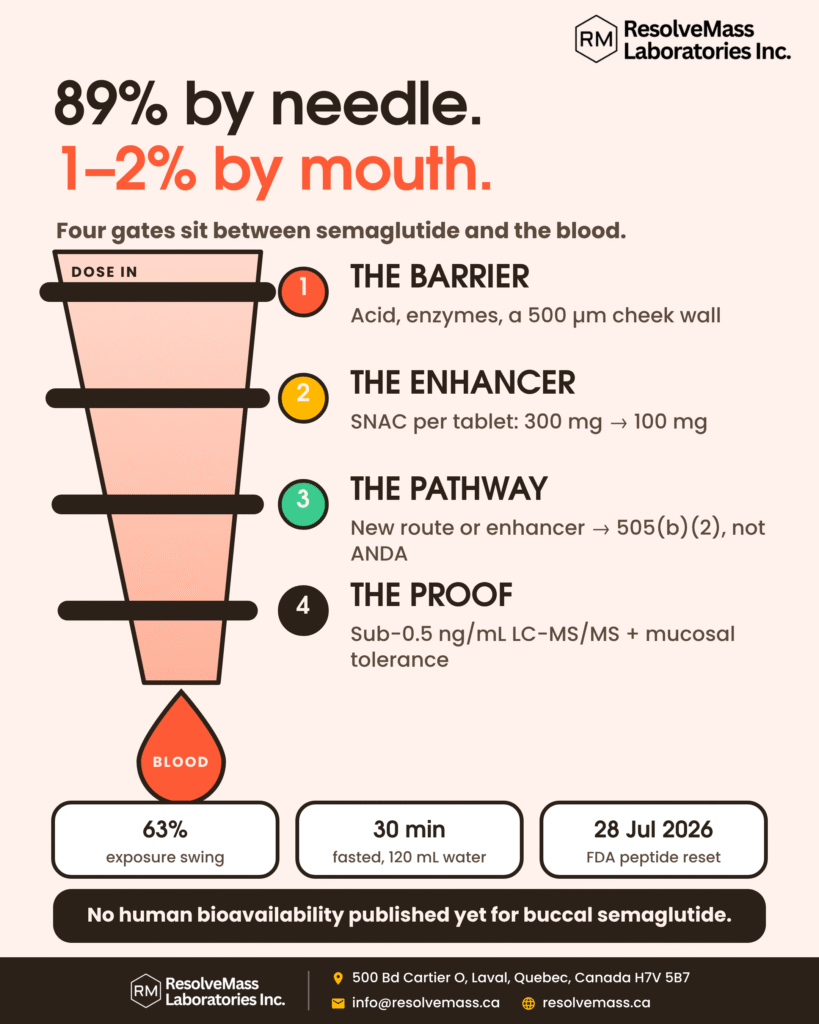
- The core problem: Semaglutide is a ~4.1 kDa BCS Class 4 peptide, so without enabling technology oral bioavailability is effectively nil — roughly 89% by subcutaneous injection versus 0.4–1% (Rybelsus R1) and 1–2% (R2) by mouth, with 63% inter-individual Cavg variability in OASIS 4.
- Two different barrier sets: Swallowed tablets fight gastric acid, pepsin and transit-dependent absorption (hence the empty stomach, ≤120 mL water and 30-minute wait); buccal films fight a 500–600 µm non-keratinized cheek epithelium, salivary wash-off, mucin entrapment and salivary peptidases, while bypassing gastric and first-pass metabolism.
- SNAC and where the market now sits: SNAC works by local pH buffering, peptide monomerization and transient membrane fluidization. R2 (1.5/4/9 mg, approved December 2024, named Ozempic tablets in February 2026) cut SNAC from 300 mg to 100 mg per tablet at better bioavailability; oral Wegovy 25 mg was approved December 22, 2025 for weight management.
- Alternative enhancers are mostly preclinical: Sodium caprate matched SNAC exposure in beagle dogs (f2 = 67.8) but still gives single-digit bioavailability and ~40% food-related exposure loss; chitosan, thiomers, bile salts, EDTA/EGTA and sub-300 nm nanocarriers are buccal candidates — with no published human buccal semaglutide bioavailability benchmark to date.
- The hard formulation trade-off: Franz diffusion work on ~500 µm porcine buccal mucosa has to show meaningful flux and that the permeability change is temporary and fully reversible, since concentrated surfactants, bile salts and chelators applied daily to the same cheek site risk irritation and tissue damage.
- Regulatory route: A new route (buccal) or an unqualified enhancer rules out the 505(j) ANDA pathway, so these programs go 505(b)(2) — requiring an RLD bridge under 21 CFR 314.54, comparative PK/BA, route-specific food and saliva effects, formal local tolerance studies, and novel excipient qualification as SNAC itself needed.
- CMC and bioanalysis just got harder: FDA’s July 28, 2026 withdrawal of the 2021 synthetic peptide ANDA guidance plus 17 revised draft PSGs tightened impurity, higher-order structure and immunogenicity expectations (HMWS typically controlled to 1–2%), while low exposure drives ICH M10 LC-MS/MS methods below 0.5 ng/mL with ≥98% enriched deuterated internal standards and HRMS metabolite profiling.
Bioavailability Challenges in Buccal and Oral Semaglutide Development
Systemic absorption of semaglutide through non-parenteral administration routes is restricted by its inherently low membrane permeability, pH-dependent precipitation, and susceptibility to rapid enzymatic degradation. These factors result in oral bioavailability substantially below the approximately 89% bioavailability achieved through subcutaneous injection. Although swallowed tablets must withstand gastric acidity and pepsin-mediated cleavage, buccal delivery systems face the additional challenge of transporting the peptide across multiple layers of cheek epithelium while preventing continuous salivary clearance.
Gastric Proteolysis, BCS Class 4 Limits, and PK Variability in Oral Formulations
Oral semaglutide exhibits considerable inter-individual pharmacokinetic variability, with the coefficient of variation (CV) for steady-state average concentration (Cavg) reaching 63% in the Phase 3 OASIS 4 trial. This variability is associated with its BCS Class 4 physicochemical characteristics and dependence on gastric transit conditions. At the structural level, semaglutide is derived from the human GLP-1 (7–37) sequence and incorporates two amino acid substitutions: Ala8 is replaced with 2-aminoisobutyric acid (Aib8), while Lys34 is substituted with Arg34. Additionally, a fatty diacid moiety is attached to the Lys26 side chain. The peptide has an isoelectric point of 5.4 and demonstrates limited aqueous solubility between pH 2 and pH 6. These characteristics encourage aggregation and restrict dissolution in acidic gastric fluids before the formulation reaches the absorption surface.
Even when semaglutide is combined with SNAC, systemic absorption remains dependent on gastric residence time, tablet positioning against the stomach lining, and dilution within the gastric lumen. Food, beverages, and excessive water intake can reduce the localized concentration of the absorption enhancer, weakening the microenvironmental pH modification required for effective peptide uptake. For this reason, approved prescribing instructions require patients to take the medication once daily in the morning on an empty stomach with no more than 4 ounces (120 mL) of plain water. Patients must then wait at least 30 minutes before consuming food or beverages or taking other oral medications.
Furthermore, GLP-1 receptor agonists delay gastric emptying, making clinical monitoring important when oral semaglutide is administered alongside oral medications with a narrow therapeutic index. The FDA’s Post-Marketing Requirement (PMR) for oral Wegovy 25 mg also includes ultrasound investigations designed to assess how fasting duration and temporary medication withholding influence retained gastric contents and the associated risk of pulmonary aspiration.
Buccal Mucosal Anatomy, Salivary Clearance, and Enzymatic Barriers
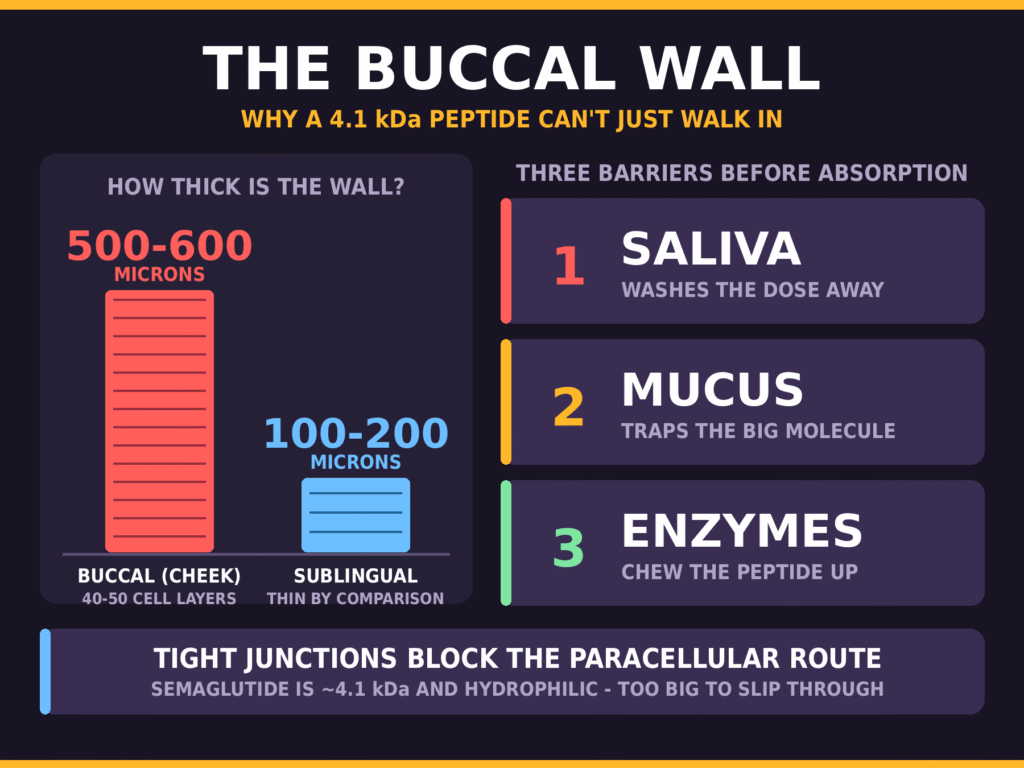
Buccal administration delivers semaglutide through the highly vascularized inner cheek mucosa and into systemic circulation. This route bypasses gastric acid exposure, pepsin-mediated degradation, and hepatic first-pass metabolism. However, it introduces other physiological barriers, including a 500–800 µm stratified epithelial layer and continuous salivary clearance. The non-keratinized buccal epithelium typically consists of approximately 40 to 50 cellular layers, with thickness measurements commonly ranging from 500 to 600 µm. It is therefore considerably thicker than the sublingual mucosa, which generally measures 100–200 µm.
Although membrane coating granules (MCGs) present within buccal epithelial cells release polar lipids that provide greater selective permeability than keratinized oral surfaces, intercellular tight junctions significantly restrict passive paracellular transport. This creates a substantial absorption barrier for large, hydrophilic peptides such as semaglutide, which has a molecular weight of approximately 4.1 kDa.
For consistent systemic exposure, buccal formulations must address three important pre-absorptive challenges:
- Continuous Salivary Wash-Off: Salivary secretions from the parotid, submandibular, sublingual, and submucosal glands continuously dilute dissolved peptide and reduce the time available for mucosal absorption. This rapid clearance can substantially limit drug retention at the application site.
- Viscoelastic Mucus Entrapment: The oral cavity is covered by a mucin glycoprotein gel that can slow the movement of macromolecules and inadequately engineered delivery carriers. Steric hindrance and electrostatic interactions within this mucus layer can prevent the peptide from reaching the epithelial surface efficiently.
- Salivary Proteolysis and pH Shifts: Salivary aminopeptidases and endopeptidases can break down unprotected peptide chains before absorption occurs. Additionally, fluctuations in natural salivary pH can move semaglutide closer to its isoelectric point of 5.4, potentially reducing its local solubility and increasing the likelihood of aggregation.
Permeation Enhancers and Formulation Architecture: From SNAC to Mucoadhesive Systems
Successful non-injectable semaglutide formulations combine sufficiently high local concentrations of chemical permeation enhancers with controlled disintegration mechanisms or mucoadhesive matrices. These formulation approaches are intended to maintain an effective concentration gradient across the mucosal barrier and improve systemic peptide absorption.
Among FDA-approved semaglutide products, SNAC is the established absorption enhancer used in oral tablet formulations. Other substances, including sodium caprate (C10), chitosan, thiomers, bile salts, and chelating agents, are being investigated as alternative permeation enhancers for next-generation oral and buccal delivery platforms.
For sponsors investigating alternative peptide formulations, generic peptide and oligonucleotide development provides relevant development and analytical support across complex therapeutic modalities.
SNAC Stoichiometry and the Evolution from Rybelsus R1 to R2 and 25 mg Tablets
SNAC facilitates gastric absorption of semaglutide through localized microenvironmental buffering, peptide monomerization, and temporary epithelial membrane fluidization. Recent improvements in tablet engineering have also reduced the required enhancer quantity by approximately two-thirds for certain diabetes maintenance doses.
When an oral tablet dissolves against the stomach lining, SNAC, which has a sodium salt molecular weight of 301.31 g/mol, increases the local pH. This change simultaneously suppresses pepsinogen-to-pepsin activation and improves semaglutide solubility. SNAC also promotes the conversion of self-associated semaglutide oligomers into monomers that are more suitable for membrane permeation. Under the proposed “quicksand” mechanism, SNAC temporarily fluidizes apical epithelial lipid bilayers, supporting passive transcellular transport without opening tight junctions at non-cytotoxic concentrations.
In the original Rybelsus R1 formulations (3 mg, 7 mg, and 14 mg), each tablet contains a fixed SNAC quantity of 300 mg, equivalent to approximately 0.996 mmol. This produces an SNAC-to-semaglutide molar ratio of approximately 1370:1 at the 3 mg strength and 294:1 at the 14 mg strength, while maintaining approximately dose-proportional systemic exposure.
In December 2024, the FDA approved the optimized R2 formulation containing 1.5 mg, 4 mg, and 9 mg semaglutide. The product was renamed Ozempic tablets in early 2026, with telehealth guidance indicating that the commercial phase-out of R1 began in May 2026. Through improvements in tablet formulation architecture, R2 reduces the SNAC content from 300 mg to 100 mg and achieves approximately 1% to 2% absolute bioavailability. It also provides systemic exposure comparable to higher-dose R1 tablets while using lower peptide quantities. Specifically, 4 mg R2 provides exposure comparable to 7 mg R1, while 9 mg R2 corresponds to 14 mg R1. However, the two formulations are not interchangeable on a milligram-to-milligram basis.
For chronic weight management, oral Wegovy was approved in December 2025. Patients follow an escalation schedule involving R2 1.5 mg, 4 mg, and 9 mg tablets (Formulation D, containing 100 mg SNAC) before transitioning to the 25 mg maintenance tablet (Formulation C, containing 300 mg SNAC). This formulation demonstrates a median Tmax of approximately 0.7 to 0.8 hours and reaches steady-state concentrations within 4 to 5 weeks.
Alternative Permeation Enhancers in Buccal and Oral Semaglutide Development
Developers working on buccal films and SNAC-free oral tablets are investigating medium-chain fatty acids, mucoadhesive polymers, bile salts, and chelating agents. These substances may help expand the absorption area or protect semaglutide from enzymatic degradation during delivery.
Sodium caprate (C10), a medium-chain fatty acid salt, has been investigated as an alternative oral absorption enhancer because of its ability to reversibly modify epithelial tight junctions. In preclinical formulation studies, dry-granulated monolayer tablets containing 14 mg semaglutide and 300 mg C10 achieved a dissolution similarity factor (f2) of 67.8 compared with Rybelsus 14 mg. These formulations also produced comparable systemic exposure in beagle dogs.
However, clinical translation reviews indicate that both C10 and SNAC generally achieve only single-digit percentage peptide bioavailability, with continuing concerns regarding pharmacokinetic variability and food sensitivity. Clinical C10 peptide studies have reported an approximately 40% reduction in systemic exposure following consumption of a low-fat breakfast.
For buccal semaglutide delivery systems, including oral dispersible films, bioadhesive patches, and nanocarriers, permeation enhancers must maintain sufficient contact with the mucosal surface while modifying epithelial barriers safely. Important investigational approaches include:
- Chitosan and Thiomers: Cationic chitosan and thiolated polymers interact electrostatically and covalently with negatively charged mucin. These interactions improve mucoadhesion, reduce salivary wash-off, and support reversible tight-junction modulation. Chitosan has also demonstrated enhanced peptide transport across porcine buccal mucosa.
- Bile Salts: Compounds such as sodium taurocholate and sodium deoxycholate can extract membrane lipids and modify tight-junction structures. Studies have demonstrated the transport of large macromolecular markers, including fluorescent dextrans measuring 70–150 kDa, across porcine buccal tissue.
- Chelating Agents (EDTA/EGTA): Chelating agents bind extracellular calcium and magnesium ions that are necessary for maintaining tight-junction integrity. Their removal can increase paracellular pore dimensions and potentially improve peptide transport across the epithelial barrier.
- Submicron Nanocarriers: Polymeric nanoparticles, including PLGA- and chitosan-based systems measuring ≤300 nm, and lipid vesicles such as liposomes and niosomes can protect peptides from salivary peptidases while supporting endocytic and transcytotic uptake. Neutral nanoparticles measuring approximately 200 nm have demonstrated deeper penetration into buccal microplicae than smaller particles measuring 25–50 nm. Additionally, PEG and zwitterionic surface coatings can improve mucus penetration.
| Delivery Platform | Primary Absorption Site | Enhancer / Excipient System | Primary Mechanism of Action | Bioavailability / Preclinical Benchmark | Key Translational Constraint |
|---|---|---|---|---|---|
| Oral Tablet R1 (Rybelsus) | Stomach (gastric mucosa) | 300 mg SNAC (fixed mass) | Local pH buffering, pepsin inactivation, monomerization, and transcellular fluidization | Approximately 0.4–1% (approximately 0.8% in industry guides) | Strict 4 oz water and 30-minute fasting requirements; high PK variability |
| Oral Tablet R2 (Ozempic Tablet) | Stomach (gastric mucosa) | 100 mg SNAC | Optimized tablet erosion with reduced SNAC quantity | 1–2% absolute bioavailability | Fasting and empty-stomach administration remain necessary; not interchangeable with R1 on a milligram-to-milligram basis |
| Oral Wegovy 25 mg Maintenance | Stomach (gastric mucosa) | 100 mg SNAC during escalation / 300 mg SNAC in the 25 mg tablet | Dose-proportional gastric uptake across 3–50 mg | 63% inter-individual Cavg CV in OASIS 4 | Gastrointestinal adverse reactions; PMR ultrasound trial evaluating retained gastric contents |
| Experimental Oral C10 Tablet | Upper intestine / gastric region | 300 mg sodium caprate (C10) | Reversible tight-junction opening and membrane lipid interaction | Matched SNAC exposure in beagle dogs (f2 = 67.8) | Single-digit clinical BA; approximately 40% exposure reduction after a low-fat meal in C10 peptide trials |
| Buccal Film / Nanocarrier | Inner cheek (500–600 µm non-keratinized epithelium) | Chitosan, thiomers, bile salts, EDTA, PLGA/niosomes | Mucoadhesion, peptidase protection, tight-junction modulation, and transcytosis | Porcine/rabbit Franz cell flux; no independent human semaglutide BA benchmark available | Salivary wash-off, 500–800 µm epithelial transport barrier, and potential mucosal irritation |
Note: Although buccal semaglutide films and nanocarrier systems have been discussed in patent literature and preclinical platform reviews, no independent, peer-reviewed human clinical bioavailability benchmark directly comparing buccal semaglutide with Rybelsus R1/R2 was identified in the available public sources.
Ex Vivo Franz Diffusion Models and Mucosal Irritation Trade-Offs
Preclinical assessment of buccal semaglutide formulations generally involves vertical Franz diffusion cells containing excised porcine buccal mucosa trimmed to approximately 500 ± 50 µm. Researchers may also use rabbit or bovine tissue models and parallel artificial membrane permeability assays (PAMPA) to evaluate the relationship between peptide permeation and tissue compatibility.
Porcine buccal tissue provides a useful approximation of human cheek mucosa because of similarities in epithelial thickness and polar lipid organization. These models allow investigators to measure steady-state peptide flux and evaluate surface peptidase activity under controlled donor–receptor sink conditions.
The primary formulation challenge is achieving clinically meaningful peptide transport without causing permanent damage to the mucosal tissue. High concentrations of surfactants, bile salts, and chelating agents can rapidly disrupt epithelial lipids and tight-junction structures. Repeated daily application at the same cheek location may consequently result in localized irritation and tissue injury.
Successful clinical translation requires evidence that the permeability-enhancing effects are temporary and completely reversible after removal of the formulation. Maintaining mucosal integrity and demonstrating acceptable biocompatibility are therefore essential requirements for developing safe buccal semaglutide delivery systems.
505(b)(2) Regulatory Strategy for Buccal and Oral Semaglutide Development
Developing a buccal film or an oral semaglutide formulation containing a novel permeation enhancer generally requires the FDA 505(b)(2) NDA pathway. This regulatory route allows sponsors to rely, in part, on previously established safety and efficacy findings for an approved Listed Drug while providing product-specific evidence covering clinical bridging, local tolerability, and synthetic peptide CMC requirements.
Changing the route of administration to buccal delivery or introducing an unapproved permeation enhancer prevents a product from meeting the pharmaceutical equivalence requirements necessary for the generic 505(j) ANDA pathway.
Reference Listed Drug Selection, Bridging Studies, and Local Tolerance Requirements
Under 21 CFR 314.54, a 505(b)(2) applicant must identify an appropriate Reference Listed Drug (RLD), such as Ozempic, Wegovy, or Rybelsus/Ozempic tablets, and establish a scientific bridge that supports reliance on the previously approved FDA findings.
For buccal and reformulated oral semaglutide development programs, regulatory bridging generally involves four major technical areas:
- Comparative Bioavailability and PK Bridging: Clinical pharmacology studies must evaluate single-dose and steady-state pharmacokinetic parameters, including AUC0-24h, Cmax, Cavg, and Tmax, against the selected Listed Drug. These studies should also determine whether buccal absorption can reduce inter-individual pharmacokinetic variability compared with the 63% Cavg CV reported for oral semaglutide 25 mg.
- Route-Specific Metabolism and Food/Saliva Effects: Regulatory submissions must investigate potential metabolic differences associated with buccal administration compared with gastric or subcutaneous delivery. They should also assess how food intake, water consumption, and salivary clearance influence drug absorption and systemic exposure.
- Local Tolerance and Enhancer Reversibility: Conventional gastric tablets distribute their contents across a relatively large stomach surface. In contrast, buccal films and patches expose a restricted area of oral mucosa to concentrated permeation enhancers. Consequently, formal local tolerance assessments are essential to demonstrate tissue compatibility and minimize irritation during repeated administration.
- Novel Excipient Qualification: When a formulation incorporates a permeation enhancer that has not previously been qualified at the proposed daily dose and administration route, additional safety, manufacturing, and control documentation is necessary. This requirement is comparable to the assessment of SNAC as a non-inert novel excipient in NDA 213051.
Patent considerations and compounding enforcement activities also influence the development strategy for 505(b)(2) products. Following the FDA’s February 21, 2025, announcement resolving the semaglutide injection shortage, compounded sublingual formulations and other non-approved semaglutide copies have faced increased regulatory scrutiny.
Developing alternative buccal formulation architectures or selecting different permeation enhancers to differentiate a product from existing SNAC-based formulations can provide sponsors with opportunities to establish differentiated intellectual property and pursue a distinct regulatory strategy. However, successful market entry still requires appropriate clinical evidence, regulatory approval, and compliant product labeling.
For developers evaluating differentiated GLP-1 formulations, review generic liraglutide development services to understand related peptide development and characterization considerations.
Navigating the July 2026 FDA Synthetic Peptide Guidance Shift and CMC Expectations
The regulatory CMC requirements for synthetic peptide submissions changed significantly on July 28, 2026. On this date, the FDA withdrew its May 2021 guidance, ANDAs for Certain Highly Purified Synthetic Peptide Drug Products That Refer to Listed Drugs of rDNA Origin, and issued 17 revised draft product-specific guidances (PSGs).
Although innovator semaglutide is manufactured using a recombinant DNA (rDNA) origin, independent pharmaceutical developers frequently produce semaglutide through solid-phase peptide synthesis (SPPS).
Following the withdrawal of the 2021 guidance and its replacement with product-specific criteria, developers using chemical synthesis must address increasingly stringent expectations for peptide-related impurities and their potential biological effects.
Process-related impurities may include missing or additional amino acids, unintended synthetic by-products, structural isomers, and high-molecular-weight species (HMWS). These impurities require detailed characterization and appropriate control strategies. HMWS are typically controlled below 1–2% at release using techniques such as SEC-MALS, depending on the applicable product specifications and development requirements.
Comprehensive impurity profiling is particularly important because peptide-related impurities may contribute to immunogenicity risks, including the development of anti-drug antibodies (ADAs) and neutralizing antibodies (NAbs). Therefore, aligning Module 3 CMC documentation with applicable ICH Q3A/Q3B, Q6B, and Q2(R1) standards is important for sponsors pursuing either a 505(b)(2) NDA or an ANDA governed by revised product-specific guidance requirements.
Specialized impurity profiling of biosimilars approaches can provide useful analytical insights into impurity identification, characterization, and control strategies for complex peptide products.
| Regulatory Dimension | 505(j) ANDA Pathway | 505(b)(2) NDA Pathway (Buccal / Novel Oral) |
|---|---|---|
| Statutory Eligibility | Requires the same active ingredient, dosage form, strength, and route of administration as the RLD | Permits a modified route of administration (buccal), a novel dosage form (film/wafer), or a different permeation enhancer |
| Clinical Bridging Burden | Requires a bioequivalence (BE) study demonstrating comparable rates and extents of absorption relative to the RLD | Requires comparative PK/BA bridging against the Listed Drug, including food and saliva effects and dose-exposure justification |
| Local & Excipient Safety | Inactive ingredients must comply with applicable approved reference requirements | Requires local mucosal tolerance studies for buccal formulations and safety/CMC qualification of novel excipients |
| Peptide CMC & Impurities | Governed by applicable July 28, 2026, revised draft PSG requirements, including synthetic-versus-rDNA impurity controls | Requires a comprehensive Module 3 CMC package, appropriate ICH Q3A/Q6B/Q2(R1) impurity controls, and ADA risk justification |
| Patent & Differentiation Strategy | Generally depends on RLD patent expiry or Paragraph IV patent challenges | Allows differentiated formulation development, including potential design-around strategies involving SNAC formulation patents and distinct clinical labeling |
Analytical Characterization and LC-MS/MS Bioanalysis for Low-Bioavailability Programs
The limited systemic exposure associated with non-parenteral semaglutide administration, combined with high excipient-to-drug ratios, creates demanding requirements for bioanalytical sensitivity and stability-indicating chromatographic separation. Reliable quantification of intact semaglutide, its metabolites, and formulation-related permeation enhancers is essential for clinical pharmacokinetic bridging and Module 3 CMC release testing.
Sub-ng/mL LC-MS/MS Bioanalysis, Deuterated Standards, and HRMS Metabolite Profiling
Oral and buccal semaglutide formulations generally produce substantially lower Cmax values than subcutaneous administration. Therefore, ICH M10-validated LC-MS/MS bioanalytical methods for oral semaglutide frequently require lower limits of quantification (LLOQ) below 0.5 ng/mL, with accuracy within ±15% and a coefficient of variation (CV) below 15%.
Preclinical plasma bioanalytical methods using protein precipitation or solid-phase extraction (SPE) have reported LLOQ values ranging from 0.4 to 5.7 ng/mL. However, clinical bridging studies involving low-bioavailability delivery platforms generally require more sensitive analytical approaches. SPE sample preparation combined with ultra-high-performance liquid chromatography-tandem mass spectrometry (UHPLC-MS/MS) provides an effective approach for quantifying low-concentration absorption profiles and terminal pharmacokinetic phases.
Biological matrix complexity presents another analytical challenge. Plasma lipids, salivary mucins, and co-extracted formulation components, including SNAC and C10, may interfere with peptide quantification and contribute to ionization suppression. Consequently, stable isotope-labeled internal standards are important for achieving reliable and reproducible analytical results.
Deuterated internal standards with at least 98% isotopic enrichment are preferred for sensitive LC-MS/MS assays. Incorporating isotopic labels at non-exchangeable carbon positions while avoiding labile –OH or –NH sites helps maintain isotopic stability and supports chromatographic co-elution with the analyte. These standards also compensate for variations in extraction recovery and ionization efficiency.
In addition to targeted multiple reaction monitoring (MRM) quantification, High-Resolution Mass Spectrometry (HRMS) provides valuable support for metabolite identification and structural characterization. HRMS can distinguish intact semaglutide from peptide fragments produced through salivary or gastric peptidase activity. This capability is particularly important when comparing different delivery routes and evaluating the metabolic stability of semaglutide during oral and buccal administration.
For advanced peptide and biologic characterization, explore biosimilar characterization using mass spectrometry to learn about mass spectrometry-based approaches for evaluating molecular structure and product quality.
ICH Method Validation, Impurity Control, and Excipient Quantification
Quality control and stability testing for oral and buccal semaglutide products require orthogonally validated analytical methods capable of separating trace-level peptide degradation products from high-mass permeation-enhancing excipients. The primary CMC analytical requirements include the following:
- Content Uniformity and Enhancer Assay: Combining approximately 1.5–25 mg of hygroscopic semaglutide with 100–300 mg of SNAC, C10, or mucoadhesive polymers can increase the likelihood of blend segregation and content variability. Therefore, manufactured batches must satisfy USP content uniformity requirements, including an acceptance value (AV) of ≤15, and assay specifications of 90.0–110.0%. Separate validated analytical methods are also necessary for accurately quantifying the permeation enhancer and monitoring its concentration throughout manufacturing and stability studies.
- Structural and Aggregation Characterization: Peptide mapping is used to confirm amino acid sequence integrity and identify structural modifications. Circular dichroism (CD) spectroscopy helps assess secondary structural stability, while size-exclusion chromatography coupled with multi-angle light scattering (SEC-MALS) quantifies oligomers and high-molecular-weight species. Appropriate release specifications generally require control of these species below 1–2%, depending on the applicable product requirements.
- Stability-Indicating Profiles and Safety Testing: Stability programs conducted according to ICH Q1A(R2) should include long-term storage conditions of 25°C/60% RH and accelerated conditions of 40°C/75% RH. Analytical methods must distinguish intact semaglutide from degradation products generated through thermal, photolytic, oxidative, and hydrolytic pathways. Particular attention is necessary when alkaline permeation enhancers modify the local pH away from semaglutide’s reported stability optimum of 7.4–7.8. Additionally, nitrosamine risk assessments and extractables and leachables (E&L) studies are necessary to establish the suitability and safety of packaging materials.
Specialized analytical CRO partners, including ResolveMass Laboratories Inc., support these complex development requirements through ICH Q2(R1) analytical method validation, HRMS-based metabolite and impurity identification, peptide mapping, CD spectroscopy, and custom synthesis of deuterated internal standards with at least 98% isotopic enrichment.
For comprehensive analytical characterization, peptide mapping approaches can help establish peptide sequence integrity and identify structural modifications relevant to product quality.
Conclusion
Successful Buccal and Oral Semaglutide Development requires a coordinated approach that integrates permeation enhancer performance, highly sensitive sub-ng/mL bioanalysis, and a well-structured 505(b)(2) regulatory strategy. Although the introduction of 100 mg SNAC R2 tablets and 25 mg oral Wegovy formulations demonstrates the commercial feasibility of oral GLP-1 therapy, important limitations remain. Absolute bioavailability of approximately 0.8–2%, inter-individual Cavg variability reaching 63%, and mandatory 30-minute fasting requirements continue to create opportunities for alternative delivery technologies, particularly buccal films and next-generation permeation enhancer systems.
Achieving FDA approval in 2026 requires sponsors to establish a strong scientific foundation through reversible ex vivo permeation studies, comprehensive local mucosal tolerance assessments, and biologic-grade impurity characterization of synthetic peptides. These requirements must be supported by appropriate CMC documentation aligned with the FDA’s July 2026 synthetic peptide guidance changes.
For pharmaceutical development teams advancing oral or buccal semaglutide candidates, specialized analytical support is essential for addressing complex formulation and regulatory challenges. Services such as analytical method validation, deuterated standard synthesis, impurity characterization, and 505(b)(2) CMC readiness can help strengthen development programs and support regulatory submissions.
Manufacturing readiness is equally important when transitioning optimized peptide formulations from laboratory development to commercial production. Explore manufacturing scale-up for generic drugs for additional insight into process optimization, technology transfer, and production scalability.
To discuss analytical development, peptide characterization, or regulatory CMC requirements, connect with the scientific specialists at ResolveMass Laboratories Inc. through the Contact Us page.
Frequently Asked Questions
Rybelsus R1 contains 300 mg SNAC in each 3 mg, 7 mg, and 14 mg tablet, while the R2 formulation uses only 100 mg SNAC in its 1.5 mg, 4 mg, and 9 mg strengths. Approved in December 2024 and renamed Ozempic tablets in 2026, R2 provides comparable systemic exposure at lower semaglutide doses. Oral Wegovy, approved in December 2025 for chronic weight management, uses the R2 formulation during dose escalation before transitioning patients to a 25 mg maintenance tablet containing 300 mg SNAC.
Food and excessive water intake can dilute SNAC around the gastric absorption site, reducing its ability to maintain the localized pH conditions required for effective semaglutide absorption. This can increase peptide degradation and decrease systemic drug exposure. Therefore, patients should take the tablet with no more than 4 ounces (120 mL) of plain water on an empty stomach and wait at least 30 minutes before consuming food, beverages, or other oral medications.
Buccal administration allows semaglutide to enter systemic circulation through the vascularized inner cheek without passing through the acidic stomach environment. This approach can avoid gastric pepsin degradation, hepatic first-pass metabolism, and absorption limitations associated with gastric emptying. However, successful delivery still depends on overcoming epithelial thickness, tight-junction restrictions, salivary enzyme activity, and continuous saliva-mediated clearance.
Several formulation components are being investigated to improve peptide transport and prolong contact with the buccal mucosa. Chitosan and thiomers provide mucoadhesive properties, while bile salts, sodium caprate (C10), and chelating agents such as EDTA and EGTA can modify epithelial permeability. Additionally, polymeric nanoparticles and lipid-based nanocarriers measuring ≤300 nm may protect semaglutide from enzymatic degradation and support mucosal absorption.
Sodium caprate (C10) is being explored as an alternative to SNAC because it can temporarily modify epithelial tight junctions and improve peptide transport. Preclinical studies using tablets containing 14 mg semaglutide and 300 mg C10 reported a dissolution similarity factor (f2) of 67.8 and comparable systemic exposure to Rybelsus 14 mg in beagle dogs. However, clinical development remains challenging because C10-based delivery can still produce low bioavailability and considerable sensitivity to food intake.
The 505(j) ANDA pathway requires a generic product to meet pharmaceutical equivalence requirements, including the same route of administration and dosage form as its Reference Listed Drug. A buccal formulation or an oral product containing a different permeation enhancer introduces formulation or administration differences that generally prevent eligibility through this pathway. The 505(b)(2) NDA route allows sponsors to rely on established findings for an approved Listed Drug while generating additional comparative pharmacokinetic, safety, and local tolerance evidence.
On July 28, 2026, the FDA withdrew its May 2021 synthetic peptide ANDA guidance and released 17 revised draft product-specific guidances (PSGs). This regulatory change requires developers to carefully evaluate the applicable product-specific expectations when preparing peptide-related submissions. Sponsors manufacturing semaglutide through solid-phase peptide synthesis (SPPS) must provide comprehensive CMC documentation addressing process-related impurities, structural characteristics, peptide purity, and potential immunogenicity risks, including anti-drug antibody (ADA) formation.
Oral and buccal semaglutide formulations generally produce lower systemic concentrations than subcutaneous administration, making highly sensitive analytical methods necessary for pharmacokinetic evaluation. Clinical LC-MS/MS assays validated according to ICH M10 commonly target a lower limit of quantification (LLOQ) below 0.5 ng/mL for oral semaglutide. Solid-phase extraction (SPE), UHPLC-MS/MS, and stable isotope-labeled deuterated internal standards help improve analytical sensitivity, minimize matrix interference, and support reliable peptide quantification.
Preclinical investigations commonly use vertical Franz diffusion cells containing excised porcine buccal mucosa, generally trimmed to approximately 500 ± 50 µm, to measure peptide permeation and evaluate enzymatic activity. Rabbit and bovine mucosal tissues provide additional experimental models, while parallel artificial membrane permeability assays (PAMPA) help assess passive transport characteristics. Researchers also examine tissue integrity, reversibility of permeability enhancement, and local irritation to determine whether repeated administration can maintain acceptable mucosal safety.
Reference:
- U.S. Food and Drug Administration. (2019). Quality assessment: Rybelsus (semaglutide) tablets, NDA 213051. Center for Drug Evaluation and Research. https://www.accessdata.fda.gov/drugsatfda_docs/nda/2019/213051Orig1s000ChemR.pdf
- U.S. Food and Drug Administration. (2026). Clinical pharmacology review: NDA 218316. Center for Drug Evaluation and Research. https://www.accessdata.fda.gov/drugsatfda_docs/nda/2026/218316Orig1s000ClinPharmR.pdf
- U.S. Food and Drug Administration. (2026). Rybelsus (semaglutide) tablets: Prescribing information. https://www.accessdata.fda.gov/drugsatfda_docs/label/2026/213051s030lbl.pdf
- U.S. Food and Drug Administration. (2026, July 28). FDA publishes revised draft product-specific guidances for certain generic peptide products. https://www.fda.gov/drugs/drug-alerts-and-statements/fda-publishes-revised-draft-product-specific-guidances-certain-generic-peptide-products
- Amer, A. A., Bingle, L., Elkordy, A. A., & Chaw, C. S. (2025). Overcoming oral cavity barriers for peptide delivery using advanced pharmaceutical techniques and nano-formulation platforms. Biomedicines, 13(11), 2735. https://doi.org/10.3390/biomedicines13112735
- Schobel, A. M., Varjan, S. M., & Wargacki, S. P. (2018). Pharmaceutical compositions with enhanced permeation (U.S. Patent Application Publication No. US20180200198A1). U.S. Patent and Trademark Office. https://patents.google.com/patent/US20180200198A1/en
- European Medicines Agency. (n.d.). Wegovy: EPAR assessment report – Extension. https://www.ema.europa.eu/en/documents/variation-report/wegovy-x-0000296344-epar-assessment-report-extension_en.pdf
- Yoon, J.-H., Kim, D.-H., & Kim, J.-E. (2026). Quality by design-based formulation development of an oral semaglutide tablet. Pharmaceutics, 18(4), 440. https://doi.org/10.3390/pharmaceutics18040440
Get In Touch With Us
About The Author