

Summary
Here’s what this blog will cover:
- Why early CMC change management is critical during IND to NDA transition
- Key regulatory considerations for pre- and post-approval change planning
- High-impact strategies to avoid approval delays and post-approval surprises
- Risk management frameworks for scalable CMC control
- Technical documentation practices that withstand regulatory scrutiny
- Timeline mapping from IND through NDA and post-approval planning
- Real-world examples of successful CMC change strategies
- Common pitfalls and how to mitigate them proactively
- CMC Change Management best practices that enhance trust with regulators
Introduction: The Strategic Value of CMC Change Management
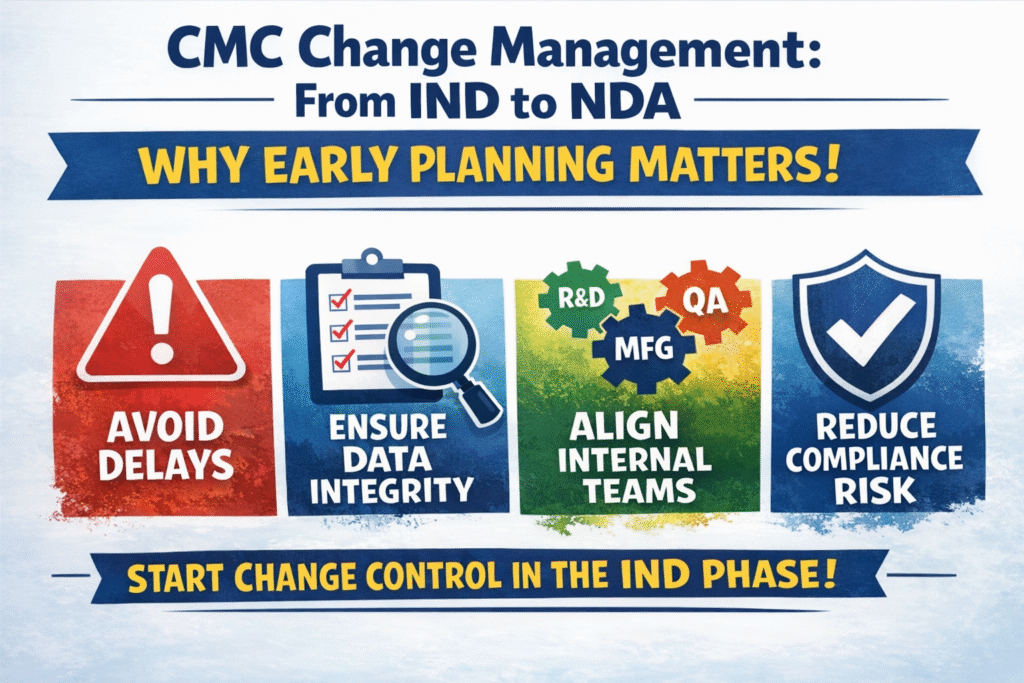
CMC Change Management from IND to NDA is more than a regulatory requirement—it’s a key strategy for ensuring long-term product success. Companies that prioritize structured change control early in development can avoid costly problems later on. This includes fewer delays during approval, lower compliance risk, and better alignment across internal teams.
When scientific and regulatory strategies are integrated from the start, data integrity and transparency are easier to maintain. At ResolveMass Laboratories Inc., we help sponsors anticipate change pathways that align with both compliance needs and business goals.
Need expert guidance on navigating the regulatory landscape? > Explore our Drug Discovery CRO Chemistry Services
Why Early CMC Change Management Matters During the IND Phase
Delaying CMC planning until the NDA stage often leads to avoidable problems. Many post-approval issues arise from undocumented or poorly supported changes made during early development. Regulatory bodies now expect sponsors to demonstrate a full change management strategy starting from the first clinical trials.
Decisions made in the IND phase often lay the groundwork for the final commercial process. Without proper documentation, it becomes difficult to demonstrate comparability later on. A structured change control approach during IND helps ensure data continuity and improves regulatory confidence throughout the product’s lifecycle.
Starting your journey? Learn how we support early-stage development: > Outsourced Medicinal Chemistry for Startups
Key factors to consider:
- Early process changes impact post-approval comparability
- Initial CMC data must justify future scale-up
- Control strategies should account for commercial manufacturing needs
- A formal CMC change log supports transparency and traceability
Pro Tip: Consider using ICH Q12 from the start of development. It helps align pharmaceutical quality systems (PQS) with both early- and late-stage expectations.
Bridging IND and NDA CMC Modules Through Regulatory Alignment
Maintaining consistency between IND and NDA CMC modules is essential for strong regulatory submissions. Regulators carefully review how CMC data evolves over time—especially within Module 3 (Quality). Gaps or inconsistencies between phases can lead to questions, delays, or requests for more data.
Alignment allows sponsors to connect early-stage development decisions with their commercial plans. Clear documentation that tracks the evolution from feasibility to validation demonstrates product knowledge maturity and builds trust with reviewers.
Facing challenges with FDA inquiries? See how we can help: > Resolving FDA CMC Queries
Key submission differences to consider:
- Analytical methods evolve from feasibility to full validation
- Processes move from pilot-scale to full-scale commercial operations
- Control strategies shift from risk-based planning to fully verified protocols
- Stability data transitions from accelerated to long-term per ICH guidelines
In short, CMC Change Management should show a logical progression with justified, data-supported changes—not just a list of modifications.
Ensure your data stands up to scrutiny: > Custom Analytical Method Development for Drug Discovery
Strengthening Post-Approval Readiness with a Robust Change Log
One of the most important tools for post-approval success is a comprehensive and auditable change log. By Phase 2b, companies should have formal systems in place to track all changes related to CMC. This creates a single source of truth for both internal decision-making and external regulatory review.
A well-maintained change log makes it easier to conduct real-time risk assessments and understand how multiple changes might affect the overall product. It also simplifies the preparation of NDA submissions and future supplements.
Common elements to track include:
- Modifications to manufacturing processes
- Updates to analytical methods
- Changes to raw material suppliers
- Equipment or facility upgrades
- Adjustments to critical quality attributes (CQAs)
Addressing Scale-Up and Tech Transfer Variability Early
Scaling up from development to commercial production brings both technical and regulatory challenges. Process behavior can shift significantly at larger scales, and unexpected changes may raise concerns with regulators. Many post-approval problems stem from poor documentation during scale-up or tech transfer.
To avoid these issues, companies should approach scale-up as a regulated change. Predefined acceptance criteria, pilot batch comparisons, and alignment between development and manufacturing teams are key.
Optimize your synthesis for commercial success: > Custom Synthesis for Drug Discovery
Requirements for readiness include:
- Pilot batch comparability protocols
- Acceptance ranges for scale-specific parameters
- Site qualification strategies aligned with GMP standards
- Analytical bridging plans validated under cGMP
When tech transfer documentation is designed with NDA expectations in mind, it minimizes the need for amendments later and builds regulatory confidence.
Using Risk-Based Categorization for Effective CMC Change Management
A one-size-fits-all approach doesn’t work when it comes to regulatory change reporting. Regulatory agencies now expect sponsors to categorize changes based on the level of risk to product quality and patient safety. Doing this proactively allows for clearer planning, faster decisions, and better use of resources.
Risk-based categorization also shows regulators that your quality systems are mature and capable of managing product changes responsibly.
Mitigate risks before they become hurdles: > Impurity Control Strategy in CMC
Example classification framework:
| Change Type | Risk Level | Regulatory Path |
|---|---|---|
| Minor excipient source change | Low | Annual Report |
| Process parameter adjustment | Medium | CBE-30 |
| Primary site of manufacture change | High | Prior Approval Supplement |
Tools like Failure Mode and Effects Analysis (FMEA) or Hazard Analysis and Critical Control Points (HACCP) help teams apply consistent risk assessments.
Planning for Post-Approval Supplements During NDA Filing
Sponsors can reduce future regulatory delays by anticipating likely post-approval changes and including them in their NDA. This not only improves transparency but also speeds up the supplement approval process after launch.
Lifecycle planning shows regulators that your team is prepared for future modifications. It also limits the amount of justification required later and increases reviewer confidence.
Common anticipated changes to include:
- Alternative suppliers for raw materials
- Future packaging configurations
- Optimization of analytical procedures
- Planned increases in production scale
These expected changes should be reflected in the Quality Overall Summary (QOS) and NDA Module 1.
Discover how we managed CMC for an IND submission: > IND CMC Case Study
Integrating ICH Q12 Tools in Early Development
ICH Q12 offers structured tools to manage post-approval changes with more flexibility and predictability. By using these tools early—ideally by Phase 3—sponsors can align expectations with regulators and reduce future burdens.
The use of Post-Approval Change Management Protocols (PACMPs) and Established Conditions (ECs) ensures that both regulators and sponsors understand how changes will be managed before they happen.
Benefits of early ICH Q12 implementation:
- PACMPs provide pre-agreed change protocols
- ECs outline what changes require reporting
- Less regulatory burden post-approval
- Greater flexibility in manufacturing operations
At ResolveMass Laboratories, we encourage drafting PACMPs before Phase 3 for high-impact changes.
Avoiding Common CMC Change Management Pitfalls
Despite available guidance, many sponsors encounter similar problems when transitioning from IND to NDA. These challenges often arise due to poor planning or lack of ownership over the CMC change process. Identifying these issues early allows for timely corrections.
Strong collaboration between regulatory, quality, and development teams helps prevent documentation gaps and miscommunications.
Common pitfalls include:
- Incomplete records of how processes evolved
- Inconsistent terminology across different modules
- Minimal coordination across departments
- Delayed engagement with regulatory experts
- Assuming all post-approval changes will be accepted without question
Solution: Implement clear change control procedures early and involve regulatory professionals throughout the lifecycle.
Looking for a partner to manage the details? > Virtual Chemistry Department CRO
Mapping the Timeline from IND to NDA and Beyond
Having a visual timeline of CMC change milestones helps teams stay aligned across departments. It promotes accountability and ensures that each development phase has the documentation needed for the next stage.
Well-mapped timelines also reduce submission delays and resource crunches near filing deadlines.
Ensure your project stays on schedule: > CRO Chemistry Services Timelines for Drug Discovery
Sample development timeline:
| Phase | Key CMC Milestone |
|---|---|
| IND (Phase 1) | Start risk-based CMC log |
| Phase 2a | Define critical quality attributes |
| Phase 2b | Develop PACMP and EC strategies |
| Phase 3 | Finalize commercial process and control strategy |
| NDA Prep | Integrate change logs and stability data |
| NDA Submission | Submit lifecycle management plan |
| Post-Approval | Execute supplements and update PACMPs |
Conclusion: CMC Change Management is a Strategic Investment
CMC Change Management should be treated as a long-term strategic approach—not just a short-term regulatory task. When companies build robust change control early in the development cycle, they benefit from faster approvals, smoother tech transfers, and better regulatory flexibility.
Structured documentation, lifecycle planning, and risk-based tools help sponsors stay ahead of evolving requirements. At ResolveMass Laboratories Inc., we support sponsors in achieving not just compliance, but lasting commercial success.
FAQs on CMC Change Management from IND to NDA
CMC Change Management is essential because it ensures continuity and traceability of changes made during product development. Regulatory authorities expect sponsors to provide clear justification for each modification, especially those that affect product quality, safety, or performance. Proper change control builds trust and supports faster approvals.
Sponsors should document any changes to manufacturing processes, analytical methods, raw material suppliers, equipment, and formulation. These modifications, if left untracked, can create gaps in data integrity. A well-maintained change log supports regulatory transparency and simplifies submission preparation.
Depending on the risk level, changes may require different submission types. Low-risk changes can go into an Annual Report, moderate-risk changes may need a CBE-30, and high-risk changes typically require a Prior Approval Supplement (PAS). Categorizing changes properly helps avoid delays.
Weak change control can result in delayed NDA approvals, post-approval compliance issues, or even product recalls. Inconsistent documentation or lack of traceability may raise concerns during regulatory review. A strong system prevents these issues and supports long-term product success.
Yes, changes introduced during scale-up can raise red flags if they are not well documented or scientifically justified. Differences in process behavior at commercial scale must be supported by comparability data. Planning early helps mitigate these risks effectively.
A proper change log should record the date of change, a detailed description, the reason behind the change, its potential impact, and supporting documentation. This serves as a reliable reference during audits, inspections, and regulatory submissions.
Reference
- U.S. Food and Drug Administration. (2024, November 19). Chemistry manufacturing and controls (CMC) guidances for industry (GFIs) and questions and answers (Q&As). U.S. Department of Health and Human Services. https://www.fda.gov/animal-veterinary/guidance-industry/chemistry-manufacturing-and-controls-cmc-guidances-industry-gfis-and-questions-and-answers-qas
- Popkin, M. E., Goese, M., Wilkinson, D., Finnie, S., Flanagan, T., Campa, C., Clinch, A., Teasdale, A., Lennard, A., Cook, G., & Mohan, G. (2022). Chemistry manufacturing and controls development, industry reflections on manufacture, and supply of pandemic therapies and vaccines. AAPS Journal, 24(6), Article 101. https://www.ncbi.nlm.nih.gov/pmc/articles/PMC9514697/
- Patel, D. H., Kumar, B. J., & Patel, A. A. (2017). Preparation and review of chemistry, manufacturing and control (CMC) sections of CTD dossier for marketing authorization. International Journal of Drug Regulatory Affairs, 5(2), 1–12. https://www.ijdra.com/index.php/journal/article/view/196
Get In Touch With Us
About The Author


