

Summary
This article explains how Contract Research Organizations (CROs) provide end-to-end support for Chemistry, Manufacturing, and Controls (CMC) strategies during Investigational New Drug (IND) and New Drug Application (NDA) development.
It specifically details:
- How CMC CRO services ensure regulatory-ready data and minimize submission risk
- The integrated role of CROs across process development, analytical control, formulation, and stability programs
- How CRO partnerships accelerate IND-enabling studies and de-risk scale-up to commercial manufacturing
- Best practices for CMC documentation strategy and regulatory alignment
- The growing influence of AI-driven CMC analytics for faster regulatory approvals
Introduction
An effective CMC strategy strongly influences how efficiently and compliantly a drug product moves from early research to market approval. When CMC activities are poorly coordinated, sponsors often face regulatory delays, missing data, and costly redevelopment work that could have been avoided. This is why CMC planning must be treated as a strategic function, not only a technical task.
CMC CRO Services act as the operational backbone for IND and NDA readiness by coordinating scientific execution, quality oversight, and regulatory compliance across all development stages. Their early involvement helps maintain consistency in data generation while ensuring continuity as programs advance.
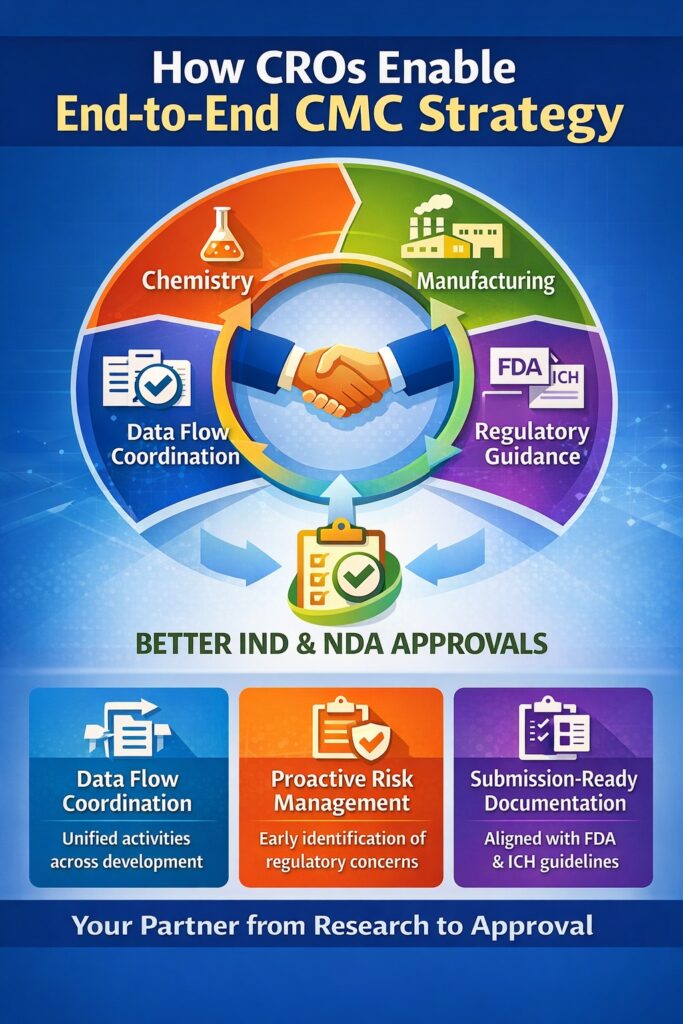
Beyond laboratory execution, CROs integrate analytical, manufacturing, and regulatory perspectives to keep CMC activities aligned with evolving FDA and ICH guidelines. This integrated approach allows sponsors to identify and address potential regulatory concerns early, while keeping documentation submission-ready throughout the entire development lifecycle.
1. The Strategic Role of CROs in End-to-End CMC Integration
CROs function as strategic partners rather than simple service providers, helping sponsors build a clear and future-focused CMC roadmap. Their responsibility is to align technical development with immediate clinical trial needs as well as long-term commercial goals.
By maintaining oversight across multiple CMC disciplines, CROs ensure that chemistry, manufacturing, and analytical strategies evolve together instead of in isolation. This coordinated development reduces the risk of late-stage changes that often trigger regulatory questions or inspection findings.
Key support areas include:
- Process chemistry optimization: Scaling chemical synthesis or biologic expression while maintaining reproducibility and impurity control
- Analytical method development and validation: Establishing consistent control of critical quality attributes (CQAs) across development phases
- Formulation and stability testing: Designing dosage forms that remain safe, effective, and stable throughout their shelf life
- Regulatory documentation: Preparing high-quality Module 3 sections for IND and NDA submissions
End-to-end CMC CRO Services bring these activities under one unified strategy, allowing smooth data flow, reduced variability, and continuous regulatory readiness.
Expert Insight: Early-stage decisions dictate late-stage success. Learn more about how to build a foundation with comprehensive Drug Discovery Services.
2. How CMC CRO Services Align Strategy with IND and NDA Requirements
The success of an IND or NDA submission depends heavily on the clarity, completeness, and scientific justification of the CMC section. CROs strengthen regulatory alignment by ensuring that manufacturing, analytical, and quality elements are fully documented and supported by reliable data.
They create structured development plans that anticipate regulatory expectations at each stage, from early feasibility studies to late-phase validation. This proactive planning approach significantly reduces the risk of unexpected questions during regulatory review.
| CMC Phase | Key CRO Contributions | Regulatory Outcome |
|---|---|---|
| Pre-IND | Process feasibility studies and impurity profiling | Early regulatory alignment |
| IND | Analytical validation and GMP-scale batch production | IND acceptance with minimal questions |
| NDA | Stability programs, lifecycle management, and comparability studies | Approval readiness and market compliance |
Through structured CMC CRO Services, sponsors can avoid rework, reduce submission delays, and meet regulatory expectations with greater confidence.
Navigate the Requirements: Understanding the shift in expectations is critical. See our detailed breakdown of IND vs NDA CMC requirements.
3. Process Chemistry and Manufacturing Optimization
CROs play a vital role in converting laboratory-scale chemistry into commercially viable manufacturing processes. Their experience in scale-up, process control, and GMP manufacturing allows sponsors to transition efficiently from development to clinical supply.
By applying scientific and regulatory best practices early, CROs help establish manufacturing processes that are robust, reproducible, and defensible during inspections. This reduces the risk of post-approval changes and long-term supply disruptions.
CRO support typically includes:
- Route scouting to improve yield, safety, and cost efficiency
- Process parameter mapping using Quality by Design (QbD) principles
- GMP-compliant manufacturing of clinical trial material (CTM)
- Preparation of detailed technology transfer packages for CDMOs or internal facilities
Strong process control strategies embedded early through CMC CRO Services help shorten IND timelines and reduce manufacturing risks later in development.
For sponsors moving toward formal filings, it is essential to have a partner that understands the nuances of NDA CMC requirements to ensure the manufacturing process is defensible during inspections.
4. Analytical Development and Control Strategies in CMC CRO Services
Analytical development is a foundation of any successful CMC submission because it directly supports product quality, safety, and consistency. CROs design, validate, and document analytical methods in line with ICH Q2(R2) guidelines and regulatory expectations.
Their analytical strategies ensure that methods remain fit for purpose as products progress from early development to commercial manufacturing. This continuity is essential for maintaining data integrity across multiple regulatory submissions.
CRO analytical services include:
- Development of stability-indicating analytical methods
- Validation of release, in-process, and characterization assays
- Reference standard qualification and impurity profiling
- Raw material and excipient characterization
By directly linking analytical data to regulatory documentation, CMC CRO Services support audit readiness and transparent regulatory review.
Technical Support: Ensure your methods are robust and compliant with our Analytical Method Development and Validation services.
5. Formulation Development and Stability Program Design
A carefully designed formulation and stability program ensures that a drug product remains within specifications throughout its intended shelf life. CROs develop stability strategies that comply with ICH Q1A(R2) guidelines and reflect real-world storage conditions.
They integrate accelerated, long-term, and in-use stability studies to generate complete degradation profiles and support shelf-life assignments. These datasets are essential for both IND and NDA submissions.
End-to-end CMC support includes:
- Pre-formulation studies and excipient compatibility testing
- Bioavailability enhancement and formulation optimization
- Container-closure system evaluation, including extractables and leachables
- Real-time stability monitoring supported by predictive modeling
The resulting data form a critical part of the IND CMC section and strengthen regulatory confidence in product quality.
Regulatory Compliance: Don’t leave your stability data to chance. Conduct rigorous Forced Degradation studies to support your shelf-life assignments.
6. Regulatory Documentation and Module 3 Authoring
CROs with regulatory writing expertise ensure that Module 3 submissions for INDs and NDAs are scientifically sound, consistent, and easy for regulators to review. Their structured approach reduces the risk of gaps or inconsistencies between data and narrative.
They ensure all CMC elements are clearly presented and supported by strong scientific justification, improving overall submission quality.
CRO regulatory support includes:
- Drafting detailed CMC sections, including 3.2.S and 3.2.P
- Aligning content with FDA eCTD structure and terminology
- Performing data integrity and cross-referencing checks
- Supporting timely and accurate responses to regulatory questions
Sponsors using comprehensive CMC CRO Services often experience fewer information requests and smoother review timelines.
7. Risk Mitigation Through Data Integrity and Quality Systems
Regulatory agencies place increasing emphasis on data integrity and traceability, guided by ALCOA principles. CROs implement validated systems to ensure accuracy, consistency, and reliability across all CMC activities.
Their quality systems are designed to withstand inspections while maintaining operational efficiency throughout development.
Risk mitigation strategies include:
- Electronic data capture systems with full audit trails
- Routine GLP and GMP internal audits
- Cross-validation between analytical methods and manufacturing batches
- Digital Quality Management Systems (QMS) for deviations and CAPAs
These practices strengthen compliance credibility and support regulatory trust.
Need specialized filing support? We provide expert IND CMC services to help you cross the clinical threshold with confidence.
8. The Role of AI and Digitalization in Modern CMC CRO Services
Modern CMC CRO Services increasingly use AI, predictive analytics, and digital tools to improve decision-making and shorten development timelines. These technologies allow better interpretation of complex datasets and earlier identification of risks.
By integrating digital solutions across the CMC lifecycle, CROs improve reproducibility and reduce uncertainty during scale-up and validation.
Key applications include:
- AI-driven impurity trend analysis
- Machine learning–based stability extrapolation
- Automated data aggregation for regulatory submissions
- Simulation of scale-up parameters before manufacturing
These innovations help biopharma companies achieve IND and NDA readiness faster while maintaining strong scientific justification.
9. Selecting the Right CRO Partner for Your CMC Strategy
Not all CROs offer true end-to-end CMC integration. Choosing the right partner requires careful evaluation of technical expertise, regulatory experience, and operational infrastructure.
An effective CRO should operate as an extension of the sponsor’s internal team, providing flexibility and strategic insight at every development stage.
Key evaluation criteria include:
- Proven experience with IND and NDA submissions
- In-house analytical, formulation, and process chemistry capabilities
- Strong data integrity and electronic documentation systems
- Ability to support both small molecules and biologics
Early use of CMC CRO Services allows sponsors to build a proactive CMC strategy instead of reacting to regulatory challenges later.
10. Long-Term Value: From IND to Lifecycle Management
CRO partnerships continue well beyond NDA approval. A strong CMC strategy includes post-approval commitments, ongoing process improvements, and global regulatory support.
CROs help sponsors maintain compliance and product quality throughout the commercial lifecycle.
Lifecycle management support includes:
- Annual product review preparation
- Post-approval stability studies and validation batches
- Regulatory support for global submissions, including EMA and PMDA
- Continuous improvement initiatives driven by process analytics
Through long-term collaboration, CMC CRO Services help ensure consistent product quality and sustained market success.
Conclusion
In today’s complex regulatory environment, CMC CRO Services are essential for IND and NDA success. They provide the scientific integration, regulatory discipline, and operational scalability required for efficient drug development.
From analytical control and formulation design to digital QMS implementation and AI-supported process optimization, CROs bring together expertise that cannot be managed in isolated silos. Their involvement reduces regulatory risk and accelerates development timelines.
By partnering with a CRO early, sponsors can ensure data integrity, regulatory alignment, and a smooth transition from discovery to market approval. To explore tailored CMC CRO Services for your development program, reach out to ResolveMass Laboratories Inc. today.
FAQs on How CROs Support End-to-End CMC Strategy
CROs manage and execute the full range of chemistry, manufacturing, and control activities required for IND filings. They generate compliant data, ensure proper documentation, and align studies with regulatory expectations. This support helps sponsors submit stronger IND packages with fewer review issues.
CROs operate under GLP and GMP standards using validated electronic systems. These systems maintain full audit trails, controlled access, and accurate data recording. This approach ensures data reliability and regulatory trust throughout development.
Yes, many CROs provide support from early laboratory studies through scale-up and commercial manufacturing readiness. They help design processes that can transition smoothly to larger-scale production. This continuity reduces risks during late-stage development.
Early CRO involvement helps align analytical methods, process development, and regulatory strategy from the beginning. This prevents data gaps and avoids rework during IND or NDA submissions. It also saves time and development costs.
CROs use AI tools for impurity trend analysis, stability prediction, and process optimization. These tools help identify risks earlier and support faster decision-making. As a result, development timelines can be shortened without compromising quality.
End-to-end CMC CRO Services manage chemistry, manufacturing, analytics, and regulatory documentation under one integrated strategy. This reduces communication gaps and improves data consistency. Sponsors benefit from better coordination and regulatory readiness.
Reference
- Popkin, M. E., Goese, M., Wilkinson, D., Finnie, S., Flanagan, T., Campa, C., Clinch, A., Teasdale, A., Lennard, A., Cook, G., & Mohan, G. (2022). Chemistry manufacturing and controls development, industry reflections on manufacture, and supply of pandemic therapies and vaccines. AAPS Journal, 24(6), Article 101. https://www.ncbi.nlm.nih.gov/pmc/articles/PMC9514697/
- Patel, D. H., Kumar, B. J., & Patel, A. A. (2017). Preparation and review of chemistry, manufacturing and control (CMC) sections of CTD dossier for marketing authorization. International Journal of Drug Regulatory Affairs, 5(2), 1–12. https://www.ijdra.com/index.php/journal/article/view/196
- U.S. Food and Drug Administration. (2024, November 19). Chemistry manufacturing and controls (CMC) guidances for industry (GFIs) and questions and answers (Q&As). U.S. Department of Health and Human Services. https://www.fda.gov/animal-veterinary/guidance-industry/chemistry-manufacturing-and-controls-cmc-guidances-industry-gfis-and-questions-and-answers-qas
Get In Touch With Us
About The Author


