

Summary (Quick Takeaways)
- Most CMC deficiencies in IND & NDA submissions stem from inadequate analytical validation, incomplete stability data, or poor process control strategies.
- FDA’s recent review trends show increasing scrutiny of raw material characterization, container closure integrity, and method transfer robustness.
- Preventing CMC deficiencies requires early integration of Quality by Design (QbD), proper comparability protocols, and strategic risk assessments during development.
- A proactive CMC strategy can reduce multiple review cycles, accelerate approval timelines, and improve compliance outcomes.
- ResolveMass Laboratories Inc. provides regulatory-aligned CMC data generation and submission support for faster IND/NDA acceptance.
Introduction
CMC Deficiencies in IND & NDA submissions remain one of the biggest challenges for pharmaceutical and biotech companies seeking regulatory approval. These deficiencies often arise from missing data, inconsistent documentation, or failure to align with evolving FDA and ICH guidance. Even when clinical data are strong, unresolved CMC issues can significantly delay progress.
Such deficiencies can result in repeated information requests, extended review timelines, or even refusal-to-file decisions. In many situations, these problems could have been avoided with better early-stage planning and closer coordination between development teams.
In this article, we explain the most common CMC Deficiencies in IND & NDA submissions, discuss current regulatory expectations, and share proven strategies to avoid them. All recommendations are based on real regulatory experience and practical compliance insights.
Strategic Resource: To navigate these complexities, a robust IND CMC Strategy is essential for aligning your technical data with regulatory expectations from day one.
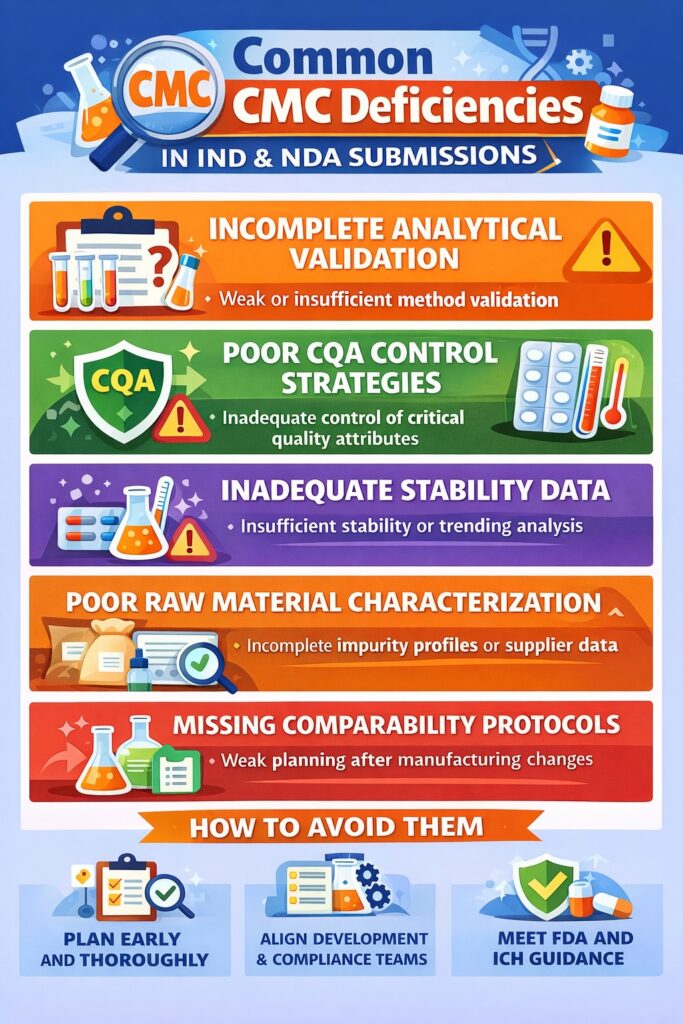
1. Incomplete Analytical Method Validation – A Major Cause of CMC Deficiencies in IND & NDA
Incomplete analytical method validation is consistently cited as a leading cause of CMC Deficiencies in IND & NDA submissions. FDA reviewers expect analytical methods to be appropriate, reliable, and validated according to their intended use and development phase.
Validation data should clearly demonstrate specificity, accuracy, precision, linearity, and robustness. When validation is partial or delayed without strong justification, regulators often raise concerns about data reliability and product quality.
Another frequent issue occurs when analytical methods change during development without proper revalidation. This creates uncertainty about historical data and overall control of the product.
Key FDA observations include:
- Missing validation data for impurity and potency methods
- Limited robustness testing for bioanalytical assays
- Poor documentation of method transfer between laboratories
How to avoid this issue:
- Validate methods in line with ICH Q2(R2) expectations.
- Perform method transfer or verification studies early, preferably by Phase II.
- Use orthogonal methods to confirm specificity and impurity profiles.
| Common Analytical Deficiency | Recommended Corrective Action |
|---|---|
| Lack of specificity data | Conduct forced degradation and confirm no co-eluting peaks |
| Inadequate precision | Perform repeatability and intermediate precision studies |
| Missing robustness data | Assess small changes in pH, flow rate, and temperature |
| Method transfer failures | Apply a structured method verification protocol at receiving labs |
Expert Support: Ensure your protocols meet ICH standards with our professional Analytical Method Development and Validation Services.
2. Weak Control Strategies for CQAs and CMC Deficiencies in IND & NDA
Poorly defined control strategies linked to Critical Quality Attributes (CQAs) are a frequent source of CMC Deficiencies in IND & NDA submissions. FDA reviewers expect a clear scientific connection between process parameters and final product quality.
When control strategies are vague or design space claims are unsupported, regulators cannot confidently assess process consistency. This often leads to additional questions or data requests.
These problems usually occur when QbD is applied only on paper and not supported by strong experimental data. Without proper studies, the overall control strategy lacks credibility.
To reduce risk:
- Apply QbD principles early using structured Design of Experiments (DoE).
- Set process limits based on statistical analysis tied to CQAs.
- Align strategies with ICH Q8(R2), Q9, and Q10 guidelines.
Example:
A Phase III biologic submission faced delays when FDA reviewers questioned glycosylation limits. The sponsor failed to link key parameters, such as temperature and feed rate, to glycan variability, resulting in a major information request.
To reduce risk, it is vital to utilize CMC CRO Services that specialize in building data-driven control frameworks that withstand rigorous agency scrutiny.
3. Inadequate Stability Programs and Trending Analysis
Insufficient stability data remains a major contributor to CMC Deficiencies in IND & NDA submissions. Stability studies are essential for confirming shelf life, packaging suitability, and long-term product quality.
Many sponsors underestimate the importance of statistical trending and complete datasets. When long-term or accelerated data are missing, FDA reviewers cannot confidently support proposed expiry periods.
The absence of stress testing or photostability studies further weakens the submission and raises concerns about degradation risks.
Common stability-related gaps include:
- Incomplete long-term and accelerated stability data
- Missing photostability or stress studies
- Lack of degradation trend analysis
Best practices include:
- Using data from at least three commercial-scale batches for NDA filings.
- Applying regression-based trending to justify shelf life.
- Designing programs aligned with ICH Q1A(R2) and relevant climatic zones.
4. Inconsistent Raw Material Characterization
Poor raw material characterization is another frequent CMC deficiency identified during regulatory review. All starting materials, excipients, and intermediates must be fully characterized and justified.
Deficiencies often arise from incomplete specifications, limited impurity data, or weak supplier qualification programs. These issues are especially critical for complex or biologically sourced materials.
FDA expects sponsors to proactively manage risks related to raw materials to ensure consistent product quality.
Key expectations include:
- Complete specifications, analytical data, and Certificates of Analysis (CoA).
- Supplier qualification, audits, and change control documentation.
- Clear traceability and viral safety data for biological materials.
| Deficiency | Regulatory Expectation |
|---|---|
| Missing impurity profiles | Provide full analytical characterization |
| No supplier change control | Implement formal qualification and monitoring |
| Poor biological traceability | Submit viral safety and source certification data |
5. Missing Comparability Protocols After Manufacturing Changes
Manufacturing changes are common during development, but weak comparability planning leads to CMC Deficiencies in IND & NDA submissions. Without predefined protocols, FDA reviewers cannot confirm that post-change material matches earlier clinical batches.
Retrospective assessments are rarely sufficient and often trigger additional studies or delays. As programs move closer to commercialization, expectations increase significantly.
Best practices to avoid this include:
- Developing prospective comparability protocols for FDA review.
- Conducting analytical, functional, and clinical bridging studies when needed.
- Maintaining clear records of process changes and justifications.
Compliance Tip: Avoid delays by performing comprehensive Extractables and Leachables Testing to ensure material compatibility and patient safety.
6. Insufficient Container Closure System (CCS) Data
Container closure system issues are frequently cited but often overlooked. FDA expects strong evidence that packaging protects the product throughout its shelf life.
Extractables and leachables (E&L) studies are a common weak point, especially when they are incomplete or poorly justified.
Insufficient CCS data raises safety and stability concerns that can delay approval.
Avoidance strategy:
- Perform full E&L studies per USP <1663> and <1664>.
- Assess all product-contact and non-contact components.
- Include container closure integrity testing such as dye ingress or helium leak tests.
7. Gaps in Process Validation and Technology Transfer
Process validation deficiencies are especially common in NDA submissions for complex products. FDA expects clear proof that manufacturing processes are reproducible and well controlled.
Problems often arise when PPQ activities are incomplete or when technology transfer documentation is weak. Without full traceability, regulators cannot confirm consistency across sites.
To reduce risk:
- Follow FDA’s 2011 Process Validation Guidance (Stages 1–3).
- Include risk assessments, PPQ protocols, and ongoing monitoring data.
- Provide detailed technology transfer records between sites.
8. Poorly Justified Specifications and Acceptance Criteria
Weak specification justification is another recurring issue in CMC Deficiencies in IND & NDA submissions. Specifications must be scientifically sound and clinically relevant.
FDA often challenges limits that appear arbitrary or unsupported by data. This can result in requests for reanalysis or tighter controls.
Specifications should evolve as product knowledge increases.
Strengthen specifications by:
- Using statistical analysis from multiple batches.
- Linking limits to safety, efficacy, and clinical performance.
- Aligning impurity limits with ICH Q3A/Q3B guidance.
9. Weak Lifecycle Management and Change Control
Lifecycle management is often underestimated but is critical for NDA success. FDA expects a clear plan for managing post-approval changes.
Deficiencies arise when change control systems lack structure or regulatory alignment. This creates concerns about long-term compliance.
To avoid these issues:
- Implement lifecycle strategies aligned with ICH Q12.
- Include pre-approval change management plans when applicable.
- Document change impact assessments thoroughly.
10. Poor Integration Between CMC and Clinical Modules
Lack of alignment between CMC and clinical data is a serious concern for FDA reviewers. Manufacturing changes that impact bioavailability or immunogenicity must be clearly linked to clinical outcomes.
When this integration is missing, approval delays and additional study requests are common. This often reflects siloed development rather than coordinated planning.
Solutions include:
- Cross-referencing manufacturing changes with clinical batch data.
- Conducting bridging PK or bioequivalence studies when required.
- Ensuring consistency across eCTD Modules 3, 4, and 5.
Conclusion: Reducing CMC Deficiencies in IND & NDA Through Smart Planning
Avoiding CMC Deficiencies in IND & NDA submissions requires early, coordinated planning across analytical, manufacturing, and regulatory teams. Reactive fixes late in development increase risk and delay approvals.
A proactive approach that combines strong analytical validation, QbD-driven control strategies, and effective lifecycle management improves submission quality and inspection readiness.
For companies seeking expert support, ResolveMass Laboratories Inc. offers advanced analytical testing, CMC strategy development, and regulatory submission support designed to accelerate IND and NDA approvals.
👉 Contact ResolveMass Laboratories Inc.
Frequently Asked Questions (FAQs)
The most common CMC Deficiencies in IND & NDA submissions include incomplete analytical method validation, insufficient stability data, weak process validation, and poorly defined control strategies. These gaps usually occur due to late-stage CMC planning or limited regulatory alignment. Addressing these issues early can significantly reduce review delays.
Analytical deficiencies can be avoided by validating methods according to ICH Q2(R2) requirements and matching the validation depth to the development stage. Sponsors should ensure accuracy, precision, specificity, and robustness are clearly demonstrated. Proper documentation and timely revalidation after method changes are also critical.
Stability studies cause delays when long-term data are incomplete or statistical trending is missing. FDA relies on stability data to confirm shelf life and packaging suitability. Without strong, well-analyzed stability results, regulators cannot confidently approve expiry periods.
Quality by Design helps establish a clear scientific link between process parameters and Critical Quality Attributes. This approach improves process understanding and reduces uncertainty during FDA review. When applied correctly, QbD strengthens control strategies and regulatory confidence.
The FDA evaluates comparability using analytical, functional, and sometimes clinical data to confirm product consistency. Predefined comparability protocols make this assessment smoother. Without them, additional studies or data requests are often required.
Reference
- Popkin, M. E., Goese, M., Wilkinson, D., Finnie, S., Flanagan, T., Campa, C., Clinch, A., Teasdale, A., Lennard, A., Cook, G., & Mohan, G. (2022). Chemistry manufacturing and controls development, industry reflections on manufacture, and supply of pandemic therapies and vaccines. AAPS Journal, 24(6), Article 101. https://www.ncbi.nlm.nih.gov/pmc/articles/PMC9514697/
- Patel, D. H., Kumar, B. J., & Patel, A. A. (2017). Preparation and review of chemistry, manufacturing and control (CMC) sections of CTD dossier for marketing authorization. International Journal of Drug Regulatory Affairs, 5(2), 1–12. https://www.ijdra.com/index.php/journal/article/view/196
- U.S. Food and Drug Administration. (2024, November 19). Chemistry manufacturing and controls (CMC) guidances for industry (GFIs) and questions and answers (Q&As). U.S. Department of Health and Human Services. https://www.fda.gov/animal-veterinary/guidance-industry/chemistry-manufacturing-and-controls-cmc-guidances-industry-gfis-and-questions-and-answers-qas
Get In Touch With Us
About The Author


