
Introduction
Evaluating COC and COP containers as glass alternatives highlights an advanced primary packaging strategy for sensitive biologics, parenteral formulations, and high-pH liquid therapeutics. These materials eliminate concerns associated with glass delamination and significantly reduce the risk of heavy metal leaching. Cyclic Olefin Copolymers (COC) and Cyclic Olefin Polymers (COP) offer glass-like optical transparency and low density while maintaining excellent chemical resistance across a broad range of pH conditions. Assessing their suitability requires a detailed examination of their extractables and leachables (E&L) profiles in accordance with United States Pharmacopeia standards USP and USP .
Unlike Type I borosilicate glass, which can release inorganic silica flakes and alkali metal ions when exposed to certain buffer solutions, cyclic olefins exhibit a different chemical profile. Their primary extractables include low-molecular-weight hydrocarbon oligomers, residual synthesis catalysts, and antioxidant degradation products. A thorough investigation of these extractables profiles provides biopharmaceutical developers with the experimental evidence needed to establish patient safety, maintain drug product integrity, and achieve long-term regulatory compliance.
For a better understanding of solvent selection during material characterization, explore this guide to solvents used in extractables studies.
Share via:
Quick Summary:
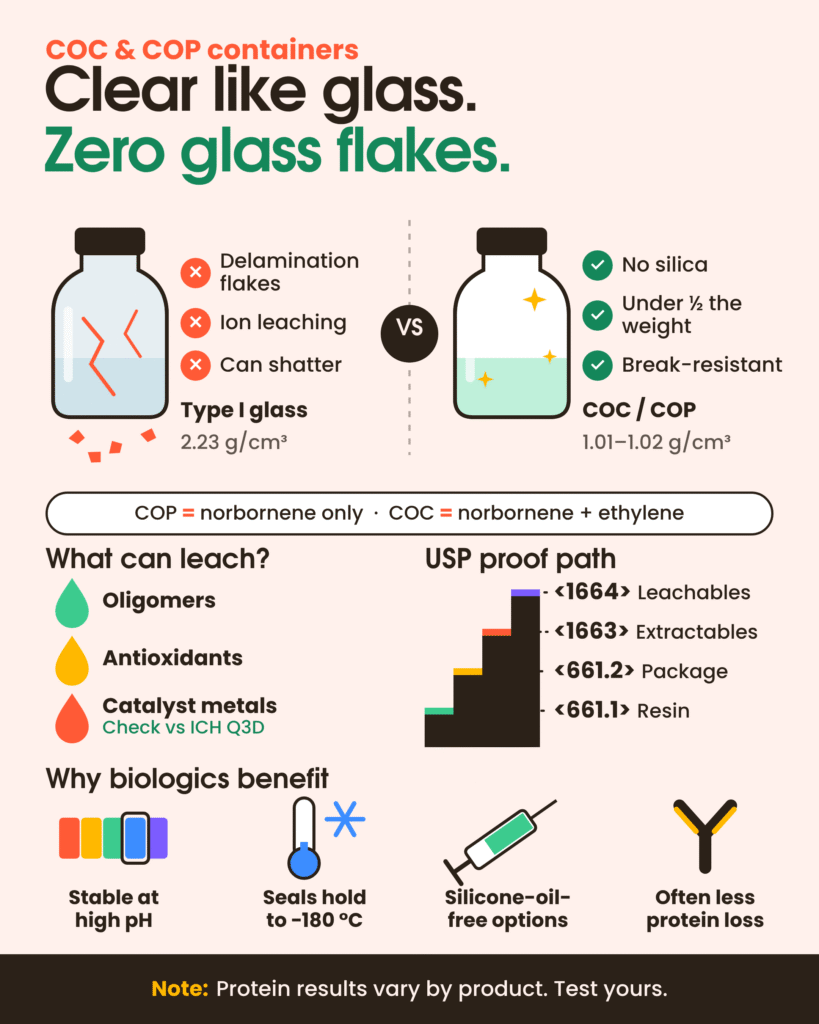
- Why switch from glass: COC and COP containers are clear like glass, but they contain no silica. That removes the risk of glass delamination flakes and ion leaching, which matter most for high-pH and citrate- or phosphate-buffered parenterals.
- How they’re made: COP is made by ring-opening polymerization of norbornene, followed by full hydrogenation. COC is a copolymer of norbornene and ethylene made with metallocene catalysts, and changing the ratio of the two controls its heat properties.
- Physical advantages: At about 1.02 g/cm³ versus 2.23 g/cm³ for borosilicate glass, they weigh less than half as much as glass. They also resist breakage, and their injection-molded shapes suit auto-injectors and wearable pumps.
- Extractables profile: Their main extractables are hydrocarbon oligomers, antioxidants (such as Irganox 1010 and Irgafos 168) and their breakdown products, and trace catalyst metals. They contain no BPA, phthalates or heavy-metal stabilizers.
- Testing and qualification path: Testing starts with the raw resin under USP <661.1> and moves to the finished package under USP <661.2>. Extractables are then studied under USP <1663> and leachables under USP <1664>, and metal residues are checked against ICH Q3D limits.
- E&L workflow: Extraction under exaggerated conditions finds compounds above the Analytical Evaluation Threshold (AET), and those compounds then get a toxicological assessment. After that, leachables are monitored in the actual drug product during real-time and accelerated stability studies.
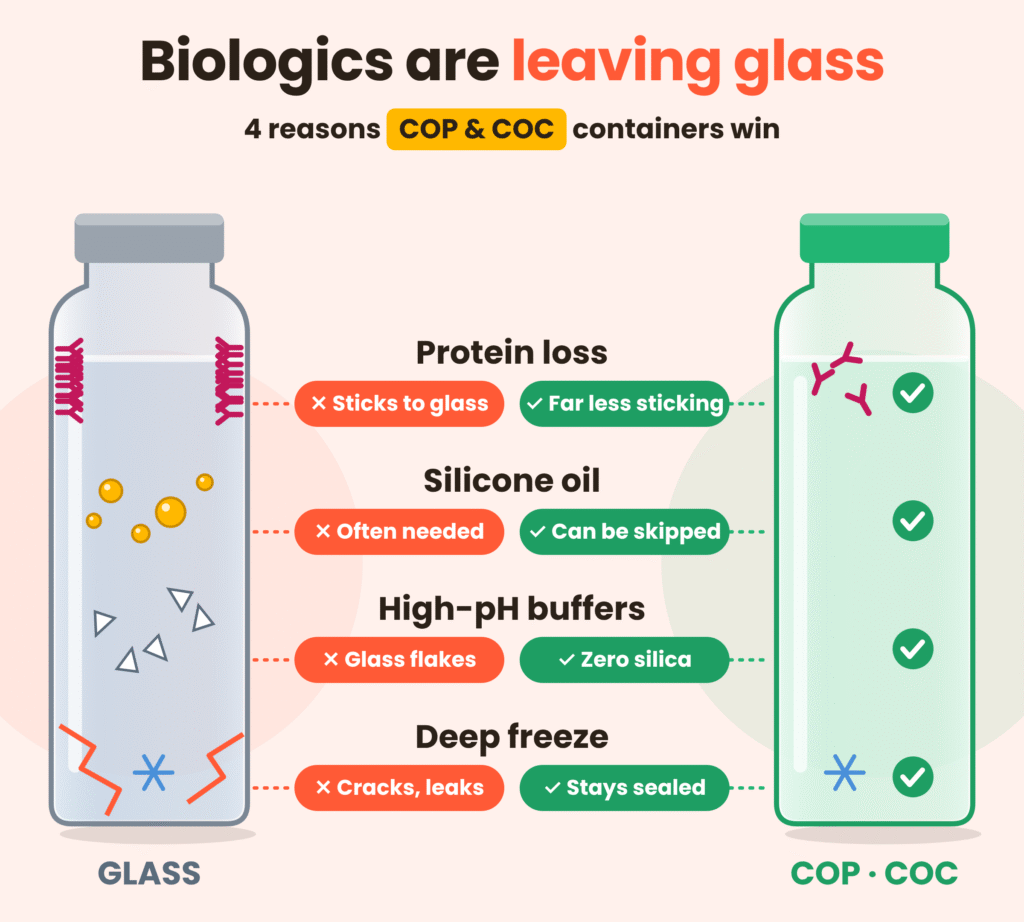
- Benefits for biologics: They are stable at high pH, and silicone-oil-free options exist. They also keep their container closure integrity at cryogenic temperatures (about −180 °C), and they often cause less protein adsorption, though this depends on the product and must be tested.
Chemical Architecture of COC and COP Containers as Glass Alternatives Compared to Borosilicate Glass
COC and COP containers as glass alternatives derive their chemical inertness and mechanical strength from fully saturated cyclic hydrocarbon backbones. These structures prevent inorganic ion leaching and eliminate the risk of glass delamination associated with conventional borosilicate containers.
Standard Type I borosilicate glass consists of approximately 76% silicon dioxide (SiO₂), 10.5% boron trioxide (B₂O₃), sodium oxide (Na₂O), and aluminum oxide (Al₂O₃). When exposed to parenteral formulations with an alkaline pH (pH > 7.5) or chelating agents such as citrate and phosphate buffers, the silica matrix can undergo surface hydrolysis. This process promotes silicate ion release and may result in the formation of glass delamination lamellae.
In contrast, cyclic olefin materials are fully synthetic, amorphous polyolefins that contain no inorganic network modifiers. Cyclic Olefin Polymer (COP) is manufactured through the ring-opening metathesis polymerization (ROMP) of norbornene monomers, followed by complete hydrogenation to produce a saturated, non-polar polymer chain. Cyclic Olefin Copolymer (COC), on the other hand, is synthesized by copolymerizing cyclic norbornene monomers with chain-like ethylene monomers using metallocene catalysts. By adjusting the norbornene-to-ethylene ratio, polymer chemists can precisely regulate the glass transition temperature (Tg) and thermal characteristics of the resulting material.
From a physical standpoint, cyclic olefin resins have a density of 1.01 to 1.02 g/cm³, representing approximately 60% less weight than borosilicate glass (2.23 g/cm³). This significant reduction in weight helps lower transportation expenses and reduces the likelihood of structural breakage during high-speed fill-finish operations. Additionally, injection molding of COP and COC enables dimensional manufacturing tolerances within ±0.005 mm. This precision helps prevent mechanical jamming in spring-loaded auto-injectors and wearable patch pumps.
| Material Parameter | Type I Borosilicate Glass | Cyclic Olefin Polymer (COP) | Cyclic Olefin Copolymer (COC) |
|---|---|---|---|
| Chemical Composition | SiO₂, B₂O₃, Na₂O, Al₂O₃ matrix | Fully hydrogenated poly-norbornene | Ethylene-norbornene copolymer |
| Density (g/cm³) | ~2.23 | ~1.01–1.02 | ~1.02 |
| Refractive Index / Abbe | 1.51 / ~65 | 1.53 / ~56 | 1.53 / ~56 |
| Delamination Flake Risk | High at pH > 7.5 or with chelating buffers | Completely absent (zero silica) | Completely absent (zero silica) |
| Dimensional Tolerance | High variance (tubular glass thermal forming) | ±0.005 mm (injection molding) | ±0.005 mm (injection molding) |
| Dominant Extractables | Si, B, Na, Ba, Al ions, glass flakes | Aliphatic oligomers, transition metals | Hydrocarbon oligomers, catalysts |
Extractables Profiles of COC and COP Containers as Glass Alternatives: Oligomers, Volatiles, and Catalysts
The extractables profiles of COC and COP containers as glass alternatives are primarily characterized by low-molecular-weight hydrocarbon oligomers, processing antioxidants, and residual metallocene catalysts. Controlled extraction studies performed under USP protocols use polar, semi-polar, and non-polar solvent systems under exaggerated temperature conditions to identify, characterize, and quantify potential chemical migrants.
Since cyclic olefins are manufactured without bisphenol-A (BPA), phthalate plasticizers, or heavy metal stabilizers, their organic extractables profiles are considerably cleaner than those associated with conventional polymers such as polyvinyl chloride (PVC) and polycarbonate (PC). This chemical composition makes them particularly suitable for pharmaceutical packaging applications that require a high level of material purity and compatibility.
For comprehensive identification of potential organic migrants, selecting suitable extraction conditions is essential. Learn more about analytical evaluation of extractables and leachables using different analytical techniques.
Organic Extractables: Oligomers, Volatiles, and Processing Additives
Organic extractables originating from cyclic olefin packaging materials mainly consist of non-polar hydrocarbon compounds generated during polymerization, extrusion molding, or gamma/electron-beam sterilization. Identifying and characterizing these compounds requires specialized analytical chromatography and mass spectrometry techniques.
– Cyclic and Acyclic Hydrocarbon Oligomers: Extraction using non-polar solvents, such as dichloromethane and n-hexane, followed by Gas Chromatography-Mass Spectrometry (GC-MS) analysis, can reveal low-molecular-weight dimers, trimers, and tetramers of norbornene and ethylene. These oligomeric compounds are important targets during extractables characterization because they may migrate from the polymer matrix under specific extraction conditions.
– Hindered Phenolic Antioxidants: Primary antioxidants, including Irganox 1010, and secondary phosphite stabilizers, such as Irgafos 168, are incorporated during resin compounding to minimize thermal oxidation. Extractables studies may identify these original additives as well as their degradation products, including oxidized Irgafos 168 and 2,4-di-tert-butylphenol. Evaluating both parent compounds and degradation products helps establish a comprehensive understanding of the material’s chemical profile.
– Volatile Organic Compounds (VOCs): Headspace GC-MS (HS-GC-MS) analysis of neat resin samples generally identifies exceptionally low background levels of volatile organic compounds. These materials also exhibit total organic carbon (TOC) values that remain well below established regulatory thresholds, supporting their suitability for pharmaceutical packaging applications.
Inorganic and Elemental Extractables: Transition Metal Catalysts
Inorganic extractables from cyclic olefin containers are primarily limited to trace catalyst residues. This differs considerably from glass containers, which may release structural silicate components and heavy metal ions under certain conditions. The polymerization of norbornene and ethylene monomers requires metallocene or Ziegler-Natta organometallic catalyst systems.
Inductively Coupled Plasma-Mass Spectrometry (ICP-MS), performed in accordance with USP and USP protocols, can identify trace quantities of titanium (Ti), zirconium (Zr), nickel (Ni), aluminum (Al), and platinum (Pt) residues. These metallic residues are generally retained within the rigid, hydrophobic polymer matrix, resulting in very low migration into aqueous parenteral drug vehicles. Nevertheless, their potential migration must be evaluated through appropriate analytical testing to demonstrate compliance with ICH Q3D Permitted Daily Exposure (PDE) limits.
To understand how trace metals are identified and quantified during packaging assessments, explore ICP-MS applications in extractables and leachables testing.
Regulatory Qualification and E&L Testing Framework for COC and COP Containers as Glass Alternatives
Demonstrating regulatory compliance for COC and COP containers as glass alternatives requires a systematic qualification process. This evaluation begins with raw polymer characterization under USP and progresses to finished packaging qualification under USP and USP /. Regulatory authorities expect comprehensive extractables and leachables (E&L) data packages to establish chemical suitability, material compatibility, and patient safety before commercial product release.
Compendial Testing Protocols: USP and USP
USP (Plastic Materials of Construction) establishes the characterization requirements for raw cyclic olefin resins before they undergo thermal processing or molding into primary packaging components. The monograph specifies several physicochemical, compositional, and biological assessments to establish the suitability of the material for pharmaceutical applications.
– Physicochemical Characterization: Water extraction solutions (S₁), prepared by refluxing 25 g of polymer material in 500 mL of purified water for 5 hours, are evaluated for Total Organic Carbon (TOC) according to USP , UV Absorbance according to USP , and acidity or alkalinity through micro-titration. These measurements help determine whether the polymer releases organic substances or other chemical species into the aqueous extraction medium.
– Compositional Additive Analysis: Toluene extraction solutions (S₂), prepared by refluxing 2.0 g of resin in toluene for 1.5 hours, are analyzed using HPLC-UV and GC-FID. These analytical techniques help quantify plastic additives, antioxidants, and other formulation-related compounds that may be present in the polymer material.
– Biological Reactivity: In vitro cytotoxicity testing conducted under USP and in vivo systemic reactivity testing under USP for parenteral applications are used to establish the biological compatibility of the material. These evaluations help determine whether potential interactions between the packaging material and biological systems could present safety concerns.
After the individual components have been manufactured through molding, the assembled primary container system must undergo qualification under USP (Plastic Packaging Systems for Pharmaceutical Use). This monograph evaluates important characteristics, including spectral transmission, container closure integrity, and toxicological safety, supported by USP extractables and USP leachables assessments.
| Testing Standard | Regulatory Focus | Key Analytical Instrumentation | Key Parameters & Compounds Analyzed |
|---|---|---|---|
| USP | Raw resin characterization for Cyclic Olefins | TOC Analyzers, UV-Vis, HPLC-UV, GC-FID, DSC | TOC, UV Absorbance, Acidity/Alkalinity, Additives, Thermal properties |
| USP | Assembled plastic packaging systems | Spectrophotometers, CCIT instruments, MS systems | Chemical safety assessment, Spectral transmission, System integrity |
| USP | Controlled Extractables profiling (exaggerated conditions) | HS-GC-MS, GC-MS, LC-MS/MS, ICP-MS | Volatile, semi-volatile, non-volatile organic extractables, metal catalysts |
| USP | Drug product Leachables evaluation (actual storage) | LC-MS/MS, GC-MS, ICP-MS, HPLC-UV | Migrated leachables in drug product under real-time / accelerated stability |
| ICH Q3D / USP | Elemental impurity evaluation | ICP-MS, ICP-OES | Class 1, 2A, 2B, and 3 elemental impurities, synthetic catalyst residues |
Advanced E&L Workflow Integration: USP and USP
Connecting extractables findings with actual leachables behavior requires a structured, multi-stage analytical workflow. Initially, packaging materials are exposed to exaggerated extraction conditions using solvents with different polarity characteristics, including water, ethanol, isopropyl alcohol, and hexane. These extractions are conducted at elevated temperatures to simulate or accelerate potential chemical migration under challenging conditions.
Following extraction, analytical identification and quantification are performed to determine the compounds present in the resulting solutions. An Analytical Evaluation Threshold (AET) is established based on the absolute dose and route of administration. Organic compounds detected above the applicable AET undergo toxicological assessment to determine their safety and establish appropriate Permitted Daily Exposure (PDE) limits.
Subsequently, leachables studies conducted under USP evaluate the migration of identified and potentially relevant compounds into the actual drug product. These investigations are performed during real-time and accelerated stability studies to monitor changes in leachables concentrations throughout the product’s shelf life. Integrating extractables and leachables findings provides a comprehensive assessment of packaging compatibility and helps establish that the selected container system does not compromise drug product quality or patient safety.
Establishing an appropriate reporting threshold is an important part of this workflow. Read more about setting the Analytical Evaluation Threshold (AET) for E&L studies.
Biopharmaceutical Compatibility: Protein Adsorption, Aggregation, and High-pH Formulations
The adoption of COC and COP containers as glass alternatives addresses several formulation stability challenges associated with therapeutic proteins, monoclonal antibodies (mAbs), cell and gene therapies, and mRNA-lipid nanoparticles (LNPs). Sensitive biologics can undergo surface-induced unfolding, aggregation, or sub-visible particulate formation when they come into contact with active silanol groups present on glass surfaces.
Cyclic olefin polymers offer several formulation compatibility advantages that make them valuable materials for advanced biopharmaceutical packaging applications.
Reduced Protein Adsorption
Monoclonal antibodies may demonstrate up to a 40% reduction in surface adsorption when stored in COP containers compared with borosilicate glass. This characteristic helps minimize protein loss and maintain formulation potency, particularly in low-dose formulations where even small amounts of protein adsorption can affect the final product concentration.
Silicone Oil Elimination
Precision injection molding makes it possible to manufacture smooth container barrel surfaces or incorporate fluoropolymer coatings. These approaches can eliminate the need for silicone oil lubrication, thereby reducing the possibility of silicone-induced protein aggregation. This is particularly important for protein-based therapeutics that are sensitive to particulate formation and surface-related instability.
Chemical Stability at Alkaline pH
Biologics formulated with buffers at pH > 7.5 may gradually erode glass surfaces during prolonged storage. In contrast, cyclic olefin materials remain chemically stable across a pH range of 2 to 12 without releasing silicates or significantly altering the solution pH. This property makes them suitable for formulations that require alkaline storage conditions.
Cryogenic Storage Integrity
Advanced therapies stored at -80°C or in liquid nitrogen vapor phases (-196°C) may experience glass fracture because of thermal shock. COP vials maintain their mechanical toughness and container closure integrity under deep cryogenic storage conditions. This makes them particularly useful for cell and gene therapies, biological samples, and other temperature-sensitive pharmaceutical products that require long-term storage at extremely low temperatures.
Leachables monitoring should continue throughout the product’s stability program to identify changes in chemical migration under real-time and accelerated storage conditions. For additional guidance, explore leachables monitoring during stability studies.
Conclusion
Adopting COC and COP containers as glass alternatives offers an advanced engineering approach to addressing longstanding challenges associated with glass delamination, heavy metal leaching, and mechanical breakage in biopharmaceutical packaging. Their extractables profiles, which primarily include non-polar hydrocarbon oligomers, trace catalyst residues, and antioxidant degradation products, demonstrate favorable chemical characteristics for packaging complex biologics, cryogenic products, and alkaline parenteral formulations.
Implementing comprehensive E&L workflows based on USP , USP , USP , and USP supports systematic material qualification and provides essential evidence of packaging suitability. These evaluations help protect patient safety, preserve drug product integrity, and support regulatory approval by identifying potential chemical interactions between packaging materials and pharmaceutical formulations.
For specialized Extractables & Leachables study design, compendial plastic qualification, and advanced mass spectrometry testing, consult the laboratory team at ResolveMass Laboratories Inc. Contact Page.
Frequently Asked Questions (FAQs)
Cyclic olefin polymers primarily release organic extractables, including low-molecular-weight hydrocarbon oligomers, residual monomers, and trace catalyst residues. In comparison, traditional Type I borosilicate glass can release inorganic substances such as silicon, boron, sodium, aluminum, and barium. These differences create distinct chemical safety considerations, particularly when packaging formulations that may promote glass delamination.
Extractables investigations using GC-MS and LC-MS/MS can identify several organic compounds in COC and COP packaging materials. Common examples include cyclic and acyclic norbornene oligomers, such as dimers, trimers, and tetramers, along with residual synthetic monomers. Other potential extractables include phenolic antioxidants such as Irganox 1010, phosphite processing additives such as Irgafos 168, and degradation products like 2,4-di-tert-butylphenol.
Cyclic olefin polymers offer manufacturing precision through injection molding, allowing dimensional tolerances of ±0.005 mm. This accuracy supports consistent breakout and glide forces in prefilled syringes and auto-injectors. Their resistance to mechanical breakage also improves container durability during spring-driven actuation, while eliminating the need for silicone oil lubrication can help reduce silicone oil-induced protein aggregation.
The evaluation of cyclic olefin packaging materials involves several compendial and regulatory standards. USP addresses raw plastic resin characterization, while USP evaluates finished packaging systems. USP and USP provide frameworks for controlled extractables and drug product leachables assessments, respectively, while ICH Q3D and USP address elemental impurity risks and their permissible exposure limits.
Glass delamination develops when certain pharmaceutical formulations interact with the internal silica-based surface of glass containers, gradually weakening its structure. This interaction can cause thin glass layers, known as lamellae, to separate and enter the drug solution as particulate contamination. COP containers avoid this particular failure mechanism because they contain no silicon dioxide or inorganic glass network, eliminating the possibility of silica-based delamination.
A comprehensive extractables investigation requires multiple analytical techniques to detect compounds with different chemical properties and molecular weights. Headspace GC-MS is used to identify Volatile Organic Compounds (VOCs), while direct-injection GC-MS characterizes Semi-Volatile Organic Compounds (SVOCs). LC-MS/MS helps detect Non-Volatile Organic Compounds (NVOCs), and ICP-MS identifies trace elemental impurities and residual catalyst metals.
Unlike glass, which provides a virtually impermeable barrier to gases and moisture, polymer containers allow some degree of molecular transmission. COC and COP offer excellent water vapor barrier performance compared with many conventional medical-grade plastics. However, formulations containing oxygen-sensitive ingredients may require additional protective measures, such as secondary overwrap packaging or plasma-deposited SiOₓ barrier coatings, to minimize oxygen exposure and maintain long-term product stability.
Metallocene and Ziegler-Natta polymerization processes use organometallic catalysts to facilitate the synthesis of cyclic olefin materials. Small residual quantities of metals, including titanium, zirconium, nickel, and aluminum, may remain in the finished polymer following manufacturing. ICP-MS analysis helps detect and quantify these elemental residues, allowing manufacturers to evaluate their potential migration and verify compliance with ICH Q3D Permitted Daily Exposure (PDE) limits.
USP focuses on evaluating raw cyclic olefin resins through physicochemical assessments, including Total Organic Carbon (TOC), UV absorbance, acidity, and alkalinity measurements. It also addresses additive composition and biological reactivity to establish the suitability of the polymer material. USP , in contrast, evaluates the finished packaging system through assessments of container closure integrity, spectral transmission, and chemical safety, supported by relevant USP and USP studies.
Reference:
- Felts, J. T., Fisk, T. E., Abrams, R. S., Ferguson, J., Freedman, J. R., Pangborn, R. J., Sagona, P. J., & Weikart, C. (2021). Passivation, pH protective or lubricity coating for pharmaceutical package, coating process and apparatus (U.S. Patent No. 11,148,856 B2). U.S. Patent and Trademark Office. https://patents.google.com/patent/US11148856B2
- Zhao, J., Lavalley, V., Mangiagalli, P., Wright, J. M., & Bankston, T. E. (2014). Glass delamination: A comparison of the inner surface performance of vials and pre-filled syringes. AAPS PharmSciTech, 15(6), 1398–1409. https://doi.org/10.1208/s12249-014-0167-y
- Squire, K. R., Oshinski, A. J., Robinson, K. D., Mehnert, C. P., Arvedson, M. M., Poole, B. J., Patil, A. O., Baugh, L. S., & Colle, K. S. (2008). Polymer compositions comprising cyclic olefin copolymers and polyolefin modifiers (International Patent Publication No. WO2008018952A1). World Intellectual Property Organization. https://patents.google.com/patent/WO2008018952A1/en
- United States Pharmacopeial Convention. (2020). 〈1663〉 Assessment of extractables associated with pharmaceutical packaging/delivery systems. USP–NF. https://doi.org/10.31003/USPNF_M7126_03_01
- Weikart, C., Clark, B. L., Stevenson, A., Abrams, R. S., Belfance, J., Jones, J. A., & Fisk, T. E. (2021). Controlling the uniformity of PECVD deposition on medical syringes, cartridges, and the like (Canadian Patent No. CA2892294C). Canadian Intellectual Property Office. https://patents.google.com/patent/CA2892294C/en
- Sio2 Medical Products, Inc. (2017). Saccharide protective coating for pharmaceutical package (U.S. Patent No. 9,545,360 B2). U.S. Patent and Trademark Office. https://patents.google.com/patent/US9545360B2/en
Get In Touch With Us
About The Author