

Introduction
In today’s highly competitive pharmaceutical market, CRO Services for Generic Drug Development go far beyond basic laboratory testing. Regulatory authorities now expect deeper scientific justification, stronger impurity control, and complete documentation at every stage of development. Data quality, transparency, and compliance are more important than ever before.
As regulatory standards continue to evolve, companies rely on specialized CRO expertise to improve ANDA approval success rates. Many delays occur due to preventable gaps in formulation design, analytical validation, or submission quality. A knowledgeable CRO identifies these risks early and applies corrective strategies before regulatory filing.
This article explains the top CRO services required for generic drug development. Each section highlights why these services are scientifically critical and how they directly influence approval timelines, cost efficiency, and long-term product success.
Accelerate Your Pipeline: Explore our Comprehensive Drug Discovery Services
Summary: Key CRO Services That Drive Successful Generic Drug Development
- Formulation development and reverse engineering are critical to match the reference listed drug (RLD) performance.
- Analytical method development and validation ensures regulatory-grade data integrity and ANDA readiness.
- Bioequivalence (BE) studies are mandatory to demonstrate therapeutic equivalence.
- Impurity profiling and stability studies protect regulatory compliance and product lifecycle.
- Regulatory dossier preparation (ANDA/CTD modules) determines submission quality and approval timelines.
- API characterization and polymorph analysis reduce risks of batch failure and regulatory queries.
- Clinical research and PK/PD evaluation support complex generics and modified-release products.
- CMC documentation and lifecycle management ensure smooth commercialization.
For pharmaceutical companies planning faster approvals, choosing the right CRO Services for Generic Drug Development is a strategic decision. The right CRO partner improves speed-to-market, strengthens regulatory confidence, and increases overall return on investment. An experienced and integrated CRO also reduces operational challenges by aligning analytical, clinical, and regulatory activities under one coordinated system.
1. Formulation Development & Reverse Engineering in CRO Services for Generic Drug Development
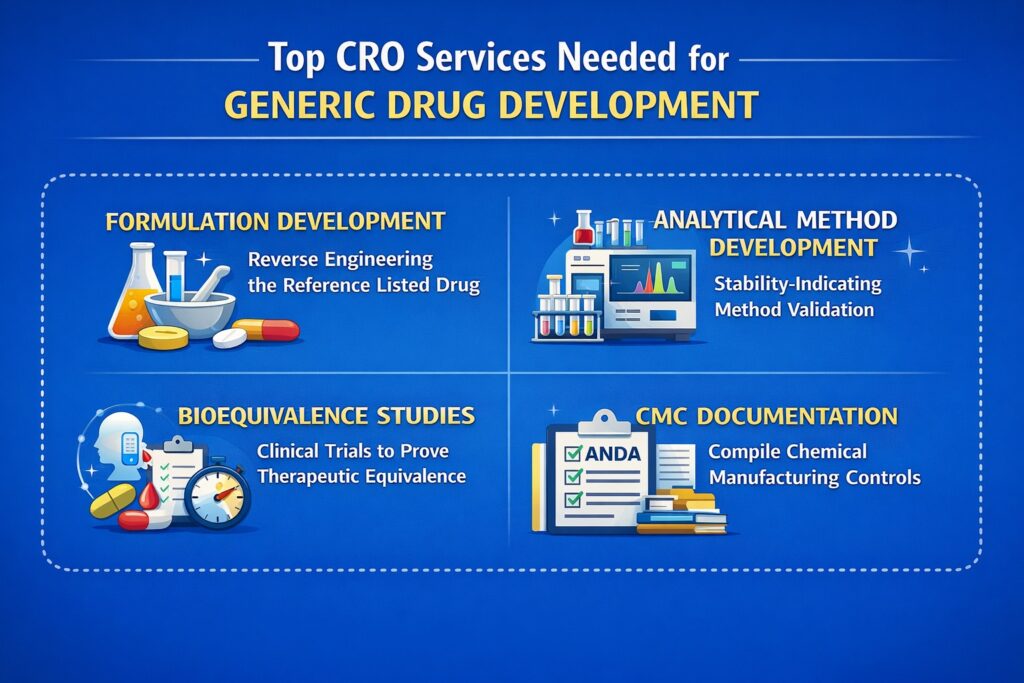
Precise formulation development is one of the most important elements in CRO Services for Generic Drug Development. The goal is to closely match the performance of the reference listed drug (RLD) in terms of release, stability, and absorption. Even small differences in excipient levels or processing methods can change product behavior.
Generic development begins with deep characterization of the RLD. Reverse engineering involves understanding excipient roles, release mechanisms, and solid-state properties. It is not simple duplication but a structured scientific evaluation of how the product performs under different conditions.
Key Capabilities Required:
- Quantitative composition profiling (Q1/Q2 analysis)
- Excipient compatibility studies
- Solid-state characterization (DSC, XRPD, TGA)
- Dissolution profile comparison across multiple pH conditions
- Particle size and polymorph identification
These evaluations confirm whether the generic formulation can deliver similar in vivo performance. Early and detailed material understanding helps prevent manufacturing and scale-up problems later.
For modified-release or complex generics, CROs must also:
- Develop matrix or coated systems that match release kinetics
- Optimize excipient ratios to achieve bioequivalence
- Perform IVIVC modeling where appropriate
Failure to match formulation performance often leads to BE study failure. Investing in proper formulation development protects timelines, budgets, and regulatory outcomes.
Detailed Molecular Analysis: Learn about our NMR Services for Small Molecules
2. Analytical Method Development & Validation in CRO Services for Generic Drug Development
Strong analytical systems are the backbone of CRO Services for Generic Drug Development. Regulatory agencies expect reliable, reproducible, and stability-indicating methods. Analytical weaknesses remain one of the most common reasons for regulatory objections.
A method developed during early stages must also remain robust during audits and inspections. Validation ensures that the method performs accurately and consistently under defined conditions.
Ensure Method Reliability: View our Analytical Method Development and Validation Services
Core Analytical Services:
- Stability-indicating HPLC/UPLC method development
- LC-MS/MS for impurity profiling
- Elemental impurity testing (ICH Q3D).
- Nitrosamine detection and quantification
- Residual solvent analysis (ICH Q3C)
- Extractables and leachables studies
Each of these services supports regulatory compliance and patient safety. Nitrosamine risk assessment, in particular, has become a global regulatory focus in recent years.
Safety and Compliance: Discover our Nitrosamine Analysis and Risk Assessment
Regulatory-Driven Requirements:
- Method validation as per ICH Q2(R2)
- Data integrity compliance (21 CFR Part 11)
- Forced degradation studies
Complete impurity profiling and validated analytical methods significantly reduce the chances of Complete Response Letters (CRLs). Partnering with an experienced CRO ensures audit-ready documentation and strong submission quality.
Packaging Compatibility: Explore Extractables and Leachables Testing
3. Bioequivalence Studies: Core Component of CRO Services for Generic Drug Development
Bioequivalence studies are central to CRO Services for Generic Drug Development. They confirm that the generic product matches the RLD in safety and effectiveness. Regulatory approval depends heavily on accurate and well-controlled BE data.
A well-designed BE study requires detailed protocol planning, correct subject selection, and proper pharmacokinetic sampling. Even small study deviations can affect statistical outcomes and delay approval.
Clinical Study Execution:
- Protocol design aligned with FDA and EMA guidance
- Volunteer recruitment and medical screening
- PK sampling and bioanalysis
- Statistical evaluation using 90% confidence interval analysis
For specialized products, CROs also provide:
- Fed and fasting studies
- Highly variable drug evaluation (scaled average BE)
- Narrow therapeutic index (NTI) studies
- Dermatological and topical BE assessments
Improper study design can delay approval by months or even years. Professional execution ensures smoother regulatory review and faster market entry.
Precision Bioanalysis: Learn more about our HPLC Analysis Services
4. Stability Studies & Impurity Profiling in CRO Services for Generic Drug Development
Stability testing confirms that the product maintains quality throughout its labeled shelf life. Within CRO Services for Generic Drug Development, stability and impurity assessment are critical for regulatory approval.
Regulators closely review degradation trends, impurity levels, and assay variability. Comprehensive data reduces regulatory questions and improves submission strength.
Essential Stability Services:
- Accelerated stability studies (40°C/75% RH)
- Long-term stability (25°C/60% RH)
- Intermediate stability testing
- Photostability testing (ICH Q1B)
Advanced Impurity Profiling:
- Genotoxic impurity assessment (ICH M7)
- Nitrosamine risk evaluation
- Degradation pathway analysis
- Forced degradation studies
Strong impurity control supports patient safety and regulatory confidence. Proper stability planning also allows strategic submission timing.
Verify Product Shelf-Life: Explore our Stability Studies for Pharma
5. API Characterization & Solid-State Analysis
Comprehensive API characterization reduces variability and regulatory uncertainty. In CRO Services for Generic Drug Development, understanding API physical and chemical properties is essential for consistent performance.
Changes in crystal form, particle size, or hygroscopic behavior can influence dissolution and bioavailability. Early identification of these risks supports stable manufacturing processes.
Leading CRO capabilities include:
- Polymorph screening
- Salt selection studies
- Hygroscopicity evaluation
- Particle size distribution analysis
- Crystallinity assessment
For injectable products, additional services such as sterility testing, endotoxin testing, and container closure integrity evaluation are required. Early solid-state analysis significantly lowers the risk of batch failure during scale-up.
6. CMC Documentation & ANDA Submission Support
High-quality CMC documentation is essential for smooth regulatory review. A major component of CRO Services for Generic Drug Development is preparing structured and compliant CTD modules.
Regulatory agencies review Module 3 in detail, focusing on specifications, validation data, and manufacturing controls. Poor documentation often results in review delays or deficiency letters.
CRO services typically include:
- Module 3 (CTD) preparation
- Specification justification
- Risk assessment documentation
- Deficiency response management
- eCTD publishing
Common Regulatory Pitfalls
| Issue | Regulatory Impact |
|---|---|
| Incomplete impurity qualification | Major deficiency |
| Weak stability justification | Approval delay |
| Data integrity gaps | Inspection risk |
| Inadequate validation | CRL issuance |
Careful planning and internal quality review help prevent these common issues before submission.
7. Clinical Research Support for Complex Generics
Complex generics often require more than traditional BE studies. In advanced CRO Services for Generic Drug Development, clinical and analytical teams work together to design tailored regulatory strategies.
Products such as inhalers, liposomal injections, transdermal patches, and ophthalmic solutions require specialized testing methods. Both in vitro and in vivo evidence may be necessary to prove equivalence.
CRO services may include:
- Comparative endpoint studies
- Pharmacodynamic (PD) modeling
- Dermatokinetic studies
- Inhalation device performance testing
- Liposomal particle characterization
Early regulatory interaction and scientific justification are especially important for these product categories.
8. Regulatory Strategy & Global Compliance Management
Strategic regulatory planning determines how quickly a product reaches the market. Within CRO Services for Generic Drug Development, regulatory experts guide companies through FDA, EMA, and Health Canada expectations.
Early agency communication can clarify requirements and prevent unnecessary delays. CROs with global experience understand regional differences and submission standards.
Key services include:
- Pre-ANDA meeting support
- Regulatory gap analysis
- Controlled correspondence submission
- Global bridging strategies
- Post-approval lifecycle management
Ongoing compliance ensures that products remain aligned with updated regulatory guidelines after approval.
How to Select the Right CRO Services for Generic Drug Development
Selecting the right CRO requires reviewing experience, compliance history, and technical capability. Companies should evaluate scientific strength as well as regulatory success rates.
Evaluation Checklist:
- FDA and EMA audit history
- Experience with complex generics
- Advanced analytical equipment
- In-house BE and bioanalytical facilities
- Proven ANDA approval track record
- Strong data integrity systems
Clear communication, structured project management, and transparent reporting also improve development efficiency.
Why Integrated CRO Services Matter in Generic Drug Development
Integrated CRO Services for Generic Drug Development reduce coordination gaps and regulatory risk. When formulation, analytical, and clinical services are handled within a unified system, consistency improves significantly.
An integrated approach offers:
- Faster data generation
- Reduced variability between studies
- Streamlined regulatory documentation
- Lower overall development costs
- Reduced risk of BE study failure
This model supports efficient submissions and strengthens regulatory trust through consistent data presentation.
Conclusion
The success of any generic program depends on selecting reliable and experienced CRO Services for Generic Drug Development. From formulation design and impurity profiling to bioequivalence execution and ANDA documentation, each service directly influences approval timelines and commercial success.
Pharmaceutical companies that partner with scientifically strong and compliance-focused CROs improve their approval probability and minimize costly delays. Strategic planning, technical expertise, and regulatory alignment together ensure smoother product development.
If you are planning your next generic drug program and require expert support, connect with our scientific team at ResolveMass Laboratories today:
Frequently Asked Questions (FAQs)
Bioequivalence studies and analytical method validation are usually the most important services for approval. Bioequivalence proves that the generic performs the same as the reference drug in the body. Analytical validation ensures that all data submitted to regulators is accurate and reliable. Without these two elements, regulatory approval becomes very difficult.
Impurity profiling is essential to confirm that the product is safe for patients and meets ICH guidelines. It helps identify and control unwanted substances that may form during manufacturing or storage. Proper impurity assessment also reduces the chances of regulatory objections. Strong impurity data builds confidence during review.
CROs help shorten timelines by designing correct studies from the beginning and avoiding unnecessary repeat work. They ensure methods are validated properly and documents are prepared in line with regulatory expectations. Early risk identification prevents costly delays. Efficient project coordination also speeds up submission readiness.
Solid-state characterization plays a major role in ensuring consistent product performance. Differences in crystal form or particle size can impact dissolution and stability. Early evaluation helps prevent unexpected issues during scale-up. This reduces the risk of batch failures and regulatory concerns.
Generic development is guided by ICH quality guidelines, FDA bioequivalence recommendations, EMA requirements, and Health Canada regulations. These guidelines define how studies should be designed and documented. CROs must stay updated with regulatory changes to ensure compliance. Following the correct standards improves approval success.
Deficiency letters are often issued due to incomplete impurity data, weak stability justification, or poorly validated analytical methods. Documentation gaps and data integrity concerns can also trigger regulatory questions. Many of these issues are preventable with proper planning. A thorough internal review before submission reduces this risk.
Reference:
- Department of Pharmaceuticals, Government of India. (2023). Study on CRO sector in India (CRO market report). https://pharma-dept.gov.in/sites/default/files/CRO%20Market%20Report_High%20Resolution.pdf
- U.S. Food and Drug Administration. (n.d.). Drug development and review definitions. https://www.fda.gov/drugs/investigational-new-drug-ind-application/drug-development-and-review-definitions
- Biala, G., Kedzierska, E., Kruk-Slomka, M., Orzelska-Gorka, J., Hmaidan, S., Skrok, A., Kaminski, J., Havrankova, E., Nadaska, D., & Malik, I. (2023). Research in the field of drug design and development. Pharmaceuticals, 16(9), 1283. https://doi.org/10.3390/ph16091283
Get In Touch With Us
About The Author


