
Introduction
Uncontrolled migration of non-bonded plasticizers and the sorption of therapeutic drugs remain two major material-compatibility challenges associated with polyvinyl chloride (PVC) medical devices. Addressing DEHP and plasticizer leachables from PVC requires a comprehensive understanding of polymer thermodynamics, toxicological exposure limits, and fluid interaction dynamics. Polyvinyl chloride is inherently a rigid, crystalline polymer that requires the incorporation of low-molecular-weight plasticizers, primarily di(2-ethylhexyl) phthalate (DEHP), at concentrations of up to 40% w/w to achieve the flexibility necessary for manufacturing intravenous (IV) bags, blood storage containers, and administration tubing sets. Since these plasticizing agents are physically blended into the polymer rather than chemically bonded to the poly(vinyl chloride) backbone, they remain vulnerable to migration and subsequent leaching into contacting fluids. At the same time, the hydrophobic regions of plasticized PVC demonstrate a strong affinity for lipophilic active pharmaceutical ingredients (APIs), potentially resulting in considerable reductions in therapeutic potency during patient administration. In response to evolving international regulatory requirements, including the EU Medical Device Regulation (MDR 2017/745) and California Assembly Bill 2300, the healthcare industry is increasingly adopting advanced non-phthalate plasticizers and alternative non-PVC polymer systems.
Manufacturers evaluating safer polymer systems can explore the characteristics of low-leachables packaging materials to understand how material selection can reduce potential chemical migration and improve product compatibility.
Share via:
Quick Summary:
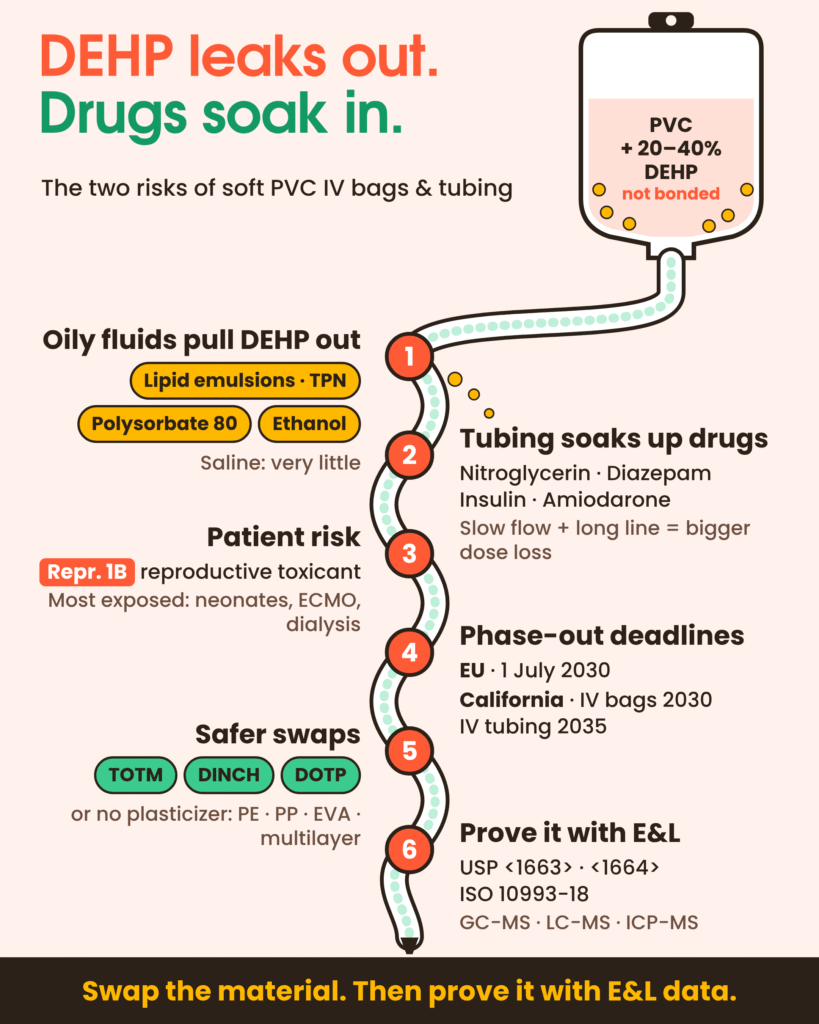
- Why DEHP leaches: Flexible PVC IV bags, blood bags and tubing contain about 20–40% DEHP by weight. Because the plasticizer is physically mixed in rather than chemically bonded, it can migrate out into the fluids it touches.
- What drives leaching: Saline and water extract very little DEHP. Lipid emulsions (TPN, propofol), surfactants such as Polysorbate 80, and co-solvents like ethanol can pull out significant amounts, and exposure increases with contact time.
- Drug loss to tubing: Lipophilic drugs such as nitroglycerin, diazepam and amiodarone are absorbed into plasticized PVC walls, and insulin is lost by surface adsorption. Slow flow rates and long lines increase the loss, which makes delivered doses inconsistent, a particular problem when titrating critical drugs.
- Toxicity: DEHP and its metabolite MEHP are linked to endocrine disruption and reproductive toxicity (REACH Repr. 1B). Neonates on TPN, ECMO patients and long-term dialysis patients face the highest exposure.
- Regulatory pressure: EU MDR requires justification for CMR substances above 0.1% w/w, and the EU REACH sunset date for DEHP in medical devices is 1 July 2030. California AB 2300 bans DEHP in IV bags from 2030 and in IV tubing from 2035.
- Safer materials: One route is to swap in non-phthalate plasticizers such as TOTM, DINCH or DOTP, which migrate less. The other is to eliminate plasticizers entirely with PE, PP, EVA, cyclic olefin polymers or multilayer co-extruded tubing that keeps the drug away from plasticized layers.
- Testing to prove safety: Extractables (USP <1663>) and leachables (USP <1664>) studies under ISO 10993-18 identify migrating compounds above an Analytical Evaluation Threshold. These studies use GC-MS, LC-MS and ICP-MS, so new materials are cleared toxicologically before clinical use.
Physico-Chemical Mechanisms Governing DEHP and Plasticizer Leachables from PVC
The migration of di(2-ethylhexyl) phthalate (DEHP) from a PVC matrix into contacting fluid streams involves a series of thermodynamically driven diffusion processes influenced by non-covalent polymer interactions and the lipophilic characteristics of the formulation. Phthalate plasticizers remain distributed throughout the poly(vinyl chloride) polymer network through relatively weak van der Waals interactions. These interactions allow the plasticizer molecules to diffuse toward the fluid interface in response to differences in chemical potential. The migration rate is primarily determined by Fick’s first and second laws of diffusion. According to these principles, the flux (J) of a leachable compound moving through the polymer wall toward the fluid interface is dependent on the diffusion coefficient (D) of the plasticizer within the polymer and the concentration gradient (∂C / ∂x):
J = -D (∂C / ∂x)
The thermodynamic force responsible for plasticizer migration is strongly influenced by the composition and chemical properties of the contacting fluid. Aqueous formulations containing hydrophobic solubilizers, surfactant excipients (e.g., Polysorbate 80, Polyoxyl 35 castor oil), co-solvents (ethanol, propylene glycol), or lipid emulsions can reduce interfacial tension and substantially increase the partition coefficient (Ksol/poly) of DEHP between the polymer matrix and the contacting fluid. Research indicates that pure water and conventional saline solutions generally produce minimal DEHP migration because phthalates have extremely limited aqueous solubility (<0.003 mg/L). In contrast, lipophilic formulations, including paclitaxel, cyclosporine, etoposide, and total parenteral nutrition (TPN) emulsions, can extract considerable amounts of DEHP from PVC materials. The amount of DEHP released into the contacting fluid also changes with exposure duration. Initially, migration occurs rapidly through surface extraction, followed by a slower accumulation phase controlled by diffusion from the interior of the polymer matrix.
| Solution Type / Excipient Matrix | Interfacial Extraction Potential | Primary Leaching Mechanism | Clinical Target Formulations |
|---|---|---|---|
| Aqueous / Isotonic Saline (0.9% NaCl) | Negligible (<0.01 µg/mL) | Pure water dissolution limit | Normal saline, 5% Dextrose |
| Lipids & Parenteral Emulsions | Severe (>50 µg/mL) | Lipophilic partitioning into fatty acid micelles | Intralipid, TPN emulsions, Propofol |
| Non-ionic Surfactants (Polysorbates, Polyoxyls) | High to Extreme (10-100 µg/mL) | Micellar solubilization of hydrophobic phthalate | Paclitaxel, Docetaxel, Teniposide |
| Co-solvent Systems (Ethanol/PG) | Moderate to High (5-30 µg/mL) | Solvation gradient enhancement | Diazepam, Digoxin, Amiodarone |
Selecting suitable extraction media is essential for accurately evaluating the migration potential of plasticizers under different chemical conditions. Learn more about solvent selection for extractables studies and its role in developing representative extraction protocols.
Drug Sorption Mechanics and Loss of Potency in Flexible Tubing
Drug sorption in flexible medical tubing involves the thermodynamic partitioning and absorption of active pharmaceutical ingredients (APIs) into the hydrophobic polymer matrix. This interaction can reduce the amount of drug reaching the patient and consequently compromise the intended clinical potency. Lipophilic, non-ionized small molecules can rapidly partition into plasticized PVC, resulting in substantial initial dosage losses that may negatively affect therapeutic outcomes.
Flow rate and contact residence time are important factors determining the extent of API depletion during dynamic intravenous administration through flexible tubing. Reduced flow rates and longer tubing configurations increase the duration of contact between the drug formulation and the polymer surface. This extended exposure promotes greater cumulative mass transfer of lipophilic drug molecules into the walls of plasticized PVC tubing.
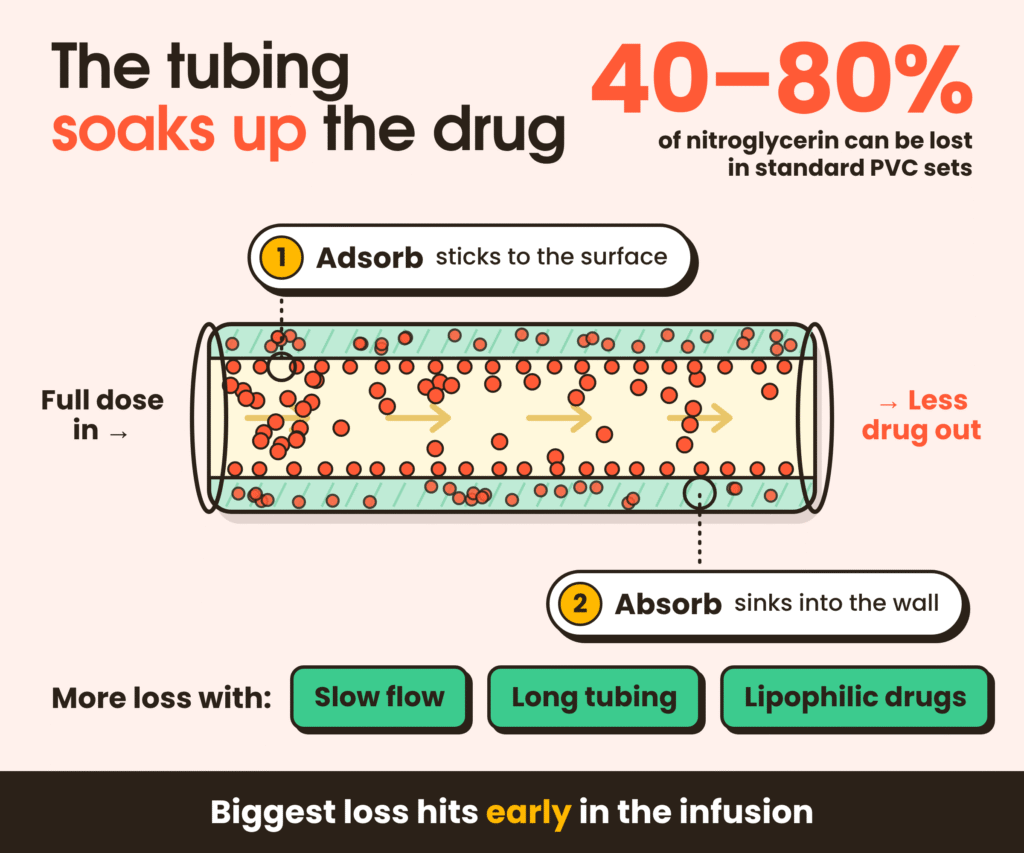
When a drug solution flows through a plasticized PVC administration line, two separate sorption processes may occur:
Adsorption: This involves the rapid initial attachment of drug molecules to the fluid-contacting polymer surface through interactions at the interface.
Absorption: Following surface adsorption, drug molecules can diffuse into the bulk polymer structure and dissolve within the plasticized polymer interior. This process is primarily driven by hydrophobic interactions between the API and the polymer matrix.
Small lipophilic molecules characterized by high octanol-water partition coefficients (log P > 1.5), including nitroglycerin (log P ≈ 1.62), diazepam (log P ≈ 2.82), amiodarone, and insulin, can demonstrate substantial depletion during administration. For example, when nitroglycerin is infused at a low flow rate through conventional Shore 80 A soft PVC tubing, the concentration of active drug delivered to the patient during the initial 30 to 60 minutes may decrease by approximately 40% to 80% relative to the nominal dose. As the inner surface of the tubing gradually approaches thermodynamic saturation and establishes equilibrium with the drug solution, the rate of additional drug loss begins to decline. Consequently, drug delivery does not remain constant throughout the infusion. This variable concentration profile can create considerable challenges when managing critical drug titration protocols that require accurate and consistent dosing.
Understanding the analytical approaches used to distinguish different organic leachables is equally important when evaluating material compatibility. Explore the differences between GC-MS and LC-MS in extractables and leachables testing to identify suitable techniques for characterizing migrating compounds.
Toxicological Profiles and Regulatory Directives for DEHP and Plasticizer Leachables from PVC
DEHP and its primary active metabolite, mono(2-ethylhexyl) phthalate (MEHP), are associated with recognized toxicological concerns, including endocrine disruption, hepatotoxicity, and reproductive toxicity. DEHP is classified under REACH as Repr. 1B, highlighting its potential reproductive hazards. Regulatory authorities across different jurisdictions are increasingly introducing restrictions and phase-out requirements for DEHP in medical devices, making comprehensive toxicological risk assessments essential for manufacturers.
Following absorption into the body, DEHP undergoes metabolic hydrolysis through esterase activity, producing MEHP and 2-ethylhexanol. MEHP can interact with peroxisome proliferator-activated receptors (PPARs) and interfere with steroidogenesis in Leydig cells. These biological interactions have been associated with anti-androgenic effects, changes in spermatogenesis, and testicular atrophy in pre-clinical models. Certain patient populations are particularly vulnerable to cumulative exposure because of their medical treatment requirements and body weight. These include neonates receiving total parenteral nutrition, pediatric patients undergoing extracorporeal membrane oxygenation (ECMO), and individuals receiving long-term hemodialysis. In some cases, their weight-normalized exposure may exceed conservative tolerable daily intake (TDI) limits.
| Regulatory Body / Jurisdiction | Regulatory Framework / Document | Specific Requirement / Limitation | Target Application / Scope |
|---|---|---|---|
| European Union (EU) | Regulation (EU) 2023/2482 / EU MDR 2017/745 | Repr. 1B classification; strict justification required for phthalates >0.1% w/w | Medical devices and IVD equipment |
| California, USA | Assembly Bill 2300 (Toxic-Free Medical Devices Act) | Absolute prohibition of intentionally added DEHP starting January 1, 2030 | Intravenous solution containers |
| Japan (PMDA) | Notification No. 1017002 | Recommended substitution of DEHP-PVC in high-risk infusion configurations | Infant/neonatal IV sets, lipid infusion tubing |
| US FDA / ISO | ISO 10993-17 / FDA Guidance | Mandatory toxicological risk evaluation and Tolerable Intake (TI) derivation | All drug-contact and blood-contact devices |
Determining whether detected leachables present an acceptable level of patient exposure requires a scientifically justified toxicological assessment. Review the principles of toxicological qualification of leachables to understand how chemical identification and exposure evaluation contribute to material safety assessments.
Alternative Plasticizers and Non-PVC Material Performance
Reducing the risks associated with plasticizer leaching and drug sorption requires either replacing DEHP with non-phthalate plasticizers or switching to inherently flexible, unplasticized non-PVC polymer materials. Selecting an appropriate material involves evaluating several performance characteristics, including mechanical flexibility (Shore hardness), transparency, autoclavability, and chemical inertness, while ensuring compatibility with the intended therapeutic formulation.
Non-Phthalate Plasticizer Alternatives (TOTM, DINCH, DOTP, DEHA)
Alternative plasticizers, including TOTM, DINCH, DOTP, and DEHA, can substantially reduce plasticizer migration and associated systemic toxicological exposure compared with DEHP while preserving the flexibility required for PVC medical devices. Mechanistic investigations indicate that certain non-phthalate alternatives can maintain important biological parameters, including platelet stability and pH balance, without compromising the functional performance of the storage system.
High-molecular-weight non-phthalate plasticizers influence migration behavior through increased steric hindrance and reduced lipid solubility. These structural characteristics can limit their movement out of the polymer matrix and into contacting fluids.
Trioctyl Trimellitate (TOTM / TEHTM): This plasticizer contains a bulky trimellitate structure and demonstrates relatively low diffusion coefficients. Its molecular characteristics can significantly reduce migration into lipophilic drug formulations and blood components, making it a suitable alternative for applications requiring improved chemical stability.
Diisononyl Cyclohexane-1,2-Dicarboxylate (DINCH): DINCH is an alicyclic ester characterized by low toxicity, good flexibility at low temperatures, and limited migration into lipid-containing systems. Meta-analyses evaluating platelet storage in DEHP-based and DINCH-based systems have reported comparable terminal storage pH values (pooled mean difference +0.025 pH units; 95% CI, -0.081 to +0.131). Similar glucose and lactate metabolic kinetics have also been observed, along with the preservation of important platelet functional markers. These findings indicate that DINCH-based systems can maintain platelet storage performance while substantially reducing cumulative exposure to plasticizer-derived compounds.
Di(2-ethylhexyl) Terephthalate (DOTP / DEHT): DOTP is a linear terephthalate isomer that offers a more favorable toxicological profile than ortho-phthalate DEHP. It also demonstrates comparatively reduced migration potential, making it a potential substitute in selected PVC medical applications.
Di(2-ethylhexyl) Adipate (DEHA): DEHA is an aliphatic plasticizer that provides favorable performance at low temperatures. However, its migration tendency can be higher than that of TOTM, particularly when used in contact with lipophilic matrices.
Fluorinated Polymers, Polyolefins, EVA, and Multilayer Co-extruded Systems
Non-PVC materials, including polyolefins (PE, PP), ethylene-vinyl acetate (EVA), and multilayer co-extruded films, can eliminate the need for conventional plasticizers while reducing the potential for drug sorption. These materials offer alternative solutions for medical devices that require improved chemical compatibility. Multilayer co-extruded tubing can incorporate an inert inner contact layer made from polyethylene or cyclic olefin polymer (COP), supported by a flexible outer layer. This configuration helps isolate the drug formulation from materials that may otherwise interact with the contacting fluid.
Polyethylene (LDPE / LLDPE / HDPE) & Polypropylene (PP): Unplasticized polyolefins contain polymer backbones that do not require the addition of conventional plasticizers. Consequently, they eliminate plasticizer leaching and generally demonstrate low drug sorption for many hydrophilic and weakly lipophilic compounds. However, monolayer LDPE has limited thermal resistance and may not withstand standard 121°C steam autoclave sterilization. Therefore, alternative sterilization approaches, such as radiation or ethylene oxide (EtO) processing, may be necessary.
Ethylene Vinyl Acetate (EVA): EVA is a flexible copolymer commonly used in Total Parenteral Nutrition (TPN) bags and other medical fluid containers. Its composition eliminates the requirement for phthalate plasticizers. Nevertheless, trace quantities of residual DEHP may occasionally be detected if recycled secondary regrind materials or contaminated processing aids are introduced during compounding.
Cyclic Olefin Polymers (COP / COC) & Advanced Resins (e.g., Zelas™ CP Series): These amorphous, fluorinated or norbornene-based copolymers are engineered to provide extremely low drug adsorption, strong thermal resistance, and excellent optical clarity. Their material properties make them useful for specialized pharmaceutical packaging and medical applications requiring high chemical compatibility.
Co-extruded Multilayer Tubing (PVC/PE or Polyolefin/TPE): These systems combine an extremely thin inner fluid-contacting layer of polyethylene (PE) or thermoplastic elastomer (TPE) with a flexible outer protective layer, such as soft PVC. By separating the drug formulation from the plasticized outer polymer matrix, this construction reduces direct API contact with the plasticizer-containing material. As a result, it provides an effective barrier against drug sorption and plasticizer migration when appropriately designed and validated.
| Polymer / Elastomer System | Plasticizer Leaching Risk | Lipophilic Drug Sorption | Thermal / Sterilization Limits | Key Clinical Application |
|---|---|---|---|---|
| Plasticized PVC (DEHP) | High to Extreme | High (Nitroglycerin, Diazepam) | Autoclavable (121°C) | Standard IV sets, blood bags |
| Plasticized PVC (TOTM / DINCH) | Low to Moderate | Moderate | Autoclavable (121°C) | Blood storage, pediatric IV |
| Polyethylene (LDPE / LLDPE) | Zero | Low to Moderate | EtO / Gamma (<115°C) | Low-sorptive IV extension lines |
| Ethylene Vinyl Acetate (EVA) | Zero (uncontaminated) | Low | Gamma / EtO (<110°C) | TPN & nutrient admixture bags |
| Multilayer Co-extruded (PE/PVC) | Zero (fluid contact) | Low | Autoclavable depending on grade | Chemotherapy & sensitive oncology sets |
Selecting an alternative polymer is only one part of the compatibility assessment. Manufacturers must also establish whether the selected material releases chemical substances under actual storage and use conditions. Explore leachables monitoring during stability studies to understand how migration profiles can be evaluated throughout a pharmaceutical product’s shelf life.
Analytical Characterization Protocols for DEHP and Plasticizer Leachables from PVC: USP , USP , and ISO 10993-18
Identifying and quantifying leachables in medical devices and pharmaceutical packaging requires standardized analytical characterization procedures established under USP , USP , and ISO 10993-18. These frameworks provide a systematic approach to evaluating chemical substances that may migrate from medical device materials into contacting pharmaceutical formulations. Establishing an Analytical Evaluation Threshold (AET) is an essential part of this process because it helps determine which migrating chemical compounds require identification, quantification, and toxicological assessment.
Extractables testing under USP involves exposing material samples to controlled but exaggerated extraction conditions. These conditions may include solvents with different polarities, extreme pH environments, and elevated temperatures to generate a comprehensive chemical profile of compounds that could potentially migrate from the material. In comparison, leachables testing under USP focuses on identifying and measuring compounds that actually migrate into pharmaceutical formulations under representative storage conditions, throughout the product shelf life, or during simulated clinical use. ISO 10993-18 incorporates chemical characterization into a broader risk management framework for medical devices.
To maintain an appropriate relationship between analytical sensitivity and patient safety, laboratories establish an Analytical Evaluation Threshold (AET) using toxicological safety limits, including the Threshold of Toxicological Concern (TTC) described in ICH M7 or ISO 10993-17. The AET establishes the reporting threshold at or above which an extractable or leachable compound must undergo further structural identification and toxicological evaluation. Its calculation can be represented as follows:
AET = (DBT / Dd) × (Vt / Ve)
Where:
- DBT represents the Dose-Based Threshold, such as 1.5 µg/day for mutagenic impurities.
- Dd refers to the maximum daily dose of the pharmaceutical product.
- Vt represents the volume of fluid contained within the container or tubing system.
- Ve refers to the experimental extraction volume.
Comprehensive analytical characterization requires the use of complementary detection techniques to identify a broad range of potential leachables with different chemical and physical properties. The principal analytical methods include:
Gas Chromatography-Mass Spectrometry (GC-MS / Headspace-GC-MS): This technique is commonly used to detect volatile and semi-volatile organic compounds. Target analytes may include unreacted monomers, residual solvents, lower-molecular-weight phthalates (e.g., DBP, DEHA), and compounds generated through thermal degradation.
Liquid Chromatography-Tandem Mass Spectrometry (LC-MS/MS or High-Resolution HRMS): These analytical techniques are particularly important for characterizing non-volatile organic leachables. They can be applied to high-molecular-weight plasticizers (e.g., TOTM), polymer oligomers, antioxidants, and complex adducts associated with surfactant-containing formulations.
Inductively Coupled Plasma-Mass Spectrometry (ICP-MS): ICP-MS is used to screen for elemental impurities, identify catalyst residues, and detect potentially harmful heavy metals in material extracts and pharmaceutical samples.
Implementing these analytical procedures requires validated methods capable of achieving sub-ppm reporting thresholds, even when testing chemically complex pharmaceutical matrices. Specialized analytical laboratories, such as ResolveMass Laboratories Inc., conduct structured Extractables and Leachables (E&L) studies using study designs aligned with applicable USP / and ISO 10993-18 requirements. These investigations support the identification of potentially harmful migrating compounds and help manufacturers establish the chemical safety of medical devices and pharmaceutical packaging for regulatory submissions.
For manufacturers requiring specialized analytical capabilities, outsourcing can provide access to advanced instrumentation, experienced analytical scientists, and established testing procedures. Discover the considerations involved in outsourcing extractables and leachables testing to support efficient study execution and regulatory documentation.
Conclusion
Moving away from conventional flexible PVC medical devices requires a coordinated approach involving material science, analytical chemistry, and regulatory compliance to reduce the risks associated with DEHP and plasticizer leachables from PVC in clinical applications. Increasingly stringent international regulations, together with the development of advanced polymer alternatives, provide a practical pathway toward improving the safety of parenteral drug delivery systems. By incorporating non-phthalate plasticizers such as TOTM and DINCH or transitioning to unplasticized polyolefins and multilayer co-extruded polymer structures, medical device manufacturers can significantly reduce plasticizer-related toxicity concerns while minimizing the potential for lipophilic drug sorption. At the same time, comprehensive chemical characterization performed under USP / and ISO 10993-18 frameworks helps ensure that alternative materials undergo appropriate chemical and toxicological risk assessments before clinical implementation. Combining suitable material selection with validated analytical testing ultimately supports patient safety, maintains pharmaceutical product quality, and improves the reliability of medical devices across global healthcare markets.
For comprehensive Extractables and Leachables (E&L) testing, material characterization, and regulatory strategy guidance, contact our analytical team at ResolveMass Contact Us.
Frequently Asked Questions
DEHP has strongly hydrophobic characteristics and extremely limited solubility in aqueous environments (<0.003 mg/L). Consequently, standard saline solutions generally extract very little DEHP from PVC materials. Lipid emulsions and surfactant-based formulations, however, provide hydrophobic environments that facilitate DEHP partitioning from the polymer matrix into the contacting fluid.
Drug sorption occurs when lipophilic active pharmaceutical ingredients migrate into the hydrophobic walls of PVC tubing instead of remaining in the administered solution. This can substantially reduce the delivered drug concentration, with initial losses reaching approximately 80% for certain drugs, including nitroglycerin. Such depletion creates inconsistent drug delivery, particularly during the early stages of infusion, potentially affecting therapeutic outcomes and dose titration.
TOTM (trioctyl trimellitate) has a larger molecular structure and higher molecular weight than DEHP, which limits its mobility within the PVC polymer matrix. Its increased steric hindrance reduces diffusion and migration into lipophilic formulations. Additionally, TOTM offers an alternative to phthalate-based plasticizers, helping reduce concerns associated with DEHP-related endocrine toxicity.
DINCH (diisononyl cyclohexane-1,2-dicarboxylate) is considered a promising non-phthalate alternative because of its favorable toxicological characteristics and relatively low migration potential. Comparative studies indicate that DINCH-based storage systems can preserve platelet metabolic activity, terminal storage pH, and functional characteristics. Meta-analyses have reported a pooled terminal pH difference of just +0.025 pH units compared with DEHP-based systems.
Non-PVC infusion bags commonly incorporate polyolefins, including polyethylene (LDPE/LLDPE) and polypropylene (PP), along with ethylene-vinyl acetate (EVA) and cyclic olefin polymers (COP/COC). These materials do not require conventional plasticizer additives to achieve their intended flexibility. Their use helps eliminate DEHP-related leaching concerns while providing suitable material properties for pharmaceutical fluid storage and administration.
Co-extruded multilayer tubing uses different polymer materials to separate the drug solution from potentially incompatible outer layers. An unplasticized inner contact layer, such as polyethylene, acts as a protective barrier, while an outer PVC or TPE layer provides the required mechanical flexibility. This arrangement limits direct contact between the drug formulation and plasticized materials, reducing the likelihood of both API sorption and plasticizer migration.
The Analytical Evaluation Threshold (AET) establishes the reporting limit above which extractable or leachable compounds must undergo appropriate identification and toxicological assessment. Its calculation considers toxicological safety limits, such as the Threshold of Toxicological Concern (TTC) in ICH M7, along with patient exposure and product dosage information. Applying the AET helps analytical laboratories prioritize potentially hazardous compounds and demonstrate that chemical characterization adequately addresses patient safety.
Comprehensive plasticizer leachable investigations generally require complementary analytical techniques to identify compounds with different chemical properties. GC-MS is primarily used to detect volatile and semi-volatile substances, including residual solvents, unreacted monomers, and certain phthalates. LC-MS/MS or high-resolution HRMS is used to characterize non-volatile compounds, including high-molecular-weight plasticizers such as TOTM, antioxidants, and their degradation products.
Several regulatory initiatives are increasing restrictions on DEHP in medical devices because of its reproductive and endocrine toxicity concerns. Important examples include the EU Medical Device Regulation (MDR 2017/745), associated with the classification and regulatory control of phthalates, and California Assembly Bill 2300, which provides for a prohibition on intentionally added DEHP in intravenous solution containers beginning January 1, 2030. These requirements are encouraging manufacturers to evaluate safer plasticizers and alternative non-PVC materials.
Reference:
- Treleano, A., Wolz, G., Brandsch, R., & Welle, F. (2009). Investigation into the sorption of nitroglycerin and diazepam into PVC tubes and alternative tube materials during application. International Journal of Pharmaceutics, 369(1–2), 30–37. https://doi.org/10.1016/j.ijpharm.2008.10.024
- Kuzmič, S., Zlobec, T., Sollner Dolenc, M., Roškar, R., & Trdan Lušin, T. (2026). Extractables and leachables in pharmaceutical products: Potential adverse effects and toxicological risk assessment. Toxics, 14(1), 92. https://doi.org/10.3390/toxics14010092
- Gotardo, M. A., & Monteiro, M. (2005). Migration of diethylhexyl phthalate from PVC bags into intravenous cyclosporine solutions. Journal of Pharmaceutical and Biomedical Analysis, 38(4), 709–713. https://doi.org/10.1016/j.jpba.2005.02.005
- Treleano, A., Wolz, G., Brandsch, R., & Welle, F. (2009). Investigation into the sorption of nitroglycerin and diazepam into PVC tubes and alternative tube materials during application. International Journal of Pharmaceutics, 369(1–2), 30–37. https://doi.org/10.1016/j.ijpharm.2008.10.024
Get In Touch With Us
About The Author