

Introduction:
Dexamethasone Injection Analytical Methods are essential to ensure the safety, quality, purity, and regulatory compliance of this widely used corticosteroid injectable. Because injectables are directly administered into the body, analytical methods must be extremely accurate, stability-indicating, and capable of detecting trace-level impurities.
Pharmaceutical companies developing generics often start with a clear development strategy for dexamethasone injection, which includes formulation, analytical testing, and regulatory planning. If you are planning development, you can explore a detailed guide on dexamethasone injection generic development.
Companies developing injectable corticosteroids must rely on robust HPLC and LC-MS analytical methods to meet regulatory expectations and avoid costly delays. This article explains the most important analytical techniques, how they are developed, and why expert laboratories play a crucial role in successful injectable development.
Share via:
Summary:
This article explains Dexamethasone Injection Analytical Methods in a clear and practical way, especially for pharmaceutical companies developing or testing injectable corticosteroids.
Key takeaways:
- HPLC is the primary technique used for routine testing of dexamethasone injection.
- LC-MS is essential for impurity identification and trace-level analysis.
- Analytical method development must follow ICH guidelines (Q2, Q3A, Q3B, Q3C).
- Stability-indicating methods are critical for regulatory submission.
- Expertise in injectable analytical methods significantly reduces regulatory risk.
- Specialized CRO laboratories like ResolveMass Laboratories Inc. provide faster and more reliable analytical solutions.
1: What Are Dexamethasone Injection Analytical Methods?
Dexamethasone Injection Analytical Methods are validated laboratory techniques used to confirm the identity, strength (assay), purity, impurities, degradation products, and stability of dexamethasone injectable formulations. These methods ensure that every batch of the injectable product is safe, effective, and compliant with global regulatory requirements such as ICH and pharmacopeial standards.
Because dexamethasone injection is a sterile dosage form administered directly into the body, the analytical methods must be highly sensitive, stability-indicating, and scientifically validated. Even small levels of impurities or degradation products must be accurately detected and controlled.
Many pharmaceutical companies therefore work with a specialized dexamethasone injectable CRO to develop and validate reliable analytical methods faster and with lower regulatory risk.
Where Are These Analytical Methods Used?
Dexamethasone Injection Analytical Methods are required throughout the entire product lifecycle:
- Raw material testing – verification of dexamethasone API quality and purity
- Formulation development – evaluation of compatibility with excipients and solvents
- Stability studies – detection of degradation under accelerated and long-term conditions
- Method validation – ensuring accuracy, precision, specificity, and robustness
- Regulatory submission – analytical data required for ANDA/CTD filing
- Commercial batch release – routine quality control testing of finished product
For example, analytical strategies may vary depending on whether the product is based on dexamethasone sodium phosphate formulation or another dexamethasone injectable form.
Without scientifically sound analytical methods, even a well-designed injectable formulation cannot meet regulatory approval requirements. Robust Dexamethasone Injection Analytical Methods (HPLC, LC-MS) are therefore one of the most critical components of successful injectable drug development.
2: Why Analytical Methods Are More Challenging for Injectables
Analytical testing for dexamethasone injection is more challenging because injectable products must meet far stricter safety, quality, and regulatory requirements than oral dosage forms. Since the drug is administered directly into the bloodstream or muscle, even very small levels of impurities or degradation products can create significant safety risks.
In addition, analytical strategy can vary depending on the type of dexamethasone ester used. If you are comparing injectable options, you can review a detailed comparison of dexamethasone phosphate vs acetate to understand how formulation differences impact analytical testing.
For this reason, Dexamethasone Injection Analytical Methods (HPLC, LC-MS) must be highly sensitive, stability-indicating, and capable of detecting impurities at extremely low levels.
Major Challenges in Analytical Testing of Dexamethasone Injection
- Extremely low impurity limits – Regulatory agencies require very tight impurity specifications for sterile injectables.
- High sensitivity to light and temperature – Dexamethasone can degrade under stress conditions, making stability-indicating methods essential.
- Container–closure compatibility – Interaction with glass vials, rubber stoppers, or packaging components can generate additional impurities.
- Sterile formulation complexity – Analytical methods must confirm quality without compromising sterility requirements.
- Detection of unknown degradation products – Advanced techniques such as LC-MS are often required to identify trace-level impurities.
Because of these challenges, robust Dexamethasone Injection Analytical Methods are not just a regulatory requirement—they are a critical part of ensuring product safety, stability, and successful approval.
3: HPLC Methods for Dexamethasone Injection
HPLC methods for Dexamethasone Injection are the primary analytical techniques used to accurately measure assay, related substances, and degradation products in injectable formulations. Because dexamethasone injection requires very tight impurity control, HPLC remains the most reliable and widely accepted method in pharmaceutical quality testing.
In modern Dexamethasone Injection Analytical Methods (HPLC, LC-MS), HPLC is mainly used for routine testing, stability studies, and regulatory submissions due to its high reproducibility and regulatory acceptance.
What Does HPLC Test in Dexamethasone Injection?
HPLC testing is used to confirm both the quality and stability of dexamethasone injection throughout product development and commercial production.
Typically, an HPLC method is developed to analyze:
- Assay of dexamethasone – accurate quantification of the active ingredient
- Related substances – identification and control of known impurities
- Degradation products – detection of impurities formed during stability studies
- Preservative content (if applicable) – especially in multi-dose injectable formulations
- Stability samples – long-term and accelerated stability testing
A stability-indicating HPLC method ensures that the API peak is clearly separated from all degradation peaks.
Typical HPLC Method Parameters for Dexamethasone Injection
Most Dexamethasone Injection Analytical Methods use reverse-phase HPLC with optimized conditions to achieve complete impurity separation.
| Parameter | Typical Condition |
|---|---|
| Column | C18 reverse-phase column |
| Mobile Phase | Water + organic solvent (acetonitrile or methanol) |
| Detection | UV detection (usually around 240 nm) |
| Flow Rate | ~1.0 mL/min (typical) |
| Run Time | 10–30 minutes depending on impurity profile |
These conditions are optimized during method development to ensure accurate detection of both the main drug and trace-level impurities.
Why a Properly Developed HPLC Method Is Important
A properly developed HPLC method ensures that dexamethasone and its impurities are completely separated without interference from excipients or degradation products. This is especially important for regulatory submissions where stability-indicating capability must be clearly demonstrated.
Well-designed Dexamethasone Injection Analytical Methods not only improve product quality but also reduce regulatory risk and development delays.
4: Why Stability-Indicating HPLC Methods Are Important
Stability-indicating HPLC methods are essential in Dexamethasone Injection Analytical Methods because they can accurately detect degradation products formed under stress conditions. Regulatory agencies require proof that the analytical method can separate the drug substance from all potential degradation products before approving an injectable formulation.
A stability-indicating method does not just measure the assay — it confirms that the method can detect real chemical degradation that may occur during storage, transportation, or long-term stability studies.
What Is Tested in Stability-Indicating HPLC Studies?
Stability-indicating testing proves that the HPLC method can identify degradation even when the drug is exposed to harsh conditions.
Regulatory authorities typically require forced degradation studies such as:
- Acid degradation – to evaluate chemical stability in acidic environments
- Base degradation – to understand degradation in alkaline conditions
- Oxidative degradation – to detect sensitivity to oxygen or oxidizing agents
- Thermal degradation – to study stability at elevated temperatures
- Photolytic degradation – to assess the impact of light exposure
These stress studies help confirm that the analytical method can detect impurities that may appear during real storage conditions.
Why This Is Critical for Dexamethasone Injection Analytical Methods
In injectable drug development, stability-indicating HPLC methods are not optional — they are a regulatory requirement. Authorities such as the US FDA, EMA, and other global agencies require clear evidence that degradation products can be detected, separated, and quantified accurately.
For this reason, stability-indicating capability is one of the most important aspects of Dexamethasone Injection Analytical Methods (HPLC, LC-MS), especially during regulatory submissions such as ANDA filings.
5: Role of LC-MS in Dexamethasone Injection Analytical Methods
LC-MS plays a critical role in Dexamethasone Injection Analytical Methods because it allows scientists to identify unknown impurities at extremely low levels that cannot be confirmed using HPLC alone. While HPLC is excellent for quantifying impurities, LC-MS provides structural information, which is essential for regulatory acceptance.
In simple terms:
- HPLC tells how much impurity is present
- LC-MS tells what the impurity actually is
This combination makes LC-MS one of the most important tools in modern analytical method development for injectable drugs.
Why LC-MS Is Essential for Dexamethasone Injection Testing
LC-MS is widely used when trace-level impurities or unknown degradation products need to be identified with high confidence. This is especially important for injectable formulations where impurity limits are extremely strict.
LC-MS is typically used for:
- Identification of unknown degradation products formed during stability studies
- Nitrosamine risk evaluation and trace-level impurity detection
- Structural confirmation of related substances
- Investigation of stability failures
- Verification of impurity pathways during forced degradation studies
Because of its high sensitivity and structural identification capability, LC-MS has become a core technique in advanced Dexamethasone Injection Analytical Methods (HPLC, LC-MS).
6: HPLC vs LC-MS: Which Is Better for Dexamethasone Injection?
Both HPLC and LC-MS are essential in Dexamethasone Injection Analytical Methods, but they are used for different purposes. HPLC is the preferred technique for routine quality testing, while LC-MS is used for advanced impurity identification and trace-level analysis.
Instead of choosing one over the other, most pharmaceutical laboratories use both techniques together to ensure complete regulatory compliance.
HPLC vs LC-MS Comparison for Dexamethasone Injection Analytical Methods
The table below clearly explains how both techniques support different stages of injectable drug development.
| Feature | HPLC | LC-MS |
|---|---|---|
| Routine testing | Yes | No |
| Assay testing | Yes | Yes |
| Impurity quantification | Yes | Yes |
| Unknown impurity identification | Limited | Excellent |
| Sensitivity | Moderate | Very high |
| Stability studies | Yes | Yes |
| Regulatory submission support | Essential | Highly recommended |
Which Technique Should Be Used?
The most effective approach is to combine both techniques in Dexamethasone Injection Analytical Methods (HPLC, LC-MS).
- Use HPLC for routine quality control, assay testing, and stability studies
- Use LC-MS for impurity identification, structural confirmation, and trace-level analysis
When both techniques are used together, pharmaceutical companies can significantly reduce analytical risk and improve the chances of first-time regulatory approval.
7: Method Development Strategy for Dexamethasone Injection
The most reliable Dexamethasone Injection Analytical Methods are developed using a systematic strategy that focuses on stability-indicating capability, accuracy, and full regulatory acceptance. A structured method development approach ensures that the analytical method performs consistently during development, validation, and regulatory submission.
Because injectable products require extremely strict impurity control, method development must be scientifically designed rather than trial-and-error.
Step-by-Step Method Development for Dexamethasone Injection Analytical Methods
A well-designed method development workflow ensures accurate impurity separation and regulatory-ready analytical performance.
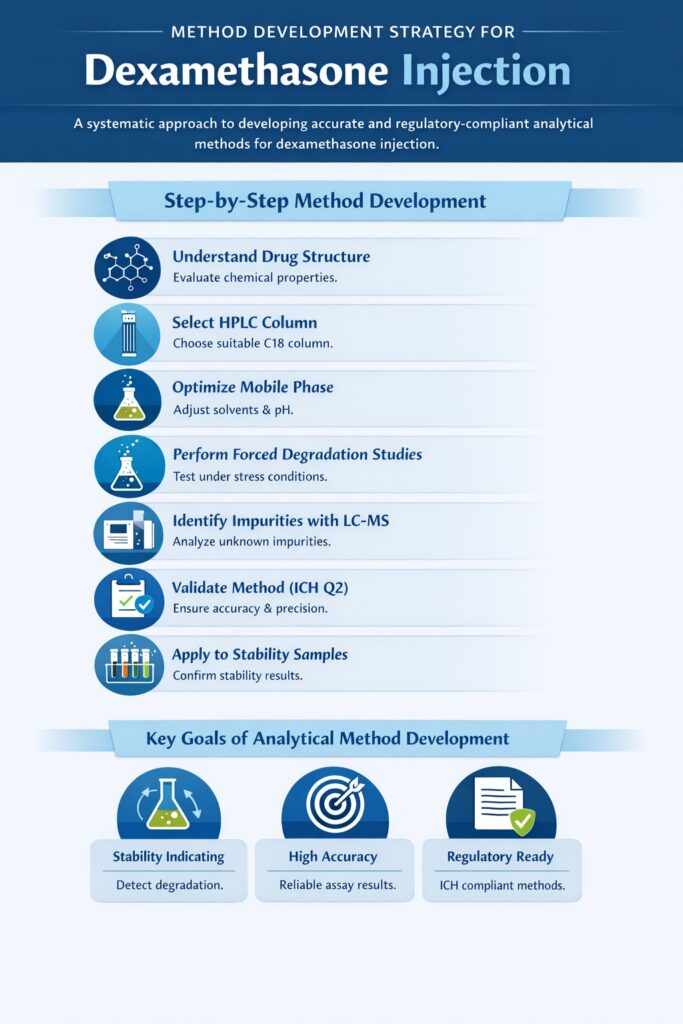
The typical step-by-step approach includes:
- Understanding the drug structure – evaluating the chemical properties and degradation behavior of dexamethasone
- Selecting the correct HPLC column – usually a reverse-phase C18 column based on polarity and separation requirements
- Optimizing the mobile phase – adjusting pH, solvent composition, and gradient conditions for better peak separation
- Performing forced degradation studies – confirming that the method can detect degradation products under stress conditions
- Identifying impurities using LC-MS – structural confirmation of unknown peaks and trace-level impurities
- Validating the method according to ICH Q2 guidelines – ensuring accuracy, precision, linearity, specificity, and robustness
- Applying the method to stability samples – verifying real-time performance during long-term and accelerated stability studies
Why a Structured Method Development Approach Is Important
A systematic strategy ensures that Dexamethasone Injection Analytical Methods are not only scientifically strong but also regulatory-ready. This significantly reduces the risk of method failure during validation or regulatory review.
When analytical methods are developed correctly from the beginning, pharmaceutical companies can save both time and development costs while improving the chances of first-time regulatory approval.
8: Method Validation Requirements for Dexamethasone Injection Analytical Methods
Method validation in Dexamethasone Injection Analytical Methods confirms that the analytical method consistently produces accurate, precise, and reliable results. Regulatory authorities require validated methods before accepting analytical data for injectable drug submissions, especially because impurity limits for injectables are extremely strict.
A properly validated method ensures that assay results, impurity levels, and stability data are scientifically reliable and regulatory-compliant.
What Must Be Validated in Dexamethasone Injection Analytical Methods?
Regulatory guidelines such as ICH Q2 require several critical validation parameters to be demonstrated before the method can be used for regulatory submissions or commercial testing.
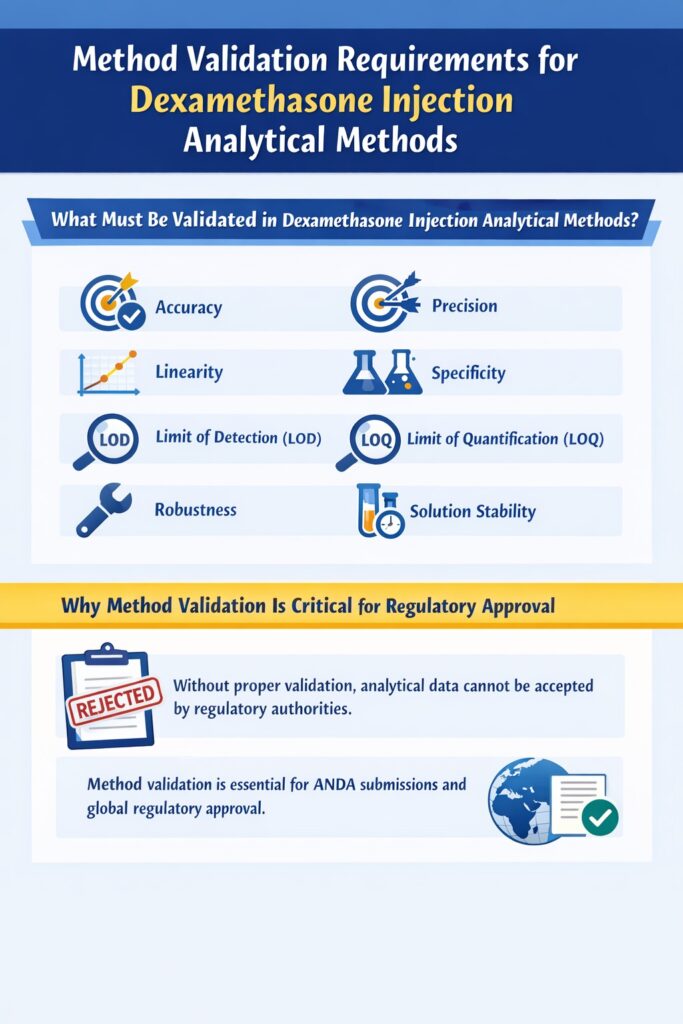
The key validation parameters include:
- Accuracy – ability of the method to produce results close to the true value
- Precision – consistency of results when the method is repeated multiple times
- Linearity – ability of the method to provide proportional results across different concentrations
- Specificity – ability to separate dexamethasone from impurities and degradation products
- Limit of Detection (LOD) – the lowest level at which an impurity can be detected
- Limit of Quantification (LOQ) – the lowest level at which an impurity can be accurately quantified
- Robustness – method reliability under small variations in analytical conditions
- Stability of analytical solution – confirmation that the sample remains stable during testing
Why Method Validation Is Critical for Regulatory Approval
Without proper validation, analytical data cannot be accepted by regulatory authorities. This means even a well-developed injectable formulation may fail regulatory review if the analytical method is not scientifically validated.
For this reason, method validation is one of the most important steps in Dexamethasone Injection Analytical Methods (HPLC, LC-MS) and plays a major role in successful ANDA submissions and global regulatory approvals.
9: Common Challenges in Dexamethasone Injection Analytical Methods
Many pharmaceutical companies face significant technical challenges when developing Dexamethasone Injection Analytical Methods, especially because injectable corticosteroids require extremely strict impurity control and stability performance. Even small analytical issues can lead to method failure during validation or delays in regulatory submission.
Because dexamethasone injection must meet tight regulatory specifications, analytical methods must be both highly sensitive and stability-indicating.
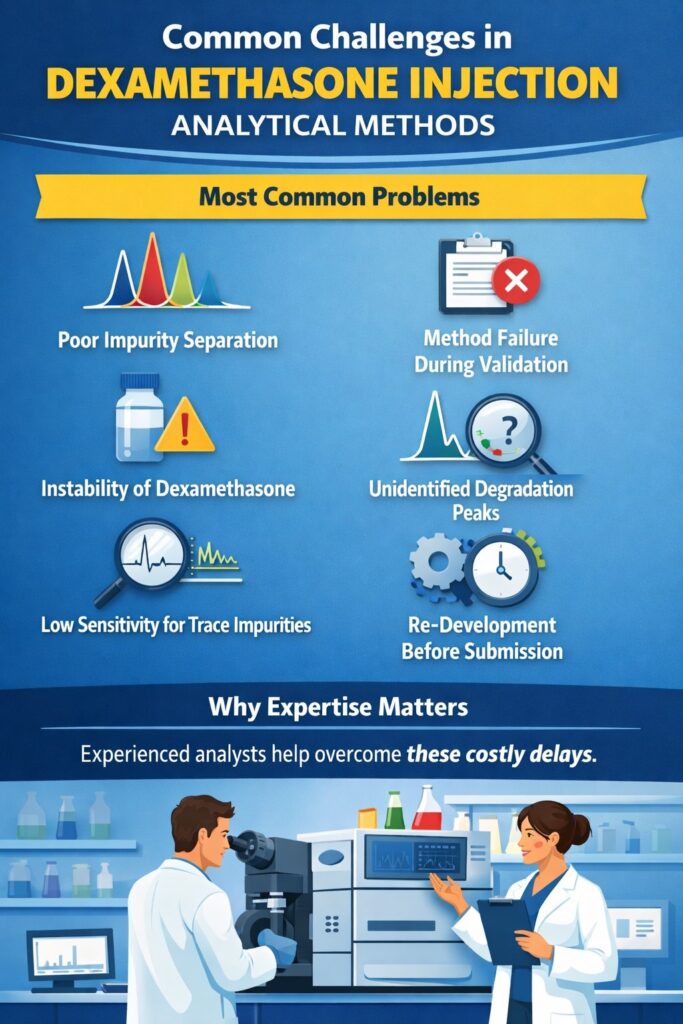
Most Common Problems in Dexamethasone Injection Analytical Methods
The following challenges are frequently observed during analytical method development and validation for injectable corticosteroids.
- Poor impurity separation – overlapping peaks can make impurity quantification inaccurate
- Instability of dexamethasone during testing – degradation may occur during sample preparation or analysis
- Low sensitivity for trace impurities – especially at regulatory threshold levels
- Method failure during validation – issues with precision, accuracy, or robustness
- Unidentified degradation peaks – unknown impurities that require LC-MS investigation
- Re-development required before regulatory submission – causing delays and additional costs
Why Expertise Matters in Solving These Challenges
Working with experienced analytical experts significantly reduces the risk of method failure and regulatory rejection. Specialized laboratories understand how dexamethasone behaves under stress conditions and how to design stability-indicating methods that meet regulatory expectations.
Strong Dexamethasone Injection Analytical Methods (HPLC, LC-MS) not only improve product quality but also help pharmaceutical companies avoid costly development delays and re-validation work.
10: Why Expertise Matters in Analytical Method Development
The success of Dexamethasone Injection Analytical Methods depends far more on scientific experience and regulatory expertise than on analytical instruments alone. Even advanced equipment such as HPLC and LC-MS cannot deliver reliable results without the right method development strategy and deep understanding of drug behavior.
For injectable corticosteroids like dexamethasone, expertise plays a critical role in ensuring stability-indicating performance and regulatory acceptance.
What an Experienced Analytical Laboratory Understands
Experienced laboratories develop Dexamethasone Injection Analytical Methods faster and with fewer validation failures because they understand the full analytical lifecycle.
An expert analytical team knows:
- How dexamethasone degrades under stress conditions and how to detect those degradation pathways
- How to identify unknown impurities using advanced LC-MS techniques
- How to optimize chromatographic separation without compromising sensitivity
- How to design stability-indicating methods that meet ICH expectations
- How to prepare regulatory-ready analytical documentation for submissions such as ANDA
How Expertise Improves Regulatory Success
Strong analytical expertise significantly increases the chances of first-time regulatory approval. When analytical methods are developed correctly from the beginning, companies can avoid method re-development, validation failures, and regulatory queries.
This is why experienced laboratories play a crucial role in successful Dexamethasone Injection Analytical Methods (HPLC, LC-MS) and in reducing both development time and regulatory risk.
11: How Specialized CRO Laboratories Help
Specialized CRO laboratories play a critical role in developing reliable Dexamethasone Injection Analytical Methods because they combine scientific expertise, advanced analytical instruments, and regulatory experience. For pharmaceutical companies working on injectable products, outsourcing analytical development to a specialized CRO often leads to faster and more reliable results.
Because injectable corticosteroids require strict impurity control and stability-indicating methods, experienced CRO laboratories can significantly reduce analytical risk.
Key Benefits of Working With a Specialized CRO Laboratory
Specialized CRO partners help pharmaceutical companies develop Dexamethasone Injection Analytical Methods faster and with better regulatory confidence.
The major benefits include:
- Faster method development timelines due to prior experience with injectable products
- Advanced LC-MS capability for identification of unknown impurities and degradation products
- Strong expertise in injectable formulations and stability-indicating method design
- Reduced risk of method failure during validation
- Better impurity profiling and structural confirmation
- Regulatory-ready analytical documentation
- Cost-effective analytical support compared to in-house development
Why This Is Important for Generic Injectable Development
For companies developing generic dexamethasone injections, working with a specialized CRO can significantly improve the chances of successful regulatory submission. Analytical methods developed by experienced laboratories are more likely to meet ICH requirements and pass regulatory review without major rework.
This is why specialized CRO laboratories are increasingly becoming a key partner in modern Dexamethasone Injection Analytical Methods (HPLC, LC-MS), especially for companies working under strict development timelines.
12: Future Trends in Dexamethasone Injection Analytical Methods
Future trends in Dexamethasone Injection Analytical Methods are focused on faster analysis, higher sensitivity, and smarter impurity identification. Modern pharmaceutical development requires analytical techniques that not only meet regulatory requirements but also reduce development timelines without compromising data quality.
As injectable drug development becomes more complex, advanced analytical technologies are playing an increasingly important role.
Emerging Trends in Dexamethasone Injection Analytical Methods
Several modern technologies are transforming how analytical methods are developed and validated for injectable corticosteroids.
The most important emerging trends include:
- Ultra-high-performance liquid chromatography (UHPLC) – faster run times with improved impurity separation
- High-resolution mass spectrometry (HRMS) – highly accurate identification of unknown degradation products
- AI-based impurity prediction tools – early identification of potential degradation pathways
- Faster stability testing strategies – improved methods for accelerated stability studies
- Advanced degradation pathway analysis – better understanding of how dexamethasone degrades under stress conditions
Why These Trends Matter for Pharmaceutical Companies
These innovations are helping pharmaceutical companies develop Dexamethasone Injection Analytical Methods faster while maintaining high analytical accuracy and regulatory compliance. Faster method development means shorter development timelines, reduced costs, and a higher probability of first-time regulatory approval.
As analytical science continues to evolve, companies that adopt modern analytical technologies will have a significant advantage in injectable drug development.
Conclusion:
Dexamethasone Injection Analytical Methods (HPLC, LC-MS) play a critical role in ensuring product safety, stability, and regulatory compliance. Without stability-indicating HPLC methods and advanced LC-MS impurity identification, pharmaceutical companies risk delays, regulatory rejection, and product instability issues.
A well-developed analytical method not only ensures regulatory approval but also improves product quality, stability confidence, and long-term commercial success.
Frequently Asked Questions:
Dexamethasone Injection Analytical Methods are validated laboratory techniques used to test identity, assay, impurities, degradation products, and stability of dexamethasone injectable formulations. These methods ensure the product meets regulatory and quality standards.
HPLC is the most commonly used analytical technique for dexamethasone injection because it provides accurate and reproducible results for assay and impurity testing. LC-MS is also used for advanced impurity identification.
LC-MS is used to identify unknown impurities and degradation products at very low levels. It provides structural information that cannot be confirmed using HPLC alone, making it essential for regulatory-compliant impurity profiling.
A stability-indicating analytical method is a method that can accurately detect degradation products formed when the drug is exposed to stress conditions such as heat, light, oxidation, acid, or base. These methods are required for regulatory approval.
Analytical methods for injectable drugs are more challenging because impurity limits are extremely strict and the drug is administered directly into the body. Even small levels of degradation products must be accurately detected and controlled.
Method validation typically includes accuracy, precision, linearity, specificity, limit of detection (LOD), limit of quantification (LOQ), robustness, and stability of the analytical solution according to ICH guidelines.
Reference
- Yuan Y, Zhou X, Li J, Ye S, Ji X, Li L, Zhou T, Lu W. Development and validation of a highly sensitive LC‐MS/MS method for the determination of dexamethasone in nude mice plasma and its application to a pharmacokinetic study. Biomedical Chromatography. 2015 Apr;29(4):578-83.https://analyticalsciencejournals.onlinelibrary.wiley.com/doi/abs/10.1002/bmc.3316
- Chen Q, Zielinski D, Chen J, Koski A, Werst D, Nowak S. A validated, stability-indicating HPLC method for the determination of dexamethasone related substances on dexamethasone-coated drug-eluting stents. Journal of pharmaceutical and biomedical analysis. 2008 Nov 4;48(3):732-8.https://www.sciencedirect.com/science/article/pii/S0731708508003853
- Gao L, Chiou WJ, Camp HS, Burns DJ, Cheng X. Quantitative measurements of corticosteroids in ex vivo samples using on-line SPE-LC/MS/MS. Journal of Chromatography B. 2009 Jan 15;877(3):303-10.https://www.sciencedirect.com/science/article/pii/S1570023208009318
- Park SJ, Kim YJ, Pyo HS, Park J. Analysis of corticosteroids in urine by HPLC and thermospray LC/MS. Journal of analytical toxicology. 1990 Mar 1;14(2):102-8.https://academic.oup.com/jat/article-abstract/14/2/102/741137
- Li L, Ma P, Wei J, Qian K, Tao L. LC-ESI-MS method for the determination of dexamethasone acetate in skin of nude mouse. Journal of Chromatography B. 2013 Aug 15;933:44-9.https://www.sciencedirect.com/science/article/pii/S1570023213003383
About the Author


