
Introduction:
Drug Product Nitrosamine Testing is the analysis of the finished dosage form (tablet, capsule, injection, inhaler, patch or other) for N-nitrosamine impurities, and it is a regulatory expectation in addition to, not a replacement for, drug substance testing. Many sponsors still ask whether a clean API result is enough. It is not, and the reason sits in the chemistry of the finished product.
Nitrosamines are probable human carcinogens that form when a secondary or tertiary amine meets a nitrosating agent, usually nitrite under acidic conditions. Since the first sartan recalls in 2018, global regulators have found nitrosamines in many product classes, and expectations have moved from the API to the whole product life cycle.
This article explains when drug product testing is required, what regulators expect, and how a defensible testing strategy is built. It is written by the analytical team at ResolveMass Laboratories Inc., a Canadian analytical CRO/CDMO that works daily with mass spectrometry, nitrosamine analysis and complex drug product characterization.
Summary:
- Short answer: No. Testing the drug substance alone is not enough; regulators expect a risk assessment and, where risk exists, confirmatory testing of the finished drug product.
- Nitrosamines can form during formulation, manufacturing, storage or from packaging, even when the active pharmaceutical ingredient (API) tests clean.
- Nitrosamine drug substance-related impurities (NDSRIs) can form only in the finished dosage form, when the API reacts with trace nitrites from excipients.
- Drug product nitrosamine testing needs validated, high-sensitivity LC-MS/MS, LC-HRMS or GC-MS/MS methods, with quantitation limits at or below the applicable acceptable intake (AI) limit.
- The regulatory process has three steps: risk assessment, confirmatory testing, and reporting with mitigation.
- Stability samples and packaging must be considered, because nitrosamine levels can rise over shelf life.
1: Is Drug Substance Testing Enough, or Is Drug Product Nitrosamine Testing Also Required?
Drug substance testing is not enough: drug product nitrosamine testing is also required wherever the risk assessment shows a plausible route for nitrosamine formation or contamination in the finished product. A clean API only proves the starting material was clean on the day it was tested. It says nothing about what happens when that API is blended with excipients, processed, packaged and stored.
The two tests answer different questions, as the table shows.
| Aspect | Drug substance (API) testing | Drug product testing |
|---|---|---|
| Question answered | Is the API free of nitrosamines from synthesis, solvents, reagents and storage? | Is the finished dosage form free of nitrosamines after formulation, processing, packaging and shelf life? |
| Typical sources covered | Synthesis route, amine-containing reagents, nitrosating agents, recovered solvents | Excipient nitrite, API-excipient reaction, process conditions, packaging, degradation |
| Can it detect NDSRIs formed in the dosage form? | No, if the NDSRI forms only after formulation | Yes |
| Sample type | API lots | Finished product batches, including stability samples where relevant |
| Regulatory expectation | Part of the risk assessment and control strategy | Confirmatory testing when risk is identified or cannot be excluded |
In practice, a robust control strategy uses both: API testing and supplier controls upstream, and drug product testing downstream where the risk assessment calls for it.
What API-only testing does and does not establish
API testing gives reliable information about:
- Nitrosamines already present in the active ingredient
- Contamination from starting materials and intermediates
- Formation during API synthesis and purification
- Carryover from solvents, reagents and recovered materials
- Batch-to-batch variability in the API impurity profile
It does not evaluate:
- Nitrite introduced by excipients
- Formation during granulation, compression or coating
- Chemical interactions between formulation ingredients
- Changes during accelerated and long-term stability studies
- Contributions from packaging materials
For this reason, API results are one input to a broader risk assessment, not the final confirmation of finished product quality. Sponsors who source APIs externally can strengthen that first layer with nitrosamine risk assessment services for API suppliers.
Consider a hypothetical tablet with an amine-containing API and an excipient with trace nitrite. The API passes testing because no impurity is detected in the drug substance, yet the nitrosamine can still develop during formulation or storage. A compliant API result does not automatically establish a compliant finished drug product.
2: Why Drug Product Nitrosamine Testing Is Necessary: How Nitrosamines Form in Finished Products
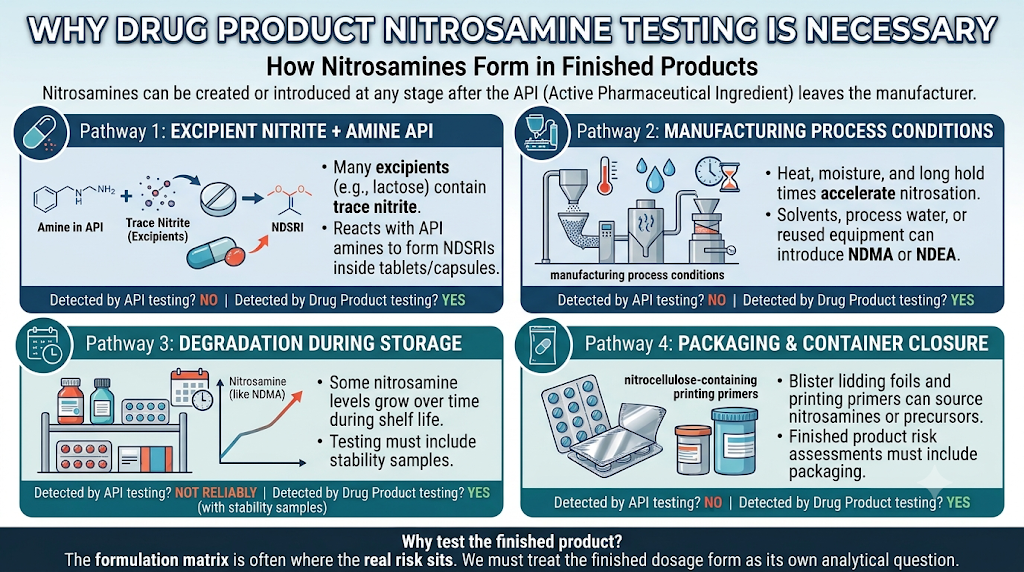
Drug product nitrosamine testing is necessary because nitrosamines can be created, or introduced, at any stage after the API leaves its manufacturer. Four pathways explain most findings, and our guide to nitrosamine formation risk in drug products covers them in more depth.
1. Excipient nitrite reacting with the API
Many common excipients, including microcrystalline cellulose, lactose and povidone, can carry trace nitrite as a by-product of their own manufacture. If the API contains a secondary or tertiary amine, that nitrite can convert it to an NDSRI inside the tablet or capsule, especially in acidic, moist or warm conditions. This reaction cannot be seen in API testing because the NDSRI does not exist until the product is formulated. Nitrite quantification in pharmaceutical excipients lets sponsors measure that precursor directly.
2. Manufacturing process conditions
Heat, moisture, acidic microenvironments and long hold times can all accelerate nitrosation. Operations such as wet granulation, drying, compression, film coating, solution preparation and sterilization each change the chemical environment. Recovered solvents, process water, reused equipment and cross-contamination between lines can also introduce small-molecule nitrosamines such as NDMA or NDEA.
3. Degradation during storage
Some nitrosamine levels grow with time. NDMA in ranitidine products rose during storage in documented cases, which is why drug product nitrosamine testing often includes stability samples and not only release batches.
4. Packaging and container closure
Certain packaging components, such as nitrocellulose-containing printing primers on blister lidding foils, have been reported as sources of nitrosamine contamination. Packaging therefore belongs in the risk assessment of every finished product.
| Pathway | Detected by API testing? | Detected by drug product testing? |
|---|---|---|
| Synthesis-related nitrosamine in API | Yes | Yes |
| Excipient nitrite + amine API (NDSRI) | No | Yes |
| Process-induced formation | No | Yes |
| Degradation over shelf life | Not reliably | Yes, with stability samples |
| Packaging-derived contamination | No | Yes |
In our laboratory experience with nitrosamine investigations, the formulation matrix is often where the real risk sits. That is why we treat the finished dosage form as its own analytical question rather than an extension of API results.
3: What Do FDA, Health Canada and EMA Expect for Drug Product Nitrosamine Testing?
FDA, Health Canada and EMA all expect a three-step approach: assess the risk, run confirmatory testing on the finished product where risk exists, and report and mitigate. None of them accepts API results alone as proof that a drug product is free of nitrosamines.
FDA
FDA’s guidance on controlling nitrosamine impurities in human drugs was revised in September 2024 and now covers both small-molecule nitrosamines and NDSRIs. It recommended that confirmatory testing of drug products be concluded, and required changes submitted, by August 1, 2025, according to FDA’s own presentation on the guidance. In June 2025 FDA allowed progress reports for mitigation that could not be completed by that date, as summarized by The FDA Law Blog. FDA’s NDSRI guidance also assigns recommended AI limits using a carcinogenic potency categorization approach, ranging from 26.5 ng/day to 1,500 ng/day, as outlined by ProPharma Group.
Health Canada
Health Canada’s Guidance on nitrosamine impurities in medications uses the same three steps: risk assessment, confirmatory testing and changes to the market authorization. It recommends:
- Assessing all drug product components as possible sources of nitrosamines or their precursors
- Confirmatory testing of the drug product, using validated methods, when a risk is identified
- Testing the API as well when the risk assessment points to it as a source
- Documenting the rationale for the chosen control strategy
The guidance also covers LOQ validation, routine testing in specifications and the number of batches to test, and it recognizes a scientifically justified worst-case strength approach for multiple strengths on a case-by-case basis. Reporting expectations have changed: according to a summary of the May 2026 update, marketing authorization holders now notify Health Canada only when a recall is decided, not every time an elevated level is found.
EMA and ICH M7
EMA’s guidance for marketing authorisation holders follows a three-step call for review: risk evaluation, confirmatory testing and updating the marketing authorisation. If a risk is identified for an active substance, EMA expects confirmatory testing of the finished product. CHMP agreed an updated Q&A document in November 2026, aligned with CMDh, with changes that include:
- Higher AI limits for eligible medicines treated for less than 10 years, through full application of the less-than-lifetime approach in ICH M7 (Q&A 24)
- Updated limits for nitrosamines originating from excipients (Q&A 10)
- A new risk factor for parenteral products packaged in polymer bags (Q&A 4)
- A longer CPCA implementation period, from 3 to 7 years under certain conditions (Q&A 22)
- Applying the AI approach to other N-nitroso compounds (Q&A 23)
These updates reinforce that the complete drug product must be evaluated, not only the API. Across regions, acceptable intakes are anchored in ICH M7(R2), which targets an excess lifetime cancer risk of no more than 1 in 100,000.
| Authority | Key expectation for the finished product |
|---|---|
| FDA | Confirmatory testing for at-risk products, including NDSRIs; AI-based limits; changes reported to the application |
| Health Canada | Confirmatory testing of the drug product when a risk is identified; API testing if the API is a possible source |
| EMA | Risk evaluation, confirmatory testing and variations where nitrosamines are found |
| ICH M7(R2) | Risk-based limits for mutagenic impurities, including the nitrosamine cohort of concern |
Because timelines and limits are revised regularly, sponsors should always confirm the current text of each guidance before finalizing a testing plan.
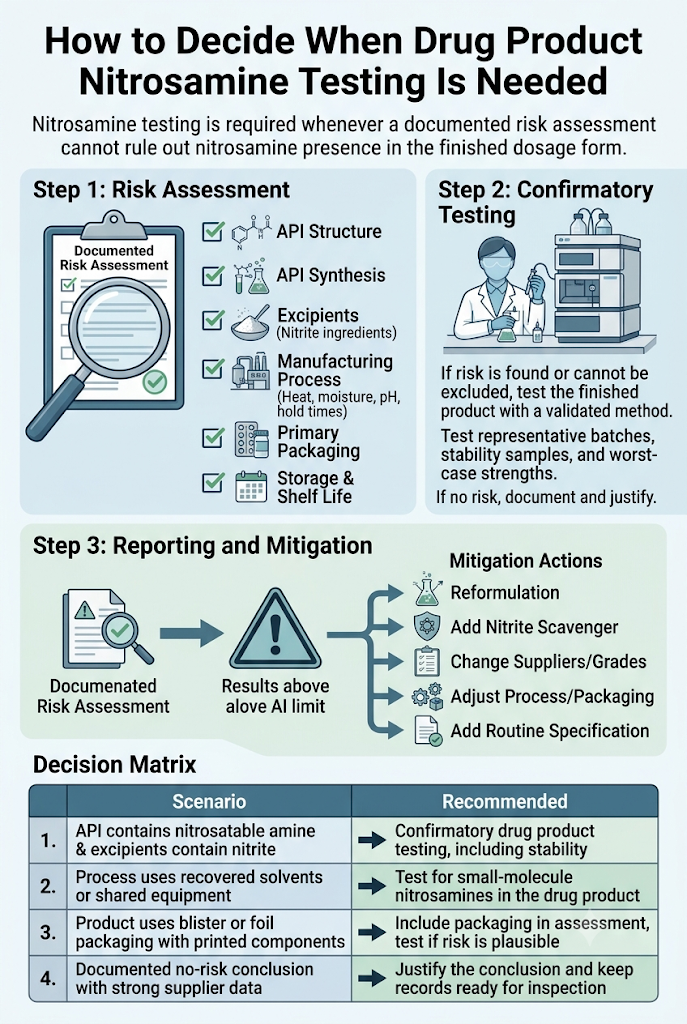
4: How to Decide When Drug Product Nitrosamine Testing Is Needed
Drug product nitrosamine testing is needed whenever a documented risk assessment cannot rule out nitrosamine presence in the finished dosage form. The risk assessment comes first, and it should cover the whole supply chain, not just the final formulation.
Step 1: Risk assessment
A defensible assessment reviews each of these areas and documents the conclusion:
- The API structure, looking for secondary, tertiary or other nitrosatable amines
- The API synthesis route, reagents, solvents and supplier controls
- Excipients, including their nitrite content and supplier data
- The manufacturing process, including heat, moisture, pH and hold times
- Primary packaging and container closure materials
- Storage conditions and shelf life
Step 2: Confirmatory testing
If the assessment finds a risk, or cannot exclude one, the finished product is tested with a validated method. Good practice is to test representative batches, include stability samples when degradation is plausible, and select the worst-case strengths and formulations. Where no risk is identified, regulators still expect the conclusion to be documented and scientifically justified.
Step 3: Reporting and mitigation
Results above the applicable AI limit must be investigated and handled under your quality system, and reported as each regulator requires, since reporting expectations differ by region and change over time. Mitigation may include reformulation, adding a nitrite scavenger such as an antioxidant, optimizing formulation pH, changing excipient suppliers or grades, improving raw material specifications, adjusting the process, improving packaging and storage controls, or adding a routine specification.
| Situation | Recommended action |
|---|---|
| API contains a nitrosatable amine and excipients contain nitrite | Confirmatory drug product testing, including stability |
| Process uses recovered solvents or shared equipment | Test for small-molecule nitrosamines in the drug product |
| Product uses blister or foil packaging with printed components | Include packaging in the assessment and test if risk is plausible |
| Documented no-risk conclusion with strong supplier data | Justify the conclusion and keep records ready for inspection |
Which batches should be selected for confirmatory testing?
Batch selection should be scientifically justified and representative of the identified risk. Manufacturers should consider:
- Different API manufacturing batches
- Variations in excipient suppliers and material grades
- Different manufacturing sites
- Formulation strengths
- Process parameter variations
- Batches representing worst-case manufacturing or storage conditions
For multiple strengths of the same dosage form with comparable risk factors, a justified worst-case strength approach may be appropriate. Health Canada recognizes this on a case-by-case basis. Our overview of confirmatory testing batch requirements explains how to build a defensible batch plan.
Should stability samples also be tested?
Yes, when the risk assessment indicates that nitrosamines may form during storage. Elevated temperature, humidity, pH changes and prolonged storage can all influence reaction kinetics. A suitable stability program may include:
- Initial nitrosamine levels
- Accelerated and long-term stability samples
- Samples from different manufacturing batches
- Changes in concentration over time
Testing intervals should be justified by the formulation, the likely reaction pathways and the product shelf life.
5: Which Analytical Methods Are Used for Drug Product Nitrosamine Testing?
Drug product nitrosamine testing is performed with mass spectrometry, most often LC-MS/MS, LC-HRMS or GC-MS/MS, using methods validated for the specific product matrix. Trace-level work at nanogram-per-day limits does not tolerate generic methods.
| Technique | Best suited for | Key strength |
|---|---|---|
| LC-MS/MS (triple quadrupole) | Targeted quantitation of known nitrosamines and many NDSRIs | High sensitivity and selectivity |
| LC-HRMS (Orbitrap or Q-TOF) | Identification and confirmation of NDSRIs and unknowns | Accurate mass, structural confidence |
| GC-MS/MS or GC-HRMS | Volatile, small-molecule nitrosamines such as NDMA and NDEA | Excellent for volatile analytes |
Why drug product methods are harder than API methods
- Matrix interference: Excipients, coatings and the API itself at high concentration can suppress or mimic the signal.
- Artifactual formation: Nitrosamines can form during sample preparation if nitrite and amines are both present. Methods need controls, such as nitrite scavengers, to prevent false positives.
- Very low limits: The method must reach a limit of quantitation low enough to measure at or below the AI-based limit for the maximum daily dose.
- NDSRI standards: Reference standards for product-specific NDSRIs often do not exist commercially and may need custom synthesis and characterization.
- Different dosage forms: Tablets, injectables, inhalation products and transdermal systems each need their own extraction approach.
What a defensible method includes
- Specificity against the matrix and the API, with chromatographic separation of the API peak from the impurity
- Validation of accuracy, precision, linearity, range, LOD and LOQ in line with ICH Q2(R2) principles
- Controls against in-situ nitrosamine formation during sample preparation
- Documented data integrity, full traceability and audit-ready reporting
A method developed for API testing should not be transferred to the finished product without checking its suitability. Validation should cover specificity and selectivity, accuracy and recovery, precision and repeatability, linearity and range, LOD, LOQ, robustness, matrix effects and solution stability. Headspace GC-MS/MS may also suit certain volatile nitrosamines, depending on the analyte and formulation.
This is the area where specialist mass spectrometry experience matters most. At ResolveMass Laboratories Inc., nitrosamine analysis sits alongside our work in biosimilar characterization, PLGA-based drug delivery and other complex analytical programs, so method development is handled by scientists used to difficult matrices. For peptide products, see our page on nitrosamine testing for peptide and GLP-1 products.
6: Common Mistakes in Drug Product Nitrosamine Testing
The most common mistake is treating a clean API certificate as proof that the finished product is clean. Others we see repeatedly:
- Relying on supplier statements without reviewing excipient nitrite data
- Skipping packaging in the risk assessment
- Using a method whose LOQ is too high for the maximum daily dose
- Not controlling for nitrosamine formation during sample preparation
- Testing only release batches when degradation over shelf life is plausible
- Documenting a no-risk conclusion without scientific justification
Conclusion:
Testing the drug substance is necessary but not sufficient. Drug product nitrosamine testing closes the gap by checking the finished dosage form for impurities formed through excipients, processing, storage and packaging, which API testing cannot see. A strong program starts with a documented risk assessment, uses sensitive and well-validated mass spectrometry methods, and keeps records ready for regulatory review.
Frequently Asked Questions:
Yes. Nitrosamines can form when susceptible amine-containing compounds interact with nitrosating agents, such as nitrite impurities, under favorable chemical conditions.
The FDA recommends a risk-based approach. When a potential nitrosamine risk is identified, manufacturers should perform confirmatory testing using sensitive and appropriately validated analytical methods.
Excipients such as microcrystalline cellulose, lactose, and povidone may contain trace nitrite impurities. Their actual contribution depends on supplier, grade, batch, and formulation conditions.
NDSRIs are nitrosamine impurities that share structural similarity with the active pharmaceutical ingredient. They may form through chemical reactions involving the API or related compounds.
Yes. Nitrosamine concentrations may increase during storage if the formulation contains suitable precursors and environmental conditions favor nitrosation reactions. Stability studies can help evaluate this risk.
Reference
- Dirat O, Urquhart MW, Akehurst H, Burns MJ, Dobo KL, Harvey J, Kuhl N, Schlingemann J, Tomlin P, Wetter C. Drug substance and drug product workflows for quality risk management for the presence of nitrosamines in medicines. Organic Process Research & Development. 2025 May 23;29(6):1538-53.https://pubs.acs.org/doi/abs/10.1021/acs.oprd.5c00097
- Bhirud D, Agrawal G, Shah H, Patel A, Palkar MB, Bhattacharya S, Prajapati BG. Nitrosamine impurities in pharmaceuticals: An empirical review of their detection, mechanisms, and regulatory approaches. Current Topics in Medicinal Chemistry. 2024 Mar 1;24(6):503-22.https://www.benthamdirect.com/content/journals/ctmc/10.2174/0115680266278636240125113509
- Dobo KL, Kenyon MO, Dirat O, Engel M, Fleetwood A, Martin M, Mattano S, Musso A, McWilliams JC, Papanikolaou A, Parris P. Practical and Science-Based Strategy for Establishing Acceptable Intakes for Drug Product N‑Nitrosamine Impurities. Chemical research in toxicology. 2022 Mar 21;35(3):475-89.https://pubs.acs.org/crtoec/article/35/3/475/494593
- Shaikh T. Nitrosamine impurities in drug substances and drug products.https://papers.ssrn.com/sol3/papers.cfm?abstract_id=3958595
- Cioc RC, Joyce C, Mayr M, Bream RN. Formation of N-nitrosamine drug substance related impurities in medicines: a regulatory perspective on risk factors and mitigation strategies. Organic Process Research & Development. 2023 Jul 21;27(10):1736-50.https://pubs.acs.org/doi/abs/10.1021/acs.oprd.3c00153
- Tarafder A, Vega E, Beck HP, Mundal D, Tilala M, Wang S. Nitrosamine control: from risk assessment to analytical testing with emphasis on sample preparation and phase-appropriate method validation. Organic Process Research & Development. 2025 Nov 7;29(11):2602-24.https://pubs.acs.org/doi/abs/10.1021/acs.oprd.5c00158
About the Author