

Introduction:
Error Types in E&L Data Analysis are one of the biggest hidden risks in extractables and leachables screening. Even when advanced instruments are used, omission and misidentification errors can still occur if data interpretation is not handled correctly.
For pharmaceutical, medical device, and packaging companies, even a single incorrect identification can impact regulatory submissions, risk assessments, and product timelines. That is why understanding Error Types in E&L Data Analysis is critical not only for scientists but also for regulatory and quality teams.
Share via:
Summary:
- Error Types in E&L Data Analysis mainly include omission errors and misidentification errors, both of which can directly affect regulatory submissions.
- Omission errors happen when a compound is present but not reported.
- Misidentification errors occur when a compound is detected but wrongly assigned.
- These errors can delay product approvals, increase costs, and reduce confidence in analytical results.
- Laboratories like ResolveMass Laboratories Inc. prevent such errors through validated workflows, advanced mass spectrometry, and expert review.
- The article explains causes, prevention strategies, real-world risks, and best practices to improve data reliability.
1: What Are Error Types in E&L Data Analysis?
Error Types in E&L Data Analysis refer to mistakes that occur during interpretation and identification of analytical results rather than during the experimental testing itself. Even when advanced techniques such as LC-MS or GC-MS are used, errors can still occur if the data is not correctly interpreted.
In most extractables and leachables (E&L) studies, these errors fall into two primary categories:
1. Omission Errors
An omission error occurs when a compound is present in the sample but is not reported in the final analytical results. This usually happens due to low signal intensity, overlapping peaks, or automated software missing borderline compounds.
2. Misidentification Errors
A misidentification error occurs when a compound is detected but assigned the wrong chemical identity. This can happen when library matches are similar, fragmentation patterns are misinterpreted, or confirmation techniques are not applied.
Both omission and misidentification errors can significantly impact toxicological risk assessments, regulatory submissions, and overall confidence in E&L data.
2: Error Types in E&L Screening: Omission Errors Explained
Omission errors in Error Types in E&L Data Analysis occur when a compound is clearly present in the chromatogram or mass spectrum but is not included in the final analytical report. This means the compound exists in the sample, but the data interpretation process fails to capture it.
These errors are more common than expected, especially in complex extractables and leachables (E&L) studies where hundreds of peaks may be present at trace levels.
Why Omission Errors Occur
Omission errors in E&L screening usually happen due to a combination of analytical and interpretation factors, such as:
- Very low signal intensity near the detection limit
- Overlapping or co-eluting peaks in complex matrices
- Poor or incomplete spectral library matching
- Automated software missing borderline compounds
- Human interpretation errors during data review
- Incorrect threshold or reporting settings in the software
Example of an Omission Error
A plasticizer degradation product appears in a GC-MS spectrum but falls slightly below the default detection threshold. Because the peak is small, it may be ignored by automated processing software. If the chromatogram is not manually reviewed by an experienced analyst, the compound may not be reported—even though it may still have toxicological relevance.
Why Omission Errors Are Dangerous
Omission errors are particularly critical in Error Types in E&L Data Analysis because the compound is actually present but not evaluated. This can lead to serious consequences such as:
- Underestimation of toxicological risk
- Incorrect safety conclusions in the risk assessment
- Regulatory agencies identifying the compound during review
- Requests for repeat testing and additional studies
- Significant delays in product approval timelines
3: Error Types in E&L Data Analysis: Misidentification Errors
Misidentification errors in Error Types in E&L Data Analysis occur when a compound is detected in the analytical results but is assigned the wrong chemical structure or name. The compound is real, but the interpretation is incorrect, which can lead to inaccurate toxicological and regulatory conclusions.
These errors are particularly critical in extractables and leachables (E&L) studies because many compounds have very similar mass spectra, especially at trace levels.
Why Misidentification Errors Occur
Misidentification errors in E&L screening usually happen due to interpretation limitations rather than instrument performance. Common causes include:
- Library matches that are similar but not fully accurate
- Misinterpretation of fragmentation patterns in mass spectrometry
- Reliance only on automated software without expert review
- Absence of confirmation using orthogonal techniques (such as LC-MS vs GC-MS)
- Poor-quality spectra caused by very low concentration levels
- Incomplete analytical databases for polymer-related compounds
Example of a Misidentification Error
A compound detected in a chromatogram may be incorrectly identified as a harmless solvent residue based on a partial library match. However, after detailed analysis, it may actually be a degradation product from a polymer component with potential toxicological relevance. If the misidentification is not corrected, the risk assessment may be completely inaccurate.
Why Misidentification Errors Are Dangerous
Misidentification errors are one of the most critical Error Types in E&L Data Analysis because the compound is reported—but with the wrong identity. This can result in:
- Delays in approval timelines
- Incorrect toxicological risk evaluation
- Misleading safety conclusions
- Regulatory questions during submission review
- Additional confirmatory testing requirements
4: Difference Between Omission and Misidentification Errors
Understanding the difference between omission and misidentification errors in Error Types in E&L Data Analysis is essential for reducing regulatory and toxicological risk. Although both errors occur during data interpretation, their impact and consequences are different.
The comparison below clearly explains how these two major error types differ.
Comparison of the Two Major Error Types in E&L Data Analysis
| Error Type | What Happens | Impact on E&L Study | Risk Level |
|---|---|---|---|
| Omission Error | A compound is present in the sample but not reported in the final analytical results | Toxicological risk may be underestimated because the compound is completely ignored | Very High |
| Misidentification Error | A compound is detected but assigned the wrong chemical identity | Toxicological assessment is performed using incorrect data | High |
| Combined Error | A compound is both missed and wrongly interpreted during data review | Can lead to serious regulatory concerns and re-evaluation of the entire study | Critical |
Why This Difference Matters
Recognizing the difference between these two Error Types in E&L Data Analysis helps companies:
- Improve the accuracy of extractables and leachables screening
- Avoid incorrect toxicological risk assessments
- Reduce the chances of regulatory queries
- Minimize repeat testing and project delays
- Improve confidence in analytical results
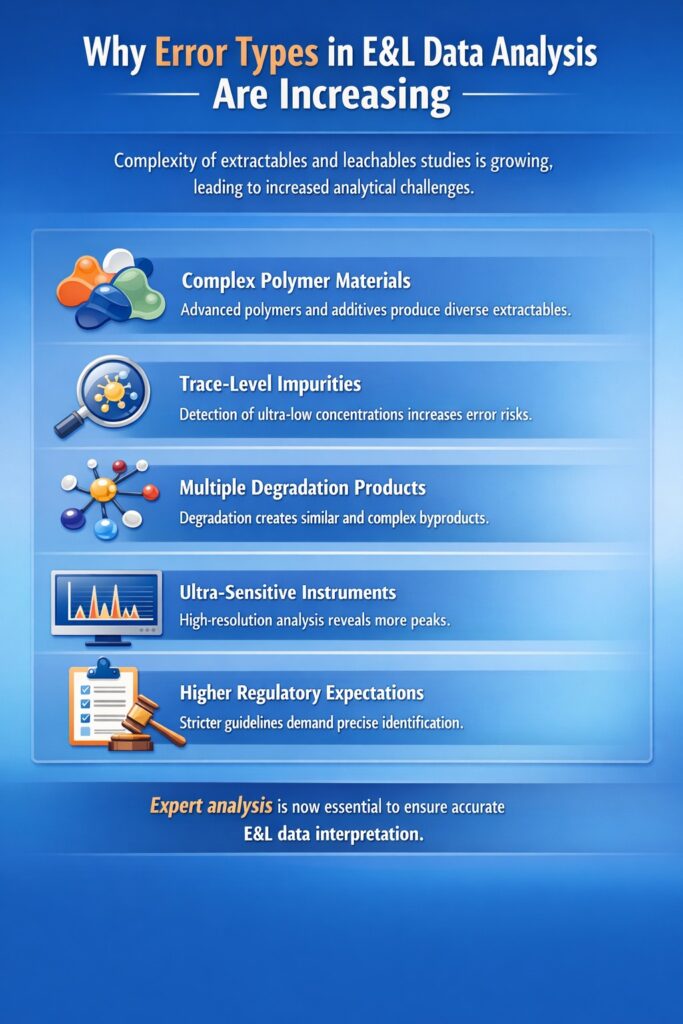
5: Why Error Types in E&L Data Analysis Are Increasing
Error Types in E&L Data Analysis are increasing because modern analytical technologies have become more sensitive, while extractables and leachables samples have become far more complex. As a result, laboratories are detecting more compounds than ever before—but interpreting them correctly has also become more challenging.
Several technical and regulatory factors are contributing to this trend.
1. Increasingly Complex Polymer Materials
Modern pharmaceutical packaging and medical device components are made from advanced polymer blends, additives, and stabilizers. These materials can generate a wide range of extractables and degradation products, making accurate identification more difficult.
2. Trace-Level Impurities Are Now Detectable
High-resolution analytical techniques such as LC-MS and GC-MS can now detect compounds at extremely low concentrations. While this improves safety, it also increases the risk of interpretation errors, especially when signals are very weak or borderline.
3. Multiple Degradation and Reaction Products
During extraction studies, materials may form several degradation products. Many of these compounds have very similar structures and mass spectra, which increases the likelihood of misidentification if the data is not carefully reviewed.
4. Ultra-Sensitive Instruments Detect More Peaks
Modern instruments generate very detailed chromatograms with hundreds of peaks. Distinguishing between real compounds, noise, and background signals requires strong analytical expertise.
5. Increasing Regulatory Expectations
Regulatory agencies now expect more accurate compound identification, detailed reporting, and strong scientific justification. This means even small errors in E&L data analysis can lead to additional questions or requests for re-analysis.
Because of these challenges, companies increasingly rely on experienced analytical partners such as ResolveMass Laboratories Inc. to reduce analytical risks and ensure accurate extractables and leachables data interpretation.
6: Real-World Impact of Error Types in E&L Screening
Error Types in E&L Data Analysis can directly affect regulatory approvals, toxicological risk assessments, and product launch timelines. Even small interpretation errors can create major regulatory and financial consequences for pharmaceutical and medical device companies.
When omission or misidentification errors are not controlled, the impact is rarely limited to a single analytical report—it often affects the entire development process.
What Happens When These Errors Are Not Controlled
The most common real-world consequences of Error Types in E&L Data Analysis include:
- Additional regulatory questions during submission review
- Requests for re-analysis or confirmatory testing
- Increased project costs due to repeat studies
- Toxicological risk reassessment based on corrected data
- Delays in product approval timelines (often several months)
- Reduced confidence in the analytical data package
- Additional documentation and justification requirements
Example of a Real-World Scenario
In many E&L studies, a compound may initially be misidentified as a common solvent residue based on a partial library match. However, during regulatory review, the compound may be flagged for further clarification. Once re-analyzed using advanced identification techniques, it may turn out to be a polymer degradation product with toxicological relevance.
In such cases, the entire E&L data set may need to be re-evaluated, which can significantly delay the submission process and increase development costs.
Why This Matters for Pharmaceutical and Medical Device Companies
Understanding the real-world impact of Error Types in E&L Data Analysis helps companies:
- Ensure smoother product approvals
- Reduce regulatory risk
- Improve data reliability
- Avoid unnecessary repeat testing
- Strengthen toxicological risk assessments
7: How Expert Laboratories Prevent Error Types in E&L Data Analysis
Expert laboratories prevent Error Types in E&L Data Analysis by combining advanced analytical technology with deep scientific expertise in data interpretation. Instruments alone cannot eliminate omission and misidentification errors—accurate results require experienced analysts, structured workflows, and regulatory-focused reporting.
This is especially important in extractables and leachables (E&L) studies where hundreds of trace-level compounds may need to be identified correctly.
Key Strategies Used to Prevent Error Types in E&L Data Analysis
Leading analytical laboratories follow a systematic approach to minimize both omission and misidentification errors:
- Use of high-resolution mass spectrometry to improve identification accuracy
- Multi-technique confirmation (such as LC-MS, GC-MS, and HRMS)
- Manual review of automated software results by experienced analysts
- Advanced library matching combined with expert validation
- Confirmation of borderline or low-intensity peaks
- Structured workflows designed specifically for E&L screening
- Regulatory-focused reporting that supports toxicological evaluation
Why Expertise Matters More Than Just Technology
Many laboratories use advanced instruments, but Error Types in E&L Data Analysis still occur when results are interpreted only by software. Expert analysts understand:
- How to interpret complex fragmentation patterns
- How to distinguish real compounds from background noise
- How to confirm compound identity using orthogonal techniques
- How to prepare reports that meet regulatory expectations
That is why companies increasingly work with specialized analytical partners such as ResolveMass Laboratories Inc., where the focus is not only on detecting compounds but also on ensuring that every identification is accurate, scientifically justified, and regulatory-ready.
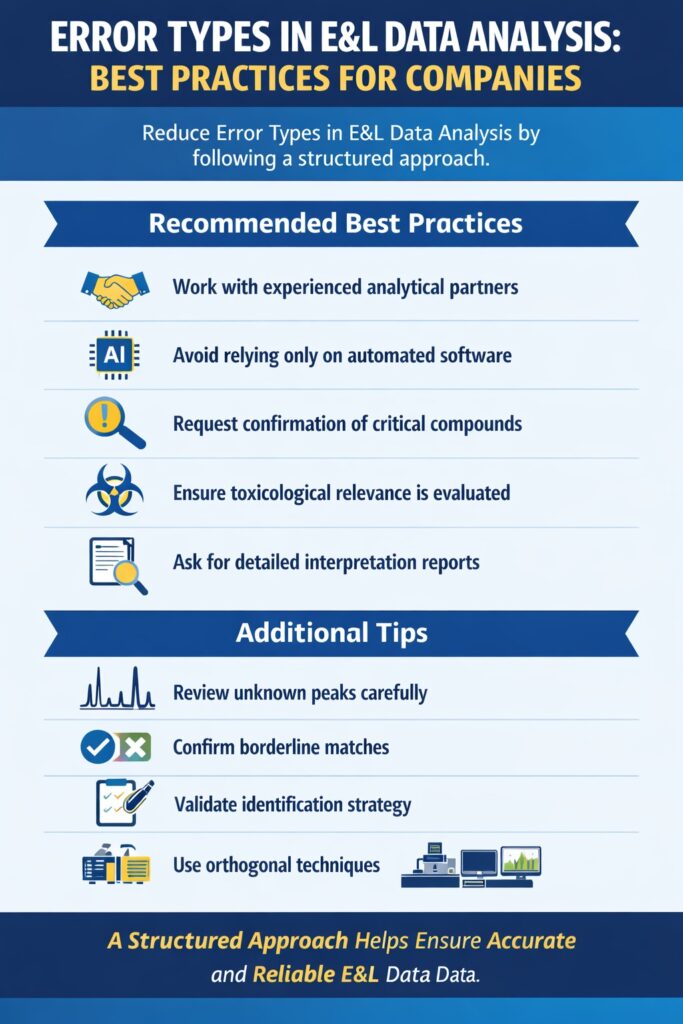
8: Error Types in E&L Data Analysis: Best Practices for Companies
Companies can significantly reduce Error Types in E&L Data Analysis by following a structured and scientifically driven approach to extractables and leachables (E&L) screening. Most omission and misidentification errors occur when data interpretation is rushed, overly automated, or not reviewed by experienced experts.
By implementing the right practices, companies can improve data accuracy, reduce regulatory risk, and strengthen toxicological evaluations.
Recommended Best Practices to Reduce Error Types in E&L Data Analysis
The following strategies can help companies minimize both omission and misidentification errors:
- Work with experienced analytical partners that specialize in E&L studies
- Avoid relying only on automated data-processing software
- Request confirmation of critical or unknown compounds
- Ensure that toxicological relevance is evaluated for all identified compounds
- Ask for detailed interpretation reports rather than only summary results
- Request justification for library matches when compounds are identified
Additional Practical Tips
Companies can further improve the reliability of their E&L data by following these additional steps:
- Always review unknown peaks carefully, especially low-intensity ones
- Confirm borderline library matches using additional techniques
- Validate the identification strategy before starting the study
- Use orthogonal analytical techniques (such as LC-MS and GC-MS together)
- Ensure that both analytical and toxicological experts are involved in the review
Why a Structured Approach Matters
Error Types in E&L Data Analysis are rarely caused by instruments alone—they are usually the result of interpretation gaps. A structured approach ensures that:
- Important compounds are not missed
- Identifications are scientifically justified
- Toxicological risk assessments are accurate
- Regulatory submissions are stronger and more reliable
9: Why Expertise Matters in E&L Data Interpretation
Error Types in E&L Data Analysis are rarely caused by analytical instruments — they are usually caused by interpretation challenges. Modern techniques such as LC-MS and GC-MS can detect compounds at extremely low levels, but correctly identifying and reporting those compounds requires deep scientific expertise.
This is why experience plays a critical role in extractables and leachables (E&L) screening.
What an Experienced Analytical Laboratory Understands
An expert laboratory does much more than simply run the analysis. Experienced analysts know how to:
- Interpret complex mass spectra, especially at trace levels
- Distinguish between structurally similar compounds
- Confirm compound identity using multiple analytical techniques
- Identify degradation products and polymer-related compounds
- Recognize false positives and avoid misidentification errors
- Prepare reports that are aligned with regulatory expectations
Why Expertise Is More Important Than Just Technology
Many laboratories have access to advanced instruments, but Error Types in E&L Data Analysis still occur when results are interpreted only by software or inexperienced analysts. Proper interpretation requires both scientific understanding and real-world regulatory experience.
That is why companies working with ResolveMass Laboratories Inc. benefit from a combination of advanced instrumentation and deep expertise in extractables and leachables data interpretation.
Conclusion:
Error Types in E&L Data Analysis — especially omission and misidentification — can significantly impact product safety and regulatory approval timelines. By understanding these errors and working with expert laboratories, companies can improve data accuracy, reduce regulatory risk, and ensure reliable extractables and leachables studies.
If your team wants to avoid costly analytical mistakes and improve confidence in E&L screening results, expert guidance can make a major difference.
Frequently Asked Questions:
Error Types in E&L Data Analysis mainly refer to mistakes that occur during interpretation and identification of analytical results rather than during the experimental testing itself. Even when advanced techniques such as LC-MS or GC-MS are used, errors can still occur if the data is not correctly reviewed. The two most common types are omission errors and misidentification errors. These errors can affect toxicological risk assessments and regulatory submissions. Understanding these error types helps companies improve the reliability of extractables and leachables (E&L) studies.
An omission error occurs when a compound is present in the sample but is not reported in the final analytical results. This usually happens when the signal intensity is very low, peaks overlap, or automated software misses borderline compounds. In complex E&L studies, hundreds of peaks may be present, making it easier for small but important compounds to be overlooked. Omission errors are particularly risky because the compound is actually present but not evaluated for toxicological relevance. This can lead to underestimation of risk and regulatory concerns.
A misidentification error occurs when a compound is detected but assigned the wrong chemical structure or name. This usually happens when library matches are similar but not completely accurate or when fragmentation patterns are misinterpreted. Sometimes automated software suggests an identification that looks correct but is scientifically incorrect. Misidentification errors can lead to wrong toxicological risk assessments because the compound is evaluated based on incorrect information. Proper confirmation techniques and expert interpretation are essential to avoid this type of error.
Error Types in E&L Data Analysis are important because regulatory agencies expect accurate identification and reporting of all relevant compounds. If a compound is missed or incorrectly identified, the entire toxicological risk assessment may become unreliable. This can result in additional regulatory questions, requests for repeat testing, or delays in product approval. In some cases, the entire E&L study may need to be re-evaluated. Accurate data interpretation helps ensure smoother and faster regulatory submissions.
Companies can reduce these errors by working with experienced analytical laboratories that specialize in extractables and leachables studies. It is also important to avoid relying only on automated software and to request confirmation of critical or unknown compounds. Reviewing unknown peaks carefully and using multiple analytical techniques such as LC-MS and GC-MS can significantly improve accuracy. Companies should also request detailed interpretation reports rather than only summary results. A structured analytical approach helps minimize both omission and misidentification errors.
Omission errors are generally considered more serious because the compound is completely missed and not evaluated for toxicological risk. However, misidentification errors can also be very critical if the compound is assigned a harmless identity while it actually has toxicological relevance. Both types of errors can lead to incorrect safety conclusions and regulatory complications. The severity usually depends on the type of compound and its concentration level. That is why both omission and misidentification errors must be carefully controlled in E&L studies.
Reference
- Reer B. Review of advances in human reliability analysis of errors of commission, Part 1: EOC identification. Reliability Engineering & System Safety. 2008 Aug 1;93(8):1091-104.https://www.sciencedirect.com/science/article/pii/S0951832007001986
- Macwan A, Mosleh A. A methodology for modeling operator errors of commission in probabilistic risk assessment. Reliability Engineering & System Safety. 1994 Jan 1;45(1-2):139-57.https://www.sciencedirect.com/science/article/pii/0951832094900825
- Procter S, Feiler P. The AADL error library: An operationalized taxonomy of system errors. ACM SIGAda Ada Letters. 2020 Jan 10;39(1):63-70.https://dl.acm.org/doi/abs/10.1145/3379106.3379113
- Jordi MA, Rowland K, Liu W, Cao X, Zong J, Ren Y, Liang Z, Zhou X, Louis M, Lerner K. Reducing relative response factor variation using a multidetector approach for extractables and leachables (E&L) analysis to mitigate the need for uncertainty factors. Journal of pharmaceutical and biomedical analysis. 2020 Jul 15;186:113334.https://www.sciencedirect.com/science/article/pii/S0731708520304283
- Rozio MG, Angelini D, Carrara S. Uncertainty factors and relative response factors: correcting detection and quantitation bias in extractables and leachables studies. Analytical and Bioanalytical Chemistry. 2025 Aug;417(19):4331-49.https://link.springer.com/article/10.1007/s00216-025-05946-5
- Ramamoorthy S, Chong NS, Hotha KK. Strengthening extractable & leachable study submissions: best practices to avoid regulatory deficiencies. American Journal of Analytical Chemistry. 2024;15(12):368-94.https://www.researchgate.net/profile/Subathra-Ramamoorthy-2/publication/387503864_Strengthening_Extractable_Leachable_Study_Submissions_Best_Practices_to_Avoid_Regulatory_Deficiencies/links/678dbc981ec9f9589f51a2bb/Strengthening-Extractable-Leachable-Study-Submissions-Best-Practices-to-Avoid-Regulatory-Deficiencies.pdf
About the Author


