
Introduction
Extractables Testing of Sterilizing-Grade Filters involves evaluating chemical compounds that migrate from filter materials under exaggerated solvent, temperature, and exposure-duration conditions. The primary objective is to establish a baseline for chemical safety and support process validation. Combining extractables datasets with process-specific filter validation ensures that final parenteral drug products comply with global regulatory requirements for sterility assurance and patient safety.
In modern biopharmaceutical manufacturing, liquid sterilizing-grade filters, typically rated at 0.2 µm or 0.22 µm, are used at critical process control points. These include cell culture media preparation, buffer filtration, bulk intermediate holds, and final aseptic fill-finish operations. Since these filters come into direct contact with processing fluids, demonstrating microbial retention alone is not sufficient to establish their suitability for regulatory approval. Evolving expectations from regulatory authorities, including the U.S. FDA, EMA, and Health Canada, require comprehensive chemical characterization to prevent potentially toxic compounds and reactive degradation products from entering the drug product stream.
Extractables are chemical substances, including residual monomers, oligomers, antioxidants, plasticizers, surfactants, and metal catalysts, that can be released from filter components under exaggerated laboratory conditions. Leachables, on the other hand, represent the subset of extractables that migrate into a specific drug formulation or process stream under normal operating conditions. Aligning model extraction studies with process-specific validation protocols allows biopharmaceutical developers to establish scientifically justified safety thresholds, optimize pre-use flushing volumes, and minimize the risk of late-stage clinical holds or post-market batch rejections.
Learn more about extractables and leachables testing approaches for pharmaceutical drug delivery systems and their role in chemical safety assessments.
Explore extractables and leachables testing for autoinjectors
Share via:
Quick Summary:
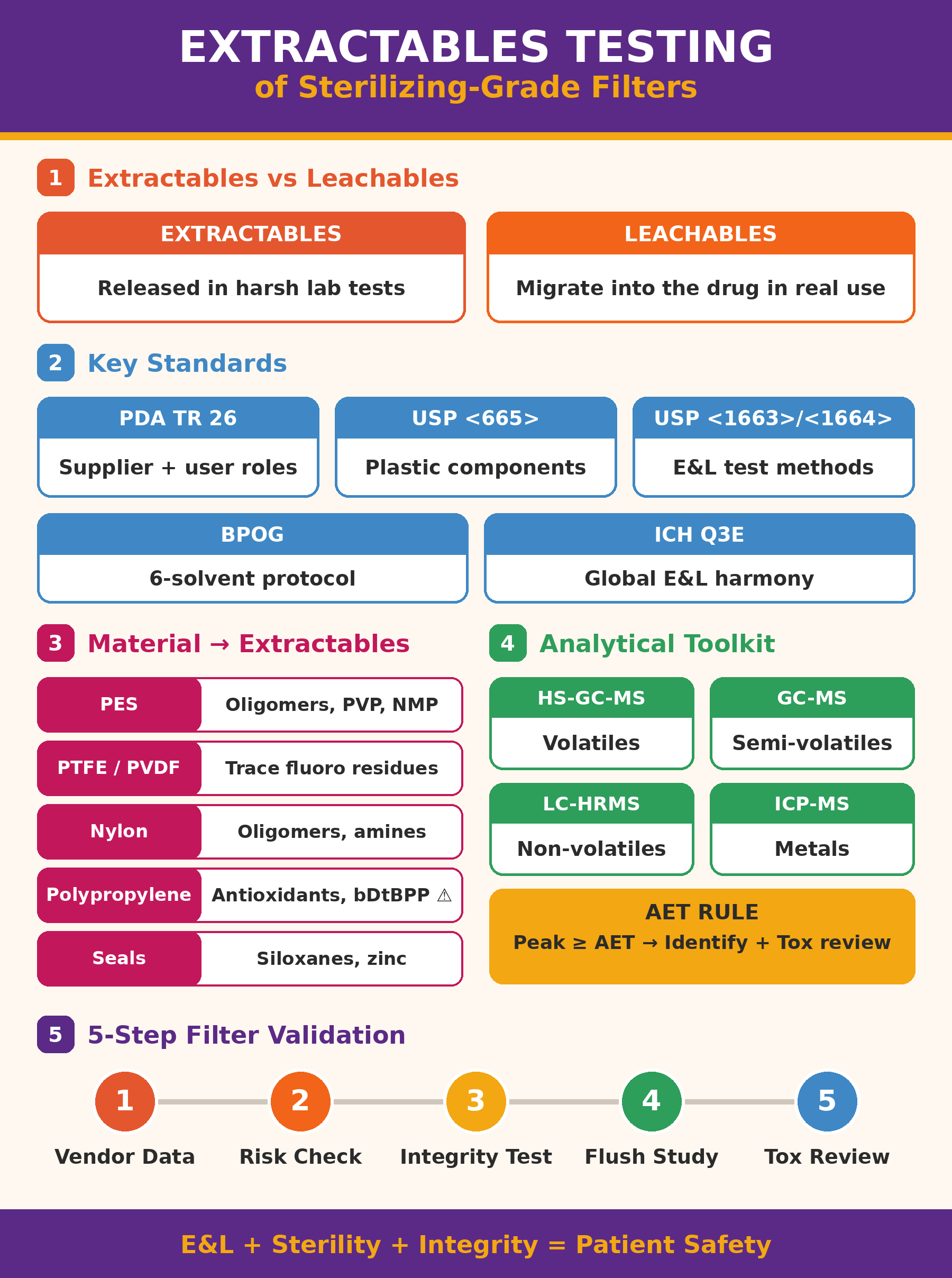
- Purpose: Extractables testing checks which chemicals migrate out of 0.2/0.22 µm sterilizing-grade filters under harsh conditions. This builds a chemical-safety baseline for parenteral drugs, since proving microbial retention alone is no longer enough for the FDA, EMA or Health Canada.
- Extractables vs leachables: Extractables are compounds released under exaggerated lab conditions. Leachables are the subset that actually migrate into a specific drug or process stream under normal use.
- Regulatory framework: PDA TR 26 (2025) splits responsibility between filter suppliers, who provide baseline data, and end-users, who make process-specific assessments. USP <665>, <1663> and <1664> cover extraction and analytical methods, BPOG standardizes a six-solvent protocol, and ICH Q3E harmonizes E&L risk management globally.
- Materials drive the risk: Each filter component has its own extractables profile. PES membranes release oligomers, PVP and NMP. Polypropylene hardware releases antioxidants such as Irganox 1010 and Irgafos 168, which can degrade into the cytotoxic bDtBPP. Elastomeric seals contribute siloxanes, phthalates and zinc.
- Orthogonal analysis: HS-GC-MS (volatiles), GC-MS (semi-volatiles), UHPLC-HRMS (non-volatiles) and ICP-MS (metals) together give full coverage. Any peak at or above the Analytical Evaluation Threshold (AET) must be identified and assessed toxicologically.
- Integrated validation in five steps: vendor data review, process-specific risk assessment, integrity and retention correlation, pre-use flush optimization, and toxicological evaluation, combined with bacterial challenge and integrity testing.
- Takeaway: Combining E&L data with sterility and integrity testing gives a scientifically defensible validation package. This matters more as single-use and continuous manufacturing become more common.
Regulatory Frameworks and Standards Governing Extractables Testing of Sterilizing-Grade Filters
Regulatory frameworks governing Extractables Testing of Sterilizing-Grade Filters require a risk-based strategy that combines compendial standards, standardized industry protocols, and regulatory guidance to ensure the chemical safety of processing fluids. Organizations such as the Parenteral Drug Association (PDA), United States Pharmacopeia (USP), BioPhorum Operations Group (BPOG), and International Council for Harmonisation (ICH) provide structured guidance that defines the testing responsibilities of filter manufacturers and pharmaceutical end-users.
PDA Technical Report No. 26 (Revised 2025), Sterilizing Filtration of Liquids, serves as a fundamental industry reference for the design, qualification, and process-specific validation of sterilizing-grade filters. TR 26 clearly establishes the responsibilities of suppliers and end-users. Filter manufacturers are expected to generate baseline extractables profiles using standardized model solvents under exaggerated testing conditions. In contrast, biopharmaceutical end-users must assess these profiles in relation to their specific drug formulations, contact temperatures, exposure durations, and batch volumes.
In addition, USP chapters establish formal requirements for polymeric materials used in pharmaceutical manufacturing systems. USP <665> defines extraction procedures and risk assessment matrices for plastic manufacturing systems, whereas USP <1663> and USP <1664> describe the analytical approaches for identifying extractables and evaluating product leachables, respectively. The BPOG protocol supports these standards by introducing a standardized six-solvent extraction approach that helps minimize repetitive testing across the bioprocessing industry. Furthermore, the ICH Q3E framework promotes global harmonization by incorporating extractables and leachables characterization into broader quality risk management principles under ICH Q9 and lifecycle management strategies.
| Regulatory Standard / Guideline | Primary Scope & Focus | Core Extractables & Leachables Requirements | Key Validation Deliverables |
|---|---|---|---|
| PDA Technical Report No. 26 (2025) | Liquid sterilizing filtration design, usage, and validation | Shared supplier and end-user responsibilities; risk-based assessment of the impact of chemical extractables on drug quality | Scientifically defensible validation package connecting integrity, sterility, and chemical safety |
| USP <665> | Polymeric manufacturing components and single-use systems | Standardized extraction testing using model solvents based on operational risk categorization | Demonstration of compendial compliance for plastic materials in contact with liquids |
| USP <1663> / <1664> | Analytical approaches for extractables and leachables studies | Identification thresholds, orthogonal analytical testing, and leachables correlation methodologies | Detailed chemical identification and quantification reports |
| BPOG Protocol | Standardized multi-solvent extraction for single-use systems | Six-solvent extraction matrix covering defined temperature and exposure-duration conditions | Comprehensive baseline extractables dataset supporting cross-industry comparisons |
| ICH Q3E (Framework) | Global harmonization of E&L risk management for drug products | Integration of risk assessments, toxicological threshold determination, and lifecycle management | Globally acceptable safety assessments and control strategies |
Polymeric Materials and Chemical Extractable Profiles in Sterilizing-Grade Filters
The polymeric materials used in sterilizing-grade filter cartridges, including membranes, structural components, and elastomeric seals, determine the types of chemical substances that may migrate into biopharmaceutical process streams. Understanding the chemical profiles associated with individual materials enables manufacturers to anticipate potential leachables risks and select suitable filter configurations for specific processing fluids.
A sterilizing-grade filter cartridge is a specially engineered assembly comprising a microporous membrane, internal support and drainage layers, a central core, an outer cage, endcaps, and elastomeric O-rings. Each component is manufactured using specific polymeric materials that may release characteristic extractable compounds when exposed to process fluids or model extraction solvents.
Polyethersulfone (PES) is widely used as a membrane material in aqueous bioprocessing applications because of its low protein-binding characteristics and high flow rates. However, PES membranes may release PES oligomers, residual casting solvents such as N-methyl-2-pyrrolidone (NMP), and hydrophilic wetting agents such as polyvinylpyrrolidone (PVP). Fluoropolymer membranes, including Polytetrafluoroethylene (PTFE) and Polyvinylidene Fluoride (PVDF), offer excellent chemical resistance and generally exhibit very low extractable levels. Nevertheless, trace quantities of fluorinated oligomers or surface-modifying agents may still be detected. Nylon (polyamide) membranes provide excellent mechanical strength but may release nylon oligomers and low-molecular-weight amine degradation products under acidic or elevated-temperature conditions.
Structural components, including the core, cage, endcaps, and support layers, are generally manufactured using polypropylene (PP) or polyester. Polypropylene components can serve as significant sources of additive-related extractables, including hindered phenol antioxidants such as Irganox 1010 and phosphite-based processing stabilizers such as Irgafos 168. When exposed to thermal or radiation stress during sterilization, Irgafos 168 may degrade into 2,4-di-tert-butylphenol (bDtBPP). This compound is a known cytotoxic degradant that can negatively affect cell growth during upstream biomanufacturing operations. Elastomeric seals manufactured from silicone, EPDM, or fluoroelastomers may also contribute cyclic siloxanes, plasticizers, zinc residues, and vulcanization-related compounds to the extractables profile.
| Filter Component | Primary Polymer / Material | Typical Function in Cartridge | Potential Chemical Extractables |
|---|---|---|---|
| Microporous Membrane | Polyethersulfone (PES) | Bacterial retention and clarification | Polyethersulfone oligomers, polyvinylpyrrolidone (PVP), and residual casting solvents (NMP) |
| Microporous Membrane | Hydrophilic / Hydrophobic PTFE | Solvent filtration, aggressive acids, and venting | Trace fluorinated oligomers and perfluorinated surfactant residues |
| Microporous Membrane | Polyvinylidene Fluoride (PVDF) | Low protein-binding sterile filtration | PVDF oligomers and surface-modifying wetting agents |
| Microporous Membrane | Nylon (Polyamide) | General aqueous filtration and HPLC preparation | Polyamide oligomers, cyclic monomer units, and low-molecular-weight amine species |
| Hardware & Cages | Polypropylene (PP) | Structural support, central core, outer cage, and endcaps | Alkanes, alkenes, Irganox 1010, Irgafos 168, and 2,4-di-tert-butylphenol (bDtBPP) |
| Support & Drainage | Polyester / Polypropylene | Pleat protection and fluid flow distribution | Terephthalic acid derivatives, ester oligomers, and spinning oils |
| Seals & O-Rings | Silicone, EPDM, Viton | Hermetic sealing within the housing assembly | Cyclic siloxanes (D3-D6), phthalates, zinc catalysts, and vulcanization agents |
Discover how low-leachables packaging materials can support better chemical compatibility and minimize contamination risks in pharmaceutical applications.
Explore low-leachables packaging materials
Analytical Methodologies for Extractables Testing of Sterilizing-Grade Filters
Analytical Extractables Testing of Sterilizing-Grade Filters uses an orthogonal combination of chromatographic and spectroscopic techniques to separate, identify, and quantify volatile, semi-volatile, non-volatile, and inorganic extractable compounds. Techniques such as HS-GC-MS, direct injection GC-MS, UHPLC-HRMS, and ICP-MS provide comprehensive analytical coverage across different chemical classes.
Extraction procedures generally involve exposing filter assemblies to selected model solvents through dynamic recirculation or controlled soaking. These procedures are performed using predefined surface-area-to-volume ratios, typically 1:1 cm²/mL for filter assemblies. The BPOG protocol includes a range of model solvents, such as Water for Injection (WFI), 0.1 M Phosphoric Acid (low pH), 0.5 N Sodium Hydroxide (high pH), 50% Ethanol/Water, 50% Isopropanol/Water, and surfactant solutions. Extractions are performed at predetermined time intervals, such as 24 hours to 21 days, and temperatures ranging from 23°C to 40°C. These studies are conducted following sterilization treatments, including gamma irradiation or autoclaving.
The resulting extraction solutions are evaluated using multiple complementary analytical techniques:
- Headspace Gas Chromatography-Mass Spectrometry (HS-GC-MS): This technique is used to separate and identify volatile organic compounds with boiling points below 150°C. These compounds may include residual monomers and low-boiling-point solvents originating from filter manufacturing processes.
- Direct Injection Gas Chromatography-Mass Spectrometry (GC-MS): This method detects semi-volatile organic compounds with boiling points ranging from 150°C to 400°C. Common examples include plasticizers, unreacted additives, and degradation products such as bDtBPP.
- Ultra-High Performance Liquid Chromatography coupled to High-Resolution Mass Spectrometry (UHPLC-HRMS / LC-MS): This analytical approach is suitable for identifying non-volatile and polar compounds with molecular weights greater than 300 Da. These may include high-molecular-weight oligomers, antioxidants, and surfactants.
- Inductively Coupled Plasma Mass Spectrometry (ICP-MS): This technique quantifies trace elemental extractables, heavy metals, and catalyst residues in accordance with ICH Q3D requirements.
Understand how GC-MS and LC-MS complement each other in identifying and characterizing different chemical compounds during extractables and leachables studies.
Compare GC-MS vs. LC-MS in extractables and leachables testing
To translate raw analytical peak responses into risk-adjusted safety thresholds, extractables testing programs establish an Analytical Evaluation Threshold (AET). Any chemical peak detected at or above the established AET must undergo structural identification and toxicological assessment. The standard equation used to calculate the AET for a sterilizing filter assembly is expressed as follows: AET = SCT Ddaily × Vbatch SAfilter × 1 UF
Where:
- SCT: Represents the Safety Concern Threshold, typically 1.5 µg/day based on ICH M7 mutagenic concern thresholds.
- Ddaily: Refers to the maximum daily dose volume administered to the patient.
- Vbatch: Represents the total production batch volume.
- SAfilter: Indicates the effective filtration area of the filter cartridge.
- UF: Represents an uncertainty factor, typically ranging from 1.3 to 2.0, which accounts for variations in analytical response.
Learn how to establish and apply an appropriate Analytical Evaluation Threshold for reliable extractables and leachables assessments.
Read about AET calculations for extractables and leachables studies
Integrating Extractables Data into Holistic Sterilizing-Grade Filter Validation Programs
Integrating Extractables Testing of Sterilizing-Grade Filters into comprehensive filter validation programs establishes a connection between supplier-generated chemical data, physical filter performance, pre-use flushing procedures, and microbial retention capabilities. This integrated strategy helps demonstrate that materials in contact with processing fluids do not adversely affect product quality, introduce toxic compounds, or compromise membrane integrity.
Filter validation programs should not assess E&L data as an independent chemical parameter. Instead, a scientifically defensible validation package should combine chemical characterization with bacterial challenge testing using Brevundimonas diminuta, chemical compatibility assessments, and non-destructive integrity testing methods such as bubble point and forward flow diffusion.
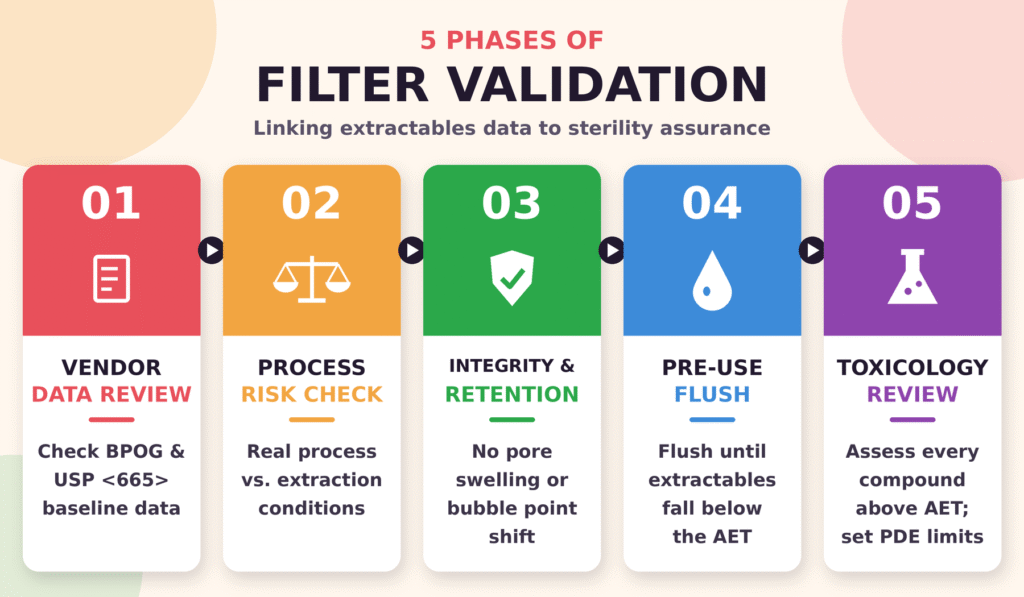
An integrated validation program generally involves five sequential phases:
1. Vendor Data Evaluation
During this phase, end-users examine extractables documentation supplied by filter manufacturers, including BPOG or USP <665> testing packages. The objective is to evaluate the baseline chemical safety of filter materials under standardized extraction conditions and determine whether the available supplier data adequately address the intended application.
2. Process-Specific Risk Assessment
Process engineers compare actual manufacturing conditions with the conditions used during vendor extraction studies. Important process variables include temperature, contact duration, flow rates, solvent strength, and pH. This comparison helps determine whether the supplier’s existing extractables profile is sufficient or whether additional product-specific leachables testing is necessary to establish chemical safety under actual operating conditions.
3. Integrity and Retention Correlation
Validation protocols must establish that interactions between the filter materials and process fluids do not cause polymer degradation, membrane pore swelling, or changes in bubble point specifications. These evaluations are essential because chemical interactions can potentially affect the physical characteristics of the membrane and compromise its bacterial retention performance.
4. Pre-Use Flush Optimization
Flushing studies determine how effectively extractable compounds, including PVP wetting agents and polymer oligomers, are reduced at different flushing volumes. By evaluating the relationship between flushing volume and extractables concentration, manufacturers can establish an appropriate pre-use WFI or buffer flushing procedure. The objective is to reduce extractable concentrations to levels well below the calculated AET before introducing the filter into drug product processing operations.
5. Toxicological Evaluation
Extractables or leachables detected at concentrations exceeding the established AET must undergo appropriate toxicological assessment. Qualified toxicologists evaluate the identified compounds and determine relevant Permissible Daily Exposure (PDE) limits. These assessments help establish whether the detected chemical substances present an unacceptable risk to the intended patient population and support the development of appropriate safety controls.
Explore the toxicological qualification of leachables and understand how identified compounds are assessed against patient safety requirements.
Learn more about toxicological qualification of leachables
Independent contract testing laboratories, such as ResolveMass Laboratories Inc., assist biopharmaceutical manufacturers throughout this validation lifecycle. Their services include specialized analytical workflows, customized AET calculations, and regulatory-compliant validation reports that support chemical characterization and filter qualification activities.
Discover the important considerations involved in outsourcing extractables and leachables testing, including analytical capabilities, regulatory compliance, and study execution.
Explore outsourcing extractables and leachables testing
Conclusion
Integrating Extractables Testing of Sterilizing-Grade Filters with comprehensive filter validation provides a scientifically sound framework for establishing chemical safety and sterility assurance in biopharmaceutical manufacturing. Combining supplier-generated baseline extractables data with USP standards, BPOG extraction protocols, and PDA TR 26 recommendations helps manufacturers develop comprehensive validation strategies that address regulatory expectations while protecting patient safety.
As biopharmaceutical manufacturing increasingly adopts complex single-use technologies and continuous processing approaches, E&L characterization must become an integral part of overall quality risk management strategies. Assessing chemical extractables alongside bacterial challenge testing, chemical compatibility evaluations, and filter integrity assessments enables manufacturers to establish scientifically justified safety margins for final drug products.
Learn how GMP-compliant extractables and leachables studies support reliable chemical characterization, quality control, and regulatory readiness in pharmaceutical manufacturing.
Explore GMP-compliant extractables and leachables testing
Biopharmaceutical developers requiring comprehensive analytical testing, customized AET determination, and scientifically defensible validation documentation can collaborate with experienced analytical testing laboratories. To explore customized E&L strategies and sterilizing-grade filter validation support, visit Contact ResolveMass Laboratories Inc.
Frequently Asked Questions (FAQs)
PDA Technical Report No. 26 (Revised 2025) provides industry guidance for the selection, qualification, and validation of liquid sterilizing filtration systems. It addresses critical aspects such as microbial retention, filter integrity, and chemical safety. The report also clarifies the responsibilities of filter suppliers and pharmaceutical manufacturers when evaluating extractables and establishing process-specific validation strategies.
The BPOG extraction protocol uses six model solvent categories to investigate chemical substances released from filter components under different conditions. These include Water for Injection (WFI), 0.1M Phosphoric Acid, 0.5N Sodium Hydroxide, 50% Ethanol/Water, 50% Isopropanol/Water, and surfactant solutions such as Polysorbate-based matrices. Together, these solvents help assess potential extractables across different chemical environments.
The Analytical Evaluation Threshold (AET) is established using several parameters, including the Safety Concern Threshold (SCT), maximum daily patient dose, total batch volume, effective filter surface area, and an uncertainty factor. These variables are incorporated into a calculation to establish the concentration above which detected chemical compounds require further investigation. Any analytical peak meeting or exceeding the AET must undergo appropriate chemical identification and toxicological assessment.
Supplier-generated extractables reports provide valuable baseline information about the chemical substances that may originate from filter materials. However, these datasets alone may not establish suitability under every manufacturing condition. Pharmaceutical manufacturers must conduct a process-specific risk assessment considering parameters such as pH, solvent composition, temperature, and contact duration to determine whether additional leachables studies are necessary.
A comprehensive extractables assessment requires multiple analytical techniques because different chemical compounds exhibit different physical and chemical properties. HS-GC-MS is used for volatile organic compounds, while GC-MS identifies semi-volatile substances. UHPLC-HRMS / LC-MS detects non-volatile and polar compounds, and ICP-MS measures trace elements, heavy metals, and catalyst residues.
Pre-use flushing involves passing Water for Injection (WFI) or an appropriate process buffer through the filter before introducing the drug product. This procedure helps remove residual extractable substances, including PVP wetting agents and membrane oligomers, that may be present on filter surfaces or within the membrane structure. Flushing validation studies establish the appropriate volume needed to reduce these compounds to acceptable levels below the calculated AET.
Yes, exposure to incompatible processing fluids or aggressive chemical conditions may affect the structural properties of filter materials. Potential changes include polymer swelling, material softening, and membrane degradation, which can influence filtration performance. Such interactions may also alter bubble point values and compromise bacterial retention, making chemical compatibility and integrity testing important parts of filter validation.
USP ⟨665⟩ establishes requirements and risk-based evaluation approaches for plastic components and systems used in pharmaceutical manufacturing. It addresses the assessment of materials that come into contact with manufacturing fluids through standardized extraction procedures and chemical characterization. Its application helps manufacturers evaluate potential chemical contamination risks associated with polymeric components, including relevant filtration system materials.
ICH Q3E provides a harmonized, risk-based approach to evaluating extractables and leachables throughout the pharmaceutical product lifecycle. It encourages manufacturers to connect chemical characterization with toxicological assessments, appropriate safety thresholds, and quality risk management principles under ICH Q9. This approach supports the development of consistent control strategies to minimize patient exposure to potentially harmful chemical substances.
Reference:
- International Council for Harmonisation of Technical Requirements for Pharmaceuticals for Human Use. (2025, August 1). ICH Q3E guideline for extractables and leachables (Draft version). U.S. Food and Drug Administration. https://www.fda.gov/media/189890/download
- United States Pharmacopeia. (n.d.). Extractables and leachables. https://www.usp.org/impurities/extractables-and-leachables
- Hong, H.-Y., Tang, Y., Xie, T., Dong, W., Cai, Q., & Huang, X. (2011). Validation of sterilizing grade filters (III): Determination of extractables and leachables. Chinese Journal of New Drugs, 20(14), 1266–1269, 1297. https://www.researchgate.net/publication/289420014_Validation_of_sterilizing_grade_filters_III_determination_of_extractables_and_leachables
Get In Touch With Us
About The Author