


Introduction
Forced Degradation Studies for ANDA play an important role in stability assessment and impurity control during generic drug development. These studies help scientists understand how a drug substance behaves under stress conditions and identify possible degradation products early in the development process. This information supports the creation of reliable analytical methods and effective stability programs.
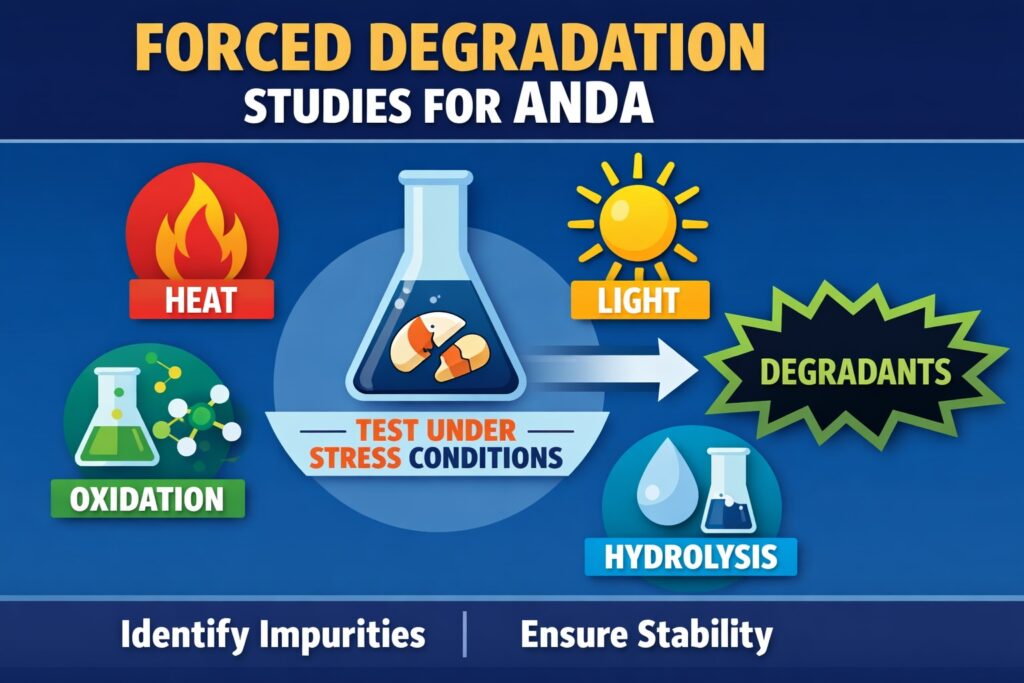
In pharmaceutical research, forced degradation experiments intentionally expose the API to stress conditions such as heat, light, oxidation, or hydrolysis. These conditions help simulate situations that may occur during manufacturing, storage, or transportation. The results allow researchers to better understand the intrinsic stability of the drug substance.
Mandatory Resource: Explore Comprehensive Forced Degradation Studies
For Abbreviated New Drug Applications (ANDA), regulatory authorities expect degradation studies to reveal stability characteristics, predict impurity formation, and support impurity specifications aligned with ICH guidelines. These studies also demonstrate that analytical methods can accurately separate the API from degradation products.
This article explains how Forced Degradation Studies for ANDA are designed to map stability and impurity pathways while supporting regulatory compliance and robust analytical development.
Share via:
Quick Summary
- Forced Degradation Studies for ANDA are essential for designing scientifically justified stability-indicating methods and identifying impurity pathways required by regulatory authorities such as the FDA and ICH.
- Effective study design focuses on predicting degradation routes, isolating degradation products, and linking them to impurity control strategies.
- Regulatory expectations are shaped primarily by ICH Q1A(R2), Q3A(R2), and Q3B(R2) guidelines governing stability testing and impurity qualification.
- Properly designed Forced Degradation Studies for ANDA enable the development of robust analytical methods (e.g., LC-MS, HPLC, UHPLC) that can detect degradants throughout the product lifecycle.
- Degradation pathways—including hydrolytic, oxidative, photolytic, and thermal mechanisms—must be systematically mapped to support impurity specifications and risk-based stability programs.
- Data from Forced Degradation Studies for ANDA directly support stability-indicating method validation, specification setting, and regulatory submissions.
Regulatory Context Driving Forced Degradation Studies for ANDA
Regulatory expectations for Forced Degradation Studies for ANDA are mainly defined by ICH stability and impurity guidelines. These guidelines establish consistent scientific approaches for evaluating degradation behavior and controlling impurities in pharmaceutical products. Following these standards ensures that drug products remain safe, effective, and stable throughout their shelf life.
The goal of these regulatory frameworks is to ensure that degradation products are properly identified, measured, and monitored. Pharmaceutical companies must evaluate impurities that may appear during manufacturing, storage, or distribution. Understanding degradation pathways helps regulators determine whether impurity levels remain within safe limits.
Key regulatory frameworks include:
| Guideline | Relevance to Forced Degradation |
|---|---|
| ICH Q1A(R2) | Stability testing requirements and stress conditions |
| ICH Q3A(R2) | Impurity limits for drug substances |
| ICH Q3B(R2) | Impurity thresholds for drug products |
| FDA ANDA Guidance | Stability-indicating analytical methods |
According to regulatory literature, forced degradation testing helps identify potential degradation products and evaluate the intrinsic stability of drug substances (Blessy et al., 2014; Singh et al., 2013). The analytical procedures developed must clearly distinguish the API from degradation products and impurities. This analytical selectivity is essential for regulatory compliance.
For ANDA submissions, regulators typically expect:
- Stress conditions producing 5–20% degradation
- Identification or characterization of major degradants
- Demonstration that analytical methods separate degradants from the API
These requirements ensure that degradation pathways are clearly understood and properly controlled. As a result, the regulatory framework strongly influences how Forced Degradation Studies for ANDA are designed and interpreted.
Designing Forced Degradation Studies for ANDA to Reveal Stability Pathways
The main objective of Forced Degradation Studies for ANDA is to intentionally induce degradation under controlled stress conditions to reveal chemical stability pathways. By applying targeted stress conditions, scientists can simulate degradation scenarios that may occur during the product lifecycle. This information helps determine how the API behaves under different environmental factors.
These studies should be carefully planned rather than random stress experiments. Scientists must design them based on the chemical structure of the API and its known reactivity. Understanding functional groups, reactive sites, and physicochemical properties helps researchers select the most relevant stress conditions.
Core stress conditions used
| Stress Condition | Purpose |
|---|---|
| Acidic hydrolysis | Identify acid-labile functional groups |
| Basic hydrolysis | Detect base-sensitive degradation pathways |
| Oxidative degradation | Identify susceptibility to peroxide or radical reactions |
| Thermal stress | Evaluate heat-induced degradation |
| Photolytic stress | Detect light-induced degradation pathways |
These conditions help reveal:
- Primary degradation mechanisms
- Secondary degradation cascades
- Reactive intermediates
The results also show whether degradation occurs rapidly or gradually under certain conditions. Such information is valuable for optimizing formulation composition and defining storage conditions.
Achieve precise separation in stress testing: Learn more about our HPLC Analysis Services
Understanding these degradation pathways allows analytical teams to predict impurities that may appear during long-term stability studies or manufacturing processes. By identifying degradants early, developers can design analytical methods capable of detecting them accurately.
Research shows that forced degradation testing helps determine intrinsic stability and degradation routes of pharmaceutical compounds, enabling predictive stability modeling (Singh et al., 2013).
Building Impurity Pathways Through Forced Degradation Studies for ANDA
Forced Degradation Studies for ANDA are critical for building impurity pathway maps that explain how degradation products form during manufacturing and storage. These pathways illustrate the sequence of chemical reactions that transform the original API into different impurities.
A degradation pathway usually begins with an initial reaction that destabilizes the API. This reaction may produce intermediate species that undergo further transformations before forming stable impurity products. Identifying these intermediate stages helps researchers fully understand the degradation mechanism.
Example conceptual pathway
| Step | Chemical Transformation | Impurity Outcome |
|---|---|---|
| API oxidation | Oxygen attack on reactive site | Oxidative degradant |
| Hydrolysis | Ester or amide cleavage | Hydrolytic impurity |
| Rearrangement | Structural isomerization | Secondary impurity |
Mapping degradation pathways offers several benefits:
- Predicts impurities during stability studies
- Supports toxicological evaluation of degradants
- Helps establish impurity specifications
Additionally, pathway analysis helps identify which impurities are most likely to appear during real storage conditions. This information guides regulatory scientists when determining which degradants must be monitored.
Advanced identification for complex molecules: See Impurity Identification for ANDA Submission
According to pharmaceutical stability research, degradation pathways identified during forced degradation studies help build impurity control strategies aligned with ICH Q3B requirements (Kogawa & Salgado, 2016).
Analytical Strategies Supporting Forced Degradation Studies for ANDA
Analytical technologies are essential for identifying degradation products formed during Forced Degradation Studies for ANDA. Advanced analytical instruments allow scientists to separate, detect, and characterize even very small amounts of impurities.
Primary analytical tools
- HPLC / UHPLC – separation of degradants
- LC-MS / LC-MS/MS – structural characterization
- HRMS – accurate mass determination
- NMR spectroscopy – confirmation of degradation structures
- Photodiode array detection – peak purity analysis
These techniques work together to provide a complete picture of degradation behavior. Chromatographic methods separate the impurities, while spectroscopic tools help identify their chemical structures.
Utilize high-sensitivity structural analysis: Explore Impurity Profiling Using LCMS
Analytical workflow for degradation characterization
| Step | Purpose |
|---|---|
| Stress sample preparation | Generate degradants |
| Chromatographic separation | Resolve API and impurities |
| Mass spectrometry | Identify molecular structures |
| Structural confirmation | Validate impurity identity |
This analytical workflow ensures that degradation products are properly detected and characterized. Each technique contributes important information to confirm impurity identity.
These analytical tools support the development of stability-indicating methods required for ANDA submissions (Dong & Huynh-Ba, 2020).
Role of Forced Degradation Studies for ANDA in Stability-Indicating Method Development
A stability-indicating method must clearly separate the API from all degradation products identified during Forced Degradation Studies for ANDA. These analytical methods are designed to detect impurities even at very low concentrations while maintaining reliable measurement accuracy.
Regulators evaluate whether analytical methods can detect a wide range of impurities, including:
- Process impurities
- Degradation products
- Excipients
- Potential co-eluting compounds
When analytical methods are tested using stressed samples, scientists can confirm that the API and degradants are properly separated. This validation demonstrates that the method can monitor degradation during the entire product lifecycle.
Address specific regulatory risks: View Nitrosamine Testing in ANDA Submissions
Critical method development considerations
- Peak resolution between API and degradants
- Mass balance calculations
- Peak purity evaluation
- Sensitivity for low-level impurities
These factors help confirm that the analytical method is selective, reliable, and suitable for long-term stability testing.
Integrating Forced Degradation Studies for ANDA into Quality by Design (QbD)
Modern pharmaceutical development increasingly integrates Forced Degradation Studies for ANDA into Quality by Design (QbD) strategies. QbD focuses on building product quality into the development process using scientific knowledge and risk-based decision making.
In this framework, degradation information helps identify potential risks associated with the API and formulation. Understanding degradation behavior allows developers to design formulations that reduce instability and impurity formation.
In this approach, degradation knowledge supports:
- Critical quality attribute (CQA) identification
- Formulation risk assessment
- Packaging compatibility studies
Example QbD integration
| Development Phase | Role of Forced Degradation |
|---|---|
| Pre-formulation | Identify degradation hotspots |
| Formulation design | Select stabilizing excipients |
| Analytical development | Develop stability-indicating methods |
| Stability program | Confirm predicted degradation |
For example, if degradation studies show strong sensitivity to oxidation, formulators may add antioxidants or select oxygen-barrier packaging. These preventive actions help maintain product stability.
Prevent common regulatory setbacks: Learn how to avoid ANDA Analytical Deficiencies
Research indicates that forced degradation knowledge improves risk-based stability strategies and strengthens analytical robustness in pharmaceutical development (Mohannaik et al., 2023).
Common Pitfalls in Forced Degradation Studies for ANDA
Even experienced laboratories may encounter challenges when performing Forced Degradation Studies for ANDA. If stress conditions are not optimized correctly, the results may not represent realistic degradation behavior.
Common problems include:
- Over-stressing samples and generating unrealistic degradants
- Applying insufficient stress and missing impurity pathways
- Failure to detect secondary degradation products
- Lack of orthogonal analytical techniques for structural confirmation
Excessive stress may produce degradation products that would never appear during normal storage conditions. On the other hand, insufficient stress may prevent important degradants from being detected.
Best practices include
- Maintaining degradation levels around 10–20%
- Monitoring mass balance carefully
- Using multiple analytical techniques for confirmation
Applying these best practices helps ensure that degradation experiments produce scientifically meaningful data. Proper planning also improves the reliability of stability-indicating analytical methods.
Conclusion
Forced Degradation Studies for ANDA are essential for designing stability programs and understanding impurity pathways during generic drug development. When these studies are carefully designed and scientifically executed, they provide valuable insights into the chemical behavior of pharmaceutical compounds under stress conditions.
The knowledge gained from these studies helps researchers develop stability-indicating analytical methods capable of detecting impurities throughout the product lifecycle. By understanding how degradation products form, scientists can build reliable quality control systems and ensure consistent product performance.
Rather than being only a regulatory requirement, Forced Degradation Studies for ANDA serve as a scientific framework for predicting degradation behavior, identifying impurities, and maintaining product quality over time.
For pharmaceutical companies preparing ANDA submissions, combining degradation pathway mapping, advanced analytical characterization, and risk-based stability strategies improves regulatory acceptance and long-term product stability. Ultimately, these studies contribute to the development of safe and reliable generic medicines.
For expert guidance on stability testing and analytical development: Contact us
Frequently Asked Questions (FAQs)
In most cases, scientists aim for about 5–20% degradation during forced degradation testing. This level is enough to generate meaningful degradation products without completely destroying the API. It allows researchers to clearly study impurity formation and evaluate analytical method performance.
Common stress conditions include acidic hydrolysis, basic hydrolysis, oxidation, heat, light exposure, and humidity. Each condition helps reveal different types of degradation reactions based on the chemical structure of the API. Together, they provide a complete understanding of how the drug substance may degrade.
These studies help identify impurities that may appear during storage or manufacturing. Once these degradation products are known, scientists can set appropriate limits for them in the product specifications. This ensures that impurity levels remain within acceptable safety limits throughout the product lifecycle.
Important guidelines include ICH Q1A(R2) for stability testing, ICH Q3A(R2) for drug substance impurities, and ICH Q3B(R2) for drug product impurities. These guidelines explain how pharmaceutical companies should evaluate degradation and control impurity levels. Following these standards is essential for regulatory approval of ANDA submissions.
When scientists understand degradation pathways, they can design formulations that reduce instability. For example, they may adjust the formulation pH, add stabilizing excipients, or select protective packaging. These steps help minimize impurity formation and improve the product’s shelf life.
A stability-indicating analytical method can clearly separate and measure the API and all related degradation products. This ensures that any change in the drug product during storage can be accurately detected. Such methods are essential for stability testing and routine quality control.
Reference:
- de Alvarenga Junior, B. R., & Carneiro, R. L. (2019). Chemometrics approaches in forced degradation studies of pharmaceutical drugs. Molecules, 24(20), 3804. https://doi.org/10.3390/molecules24203804
- Patel, H., & Shah, V. (2023). Analytical method development and forced degradation studies: A review. International Journal of Innovative Science and Research Technology, 8(10), 347–352. https://ijisrt.com/assets/upload/files/IJISRT23OCT043.pdf
- Pawar, J., Hegde, N., & Sharma, S. (2025). Focusing on first cycle approval in ANDA submission: Understanding common deficiencies & case study insights. Therapeutic Innovation & Regulatory Science, 59(3), 426–437. https://doi.org/10.1007/s43441-025-00755-5
Get In Touch With Us
About The Author


