

Article Summary
- GC-MS is one of the most accurate analytical techniques available for chemical identification and quantification.
- GC-MS Sensitivity determines how small an amount of a compound can be reliably detected.
- Accuracy depends on instrument design, method development, calibration, and analyst expertise.
- Detection limits often reach parts-per-billion (ppb) or parts-per-trillion (ppt) levels.
- High specificity allows GC-MS to distinguish compounds even in complex matrices.
- Laboratories like ResolveMass Laboratories Inc. ensure accuracy through validated methods, QA/QC protocols, and experienced scientists.
Introduction: How Accurate Is GC-MS Analysis?
GC-MS analysis is widely trusted because it delivers exceptional GC-MS Sensitivity along with strong molecular specificity for detecting trace-level compounds. These strengths make it essential in industries where even tiny measurement errors can have serious consequences. Pharmaceuticals, environmental monitoring, forensics, food safety, and chemical manufacturing all rely on GC-MS for dependable data.
The accuracy of GC-MS does not come from technology alone. It also depends on well-controlled laboratory workflows, validated analytical methods, and skilled professionals who know how to interpret complex results. When these elements work together, GC-MS produces data that is both reproducible and defensible.
At ResolveMass Laboratories Inc., GC-MS is treated as a complete analytical system rather than just an instrument. Scientific expertise, method validation, and quality assurance are integrated into every project. This article explains how accurate GC-MS truly is, what drives GC-MS Sensitivity, and how detection limits and specificity impact real-world decisions.
Master the fundamentals of this technology: Learn more about Gas Chromatography Mass Spectrometry
What Is GC-MS and Why Is It Considered So Accurate?
GC-MS is considered highly accurate because it combines two independent analytical techniques to confirm both compound identity and quantity. This layered approach significantly improves reliability compared to single-method analyses.
Gas Chromatography (GC) separates compounds based on properties such as volatility and polarity. This ensures that individual components are resolved before they reach the detector. Mass Spectrometry (MS) then identifies those components by measuring their unique mass-to-charge ratios.
This dual process allows analysts to distinguish compounds that may look similar using other techniques. Even in complex sample mixtures, GC-MS can provide clear separation and confident identification.
By using both separation and molecular identification, GC-MS reduces ambiguity and delivers consistent, high-quality data across many applications.
Understand the mechanics behind the data: Discover the Working Principle of GC-MS
Why GC-MS Stands Out
GC-MS offers several features that directly support its accuracy and reliability. These characteristics work together to minimize analytical uncertainty.
- Two-step confirmation using retention time and mass spectra
- Compound-specific molecular identification
- Low risk of false positives
- Reliable quantification at trace levels
This dual confirmation process is a major reason why GC-MS Sensitivity and overall accuracy often outperform alternative analytical methods. It ensures that detected compounds are truly present and correctly identified.
Explore diverse industry uses: See the many Applications of GC-MS
GC-MS Sensitivity Explained (How Low Can GC-MS Detect?)
GC-MS Sensitivity refers to the system’s ability to detect extremely small amounts of a compound while maintaining reliable identification and quantification. This parameter is especially important when analyzing samples with very low concentration levels.
Modern GC-MS instruments can detect compounds at parts-per-billion and even parts-per-trillion levels, depending on the method and sample type. Achieving this performance requires careful optimization of the entire analytical process.
Factors such as ionization efficiency, detector stability, and background noise strongly influence sensitivity. When these factors are well controlled, GC-MS can consistently detect trace contaminants.
This level of sensitivity is essential for regulatory compliance, contamination investigations, and safety assessments.
Access high-sensitivity testing services: Get details on our GCMS Analysis Service
Typical GC-MS Sensitivity Ranges
| Application Area | Typical Detection Limits |
|---|---|
| Environmental VOCs | 0.1–1 ppb |
| Pesticides | <1 ppb |
| Pharmaceuticals | ppt–ppb |
| Forensic toxicology | ng/mL |
| Industrial contaminants | ppb |
At ResolveMass Laboratories Inc., GC-MS Sensitivity is enhanced through carefully designed technical and procedural controls. Each step is optimized to ensure stable and repeatable performance.
These controls include advanced ion source optimization, precise quadrupole tuning, appropriate column selection, and the use of certified calibration standards. Together, they support consistent low-level detection across different sample types.
Ensure safety with precision testing: Pesticide Testing Services using GC-MS in Canada
How Accurate Is GC-MS Quantification?
GC-MS quantification accuracy typically ranges from ±2% to ±10%, depending on the analytical method and sample complexity. This range reflects realistic laboratory conditions rather than ideal instrument specifications.
Accuracy can vary when samples contain complex matrices that interfere with measurement. In such cases, additional method development and validation are required to maintain reliable results.
Proper calibration, internal standards, and instrument stability are critical for accurate quantification. Without these controls, even a highly sensitive system can produce misleading data.
By following ISO-aligned validation protocols, ResolveMass Laboratories ensures that GC-MS Sensitivity supports dependable quantitative results, not just compound detection.
Develop custom protocols for your samples: Expert GCMS Method Development Service
Key Factors That Influence Accuracy
Several factors directly affect GC-MS accuracy and must be managed carefully during analysis. Each one contributes to overall data quality.
- Calibration curve linearity
- Correct internal standard selection
- High-quality sample preparation
- Instrument stability and performance
- Analyst experience and interpretation
When these elements are properly controlled, GC-MS delivers precise and reproducible results suitable for scientific and regulatory use.
GC-MS Sensitivity vs Specificity: What’s the Difference?
GC-MS Sensitivity and specificity describe different aspects of analytical performance, but both are essential for meaningful results.
Sensitivity refers to how small an amount of a compound can be detected. Specificity refers to how confidently that compound can be identified among other substances.
High sensitivity without specificity may lead to uncertainty, while specificity without sensitivity may miss low-level contaminants. GC-MS provides a strong balance of both.
This balance is a key reason why GC-MS is trusted for high-stakes analytical applications.
GC-MS Specificity Advantages
GC-MS delivers strong specificity through several technical features that improve identification confidence, even in complex samples.
- Unique mass spectral fingerprints
- Extensive library matching such as NIST and Wiley
- Selective Ion Monitoring (SIM)
- Reduced interference from co-eluting compounds
Because of this high specificity, GC-MS Sensitivity can be applied with confidence in legal investigations, regulatory testing, pharmaceutical release analysis, and environmental assessments.
Detection Limits in GC-MS: What Do They Really Mean?
Detection limits define the lowest concentration at which a compound can be reliably distinguished from background noise. These values are critical for correct interpretation of analytical data.
Understanding detection limits helps prevent overinterpretation and ensures results remain scientifically defensible. Detection limits are not fixed and depend on the method and sample matrix.
Clearly defined detection limits are essential for compliance testing and risk evaluation. They ensure that reported results are meaningful and accurate.
Common Detection Terms
- LOD (Limit of Detection): Lowest detectable amount
- LOQ (Limit of Quantification): Lowest reliably quantifiable amount
- MDL (Method Detection Limit): Detection limit including sample preparation effects
At ResolveMass Laboratories Inc., detection limits are experimentally verified rather than assumed. They are tailored to specific matrices and documented in validation reports.
Detection limits are also reviewed regularly to ensure consistency and confidence. This helps maintain practical and defensible GC-MS Sensitivity.
What Impacts GC-MS Sensitivity the Most?
GC-MS Sensitivity is influenced by both instrument design and laboratory practices. Neither factor alone is enough to achieve optimal performance.
Instrument configuration affects ionization efficiency and signal quality. Laboratory procedures determine how much noise or analyte loss occurs before analysis.
Maintaining high sensitivity requires attention to detail at every stage of the workflow. Small issues can significantly impact trace-level detection.
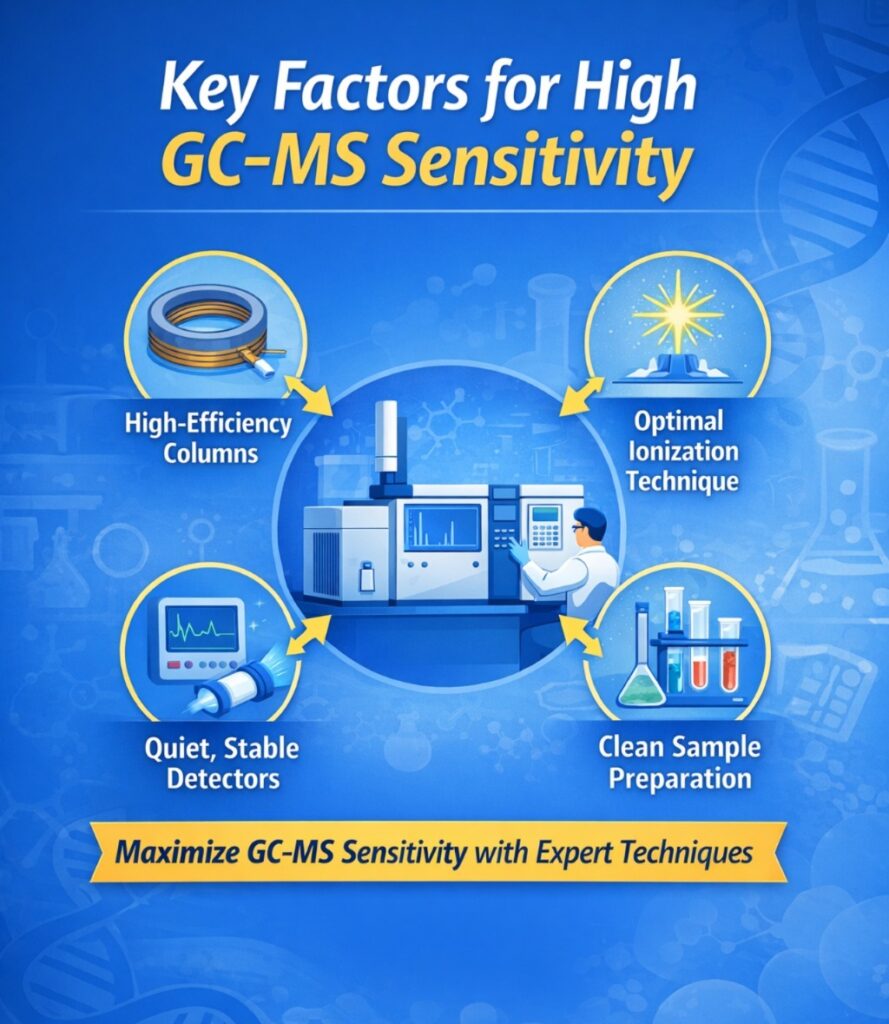
Key Contributors to High GC-MS Sensitivity
Several technical and operational factors support strong GC-MS Sensitivity and consistent results.
- High-efficiency capillary columns
- Appropriate choice of ionization technique
- Clean and consistent sample preparation
- Low-noise, well-maintained detectors
- Routine instrument maintenance
When these factors are aligned, GC-MS performance remains stable and predictable over time.
Laboratory Expertise Matters
Even the most advanced GC-MS system can produce unreliable data if it is not operated correctly. Skilled analysts are essential for meaningful results.
At ResolveMass Laboratories Inc., analyses are performed by experienced analytical chemists who understand matrix effects, ion suppression, and co-elution challenges.
These scientists know how to adjust methods and interpret complex data when unexpected issues arise. Their expertise ensures GC-MS Sensitivity is fully and correctly applied.
Is GC-MS Always the Best Choice?
GC-MS is highly effective for volatile and semi-volatile compounds, but it is not suitable for every analytical need. Choosing the right technique depends on the specific application.
For thermally stable organic compounds requiring clear identification, GC-MS is often the best option. Other techniques may be more appropriate for non-volatile or inorganic analytes.
Understanding these limitations helps ensure the most effective analytical approach is selected.
GC-MS Works Best When:
GC-MS is especially valuable in situations where accuracy and defensibility are critical.
- High GC-MS Sensitivity is required
- Compounds are volatile or semi-volatile
- Clear compound identification is essential
- Regulatory or legal defensibility is needed
While LC-MS or ICP-MS may be better for other analytes, GC-MS remains unmatched for volatile organic analysis.
Why ResolveMass Laboratories Inc. Is Trusted for GC-MS Analysis
Confidence in GC-MS results depends on the laboratory performing the work. Instrument quality alone is not enough.
ResolveMass Laboratories Inc. demonstrates strong experience and expertise across multiple industries. All GC-MS methods are scientifically validated and thoroughly documented.
The laboratory maintains transparent QA/QC systems, calibrated instruments, and certified reference materials. Reports are clear, accurate, and designed to support client decisions.
Every project is handled with the understanding that regulatory outcomes, safety decisions, and business results depend on accurate GC-MS data.
Identify trace impurities effectively: GCMS Residual Solvent Analysis: What You Must Know
Conclusion: How Accurate Is GC-MS Analysis?
GC-MS analysis is exceptionally accurate when GC-MS Sensitivity, specificity, and detection limits are properly controlled and validated. Accuracy is achieved through both advanced technology and scientific expertise.
From trace-level detection to confident compound identification, GC-MS continues to set the standard for analytical reliability. Its importance remains strong across regulated industries.
At ResolveMass Laboratories Inc., accuracy is never assumed. It is verified, documented, and continuously improved through rigorous scientific practices.
When applications demand reliable GC-MS Sensitivity and defensible results, working with an experienced laboratory makes a clear difference.
Secure reliable testing in Quebec: Professional GCMS Analysis in Montreal
Contact ResolveMass Laboratories Inc.
For expert GC-MS analysis and consultation, contact our scientific team:
Frequently Asked Questions (FAQs)
GC-MS is highly sensitive and can detect compounds at very low concentrations, often in the parts-per-billion range. With well-optimized methods, sensitivity can reach parts-per-trillion levels. The actual sensitivity depends on the instrument setup, sample type, and analytical conditions.
GC-MS sensitivity can be improved by optimizing sample preparation, reducing background noise, and selecting the right column and ionization mode. Proper instrument tuning and regular maintenance also play a key role. Using selective ion monitoring can further enhance detection of target compounds.
Yes, GC-MS results can be inaccurate if the method is not properly validated or if sample preparation is poor. Instrument drift, matrix interference, or incorrect data interpretation may also affect results. This is why experienced analysts and strong quality control are essential.
The limit of detection for GC-MS typically falls in the parts-per-billion range and can reach parts-per-trillion levels in optimized methods. It varies based on the compound, sample matrix, and analytical procedure. Laboratories must experimentally verify detection limits for each method.
The peak area in GC-MS represents the total signal produced by a compound as it passes through the detector. It is directly related to the amount of that compound in the sample. Peak area values are commonly used for quantitative analysis.
GC-MS is preferred for volatile and semi-volatile organic compounds that can be easily vaporized. It offers strong compound identification through reproducible mass spectra and established libraries. For these types of analytes, GC-MS often provides more definitive identification than LC-MS.
Reference
- Upadhyay, R., Patel, K., & Upadhyay, U. (2023). A review article on advancements in GC-MS. International Journal of Pharmaceutical Research and Applications, 8(2), 54–59. https://doi.org/10.35629/7781-08025459
- Bajo-Fernández, M., Souza-Silva, É. A., Barbas, C., Rey-Stolle, M. F., & García, A. (2024). GC-MS-based metabolomics of volatile organic compounds in exhaled breath: Applications in health and disease. A review. Frontiers in Molecular Biosciences, 10, 1295955. https://doi.org/10.3389/fmolb.2023.1295955
- Jadhav, V. S., Kadam, G. L., Charde, M. S., Chakole, R. D., & Murkar, N. S. (2023). Applications of GC-MS: A review. International Journal of Scientific Development and Research, 8(6), 1209–1212. https://ijsdr.org/papers/IJSDR2306170.pdf
Get In Touch With Us
About The Author


