
Introduction
Generic Glucagon Development has progressed from traditional lyophilized emergency kits to sophisticated drug-device combination products regulated under the FDA’s revised product-specific guidances (PSGs), released on July 28, 2026, for injectable, non-aqueous, and intranasal glucagon formulations. Although the FDA approved the first generic lyophilized glucagon injection in December 2020, developing equivalent ready-to-use (RTU) emergency products, particularly dimethyl sulfoxide (DMSO)-solubilized autoinjectors and dry nasal powders, requires addressing rapid peptide aggregation kinetics, primary container-closure compatibility concerns, and stringent comparative characterization requirements.
For Abbreviated New Drug Application (ANDA) sponsors, establishing therapeutic equivalence involves considerably more than verifying the primary amino acid sequence. Native human glucagon is a 29-amino-acid single-chain polypeptide (molecular formula C153H225N43O49S; molecular weight 3,483) that is susceptible to rapid deamidation, aspartyl bond cleavage, methionine oxidation, and amyloid fibril formation in acidic aqueous environments. Successfully advancing a generic candidate through FDA review requires coordinated control of peptide synthesis or recombinant expression, stability-indicating orthogonal analytical methods, qualitative and quantitative (Q1/Q2) excipient parity, and population bioequivalence (PBE) device testing.
Share via:
Quick Summary:
- New FDA rules: On July 28, 2026, the FDA withdrew its May 2021 synthetic peptide ANDA guidance. It issued 17 revised draft product-specific guidances (PSGs), including ones for the three glucagon reference products: the Glucagon Emergency Kit, Gvoke and Baqsimi. These now cover synthetic, semi-synthetic and recombinant glucagon.
- Three routes to bioequivalence: The lyophilized kit can request an in vivo BE waiver if its inactive ingredients match the reference product (Q1/Q2). Gvoke, a ready-to-use DMSO solution, can get a waiver with Q1/Q2 sameness within ±5%, plus population bioequivalence (PBE) testing of the autoinjector. Baqsimi nasal powder needs both an in vivo PK study and an in vitro drug deposition and mass balance study.
- Stability challenges: In acidic water, glucagon breaks down through Asp cleavage, deamidation and Met-27 oxidation, and it can form amyloid-like fibrils and gels. Aggregates also raise toxicity and immunogenicity concerns. The DMSO and dry-powder formulations avoid water-driven degradation, but they bring their own risks, such as moisture uptake and particle formation when DMSO solutions are diluted.
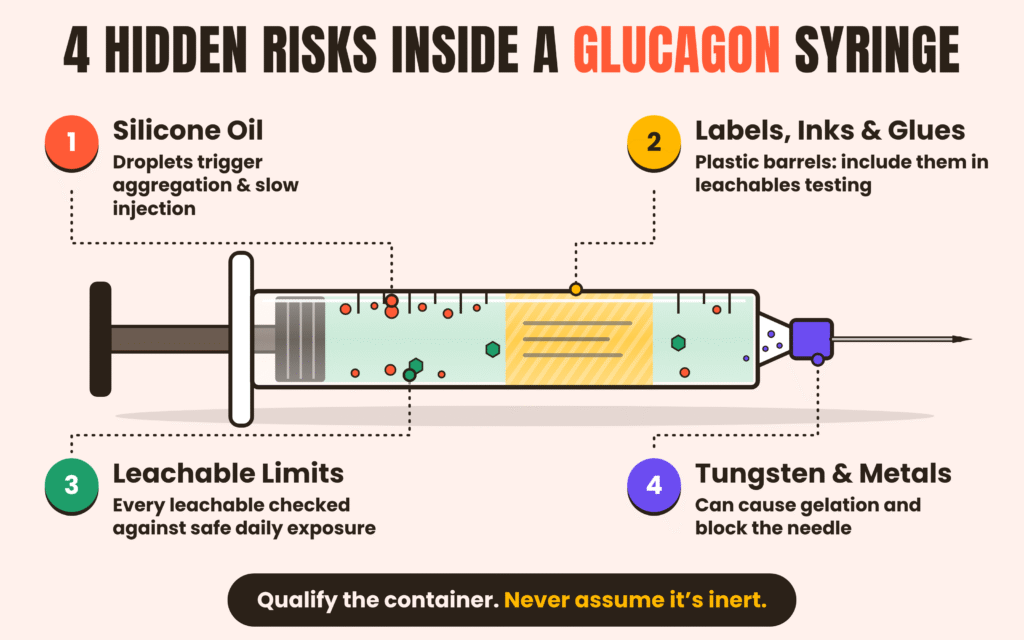
- Container-closure risks: Prefilled syringes and autoinjectors need testing for silicone oil, tungsten and metal residues, and extractables and leachables. That testing should include labels, inks and adhesives, with leachables assessed against toxicological safety thresholds.
- Analytical sameness and impurities: Sponsors must compare at least three test batches, at release and at end of shelf life, with at least three aged reference batches. They need orthogonal methods such as HRMS, LC-MS/MS, CE and NMR. The revised PSGs set a reporting threshold above 0.1% and an identification threshold above 0.5%. For Gvoke, common impurities may not exceed the reference level or 1.0%, whichever is greater.
- Device and usability parity: All three forms need comparative analyses and comparative use human factors studies. The generic device must match the reference in key features such as needle size, dose markings, injection performance and single-use nasal actuation.
- Market barriers: No generic Baqsimi is approved yet. It is protected by new patient population exclusivity until March 17, 2028, and by listed patents running to 2036 and 2039.
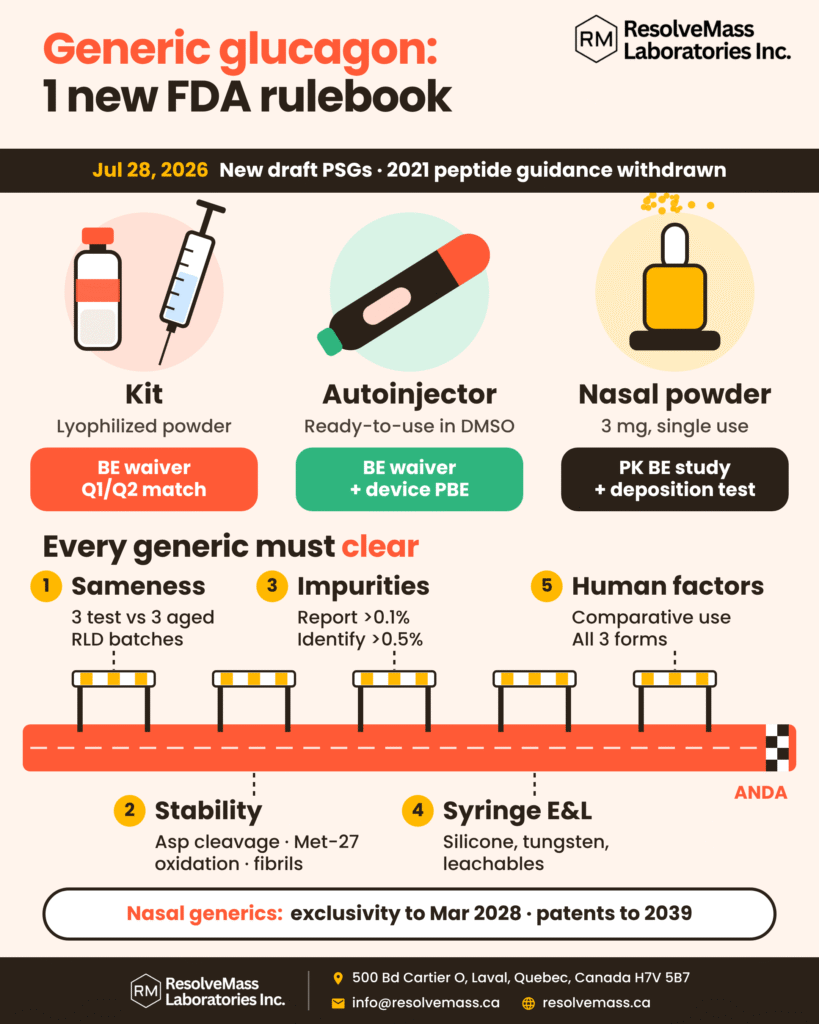
Regulatory Landscape for Generic Glucagon Development: The July 2026 FDA Shift
The regulatory framework for Generic Glucagon Development experienced a significant change on July 28, 2026, when the FDA withdrew its May 2021 guidance on ANDAs for Certain Highly Purified Synthetic Peptide Drug Products That Refer to Listed Drugs of rDNA Origin and released 17 revised draft PSGs for generic peptides. Although the May 2021 framework facilitated early approvals of synthetic peptides referencing recombinant products, including Amphastar Pharmaceuticals’ December 2020 approval (ANDA 208086) referencing Eli Lilly’s yeast-derived recombinant Glucagon for Injection (NDA 020928), the agency concluded that the 2021 guidance no longer adequately represented contemporary analytical science and indicated that an updated replacement guidance would be developed.
Explore analytical approaches that support generic drug development, including comparative characterization and impurity evaluation:
Analytical Services for Generic Drug Development
Before the synthetic peptide ANDA framework became established, developers seeking to introduce synthetic glucagon products referencing recombinant drugs frequently relied on the 505(b)(2) New Drug Application pathway. For example, FDA clinical pharmacology reviews for NDA 201849, a 505(b)(2) lyophilized glucagon product intended for radiologic gastrointestinal motility inhibition, documented clinical pharmacokinetic (PK) and pharmacodynamic (PD) comparability studies demonstrating 90% confidence intervals within 80–125% for glucagon exposure and blood glucose response. Fresenius Kabi likewise reported using the 505(b)(2) pathway to establish PK and PD bioequivalence for its synthetic Glucagon Emergency Kit against GlucaGen.
Under the revised July 2026 PSGs, for which the public comment period ended on September 28, 2026, the FDA explicitly establishes ANDA requirements for glucagon drug substances manufactured through synthetic, semi-synthetic, or recombinant processes across all three reference listed drug (RLD) platforms. For glucagon APIs produced through recombinant technology, sponsors must also demonstrate adequate manufacturing process controls and comparative removal of host cell proteins and residual DNA, in addition to complying with compendial specifications.
Strengthen your regulatory strategy with technical and submission-focused support:
Regulatory Support for Generic Drug Development
| Regulatory Parameter | Lyophilized Injection (PSG_020928) | RTU Solution IV/SC (PSG_212097) | Nasal Powder (PSG_210134) |
|---|---|---|---|
| Reference Listed Drug | NDA 020928 (Glucagon Emergency Kit, 1 mg/vial) | NDA 212097 (Gvoke PFS / HypoPen / Kit, 0.5 mg/0.1 mL; 1 mg/0.2 mL) | NDA 210134 (Baqsimi Nasal Powder, 3 mg) |
| PSG Revision History | Recommended Nov 2025; Revised Jul 2026 | Recommended Nov 2021; Revised Aug 2023, Dec 2025, Jul 2026 | Recommended Feb 2023; Revised Dec 2025, Jul 2026 |
| Comparative Batch Requirement | ≥ 3 test batches (release and end of shelf life) vs. ≥ 3 aged RLD batches | ≥ 3 test batches (release and end of shelf life) vs. ≥ 3 aged RLD batches | ≥ 3 test batches (release and end of shelf life) vs. ≥ 3 aged RLD batches |
| In Vivo Bioequivalence | Waiver request for in vivo BE; Q1/Q2 (±5%) or justification under 21 CFR 314.94(a)(9)(iii) | Eligible for waiver under 21 CFR 320.22(b)(1) if Q1/Q2 (±5%) | Required: Baseline-corrected plasma/serum glucagon PK (AUC0-t, AUC0-inf, Cmax) |
| In Vitro / Device BE Studies | Prefilled diluent syringe with staked needle, dose markings, matching gauge and length | Autoinjector PBE for delivered volume and extended needle length; ejection time and trigger force | In vitro drug deposition / mass balance across ≥ 3 batches (≥ 10 units/batch; 85–115% of label claim) |
| User Interface Assessment | Comparative analyses and Comparative Use Human Factors required | Comparative analyses and Comparative Use Human Factors required | Comparative analyses and Comparative Use Human Factors required; single-use, no priming |
Chemical and Physical Stability Challenges in Glucagon Formulations
Native glucagon is inherently unstable in aqueous solutions because the acidic pH necessary for peptide solubilization also promotes hydrolytic degradation and self-assembly into amyloid-like fibrils. Lyophilized products, such as NDA 201849, formulated with 1 mg/mL glucagon hydrochloride and 107 mg lactose monohydrate at pH 2.5–3.5 after reconstitution, reduce this risk during storage and distribution by maintaining the peptide in a dry cake until it is mixed at the point of use. Nevertheless, prescribing information requires immediate administration following reconstitution and visual examination of the solution. Solutions showing cloudiness, discoloration, or particulate matter must be discarded.
Discover analytical strategies for evaluating degradation products and maintaining quality throughout generic development:
Comparative Testing Between Generic and RLD
At the chemical level, acidic aqueous environments promote glutaminyl deamidation and site-specific aspartyl peptide bond hydrolysis. Solution-phase kinetic investigations indicate that cleavage at Asp-9 and Asp-15 occurs more rapidly than at Asp-21 across the studied acidic pH ranges, with rate constants exhibiting non-first-order dependence on hydronium ion concentration. Under elevated temperatures, neutral-to-basic pH shifts, exposure to trace metals, or light, glucagon may also undergo N-terminal cyclization to pyroglutamic acid, resulting in a -17 Da mass loss at Gln that neutralizes the terminal charge and alters the peptide’s isoelectric point and receptor affinity. Oxidation may additionally occur at Met-27, Trp, and His residues.
From a physical stability perspective, glucagon self-association presents substantial formulation and safety challenges. Liquid-state nuclear magnetic resonance (NMR) studies identify Met-27 as an important residue involved in initiating glucagon oligomerization under acidic conditions, facilitating the formation of structured amyloid-like fibrils. These aggregates can produce visible cloudiness, agglomeration, and gelation, potentially impairing injectability. Furthermore, aged glucagon fibrils have demonstrated considerable cytotoxicity in PC12 cellular models, comparable to prion protein fragment PrP106–126 and beta-amyloid Aβ1–42. Multimeric aggregates also raise immunogenicity concerns because they can generate repetitive conformational epitopes.
| Degradation Mechanism | Vulnerable Residues / Conditions | Analytical Detection & Characterization Methods | Impact on Glucagon Drug Product |
|---|---|---|---|
| Aspartyl Cleavage | Asp-9, Asp-15 (faster), Asp-21 (slower); acidic pH | RP-HPLC, LC-MS/MS peptide mapping, HRMS | Chain truncation, fragment impurities, loss of receptor binding potency |
| Deamidation & Isomerization | Gln residues; N-terminal Gln/Asn pyroglutamic acid (-17 Da for Gln) | LC-MS/MS, Capillary Electrophoresis (CE), Ion-Exchange Chromatography | Changes in isoelectric point (pI), altered receptor affinity, formation of co-eluting positional isomers |
| Oxidation | Met-27, Trp, His; heat, light, oxygen, trace metals | RP-HPLC, LC-MS/MS, MALDI-TOF MS | Initiates acidic oligomerization at Met-27; produces stability-indicating variants |
| Amyloid Fibrillation & Gelation | Acidic aqueous media, agitation, hydrophobic interfaces, reactive leachables | SEC-MALS, DLS, SV-AUC, Micro-Flow Imaging (MFI), NMR | Solution cloudiness, viscosity increase, gelation, PC12 cytotoxicity, immunogenicity risk |
Ready-to-Use Emergency Formulations: Chemistry, Container Closure, and Patent Barriers
Ready-to-use emergency glucagon formulations eliminate the need for multi-step reconstitution at the point of administration by stabilizing native glucagon in an anhydrous organic solvent or as a dry nasal powder. In contrast, newer peptide analogs achieve aqueous stability through modifications to the primary amino acid sequence. For example, dasiglucagon (Zegalogue, NDA 214231) contains seven amino acid substitutions across its 29-residue chain, enabling aqueous stability in a prefilled syringe and autoinjector. Consequently, it is covered by a dedicated PSG (PSG_214231) rather than the ANDA pathways applicable to native glucagon. Developers pursuing generic versions of native glucagon RTU products must navigate distinct formulation, bioequivalence, container-closure, and intellectual property challenges.
Learn more about the manufacturing considerations involved in taking generic drug products toward commercial production:
Manufacturing Scale-Up for Generic Drugs
Non-Aqueous DMSO Solutions (Gvoke NDA 212097)
Non-aqueous RTU glucagon formulations, including Gvoke (NDA 212097, originally approved September 10, 2019), prevent aqueous hydrolysis and amyloid fibril gelation by dissolving solid-phase synthesized glucagon in DMSO alongside stabilizing carbohydrates and mineral acid. According to DailyMed labeling, each 0.1 mL of the 0.5 mg Gvoke HypoPen contains 0.5 mg glucagon, 5.6 mg trehalose dihydrate NF, and 0.6 mg of 1N sulfuric acid in 104 mg DMSO diluent. Patent disclosures, including U.S. Patent 12,128,089 B2, also describe formulations containing trehalose dihydrate, 5.8 mg mannitol USP, and 1.32 mg of 1N sulfuric acid in DMSO. According to Drugs@FDA records compiled by Arca as of November 13, 2026, the 0.5 mg/0.1 mL prefilled syringe and 1 mg/0.2 mL intravenous Vialdx presentations have been discontinued. The active marketed reference products include the 1 mg/0.2 mL prefilled syringe, 0.5 mg/0.1 mL and 1 mg/0.2 mL HypoPen autoinjectors, and the 1 mg/0.2 mL Kit.
Replacing water with DMSO transfers the primary CMC risks from peptide hydrolysis to moisture ingress, solvent oxidation, and precipitation following dilution. DMSO is highly hygroscopic, and even minor water absorption during formulation or storage can affect solution viscosity, freezing point, glucagon solubility, and potency. Additionally, exposure to oxygen, elevated temperatures, or light may promote oxidation of DMSO into dimethyl sulfone.
The FDA’s February 9, 2024, action letter for NDA 212097/S-012, issued before the supplement’s approval on March 14, 2025, also highlighted the possibility of submicron particle formation, gelation, and agglomeration when DMSO-based glucagon is diluted for intravenous administration. These concerns necessitate comparative dose-accuracy testing, Dynamic Light Scattering (DLS) particle-size analysis, and comparative gelation assessments. To qualify for an in vivo bioequivalence waiver under 21 CFR 320.22(b)(1), a generic RTU solution must demonstrate Q1 qualitative sameness and Q2 quantitative sameness within ±5% of the RLD’s inactive ingredients or provide justification for differences in preservatives, buffers, or antioxidants under 21 CFR 314.94(a)(9)(iii).
Intranasal Dry Powder Formulations (Baqsimi NDA 210134)
Intranasal glucagon (Baqsimi, NDA 210134, approved July 24, 2019, under Eli Lilly and held by Amphastar Pharmaceuticals Inc. in October 2026 Orange Book snapshots) avoids solution-related degradation by delivering 3 mg of preservative-free glucagon blended with betadex and dodecylphosphocholine as a single-use dry powder. Unlike parenteral solutions, generic nasal powder products cannot qualify for a Q1/Q2 biowaiver because mucosal bioavailability is influenced by aerodynamic particle distribution and local dissolution characteristics.
Under the July 2026 PSG_210134, sponsors must conduct an in vitro drug deposition and mass balance bioequivalence study alongside an in vivo PK bioequivalence study. The in vitro study must evaluate at least three test batches and three reference standard batches, with a minimum of 10 units per batch. Mass balance accountability across all impactor stages and device accessories must remain within 85–115%. The in vivo PK study must assess the 90% confidence intervals for baseline-corrected glucagon AUC0-t, AUC0-inf, and Cmax.
Commercialization of generic intranasal glucagon also involves substantial exclusivity and patent-related obstacles. As of October 7, 2026, Drugs.com reported that no FDA-approved generic version of Baqsimi was available. According to October 2026 Orange Book data compiled by Assyro AI and Drugs.com, NDA 210134 is protected by three-year New Patient Population (NPP) exclusivity through March 17, 2028, associated with March 2025 labeling that extended pediatric use to children as young as one year. The product also has three listed patents: U.S. Patents 10,213,487 and 12,370,241, covering nasal powder formulations and expiring February 16, 2036, and U.S. Patent 10,765,602, covering the delivery system and expiring September 23, 2039.
Prefilled Syringe Compatibility, Silicone Oil, and Extractables and Leachables
Prefilled syringes (PFS) and autoinjectors expose emergency glucagon formulations to relatively high surface-area-to-volume ratios and multiple material-contact interfaces, which can contribute to peptide instability or contamination from leachable substances. Container-closure qualification programs must address four principal risk categories:
- Silicone Oil Lubrication: Both spray-on and baked-on siliconization levels, along with barrel homogeneity, must be assessed through spiking studies and stability correlations. Migrating silicone oil microdroplets can influence syringeability, including injection time and glide force, promote interfacial aggregation, and act as immunological adjuvants in biologics models.
- Tungsten, Adhesives, and Transition Metals: Residual tungsten originating from needle-hole formation, needle-mounting adhesives, and elastomer-derived ions such as Zn2+ must be evaluated through forced-degradation spiking studies. Parenteral biologics investigations have demonstrated that trace metal release can contribute to rapid viscosity increases, gelation, and needle blockage.
- Semi-Permeable Polymer Components: Extractables and leachables (E&L) assessments for cyclic olefin copolymer (COC) or plastic syringe systems must incorporate secondary packaging, barrel labels, inks, glues, and adhesives. Excluding syringe label components from initial extractable profiling has been documented as a potential cause of FDA deficiency letters.
- Toxicological Qualification Thresholds: Leachables detected in stability batches must be assessed against Permitted Daily Exposure (PDE) limits and ICH M7(R1) parenteral Thresholds of Toxicological Concern (TTC), specifically 35, 110, and 180 µg/day for non-mutagenic exposures spanning more than 10 years, more than 1–10 years, and one year or less, respectively. ISO/TS 21726 Dose-Based Thresholds should be applied to establish the Analytical Evaluation Threshold (AET).
Analytical Sameness, Impurity Controls, and Device Bioequivalence Requirements
Demonstrating active ingredient sameness under the July 2026 Glucagon PSGs requires comparative analytical evaluation of at least three batches of the proposed generic product, tested at or near release and again at the end of the proposed shelf life, against at least three RLD batches aged before expiry under the most restrictive label storage conditions. Solid-phase peptide synthesis (SPPS) can generate deletion sequences, truncated peptides, and D/L-epimers that may co-elute with native glucagon under conventional reversed-phase chromatographic gradients. Therefore, chromatographic retention time alone is insufficient to establish peptide identity or analytical sameness.
Explore advanced mass spectrometry approaches for structural characterization and comparative analysis:
Biosimilar Characterization Using Mass Spectrometry
Comprehensive peptide impurity investigations should compare crude material, purified API, finished drug product, freshly manufactured batches, stability samples, forced-degradation samples, and RLD controls through parallel testing using orthogonal high-resolution mass spectrometry (HRMS), LC-MS/MS sequence mapping, MALDI-TOF MS, and capillary electrophoresis (CE). Analytical method validation must also address peptide-related artifacts, including container surface adsorption, ion suppression, carryover, multiple charge states, and artificial degradation occurring during sample storage or handling.
Learn how peptide mapping contributes to detailed molecular characterization:
Peptide Mapping in Biosimilars
Impurity Thresholds and Immunogenicity Controls in Generic Glucagon Development
A significant regulatory change in Generic Glucagon Development involves the revised impurity reporting and identification requirements introduced between the withdrawn May 2021 synthetic peptide guidance and the July 2026 revised Glucagon PSGs. Under the 2021 framework, generic applicants were subject to a 0.10% identification threshold and a prohibition on generic-only impurities exceeding 0.5%. Under the revised July 2026 PSGs, the FDA establishes a reporting threshold of > 0.1% and an identification threshold of > 0.5% of the drug substance across all three glucagon dosage forms.
Additionally, PSG_212097 requires common impurities to remain at or below the RLD level or 1.0%, whichever is greater. Manufacturing process controls should aim to reduce new impurities below 1.0%, while the total active-ingredient-related impurities exceeding 0.1% must not surpass the total impurity level of the RLD. Scientific justification or consultation with the Office of Generic Drugs (OGD) may be appropriate when these limits are exceeded.
| Impurity / Quality Criterion | Withdrawn May 2021 Synthetic Peptide Guidance | Ph. Eur. Monograph 2034 (Baseline) | July 2026 Revised Glucagon PSGs (020928 / 212097 / 210134) |
|---|---|---|---|
| Reporting Threshold | 0.10% (scaled against RLD) | > 0.1% | > 0.1% of drug substance (all three PSGs) |
| Identification Threshold | ≥ 0.10% (complete structural identification required) | > 0.5% | > 0.5% of drug substance (all three PSGs) |
| Common Impurity Limit (Present in RLD) | Controlled relative to RLD profile | > 1.0% qualification threshold (≤ 1.0% unqualified known limit) | Not to exceed RLD level or 1.0% of drug substance, whichever is greater (PSG_212097) |
| New Impurity Limit (Generic-Only) | 0.10–0.5% requires immunogenicity justification; > 0.5% prohibited | Subject to monograph limits | Process controls applied to reduce below 1.0%; total impurities (> 0.1%) ≤ RLD (PSG_212097) |
| Innate Immune Testing Waiver | Generally required for new or elevated impurities | Not explicitly specified | May not be scientifically necessary if non-API impurities meet compendial/tox limits and the aggregate profile matches the RLD |
Higher-order structure (HOS) and aggregate comparability assessments rely on complementary biophysical methods, including NMR, Size-Exclusion Chromatography with Multi-Angle Light Scattering (SEC-MALS), DLS, Micro-Flow Imaging (MFI), and Sedimentation Velocity Analytical Ultracentrifugation (SV-AUC). SV-AUC enables quantification of native monomeric and oligomeric species without introducing chromatographic matrix shear. Notably, PSG_212097 and PSG_020928 clarify that biological or functional assays, such as cell-based assays or ligand-binding assays, may not always be necessary if the sponsor demonstrates that the formulated peptide does not possess functional secondary or higher-order structure.
Consolidating these multi-platform characterization methods, nitrosamine risk screening, and PFS leachables assessments within a single laboratory reduces data gaps between vendors. For example, ResolveMass Laboratories Inc., operating in Laval, Québec, under Health Canada GMP Drug Establishment Licence 3-002945-A, FDA registration 3042696771, and ISO 9001:2015 certification, performs HRMS structural elucidation, LC-MS/MS sequencing, NMR, and E&L assessments under a unified quality system to support regulatory CMC submissions.
Combination Product Device Testing and User Interface Parity
Because emergency glucagon is commonly administered by untrained bystanders or caregivers during severe hypoglycemia, the delivery device plays a critical role in establishing therapeutic equivalence. For RTU autoinjectors under PSG_212097, sponsors must demonstrate statistical equivalence through Population Bioequivalence (PBE) analysis for delivered volume and extended needle length, supplemented by comparative assessments of ejection time and trigger force. These evaluations must also address matching external design characteristics, medication viewing windows, and needle gauge and length.
Generic lyophilized kits under PSG_020928 must reproduce the geometry of the staked-needle prefilled diluent syringe, dose markings, and needle dimensions. Intranasal generics under PSG_210134 must replicate the single-use, no-priming actuation mechanism. For all product presentations, comprehensive comparative analyses and Comparative Use Human Factors assessments are required to establish equivalent clinical safety and usability.
Conclusion
Successfully developing generic glucagon products under the FDA’s post-July 2026 framework requires coordinated implementation of peptide synthesis controls, non-aqueous or dry-powder stabilization strategies, orthogonal higher-order structure characterization, and combination-product device engineering from the earliest development stages. Sponsors pursuing lyophilized emergency kits, DMSO-solubilized autoinjectors, or intranasal powders must establish three-batch release and end-of-shelf-life comparability programs against aged RLD batches while developing scientifically defensible extractables and leachables (E&L) and Population Bioequivalence (PBE) datasets.
Pharmaceutical teams seeking integrated analytical method development, HRMS-based impurity elucidation, forced-degradation kinetics, or GMP release and E&L testing to support an ANDA submission can connect with the scientific team at ResolveMass Laboratories Inc. through the Contact Us page.
Frequently Asked Question
Yes. Generic intravenous or subcutaneous glucagon solutions referencing Gvoke (NDA 212097) may qualify for an in vivo bioequivalence waiver under 21 CFR 320.22(b)(1), provided they demonstrate Q1 and Q2 sameness, with inactive ingredient quantities remaining within ±5% of the reference product. Any differences involving preservatives, buffers, or antioxidants must be scientifically justified under 21 CFR 314.94(a)(9)(iii), supported by evidence that such variations do not compromise product safety or therapeutic performance.
Native glucagon is highly susceptible to chemical degradation and physical aggregation in acidic aqueous environments, resulting in deamidation, aspartyl bond cleavage, oligomerization, and amyloid-like fibril formation. DMSO provides a non-aqueous formulation environment that limits these water-dependent degradation pathways. When combined with stabilizing excipients such as trehalose dihydrate and sulfuric acid, it supports the development of liquid glucagon products suitable for storage in prefilled syringes and autoinjectors.
The July 2026 Glucagon PSGs establish a reporting threshold above 0.1% and an identification threshold above 0.5% for drug substance-related impurities. Under PSG_212097, impurities also present in the RLD should remain within the RLD level or 1.0%, whichever is higher. Manufacturing controls should minimize newly generated impurities below 1.0%, while the overall level of impurities exceeding 0.1% must not be greater than the corresponding RLD impurity level.
As of October 2026, the FDA had not approved a generic equivalent of Baqsimi (NDA 210134). The product faces significant regulatory and intellectual property barriers that complicate generic development and commercialization. October 2026 Orange Book information identifies New Patient Population (NPP) exclusivity through March 17, 2028, formulation patents extending until February 16, 2036, and a delivery system patent expiring September 23, 2039.
Intranasal glucagon absorption is influenced by several formulation and delivery characteristics, including aerodynamic particle distribution, nasal deposition, excipient functionality, and dissolution across the nasal mucosa. Therefore, matching the composition of the reference product alone cannot establish equivalent drug absorption. Under PSG_210134, sponsors must conduct both in vitro drug deposition and mass balance testing, maintaining 85–115% of the label claim, and an in vivo PK study evaluating the 90% confidence intervals for baseline-corrected glucagon AUC0-t, AUC0-inf, and Cmax.
In vitro innate immune response testing may be scientifically unnecessary when the generic product demonstrates an impurity and aggregate profile comparable to that of the RLD. This consideration applies when non-active-ingredient impurities, such as particulate matter, microbial contaminants, residual organic solvents, elemental impurities, and leachables, comply with relevant compendial specifications and toxicological limits. Sponsors must provide sufficient analytical evidence to establish that these impurities do not introduce additional quality or safety concerns.
Generic glucagon autoinjectors referencing Gvoke must demonstrate Population Bioequivalence (PBE) for delivered volume and extended needle length in accordance with PSG_212097. Additional comparative testing must evaluate important functional characteristics, particularly ejection time and trigger force. Sponsors must also establish similarity in critical device features, including the medication viewing window, needle gauge, and needle length, supported by comparative user interface assessments.
The July 2026 Glucagon PSGs recommend evaluating a minimum of three generic product batches against three batches of the reference listed drug. Generic batches must undergo comparative testing at or near release and again at the end of the proposed shelf life. The RLD batches should be aged before their expiry dates under the most restrictive storage conditions specified in the product labeling to establish an appropriate comparison of product quality and stability.
Prefilled glucagon syringes can introduce formulation-related risks through contact with silicone oil, residual tungsten, needle-mounting adhesives, and elastomer-derived leachables such as Zn2+. These substances may contribute to peptide aggregation, changes in viscosity, gel formation, and inconsistent syringe glide or injection forces. Plastic and cyclic olefin copolymer (COC) syringe systems also require comprehensive Extractables and Leachables (E&L) assessments covering barrel labels, inks, adhesives, and other product-contact materials, with toxicological evaluation against PDE limits and ICH M7(R1) parenteral TTC requirements.
Reference:
- U.S. Food and Drug Administration. (2026, July). Draft guidance on glucagon: Intravenous, subcutaneous solution (NDA 212097). https://www.accessdata.fda.gov/drugsatfda_docs/psg/PSG_212097.pdf
- U.S. Food and Drug Administration. (2026, July). Draft guidance on glucagon: Nasal powder (NDA 210134). https://www.accessdata.fda.gov/drugsatfda_docs/psg/PSG_210134.pdf
- U.S. Food and Drug Administration. (2026, July). Draft guidance on glucagon: Injectable (NDA 020928). https://www.accessdata.fda.gov/drugsatfda_docs/psg/PSG_020928.pdf
- Pang, E., Chong, W., & Luke, M. C. (2021). Scientific and regulatory considerations for the approval of the first generic glucagon. Journal of the Endocrine Society, 5(Supplement 1), A324–A325. https://doi.org/10.1210/jendso/bvab048.662
- Pluchino, K. (2021). Clinical review: Zegalogue (dasiglucagon injection), NDA 214231. U.S. Food and Drug Administration. https://www.accessdata.fda.gov/drugsatfda_docs/nda/2021/214231Orig1s000MedR.pdf
- Moorthy, B. S., Ghomi, H. T., Lill, M. A., & Topp, E. M. (2015). Structural transitions and interactions in the early stages of human glucagon amyloid fibrillation. Biophysical Journal, 108(4), 937–948. https://doi.org/10.1016/j.bpj.2015.01.004
- U.S. Food and Drug Administration. (2019). Glucagon for injection: Prescribing information. https://www.accessdata.fda.gov/drugsatfda_docs/label/2019/201849s005lbl.pdf
Get In Touch With Us
About The Author