

Introduction
Generic Octreotide and Lanreotide Development represents one of the most technically challenging areas of complex parenteral Abbreviated New Drug Application (ANDA) submissions. The primary difficulties arise from their sophisticated depot-forming formulation architectures rather than patent-related obstacles. Although Novartis’s Sandostatin LAR Depot (NDA 021008, approved November 25, 1998) had no patents listed in the FDA Orange Book snapshot, its biodegradable polymer microsphere matrix created substantial formulation and regulatory challenges. Consequently, the first U.S. generic commercial launch did not occur until Teva Pharmaceuticals introduced octreotide acetate for injectable suspension in October 2024. Similarly, Ipsen’s Somatuline Depot (NDA 022074, approved August 30, 2007), which recorded $983 million in U.S. annual sales for the 12 months ending July 2026 according to IQVIA data cited by Amneal, uses a polymer-free, supersaturated peptide gel. Its self-assembling nanotube structure has made establishing regulatory equivalence particularly challenging through 2026.
For generic developers, reproducing these monthly somatostatin analogs involves considerably more than achieving comparable active pharmaceutical ingredient (API) purity. Under 21 CFR 314.94(a)(9)(iii), parenteral ANDAs must demonstrate qualitative (Q1) and quantitative (Q2) sameness, together with comprehensive physicochemical and structural (Q3) equivalence, to establish comparable in vivo drug-release performance. Differences in polymer branching, peptide conformation, or prefilled syringe configuration can influence depot formation at the injection site, compromise bioequivalence, and potentially prevent the assignment of a therapeutic equivalence rating.
Explore regulatory support for generic drug development to understand the regulatory considerations involved in complex generic development programs.
Share via:
Quick Summary:
- The barrier is the formulation, not patents. Generic octreotide and lanreotide depots are hard to copy because of how their monthly depots form and release drug, not because of API purity.
- Two very different depots. Sandostatin LAR uses biodegradable glucose-star PLGA microspheres given intramuscularly. Somatuline Depot is a polymer-free, supersaturated peptide gel that self-assembles into nanotubes after a deep subcutaneous injection.
- Small changes can break equivalence. For octreotide, the PLGA’s lactide-to-glycolide ratio, molecular weight, branching and Tg control drug release. For lanreotide, small shifts in concentration, pH or temperature history can disrupt nanotube formation.
- Two bioequivalence routes. Octreotide needs an in vivo PK study at 30 mg. Under FDA’s August 2026 revised guidance, the 90% confidence intervals for log-transformed AUC0-28, AUCt, AUC0-∞, and Cmax should fall within 80.00–125.00% (the article still lists AUC28-56, which was dropped). Lanreotide can use an in vitro Q3 biowaiver, which shows matching conformation, nanotube structure and thermal stability across at least 3 lots, or an in vivo study at 120 mg.
- Only a full ANDA gives substitutability. InvaGen’s 2021 505(b)(2) lanreotide had no in vivo bioequivalence study and a different device. Full generic substitution came with Cipla’s AP-rated ANDA in 2024. Amneal followed in September 2026, and Teva launched the first generic octreotide LAR in October 2024.
- Analytics carry the approval. These programs need high-resolution impurity and aggregate profiling, discriminating IVRT methods, E&L and nitrosamine assessments, and device and human-factors data, especially for the viscous lanreotide prefilled syringe.
- Integration reduces risk. The article positions ResolveMass as a single-site CRO/CDMO for this work: PLGA characterization, peptide Q3 and impurity profiling by Orbitrap HRMS, E&L, and GMP release testing.
Formulation Architecture in Generic Octreotide and Lanreotide Development
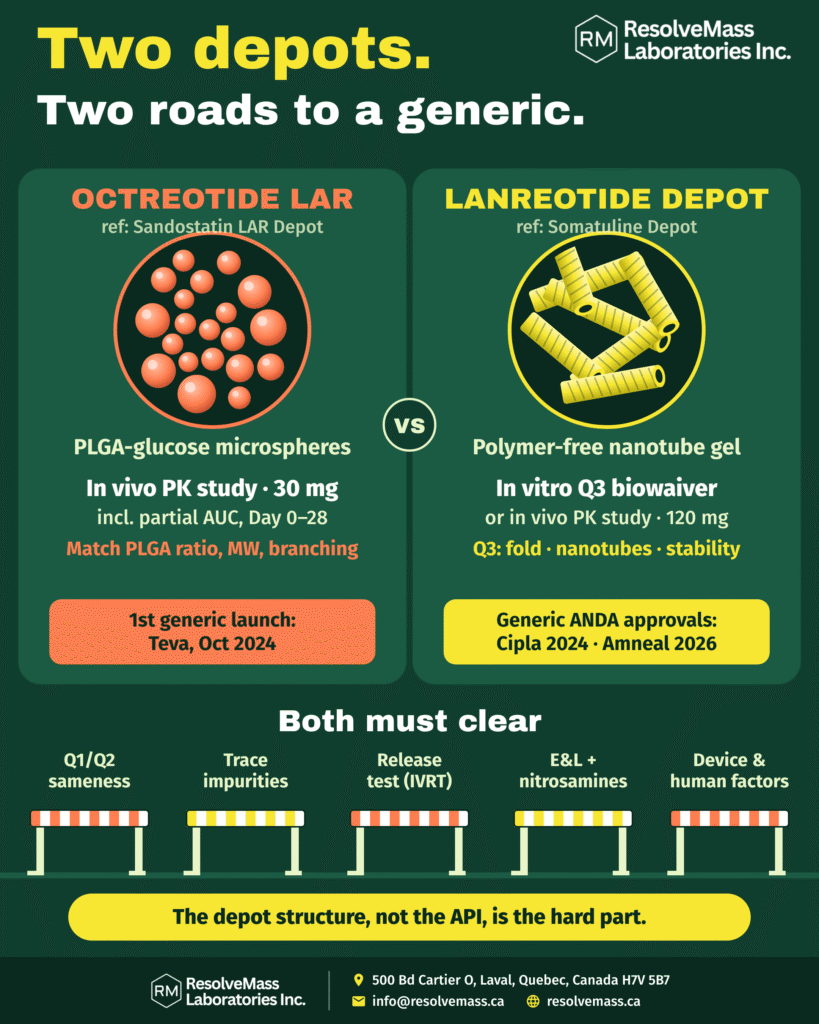
Generic octreotide LAR provides sustained drug release over four weeks by incorporating the cyclic octapeptide into biodegradable glucose-star PLGA polymer microspheres. In contrast, generic lanreotide depot formulations do not contain synthetic polymers. Instead, they use a supersaturated aqueous acetic acid solution that undergoes self-assembly to form peptide nanotubes. Although both synthetic octapeptides mimic endogenous somatostatin and are used to manage acromegaly and neuroendocrine tumors, their fundamentally different depot-forming mechanisms create distinct formulation development, characterization, and reverse-engineering challenges.
| Formulation Attribute | Sandostatin LAR Depot (Octreotide Acetate) | Somatuline Depot (Lanreotide Acetate) |
|---|---|---|
| Reference Listed Drug (RLD) | NDA 021008 (Novartis, approved Nov 25, 1998) | NDA 022074 (Ipsen, approved Aug 30, 2007) |
| Peptide Structure & MW | Cyclic octapeptide (D-Phe first unit, threoninol last); MW 1019.3 (per label summary) | Cyclic octapeptide (3-(2-naphthyl)-D-alanine first unit); MW 1096.34 (base, per label summary) |
| Depot Mechanism | Microspheres composed of biodegradable glucose-star D,L-lactic and glycolic acids copolymer (PLGA-glu) | Polymer-free, supersaturated aqueous gel that self-assembles into nanotubes; forms an in-situ depot upon contact with body fluids |
| Excipients & Diluent | Vial: PLGA-glu and mannitol; Diluent: Na-CMC, mannitol, poloxamer 188, WFI | Lanreotide acetate, Water for Injection, and acetic acid (to adjust pH) |
| Approved Strengths | 10 mg, 20 mg, and 30 mg base/vial | 60 mg/0.2 mL, 90 mg/0.3 mL, and 120 mg/0.5 mL single-use prefilled syringes |
| Route & Dosing Interval | Intramuscular (intragluteal) injection every 4 weeks | Deep subcutaneous injection (superior external buttock quadrant) every 4 weeks |
| Release Kinetics | Bimodal (two-phase) release through polymer biodegradation, primarily hydrolysis | Passive diffusion from the in-situ depot; 23–30 day half-life |
Why Is the Glucose-Star PLGA Matrix Critical for Octreotide LAR?
Sandostatin LAR uses a branched glucose-star copolymer of D,L-lactic and glycolic acids (PLGA-glu) instead of a conventional linear PLGA backbone. This distinctive polymer architecture makes the selection of suitable polymer materials and their detailed characterization essential for establishing generic equivalence.
In the innovator formulation, octreotide base doses of 10 mg, 20 mg, and 30 mg correspond to 11.2 mg, 22.4 mg, and 33.6 mg of octreotide acetate, respectively. These quantities are incorporated into proportionally adjusted PLGA-glu matrices containing 188.8 mg, 377.6 mg, and 566.4 mg of polymer, respectively. The formulation also contains mannitol at corresponding amounts of 41.0 mg, 81.9 mg, and 122.9 mg.
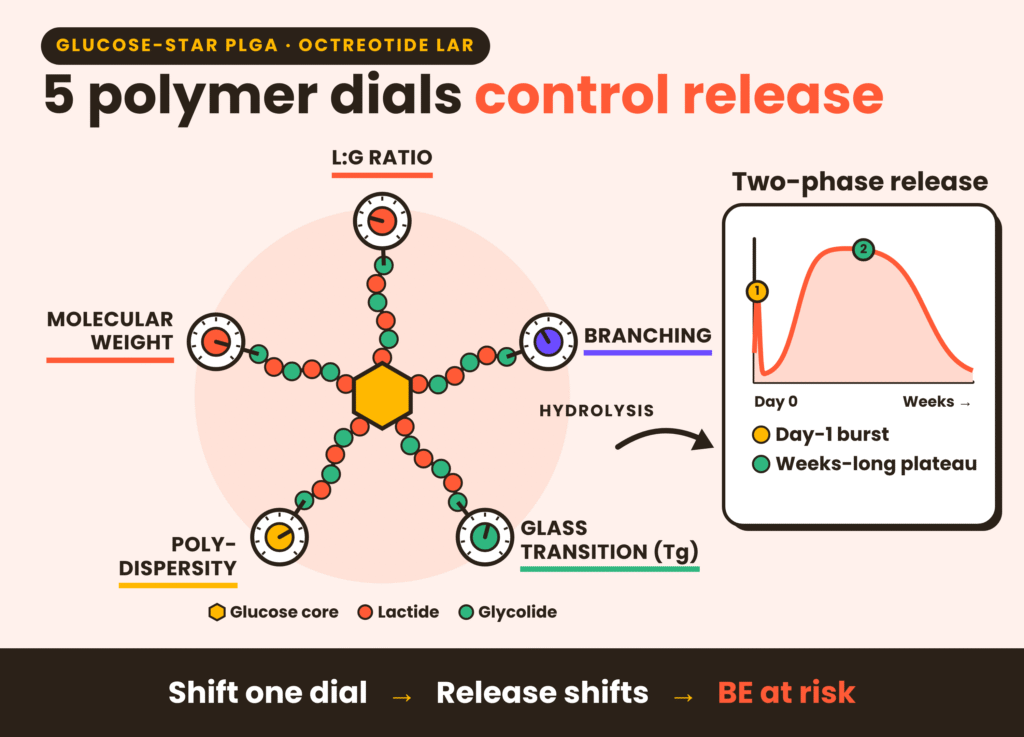
Because sustained drug release is governed by polymer biodegradation, primarily through hydrolysis, even relatively small differences in polymer characteristics can affect product performance. Critical parameters include the lactide-to-glycolide molar ratio, branching architecture, molecular weight distribution, polydispersity, and glass transition temperature (Tg). Variations in any of these properties can modify polymer degradation behavior and subsequently change the drug-release profile.
Preclinical investigations and formulation assessments of octreotide PLGA microspheres have identified a characteristic bimodal (two-phase) drug-release pattern. Reproducing this complex release behavior during scale-up is particularly challenging because microsphere production involves demanding, multi-unit operation processes, specialized equipment that is not commonly available, and highly experienced technical personnel.
Even minor differences between laboratory-scale batches and commercial-scale manufacturing can change microsphere properties. Such variations may influence drug distribution, polymer degradation, and in vivo release kinetics, ultimately creating difficulties in demonstrating bioequivalence.
Discover manufacturing scale-up considerations for generic drugs to learn how process consistency can be maintained during commercial production.
How Does Peptide Nanotube Self-Assembly Govern Lanreotide Depot Performance?
Lanreotide acetate undergoes spontaneous self-assembly into organized and reversible nanotubes in aqueous acetic acid under thermodynamic equilibrium. This process produces a white to pale-yellow, viscoelastic semi-solid gel without requiring synthetic polymers. Its molecular structure, which includes a cyclic octapeptide ring closed by a sulfur bond and a 3-(2-naphthyl)-D-alanine residue, supports the formation of cylindrical nanotube assemblies.
Following deep subcutaneous administration, the formulation interacts with physiological fluids and establishes an in situ drug depot. Lanreotide is subsequently released from this depot through passive diffusion into surrounding tissues and systemic circulation. Its prolonged elimination profile is characterized by a half-life of approximately 23–30 days.
The self-assembly process is highly dependent on temperature and peptide concentration, following a specific phase diagram under thermodynamic equilibrium. Consequently, even minor changes in peptide concentration, pH, or thermal history can interfere with the formation and maintenance of the required structural organization.
Experimental investigations indicate that modifications to important molecular characteristics may eliminate lanreotide’s ability to self-assemble or cause it to transition into less-organized structures, including amyloid fibers and curved lamellae.
Another important consideration is the high viscosity of the resulting supersaturated gel. This property requires specialized prefilled syringe and needle configurations capable of delivering the intended dose accurately and safely into deep subcutaneous tissue. Inadequate device engineering may increase the possibility of administration errors and compromise product performance.
Learn more about lanreotide generic development services and the technical considerations involved in developing equivalent depot formulations.
FDA Product-Specific Guidance and Bioequivalence Pathways
The FDA applies stringent Q1 and Q2 sameness expectations under 21 CFR 314.94(a)(9)(iii) to generic octreotide and lanreotide parenteral formulations. However, the agency’s expectations for demonstrating clinical bioequivalence differ substantially between these two depot products.
Octreotide LAR requires an in vivo pharmacokinetic bioequivalence study that evaluates two partial area-under-the-curve (AUC) intervals to establish comparable drug-release behavior. Conversely, lanreotide acetate provides an opportunity for an in vitro biowaiver, provided that applicants demonstrate comprehensive Q3 structural and thermodynamic equivalence.
| Regulatory Parameter | Octreotide Acetate IM Microsphere (RLD 021008) | Lanreotide Acetate SC Depot (RLD 22074) | Octreotide Acetate SC Pen Solution (RLD 213224) |
|---|---|---|---|
| FDA PSG Status | Recommended Jan 2011; Revised Feb 2014 | Recommended Jul 2014 | Recommended Mar 2021; Revised Feb 2026 |
| Q1 / Q2 Requirement | Same inactive ingredients (Q1) and concentrations (Q2) under 21 CFR 314.94(a)(9)(iii) | Q1/Q2 sameness under 21 CFR 314.94(a)(9)(iii) | Q1 and Q2 within ±5%; differences in preservatives, buffers, or antioxidants permitted with supporting safety and efficacy data |
| Primary BE Pathway | Single-dose, fasting, parallel in vivo study at 30 mg IM in healthy subjects | Option 1: In vitro Q3 evaluation and release biowaiver (at least 3 lots); OR Option 2: Parallel in vivo BE study at 120 mg deep SC | Request for waiver of in vivo BE under 21 CFR 320.22(b)(1) |
| Key PK / Release Endpoints | 90% CI (80.00–125.00%) for log-transformed AUC0-28, AUC28-56, AUCt, AUC0-∞, and Cmax | In vitro release testing across at least 3 lots (Option 1), or 90% CI for plasma lanreotide concentrations (Option 2) | Comparative primary sequence and oligomer/aggregation profile across at least 3 batches, evaluated at release and end of shelf life |
| Lower Strength Waivers | 10 mg and 20 mg waived based on 30 mg BE, proportional similarity, and comparative dissolution testing using 12 units | 60 mg and 90 mg waived based on 120 mg BE, proportional similarity, and comparative dissolution testing using 12 units | Single strength (EQ 7 mg Base/2.8 mL; EQ 2.5 mg Base/mL) |
| Device / Human Factors | Standard IM vial and diluent kit | Not explicitly specified in the 2014 PSG, although prefilled syringe-related user errors have received regulatory scrutiny | Comparative user-interface and human factors assessment for the variable-dose disposable pen injector |
Bioequivalence and Partial AUC Hurdles for Octreotide Microspheres
For ANDA approval of octreotide acetate microspheres, applicants must demonstrate in vivo bioequivalence using the highest approved strength, 30 mg. The FDA recommends a single-dose, fasting, parallel-design study involving healthy male and nonpregnant female subjects who receive the product through intragluteal intramuscular injection.
Unlike conventional immediate-release injectable products, octreotide LAR requires applicants to demonstrate that the 90% confidence intervals fall within the 80.00–125.00% acceptance range for five log-transformed pharmacokinetic parameters. These include Cmax, AUC0-∞, AUCt, and two partial AUC measurements: AUC0-28, representing exposure from days 0 to 28, and AUC28-56, representing exposure from days 28 to 56.
In addition to the FDA requirements, the European Medicines Agency’s octreotide depot guidance (EMA/CHMP/291571/2018) evaluates AUC0-t, Cmax, and early-exposure AUC0-72.
The requirement to measure both AUC0-28 and AUC28-56 ensures that generic formulations reproduce the complete two-phase drug-release profile in vivo. This prevents a formulation with substantially different early-stage or late-stage release behavior from demonstrating bioequivalence based exclusively on comparable total systemic exposure.
Since octreotide LAR bioequivalence studies require a parallel design with pharmacokinetic monitoring over nearly two months for each administered dose, clinical development can involve considerable expenses and increased exposure to inter-subject variability.
Once bioequivalence has been established for the 30 mg strength, applicants may obtain waivers for the 10 mg and 20 mg strengths. These waivers depend on proportional formulation similarity and acceptable comparative dissolution results obtained using 12 dosage units per strength, sourced from 12 different bottles.
Generic developers pursuing immediate-release octreotide pen injectors, referencing Sun Pharma’s Bynfezia Pen (NDA 213224), must follow a different regulatory framework under the revised February 2026 FDA draft guidance.
This subcutaneous solution may qualify for an in vivo bioequivalence waiver under 21 CFR 320.22(b)(1), provided that Q1 and Q2 sameness requirements, including the ±5% quantitative criterion, are satisfied. However, applicants must establish that the primary peptide sequences and oligomer/aggregation profiles are equivalent.
This assessment requires testing at least three generic batches at or near release and at the end of the proposed shelf life. The results must be compared against aged reference standard batches tested before their expiry dates. Additionally, applicants must provide comparative user-interface and human factors assessments for the variable-dose pen injector to establish that the delivery system performs appropriately and supports safe administration.
Navigating Biowaivers vs. 505(b)(2) Pathways in Generic Octreotide and Lanreotide Development
For lanreotide depot, the FDA’s July 2014 draft guidance provides a potential route to ANDA approval without conducting in vivo clinical bioequivalence studies. This in vitro biowaiver pathway is available when the generic applicant demonstrates equivalent Q3 molecular, structural, and thermodynamic characteristics, supported by comparative in vitro drug-release testing involving at least three lots each of the test and reference products.
Applicants must establish equivalence across three fundamental Q3 characterization areas:
1. Lanreotide conformation: Applicants must demonstrate that the generic formulation maintains a peptide secondary structure and molecular folding pattern comparable to the reference listed drug.
2. Nanotube structure: The self-assembled supramolecular nanotube morphology and organization must be characterized and shown to be equivalent to those of the reference product.
3. Thermo-stability across temperatures and dilutions: Applicants must establish comparable phase diagram behavior and equilibrium stability under different temperature conditions and dilution levels.
The commercial and regulatory implications of failing to maintain strict ANDA Q1/Q2/Q3 alignment are evident from the product’s U.S. regulatory history.
In December 2021, InvaGen obtained FDA approval for a lanreotide acetate injection through a hybrid 505(b)(2) NDA (NDA 215395) referencing Somatuline Depot. However, a subsequent Citizen Petition highlighted several differences and regulatory concerns. These included an approximately 7% difference in active ingredient concentration (27.3% versus 29.3% in Somatuline Depot), FDA expert concerns regarding potential user errors associated with the delivery device, and the absence of an in vivo bioequivalence study.
These issues prevented the product from receiving a therapeutic equivalence rating and initially resulted in the exclusion of the carcinoid syndrome indication. Regulatory uncertainty increased further when Ipsen initiated federal litigation, arguing that Somatuline Depot met the definition of a “protein” and should therefore be regulated as a biological product rather than a drug.
Ultimately, achieving full generic substitutability required a formal ANDA development and approval pathway.
In May 2024, Cipla announced final FDA approval for an AP-rated generic version of Somatuline Depot. However, Drugs@FDA records reviewed on November 20, 2026, subsequently listed both earlier InvaGen applications, NDA 215395 and ANDA 217193, as discontinued.
For octreotide LAR, an FDA Orange Book snapshot refreshed on October 8, 2026, identifies active generic ANDAs from several manufacturers. These include Teva (ANDA 210317), which commercially launched its product in October 2024; Gland Pharma (ANDAs 216839 and 216807); Shuangcheng (ANDA 217860); and Mylan/Viatris (ANDA 216589). Viatris announced U.S. FDA approval of its product in December 2025.
More recently, on September 18, 2026, Amneal Pharmaceuticals received FDA approval for its generic lanreotide injection (120 mg/0.5 mL, ANDA 218217), supported by Competitive Generic Therapy (CGT) designation. The company immediately launched the product, which is manufactured in-house.
Outside the United States, patient-advocacy tracking in Europe indicates that Advanz Pharma has supplied regional generic lanreotide products under brand names such as Mytolac, Myrelez, and Lanreotide Advanz Pharma.
Critical Analytical, Impurity, and IVRT Challenges
The successful approval of complex peptide depot ANDAs depends on resolving three closely connected analytical challenges. These include the development of well-defined in vitro release testing (IVRT) methods, the limited availability of reliable models for establishing in vivo pharmacokinetics (IVIVC), and highly sensitive characterization of peptide-related impurities and oligomers.
Since polymer hydrolysis and supramolecular nanotube dissociation occur gradually over several weeks, analytical methods used as accelerated surrogates must accurately reflect the formulation’s microstructure. At the same time, these methods must avoid introducing artificial peptide degradation or altering the structural characteristics being investigated.
Explore comparative testing between generic products and reference listed drugs to understand the analytical assessments used to establish product equivalence.
High-Resolution Peptide Impurity and Aggregation Profiling
Regulatory assessment of synthetic peptide generics depends on highly sensitive and selective analytical procedures. Techniques such as ultra-high-performance liquid chromatography coupled with high-resolution mass spectrometry (UHPLC-HRMS) are particularly important for detecting, quantifying, and characterizing peptide-related impurities.
Under FDA benchmarks established in synthetic peptide ANDA guidance frameworks, including Docket No. FDA-2017-D-5767 for synthetic peptides referencing rDNA-origin listed drugs, applicants are expected to identify individual peptide-related impurities present at or above 0.10% of the drug substance.
Furthermore, any newly identified impurity within the 0.10% to 0.5% range requires appropriate justification demonstrating that it does not negatively affect product safety, effectiveness, or immunogenicity.
Long-acting peptide formulations can undergo several degradation processes during manufacturing, storage, and administration. Important degradation pathways include oxidation, deamidation, sequence truncation, and oligomerization/aggregation.
The revised February 2026 octreotide guidance further emphasizes the importance of demonstrating comparable oligomer and aggregation profiles between generic and reference products. Applicants must evaluate at least three test batches at or near release and at the end of the proposed shelf life. These results must be compared against aged reference standard batches.
Conventional analytical techniques may not provide sufficient sensitivity to detect and characterize extremely low concentrations of peptide-related impurities in complex formulation matrices. Therefore, high-resolution mass spectrometry, peptide sequencing, and complementary orthogonal characterization techniques are essential for establishing comprehensive impurity profiles.
Learn about impurity profiling of biosimilars and the analytical approaches used to identify and characterize product-related impurities.
In Vitro Release Testing (IVRT), IVIVC, and Device Human Factors
A significant regulatory challenge identified in complex injectable product reviews is the widespread use of inadequately defined in vitro drug-release assay methods, combined with the limited availability of reliable models for predicting in vivo pharmacokinetics.
Both octreotide LAR and lanreotide product-specific guidances require comparative dissolution or drug-release testing using 12 dosage units across the relevant strengths. For lanreotide products pursuing the in vitro biowaiver pathway, testing must additionally cover at least three lots.
Developing discriminatory accelerated release methods is particularly important for these formulations. For example, surfactant-mediated in vitro release testing methods designed for PLGA systems may help accelerate analytical evaluation. However, the methods must establish a meaningful relationship with multi-week in vivo drug-release behavior without artificially changing polymer erosion or degradation characteristics.
At the same time, delivery device functionality and container-closure compatibility have a significant influence on regulatory approval.
For prefilled syringes containing high-viscosity lanreotide gels, syringe geometry, needle dimensions, and other delivery system characteristics directly influence administration performance. FDA reviewers have also identified the potential for user errors as an important consideration when assessing therapeutic equivalence.
Furthermore, prolonged contact between peptide formulations and packaging components, delivery systems, or manufacturing contact materials requires comprehensive extractables and leachables (E&L) investigations. Nitrosamine risk assessments must also be incorporated into the overall product evaluation strategy, covering both accelerated and real-time stability studies.
Specialized Analytical Execution for Long-Acting Peptide ANDAs
Resolving polymer architecture, supramolecular Q3 equivalence, and trace-level peptide impurity challenges within an ANDA development timeline requires a coordinated approach. This involves integrating polymer science, peptide chemistry, high-resolution mass spectrometry, and GMP release testing under a unified quality management system.
When polymer synthesis, deformulation, and analytical method validation are distributed among multiple independent contractors, differences in technical approaches and communication gaps can result in the loss of critical development information. Such fragmentation may also increase project timelines and delay regulatory submissions.
ResolveMass Laboratories Inc., based in Laval/Montreal, Québec, Canada, operates as an integrated CRO and CDMO with a Health Canada GMP Drug Establishment Licence (3-002945-A), FDA registration (Establishment Identifier 3042696771), and ISO 9001:2015 certification.
Explore biosimilar characterization using mass spectrometry to understand how advanced analytical techniques support complex peptide characterization and comparability assessments.
The organization supports complex peptide ANDA development programs, including lanreotide sameness assessments and controlled-release PLGA formulations. Its integrated laboratory capabilities combine PhD-led custom synthesis, polymer characterization, and mass spectrometry workflows within a single facility.
The major analytical capabilities include:
1. PLGA and Polymer Characterization: Custom PLGA and PLA synthesis, together with GPC/SEC analysis for evaluating molecular weight, polydispersity, and polymer branching or structural characteristics. Additional capabilities include NMR for determining monomer ratios and block lengths, FTIR for structural verification, and DSC/TGA for assessing glass transition temperature, crystallinity, moisture content, and thermal stability.
2. Peptide Q3 & Impurity Profiling: Orbitrap HRMS and LC-MS/MS are used for peptide sequencing, structural confirmation, and the identification of oxidation, deamidation, truncation, and aggregate-related impurities. The analytical workflow also includes forced-degradation impurity synthesis and ICH Q2 analytical method validation.
3. Container-Closure & GMP Release Support: Comprehensive extractables and leachables (E&L) studies, nitrosamine/NDSRI screening, bioanalytical quantification, and GMP analytical release testing. The laboratory also maintains an internal catalog of deuterated and isotopically labeled reference standards.
Discover peptide mapping approaches for biosimilar characterization and their role in evaluating primary structural characteristics.
Conclusion
Generic Octreotide and Lanreotide Development depends on successfully addressing the combined challenges of polymer physics, supramolecular peptide chemistry, and stringent FDA regulatory expectations.
Whether the development program involves reproducing the glucose-star PLGA hydrolysis behavior and dual partial AUC requirements of Sandostatin LAR or demonstrating nanotube Q3 equivalence and delivery device parity for Somatuline Depot, generic sponsors must prioritize several critical activities from the early stages of development. These include high-resolution analytical deformulation, discriminatory IVRT method development, and comprehensive ICH-compliant impurity control strategies.
For pharmaceutical companies developing complex peptide injectables, microsphere formulations, and long-acting depot ANDAs, collaborating with an accredited analytical CRO/CDMO can help minimize technical risks throughout the development lifecycle, from early-stage research and development to GMP batch release.
To discuss custom PLGA characterization, Q1/Q2/Q3 sameness testing, or validated peptide impurity profiling with ResolveMass Laboratories Inc., connect with the scientific team through the Contact Us page.
Frequently Asked Questions
According to the FDA Product-Specific Guidance for octreotide acetate injectable suspension (RLD 021008), applicants must conduct a 30 mg single-dose, fasting, parallel in vivo bioequivalence study. The 90% confidence intervals for log-transformed Cmax, AUCt, AUC0-∞, AUC0-28 (days 0–28), and AUC28-56 (days 28–56) must remain within 80.00–125.00%. The European Medicines Agency also considers AUC0-72, together with AUC0-t and Cmax, when evaluating drug exposure.
Yes. The FDA’s July 2014 Draft Guidance for lanreotide acetate (RLD 22074) provides an in vitro biowaiver pathway under Option 1. Applicants must establish Q1/Q2 sameness under 21 CFR 314.94(a)(9)(iii) and demonstrate comparable Q3 molecular conformation, nanotube architecture, and thermo-stability across different temperatures and dilutions. Additionally, comparative in vitro drug-release testing must produce acceptable results using at least three lots each of the test and reference products.
InvaGen’s December 2021 505(b)(2) NDA (NDA 215395), which referenced Somatuline Depot, raised several regulatory concerns. These included an approximately 7% difference in active ingredient concentration (27.3% versus 29.3%), potential user errors associated with the delivery device, and the absence of an in vivo bioequivalence study. These differences prevented the product from receiving a therapeutic equivalence rating and initially excluded the carcinoid syndrome indication. Subsequent generic development efforts included Cipla’s May 2024 approval announcement and Amneal’s September 2026 ANDA approval.
Establishing Q3 equivalence for lanreotide requires analytical methods capable of examining peptide conformation, nanotube organization, and structural stability. Infrared (IR) and Raman spectroscopy help evaluate molecular conformational characteristics, while small-angle and wide-angle X-ray scattering (SAXS/WAXS) provide information about supramolecular organization. Optical and electron microscopy are also useful for examining nanotube morphology, supported by temperature-concentration phase studies to assess thermodynamic stability.
The FDA expects generic peptide developers to use sensitive analytical methods, including UHPLC-HRMS, to identify and characterize peptide-related impurities present at or above 0.10% of the drug substance. Under synthetic peptide ANDA guidance frameworks, including Docket No. FDA-2017-D-5767, applicants must also justify that newly identified impurities between 0.10% and 0.5% do not compromise safety, effectiveness, or immunogenicity. Additionally, the February 2026 revised octreotide pen guidance (PSG_213224) requires comparative primary sequence and oligomer/aggregation profiling across at least three batches at or near release and at the end of the proposed shelf life.
Lower-strength bioequivalence waivers depend on demonstrating that the formulations maintain proportional similarity to the highest strength that has successfully passed in vivo BE testing. For octreotide LAR, the 10 mg and 20 mg strengths require acceptable results from the 30 mg BE study and comparative dissolution testing involving 12 dosage units sourced from 12 different bottles per strength. Similarly, lanreotide applicants must establish BE at 120 mg and demonstrate proportional formulation similarity, supported by comparative dissolution testing using 12 dosage units for the 60 mg and 90 mg strengths.
Developing a reliable IVIVC for octreotide PLGA microspheres is challenging because their drug-release behavior follows a complex two-phase (bimodal) pattern controlled by polymer biodegradation. Conventional in vitro release methods may not adequately reproduce the gradual polymer erosion and prolonged drug release observed under physiological conditions. Furthermore, the limited availability of validated models for predicting in vivo pharmacokinetics makes it difficult to establish a dependable relationship between laboratory release results and actual drug exposure.
Under 21 CFR 314.94(a)(9)(iii) and the February 2026 FDA Product-Specific Guidance for octreotide subcutaneous solution (RLD 213224), applicants must generally maintain Q1 and Q2 sameness within ±5%. Differences in preservatives, buffers, or antioxidants may be acceptable when properly identified, characterized, and supported by evidence demonstrating that product safety and efficacy remain unaffected. Long-acting depot formulations, however, require particularly strict Q1/Q2 matching because changes in excipient composition can influence depot formation, formulation stability, and sustained in vivo drug-release performance.
Developers must thoroughly characterize the reference PLGA-glu copolymer to reproduce the properties responsible for its controlled-release performance. Important attributes include the D,L-lactic-to-glycolic acid molar ratio, glucose-star branching architecture, molecular weight distribution, polydispersity, and glass transition temperature (Tg). Analytical methods such as GPC/SEC, quantitative NMR, FTIR, and DSC/TGA provide complementary information for evaluating polymer composition, molecular structure, and thermal characteristics.
Reference:
- Panchal, K., Katke, S., Dash, S. K., Gaur, A., Shinde, A., Saha, N., Mehra, N. K., & Chaurasiya, A. (2023). An expanding horizon of complex injectable products: Development and regulatory considerations. Drug Delivery and Translational Research, 13(2), 433–472. https://doi.org/10.1007/s13346-022-01223-5
- Pharmathen S.A. (2022). Process and apparatus for preparing viscous pharmaceutical formulations (International Patent Publication No. WO2022028739A1). World Intellectual Property Organization. https://patents.google.com/patent/WO2022028739A1/en
- U.S. Food and Drug Administration. (n.d.). Draft product-specific guidance on lanreotide acetate injection (RLD 22074). https://www.accessdata.fda.gov/drugsatfda_docs/psg/Lanreotide%20Acetate_draft_Subcutaneous%20injection_RLD%2022074_RC07-14.pdf
- U.S. Food and Drug Administration. (1998). Sandostatin LAR Depot (octreotide acetate for injectable suspension): Prescribing information. https://www.accessdata.fda.gov/drugsatfda_docs/label/1998/21008lbl.pdf
- Beig, A., Feng, L., Walker, J., Ackermann, R., Hong, J. K. Y., Li, T., Wang, Y., Qin, B., & Schwendeman, S. P. (2020). Physical-chemical characterization of octreotide encapsulated in commercial glucose-star PLGA microspheres. Molecular Pharmaceutics, 17(11), 4141–4151. https://doi.org/10.1021/acs.molpharmaceut.0c00619
- Chopra, D. K., Majumder, A., Bhagwatwar, H., van Vught, J., & Verrijk, R. (2019). Sustained release microspheres with low initial burst and methods of preparation thereof (WO Patent No. WO2019155396A1). World Intellectual Property Organization. https://patents.google.com/patent/WO2019155396A1/en
- European Medicines Agency. (2019, February 8). Octreotide acetate depot powder and solvent for suspension for injection 10 mg, 20 mg and 30 mg: Product-specific bioequivalence guidance (EMA/CHMP/291571/2018). https://www.ema.europa.eu/en/scientific-guidelines/octreotide-acetate-product-specific-bioequivalence-guidance
Get In Touch With Us
About The Author