
Introduction
Generic Peptide Development through the Abbreviated New Drug Application (ANDA) 505(j) pathway presents distinct commercial opportunities for icatibant, bivalirudin, and vasopressin. Although the primary composition-of-matter patents for these peptides have expired, challenges involving stereochemistry, formulation, and stability continue to limit sustainable market competition. Sponsors pursuing these three parenteral peptides must ensure that their Chemistry, Manufacturing, and Controls (CMC) programs comply with the U.S. Food and Drug Administration’s (FDA) July 2026 updates to generic peptide standards while addressing molecule-specific impurity profiles and shelf-life limitations.
Across these three therapeutic categories, commercial success depends more on strategic lifecycle positioning than on simply achieving large-scale solid-phase or solution-phase synthesis. Icatibant acetate competes in the acute hereditary angioedema (HAE) market, where prefilled syringe usability and the stereochemical integrity of non-proteinogenic amino acids are important considerations. Bivalirudin has developed into two distinct market segments: the 250 mg/vial presentation, which faces structural volume pressure, and the ready-to-use (RTU) formulation, which remains protected until 2039. Vasopressin, following Paragraph IV non-infringement litigation, offers opportunities for manufacturers with the technical capability to control disulfide-bridge integrity, aqueous deamidation, and the stability of premixed infusion products.
Explore specialized generic peptide development and analytical project capabilities for complex therapeutic molecules.
Share via:
Quick Summary:
- The opportunity: The main composition patents for icatibant, bivalirudin and vasopressin have expired. Even so, stereochemistry, formulation and stability problems keep the 505(j) ANDA market hard to win, so success depends on lifecycle positioning and analytical strength rather than just making the peptide at scale.
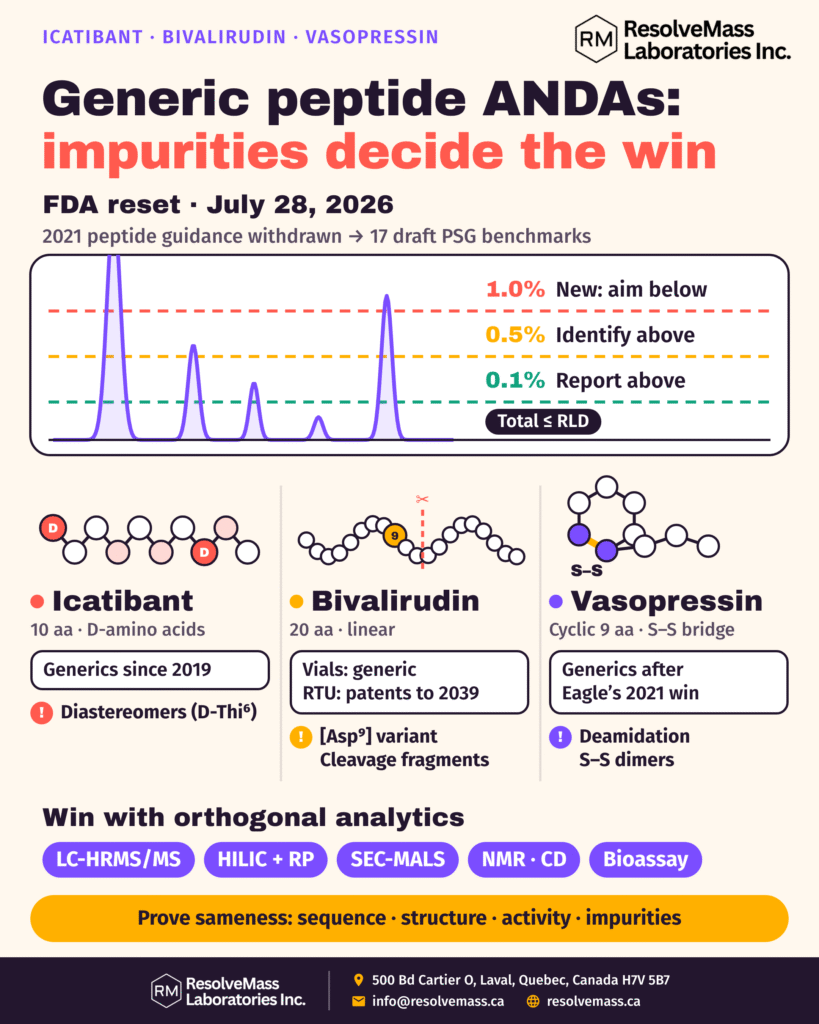
- FDA’s July 2026 reset: On July 28, 2026, FDA withdrew its 2021 synthetic peptide ANDA guidance and issued 17 revised draft product-specific guidances (PSGs) covering nine peptides. They address five areas: ANDA eligibility, innate immune testing, impurity thresholds, higher-order structure and biological activity. A replacement umbrella guidance is planned.
- Impurity benchmarks: The new draft PSGs recommend:
- reporting impurities above 0.1% and identifying those above 0.5%
- keeping shared impurities at or below the RLD level or 1.0%, whichever is greater
- aiming to keep new impurities below 1.0%
- keeping total impurities at or below the RLD’s.
- Icatibant (Firazyr): It is a 10-amino-acid peptide with D-amino acids and unnatural residues. Generics have been on the market since July 2019. The key manufacturing risks are diastereomers such as (D-Thi)⁶-icatibant, deletion peptides and residual solvents. Because the HAE market is shifting toward preventive therapies, generic makers need low cost, reliable devices and long shelf life.
- Bivalirudin (Angiomax): It is a 20-amino-acid anticoagulant. The 250 mg vial market is already genericized and shrinking, while Angiomax RTU is protected by patents until May 2039. The key impurities are the [Asp⁹] variant, the [des-Glu¹³] variant and cleavage fragments, which need HILIC plus RP-LC with high-resolution MS to separate.
- Vasopressin (Vasostrict): It is a cyclic 9-amino-acid peptide whose activity depends on its Cys1–Cys6 disulfide bridge. Eagle’s non-infringement win in 2021, upheld on appeal in 2022, opened the market to generics. The main formulation challenges are deamidation, scrambled disulfide dimers and pH-sensitive degradation in solution.
- The winning strategy: A single UV-HPLC method is not enough. Sponsors should build an orthogonal analytical package (LC-HRMS/MS, HILIC, SEC-MALS, NMR/CD and bioassays), with forced degradation, stability data and side-by-side RLD comparisons, early in development to reduce late-stage CMC risk.
Regulatory Framework Shaping Generic Peptide Development in 2026
Generic Peptide Development in the United States now follows an updated FDA regulatory framework established between July 28 and July 30, 2026. During this period, the agency withdrew its May 2021 guidance concerning synthetic peptides of recombinant DNA (rDNA) origin and issued 17 revised draft Product-Specific Guidances (PSGs). Released under the FDA Drug Competition Action Plan (DCAP) and Executive Order 14273, these July 2026 updates (91 FR 47834; Docket No. FDA-2007-D-0369) establish revised expectations for demonstrating active ingredient sameness and impurity comparability against Reference Listed Drugs (RLDs).
Although the 17 revised draft PSGs cover nine specific active ingredients—calcitonin salmon, dasiglucagon hydrochloride, glucagon, liraglutide, pegcetacoplan, semaglutide, teriparatide, tirzepatide, and vosoritide—the FDA has explicitly indicated that manufacturers developing other generic peptide products may also follow these recommendations. Sponsors can seek additional regulatory clarification from the Office of Generic Drugs (OGD) through controlled correspondence or formal meetings. At the same time, the Center for Drug Evaluation and Research (CDER) 2026 Guidance Agenda identifies a replacement umbrella document titled Considerations for Peptide Drug Products in ANDAs. Additionally, provisions under the Generic Drug User Fee Amendments (GDUFA III) allow the early assessment of certain Type II Drug Master Files (DMFs) up to six months before ANDA submission.
The July 2026 draft PSGs establish consistent scientific expectations across five major areas:
- ANDA eligibility and supporting data packages: Requirements for peptides manufactured through recombinant, synthetic, or semi-synthetic production processes.
- Innate immune response testing: Assessments designed to establish immunogenicity comparability with the RLD.
- Impurity threshold reporting: Identification, quantification, and comparative evaluation of impurities against the RLD.
- Higher-order structure (HOS) assessments: Characterization of peptide conformational properties to demonstrate structural sameness.
- Biological activity assessments: Clarification that non-clinical testing approaches may establish clinical sameness under the labeled conditions of use.
For parenteral peptide formulations, including bivalirudin and vasopressin, the FDA’s November 2025 final guidance, Considerations for Waiver Requests for pH Adjusters in Generic Drug Products Intended for Parenteral, Ophthalmic, or Otic Use, also explains the scientific justification required when sponsors propose qualitative (Q1) or quantitative (Q2) differences in pH-adjusting agents compared with the RLD.
Strengthen your submission strategy with specialized regulatory support for generic drug development.
Analytical Sameness Pillars in Generic Peptide Development
Establishing active ingredient sameness during Generic Peptide Development requires comprehensive evidence of primary sequence identity, physicochemical comparability, higher-order structural equivalence, and functional similarity with the RLD. Sponsors must also demonstrate compliance with peptide-specific impurity limits, which can be more stringent than the conventional impurity thresholds applied to small-molecule drugs under ICH guidelines.
Because ICH Q3A and Q3B explicitly exclude peptides from their scope, FDA peptide ANDA assessments apply a 0.10% structural identification threshold. Newly introduced peptide-related impurities exceeding 0.5% are considered unacceptable for the 505(j) pathway. These requirements, discussed in specialized CRO regulatory literature, can create substantial analytical challenges and may require sponsors to consider an alternative regulatory route, such as a 505(b)(2) NDA submission.
Under this regulatory approach, impurities shared by the proposed generic product and the RLD must remain at concentrations equal to or lower than those observed in the reference product throughout the labeled shelf life. Newly introduced peptide-related impurities within the 0.10%–0.5% range require complete structural characterization and a scientifically supported immunogenicity assessment. Relevant approaches may include pattern recognition receptor (PRR) innate immune assays, in silico HLA-DR binding assessments, MHC Class II competitive assays, and MAPPs adaptive immunogenicity screening.
Since European Pharmacopoeia (Ph. Eur.) Monograph 2034 establishes different default impurity thresholds, manufacturers developing products for multiple regulatory markets generally validate their analytical methods against the more restrictive FDA requirements.
| Regulatory Parameter | FDA Synthetic Peptide ANDA Standard | Ph. Eur. Monograph 2034 | ICH Q3A / Q3B Standard |
|---|---|---|---|
| Scope | Synthetic peptides, including the expanded July 2026 PSG framework for comparison with the RLD | Synthetic peptides under the European Pharmacopoeia framework | Chemically synthesized small molecules; peptides are explicitly excluded |
| Identification Threshold | 0.10% (complete structural identification required) | 0.5% default identification threshold | 0.10% or 1.0 mg TDI, whichever is lower (reporting threshold of 0.05% for MDD ≤ 1 g) |
| New / Unqualified Impurity Limit | Impurities above 0.5% are prohibited for ANDA; impurities between 0.10% and 0.5% require immunogenicity justification | 1.0% unqualified known impurity limit | 0.15% or 1.0 mg TDI, whichever is lower |
| Shared Impurity Parity | Concentrations must remain at or below the levels observed in the RLD throughout shelf life | Evaluated against applicable monograph limits | Evaluated against toxicological qualification requirements |
| Non-Peptide / Residual Limits | Governed by PDE / TTC requirements covering residual solvents, heavy metals, nitrosamines, and residual TFA | Governed by ICH Q3C / Q3D requirements and monograph specifications | Governed by ICH Q3C / Q3D / M7 |
Review advanced peptide mapping and mass spectrometry approaches for detailed sequence characterization and structural assessment.
Comparative ANDA Landscape Across Icatibant, Bivalirudin, and Vasopressin
Although AP-rated generics already compete in established presentations of icatibant, bivalirudin, and vasopressin, maintaining sustainable ANDA margins requires manufacturers to identify relevant patent-expiry opportunities while controlling the dominant degradation pathways and synthesis-related impurities of each molecule.
An assessment of RLD regulatory filings, Orange Book patent protections, exclusivity periods, and sequence-dependent CMC challenges reveals where formulation development and orthogonal impurity profiling can provide meaningful competitive advantages.
| Dimension | Icatibant Acetate | Bivalirudin | Vasopressin |
|---|---|---|---|
| Primary RLD & NDA | Firazyr (NDA 022150; 30 mg/3 mL SC prefilled syringe) | Angiomax (NDA 020873; 250 mg/vial IV); Angiomax RTU (NDA 211215) | Vasostrict (NDA 204485; 20 units/mL IV); Premixed RTU (NDA 217569) |
| Peptide Architecture | Linear decapeptide (10 aa) containing D-amino acids and non-proteinogenic residues | Synthetic 20-amino-acid peptide | Cyclic nonapeptide (9 aa) containing a Cys1–Cys6 disulfide bridge and C-terminal amide |
| Key Patent / Exclusivity Status | US 5,648,333 expired during 2014–2015; no active Orange Book patents or exclusivities listed | AP-rated generics approved for 250 mg/vial; Angiomax RTU lists US 11,903,993, expiring May 20, 2039 | Eagle non-infringement ruling (ANDA 211538); multiple 20 units/mL entrants; Vasostrict RTU NDA 217569 |
| Generic / Competitive Field | Cipla (AP-rated ANDA 212446), Hikma, Alembic, Eugia, Teva, Hansoh, and Lupin (New Zealand) | AP-rated 250 mg/vial generics; declining overall market volume | Eagle (AP-rated ANDA 211538), American Regent (NDA 212593, AP-listed), and Cipla |
| Dominant CMC / Impurity Risk | (D-Thi)6 diastereomer, coupling deletions, and residual solvents | [Asp9]-bivalirudin, [des-Glu13], [1-11] and [12-20] cleavage fragments | [Glu4]/[Asp5]/AVP acid deamidation, Cys1–Cys6 scrambled dimers, and pH sensitivity |
Establish a stronger reference-product comparison strategy through comparative testing between generic drugs and RLDs.
Icatibant (Firazyr) ANDA Opportunities and CMC Hurdles
Icatibant acetate represents a specialized opportunity within the acute-care HAE market. The expiration of its composition-of-matter patent and orphan exclusivities has opened the 30 mg/3 mL prefilled syringe segment to generic competition. Consequently, competitive differentiation increasingly depends on stereochemical purity, reliable supply chains, and the usability of the injection device.
The FDA approved Shire/Takeda’s Firazyr on August 25, 2011, under NDA 022150, following its European Medicines Agency (EMA) approval in July 2008. Firazyr is a selective bradykinin B2 receptor antagonist administered subcutaneously at a dose of 30 mg/3 mL (10 mg/mL). It is indicated for the treatment of acute HAE attacks in adults aged 18 years and older.
From an intellectual property perspective, US Patent 5,648,333, granted in July 1997 and directly covering the icatibant sequence, expired during the 2014–2015 period. FDA Orange Book information summarized by DrugCentral and DrugPatentWatch indicates that no active U.S. patents are listed for the molecule.
Cipla received final FDA approval for its AP-rated generic prefilled syringe under ANDA 212446 in July 2020. Its product joined the market alongside other FDA-listed therapeutic equivalents and applicants, including Hikma, Alembic, Eugia, Teva, and Jiangsu Hansoh. International procurement developments also demonstrate increasing generic penetration. For example, New Zealand Pharmac’s 2026 transition from Firazyr to Lupin reflects the continued expansion of generic access in international markets.
According to IQVIA data reported by Drug Store News in July 2020, Firazyr and its generic equivalents generated approximately 270 million in sales during the 12 months ending May 2020. No more recent independent U.S. revenue figure was identified in the consulted public sources.
A DrugPatentWatch market assessment also highlights that icatibant is an acute, event-driven treatment. Increasing adoption of HAE prophylactic therapies, including C1-inhibitor and kallikrein-inhibitor products, places additional pressure on the addressable market for acute attacks. As a result, generic manufacturers must prioritize extended shelf-life stability, reliable injection devices, and cost-efficient API manufacturing to protect commercial profitability.
From a chemical manufacturing perspective, icatibant’s primary sequence, H-D-Arg-Arg-Pro-Hyp-Gly-Thia-Ser-D-Tic-Oic-Arg-OH, creates demanding requirements for solid-phase peptide synthesis (SPPS) process control. The sequence combines D-configured amino acids, including D-Arg and D-Tic, with bulky non-proteinogenic heterocyclic amino acids such as Hyp, Thia/Thi, and Oic.
Inefficient coupling reactions and racemization during sequential SPPS can generate unreacted intermediates, deletion peptides, and structurally similar diastereomers, including (D-Thi)6-icatibant. These impurities present significant analytical challenges because stereoisomers have molecular masses identical to the active decapeptide and may co-elute during conventional reversed-phase HPLC analysis.
To address these risks, ANDA sponsors should combine high-resolution RP-HPLC with LC-HRMS/MS, stereochemistry verification, amino acid analysis, and residual solvent testing. Residual solvents such as dichloromethane, methanol, and ethanol require appropriate monitoring. Counter-ion quantification is also essential to demonstrate that the acetate stoichiometry matches the RLD.
Explore generic lanreotide development services to understand analytical and manufacturing considerations for other complex synthetic peptide products.
Bivalirudin (Angiomax and Angiomax RTU) Generic Strategy
Bivalirudin has developed into two distinct commercial segments. Legacy 250 mg/vial IV presentations, represented by the RLD Angiomax (NDA 020873), already face competition from AP-rated generics. In contrast, Angiomax RTU (NDA 211215) retains Orange Book patent protection extending through May 2039.
Bivalirudin is a synthetic 20-amino-acid bivalent direct thrombin inhibitor that interacts with both the active site and exosite of thrombin. It remains an established anticoagulant in hospital settings. However, maintaining its commercial value increasingly depends on formulation convenience, presentation differentiation, and effective impurity management.
Improve production consistency and commercial readiness with manufacturing scale-up solutions for generic drugs.
Although Sandoz’s Angiomax (NDA 020873, 250 mg/vial) has been exposed to AP-rated generic competition for several years, Maia Pharmaceuticals received approval for Angiomax RTU under NDA 211215 in 2019.
Orange Book supplement records from April 2024 identify US Patent 11,903,993, associated with Use Code U-3817, for Angiomax RTU. The patent is listed with an expiration date of May 20, 2039.
At the same time, DrugPatentWatch describes the broader bivalirudin market as experiencing contraction due to structural commercial pressures. Therefore, generic manufacturers targeting the established 250 mg/vial segment must optimize production costs and manufacturing efficiency. Companies seeking entry into the RTU segment before 2039 must evaluate non-infringing Paragraph IV formulation strategies or consider a differentiated 505(b)(2) submission.
Maintaining the chemical integrity of bivalirudin API and finished drug products requires particular attention to aspartate isomerization and peptide backbone cleavage.
The official USP Bivalirudin and Bivalirudin Injection monographs, effective December 1, 2023, specify an assay acceptance range of 96.0%–103.0%. They also provide dedicated reference standards for process-related and degradation impurities, including [Asp9]-bivalirudin (C98H137N23O34), [des-Glu13]-bivalirudin, and the cleavage fragments [1-11]-bivalirudin and [12-20]-bivalirudin.
Asp isomerization in peptides occurs through the formation of a cyclic succinimide intermediate, producing structurally similar variants that can be difficult to distinguish using a single chromatographic column. Peer-reviewed analytical research has demonstrated that combining hydrophilic interaction liquid chromatography (HILIC) with reversed-phase LC and high-resolution mass spectrometry can resolve at least 10 non-oligomeric bivalirudin impurities.
This orthogonal analytical approach provides the separation capability required to complement amino acid analysis and thrombin-inhibition potency bioassays, supporting a more comprehensive assessment of API and finished-product quality.
Strengthen complex peptide characterization using biosimilar characterization approaches based on mass spectrometry.
Vasopressin (Vasostrict) Post-Litigation Market and Formulation Challenges
The vasopressin injectable market has transitioned from a single-NDA hospital product franchise into a competitive generic and RTU segment. This change followed Paragraph IV litigation that removed Endo/Par’s exclusivity barriers. Consequently, current ANDA opportunities depend heavily on aqueous formulation stability, disulfide-bridge integrity, and control of degradation throughout the product’s shelf life.
Par Sterile Products (Endo) obtained FDA approval for Vasostrict under NDA 204485 on April 17, 2014. The product is a 20 units/mL IV formulation. By late 2018, the company had established patent protection through six patents, including Orange Book-listed US Patent 10,844,435.
These exclusivity protections were challenged after Eagle Pharmaceuticals submitted ANDA 211538 in 2018. The company subsequently prevailed in the U.S. District Court for the District of Delaware, which determined that Eagle’s proposed vasopressin product did not infringe the patent claims asserted by Par.
Eagle received approval for its AP-rated generic in December 2021. Other market participants include American Regent, whose 20 units/mL NDA 212593 was approved in August 2020 and received an AP listing in December 2023, as well as Cipla’s Orange Book-listed 20 units/mL product.
To strengthen its position in the hospital market, Par/Endo subsequently introduced NDA 217569 for diluted Vasostrict presentations. These formulations include 20 units/100 mL (0.2 units/mL) and 40 units/100 mL (0.4 units/mL).
Manufacturers developing either conventional vial products or diluted RTU presentations must demonstrate strict Q1/Q2 comparability with the RLD. Alternatively, they must provide scientifically justified pH-adjuster waiver requests under the FDA’s November 2025 parenteral guidance. In either case, preventing rapid aqueous degradation remains a central formulation challenge.
Explore generic glucagon development and analytical characterization for additional insights into complex injectable peptide development.
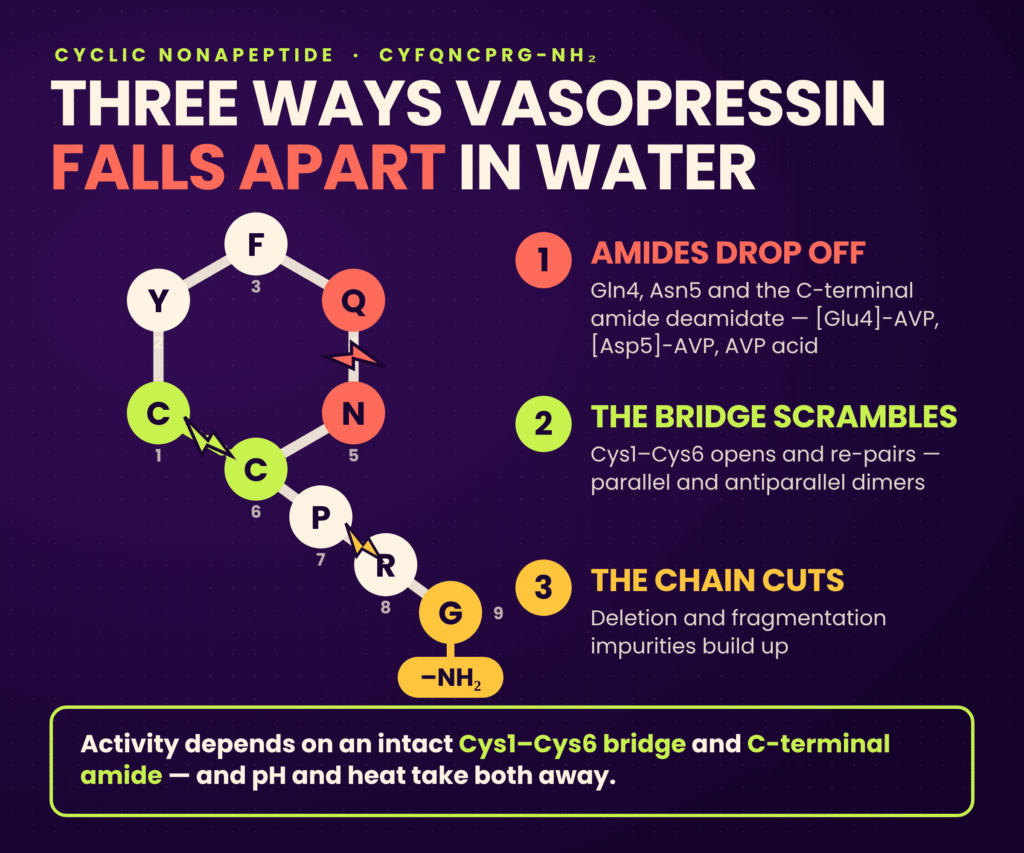
From a structural perspective, [Arg8]-Vasopressin (CYFQNCPRG-NH2; approximately 1084.25 g/mol) is a cyclic nonapeptide. Its pressor and antidiuretic activities are mediated through V1aR, V1bR, and V2R receptors. Clinically, vasopressin is used to increase blood pressure in patients experiencing fluid- and catecholamine-resistant vasodilatory shock.
The biological activity of this peptide depends on maintaining an intact Cys1–Cys6 disulfide bridge and C-terminal amide. During aqueous formulation development and stability studies, including evaluations at 5°C, 25°C, and 40°C in dextrose and sodium chloride matrices, vasopressin undergoes degradation through three principal chemical pathways:
- Deamidation: Reactions involving Gln4, Asn5, and the C-terminal glycinamide generate [Glu4]-AVP, [Asp5]-AVP, and AVP acid.
- Disulfide-bond cleavage or scrambling: These reactions produce parallel and antiparallel covalent dimers.
- Amino acid deletions and peptide chain fragmentation: These processes contribute to additional degradation-related impurities and changes in the peptide profile.
Further compendial oversight under USP-NF revisions requires acetic acid content to remain not more than 15.0% according to USP. Historical compendial standards, including USP29–NF24, specify vasopressor potency of not less than 300 USP Vasopressin Units/mg. These standards also emphasize that reversed-phase chromatographic retention at pH 3.0 is particularly sensitive to minor variations in mobile-phase acetonitrile concentration.
A generic vasopressin formulation that cannot adequately control pH fluctuations and temperature-dependent deamidation may develop impurity levels that exceed the FDA’s 0.10% identification threshold and 0.5% new-impurity limit before reaching its labeled expiry date.
Evaluate stability-related analytical strategies through forced degradation studies for complex biologics.
Building a Defensible Analytical Package for Generic Peptide ANDAs
Successful Generic Peptide Development for icatibant, bivalirudin, and vasopressin requires a comprehensive analytical comparability strategy. This strategy should integrate synthesis-related information, forced-degradation studies, and multi-lot RLD benchmarking into a unified CMC submission package.
Relying exclusively on single-column UV-HPLC analysis is often insufficient for peptide characterization. Such methods can fail to detect co-eluting diastereomers, positional Asp isomers, and disulfide-scrambled dimers. Failure to identify and characterize these impurities can result in additional FDA review questions, regulatory delays, or refuse-to-receive actions.
| Target Peptide | Critical Process & Degradation Impurities | Recommended Orthogonal Analytical Techniques | Key Regulatory / Pharmacopeial Targets |
|---|---|---|---|
| Icatibant Acetate | (D-Thi)6 diastereomer, coupling deletions, residual DCM/MeOH, and counter-ion variation | RP-HPLC + LC-HRMS/MS, stereochemistry/AAA verification, IC / 19F NMR | RLD sequence and counter-ion matching; impurities ≤ RLD levels or below the 0.10% identification threshold and 0.5% limit |
| Bivalirudin | [Asp9]-bivalirudin, [des-Glu13], [1-11] and [12-20] cleavage products, and aggregates | Orthogonal HILIC + RP-HPLC-HRMS, SEC-UV/MALS, NMR/CD HOS, and thrombin potency bioassay | USP assay range of 96.0%–103.0%; impurities ≤ RLD levels or below the 0.10% identification threshold and 0.5% limit |
| Vasopressin | [Glu4]-AVP, [Asp5]-AVP, AVP acid, Cys1–Cys6 scrambled dimers, and deletion impurities | LC-HRMS/MS peptide mapping, disulfide-bridge analysis, SEC-MALS, USP acetic acid testing, and bioassay | Acetic acid NMT 15.0%; pH-stabilized impurity parity with the RLD throughout shelf life |
Regulatory reviewers also expect comprehensive, side-by-side impurity monitoring across different manufacturing and stability stages. The analytical package should include crude API, purified API, freshly manufactured drug product, accelerated stability samples (40°C/75% RH), and forced-degradation studies covering acidic, alkaline, oxidative, thermal, and photolytic conditions. Multiple RLD control lots should also be included to establish an appropriate comparative impurity profile.
Learn about advanced impurity profiling approaches for complex pharmaceutical products.
Specialized North American CROs, including ResolveMass Laboratories Inc., provide analytical characterization and CMC support for these complex peptide development programs. ResolveMass Laboratories Inc. operates from Laval, Québec, and holds a Health Canada GMP Drug Establishment Licence (3-002945-A), FDA registration (Establishment ID 3042696771), and ISO 9001:2015 certification.
The facility supports integrated analytical workflows using advanced technologies such as Orbitrap, Q-TOF, and FT-ICR HRMS, NMR, ion chromatography, and enzymatic peptide mapping. These capabilities support the investigation of peptide-related impurities, structural variations, and degradation pathways. The analytical approach is further supported by peer-reviewed LC-HRMS methodology for cyclic nonapeptides published in Analytical and Bioanalytical Chemistry.
Explore specialized generic peptide semaglutide development projects.
Conclusion
Successful Generic Peptide Development for icatibant, bivalirudin, and vasopressin requires manufacturers to recognize orthogonal impurity profiling, higher-order structure verification, and formulation stability as essential commercial differentiators rather than treating them as late-stage regulatory requirements.
Following the FDA’s July 2026 updates to peptide guidance, demonstrating compliance with the 0.10% identification threshold, maintaining newly introduced peptide-related impurities below 0.5%, and establishing biological and conformational parity with the RLD are critical factors influencing ANDA approval and market-entry timelines.
Whether the objective is to optimize stereochemical purity in icatibant prefilled syringes, assess intellectual property-compliant bivalirudin RTU strategies ahead of 2039, or improve the stability of cyclic disulfide-bridged vasopressin infusions, early investment in high-resolution analytical characterization can substantially reduce late-stage CMC risks.
To discuss peptide sameness packages, orthogonal LC-HRMS impurity profiling, or ANDA stability studies directly with PhD analytical chemists, contact ResolveMass Laboratories Inc. through its contact page.
Frequently Asked Questions
Unlike conventional small-molecule drugs, peptides are excluded from the scope of ICH Q3A and Q3B, so FDA peptide ANDA assessments follow specific impurity requirements. These include a 0.10% identification threshold and a 0.5% limit for newly introduced peptide-related impurities. Shared impurities must not exceed their corresponding RLD concentrations, while newly detected impurities between 0.10% and 0.5% require appropriate structural characterization and immunogenicity risk justification.
Generally, a newly introduced peptide-related impurity exceeding 0.5% creates a significant regulatory obstacle for approval under the 505(j) pathway. Such an impurity may raise concerns about product safety, structural differences, and potential immunogenicity compared with the Reference Listed Drug (RLD). Manufacturers should investigate improvements in synthesis, purification, and process controls to reduce the impurity, or assess whether a 505(b)(2) NDA submission is more appropriate.v
Icatibant contains D-configured amino acids, including D-Arg and D-Tic, together with non-proteinogenic residues such as Hyp, Thia, and Oic. These structural features increase the possibility of incomplete coupling, deletion sequences, and racemization during solid-phase peptide synthesis. Impurities such as (D-Thi)6-icatibant are particularly challenging because they have the same molecular mass as the parent peptide and may co-elute during conventional HPLC analysis, requiring stereochemical verification and complementary LC-HRMS/MS methods.
No. The primary icatibant sequence patent, US 5,648,333, expired during 2014–2015, allowing generic manufacturers to pursue market entry. FDA-approved and listed generic alternatives include products from companies such as Cipla, Hikma, Alembic, and Eugia. Current competition therefore depends more heavily on manufacturing efficiency, prefilled syringe quality, product stability, and dependable supply, particularly as preventive HAE treatments influence demand for acute therapies.
The established 250 mg/vial Angiomax presentation already faces competition from AP-rated generic products, but the RTU formulation has a different intellectual property position. Angiomax RTU (NDA 211215), marketed by Maia Pharmaceuticals, lists US Patent 11,903,993, which expires on May 20, 2039. Companies considering earlier entry into this segment must evaluate a scientifically supported non-infringing Paragraph IV strategy or develop an alternative formulation through an appropriate 505(b)(2) regulatory pathway.
[Asp9]-bivalirudin (C98H137N23O34) can develop during manufacturing or storage through aspartate isomerization. Because the resulting impurity has structural and physicochemical similarities to intact bivalirudin, conventional single-column chromatographic methods may not provide adequate separation. A combination of HILIC, reversed-phase LC-HRMS, and stability-indicating methods helps distinguish this impurity from other related substances, including [des-Glu13], [1-11], and [12-20] cleavage fragments.
Paragraph IV litigation significantly changed the competitive landscape after Eagle Pharmaceuticals challenged patents associated with Par Sterile Products’ Vasostrict (NDA 204485). The Delaware federal court ruled that Eagle’s proposed product did not infringe the asserted patent claims, enabling the company to obtain AP-rated generic approval under ANDA 211538 in December 2021. The market subsequently expanded to include manufacturers such as American Regent (NDA 212593) and Cipla, while Par/Endo introduced diluted ready-to-use Vasostrict presentations under NDA 217569.
Vasopressin is a cyclic nonapeptide whose stability depends on maintaining its Cys1–Cys6 disulfide bridge and intact peptide structure. In aqueous formulations, it can undergo deamidation, producing [Glu4]-AVP, [Asp5]-AVP, and AVP acid, along with disulfide scrambling that generates parallel and antiparallel dimers. Amino acid deletions and peptide fragmentation can also occur, making careful pH regulation, temperature control, and stability monitoring essential for maintaining impurity comparability with the RLD and meeting the USP acetic acid specification of NMT 15.0%.
The FDA’s July 2026 revised draft PSGs clarify how non-clinical evidence can support demonstrations of clinical sameness for generic peptide products under labeled conditions of use. Relevant approaches include primary sequence characterization, higher-order structure analysis, comparative impurity profiling, innate immune response testing, and biological activity assays. However, the suitability of these methods depends on the individual peptide and its product-specific requirements, so sponsors should consult the Office of Generic Drugs (OGD) through controlled correspondence or pre-ANDA meetings.
Reference:
- U.S. Food and Drug Administration. (2026, July 28). FDA publishes revised draft product-specific guidances for certain generic peptide products. https://www.fda.gov/drugs/drug-alerts-and-statements/fda-publishes-revised-draft-product-specific-guidances-certain-generic-peptide-products
- Kenney, M., Kannan, V., Vandse, S., & Sanghvi, S. (2018). Vasopressin formulations for use in treatment of hypotension (U.S. Patent No. 9,919,026 B2). U.S. Patent and Trademark Office. https://patents.google.com/patent/US9919026B2/en
- U.S. Food and Drug Administration. (n.d.). Guidance for industry. https://www.fda.gov/media/71474/download?attachment
- United States Pharmacopeia. (n.d.). Peptides. https://www.usp.org/biologics/peptides
- Wu, P., Ye, S., Li, M., Li, H., Kan, Y., & Yang, Z. (2020). Impurity identification and quantification for arginine vasopressin by liquid chromatography/high-resolution mass spectrometry. Rapid Communications in Mass Spectrometry, 34(12), e8799. https://doi.org/10.1002/rcm.8799
- Mishra, S. H., Kaur, A., Vu, D., & Bhavaraju, S. (2026). Comprehensive solution NMR characterization of bivalirudin, a direct thrombin inhibitor peptide, and its process impurities by heteronuclear spectral fingerprinting at natural isotopic abundance. Journal of Pharmaceutical and Biomedical Analysis, 281, 117684. https://doi.org/10.1016/j.jpba.2026.117684
- United States Pharmacopeial Convention. (2011). Vasopressin. USP–NF Revision Bulletin. https://www.uspnf.com/sites/default/files/usp_pdf/EN/USPNF/revisions/vasopressin.pdf
Get In Touch With Us
About The Author