
Introduction
Evaluating Generic Saxenda vs Generic Victoza as of late 2026 reveals a sharply divided commercial landscape. While the US generic Victoza market is saturated with eight Abbreviated New Drug Application (ANDA) approvals and significant price erosion across discount channels, opportunities for new liraglutide products remain in the post-discontinuation US generic Saxenda market, underserved international territories such as Canada, and supply chains designed to withstand shortages. Capturing these remaining opportunities in 2027 and beyond requires considerably more than demonstrating basic bioequivalence. Commercial success now depends on understanding Orange Book therapeutic equivalence classifications, brand discontinuations, and the FDA’s recently strengthened analytical and regulatory expectations.
Since Teva introduced the first authorized generic of Victoza in June 2024 and Hikma obtained the first true ANDA approval in December 2024, liraglutide has emerged as an important testing ground for complex generic GLP-1 receptor agonists. However, the two reference products have developed distinctly different competitive landscapes. Companies considering the development, licensing, partnership, or remediation of a liraglutide dossier must evaluate several factors, including declining US diabetes-market margins, comparatively limited competition in weight management, Novo Nordisk’s planned January 2027 withdrawal of branded Saxenda from the US market, and the FDA’s July 2026 revisions to peptide Product-Specific Guidances (PSGs).
Share via:
Quick Summary:
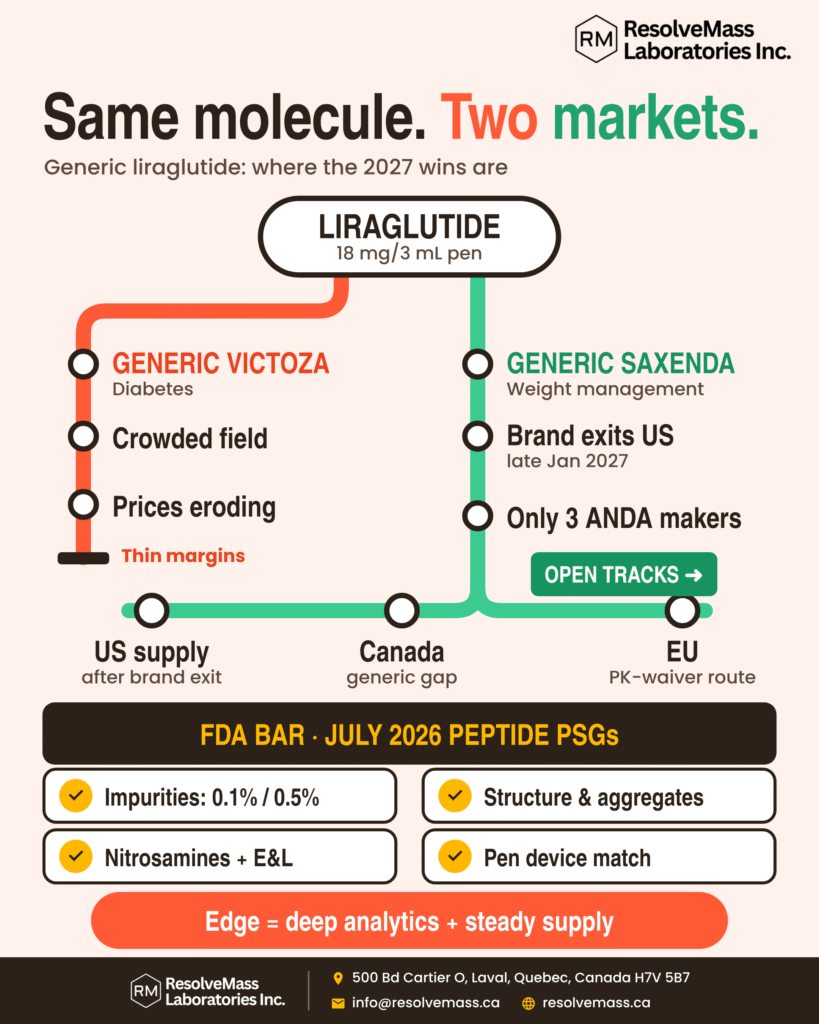
- Same molecule, two markets: Generic Victoza (diabetes) and generic Saxenda (weight management) contain the same 18 mg/3 mL liraglutide. They are separate products under separate ANDAs, with different pens, doses and therapeutic-equivalence ratings, so they cannot be substituted for each other.
- Generic Victoza is crowded: Many manufacturers have entered since Hikma’s first approval in December 2024, and discount prices have dropped sharply. New entrants without their own API supply will find little margin left.
- Generic Saxenda is less crowded: Only three ANDA holders (Teva, Biocon, Orbicular) are on the market. Novo Nordisk will stop shipping branded Saxenda in the US in late January 2027, leaving demand to generics.
- Competition from newer drugs: Weekly injectables and daily oral GLP-1 pills priced at about $149 a month limit how much high-dose liraglutide can charge.
- Remaining opportunities: These are reliable US Saxenda supply after the brand exits, Canada (where the article reports no marketed generic yet), and the EU, where a new route allows the PK study to be waived if in-vitro comparability is shown.
- Higher FDA expectations: In July 2026, FDA withdrew its 2021 peptide ANDA guidance and revised the liraglutide product-specific guidances. Applicants now face tighter impurity thresholds (0.1% reporting, 0.5% identification), plus requirements on structure and aggregates, innate immune testing, nitrosamine and E&L control, and pen device comparability.
- Bottom line: Success in 2027 depends on strong, multi-batch analytical dossiers combined with dependable manufacturing and supply, not just on proving bioequivalence.
Generic Saxenda vs Generic Victoza: Why the Same Molecule Faces Two Different Markets
Although both products contain the same 18 mg/3 mL (6 mg/mL) subcutaneous liraglutide solution, generic Saxenda and generic Victoza operate in separate commercial segments with different regulatory and product requirements. These differences are determined by their respective FDA Orange Book therapeutic equivalence ratings, pen-delivery systems, dosing configurations, and patent considerations. Since pharmacies cannot automatically substitute an AP1-rated diabetes pen for an AP2-rated obesity prescription, manufacturers must develop and maintain separate ANDAs, device dose selectors, carton configurations, and commercialization strategies.
Developing separate formulations and delivery presentations requires careful consideration of drug-product composition, device compatibility, and manufacturing requirements. A structured approach to formulation development for generic drug products can help manufacturers address these challenges during product development.
In the United States, Victoza (NDA 022341) serves as the reference product for the AP1 therapeutic equivalence category, covering fixed daily doses of 0.6 mg, 1.2 mg, and 1.8 mg. Saxenda (NDA 206321), on the other hand, belongs to the AP2 category and supports variable dose titration up to 3.0 mg daily. Regarding intellectual property, Novo Nordisk’s propylene glycol peptide formulation patents expired in August 2025 and February 2026. However, US Patent 9,968,659, which covers cardiovascular risk reduction in adults with type 2 diabetes and established cardiovascular disease, remains listed until 2037. As a result, FDA-approved generic liraglutide diabetes pens carry labeling for glycemic control rather than the cardiovascular outcomes claim associated with Victoza. According to Arca’s November 2026 compilation of Drugs@FDA records, 13 US liraglutide applications have received approval, comprising two branded and 11 generic applications. Nevertheless, Drugs.com availability tracking indicates that generic approvals are distributed predominantly toward Victoza, with an 8-to-3 ratio compared with Saxenda.
| Market Dimension (As of Late 2026) | Generic Victoza (AP1) | Generic Saxenda (AP2) |
|---|---|---|
| Reference Listed Drug | NDA 022341 (Novo Nordisk, approved Jan 2010) | NDA 206321 (Novo Nordisk, approved Dec 2014) |
| Strength and Pen Configuration | 18 mg/3 mL (6 mg/mL); 2-pen or 3-pen cartons delivering 0.6, 1.2, or 1.8 mg | 18 mg/3 mL (6 mg/mL); 5-pen cartons delivering 0.6, 1.2, 1.8, 2.4, or 3.0 mg |
| Approved US ANDA Holders | 8 ANDA holders (Hikma, Nanjing King-Friend/Meitheal, Lupin, Orbicular, Biocon, Fresenius Kabi, Mylan, Sandoz), plus Teva authorized generic | 3 ANDA holders (Teva, Biocon, Orbicular; plus Cipla USA marketed presentation) |
| Brand Discontinuation Status | Brand experiencing backorders and shortages; no US discontinuation announced | Brand discontinuation in the US scheduled for late January 2027 (Australia, December 2025) |
| Representative US Discount / Cash Pricing | 105.75 (2 pens) to 144.35 (3 pens) through GoodRx; 129.20 base price (+55.00 cold shipping) per box at Cost Plus Drugs | 372.45 (5 pens) through GoodRx; 716.50 base price (+55.00 cold shipping) per 5-pen box at Cost Plus Drugs |
| Supply Continuity Status | Periodic backorders involving Novo Nordisk and Teva 2-count presentations despite multiple approvals | Overall liraglutide shortage continues, with limited brand availability ahead of the January 2027 exit |
US Pricing Erosion and the 2027 Brand Saxenda Exit
The US generic Victoza market has experienced substantial price compression following the entry of multiple manufacturers, with retail discount-card prices falling to approximately 106–144 per carton. In comparison, generic Saxenda continues to command higher cash prices, although the introduction of oral GLP-1 medications priced at 149 per month and Novo Nordisk’s planned January 2027 brand withdrawal are changing the commercial outlook for obesity treatments. For prospective market entrants, high-dose liraglutide now occupies a relatively narrow commercial position, constrained by low-priced diabetes pens at the lower end and increasingly competitive weekly injectables and daily oral incretin therapies at the upper end.
The difference in historical revenue between the two reference products helps explain why generic manufacturers initially concentrated on Victoza. According to IQVIA data cited by Teva, Victoza generated annual US sales of 1.656 billion as of April 2024, whereas Pienomial reported annual US Saxenda sales of 165 million as of June 2025. This approximately tenfold revenue difference encouraged an aggressive wave of AP1 ANDA submissions. Hikma received approval in December 2024, followed by Nanjing King-Friend/Meitheal in April 2025 and Lupin in July 2025. During 2026, additional approvals were granted to Orbicular, Biocon, Fresenius Kabi, Mylan Institutional, and Sandoz, while Cipla USA and NorthStar Rx also entered the market with commercial launches.
As competition increased, average retail cash prices reported by GoodRx, ranging from 498.07 to 924.01 depending on package size and pharmacy pricing, declined considerably when discount coupons were applied. The resulting prices reached 105.75 for two pens and 144.35 for three pens. Meanwhile, Mark Cuban Cost Plus Drug Company lists a one-box supply at 129.20, with an additional 55.00 charge for next-day refrigerated shipping.
Generic Saxenda has experienced a considerably slower increase in competition. Teva introduced the first US AP2 generic on August 28, 2025, and the market subsequently received approvals for Biocon and Orbicular on February 24, 2026. Cipla USA introduced a marketed National Drug Code (NDC) presentation the following day. With only three ANDA sponsors actively participating in the market during 2026, prices for a five-pen carton remain substantially higher. The lowest GoodRx pricing tier is approximately 372.45, while Cost Plus Drugs lists the product at a base price of 716.50, excluding 55.00 for refrigerated shipping.
Nevertheless, competition from newer treatment modalities presents a significant challenge. Novo Nordisk plans to discontinue branded Saxenda in the United States, with final wholesaler shipments expected in late January 2027, as the company redirects manufacturing capacity toward semaglutide products. The company has also announced a US list-price reduction to 675 per month across Wegovy, Ozempic, and Rybelsus, effective January 1, 2027. At the same time, late-2026 self-pay pricing reported by telehealth aggregator Doctronic places the daily oral Wegovy tablet, approved in December 2025, and Eli Lilly’s small-molecule oral GLP-1 medication Foundayo (orforglipron), approved in April 2026, at approximately 149 per month. Additionally, Medicare’s GLP-1 Bridge program, scheduled to operate from July 2026 through December 2027, provides eligible Part D beneficiaries access to Wegovy, Foundayo, and Zepbound KwikPens for 50 per month while excluding Saxenda.
Where Real Whitespace Still Exists for a New Liraglutide Entrant
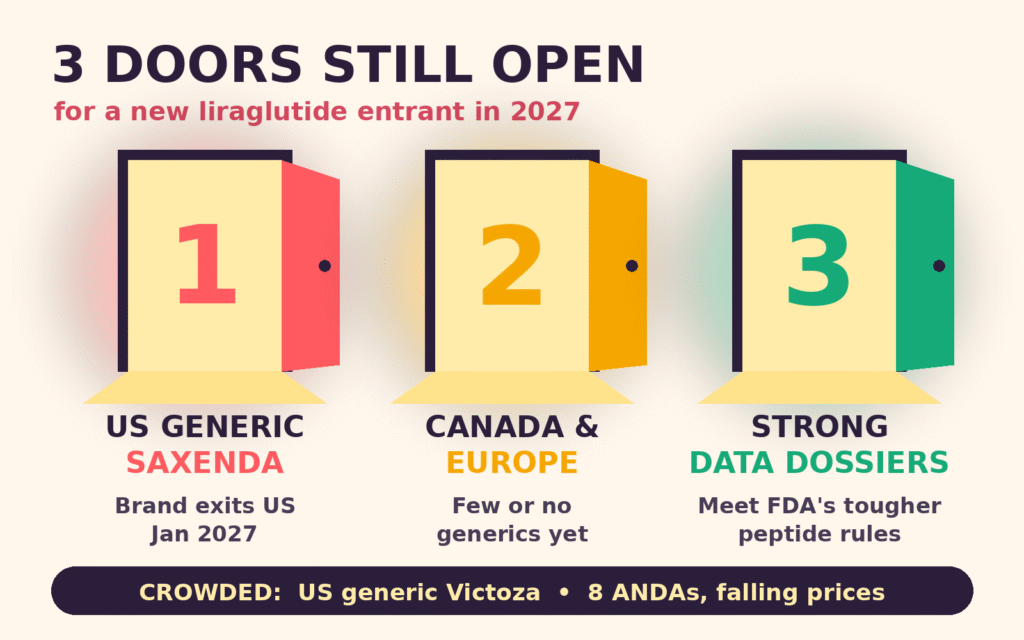
Despite intense competition across US diabetes formularies and the availability of oral alternatives priced at 149 per month, opportunities for new liraglutide manufacturers have not disappeared. Three strategic areas continue to offer commercial potential: maintaining generic Saxenda supply after 2027, entering international markets with limited generic penetration, and developing technically advanced analytical dossiers that meet the FDA’s July 2026 peptide guidance requirements.
Post-2027 AP2 Generic Saxenda Supply Resilience
Once Novo Nordisk stops shipping branded Saxenda in the United States in late January 2027, the three existing AP2 generic manufacturers will need to accommodate the continuing demand for 3.0 mg liraglutide. This transition is particularly important because liraglutide injection remains listed on both the FDA and ASHP drug shortage lists. ASHP shortage information updated in August 2026 demonstrates that regulatory approval alone has not ensured consistent product availability. Novo Nordisk’s Victoza pens continued to experience backorders without a confirmed resupply date, while Saxenda had limited availability before its planned discontinuation. Teva’s two-count liraglutide pens also experienced backorders, with an estimated release in late October 2026. Consequently, alternative suppliers, including Meitheal, have remained important for addressing immediate hospital and retail supply requirements.
A fourth or fifth AP2 market entrant could still secure attractive institutional and pharmacy-benefit margins by establishing a competitive cost of goods sold. From a clinical perspective, generic Saxenda may retain a relatively stable patient population among pediatric patients aged 12 to 17 years who weigh more than 60 kg and have obesity. It may also remain relevant for adults who experience intolerable gastrointestinal adverse effects with higher-potency weekly incretins or prefer the flexibility of gradual daily dose titration. However, competing successfully below the 149-per-month oral self-pay price point will require manufacturers to establish dependable pen assembly operations, vertically integrated peptide API production at tonne-scale capacity, and automated sterile fill-finish infrastructure. Depending on expensive merchant API suppliers and high-cost manufacturing arrangements could make it difficult to achieve sustainable margins.
Strengthen commercial production readiness through manufacturing scale-up services for generic drugs.
Ex-US Opportunities in Canada, Europe, and Divergent Global Markets
Examining markets outside the United States reveals considerable differences in generic liraglutide availability. Canada continues to represent a potential market-entry opportunity because marketed generic DINs are absent, while the European Union has introduced a more clearly defined pharmacokinetic (PK) waiver pathway. Companies comparing Generic Saxenda vs Generic Victoza primarily through US ANDA approval numbers may overlook three important international developments.
Canada’s Unfilled Marketed Gap: Health Canada’s Drug Product Database, modified in July 2026, identifies only Novo Nordisk Canada’s Victoza (DIN 02351064) and Saxenda (DIN 02437899) as marketed liraglutide products. No approved generic DINs appear in the active ingredient group search. However, pending Abbreviated New Drug Submissions (ANDSs) may be identified through Health Canada’s downloadable monthly GSUR spreadsheet. International Saxenda discontinuations, together with Health Canada’s October 2026 revisions to generic bioequivalence evaluation templates and peptide-related notices, indicate a potentially favorable environment for companies considering Canadian market entry.
Navigate complex submission requirements with regulatory support for generic drug development.
Europe’s Hybrid and PK-Waiver Route: In August 2026, the European Medicines Agency (EMA) published the European Public Assessment Report for Liraglutide STADA (EMEA/H/C/006615), a chemically synthesized hybrid medicine referencing recombinant Victoza. Earlier in 2026, the EMA also issued draft product-specific bioequivalence guidance (EMA/65789/2026). This guidance allows sponsors to request a waiver of in vivo PK studies when comparability is demonstrated across at least five test batches and five reference batches using orthogonal analytical techniques. The recommended methods include LC-MS/MS, chiral GC-MS, FTIR, circular dichroism, 2D NMR, SV-AUC, SEC-MALS, DLS, and Thioflavin T fibril assays. If the comparability assessment identifies inadequate oligomerization equivalence, a single-dose 0.6 mg PK study may be required.
UK and India Market Divergence: The United Kingdom has already entered a multi-brand liraglutide competition phase. Products such as Diavic and Zegluxen are prescribed for type 2 diabetes, while Biolide and Nevolat are available for weight management alongside Biocon’s 2024 UK approval. India’s market presents a different situation. Pharmacy reports available as of November 2026 indicate that the 3 mg Saxenda presentation is not actively marketed in the country. Consequently, domestic demand remains concentrated on lower-dose liraglutide products for diabetes management and weekly alternatives such as Wegovy or tirzepatide (Mounjaro/Yurpeak).
Generic Saxenda vs Generic Victoza Under the July 2026 FDA Peptide Guidances
On July 28, 2026, the FDA withdrew its May 2021 guidance concerning synthetic peptides that reference drugs originating from recombinant DNA (rDNA) technology and released revised draft PSGs for Victoza (NDA 022341) and Saxenda (NDA 206321). These revisions significantly increased the analytical and regulatory requirements for late-stage ANDA applicants. Although the updated recommendations introduce additional technical challenges for new applicants, they also create a regulatory barrier that favors manufacturers capable of producing comprehensive, scientifically justified, multi-batch comparability packages.
To qualify for an in vivo bioequivalence waiver under 21 CFR 320.22(b)(1), applicants must demonstrate Q1/Q2 formulation sameness. Inactive ingredients must remain within ±5% of the Reference Listed Drug (RLD), unless differences involving preservatives, buffers, or antioxidants are adequately justified under 21 CFR 314.94(a)(9)(iii). Applicants must also perform comparative characterization using at least three batches of the proposed generic product at release and at the end of its shelf life. These batches must be evaluated against at least three RLD batches aged before their expiry dates under worst-case labeled storage conditions.
In particular, the July 2026 draft PSGs and associated combination-product requirements establish four major technical benchmarks that sponsors must address.
Tight Active-Ingredient Impurity Thresholds: Applicants must report every active-ingredient-related impurity present above 0.1% of the drug substance and identify all impurities exceeding 0.5%. Common and specified impurities must be controlled at or below the levels observed in the RLD or 1.0%, whichever is higher. Newly identified unspecified impurities must remain below 1.0%, while the total impurity content must not exceed the overall impurity level measured in the RLD. These requirements make comprehensive impurity identification, quantification, and comparative profiling essential components of a generic liraglutide development program.
Support complex peptide testing requirements through specialized analytical services for generic drug development.
Higher-Order Structure and Immunogenicity Waivers: Manufacturers must demonstrate comparability in secondary and tertiary structures, together with acceptable oligomer and aggregate profiles. An in vitro innate immune testing waiver may be considered only when aggregate comparability has been adequately established and impurities unrelated to the active ingredient meet the applicable compendial and toxicological limits. These impurities include particulates, microbial contaminants, residual solvents, elemental impurities, and leachables. A scientifically supported characterization strategy is therefore necessary to establish structural consistency and minimize potential immunogenicity concerns.
Strengthen molecular characterization with mass spectrometry-based analytical approaches.
Improve molecular comparability assessments through LC-MS-based analytical characterization.
Trace Nitrosamine (NDSRI) and E&L Control: Multi-dose liraglutide pens maintain prolonged contact between aqueous peptide formulations and several packaging components, including elastomeric plungers, adhesives, and propylene glycol/phenol matrices. Under certain conditions, migrating nitrites and secondary amines may contribute to the formation of nitrosamine drug substance-related impurities (NDSRIs). Therefore, manufacturers must establish validated sub-ppb LC-MS/MS quantitation methods. Relevant analytical performance criteria may include an LOQ ≤10% of Acceptable Intake, an r² value ≥0.999, and matrix spike recovery between 90% and 110%. These methods should be integrated with ICH stability studies and comprehensive extractables and leachables (E&L) assessments to evaluate potential interactions between the formulation and container-closure system throughout the product’s shelf life.
Device Interface and Class Labeling Alignment: Generic manufacturers must demonstrate that their multi-use variable-dose disposable pens are comparable to the RLD in terms of size, shape, dose selector, dose button, and needle compatibility. These requirements should be supported by comparative user-interface assessments and human factors threshold analyses. Manufacturers must also account for the FDA’s November 9, 2026, class-wide labeling update concerning non-arteritic anterior ischemic optic neuropathy (NAION), ensuring that the applicable safety information is appropriately incorporated into product labeling.
Explore generic liraglutide development services for specialized peptide development support.
Addressing these requirements for multi-batch aging, impurity identification, structural characterization, and combination-product comparability leaves little room for fragmented analytical testing strategies. Partnering with an accredited analytical organization such as ResolveMass Laboratories Inc., a Canadian CRO/CDMO holding a Health Canada GMP Drug Establishment Licence (3-002945-A), US FDA registration (FEI 3042696771), and ISO 9001:2015 certification, allows pharmaceutical developers to consolidate multiple analytical activities within a coordinated CMC development program. These capabilities include orthogonal peptide characterization using LC-MS/MS, NMR, HPLC, CE, and AAA; custom stable-isotope NDSRI reference standard synthesis; and container-closure E&L assessments supported by stability testing. Bringing these activities together can help establish scientifically consistent CMC documentation for FDA and Health Canada regulatory review.
Discover technical capabilities for generic semaglutide peptide development projects.
Conclusion: Positioning a Winning Liraglutide Strategy in 2027
As the Generic Saxenda vs Generic Victoza market moves into 2027, pursuing an undifferentiated US AP1 generic Victoza filing without access to captive API manufacturing capacity is likely to offer limited commercial returns. More promising opportunities remain in the post-discontinuation US AP2 generic Saxenda segment, Canadian ANDS submissions, and European hybrid development programs that utilize PK-waiver pathways. Long-term success in the liraglutide market will depend on manufacturers’ ability to combine dependable cartridge fill-finish operations with comprehensive analytical dossiers designed from the beginning to satisfy the FDA’s July 2026 draft PSG requirements and the EMA’s comparability frameworks.
Pharmaceutical companies planning a new liraglutide ANDA, Canadian ANDS, or EU hybrid submission, as well as those seeking to address analytical characterization, impurity profiling, NDSRI, and E&L deficiencies under the 2026 peptide guidance framework, can consult the scientific team at ResolveMass Laboratories Inc. through its Contact Us page.
Frequently Asked Questions
The difference in pricing is primarily driven by the number of competing manufacturers and the level of market penetration. Generic Victoza has eight approved ANDA sponsors, in addition to Teva’s authorized generic, resulting in substantial price competition and lower discount-card prices. Generic Saxenda has only three approved ANDA sponsors, namely Teva, Biocon, and Orbicular, while its five-pen packaging configuration and comparatively limited competition help maintain higher market prices.
Novo Nordisk has announced plans to discontinue branded Saxenda shipments to US wholesalers in late January 2027, following its earlier withdrawal from Australia in December 2025. This decision does not automatically affect FDA-approved generic versions of liraglutide. Generic Saxenda products from manufacturers such as Teva, Biocon, and Orbicular are expected to remain available, with Cipla participating through its marketed presentation.
The continued shortage reflects the difference between obtaining regulatory approval and maintaining a consistent commercial supply. Increasing demand for GLP-1 therapies, manufacturing limitations, and supplier-specific distribution problems have contributed to recurring shortages. ASHP’s August 2026 tracking reported backorders involving Novo Nordisk Victoza pens, restricted Saxenda availability before discontinuation, and supply interruptions affecting Teva’s two-count liraglutide pens, demonstrating that multiple generic approvals have not completely resolved availability concerns.
Entering the US generic Victoza market has become increasingly difficult because eight ANDA sponsors already compete in a price-sensitive environment. Manufacturers dependent on third-party peptide API suppliers and conventional retail distribution may struggle to maintain competitive margins. However, opportunities may remain for companies with captive tonne-scale peptide API manufacturing, efficient production infrastructure, institutional supply agreements, or the ability to address temporary market shortages.
The introduction of oral GLP-1 treatments at approximately 149 per month has increased pricing pressure on injectable obesity medications, including generic Saxenda. Medicare’s GLP-1 Bridge program also offers eligible patients certain alternative treatments at 50 per month while excluding Saxenda. Consequently, manufacturers entering the generic Saxenda market must optimize API production, formulation development, and pen manufacturing costs to establish pricing that remains competitive against oral therapies and weekly injectable alternatives.
According to Health Canada’s Drug Product Database update from July 2026, the marketed liraglutide products identified are Novo Nordisk Canada’s Victoza (DIN 02351064) and Saxenda (DIN 02437899). No approved generic liraglutide DINs were listed in the relevant active ingredient group search. This situation presents a potential opportunity for pharmaceutical companies considering Abbreviated New Drug Submissions (ANDSs), particularly in light of Health Canada’s October 2026 updates to bioequivalence evaluation templates and peptide-related regulatory notices.
On July 28, 2026, the FDA withdrew its May 2021 guidance on synthetic peptides referencing rDNA-origin drugs and introduced revised draft Product-Specific Guidances (PSGs) for Victoza and Saxenda. The updated recommendations place greater emphasis on comparative testing involving multiple generic and aged Reference Listed Drug (RLD) batches, higher-order structural characterization, and comprehensive impurity assessment. They also establish stricter expectations for impurity reporting and identification, aggregate comparability, and the scientific justification required to waive in vitro innate immune testing.
Yes, the EMA’s 2026 draft product-specific bioequivalence guidance (EMA/65789/2026) describes a potential pathway for waiving in vivo pharmacokinetic (PK) studies through comprehensive analytical and functional comparability assessments. Sponsors must demonstrate comparability using at least five test batches and five reference batches through appropriate orthogonal analytical methods. If the results do not establish sufficient oligomerization comparability, an additional single-dose 0.6 mg PK study may be necessary.
Liraglutide ANDA development can encounter several technical challenges involving impurity identification, higher-order structural characterization, and product stability. Unidentified peptide-related impurities, aggregate formation during shelf life, and inadequate comparative human factors assessments of variable-dose pen devices can create regulatory concerns. Additional challenges include detecting sub-ppb nitrosamine drug substance-related impurities (NDSRIs) and evaluating extractables and leachables migrating from elastomeric components and other container-closure materials.
Reference:
- U.S. Food and Drug Administration. (2026, July 28). FDA publishes revised draft product-specific guidances for certain generic peptide products. https://www.fda.gov/drugs/drug-alerts-and-statements/fda-publishes-revised-draft-product-specific-guidances-certain-generic-peptide-products
- U.S. Food and Drug Administration. (2026, February). Approved drug products with therapeutic equivalence evaluations: 46th edition, cumulative supplement number 02 (February 2026). https://www.fda.gov/media/191553/download
- U.S. Food and Drug Administration. (2026, July). Draft guidance on liraglutide: Product-specific guidance for generic drug development (NDA 022341). https://www.accessdata.fda.gov/drugsatfda_docs/psg/PSG_022341.pdf
- European Medicines Agency. (2026, March 16). Liraglutide 6 mg/mL solution for injection in pre-filled pen: Product-specific bioequivalence guidance (EMA/65789/2026). https://www.ema.europa.eu/en/documents/scientific-guideline/liraglutide-6-mg-ml-solution-injection-prefilled-pen-product-specific-bioequivalence-guidance_en.pdf
- European Medicines Agency. (2026, August 25). Liraglutide STADA: European public assessment report (EPAR). https://www.ema.europa.eu/en/medicines/human/EPAR/liraglutide-stada
- Health Canada. (n.d.). Drug Product Database: Product information (Product ID 83627). Government of Canada. https://health-products.canada.ca/dpd-bdpp/info.do?lang=en&code=83627
- Health Canada. (n.d.). Generic submissions under review. Government of Canada. https://www.canada.ca/en/health-canada/services/drug-health-product-review-approval/generic-submissions-under-review.html
Get In Touch With Us
About The Author