

Introduction
GLP bioanalytical services are the cornerstone of regulatory-compliant drug development, providing the validated testing frameworks necessary for FDA and EMA submissions. In pharmaceutical and biotechnology development, choosing between Good Laboratory Practice (GLP) and non-GLP bioanalytical services can significantly impact timelines, costs, and regulatory success. ResolveMass Laboratories Inc. delivers comprehensive bioanalytical services that support every stage of bioanalytical services in drug development, from early discovery through regulatory filing.
ResolveMass Laboratories Inc. delivers comprehensive bioanalytical services that support every stage of drug development, from early discovery through regulatory filing. Our state-of-the-art facilities and experienced scientific team ensure that sponsors receive accurate, defensible data that meets the stringent requirements of global regulatory agencies while optimizing development strategies.
Understanding when to implement GLP bioanalytical services versus non-GLP approaches is essential for efficient drug development. This article provides an in-depth examination of both service types, their applications, regulatory requirements, and how to strategically integrate them into your development program.
Summary
This comprehensive guide covers GLP bioanalytical services and their critical role in drug development:
- GLP vs Non-GLP: Understanding discovery vs regulated bioanalysis
- Service Applications: Method development, validation, and bioanalytical quantification
- Regulatory Compliance: FDA, EMA, and ICH guidelines
- Strategic Outsourcing: Bioanalytical outsourcing for efficiency
- Expert Partnership: Working with a trusted bioanalytical CRO
1: What Are GLP Bioanalytical Services?
GLP bioanalytical services are laboratory testing services conducted under Good Laboratory Practice regulations that ensure data quality, integrity, and traceability for regulatory submissions. These services are essential for bioanalytical services for IND and NDA submissions and global regulatory filings.
GLP-compliant testing is a core offering of regulated bioanalytical services in North America.
Core Components of GLP Compliance
GLP bioanalytical services require adherence to specific organizational and operational standards:
- Quality Assurance Unit (QAU): Independent oversight of all GLP studies
- Standard Operating Procedures (SOPs): Comprehensive documentation of all processes
- Equipment Qualification: IQ/OQ/PQ protocols for all instrumentation
- Personnel Training: Documented qualification and ongoing competency assessment
- Audit Trails: Complete traceability of all data and activities
- Master Schedule: Centralized tracking of all GLP studies
- Archive Systems: Secure, long-term storage of raw data and study records
When GLP Bioanalytical Services Are Required
| Development Stage | GLP Requirement | Purpose |
|---|---|---|
| IND-Enabling Studies | Required | Toxicology support for regulatory submission |
| Phase I Clinical Trials | Required | Safety and PK assessment in humans |
| Phase II/III Trials | Required | Efficacy and safety validation |
| NDA/BLA Submission | Required | Regulatory filing documentation |
| Post-Marketing Studies | Context-Dependent | Surveillance and additional indications |
2: Understanding Non-GLP Bioanalytical Services
Non-GLP bioanalytical services provide flexibility during early discovery and exploratory development. They are commonly used by sponsors seeking affordable bioanalytical services for biotech startups before regulatory commitment.
Many organizations choose to outsource bioanalysis for biotech startups during early phases.
Advantages of Non-GLP Approaches
Non-GLP bioanalytical testing offers several strategic benefits:
- Accelerated Timelines: Faster turnaround without extensive documentation requirements
- Cost Efficiency: Reduced overhead from streamlined quality systems
- Methodological Flexibility: Rapid optimization and troubleshooting capabilities
- Exploratory Freedom: Testing of multiple approaches simultaneously
- Resource Optimization: Appropriate rigor for decision-making studies
Appropriate Applications for Non-GLP Services
Non-GLP bioanalytical services are ideal for:
- Discovery Research: Lead candidate identification and optimization
- Proof-of-Concept Studies: Preliminary efficacy and PK screening
- Method Development: Optimization before GLP validation
- Feasibility Assessments: Sample stability and matrix evaluation
- Formulation Development: Bioavailability comparisons
- Investigational Studies: Mechanism of action research
Many sponsors strategically combine non-GLP method development with later transition into GLP bioanalytical validation to optimize both speed and cost.
3: Key Bioanalytical Service Offerings
3.1 Method Development and Optimization
Method development establishes robust, selective, and sensitive analytical procedures tailored to your specific drug candidate and biological matrix. ResolveMass Laboratories Inc. employs cutting-edge technologies including LC-MS/MS, ELISA, and ligand-binding assays to develop methods that meet your study objectives.
Our method development process includes:
- Analyte characterization and stability assessment
- Matrix selection and optimization
- Extraction procedure development
- Chromatographic optimization
- Mass spectrometry parameter tuning
- Specificity and selectivity evaluation
- Range determination and linearity assessment
ResolveMass offers advanced bioanalytical method development using LC-MS/MS and immunoassays. Our scientists address common challenges in bioanalytical method development, including bioanalytical matrix effects.
Learn more about our Bioanalytical Method Development Services.
3.2 Method Validation for GLP Bioanalytical Services
Method validation under GLP bioanalytical services demonstrates that an analytical procedure is suitable for its intended purpose through systematic documentation of performance characteristics. Validation follows FDA Bioanalytical Method Validation Guidance and ICH guidelines.
ResolveMass provides high-quality PK/PD bioanalysis, toxicokinetic bioanalysis, and biomarker bioanalytical services for preclinical and clinical programs.
Validation Parameters
| Parameter | Acceptance Criteria | Purpose |
|---|---|---|
| Accuracy | ±15% (±20% at LLOQ) | Closeness to true value |
| Precision | ≤15% CV (≤20% at LLOQ) | Reproducibility |
| Selectivity | No interference at LLOQ | Matrix effects assessment |
| Sensitivity | Defined LLOQ | Detection capability |
| Linearity | r ≥ 0.98 | Calibration curve quality |
| Stability | ±15% of nominal | Sample handling conditions |
| Recovery | Consistent across range | Extraction efficiency |
| Matrix Effect | ±15% variation | Ion suppression/enhancement |
3.3 Sample Analysis and Study Support
Sample analysis services provide quantitative measurement of drug concentrations and metabolites in biological matrices with complete chain-of-custody documentation. ResolveMass Laboratories Inc. handles thousands of samples annually for pharmacokinetic, toxicokinetic, and clinical studies.
Our analysis capabilities include:
- Preclinical Studies: Rodent, dog, primate, and specialized animal models
- Clinical Studies: Human plasma, serum, urine, and tissue samples
- Specialized Matrices: CSF, synovial fluid, tissue homogenates
- Metabolite Profiling: Identification and quantification of drug metabolites
- Biomarker Analysis: Target engagement and pharmacodynamic markers
- Immunogenicity Testing: Anti-drug antibody assessments
4: Regulatory Compliance and Quality Standards
Our GLP bioanalytical services support FDA and EMA submissions while maintaining cost transparency through informed bioanalytical testing services cost planning.
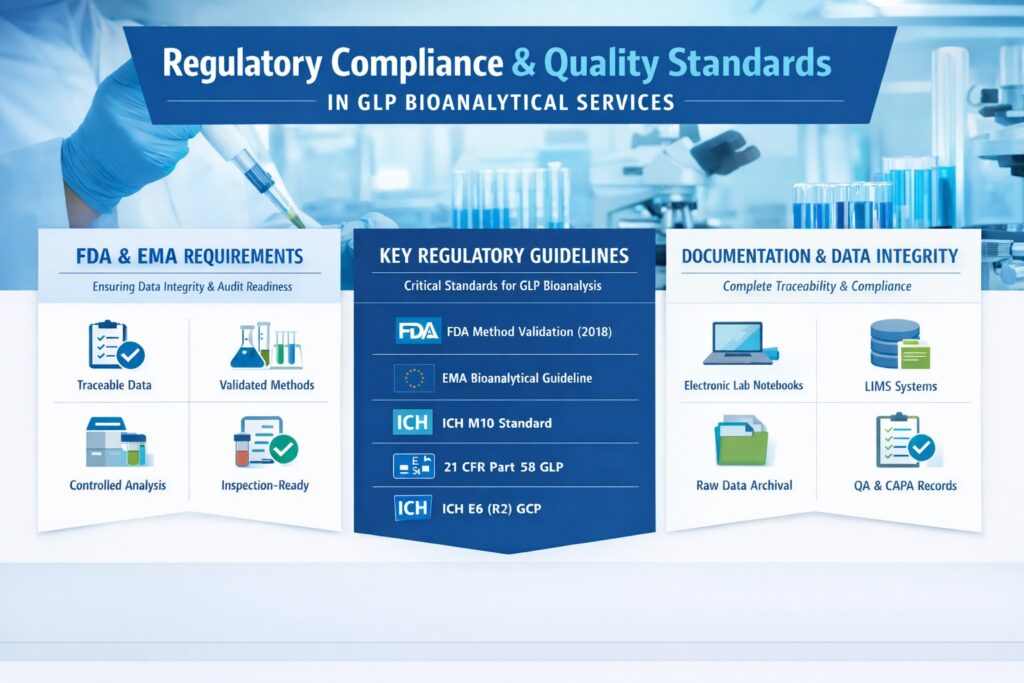
FDA and EMA Requirements for GLP Bioanalytical Services
Regulatory agencies require GLP bioanalytical services for all pivotal nonclinical safety studies and clinical trials supporting marketing applications. Compliance ensures data integrity and study reconstruction capabilities during regulatory inspections.
Key Regulatory Guidances
- FDA Bioanalytical Method Validation Guidance (2018): Standards for method validation and sample analysis
- EMA Bioanalytical Method Validation Guideline: European requirements for bioanalytical procedures
- ICH M10 Guideline: Harmonized bioanalytical method validation standards
- 21 CFR Part 58: GLP regulations for nonclinical laboratory studies
- ICH E6 (R2): Good Clinical Practice for clinical trial bioanalytics
Documentation and Data Integrity
Comprehensive documentation in GLP bioanalytical services ensures complete traceability and enables reconstruction of all study activities. ResolveMass Laboratories Inc. maintains electronic and paper-based systems that meet 21 CFR Part 11 requirements.
Our documentation systems include:
- Electronic Laboratory Notebooks (ELN) with audit trails
- Laboratory Information Management Systems (LIMS)
- Validated data processing software
- Raw data archival with controlled access
- Study protocols and final reports
- Quality assurance inspection records
- Deviation and corrective action documentation
5: Strategic Selection: GLP vs Non-GLP Bioanalytical Services
Sponsors often combine early non-GLP development with later GLP validation through bioanalytical services outsourcing for pharma and CRO partnerships.
ResolveMass supports seamless transitions through bioanalytical CRO services for PK and TK.
Decision Framework
The choice between GLP bioanalytical services and non-GLP approaches depends on regulatory requirements, development stage, data defensibility needs, and resource considerations. A strategic approach optimizes both scientific quality and development efficiency.
Decision Tree for Service Selection
Question 1: Is the study intended for regulatory submission?
- Yes → GLP bioanalytical services required
- No → Proceed to Question 2
Question 2: Will the data support critical development decisions?
- Yes → Consider GLP for data defensibility
- No → Non-GLP may be appropriate
Question 3: Is the method fully optimized and validated?
- Yes → GLP implementation feasible
- No → Non-GLP development recommended
Transitioning from Non-GLP to GLP
Efficient transition from non-GLP method development to GLP bioanalytical services requires strategic planning and proper documentation. ResolveMass Laboratories Inc. facilitates seamless transitions through:
- Method Transfer Protocols: Formal documentation of analytical procedures
- Pre-Validation Assessment: Verification of method robustness
- Validation Planning: Comprehensive validation protocols
- Cross-Validation Studies: Comparison of non-GLP and GLP data
- Regulatory Strategy Alignment: Coordination with submission timelines
6: Technology and Instrumentation
6.1 Advanced Analytical Platforms
ResolveMass Laboratories Inc. operates state-of-the-art instrumentation for both GLP and non-GLP bioanalytical services:
- High-Resolution Mass Spectrometry: Accurate mass determination and metabolite identification
- Triple Quadrupole LC-MS/MS: Sensitive quantification with wide dynamic range
- Immunoassay Platforms: ELISA, MSD, Gyros for biologics and biomarkers
- Hybrid LBA-LCMS: Combined approaches for complex molecules
- Automated Sample Processing: Hamilton and Tecan robotic systems
6.2 Quality Control and System Suitability
Rigorous quality control procedures ensure consistent performance of GLP bioanalytical services throughout study conduct. Every analytical run includes:
- Calibration standards across the quantification range
- Quality control samples at low, mid, and high concentrations
- Blank and zero samples for background assessment
- System suitability standards before sample analysis
- Incurred sample reanalysis for clinical studies
- Long-term quality control trending
Our platforms include:
7: Benefits of Partnering with ResolveMass Laboratories Inc.
7.1 Technical Expertise and Experience
ResolveMass Laboratories Inc. brings decades of combined experience in GLP bioanalytical services for small molecules, biologics, and biomarkers. Our scientific team includes:
- PhD-level method development scientists
- GLP-trained analysts with extensive regulatory experience
- Quality assurance professionals with inspection expertise
- Regulatory affairs specialists for submission support
7.2 Comprehensive Service Integration
Our integrated approach to GLP bioanalytical services streamlines development timelines and ensures consistency across study phases. We provide:
- Seamless transition from discovery to development
- Coordinated method development and validation
- Flexible study support for adaptive trial designs
- Rapid turnaround for time-critical analyses
- Proactive communication and technical consultation
7.3 Regulatory Success Record
ResolveMass Laboratories Inc. has supported numerous successful regulatory submissions with zero critical findings during inspections. Our quality systems and scientific rigor have enabled:
- Multiple IND submissions across therapeutic areas
- NDA and BLA applications for novel therapeutics
- International regulatory filings (FDA, EMA, PMDA)
- Biosimilar development programs
- Generic drug applications
8: Industry Applications and Case Studies
8.1 Oncology Drug Development
GLP bioanalytical services for oncology therapeutics require specialized expertise in challenging matrices and complex dosing regimens. ResolveMass has supported development of targeted therapies, immunotherapies, and combination treatments with:
- Ultra-sensitive methods for low-dose compounds
- Matrix validation in cancer patient samples
- Metabolite profiling for active metabolite identification
- Biomarker analysis for target engagement
We support small molecule vs large molecule bioanalysis and small & large molecule quantification.
8.2 Biologics and Biosimilars
Large molecule GLP bioanalytical services demand unique methodologies for stability, immunogenicity, and pharmacokinetic characterization. Our biologics capabilities include:
- Ligand-binding assays for therapeutic proteins
- Anti-drug antibody assessments
- Neutralizing antibody detection
- Biomarker and pharmacodynamic assays
- Comparability studies for biosimilars
Our expertise includes large molecule bioanalysis, biosimilar bioanalysis, and cell and gene therapy bioanalysis.
8.3 Rare Disease and Orphan Drugs
Specialized GLP bioanalytical services for rare disease programs accommodate limited sample volumes and unique patient populations. ResolveMass provides:
- Micro-volume sampling techniques
- Pediatric sample analysis
- Specialized matrix validation
- Flexible study designs for small populations
9: Future Trends in Bioanalytical Services
Emerging Technologies
The field of GLP bioanalytical services continues to evolve with technological advances:
- Microsampling Techniques: Dried blood spots and volumetric absorptive devices
- High-Resolution Mass Spectrometry: Untargeted metabolomics and exposomics
- Artificial Intelligence: Data processing and method optimization
- Multiplexed Assays: Simultaneous measurement of multiple analytes
- Point-of-Care Analysis: Decentralized testing for clinical trials
Regulatory Evolution
Regulatory agencies continue refining expectations for GLP bioanalytical services through updated guidances and harmonization efforts. Current trends include:
- Increased focus on critical reagent qualification for LBA
- Enhanced requirements for incurred sample reanalysis
- Harmonization through ICH M10 implementation
- Greater scrutiny of data integrity and electronic records
- Risk-based approaches to method validation
Conclusion
GLP bioanalytical services remain the gold standard for regulatory-quality data, while non-GLP services accelerate early discovery. ResolveMass Laboratories Inc. delivers integrated solutions through its bioanalytical CRO for drug discovery and full bioanalytical services overview.
Our commitment to scientific excellence, regulatory compliance, and client partnership ensures that your bioanalytical needs are met with precision and reliability. Whether you require GLP bioanalytical services for pivotal studies or non-GLP support for exploratory research, our team delivers customized solutions that advance your therapeutic development goals.
Frequently Asked Questions:
GLP (Good Laboratory Practice) refers to a regulated quality system governing how nonclinical laboratory studies are planned, performed, monitored, recorded, and reported to ensure data integrity and reliability for regulatory submissions.
Non-GLP refers to laboratory studies conducted outside formal GLP regulations. While scientifically valid, non-GLP studies are typically used for exploratory research, discovery, or early decision-making and are not intended for direct regulatory submission.
In drug development, GLP ensures that nonclinical safety, toxicology, pharmacokinetic (PK), and bioanalytical data are credible, traceable, and acceptable to regulatory agencies such as the FDA and EMA.
GLP-compliant studies are required to support:
-IND-enabling toxicology studies
-First-in-human clinical trials
-NDA/BLA regulatory submissions
GLP provides regulators confidence that nonclinical data accurately reflect the safety profile of a drug candidate.
The five core principles of GLP are:
~Organization and Personnel – Clearly defined roles, responsibilities, and qualified staff
~Quality Assurance (QA) – Independent oversight to ensure GLP compliance
~Facilities and Equipment – Suitable, validated, and properly maintained infrastructure
~Standard Operating Procedures (SOPs) – Documented, controlled procedures for all activities
~Data Recording and Reporting – Accurate, traceable, and auditable raw data and final reports
Together, these principles ensure study reproducibility, data integrity, and regulatory defensibility.
Non-GLP medications are drug candidates or formulations that have been evaluated using non-GLP studies, typically during early discovery or preclinical research.
This does not mean the medications are unsafe or low quality—only that the supporting data were generated outside formal GLP compliance and therefore cannot be used alone for regulatory approval.
The main purpose of GLP is to ensure the quality, integrity, reliability, and traceability of nonclinical study data submitted to regulatory authorities.
GLP protects:
-Patient safety
-Regulatory decision-making
-Scientific credibility
-Sponsor accountability
Good Laboratory Practice (GLP) defines responsibilities to ensure studies are conducted with quality, integrity, and regulatory compliance.
-Test Facility Management: Ensures overall GLP compliance, resources, SOPs, and staff training
-Study Director: Has full responsibility for study design, conduct, data integrity, and final report
-Quality Assurance Unit (QAU): Independently audits studies, processes, and reports for GLP compliance
-Principal Investigator: Manages delegated study phases at test sites
-Study Personnel/Analysts: Perform experiments, follow SOPs, and record accurate data
-Archivist: Maintains secure storage and retrieval of study records and data
Purpose: To ensure reliable, traceable, and regulatory-acceptable study data.
Reference
- GLP Regulations for Nonclinical Studies.https://link.springer.com/chapter/10.1007/978-3-030-75537-9_5
- Wenkui Li ,Jim Glick, Panos Hatsis, Yunlin Fu, Harvey Chin, Paul Moench.An Integrated Outsourcing Practice of Nonclinical LC–MS Bioanalysis and Toxicokinetics at Novartis small Molecule Drug Development.https://www.tandfonline.com/doi/abs/10.4155/bio-2021-0072
- DEVELOPMENT OF A STRUCTURED REVIEW SERVICE FOR NON-GLP STUDY DATA INTENDED TO SUPPORT REGULATORY SUBMISSIONS AT AN ACADEMIC INSTITUTION.https://www.sciencedirect.com/science/article/abs/pii/S1465324924003050
- Bernd A Bruenne ,Roger V Pham, Wale Rufai &Christopher A James.Perspectives on a Flexible Strategy for the Management of Nonregulated Bioanalysis.https://www.tandfonline.com/doi/full/10.4155/bio-2022-0094
- Amanda Wilson,Stephen Silvester &Karen Woods.A Community of Practice Approach to Bioanalysis Delivery: The Role of The Preclinical Bioanalysis and Toxicokinetics Department at Astrazeneca.https://www.tandfonline.com/doi/abs/10.4155/bio.14.106
About the Author


