

Introduction
Headspace GC-MS for Volatile Extractables is a primary analytical technique used to isolate, identify, and quantify low-boiling organic chemical migrants released from pharmaceutical packaging, drug delivery devices, and medical products under controlled laboratory conditions. By assessing vapor-phase equilibrium above a solid or liquid sample matrix, this technique enables the quantification of trace volatile organic compounds without introducing non-volatile polymer matrices into the gas chromatograph.
Polymeric packaging systems, elastomeric closures, Single-Use Systems (SUS), and patient-contacting medical devices are manufactured using complex formulations containing raw monomers, polymerization solvents, catalysts, cross-linking agents, and protective additives. During thermal processing, molding, or terminal sterilization procedures, including gamma irradiation and ethylene oxide processing, residual unreacted monomers, processing solvents, and volatile degradation products may remain trapped within the material matrix. When these materials come into contact with liquid drug formulations or biological fluids, low-molecular-weight volatile organic compounds (VOCs) may migrate into the patient contact pathway. Such migration can introduce potential toxicological risks, compromise drug stability, or negatively affect product quality. Systematic characterization of volatile extractables through advanced gas chromatography-mass spectrometry (GC-MS) workflows provides the analytical foundation necessary to meet ISO 10993-18, USP, and ICH Q3E regulatory requirements.
For reliable recovery of residual solvents during chemical characterization, select appropriate solvents for extractables studies.
Share via:
Quick Summary:
- What it is: Headspace GC-MS finds and measures low-boiling chemicals that can migrate out of drug packaging, single-use systems and medical devices. It samples only the vapor above the sample, so the non-volatile polymer never enters the instrument.
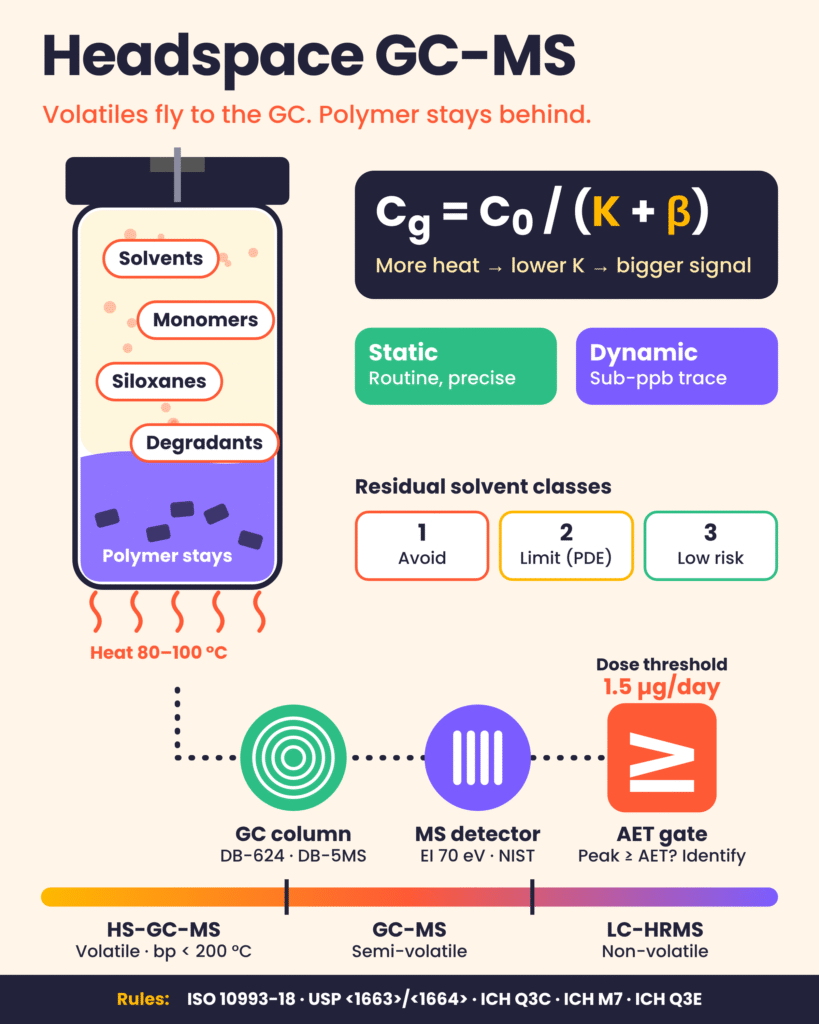
- How it works: Volatiles split between the sample and the vapor according to the partition coefficient (K) and the phase ratio (β), as described by Cg = C0 / (K + β). Raising the temperature or adding salt pushes more analyte into the vapor and gives a stronger signal. Static headspace suits routine, precise screening, while dynamic headspace traps the vapor and reaches sub-ppb levels.
- What it detects: It finds residual solvents (ICH Q3C Classes 1, 2 and 3), unreacted monomers such as ethylene oxide, styrene and vinyl chloride, and cyclic siloxanes (D4, D5). It also picks up degradation products from heat, sterilization or radiation, such as aldehydes and antioxidant fragments.
- Regulatory basis: The work supports ISO 10993-18 for medical devices, USP <1663> and <1664> for extractables and leachables, PQRI recommendations, and the draft ICH Q3E guideline. Studies use polar, mid-polar and non-polar solvents to mimic worst-case clinical exposure.
- AET: The analytical evaluation threshold converts a safety threshold (1.5 µg/day) into a concentration in the extract. Any peak at or above the AET must be identified and assessed by a toxicologist. With the article’s example inputs, the correct value is about 96 µg/L.
- Typical instrument settings: Samples are incubated at 80–100 °C for 30–60 minutes. The column is DB-624 for solvents or DB-5MS for broad screening, with the oven running from 35 °C to 300 °C. Detection uses EI at 70 eV with library matching against NIST and Wiley.
- Where it fits: Headspace GC-MS covers volatiles, direct-injection GC-MS covers semi-volatiles, and LC-HRMS covers non-volatile and heat-sensitive compounds. Used together, these give a complete extractables and leachables profile.
Methodological Framework of Headspace GC-MS for Volatile Extractables
The fundamental mechanism of Headspace GC-MS for Volatile Extractables involves establishing thermodynamic equilibrium between a liquid or solid sample matrix and the vapor phase above it within a sealed container. Partitioning analytes into the gas phase eliminates the need for direct liquid injection of complex extract matrices. This approach helps prevent inlet contamination and column degradation associated with non-volatile polymers and high-boiling-point additives.
The physical chemistry underlying static headspace gas chromatography is governed by the thermodynamic distribution of volatile compounds between the sample phase and the gas phase. This distribution is described by the partition coefficient (K), which is defined as follows:
Partition Coefficient:
K = Cs / Cg
Here, Cs represents the equilibrium concentration of the volatile analyte within the sample matrix, while Cg represents its concentration in the headspace vapor phase. A lower partition coefficient indicates greater analyte volatility and a stronger tendency to transfer into the vapor phase under equilibrium conditions, resulting in improved chromatographic sensitivity.
The phase ratio (β) describes the volumetric relationship between the vapor phase (Vg) and the sample matrix phase (Vs):
Phase Ratio:
β = Vg / Vs
By combining these thermodynamic parameters, the fundamental headspace response equation for the gas-phase concentration (Cg), expressed in relation to the initial analyte concentration in the sample matrix (C0), can be obtained:
Headspace Concentration Equation:
Cg = C0 / (K + β)
Achieving maximum analytical sensitivity requires careful optimization of sample volume, equilibration temperature, and ionic strength. For example, salting-out techniques in aqueous extracts can be used to improve analyte transfer into the vapor phase. These parameters must be adjusted to reduce the practical effects of K and β while ensuring that the sample matrix remains stable and does not undergo degradation.
Analytical laboratories generally employ two primary headspace sampling configurations, depending on the required sensitivity and analyte volatility:
Static Headspace GC-MS (HS-GC-MS): This technique collects a defined aliquot of the equilibrated vapor phase after the sample has been heated at a controlled temperature. Static headspace offers excellent quantitative reproducibility and precision, making it suitable for routine screening of residual solvents and highly volatile extractables in accordance with USP and ISO 10993-18.
Dynamic Headspace GC-MS (DHS-GC-MS): This approach continuously purges the vapor space inside the sample vial using an inert sweep gas. The volatile analytes are transferred onto an adsorbent trap, such as Tenax TA or broad-range carbon adsorbents, before being thermally desorbed onto the GC column. Dynamic headspace can achieve detection limits in the sub-parts-per-billion (ppb) range, making it particularly effective for ultra-trace volatile extractables profiling.
Key Volatile Target Compounds: Solvents, Monomers, and Thermal Degradants
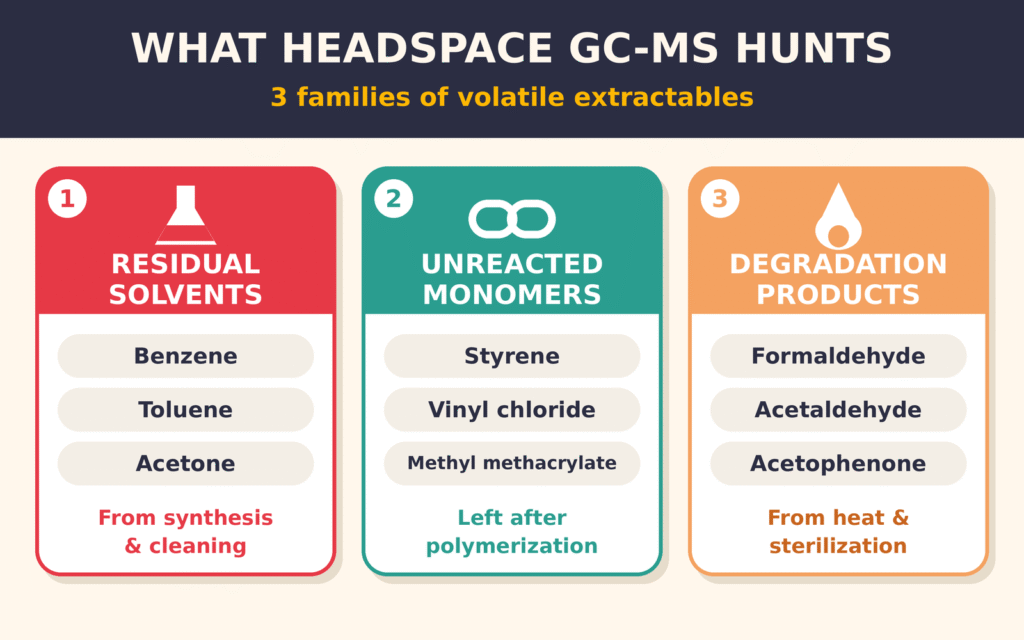
Volatile extractables investigations primarily focus on three categories of compounds: residual organic solvents originating from raw material processing, unreacted monomers remaining after polymerization, and volatile fragments produced through thermal, chemical, or radiation-induced degradation. Identifying these chemical categories provides toxicologists with the necessary analytical information to perform human health risk assessments in accordance with ISO 10993-17 and ICH M7.
Residual Solvents
Residual solvents are volatile organic chemicals that are either used or generated during resin synthesis, device cleaning, or component manufacturing. Established toxicological classification frameworks, including ICH Q3C and USP, divide these solvents into three categories according to their potential health risks:
Class 1 Solvents (Known Human Carcinogens): These high-risk compounds include benzene, 1,2-dichloroethane, 1,1-dichloroethene, and carbon tetrachloride. Their use during manufacturing should be avoided unless a specific justification supports their presence.
Class 2 Solvents (Nongenotoxic Animal Carcinogens or Systemic Toxins): These solvents are subject to strict Permitted Daily Exposure (PDE) limits. Representative examples include acetonitrile, hexane, methanol, toluene, methylene chloride, and N,N-dimethylformamide.
Class 3 Solvents (Low Toxic Potential): These solvents generally exhibit low toxicological potential and have PDEs of 50 mg/day or higher. Common examples include ethanol, acetone, isopropanol, ethyl acetate, heptane, and methyl ethyl ketone.
Unreacted Monomers and Synthetic Building Blocks
Incomplete polymer conversion can leave volatile monomers, low-molecular-weight reactive intermediates, and processing aids trapped within polymer matrices. Common target monomers and related compounds include:
Ethylene Oxide (EO) and Ethylene Chlorohydrin (ECH): These toxic residues may originate from gaseous sterilization processes used for pre-packaged medical devices.
Styrene and Vinyl Chloride: These residual volatile building blocks may remain in formulations containing polystyrene (PS), acrylonitrile-butadiene-styrene (ABS), and polyvinyl chloride (PVC).
Acrylic Acid Esters and Methyl Methacrylate: These monomeric residues may originate from acrylic adhesives, intraocular lenses, and structural bone cements.
Low-Boiling Cyclic Siloxanes: These volatile organosilicon compounds include hexamethyldisiloxane (HMDSO), octamethylcyclotetrasiloxane (D4), and decamethylcyclopentasiloxane (D5). They may originate from silicone lubricants, elastomeric stoppers, or hydrophobic plasma surface treatments.
Volatile Degradation Products
Polymeric materials can undergo degradation when exposed to high-shear compounding, elevated molding temperatures, or ionizing radiation, including gamma and electron-beam sterilization. Such degradation processes can generate several volatile chemical species, including:
Oxidized Antioxidant Breakdown Products: These low-boiling degradation fragments may originate from hindered phenol antioxidants, such as 2,6-di-tert-butyl-4-methylphenol or BHT breakdown products, as well as phosphite processing stabilizers.
Short-Chain Aldehydes and Ketones: Compounds such as formic acid, formaldehyde, acetaldehyde, acrolein, and acetone can form through oxidative chain scission of polyolefins, including polyethylene and polypropylene.
Photoinitiator Cleavage Residues: These low-molecular-weight fragments are generated during the degradation of UV-cured inks, coatings, and structural adhesives. Examples include acetophenone and benzophenone derivatives.
Target Volatile Compounds and Recommended Analytical Strategies
| Target Chemical Category | Representative Volatile Analytes | Typical Source Materials | Primary Toxicological Risk | Recommended Headspace GC-MS Strategy |
|---|---|---|---|---|
| Class 1 and 2 Residual Solvents | Benzene, Toluene, Acetonitrile, Hexane, Methylene chloride | Polymer synthesis, solvent bonding, equipment washing | Carcinogenicity, mutagenicity, organ toxicity | DB-624 / G43 column, static HS (80°C–100°C), EI-MS full scan |
| Class 3 Residual Solvents | Ethanol, Acetone, Isopropanol, Ethyl acetate | Resin purification, wiping agents, processing aids | Low systemic toxicity; drug product degradation | Non-polar DB-5MS or DB-WAX column, optimized β ratio |
| Unreacted Monomers | Ethylene oxide, Styrene, Methyl methacrylate, Vinyl chloride | Incomplete polymerization, gas sterilization | Mutagenicity, tissue irritation, cytotoxicity | Cryogenic initial oven hold (35°C), cold-trap focusing |
| Volatile Siloxanes | HMDSO, D4, D5, D6 cyclic siloxanes | Silicone oil coatings, elastomeric seals, plasma treatments | Subcutaneous reactivity, therapeutic protein aggregation | DB-1MS / DB-5MS column, high-temperature inert transfer line |
| Volatile Degradants | Acetaldehyde, BHT breakdown fragments, Acetophenone | Thermo-oxidative extrusion, gamma/E-beam sterilization | Contact sensitization, cellular toxicity, drug interaction | Full scan mass spectral deconvolution against NIST/Wiley libraries |
For device-specific chemical characterization, assess extractables and leachables in autoinjector systems.
Regulatory Standards and Analytical Mandates (ISO 10993-18 and USP)
Regulatory compliance for medical devices and pharmaceutical container closure systems requires comprehensive chemical characterization protocols to identify and quantify volatile extractables. Compendial standards establish requirements for controlled extraction procedures combined with mass-spectrometric analysis to generate the data necessary for toxicological risk assessments.
ISO 10993-18: Biological Evaluation of Medical Devices — Chemical Characterization
ISO 10993-18:2020 establishes the required framework for the chemical characterization of patient-contacting medical devices. The standard specifies a risk-based testing approach that considers the type of body contact, including surface, external communicating, or implant contact, along with the duration of exposure. Contact duration is classified into the following categories:
- Limited Contact (A): Single or cumulative exposure lasting ≤ 24 hours.
- Prolonged Contact (B): Exposure lasting > 24 hours to 30 days.
- Permanent Contact (C): Exposure lasting > 30 days.
According to ISO 10993-18, chemical extraction procedures should incorporate polar solvents, such as purified water; mid-polar solvents, such as ethanol/water mixtures; and non-polar solvents, such as hexane or refined oil. These solvents are selected to simulate worst-case clinical exposure conditions.
Accelerated extraction studies are typically performed at elevated temperatures, generally between 50°C and 70°C, for 24 to 72 hours. These conditions are intended to maximize extractable recovery without inducing thermal degradation of the underlying polymer. Headspace GC-MS is an essential analytical technique for assessing volatile organic extractables present in liquid extracts or released through direct thermal off-gassing.
USP and USP: Assessment of Extractables and Leachables
United States Pharmacopeia standards USP and USP establish important testing frameworks for pharmaceutical container closure systems, prefilled syringes, inhalers, and single-use bioprocessing assemblies. USP governs controlled extractables studies designed to generate worst-case chemical profile data. It identifies headspace GC-MS as an important analytical technique for detecting volatile migrants that may otherwise evaporate during conventional liquid-solvent concentration procedures.
USP addresses leachables assessments by evaluating compounds that migrate into actual drug formulations throughout their commercial shelf life. These studies help determine the chemical substances to which patients may be exposed during the intended use of a pharmaceutical product.
For syringe-based drug delivery products, identify potential chemical migrants in pre-filled syringe systems.
PQRI Guidelines and ICH Q3E Guidance
Recommendations developed by the Product Quality Research Institute (PQRI) for Orally Inhaled and Nasal Drug Products (OINDP) and Parenteral and Ophthalmic Drug Products (PODP) establish important toxicological safety thresholds. These frameworks, together with the draft ICH Q3E guideline, define the Safety Concern Threshold (SCT) at 1.5 µg/day. Below this threshold, an uncharacterized leachable is considered to present a negligible risk of carcinogenic or systemic toxicity under the applicable assessment framework.
Analytical Evaluation Threshold (AET) Calculations in Headspace GC-MS for Volatile Extractables
The Analytical Evaluation Threshold (AET) establishes the instrument concentration limit at or above which an unidentified peak detected in a headspace chromatogram must undergo chemical identification and toxicological assessment. Determining the AET helps ensure that analytical detection capabilities are appropriately aligned with patient safety requirements.
The calculation begins with the Dose-Based Threshold (DBT), which is derived directly from the Safety Concern Threshold (SCT = 1.5 µg/day) or the Threshold of Toxicological Concern (TTC = 0.15 µg/day) applicable to potential mutagenic impurities under ICH M7.
The final absolute concentration limit (AETfinal) considers several parameters, including extraction solvent volume, device surface area or quantity, daily patient dosing, and variability in analytical response:
Analytical Evaluation Threshold Equation:
AET = (DBT / Ddaily) × (Vextract / Ndevice) × (1 / UF)
Where:
- DBT: Represents the dose-based threshold (µg/day) established using applicable safety guidelines.
- Ddaily: Represents the maximum number of medical devices or the dose volume administered to a patient per day.
- Vextract: Represents the total volume of solvent used during the controlled laboratory extraction (mL).
- Ndevice: Represents the total number of medical devices or packaging components extracted into the volume Vextract.
- UF: Represents the Uncertainty Factor, a correction factor generally ranging from 1.3 to 2.0. It accounts for differences in response factors between analytical internal standards and unidentified volatile analytes during electron ionization mass spectrometry.
Practical AET Calculation Example
Consider an extraction profile in which 10 medical device components (Ndevice = 10) are extracted using 100 mL of aqueous solvent (Vextract = 100 mL). The clinical application involves the use of one device per patient per day (Ddaily = 1 device/day). Using an SCT-derived DBT of 1.5 µg/day and an uncertainty factor of UF = 1.56, the AET calculation is as follows:
AET = (1.5 µg/day / 1 device/day) × (100 mL / 10 devices) × (1 / 1.56)
AET = 1.5 × 10 × 0.6410
AET = 9.615 µg/L (ppb)
Based on this quantitative assessment, any volatile extractable peak detected during headspace GC-MS analysis at a concentration ≥ 9.615 ppb must undergo structural characterization and toxicological evaluation.
Accurate threshold setting is essential for reliable chemical assessment; establish appropriate AET limits for extractables and leachables studies.
Instrument Parameter Optimization for Headspace GC-MS for Volatile Extractables
Optimizing headspace sampler setpoints, capillary column parameters, and mass spectrometer operating conditions is essential for achieving broad analyte recovery while minimizing the risk of thermal degradation. The following parameters represent commonly used conditions for volatile extractables screening.
Headspace Automated Sampler Setpoints
Incubation Temperature: For aqueous liquid extracts, the incubation temperature is generally maintained between 80°C and 100°C. For direct solid polymer off-gassing investigations, temperatures between 100°C and 140°C may be used. Increasing the incubation temperature reduces the partition coefficient (K), promoting the transfer of volatile analytes into the gas phase. However, the selected temperature must remain below the thermal decomposition temperature of the base polymer to prevent the formation of artificial degradation products.
Equilibration Time: Equilibration is typically maintained for 30 to 60 minutes, with continuous mechanical agitation to establish steady-state thermodynamic equilibrium between the sample matrix and the headspace vapor phase.
Sample Loop and Transfer Line Temperature: These temperatures are generally maintained 10°C to 20°C above the equilibration temperature, typically within the range of 110°C to 150°C. Maintaining sufficiently elevated temperatures prevents the formation of cold spots and minimizes analyte condensation along the sample transfer pathway.
Gas Chromatograph (GC) Setpoints
Capillary Column Chemistry: Non-polar columns, such as DB-5MS or HP-5MS, containing 5% phenyl-95% methylpolysiloxane and having dimensions of 30 m × 0.25 mm ID × 0.25 µm film thickness, provide high chromatographic efficiency for volatile organic compounds.
Mid-polar stationary phases, including DB-624 / G43 phase, containing 6% cyanopropylphenyl-94% dimethylpolysiloxane, are commonly selected when separating low-boiling Class 1, 2, and 3 residual solvents in accordance with USP.
Oven Temperature Program: The initial oven temperature is generally maintained between 35°C and 40°C for 3 to 5 minutes. This initial low-temperature hold helps focus low-boiling volatile compounds at the beginning of the capillary column. The oven temperature is subsequently increased at a rate of 10°C/min to 15°C/min until it reaches 300°C. This temperature program facilitates the elution of residual semi-volatile compounds while minimizing potential column contamination.
Carrier Gas Flow: High-purity Helium (99.999%) is typically used as the carrier gas and maintained at a constant flow rate of 1.0 to 1.2 mL/min.
Mass Spectrometer (MS) Operating Parameters
Ionization Mode: Standard Electron Ionization (EI) is performed at an energy of 70 eV. This ionization technique generates reproducible fragmentation patterns that support compound identification through spectral library matching against NIST, Wiley, and specialized extractables databases.
Mass Scan Range: Full-scan acquisition is generally performed across an m/z range of 35 to 550. This range enables the detection of both low-molecular-weight fragments and larger volatile analytes.
Ion Source and Quadrupole Temperatures: The MS ion source is typically maintained at 230°C, while the quadrupole temperature is set to 150°C. These operating conditions help maintain consistent ionization efficiency throughout the analytical process.
Reliable identification also depends on appropriate toxicological assessment; evaluate the safety of identified leachables through toxicological qualification.
Comparative Platform Analysis: Headspace GC-MS vs. Direct Injection GC-MS and LC-HRMS
Comprehensive characterization of extractables and leachables requires the integration of complementary analytical platforms to capture the widest possible range of potential chemical migrants. Since these compounds differ considerably in volatility, polarity, and molecular weight, no single analytical technique can adequately detect every extractable species.
Headspace GC-MS is primarily used to isolate volatile compounds with high vapor pressures. In comparison, direct injection GC-MS targets semi-volatile organic compounds (SVOCs), including phthalates, fatty acid esters, and high-molecular-weight antioxidants.
Liquid chromatography coupled with high-resolution mass spectrometry (LC-HRMS) is used to investigate non-volatile, polar, and thermally labile compounds, including oligomers, slip agents, and photoinitiators. These compounds may undergo decomposition before vaporization when exposed to the high temperatures of gas chromatography inlets.
Comparison of Analytical Platforms
| Analytical Performance Metric | Headspace GC-MS | Direct Injection GC-MS | LC-MS / LC-HRMS (Orbitrap/Q-TOF) |
|---|---|---|---|
| Target Analyte Class | Volatile Organic Compounds (VOCs), residual solvents, low-boiling monomers | Semi-Volatile Organic Compounds (SVOCs), plasticizers, antioxidants | Non-Volatile Organic Compounds (NVOCs), oligomers, polar surfactants |
| Analyte Volatility Range | High volatility (boiling point < 200°C) | Moderate to low volatility (boiling point 200°C–450°C) | Non-volatile or thermally unstable species |
| Molecular Weight (MW) Range | Low molecular weight (< 250 Da) | Medium molecular weight (100–800 Da) | Broad range (200–3000+ Da) |
| Sample Preparation Requirement | Sealed vial thermal equilibration; direct vapor phase injection | Solvent extraction, liquid-liquid concentration, derivatization | Solvent filtration, dilution, direct liquid phase injection |
| Matrix Interferences | Low; non-volatile polymer residues remain in the sample vial | High; non-volatile residues enter the injection port, requiring column care | Moderate; matrix suppression can affect electrospray ionization |
| Compound Structural Identification | Standard 70 eV EI spectral matching against NIST/Wiley reference libraries | Standard 70 eV EI spectral matching against NIST/Wiley reference libraries | Accurate mass calculation, isotope pattern analysis, MS/MS fragmentation |
Selecting the right analytical platform is important for comprehensive chemical characterization; compare GC-MS and LC-MS approaches for extractables and leachables testing.
Conclusion
The standardized application of Headspace GC-MS for Volatile Extractables plays a critical role in identifying residual solvents, unreacted monomer residues, and thermal degradation products present in medical devices and pharmaceutical packaging materials. By combining thermodynamic gas-phase partitioning with electron ionization mass spectrometry, this technique delivers the analytical sensitivity required to support compliance with ISO 10993-18 and USP regulatory standards.
Accurate calculation of Analytical Evaluation Thresholds (AET) ensures that chemical characterization studies can identify and evaluate potential chemical migrants before products reach patients. As regulatory expectations continue to expand for single-use bioprocessing assemblies and drug-device combination products, headspace GC-MS remains a fundamental analytical approach for comprehensive chemical safety evaluations.
Long-term product safety also requires monitoring compounds that migrate during storage; track leachables throughout pharmaceutical stability studies.
To learn more about chemical characterization programs and analytical testing protocols, visit the ResolveMass Laboratories Contact Page.
Frequently Asked Questions
Equilibration temperature directly affects the distribution of volatile analytes between the sample matrix and the vapor phase. Increasing the temperature generally reduces the partition coefficient (K), encouraging more analytes to migrate into the headspace (Cg). This improves analyte recovery and can enhance chromatographic sensitivity while lowering detection limits.
Static headspace sampling involves heating a sealed sample vial until thermodynamic equilibrium is established, followed by the collection of a specific volume of vapor for GC-MS analysis. Dynamic headspace sampling continuously passes an inert gas through the sample vial, transferring volatile compounds onto an adsorbent trap. Subsequent thermal desorption releases the concentrated analytes for analysis, allowing detection at sub-parts-per-billion levels.
Volatile extractables generally have boiling points below 200°C and sufficiently high vapor pressures to transfer readily into the gas phase during headspace sampling. Semi-volatile extractables (SVOCs), typically having boiling points between 200°C and 450°C, exhibit lower volatility and are more appropriately analyzed using solvent extraction followed by direct injection GC-MS. Selecting the correct analytical approach ensures better recovery and identification of different chemical compounds.
Electron Ionization (EI) at 70 eV generates characteristic fragmentation patterns that provide reproducible mass spectra for compound identification. These fragmentation profiles can be compared with established reference databases, including NIST and Wiley libraries, to determine the identity of unknown volatile compounds. Consistent fragmentation also supports reliable spectral matching across different analytical runs.
The Analytical Evaluation Threshold (AET) defines the concentration above which an unidentified chromatographic peak requires further chemical identification and toxicological assessment. It translates dose-based safety limits, such as the Safety Concern Threshold (SCT), into measurable analytical concentration limits. The calculation considers extraction volume, the number of devices analyzed, daily patient exposure, and applicable uncertainty factors.
No, headspace GC-MS is designed to detect volatile organic compounds and is not suitable for determining inorganic elemental impurities. Heavy metals, elemental catalysts, and inorganic salts require specialized elemental analysis techniques, particularly Inductively Coupled Plasma-Mass Spectrometry (ICP-MS). Such testing is performed in accordance with applicable requirements under USP and ISO 10993-18.
Water and selected high-boiling organic solvents with sufficiently low vapor pressures at the incubation temperature can be used for static headspace analysis. Examples include dimethyl sulfoxide and dimethylformamide, depending on the analytical method and target compounds. Low-boiling solvents, such as dichloromethane and hexane, may generate excessive vapor concentrations, increase vial pressure, and interfere with chromatographic measurements.
Residual ethylene oxide is commonly measured by placing the medical device or a representative sample in a sealed headspace vial and heating it under controlled conditions. This allows trapped ethylene oxide residues to partition into the vapor phase for subsequent GC-MS analysis. Quantification is performed using matrix-matched calibration standards or standard addition techniques to compensate for matrix-related effects on analyte recovery.
Volatile extractables characterization for medical devices primarily follows ISO 10993-18, which addresses chemical characterization, and ISO 10993-17, which covers toxicological risk assessment. Pharmaceutical packaging and drug delivery systems are evaluated using applicable USP requirements, including USP, USP, and USP. PQRI recommendations and ICH Q3E guidance also provide relevant safety assessment principles for evaluating potential chemical migrants and patient exposure.
Reference:
- Wijeweera Patabandige, M., Hill, J., Herath, A., Naimi, I., & Wickramasekara, S. (2024). Dynamic headspace GC–MS method to detect volatile extractables from medical device materials. Biomedical Materials & Devices, 2(2), 1125–1142. https://doi.org/10.1007/s44174-023-00145-1
- Xie, Z., Liu, Q., Liang, Z., Zhao, M., Yu, X., Yang, D., & Xu, X. (2013). The GC/MS analysis of volatile components extracted by different methods from Exocarpium Citri Grandis. Journal of Analytical Methods in Chemistry, 2013, Article 918406. https://doi.org/10.1155/2013/918406
- Wijeweera Patabandige, M., Nahan, K., Young, J. A., Oktem, B., Sussman, E. M., Yun, B. H., & Wickramasekara, S. (2024). Thermal extraction: An alternative headspace GC–MS method for volatile extractables from medical device materials. Biomedical Materials & Devices, 2(1), 474–484. https://doi.org/10.1007/s44174-023-00103-x
- Wijeweera Patabandige, M., & Wickramasekara, S. (n.d.). Dynamic headspace GC-MS method to detect volatile extractables from medical device materials. U.S. Food and Drug Administration. https://www.fda.gov/media/168979/download
Get In Touch With Us
About The Author