

Introduction:
HRMS vs Triple Quadrupole for Bioanalysis is a platform decision that balances sensitivity, selectivity, quantitative accuracy, analytical flexibility and regulatory requirements. Understanding it helps pharmaceutical companies, biotechnology organizations and contract research organizations (CROs) choose the analytical approach that fits their development program.
Both technologies are coupled with liquid chromatography (LC) to quantify drugs, metabolites, peptides and other compounds in matrices such as plasma, serum, urine and tissue extracts. Triple quadrupole instruments use selected or multiple reaction monitoring (SRM/MRM) for highly sensitive, reproducible measurement of predefined analytes. HRMS instruments, including quadrupole-Orbitrap and quadrupole time-of-flight (Q-TOF) systems, provide accurate-mass, high-resolution detection that supports both targeted quantification and broader investigation.
The decision is not about picking the more advanced instrument. It is about selecting the platform that meets the scientific objectives, sensitivity requirements, sample characteristics and regulatory expectations of your program. This article compares both technologies and gives practical guidance for choosing between them.
Summary:
- High-resolution mass spectrometry (HRMS) and triple quadrupole (QqQ) mass spectrometry are the two main platforms for quantitative bioanalysis, and they serve different analytical needs.
- Triple quadrupole LC-MS/MS is generally preferred for routine, highly sensitive, targeted quantification of known drugs and metabolites in biological matrices.
- HRMS provides high mass accuracy and resolving power, and supports targeted, suspect and non-targeted screening.
- HRMS is particularly useful for metabolite identification, biotransformation studies, impurity profiling and retrospective data analysis.
- Triple quadrupole instruments often offer better practical sensitivity and throughput for established assays at very low concentrations.
- The right platform depends on sensitivity, selectivity, analyte characteristics, study objectives, sample availability, regulatory expectations and cost.
- Combining both platforms gives a comprehensive strategy for complex drug development programs.
1: What Is Triple Quadrupole Mass Spectrometry in Quantitative Bioanalysis?
Triple quadrupole mass spectrometry is a targeted technique that uses three quadrupole stages to selectively detect and quantify predefined compounds, and it is widely considered the standard platform for routine LC-MS/MS bioanalysis. Its strengths are sensitivity, reproducibility and throughput.
How Does a Triple Quadrupole Mass Spectrometer Work?
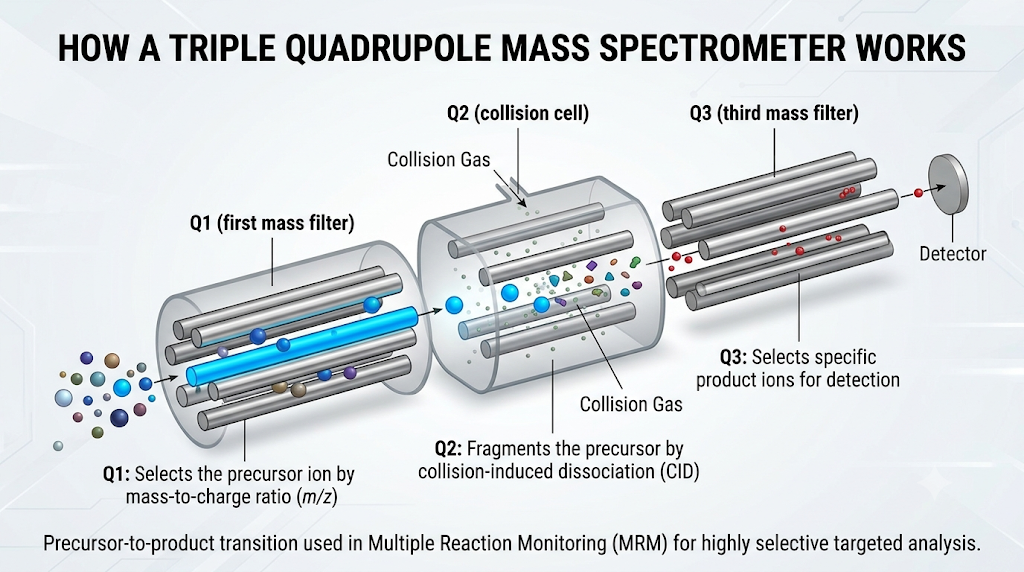
A triple quadrupole selects a precursor ion, fragments it, and then selects a characteristic product ion for detection.
- Q1 (first mass filter): selects the precursor ion by mass-to-charge ratio (m/z).
- Q2 (collision cell): fragments the precursor by collision-induced dissociation (CID), producing characteristic product ions.
- Q3 (third mass filter): selects specific product ions for detection.
For example, when quantifying a drug in human plasma, Q1 selects the drug’s precursor ion, Q2 fragments it, and Q3 monitors one characteristic product ion. Monitoring this precursor-to-product transition gives high selectivity.
What Is Multiple Reaction Monitoring (MRM)?
MRM is a targeted acquisition mode in which the instrument monitors specific precursor-to-product transitions for multiple analytes in a single run. Because ions are filtered at two stages, MRM reduces interference from endogenous matrix components and supports reliable quantification at low concentrations.
MRM is widely used for:
- Pharmacokinetic (PK) and bioequivalence studies
- Drug concentration measurements and therapeutic drug monitoring
- Metabolite quantification
- Clinical and preclinical bioanalysis
Laboratories offering dedicated LC-MS/MS bioanalytical services typically build these validated MRM methods for sponsors. For analytes beyond conventional drug panels, see how quantification using triple quadrupole mass spectrometry can be applied.
2: What Is High-Resolution Mass Spectrometry (HRMS)?
HRMS separates ions by mass-to-charge ratio with high resolving power and measures their accurate masses, supporting both targeted quantification and screening for known and unknown compounds.
Common HRMS platforms include quadrupole-Orbitrap, Q-TOF and Fourier transform ion cyclotron resonance (FT-ICR) instruments.
How Does HRMS Work?
HRMS measures ions with ppm-level mass accuracy, allowing scientists to distinguish compounds with closely related m/z values. A Q-TOF determines accurate mass from ion flight time, while an Orbitrap determines it from ion oscillation frequency.
Common acquisition strategies:
| Mode | What it does |
|---|---|
| Full scan | Collects spectra across a predefined m/z range |
| Data-dependent acquisition (DDA) | Selects ions from a full scan for subsequent fragmentation |
| Data-independent acquisition (DIA) | Fragments groups of ions across predefined isolation windows |
| Parallel reaction monitoring (PRM) | Selects precursors and measures their product-ion spectra at high resolution |
Why Is HRMS Useful in Pharmaceutical Bioanalysis?
HRMS offers flexibility beyond targeted quantification, which matters when you must investigate unknown metabolites, find unexpected drug-related compounds, or revisit previously acquired data. Typical applications include:
- Drug metabolism and pharmacokinetic investigations
- Metabolite identification and biotransformation studies
- Biomarker discovery
- Impurity and degradation product investigations
- Suspect and non-targeted screening
- Retrospective data analysis
The same accurate-mass strengths apply in other regulated analytical areas, such as HRMS for nitrosamine testing.
3: HRMS vs Triple Quadrupole for Bioanalysis: Key Differences
The primary difference is analytical approach: triple quadrupole excels at highly sensitive targeted quantification, whereas HRMS provides accurate-mass detection and greater flexibility for identifying and investigating compounds.
| Parameter | Triple Quadrupole (QqQ) | High-Resolution MS (HRMS) |
|---|---|---|
| Primary purpose | Targeted quantification | Targeted and non-targeted analysis |
| Mass resolution | Unit mass resolution | High mass resolution |
| Mass accuracy | Unit-mass filtering | Typically ppm-level |
| Sensitivity | Generally excellent for targeted assays | Strong, but method- and platform-dependent |
| Acquisition | MRM/SRM | Full scan, DDA, DIA, PRM |
| Selectivity | Precursor and product ion filtering | Accurate mass, resolving power and MS/MS |
| Unknown metabolite identification | Limited | Strong |
| Retrospective analysis | Limited by acquisition method | Possible from suitable full-scan datasets |
| Routine PK studies | Excellent suitability | Suitable with validated methods |
| Method development | Target-specific optimization | Flexible acquisition and screening |
| Data processing | Comparatively straightforward | Often more computationally intensive |
| Throughput | Generally high for targeted panels | Depends on acquisition strategy |
Which Platform Offers Better Quantitative Performance?
For many established small-molecule assays, triple quadrupole offers superior practical sensitivity and throughput, but modern HRMS can deliver robust quantitative performance when properly optimized and validated.
4: Sensitivity and Selectivity: Which Platform Performs Better?
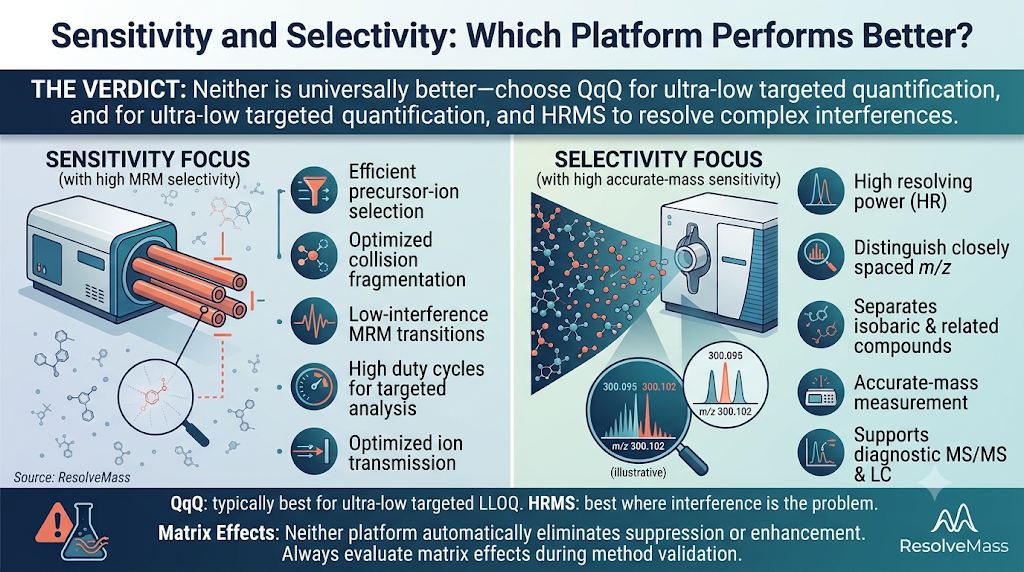
Triple quadrupole generally has the advantage when extremely low concentrations must be measured in complex matrices, while HRMS adds a dimension of selectivity through accurate mass.
Triple Quadrupole Sensitivity
QqQ is widely used when PK and bioequivalence studies need low-concentration quantification. Its sensitivity is supported by:
- Efficient precursor-ion selection
- Optimized collision-induced fragmentation
- MRM transitions with low background interference
- High duty cycles for targeted measurements
- Optimized ion transmission and detection
HRMS Selectivity
High resolving power lets scientists distinguish ions with closely spaced m/z values, which helps in samples containing endogenous compounds, metabolites and structurally related molecules. Two compounds with the same nominal mass but different exact masses may be separated by accurate-mass measurement. Accurate mass alone does not establish identity, so chromatographic separation and diagnostic MS/MS fragmentation may still be needed.
Practical consideration: neither platform automatically eliminates matrix effects. Suppression, enhancement, extraction recovery, ionization efficiency and interference must be evaluated during method development and validation.
5: Application-Based Comparison: When Should You Use Each Platform?
Triple quadrupole is generally preferred for established targeted assays, while HRMS is particularly useful for exploratory studies and complex characterization.
| Bioanalytical application | Recommended platform | Reason |
|---|---|---|
| Routine pharmacokinetic studies | Triple quadrupole | Sensitive targeted quantification |
| Bioequivalence studies | Triple quadrupole | Reproducible concentration measurements |
| Low-level drug quantification | Triple quadrupole, subject to performance | Strong targeted sensitivity |
| Unknown metabolite identification | HRMS | Accurate-mass and MS/MS information |
| Drug metabolism studies | HRMS | Broad metabolite profiling |
| Biomarker discovery | HRMS | Broad-spectrum capability |
| Targeted peptide quantification | Either | Depends on sensitivity and selectivity needs |
| Retrospective screening | HRMS | Full-scan data supports additional investigation |
| Targeted multi-analyte panels | Triple quadrupole | Efficient MRM-based analysis |
For peptide-based programs, specialized peptide bioanalytical services can help determine which platform meets your sensitivity and selectivity needs.
When Should You Choose Triple Quadrupole MS?
- Your target analytes are already known.
- The study requires very low quantification limits.
- Large sample batches must be processed efficiently.
- The method relies on established MRM transitions.
- Reproducible concentration measurement is the primary objective.
When Should You Choose HRMS?
- Unknown or unexpected metabolites may be present.
- Accurate-mass confirmation is important.
- The study requires broad metabolite profiling.
- Multiple related compounds need investigation.
- Retrospective data analysis may be valuable.
- The objective extends beyond predefined targets.
6: Method Development and Validation Considerations
Both platforms require systematic development and validation; instrument selection alone does not guarantee an accurate bioanalytical method. Key parameters:
- Selectivity: endogenous matrix components must not interfere with the analyte.
- Sensitivity: establish an appropriate lower limit of quantification (LLOQ).
- Accuracy and precision: evaluate reliability and reproducibility of measured concentrations.
- Matrix effect: assess ion suppression or enhancement across matrix sources.
- Recovery: determine extraction efficiency.
- Carryover: evaluate residual signal after high-concentration samples.
- Stability: establish stability under collection, processing, storage and analytical conditions.
- Dilution integrity: confirm reliable measurement above the upper limit of quantification.
For regulated work, validation should align with the FDA’s bioanalytical method validation guidance and ICH M10: Bioanalytical Method Validation and Study Sample Analysis. Programs conducted under good laboratory practice typically use GLP bioanalytical services with documented, auditable workflows.
Does HRMS Require a Different Validation Strategy?
HRMS requires the same fundamental demonstration of quantitative performance, with additional considerations depending on the acquisition strategy.
- Monitor mass accuracy and resolving power.
- Establish precursor and product-ion confirmation criteria.
- Ensure acquisition windows give adequate data points across chromatographic peaks.
- Define instrument calibration and quality-control procedures.
- Document data processing parameters and integration rules.
For triple quadrupole methods, the key optimization parameters are transition selection, collision energy, ion ratios, dwell time and scheduled MRM windows.
7: Can HRMS and Triple Quadrupole Be Used Together?
Yes. Combining both platforms improves the overall strategy by using each for what it does best. A practical workflow:
- Initial investigation with HRMS: identify drug-related compounds, metabolites and unexpected components.
- Analytical characterization: evaluate accurate mass, fragmentation patterns and potential structures.
- Targeted method development: establish MRM transitions for compounds requiring routine quantification.
- Quantitative bioanalysis with triple quadrupole: measure predefined analytes across large batches.
- Additional HRMS investigations: revisit samples or acquire further full-scan data when broader characterization is needed.
This approach is especially valuable for complex molecules, multiple metabolites and extensive PK programs. It also suits fast-moving programs, such as those using rapid proof-of-concept bioanalytical services, and programs with limited or precious samples, such as bioanalytical services for rare disease, where careful platform planning protects sample availability.
8: Factors to Consider Before Selecting a Mass Spectrometry Platform
Evaluate the complete analytical requirements of the program rather than instrument specifications alone.
| Factor | What to evaluate |
|---|---|
| Study objectives | Targeted quantification, metabolite identification or comprehensive screening |
| Required sensitivity | Expected analyte concentrations and required LLOQ |
| Sample availability | Volume available for method development and repeat analysis |
| Analyte complexity | Molecular weight, structure, stability, potential interferences |
| Study throughput | Sample volume, batch size, turnaround time |
| Regulatory expectations | Ability to meet validation and documentation requirements |
| Total analytical cost | Instrument access, method development, data processing, maintenance, sample analysis |
A well-designed strategy delivers scientifically meaningful results while maintaining reproducibility, efficiency and regulatory confidence.
9: How ResolveMass Laboratories Supports Quantitative Bioanalysis
Platform selection is only one part of a successful program; reliable sample preparation, optimized chromatography, appropriate detection and robust validation matter equally.
ResolveMass Laboratories Inc. is a USFDA-registered Canadian CRO/CDMO that supports pharmaceutical and biotechnology programs through specialized analytical testing and characterization. Its expertise includes:
- LC-MS and LC-MS/MS for targeted drug and metabolite analysis
- High-resolution mass spectrometry for accurate-mass characterization
- HPLC and UHPLC for chromatographic separation
- Method development, optimization and validation
- Impurity profiling and structural characterization
- Pharmaceutical analytical investigations and CMC support
For sponsors developing small molecules, peptides and complex drug products, choosing the analytical strategy early can reduce development uncertainty and improve data quality. The ResolveMass team starts by defining the analytical question, then selects and justifies the platform, rather than starting from a fixed instrument preference.
Conclusion:
The comparison of HRMS vs Triple Quadrupole for Bioanalysis shows that both technologies have important but different roles: triple quadrupole for routine, sensitive, high-throughput targeted quantification, and HRMS for accurate-mass flexibility, metabolite identification and retrospective analysis.
There is no universally superior platform. The right choice depends on analyte characteristics, required sensitivity, study objectives, regulatory expectations and available resources. For complex development programs, using HRMS for discovery and characterization alongside triple quadrupole for routine quantification is often the most effective strategy. Working with an experienced analytical CRO helps you select, develop and validate the most appropriate method.
Frequently Asked Questions:
Not necessarily. Triple quadrupole instruments generally provide better practical sensitivity for many targeted quantitative assays, particularly at very low analyte concentrations. However, sensitivity depends on the instrument, analyte, ionization conditions, sample preparation, and analytical method.
Multiple reaction monitoring (MRM) selectively monitors predefined precursor-to-product ion transitions. This improves selectivity and helps quantify specific drugs and metabolites in complex biological matrices such as plasma, serum, and urine.
MRM is commonly performed on triple quadrupole instruments and monitors specific precursor-to-product ion transitions. PRM is typically performed on high-resolution instruments, where selected precursor ions are fragmented and their product-ion spectra are measured with high resolution.
No. HRMS does not eliminate matrix effects. Endogenous substances can still cause ion suppression or enhancement during electrospray ionization. Matrix effects must be evaluated through appropriate sample preparation, chromatographic optimization, and validation experiments.
Triple quadrupole MS can be more cost-effective for routine targeted analysis involving large sample batches because of its established workflows and high throughput. HRMS may offer greater value for complex investigations where multiple compounds, unknown metabolites, or retrospective analysis are important. Overall costs depend on project requirements and laboratory infrastructure.
Retrospective data analysis involves reprocessing previously acquired HRMS full-scan data to investigate additional compounds or metabolites that were not part of the original analysis. It can reduce the need for additional sample analysis when the original acquisition captured sufficient information and data quality is adequate.
Reference
- Fung EN, Jemal M, Aubry AF. High-resolution MS in regulated bioanalysis: where are we now and where do we go from here?. Bioanalysis. 2013 May 1;5(10):1277-84.https://www.tandfonline.com/doi/abs/10.4155/bio.13.81
- DelGuidice CE, Ismaiel OA, Mylott Jr WR, Halquist MS. Comparison of methods for quantitative analysis of ranibizumab and bevacizumab in human plasma using various bioanalytical techniques, including microfluidic immunoassay, triple quadrupole, and high-resolution liquid chromatography-tandem mass spectrometry approaches. Journal of Pharmaceutical and Biomedical Analysis. 2022 Aug 5;217:114823.https://www.sciencedirect.com/science/article/pii/S0731708522002448
- Morin LP, Mess JN, Garofolo F. Large-molecule quantification: sensitivity and selectivity head-to-head comparison of triple quadrupole with Q-TOF. Bioanalysis. 2013 May 1;5(10):1181-93.https://www.tandfonline.com/doi/abs/10.4155/bio.13.87
- Grund B, Marvin L, Rochat B. Quantitative performance of a quadrupole-orbitrap-MS in targeted LC–MS determinations of small molecules. Journal of pharmaceutical and biomedical analysis. 2016 May 30;124:48-56.https://www.sciencedirect.com/science/article/pii/S0731708516300875
- Kaufmann A. High‐resolution mass spectrometry for bioanalytical applications: Is this the new gold standard?. Journal of Mass Spectrometry. 2020 Sep;55(9):e4533.https://analyticalsciencejournals.onlinelibrary.wiley.com/doi/abs/10.1002/jms.4533
- Geib T, Sleno L, Hall RA, Stokes CS, Volmer DA. Triple quadrupole versus high resolution quadrupole-time-of-flight mass spectrometry for quantitative LC-MS/MS analysis of 25-hydroxyvitamin D in human serum. Journal of The American Society for Mass Spectrometry. 2016 Aug;27(8):1404-10.https://link.springer.com/article/10.1007/s13361-016-1412-2
- Rochat B. Quantitative and qualitative LC-high-resolution MS: The technological and biological reasons for a shift of paradigm. Recent advances in analytical chemistry. 2018 Dec 14.https://books.google.com/books?hl=en&lr=&id=EBf9DwAAQBAJ&oi=fnd&pg=PA3&dq=High-Resolution+MS+vs.+Triple+Quadrupole+for+Quantitative+Bioanalysis:+Which+Platform+Fits+Your+Program%3F&ots=L7sEfRKFnd&sig=D3W_tS0XYXyHmL7PEilrgHrHEcs
About the Author