


Introduction
Impurity Identification for ANDA Submission becomes very important when unknown peaks appear during stability or release testing. If these impurities are not clearly identified and controlled, they can delay the approval process or even lead to rejection. Regulatory authorities expect a clear understanding of impurity profiles to ensure the safety, quality, and performance of the drug product. This case study explains a practical and structured approach to identifying and characterizing unknown impurities using advanced analytical tools and regulatory-aligned workflows.
Unlike general theoretical discussions, this article focuses on a real-world problem-solving approach. It explains how an unknown impurity was detected, studied, and finally controlled to meet ANDA requirements. The case also shows how analytical science, formulation knowledge, and process understanding must work together. Such an integrated approach is now expected in modern pharmaceutical submissions.
Ensure your submission meets all regulatory benchmarks: Explore our Analytical Requirements for ANDA Submissions
Share via:
🔍 Summary
- Unknown impurities in ANDA submissions are most often detected during stability studies or batch analysis and require rapid structural elucidation.
- A multidisciplinary workflow (LC-MS → HRMS → isolation → NMR) is the most reliable approach for impurity identification.
- Early-stage mass spectrometry fragmentation analysis provides molecular weight and tentative structures.
- Preparative isolation followed by NMR confirms structural identity when LC-MS is insufficient.
- Root cause investigations often trace impurities to process reactions, degradation pathways, or excipient interactions.
- Regulatory success depends on complete characterization, toxicological qualification, and control strategy.
- Delays in impurity identification are a major cause of ANDA deficiencies and review cycles.
Impurity Identification for ANDA Submission – Case Study Overview
Unknown impurities in this case were detected as unexpected peaks (>0.1%) during accelerated stability studies, which triggered a full investigation workflow.
Case Background
Dosage form: Solid oral tablet
API: Small molecule (confidential generic)
Stage: ANDA stability study (6 months accelerated)
Observation:
- Two unknown impurity peaks at 0.12% and 0.18%
- Not present in initial release batch
- Increasing trend over time
These observations clearly showed that the impurities were formed during storage rather than during manufacturing. The increasing trend raised concerns about possible degradation pathways under accelerated conditions. Such findings require immediate attention to avoid regulatory risks and ensure product quality.
Initial Risk Assessment
| Parameter | Observation | Risk Level |
|---|---|---|
| Unknown impurity > ICH threshold | Yes (>0.1%) | High |
| Increasing trend | Yes | Critical |
| Structural alert risk | Unknown | Pending |
👉 According to industry case studies, such impurities must be identified and qualified before submission approval (Alsante et al., 2004). Regulatory agencies evaluate both impurity level and trend. Early investigation helps avoid complications later in the submission process.
Need expert help with unexpected peaks? Learn more about our Impurity Profiling using LC-MS
Impurity Identification for ANDA Submission – Analytical Strategy
A stepwise analytical approach using LC-MS, HRMS, isolation, and NMR is essential for reliable impurity identification.
Stepwise Analytical Approach
LC-MS Screening
- Identifies molecular ion peaks
- Provides initial molecular weight
- Helps detect impurity profiles quickly across samples
High-Resolution Mass Spectrometry (HRMS)
- Determines exact mass and elemental composition
- Enables accurate molecular formula prediction
- Reduces uncertainty in structure analysis
MS/MS Fragmentation Analysis
- Generates fragmentation patterns
- Shows similarity with API structure
- Helps identify functional group changes
Isolation via Preparative HPLC
- Required for NMR confirmation
- Needs milligram-level impurity
- Ensures purity of the isolated sample
NMR Characterization
- Confirms final structure
- Provides detailed structural information
- Acts as definitive proof for regulatory acceptance
📌 Studies show that LC-MS alone is not enough, and NMR confirmation is required for regulatory acceptance (Qiu & Norwood, 2007; Ahuja, 2004). Using multiple analytical techniques improves confidence and reduces the chance of errors.
Achieve superior accuracy in molecular formula prediction: Discover High-Resolution Mass Spectrometry (HRMS) Analysis
Impurity Identification for ANDA Submission – Structural Elucidation
The unknown impurity was identified as an oxidative degradation product formed due to API-excipient interaction.
Key Findings
- Molecular weight shift: +16 Da
- Indicates oxidation reaction
- Fragmentation pattern retained API core
These results suggested that an oxygen atom was added without changing the core structure of the API. This type of change is commonly seen in oxidative degradation pathways. The similarity in fragmentation patterns confirmed that the impurity was closely related to the parent compound.
Structural Interpretation
| Technique | Insight |
|---|---|
| LC-MS | Molecular ion at m/z +16 |
| HRMS | Confirmed addition of oxygen |
| MS/MS | Similar fragmentation to API |
| NMR | Confirmed hydroxylated structure |
Final Identification
👉 The impurity was confirmed as a hydroxylated derivative of the API, formed due to oxidative stress during storage. This is a common degradation pathway when drug substances are exposed to oxygen over time.
📚 Literature also supports oxidation as a common pathway in solid dosage forms (Weidolf et al., 2020; Cordeiro et al., 2026). Understanding such pathways helps in predicting and preventing future impurity issues.
Is your API a complex molecule? See our Peptide Characterization Services
Impurity Identification for ANDA Submission – Root Cause Analysis
The impurity was formed due to oxidative degradation, supported by excipient interaction under stress conditions.
Root Cause Investigation
Stress testing performed:
- Oxidative (H₂O₂)
- Thermal
- Photolytic
These studies simulate extreme conditions to understand how the drug behaves. Among all tests, oxidative stress showed the highest impurity formation. This clearly indicated that oxygen played a major role in degradation.
Observations
- High impurity formation under oxidative stress
- Trace formation with magnesium stearate
- Increased levels under high humidity
Humidity likely increased molecular movement, making reactions easier between API and excipients. Magnesium stearate may have acted as a catalyst, accelerating oxidation. These combined factors explain the impurity increase during stability studies.
Address specific regulatory concerns for mutagenic impurities: View our Nitrosamine Analysis Services
Root Cause Conclusion
- Primary cause: Oxidative degradation
- Secondary factor: Excipient-induced catalysis
📌 Such issues often result from complex interactions between API, excipients, and environmental factors (Alsante et al., 2004). A detailed investigation is necessary to fully understand the root cause.
Impurity Identification for ANDA Submission – Control Strategy
A strong control strategy was implemented through formulation changes and strict impurity limits.
Implemented Controls
Reformulation:
- Replaced reactive excipient
- Improved compatibility with API
- Reduced degradation risk
Packaging:
- Used low oxygen permeability blister packs
- Limited oxygen exposure
- Improved product stability
Process:
- Reduced oxygen exposure during manufacturing
- Optimized processing conditions
- Improved batch consistency
Specification Setting
| Parameter | Limit |
|---|---|
| Individual impurity | NMT 0.15% |
| Total impurities | NMT 1.0% |
Stability Outcome
- Impurity reduced to <0.05%
- No increasing trend observed
These results confirmed that the control strategy was effective. Stability data supported the formulation and packaging improvements, strengthening the ANDA submission.
📌 Regulatory guidelines require proper justification and supporting data for impurity limits (Tapkir et al., 2022). Clear documentation is essential for approval.
Navigate the complexities of regulatory validation: Check ANDA Method Validation Requirements
Impurity Identification for ANDA Submission – Regulatory Documentation
Complete and well-structured documentation is critical for successful submission.
Key Submission Components
- Impurity characterization report
- Structural data (LC-MS, NMR)
- Degradation pathway explanation
- Toxicological qualification (if needed)
- Updated specifications
Each element is important to demonstrate full control over impurity risks. Regulatory agencies expect clear and traceable evidence. Missing details can lead to queries or delays.
Regulatory Impact
- Avoided deficiency letters
- Smooth ANDA review process
📚 Regulatory agencies emphasize complete impurity profiling to ensure drug safety (Singh & Singh, 2023). A strong submission reduces review time and improves approval chances.
Ensure your packaging doesn’t compromise your product: Learn about Extractables & Leachables Testing
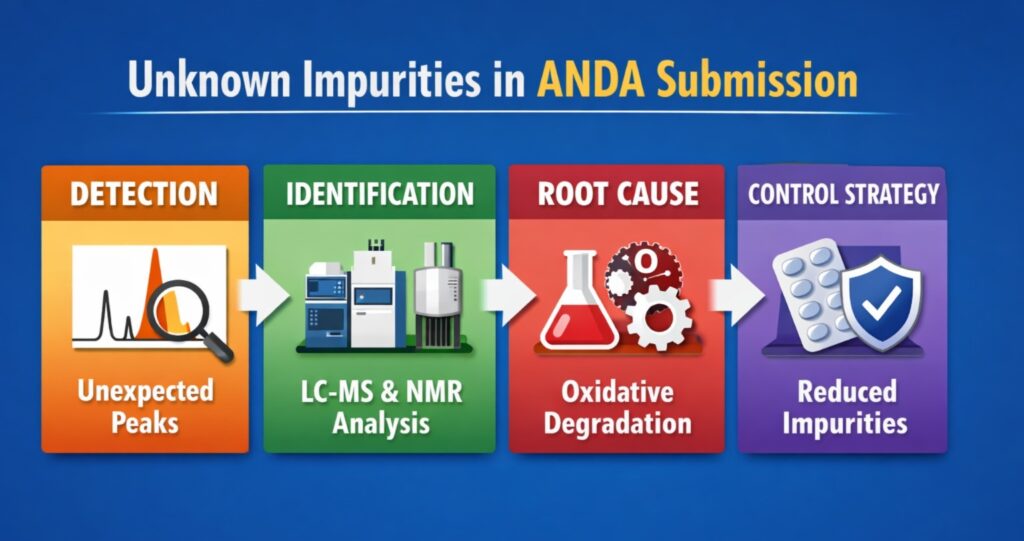
Impurity Identification for ANDA Submission – Key Lessons from Case Study
Early detection, proper analytical methods, and root cause understanding are essential for success.
Critical Takeaways
- Investigate impurities as early as possible
- Use multiple analytical techniques
- Isolation and NMR are often required
- Check excipient compatibility carefully
- Ensure complete and clear documentation
These lessons highlight the importance of a proactive approach. Solving impurity issues early saves time, cost, and effort. A combined strategy involving analytical, formulation, and regulatory teams is the most effective.
Conclusion
This case study shows that Impurity Identification for ANDA Submission is not just a lab activity but a complete scientific and regulatory process. Unknown impurities must be studied step by step, from detection to structure confirmation and finally control strategy implementation. Each stage plays an important role in meeting regulatory expectations.
By using advanced techniques like LC-MS, HRMS, and NMR, along with formulation and process knowledge, companies can successfully manage impurity challenges. This approach improves product quality, ensures patient safety, and increases the chances of ANDA approval. A strong impurity control strategy is the key to long-term success.
Ready to streamline your next submission? Explore Outsourcing Analytical Testing for ANDA Submissions
📞 Contact Experts
For expert support in impurity identification and ANDA submissions:
❓ FAQs: Impurity Identification for ANDA Submission
Impurity identification is required when unknown peaks cross regulatory thresholds, typically around 0.1%, or when their levels increase during stability studies. These situations raise safety and quality concerns. Regulatory agencies expect clear identification in such cases. Addressing them early helps avoid delays in approval.
LC-MS is useful for identifying molecular weight and basic fragmentation patterns, but it cannot confirm the full chemical structure. It provides direction, not final proof. For complete structural confirmation, NMR is necessary. Using both techniques ensures reliable and acceptable results.
Isolation is needed when detailed structural analysis, especially NMR, must be performed. It ensures that the impurity sample is pure and free from interference. Without isolation, accurate interpretation becomes difficult. This step is often essential for regulatory submissions.
One major challenge is obtaining enough quantity of the impurity for analysis. Another difficulty is interpreting complex analytical data correctly. These processes can take time and require technical expertise. Proper planning and advanced tools can help overcome these issues.
Excipients can interact with the API and sometimes speed up chemical reactions that lead to impurities. Their effect becomes stronger under stress conditions like heat and humidity. Some excipients may even act as catalysts. Careful selection and compatibility studies help reduce this risk.
Not all impurities need full identification. Only those above certain regulatory limits or with potential safety risks must be studied in detail. Lower-level impurities may not require complete analysis. Guidelines help define which impurities need attention.
Delays often occur when impurity data is incomplete or not well explained. Missing structural details or weak justification can lead to regulatory questions. This slows down the review process. Clear and complete documentation helps prevent such issues.
Reference:
- Satheesh, B., Sree Ganesh, K. K., & Saravanan, D. (2012). Identification, isolation and characterization of an unknown impurity of varenicline. Scientia Pharmaceutica, 80(2), 329–336. https://doi.org/10.3797/scipharm.1201-08
- Belwal, C., Goyal, P. K., Balte, A., Kolhe, S., Chauhan, K., Rawat, A. S., & Vardhan, A. (2013). Isolation, identification, and characterization of an unknown impurity in lovastatin EP. Scientia Pharmaceutica, 82(1), 43–52. https://doi.org/10.3797/scipharm.1305-04
- Vaddamanu, G., Goswami, A., Reddy, N. R. S., Reddy, K. R. V. K., & Mulakayala, N. (2023). Identification, synthesis, and characterization of novel baricitinib impurities. ACS Omega, 8(10), 9583–9591. https://doi.org/10.1021/acsomega.3c00100
Get In Touch With Us
About The Author


