
Introduction
Innovator Reference Product Characterization Services establish the structural, physicochemical, and functional benchmarks that guide every subsequent decision in a U.S. 351(k) or European Medicines Agency (EMA) biosimilar development program. Under the U.S. Food and Drug Administration’s (FDA) September 2025 final Comparative Analytical Assessment (CAA) guidance and its October 2025 draft guidance on waiving routine comparative efficacy studies, analytical similarity has evolved from a supporting component into the central evidentiary foundation for regulatory licensure.
For biosimilar sponsors, characterizing the licensed originator biologic involves measuring biological heterogeneity across commercial lots, geographical markets, and manufacturing histories rather than simply confirming one fixed molecular structure. Establishing a scientifically defensible originator profile requires orthogonal high-resolution mass spectrometry, biophysical higher-order structure (HOS) analysis, and risk-based statistical modeling aligned with ICH Q6B, ICH Q2(R2), and ICH Q14 standards. Dual-compliant R&D and GMP laboratories, such as ResolveMass Laboratories Inc., allow sponsors to carry reference product characterization findings directly into regulatory comparability dossiers while minimizing inter-laboratory method variability.
A comprehensive analytical characterization strategy is essential for establishing reliable reference product benchmarks and supporting regulatory submissions.
Explore biosimilar characterization services
Share via:
Quick Summary:
- Why it matters: FDA’s September 2025 final guidance on comparative analytical assessment (CAA) and its October 2025 draft guidance on comparative efficacy studies make analytical similarity the core evidence for biosimilar approval. A strong analytical package, backed by PK and immunogenicity data, may now replace costly Phase III efficacy trials.
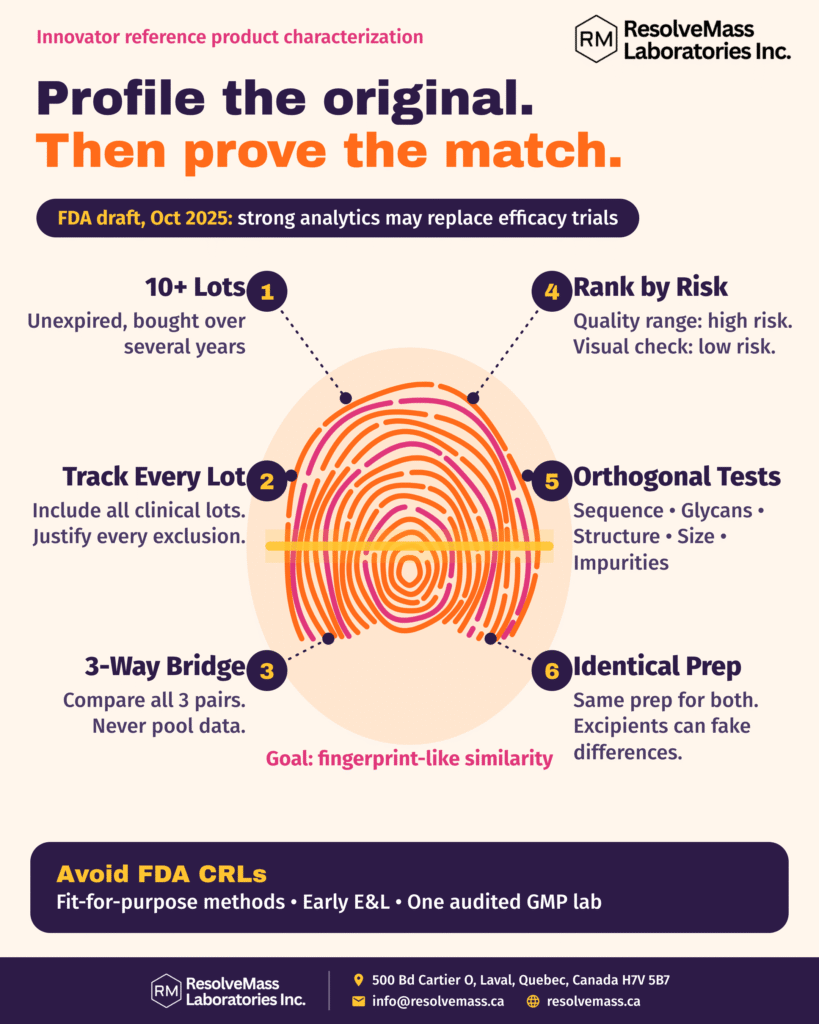
- Reference lot sourcing: Sponsors should test at least 10 unexpired reference product lots bought over several years, so the originator’s natural lot-to-lot variability (“drift”) is captured. Approved BLAs have often used far more, such as 68 U.S. Humira lots for PF-06410293.
- Lot governance: Every lot acquired must be accounted for, with any exclusion justified. Lots used in clinical studies must be included. Expired lots should generally be left out unless they were stored under proven stable conditions, such as −80°C.
- Non-U.S. comparator bridging: When a non-U.S. comparator is used, sponsors must provide all three pairwise analytical comparisons (biosimilar vs U.S., biosimilar vs non-U.S., non-U.S. vs U.S.). U.S. and non-U.S. data must never be pooled, and acceptance criteria come only from U.S. reference lots.
- Risk-based statistics: Quality attributes are ranked by their potential impact on efficacy, PK, safety and immunogenicity. FDA recommends quality ranges (typically mean ± 3 SD) for high- and moderate-risk attributes and side-by-side visual comparison for low-risk ones. Equivalence testing is an option the sponsor can propose.
- Orthogonal analytics and sample prep: Each structural level is checked with complementary methods:
- sequence and PTMs by LC-MS/MS
- glycans by HILIC-MS
- higher-order structure by CD, FTIR, DSC and HDX-MS
- size and particles by SEC-MALS, AUC and MFI
- impurities by ddPCR and proteomics
- Avoiding CRLs and choosing a lab: Common causes of Complete Response Letters include unjustified LOD/LOQ, method drift, unbridged assay changes, pooled comparator data and incomplete E&L studies. Running characterization in one audited R&D + GMP lab, such as ResolveMass, reduces data-integrity gaps and method-transfer risk.
Why Are Innovator Reference Product Characterization Services Critical Under 2025–2026 FDA and EMA Guidance?
Innovator Reference Product Characterization Services help determine whether a biosimilar candidate can qualify for streamlined clinical development pathways and potentially avoid expensive Phase III comparative efficacy trials under current regulatory frameworks. Industry analyses indicate that modern biophysical assays can identify molecular differences at approximately 1%–2% analytical resolution, compared with the 15%–20% sensitivity margins generally associated with clinical efficacy endpoints. Consequently, regulators are placing increasing emphasis on comprehensive reference product characterization, supported by pharmacokinetic/pharmacodynamic (PK/PD) and immunogenicity data, to establish that no clinically meaningful differences exist between the proposed biosimilar and its reference product.
Three major regulatory developments between 2024 and 2026 have significantly influenced originator characterization expectations. First, the FDA’s September 2025 final CAA guidance (Docket FDA-2019-D-2102) replaced its earlier 2015 quality guidance and 2019 draft guidance. It established more stringent requirements for lot accounting, non-U.S. comparator bridging, exclusion of expired reference products, and risk-based statistical assessments. Second, on October 29, 2025, the FDA released draft guidance proposing that routine Phase III comparative efficacy studies (CES) may be unnecessary when a comprehensive CAA and clinical pharmacology package adequately address remaining scientific uncertainties. According to an industry analysis published by ResolveMass Laboratories, citing Ranbhor and Kulkarni (2026), eliminating unnecessary CES programs could generate savings of approximately 25 million per program, reduce development timelines by 1.5–3 years, increase risk-adjusted net present value by 25%–29%, and reduce the minimum peak sales threshold for commercial viability from 300 million to 250 million or less.
At the same time, European and international regulatory harmonization has further strengthened this analytical-first approach. The EMA finalized its reflection paper on a tailored clinical approach, which generally recommends using at least 10 reference medicinal product (RMP) batches to establish the foundation for similarity assessments. This recommendation reflects retrospective EMA evaluations indicating that comparative efficacy study outcomes did not alter regulatory conclusions once analytical and PK similarity had been demonstrated. In addition, ICH Q2(R2) and ICH Q14, implemented by the FDA on March 7, 2024, and in Europe on June 14, 2024, incorporate ICH Q8/Q9 quality risk management principles into analytical procedure development and validation throughout the product lifecycle.
| Regulatory Framework | Implementation Status | Core Impact on Reference Product Characterization | Primary Analytical Implication |
|---|---|---|---|
| FDA Final CAA Guidance (Docket FDA-2019-D-2102) | Finalized September 2025 | Replaces the 2015 and 2019 guidances and introduces strict lot-tracking and non-pooling requirements. | Requires sponsor-derived acceptance ranges based on unexpired U.S. reference product lots. |
| FDA Draft Guidance on Comparative Efficacy Studies | Issued October 29, 2025 | Proposes waiving routine Phase III CES when CAA and PK/PD assessments adequately resolve scientific uncertainty. | Places primary evidentiary emphasis on analytical methods capable of detecting differences at approximately 1%–2% resolution. |
| EMA Reflection Paper on Tailored Clinical Approach | Finalized | Generally recommends at least 10 RMP batches to support streamlined clinical development and regulatory submissions. | Requires comprehensive mapping of lot-to-lot variability across commercially available EU batches. |
| ICH Q2(R2) and ICH Q14 | FDA: March 2024; EC/EMA: June 2024 | Applies ICH Q8/Q9 risk management principles to analytical development and validation. | Helps minimize assay variability and method drift during manufacturing scale-up and technology transfer. |
Understanding how critical quality attributes influence analytical similarity helps sponsors establish scientifically justified characterization strategies.
Review critical quality attributes in biosimilars
How Should Sponsors Execute Reference Lot Sourcing, Drift Tracking, and Expiration Controls?
Sponsors must obtain multiple unexpired commercial lots of the innovator biologic representing different manufacturing dates and geographical markets while maintaining a complete record of every lot included in the regulatory submission. Inadequate representation of natural originator variability or the inclusion of expired vials can distort established quality ranges and increase the likelihood of regulatory deficiency notices.
As described by Schiestl et al. (2011) in Nature Biotechnology, marketed glycosylated biologics can exhibit manufacturing-related variability, commonly referred to as “drift,” in glycosylation patterns, charge variants, and impurity profiles across successive commercial production cycles. Therefore, characterizing only a limited number of reference vials may establish artificially narrow analytical targets that could even be exceeded by later batches of the innovator product. Although the EMA generally recommends a minimum of 10 RMP batches, historical FDA Chemistry Reviews indicate that considerably larger reference product datasets have been used in approved 351(k) Biologics License Applications (BLAs). For example, PF-06410293 included 68 U.S.-Humira and 77 EU-Humira lots alongside 10 biosimilar lots. BAT1806/BIIB800 evaluated 44 reference tocilizumab (TCZ) lots against 10 biosimilar lots, while SB11 (Byooviz) assessed 27 U.S.-Lucentis lots compared with 13 SB11 lots.
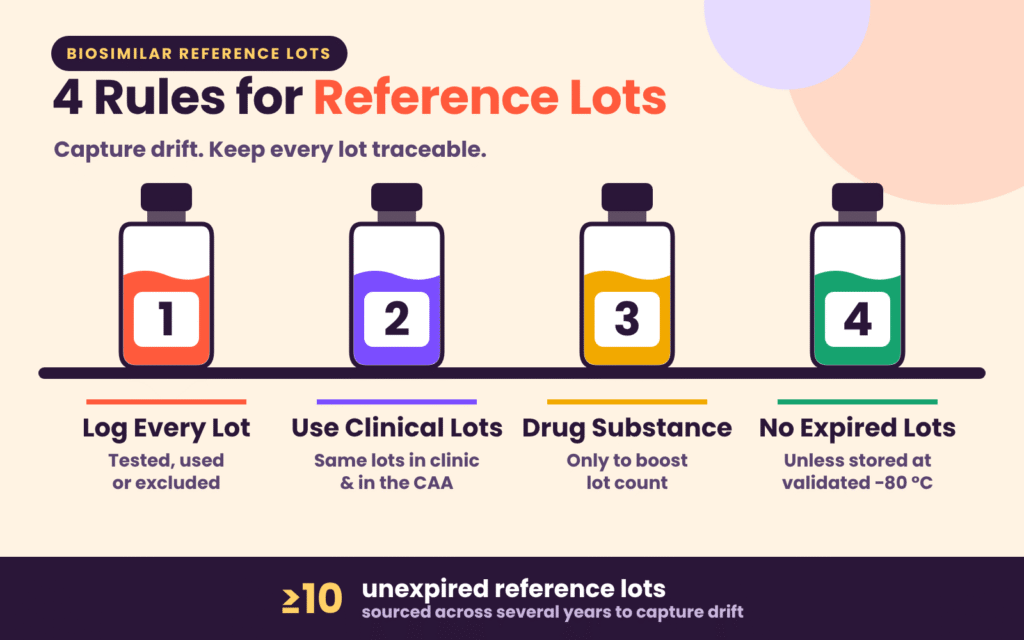
To minimize sampling bias and comply with the FDA’s September 2025 CAA requirements, sponsors should implement four essential lot governance controls:
Full Lot Accounting: Maintain comprehensive documentation of every reference product lot obtained and characterized throughout development. Records should specify the physicochemical, functional, and clinical studies performed using each lot, along with scientific justifications for any lots excluded from particular evaluations.
Mandatory Clinical Lot Inclusion: Confirm that the exact lots of the proposed biosimilar, U.S.-licensed reference product, and any non-U.S. comparator used in clinical studies are directly represented in the CAA analytical dataset.
Drug Substance Supplementation: Include drug substance lots used in drug product manufacturing only when necessary to achieve sufficient lot numbers for reliable statistical evaluation.
Strict Expiration Controls: Record both the dates of analytical testing and the expiration dates of individual lots. Expired reference product lots must be excluded from the CAA because degradation occurring after expiration can artificially increase the estimated variability of the reference product. Testing beyond the labeled expiration date is acceptable only when samples have been maintained under validated stability-preserving conditions, such as storage at -80°C, and supporting data demonstrate that storage conditions have not affected the relevant quality attributes.
How Do Sponsors Integrate Non-U.S. Comparator Bridging Into Innovator Reference Product Characterization Services?
When sponsors use a non-U.S.-licensed comparator in clinical or nonclinical studies, Innovator Reference Product Characterization Services must establish a clearly documented three-way analytical bridge without combining comparator datasets. Under FDA policy, a non-U.S. comparator is acceptable only when it is licensed by a regulatory authority that maintains regulatory standards and manufacturing quality oversight comparable to those of the FDA. Publicly available literature alone cannot replace direct, head-to-head analytical comparison data.
Although the FDA now allows traditional three-way clinical PK bridging studies to be waived under specific circumstances when strong Chemistry, Manufacturing, and Controls (CMC) analytical bridges are available, the analytical bridging requirements remain mandatory. Sponsors must provide comparative analytical results covering all three pairwise assessments: the proposed biosimilar versus the U.S.-licensed reference product, the proposed biosimilar versus the non-U.S. comparator, and the non-U.S. comparator versus the U.S.-licensed reference product. Importantly, U.S. reference product data and non-U.S. comparator data cannot be pooled to establish acceptance criteria or perform the CAA. All similarity acceptance criteria must be derived exclusively from direct analytical characterization of U.S.-licensed reference product lots.
A well-designed comparability exercise helps establish reliable analytical evidence across reference and proposed biosimilar products.
Learn about biosimilar comparability studies
What Statistical Tiering Framework Governs Comparative Analytical Assessment?
Comparative Analytical Assessment classifies structural, physicochemical, and functional quality attributes into a risk-based statistical hierarchy, generally organized into Tier 1 (Equivalence Testing), Tier 2 (Quality Range), and Tier 3 (Graphical Comparison). This classification is determined by the potential influence of each attribute on efficacy, PK, PD, safety, and immunogenicity. Establishing the hierarchy early in development helps sponsors allocate analytical resources appropriately, avoid unnecessary testing of low-priority attributes, and reduce the possibility of regulatory deficiency letters resulting from inadequate Critical Quality Attribute (CQA) selection.
The FDA’s stepwise CAA process begins with identifying and mapping the structural and functional attributes of the reference product. These attributes are subsequently assigned risk categories based on their biological relevance, mechanism of action, and publicly available FDA determinations concerning safety, purity, and potency. Degradation rates identified through forced degradation and stability studies also contribute to the overall comparability assessment, although they are generally not included in the formal CQA risk-ranking exercise. While FDA statistical recommendations have increasingly emphasized the Quality Range (QR) approach for quantitative attributes, approved BLA reviews and industry protocols commonly combine Tier 1 equivalence testing for the highest-risk potency assays with Tier 2 QR evaluations and Tier 3 visual comparisons.
| Risk Tier | Representative Quality Attributes | Primary Analytical Platforms | Statistical Evaluation & Acceptance Benchmark |
|---|---|---|---|
| Tier 1 (Highest Clinical Risk) | Biological potency, target antigen binding, FcγR/FcRn/C1q effector activity, ADCC/CDC | Cell-based bioassays, Surface Plasmon Resonance (SPR), Bio-Layer Interferometry (BLI) | Two One-Sided Tests (TOST) equivalence testing; 90% or 95% confidence intervals for the biosimilar mean must fall within predefined ±xσ margins. |
| Tier 2 (Moderate / Important Risk) | Higher-order structure, glycosylation (e.g., afucosylation, sialylation), aggregates, charge variants | HILIC-MS, SEC-MALS, SV-AUC, cIEF, WCX, Far/Near-UV CD, FTIR, DSC | Quality Range (μ ± xσ) with a scientifically justified SD multiplier; typically, at least 90% of biosimilar lots should fall within the reference QR. |
| Tier 3 (Low Risk / Qualitative) | Primary sequence identity, disulfide linkage map, mass distribution, minor impurities | LC-MS/MS peptide mapping, intact/subunit MS, side-by-side electropherograms | Descriptive statistics and comparative graphical or visual profile assessments. |
Assigning attributes to specific tiers has direct implications for reference lot procurement, analytical testing, and manufacturing process development. In effector-active monoclonal antibodies, core afucosylation enhances FcγRIIIa binding and antibody-dependent cellular cytotoxicity (ADCC). Therefore, cell-based ADCC bioassays and glycan fucosylation assessments require stringent Tier 1 or Tier 2 monitoring. Conversely, C-terminal lysine clipping in antibodies often produces comparable complement-dependent cytotoxicity (CDC) potency in clipped and unclipped variants. Fc-region deamidation generally represents a lower clinical-risk attribute, with its significance influenced by sequence context, pH, temperature, and ionic strength. It is primarily evaluated as an indicator of molecular stability under real-time and accelerated storage conditions.
Which Orthogonal Analytical Platforms Resolve Critical Quality Attributes and Excipient Interference?
Establishing “fingerprint-like similarity” under ICH Q6B requires the use of complementary analytical technologies across every structural level. This orthogonal approach ensures that the limitations, potential biases, or resolution constraints of one analytical technique can be addressed through independent measurements obtained from other platforms. Depending exclusively on isolated analytical results, such as SEC-UV for aggregation assessment or optical spectroscopy for protein folding, may leave co-eluting molecular species and localized conformational changes undetected.
Primary structural characterization is particularly important for confirming sequence identity, post-translational modifications, and molecular integrity.
Understand biological characterization under ICH Q6B guidelines
At the primary structural level, LC-MS/MS peptide mapping with greater than 95% sequence coverage is widely used to verify identical amino acid sequences and terminal residues. Any unexplained sequence variation can disqualify a candidate from the 351(k) pathway. Site-specific peptide mapping measures methionine and tryptophan oxidation within complementarity-determining regions (CDRs), which may negatively affect antigen binding, while also identifying deamidation, glycation, and N-terminal pyroglutamate formation. Non-reducing peptide mapping confirms intra- and inter-chain disulfide pairing and detects disulfide scrambling below 1%, together with free cysteine residues. These findings can be independently supported using Ellman’s reagent (DTNB) or fluorometric alkylation assays. Enzymatic digestion below the hinge region using IdeS, followed by reduction, separates smaller protein domains for high-resolution mass analysis. In addition, PNGase F-mediated glycan release combined with HILIC-MS enables the characterization of core fucosylation and the measurement of human N-acetylneuraminic acid (Neu5Ac) compared with potentially immunogenic non-human N-glycolylneuraminic acid (Neu5Gc).
Higher-order structure, molecular size distribution, and impurity characterization require an equally comprehensive orthogonal analytical strategy. Far-UV and Near-UV Circular Dichroism, supported by RMSD statistical scoring, FTIR (which is particularly sensitive to β-sheet content), intrinsic tryptophan fluorescence, and Differential Scanning Calorimetry (DSC) melting temperatures and unfolding enthalpy, are used to evaluate secondary structure, tertiary structure, and thermal stability. Hydrogen-Deuterium Exchange MS (HDX-MS) and 2D-NMR provide additional information about regional conformational dynamics and solvent accessibility. For aggregation analysis, column-based SEC-MALS, which determines absolute molar mass without relying on calibration assumptions, is combined with matrix-free Sedimentation Velocity Analytical Ultracentrifugation (SV-AUC) performed in native formulation buffer, Dynamic Light Scattering (DLS), and reduced/non-reduced CE-SDS for identifying clipped species. Sub-visible particles are evaluated through Flow Imaging Microscopy (MFI, 2–100 µm), which helps distinguish protein aggregates from silicone oil droplets, and Resonant Mass Measurement (RMM, 0.1–1 µm). Finally, quantitative NMR (qNMR) and amino acid analysis establish primary standard purity and extinction coefficients. Droplet digital PCR (ddPCR) measures residual host cell DNA, while targeted proteomics MS identifies host cell proteins that may not be detected through ELISA. Side-by-side forced degradation studies involving thermal, pH, oxidative, and light stress further establish whether the reference product and proposed biosimilar follow comparable degradation pathways.
| Analytical Domain | Specific Quality Attributes | Primary & Orthogonal Instrumentation | Key Regulatory & Technical Rationale |
|---|---|---|---|
| Primary Structure & PTMs | Sequence identity, N/C-termini, CDR oxidation, deamidation, disulfide scrambling | LC-MS/MS (>95% coverage), non-reducing peptide map, IdeS subunit MS, DTNB | Establishes sequence identity and helps identify disulfide mismatches below 1%. |
| Glycosylation & Charge | Core fucosylation, high-mannose, Neu5Ac/Neu5Gc, acidic/basic isoforms | PNGase F + HILIC-MS, intact/native SEC-MS, cIEF, WCX | Connects glycan profile differences with FcγRIIIa/ADCC potency and terminal half-life. |
| Higher-Order Structure | Secondary/tertiary fold, domain Tm, regional solvent accessibility | Far/Near-UV CD, FTIR, DSC, Fluorescence, HDX-MS, 2D-NMR | Identifies subtle Fc or Fab conformational changes that may not be evident from sequence analysis alone. |
| Size & Sub-Visible Particles | Monomer, HMW aggregates, LMW clips, 0.1–100 µm particulates | SEC-MALS, SV-AUC, DLS, CE-SDS, MFI (2–100 µm), RMM (0.1–1 µm) | Minimizes column-related shear bias and distinguishes protein particles from silicone oil droplets. |
| Impurities & Content | Extinction coefficient, standard purity, hcDNA, HCPs, Protein A | qNMR, AAA, ddPCR, targeted proteomics LC-MS, immunoassays | Establishes a comprehensive impurity profile rather than relying on a single overall purity measurement. |
Combining complementary mass spectrometry and proteomics methods provides greater confidence in identifying structural differences and product-related impurities.
Discover proteomics approaches for biosimilar characterization
How Can Laboratories Prevent Formulation Excipient Artifacts During Sample Preparation?
Laboratories can minimize formulation excipient artifacts by replacing aggressive manual buffer-exchange procedures with online chromatographic desalting or native SEC-MS and ensuring that reference product and biosimilar samples undergo identical side-by-side preparation. Commercial originator biologics contain stabilizing excipients, including L-histidine buffers, trehalose dihydrate, salts, and polysorbate 20. These formulation components can suppress electrospray ionization and influence chromatographic retention, potentially affecting the reliability of analytical results.
Peer-reviewed experimental investigations comparing innovator and biosimilar trastuzumab have demonstrated that removing formulation excipients through buffer exchange can alter monoclonal antibody physical stability, as well as size distribution, charge variant profiles, and HOS analytical results. To ensure that measured differences represent genuine molecular characteristics rather than sample matrix interference, laboratories use analytical protocols that isolate proteins online through reversed-phase LC or native SEC. These procedures may employ sodium acetate buffers with controlled ionic strength at pH 6–7 and avoid denaturing organic solvents. Most importantly, originator and biosimilar samples must undergo the same preparation procedures before injection to maintain consistency and prevent sample-handling bias.
Native mass spectrometry can help preserve protein structures during analytical evaluation and minimize sample preparation-related interference.
Read about native mass spectrometry for biosimilars
What Analytical and CMC Pitfalls Trigger FDA Complete Response Letters in Biosimilar Filings?
Gaps in analytical comparability, method variability during manufacturing scale-up, and unbridged changes in assay formats are among the recurring factors associated with FDA Complete Response Letters (CRLs) and prolonged biosimilar approval timelines. Across regulatory reviews, approximately 74% of FDA CRLs issued between 2020 and 2024 reportedly identified quality or CMC-related deficiencies. An industry assessment covering more than 200 recent CRL summaries also identified manufacturing, analytical, and bioequivalence deficiencies as major obstacles to approval, with biosimilar applications accounting for a disproportionate share of biologics-related CRLs compared with novel BLAs.
Publicly available FDA review records demonstrate how individual analytical and quality deficiencies can delay 351(k) licensure. In BLA 125545 (Epoetin Hospira), an October 2015 CRL requested additional drug product lot information, revised release and shelf-life specifications, clearly defined “no new bands” analytical acceptance criteria, and further clarification regarding immunogenicity assays. More recently, BLA 761377 (CT-P42, an aflibercept biosimilar) received a CRL in June 2024 that identified product quality, microbiology, and facility-related deficiencies before those issues were addressed for subsequent approval. Similarly, BLA 761073 (ABP 980, a proposed Herceptin biosimilar) received a CRL in May 2018. Across CRL datasets, regulators repeatedly identify issues involving non-objective analytical runs, inadequate scientific justification for limits of detection and quantification (LOD/LOQ), method drift during scale-up, and changes in assay formats between clinical development phases without appropriate bridging or revalidation. Other recurring concerns include unbridged EU comparator datasets and incomplete extractables and leachables (E&L) profiling of prefilled syringes (PFS) and autoinjectors.
Before finalizing a CAA protocol or submitting a 351(k) BLA, biosimilar sponsors should evaluate their originator reference characterization package against five important preventive checkpoints:
- Validate analytical method suitability: Confirm ICH Q2(R2)/Q14 assay suitability and provide scientifically justified LOD/LOQ sensitivity requirements for all Tier 1–3 analytical methods before beginning commercial originator lot testing.
- Maintain objective analytical execution: Implement blinded and objective analytical run procedures, ensuring that every clinical biosimilar and comparator lot is appropriately represented in the CAA dataset.
- Review non-U.S. comparator bridging: Examine all non-U.S. comparator bridging datasets to verify that no data pooling has occurred and that all three required pairwise statistical comparisons are complete.
- Complete comprehensive E&L studies: Conduct detailed E&L assessments covering PFS, vial, and autoinjector product-contact components early in the shelf-life planning process.
- Perform independent regulatory gap assessments: Arrange independent mock CRL evaluations and technology transfer reviews approximately 18–24 months before the planned BLA submission to identify and address potential deficiencies in advance.
Charge heterogeneity and aggregation are important analytical considerations when evaluating product quality and identifying potential comparability gaps.
Review charge variant analysis approaches for biosimilars
What Laboratory Quality Standards Are Required for Regulatory-Grade Reference Characterization?
Regulatory-grade reference product characterization requires R&D structural elucidation and GMP comparability testing to be performed within a unified, audited quality management system that meets FDA, Health Canada, and EMA expectations. Distributing mass spectrometry, NMR, polymer and excipient testing, and E&L profiling among multiple independent vendors can introduce sample-handling variability, delay analytical method transfers, and create data integrity gaps. These issues may subsequently result in findings during pre-approval inspections.
Operating from a single facility in Laval, Québec, and supporting pharmaceutical sponsors throughout North America and more than nine countries worldwide, ResolveMass Laboratories Inc. combines advanced analytical R&D with GMP regulatory testing capabilities under one roof. The laboratory holds a Health Canada GMP Drug Establishment Licence (Licence No. 3-002945-A), maintains U.S. FDA registration (Establishment Identifier 3042696771), operates an ISO 9001:2015-certified Quality Management System, and maintains ISO/IEC 17025-accredited analytical workflows. Its quality framework includes quarterly external audits, Corrective and Preventive Action (CAPA) systems, and complete Installation Qualification (IQ), Operational Qualification (OQ), and Performance Qualification (PQ) of analytical equipment.
Each sponsor engagement receives direct laboratory oversight from PhD scientists with an average of more than 15 years of pharmaceutical analytical experience across over 200 compounds. By bringing Quadrupole-Orbitrap HRMS, triple quadrupole MS/MS, LC-MS, MALDI-TOF, NMR/qNMR, HPLC, GPC/SEC (with RI, UV, light scattering, and viscometry detection), FTIR, GC-MS, DSC/TGA, and USP / E&L testing capabilities together within one quality system, the laboratory helps biosimilar sponsors maintain continuous data integrity. This integrated approach supports the complete development process, from early-stage originator fingerprinting through final BLA submission.
A coordinated analytical package can help sponsors connect characterization findings with regulatory comparability requirements and submission documentation.
View the end-to-end biosimilar analytical package
Conclusion
Innovator Reference Product Characterization Services constitute a critical technical investment for biosimilar sponsors navigating the post-2025 regulatory environment, where analytical precision plays a central role in clinical efficacy trial waivers and first-cycle BLA approval. Combining the procurement of multiple unexpired originator lots with rigorous three-way non-U.S. comparator bridging, excipient-aware orthogonal MS and HOS analytical workflows, and risk-based statistical modeling enables development teams to identify potential CMC deficiencies early, minimize unexpected regulatory challenges, and establish fingerprint-like similarity that can withstand global regulatory scrutiny.
For biosimilar sponsors looking for an FDA-registered, Health Canada GMP-licensed, and ISO-certified analytical partner with PhD-led HRMS, NMR, and E&L capabilities under one roof, connect with the scientific team at ResolveMass Laboratories Inc. through our Contact Us page:
Contact ResolveMass Laboratories Inc.
Frequently Asked Questions
No, U.S.-licensed reference product data and non-U.S.-licensed comparator data must remain separate when establishing analytical acceptance criteria. The FDA’s September 2025 final CAA guidance requires quality ranges to be developed using sponsor-generated analytical results from U.S. reference product lots. Sponsors must also provide separate three-way pairwise comparisons to demonstrate the analytical relationship between the proposed biosimilar and both reference products.
Expired innovator reference product lots should normally be excluded from the CAA because degradation occurring beyond the approved shelf life can distort analytical measurements and exaggerate natural product variability. Testing beyond the expiration date may be considered when samples have been maintained under validated storage conditions, such as -80°C freezing. Supporting experimental evidence must demonstrate that storage has preserved the relevant quality attributes without introducing additional degradation.
Sponsors may qualify for a waiver of routine Phase III comparative efficacy studies when comprehensive analytical similarity data, supported by appropriate PK/PD and immunogenicity assessments, sufficiently address potential clinical uncertainties. The FDA’s October 29, 2025 draft guidance and the EMA’s tailored clinical approach support this analytical-focused development strategy under appropriate circumstances. Significant unresolved differences in high-risk critical quality attributes may still require additional clinical investigation before regulatory approval.
High LC-MS/MS peptide mapping coverage helps establish that the proposed biosimilar has the same primary amino acid sequence and terminal residues as its reference product. IdeS digestion provides additional information about individual protein domains, while non-reducing peptide mapping evaluates disulfide connectivity and identifies potential structural abnormalities. Combining these methods strengthens molecular characterization by detecting sequence variations, domain-level differences, disulfide scrambling, and free cysteine residues.
Removing formulation components such as L-histidine, trehalose, and polysorbate 20 through conventional buffer exchange can affect monoclonal antibody stability and produce misleading changes in molecular size, charge distribution, and higher-order structure (HOS). Such changes may arise from sample preparation rather than actual differences between the innovator and biosimilar. Laboratories can reduce these effects by using native SEC-MS or online desalting and applying identical preparation procedures to both products before comparative analysis.
Tier 1 critical quality attributes, including biological potency, target binding, and important effector functions, are commonly assessed using Two One-Sided Tests (TOST) equivalence testing with predefined acceptance margins and 90% or 95% confidence intervals. Tier 2 attributes, such as glycosylation, higher-order structure, aggregation, and charge variants, are generally evaluated using the Quality Range (μ ± xσ) approach. This assessment typically examines whether at least 90% of biosimilar batches fall within the scientifically established reference product quality range.
A comprehensive aggregation assessment combines SEC-MALS for absolute molar mass determination with SV-AUC for evaluating molecular size distribution in native formulation buffer and DLS for particle characterization. Reduced and non-reduced CE-SDS provide additional information about fragmented and clipped protein species. Flow Imaging Microscopy (MFI) helps distinguish protein aggregates from silicone oil droplets within the 2–100 µm range, whereas Resonant Mass Measurement (RMM) detects smaller particulates between 0.1 and 1 µm.
ICH Q2(R2) and ICH Q14 establish a more comprehensive, science-based approach to analytical method validation and procedure development throughout the product lifecycle. ICH Q14 incorporates quality risk management principles from ICH Q8 and ICH Q9 into analytical procedure development, while ICH Q2(R2) defines updated expectations for demonstrating method suitability and performance. Together, these guidelines require sponsors to establish appropriate assay sensitivity, justify LOD/LOQ limits, and maintain analytical consistency during method transfers and manufacturing scale-up.
Analytical and CMC deficiencies frequently delay biosimilar approvals, with approximately 74% of FDA CRLs issued between 2020 and 2024 reportedly identifying quality-related concerns. Common problems include analytical method drift during commercial manufacturing scale-up, unvalidated assay format changes between development phases, inadequate LOD/LOQ justifications, and inconsistent analytical execution. Incomplete U.S. and EU comparator bridging and insufficient container-closure extractables and leachables (E&L) assessments can also create significant regulatory obstacles.
Reference:
- U.S. Food and Drug Administration. (2025, September). Development of Therapeutic Protein Biosimilars: Comparative Analytical Assessment and Other Quality-Related Considerations — Guidance for Industry (Docket No. FDA-2019-D-2102). https://www.fda.gov/regulatory-information/search-fda-guidance-documents/development-therapeutic-protein-biosimilars-comparative-analytical-assessment-and-other-quality
and https://www.fda.gov/media/159261/download. - U.S. Food and Drug Administration. (2025, October). Scientific Considerations in Demonstrating Biosimilarity to a Reference Product: Updated Recommendations for Assessing the Need for Comparative Efficacy Studies — Draft Guidance for Industry. https://www.fda.gov/regulatory-information/search-fda-guidance-documents/scientific-considerations-demonstrating-biosimilarity-reference-product-updated-recommendations.
- European Medicines Agency (EMA). Reflection Paper on a Tailored Clinical Approach in Biosimilar Development. https://www.ema.europa.eu/en/documents/other/reflection-paper-tailored-clinical-approach-biosimilar-development_en.pdf-0
and Regulatory Affairs Professionals Society (RAPS) summary https://www.raps.org/resource/euro-roundup-ema-finalizes-reflection-paper-on-biosimilar-comparative-efficacy-studies.html. - International Council for Harmonisation (ICH). Quality Guidelines: ICH Q2(R2) Validation of Analytical Procedures and ICH Q14 Analytical Procedure Development. https://www.ich.org/page/quality-guidelines.
- ResearchGate. Some Thoughts on the QR Method for Analytical Similarity Evaluation. https://www.researchgate.net/publication/339451161_Some_thoughts_on_the_QR_method_for_analytical_similarity_evaluation.
Get In Touch With Us
About The Author