
Introduction
The analytical characterization of Interferon Beta-1a Biosimilars involves an extensive evaluation of complex N-glycosylation profiles to establish structural and functional comparability with originator biopharmaceuticals in accordance with regulatory totality-of-evidence frameworks. Recombinant human Interferon beta-1a (rh-IFN-β-1a) is a 166-amino acid therapeutic cytokine primarily produced using Chinese Hamster Ovary (CHO) cell lines to maintain native-like post-translational modifications. Unlike unglycosylated variants, such as Interferon beta-1b, which is produced in Escherichia coli and does not contain carbohydrate modifications, native and recombinant Interferon beta-1a contains a single conserved N-linked glycosylation site at Asparagine-80 (Asn80).
This N-glycan represents a key Critical Quality Attribute (CQA) because it significantly influences the cytokine’s tertiary structure, physical stability, aqueous solubility, pharmacokinetic (PK) half-life, and immunogenicity profile. Demonstrating biosimilarity under the US Food and Drug Administration (FDA 351(k)) and European Medicines Agency (EMA) regulatory pathways requires extensive analytical similarity testing. Glycan micro-heterogeneity is particularly sensitive to minor changes in upstream cell culture conditions, including dissolved oxygen, temperature, pH, and feed composition. Consequently, biosimilar manufacturers face considerable technical challenges when reproducing the glycoform distribution of the reference product. Advanced biopharmaceutical testing laboratories, such as ResolveMass Laboratories Inc., apply high-resolution mass spectrometry (HRMS), Hydrophilic Interaction Liquid Chromatography (HILIC-UPLC-MS), and Hydrogen-Deuterium Exchange Mass Spectrometry (HDX-MS) to characterize complex glycan structures and assess higher-order structural equivalence.
A comprehensive assessment of these molecular attributes requires a systematic approach to biosimilar analytical characterization, including structural analysis, glycan profiling, and orthogonal testing techniques.
Share via:
Quick Summary;
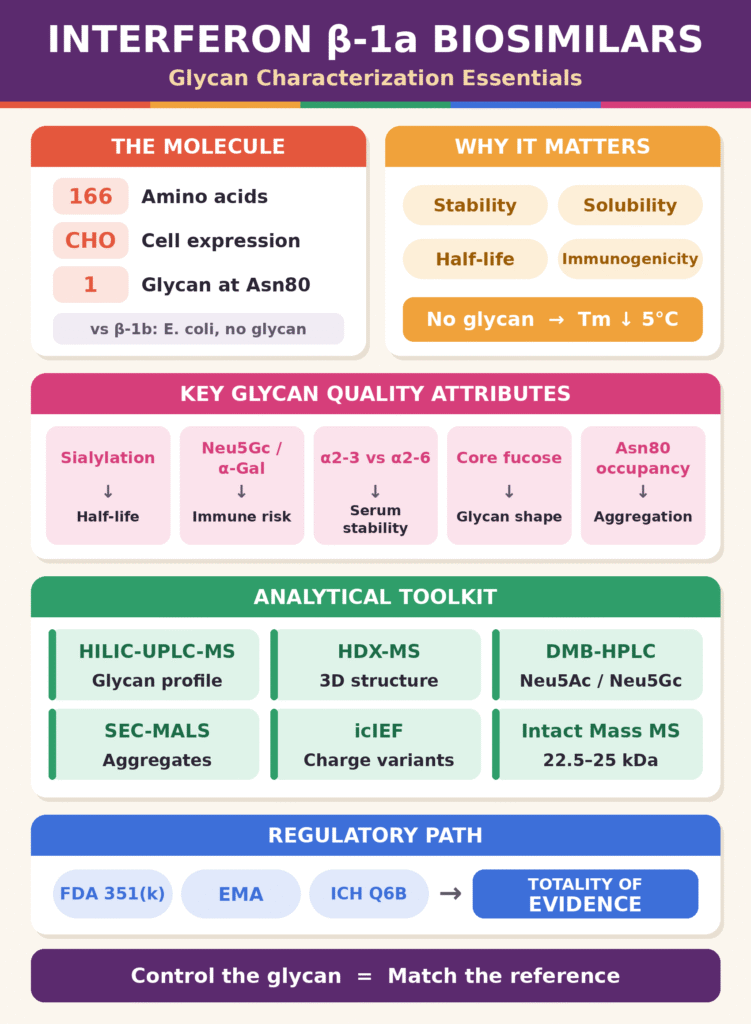
- Glycosylation defines the molecule. Interferon beta-1a is a 166-amino-acid cytokine produced in CHO cells. It carries a single N-glycan at Asparagine-80 (Asn80), unlike Interferon beta-1b, which is made in E. coli and has no glycan.
- The Asn80 glycan is a Critical Quality Attribute. It stabilizes the protein’s α-helical fold through hydrogen bonds with Gln23 and Asn86. It also shields a hydrophobic patch that would otherwise drive aggregation. Without it, the melting temperature drops by about 5°C.
- Sialylation controls half-life. The main glycoform is a biantennary, core-fucosylated glycan with α2-3-linked Neu5Ac. Terminal sialic acid adds negative charge and blocks clearance by hepatic asialoglycoprotein receptors, so it extends circulation time.
- Non-human sugars are an immunogenicity risk. CHO cells under stress can produce Neu5Gc and α-Gal. Humans carry antibodies against Neu5Gc, so even trace amounts may trigger anti-drug antibody or hypersensitivity responses.
- Glycan profiles are hard to reproduce. Small changes in culture conditions shift the glycoform distribution. These include pH, temperature, dissolved oxygen and feed composition. This makes matching the reference product a major challenge.
- Orthogonal analytics establish similarity. No single method is enough, so developers combine several:
- HILIC-UPLC-FLR-MS for released glycans
- DMB-RP-HPLC for Neu5Ac and Neu5Gc quantification
- HDX-MS for higher-order structure
- SEC-MALS for aggregates
- icIEF for charge variants
- Intact mass ESI-QTOF-MS for the 22.5–25 kDa mass distribution
- Approval rests on totality of evidence. Under the FDA 351(k) pathway, EMA guidelines and ICH Q6B, strong analytical comparability against multi-batch reference ranges can reduce the need for additional clinical efficacy trials. Functional bioassays are also needed to support it.
Structural and Functional Roles of Asn80 N-Glycosylation in Interferon Beta-1a Biosimilars
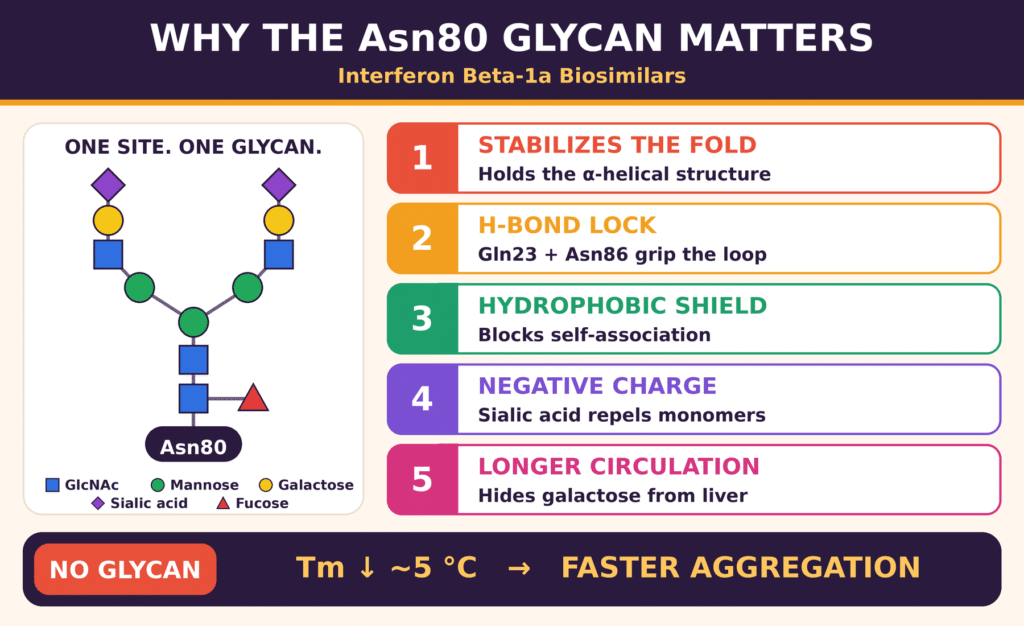
The single N-linked biantennary complex glycan attached to Asparagine-80 (Asn80) in Interferon Beta-1a Biosimilars contributes significantly to the stabilization of the cytokine’s tertiary α-helical fold and helps limit rapid molecular aggregation. Findings from X-ray crystallography and biophysical characterization indicate that this glycan moiety supports structural stability through hydrogen-bonding interactions with neighboring amino acid residues and steric shielding of an exposed hydrophobic surface region.
The associated hydrogen-bonding network includes interactions between the glycan structure and nearby residues, particularly Glutamine-23 (Gln23) and Asparagine-86 (Asn86). These interactions help stabilize the flexible loop region and preserve the protein’s structural integrity. Without this protective carbohydrate structure, exposed uncharged hydrophobic residues may undergo self-association due to thermodynamic forces, resulting in soluble oligomers and high-molecular-weight aggregates. Non-glycosylated IFN-β-1a has a thermal denaturation temperature (Tₘ) approximately 5°C lower than that of its native glycosylated counterpart. This structural limitation helps explain why unglycosylated Interferon beta-1b requires engineered mutations, including Cys17Ser, to minimize non-native disulfide scrambling. Nevertheless, it can still demonstrate a greater tendency toward aggregation in clinical formulations than glycosylated Interferon beta-1a.
Because glycosylation can influence protein stability and self-association, aggregation analysis in biosimilars is an important component of evaluating molecular integrity and detecting potentially relevant differences between a biosimilar and its reference product.
The principal glycan structure in CHO-expressed Interferon beta-1a consists of a biantennary complex N-glycan containing a core α1-6-linked fucose and terminal α2-3-linked N-acetylneuraminic acid (Neu5Ac) residues. Terminal sialylation contributes a net negative charge, encouraging electrostatic repulsion between monomers. It also shields terminal galactose residues from recognition by hepatic asialoglycoprotein receptors, thereby helping extend the duration of systemic circulation.
Critical Quality Attributes of Glycosylation in Interferon Beta-1a Biosimilar Development
The identification and routine monitoring of Critical Quality Attributes (CQAs) associated with N-glycosylation in Interferon Beta-1a Biosimilars are essential because even small changes in carbohydrate composition may influence receptor-binding affinity, pharmacokinetics, and immunogenic safety. Major glycosylation-related CQAs include sialic acid occupancy, terminal linkage stereochemistry, core fucosylation, and the presence of non-human sugars.
A structured assessment of these parameters helps define the quality characteristics that must be evaluated during development. Understanding critical quality attributes in biosimilars is therefore essential for identifying molecular features that may affect product quality, biological activity, and safety.
Therapeutic cytokines exert their biological effects through interactions with the heterodimeric IFNAR1/IFNAR2 cell-surface receptor complex. Variations in sialic acid density can alter systemic clearance rates and consequently affect pharmacokinetic behavior. During comparability assessments, particular attention is given to potentially immunogenic non-human glycans, especially N-glycolylneuraminic acid (Neu5Gc) and α1-3-galactose (α-Gal), which CHO cells may produce under certain metabolic stress conditions. Humans lack functional CMP-Neu5Ac hydroxylase, and human serum naturally contains anti-Neu5Gc antibodies. Therefore, even trace quantities of Neu5Gc in an Interferon beta-1a biosimilar may create an immunogenicity concern, potentially contributing to anti-drug antibody (ADA) responses or hypersensitivity reactions.
| Critical Quality Attribute (CQA) | Structural / Chemical Variant | Biological & Clinical Impact | Primary Analytical Characterization Technique |
|---|---|---|---|
| Sialylation Level | Mono- and di-sialylated biantennary glycans | Influences PK half-life. Non-sialylated species can bind to asialoglycoprotein receptors, leading to faster hepatic clearance. | HPAEC-PAD, RP-HPLC-FLD (DMB labeling), LC-MS |
| Non-Human Sialic Acid Content | N-Glycolylneuraminic acid (Neu5Gc) versus Neu5Ac | May increase immunogenicity risk because Neu5Gc can induce neutralizing anti-Neu5Gc antibodies in humans. | UHPLC-FLD with DMB derivatization, ESI-MS/MS |
| Terminal Linkage Stereochemistry | α2-3 versus α2-6 sialic acid linkages | Affects hydrodynamic radius and serum stability. CHO expression predominantly produces α2-3 linkages. | Exoglycosidase digestion arrays coupled with HILIC-UPLC-MS |
| Core Fucosylation | α1-6 fucose on core GlcNAc | Influences local glycan conformation and structural rigidity around the Asn80 domain. | HILIC-UPLC-FLR-MS, MALDI-TOF-MS glycan mapping |
| Glycan Macro-Heterogeneity | Asn80 occupancy: fully glycosylated versus aglycosylated | Aglycosylated variants exhibit an approximately 5°C decrease in Tₘ, which may contribute to accelerated protein aggregation. | Intact mass ESI-QTOF-MS, rCE-SDS, C4 RP-HPLC |
Advanced Analytical Methodologies for Characterizing Interferon Beta-1a Biosimilars
Establishing analytical similarity between Interferon Beta-1a Biosimilars and their reference products requires a coordinated combination of high-resolution structural mass spectrometry, liquid chromatography, and biophysical characterization techniques. These orthogonal methods provide complementary information about glycan micro-heterogeneity and higher-order structural integrity under native and denaturing conditions.
Integrating orthogonal analytical methods into a comprehensive biosimilar comparability study helps assess whether observed molecular differences fall within an acceptable range of similarity to the reference product.
Higher-Order Structure Evaluation of Interferon Beta-1a Biosimilars via HDX-MS
Hydrogen-Deuterium Exchange Mass Spectrometry (HDX-MS) provides information about localized peptide backbone dynamics and tertiary conformational consistency in Interferon Beta-1a Biosimilars under physiological buffer conditions. This spatially resolved method can reveal subtle conformational micro-unfolding events that may not be readily detected through conventional optical spectroscopy.
In an HDX-MS workflow, protein samples are exposed to deuterated water (D₂O), allowing backbone amide hydrogens to exchange with deuterium at rates influenced by local solvent accessibility and hydrogen-bonding strength. The exchange reaction is subsequently stopped through rapid acid and low-temperature quenching at pH 2.5 and 0°C. Pepsin digestion then produces discrete peptide fragments, which are analyzed by high-resolution LC-MS to map mass increases across the primary sequence. HDX-MS can be used to monitor structural changes around free Cys17 or the Asn80 glycosylation loop. For example, localized differences in deuterium uptake within peptic fragments spanning residues 88–102 may provide evidence of conformational destabilization and an increased tendency toward aggregation.
Complementary structural information can be obtained through native mass spectrometry for biosimilars, which helps investigate intact molecular species and non-covalent interactions while preserving relevant aspects of the native protein state.
Orthogonal Glycomic and Intact Mass Profiling Workflows
Combining intact mass ESI-QTOF-MS, PNGase F enzymatic cleavage, and HILIC-UPLC-FLR-MS in orthogonal glycomics workflows enables comprehensive quantitative characterization of glycan macro- and micro-heterogeneity in Interferon Beta-1a Biosimilars. These analytical approaches help verify the intact mass distribution within the 22.5–25 kDa range while providing detailed information about individual released glycan structures.
PNGase F enzymatic cleavage hydrolyzes the amide bond associated with Asn80, converting Asparagine to Aspartic acid and producing a characteristic +0.984 Da mass shift. This modification can be identified through high-resolution LC-MS/MS peptide mapping. Following enzymatic release, glycans are labeled with fluorescent tags, such as 2-AB or Procainamide, and analyzed by HILIC-UPLC using combined FLR and ESI-MS detection. This approach enables the quantification of neutral, mono-sialylated, and di-sialylated species. Absolute quantification of Neu5Ac and immunogenic Neu5Gc can be performed using 1,2-diamino-4,5-methylenedioxybenzene (DMB) derivatization, followed by reverse-phase HPLC with fluorescence detection. Additionally, Size-Exclusion Chromatography coupled with Multi-Angle Light Scattering (SEC-MALS) and imaged capillary Isoelectric Focusing (icIEF) can be employed to evaluate soluble aggregate content and overall charge heterogeneity associated with differences in terminal sialic acid composition.
For a broader understanding of molecular variants and product-related impurities, impurity profiling of biosimilars can complement glycan characterization by helping identify and assess potentially relevant impurities in the product.
| Analytical Methodology | Target Attribute / CQA | Limit of Detection / Analytical Resolution | Strategic Advantage in Biosimilarity Assessment |
|---|---|---|---|
| HILIC-UPLC-FLR-MS | Released N-glycan profiling, antennarity, and sialylation | Sub-picomole sensitivity for fluorescently labeled glycans. | Distinguishes isomeric glycan structures and quantifies individual sialylated species. |
| HDX-MS | Higher-Order Structure (HOS) and backbone dynamics | Detects localized conformational perturbations in 1–5% sub-populations. | Maps structural perturbations spatially under physiological buffer conditions. |
| DMB-RP-HPLC-FLD | Absolute quantification of Neu5Ac and Neu5Gc sialic acids | Femtomole detection limit for N-glycolylneuraminic acid. | Enables highly sensitive detection of non-human immunogenic sialic acid variants. |
| SEC-MALS | Soluble aggregates, oligomerization, and molar mass distribution | Measures absolute molecular mass independently of column matrix interactions. | Differentiates monomeric IFN-β-1a from low-level soluble aggregate species. |
| icIEF / CEX-MS | Charge heterogeneity, including acidic and basic variants | Resolves variants that differ by individual sialic acid charges or deamidation events. | Establishes a relationship between sialic acid charge distribution and intact molecular variants. |
Regulatory Alignment and Totality-of-Evidence Strategy
Regulatory approval of Interferon Beta-1a Biosimilars under the US FDA 351(k) pathway and EMA guidelines follows a totality-of-evidence framework. Under this approach, comprehensive analytical comparability data can help reduce the need for additional clinical efficacy trials when supported by the complete body of evidence. Regulatory authorities expect biosimilar developers to establish rigorous quality target product profiles (QTPPs) using historical variability ranges derived from multiple batches of the innovator product.
According to ICH Q6B guidelines, biosimilar submissions must provide extensive evidence of physicochemical and functional comparability. This assessment includes confirmation of primary sequence identity, evaluation of structural equivalence using HDX-MS, detailed comparison of glycan profiles, and demonstration of comparable biological activity through cell-based antiviral assays or cell-proliferation inhibition assays. Specialized analytical testing laboratories, such as ResolveMass Laboratories Inc., provide the mass spectrometry expertise and analytical capabilities necessary to determine whether observed analytical differences have clinically meaningful implications for product safety or efficacy.
Developers can strengthen this evidence package by aligning their analytical strategy with ICH Q6B guidelines for biological characterization, which address the characterization and specifications of biotechnology-derived biological products.
Conclusion
The successful development of clinically equivalent Interferon Beta-1a Biosimilars depends on the thorough analytical characterization of Asn80 N-glycosylation and higher-order structural dynamics. Consistent control of glycan micro-heterogeneity, sialic acid density, and structural stability is essential for achieving pharmacokinetic performance, therapeutic efficacy, and safety comparable to those of the reference drug.
Integrating HILIC-UPLC-MS, DMB-based sialic acid profiling, HDX-MS, and cell-based bioassays helps biopharmaceutical developers meet the stringent regulatory expectations of the FDA and EMA. Organizations involved in developing complex biologic therapeutics can contact ResolveMass Laboratories Inc. for specialized mass spectrometry, glycan profiling, and structural comparability services – Contact us.
Frequently Asked Questions
Sialic acid content is an important Critical Quality Attribute because it influences the circulation time and clearance characteristics of Interferon Beta-1a Biosimilars. By covering terminal galactose residues, sialic acids can limit recognition by hepatic asialoglycoprotein receptors and reduce rapid removal from circulation. Differences in sialylation may therefore affect pharmacokinetic performance and product comparability.
Hydrogen-Deuterium Exchange Mass Spectrometry (HDX-MS) examines protein backbone dynamics at the peptide level, allowing researchers to identify localized conformational differences under physiological buffer conditions. In comparison, conventional optical techniques, such as Circular Dichroism (CD) and Fourier-Transform Infrared Spectroscopy (FTIR), primarily provide information about broader structural characteristics. Using HDX-MS alongside these methods can improve the detection of subtle structural variations between biosimilars and reference products.
Non-human sialic acids, particularly N-glycolylneuraminic acid (Neu5Gc), may introduce immunogenicity concerns when present in Interferon Beta-1a Biosimilars. Humans can possess antibodies that recognize Neu5Gc, potentially resulting in immune responses against the glycan-containing therapeutic protein. Therefore, monitoring Neu5Gc levels is important when evaluating product purity, safety, and comparability.
Removing the glycan attached to Asn80 can compromise the conformational stability of Interferon Beta-1a and increase its susceptibility to aggregation. Non-glycosylated IFN-β-1a has been described as exhibiting a thermal denaturation temperature (Tₘ) approximately 5°C lower than that of its glycosylated counterpart. This reduction in thermal stability can promote molecular self-association and the formation of aggregates under susceptible formulation conditions.
Glycan micro-heterogeneity can be characterized using Hydrophilic Interaction Liquid Chromatography coupled with Mass Spectrometry (HILIC-UPLC-MS). In a typical workflow, PNGase F releases N-linked glycans from the protein, after which fluorescent labels such as 2-AB or Procainamide facilitate sensitive detection and quantification. Complementary mass spectrometry and fluorescence-based methods help distinguish glycan species and assess differences in sialylation and glycan composition.
Interferon Beta-1a biosimilars are designed to match the reference Interferon beta-1a, a 166-amino acid glycoprotein generally produced in mammalian expression systems such as CHO cells. Interferon beta-1b is an unglycosylated, 165-amino acid protein produced in Escherichia coli and contains a Cys17Ser substitution. These differences in amino acid sequence and glycosylation contribute to distinct structural and biophysical characteristics.
Bioreactor parameters, including temperature, pH, dissolved oxygen, and nutrient availability, can influence cellular metabolism and the activity of glycosylation-related enzymes. These changes may affect nucleotide sugar availability and alter glycan characteristics, including terminal sialylation, antennarity, and site occupancy. Consistent control of upstream manufacturing conditions is therefore essential for maintaining a glycosylation profile comparable to that of the reference product.
Size-Exclusion Chromatography coupled with Multi-Angle Light Scattering (SEC-MALS) is used to characterize the molar mass and distribution of protein species in Interferon Beta-1a Biosimilars. The technique helps distinguish monomeric protein from soluble oligomers and higher-molecular-weight aggregates. Because light scattering provides mass information independently of conventional column calibration, SEC-MALS offers valuable complementary evidence during analytical comparability assessments.
The analytical comparability of Interferon Beta-1a Biosimilars is evaluated within the applicable regulatory frameworks of the US FDA 351(k) pathway and the EMA, supported by relevant quality guidance such as ICH Q6B. Developers must provide evidence addressing primary structure, higher-order structure, biological activity, and glycosylation-related Critical Quality Attributes. These results contribute to the totality-of-evidence assessment used to determine whether the biosimilar is highly similar to its reference product and whether any identified differences are clinically meaningful.
Reference:
- Rodriguez, J., Spearman, M., Huzel, N., & Butler, M. (2005). Enhanced production of monomeric interferon-β by CHO cells through the control of culture conditions. Biotechnology Progress, 21(1), 22–30. https://doi.org/10.1021/bp049807b
- U.S. Food and Drug Administration. (2025, September). Development of therapeutic protein biosimilars: Comparative analytical assessment and other quality-related considerations—Guidance for industry. https://www.fda.gov/regulatory-information/search-fda-guidance-documents/development-therapeutic-protein-biosimilars-comparative-analytical-assessment-and-other-quality
- Mills, B. J., & Laurence Chadwick, J. S. (2018). Effects of localized interactions and surface properties on stability of protein-based therapeutics. Journal of Pharmacy and Pharmacology, 70(5), 609–624. https://doi.org/10.1111/jphp.12658
- Song, K., Yoon, I.-S., Kim, N. A., Kim, D.-H., Lee, J., Lee, H. J., Lee, S., Choi, S., Choi, M.-K., Kim, H. H., Jeong, S. H., Son, W. S., Kim, D.-D., & Shin, Y. K. (2014). Glycoengineering of interferon-β 1a improves its biophysical and pharmacokinetic properties. PLOS ONE, 9(5), e96967. https://doi.org/10.1371/journal.pone.0096967
- Scapin, G., Cagdas, E., Grav, L. M., Lewis, N. E., Goletz, S., & Hafkenscheid, L. (2024). Implications of glycosylation for the development of selected cytokines and their derivatives for medical use. Biotechnology Advances, 77, 108467. https://doi.org/10.1016/j.biotechadv.2024.108467
- U.S. Food and Drug Administration. (2021, May). Development of therapeutic protein biosimilars: Comparative analytical assessment and other quality-related considerations: Guidance for industry. https://www.fda.gov/media/159261/download
Get In Touch With Us
About The Author