

Introduction
LC-MS Characterization of GLP-1 Peptides is an essential analytical strategy used to confirm structural integrity, detect impurities, and monitor degradation pathways in GLP-1 peptide drugs. As GLP-1 receptor agonists such as semaglutide, liraglutide, and exenatide become more widely used in treating diabetes and obesity, the demand for accurate analytical characterization continues to grow. These therapies are closely monitored by regulatory authorities to ensure consistent quality, safety, and effectiveness.
Compared with traditional small-molecule drugs, GLP-1 peptides are structurally more complex and can exist in multiple molecular forms. They may experience chemical degradation, conformational changes, or formulation-related instability over time. Because of this complexity, conventional analytical techniques are often not sensitive enough to fully characterize them. Advanced LC-MS technologies provide high-resolution structural information that helps overcome these analytical challenges.
Liquid chromatography combined with mass spectrometry allows both separation and molecular identification of peptide species. This powerful combination helps scientists detect sequence variations, structural modifications, and degradation products with high accuracy. As a result, LC-MS has become a critical analytical tool in the development, quality control, and regulatory evaluation of peptide therapeutics.
Explore specialized development support for your molecule: Generic Drug Development CDMO Services
Share via:
Summary of Key Insights
- LC-MS Characterization of GLP-1 Peptides is the primary analytical strategy used to identify sequence variants, degradation products, and process-related impurities in GLP-1 analog drugs such as semaglutide, liraglutide, and exenatide.
- High-resolution LC-MS techniques enable precise molecular weight confirmation, peptide mapping, and structural characterization of GLP-1 therapeutics.
- Analytical workflows commonly combine reversed-phase LC separation, high-resolution mass spectrometry (HRMS), and tandem MS fragmentation to detect low-level impurities and structural modifications.
- LC-MS is particularly valuable for identifying oxidation, deamidation, isomerization, lipid-chain modifications, and peptide truncations, which are common in GLP-1 peptide drugs.
- Regulatory frameworks require detailed impurity profiling (≥0.10%) and stability-indicating assays, making LC-MS an essential tool in GLP-1 drug development and quality control.
- Advanced workflows such as LC-HRMS/MS, peptide mapping, hydrogen-deuterium exchange MS, and ion mobility MS improve structural characterization and comparability studies.
- Robust LC-MS characterization supports biosimilar comparability, manufacturing consistency, and stability assessment of GLP-1 therapeutics.
LC-MS Characterization of GLP-1 Peptides for Structural Confirmation
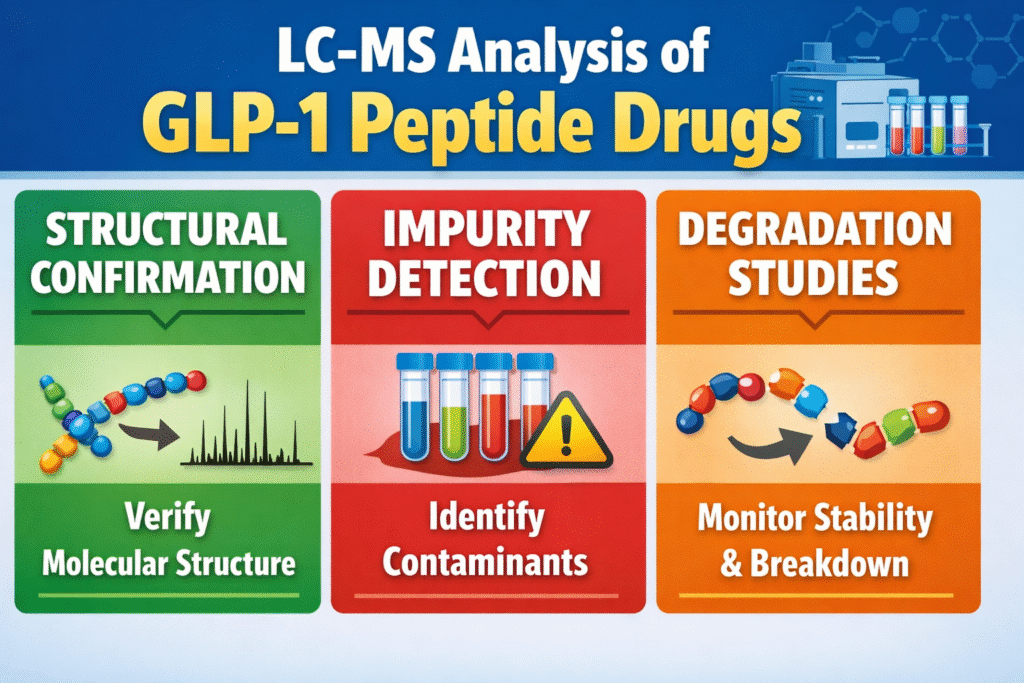
LC-MS Characterization of GLP-1 Peptides plays a critical role in confirming the molecular identity and structural integrity of therapeutic peptides. By measuring accurate molecular masses and examining fragmentation patterns, scientists can confirm whether a synthesized peptide matches the intended molecular design. This verification step is essential during drug development as well as during routine manufacturing quality control.
GLP-1 peptide drugs usually contain 31–39 amino acids and often include structural modifications such as fatty-acid conjugation. These lipid modifications extend the drug’s half-life and improve pharmacokinetic behavior in the body. However, they also increase analytical complexity and require highly accurate analytical techniques. High-resolution LC-MS allows researchers to confirm these structural features with excellent precision.
Ensure your peptide meets all structural requirements: View our Peptide Characterization Service
Structural confirmation typically involves several complementary LC-MS approaches that work together to validate peptide sequence and molecular composition.
Key LC-MS Structural Confirmation Approaches
| Analytical Strategy | Purpose | Typical Output |
|---|---|---|
| Intact mass analysis | Confirm molecular weight | Accurate mass measurement |
| Peptide mapping | Verify amino acid sequence | Fragment ion spectrum |
| MS/MS fragmentation | Identify structural variants | b- and y-ion fragments |
| LC separation | Resolve isoforms | Retention time profiles |
High-resolution mass spectrometry is sensitive enough to detect single amino acid substitutions, truncated peptides, and post-translational modifications. Even small molecular differences can influence the therapeutic performance of peptide drugs. Detecting these changes early ensures that only structurally correct peptides progress to clinical or commercial stages.
Research on GLP-1 analogs has shown that LC-MS/MS can accurately identify sequence variants and peptide modifications even at extremely low concentrations. This analytical capability increases confidence in structural verification during pharmaceutical manufacturing. As a result, LC-MS remains one of the most trusted techniques for confirming the structure of therapeutic peptides.
Confirm primary structure and sequence integrity: Discover our Peptide Sequencing Service
LC-MS Characterization of GLP-1 Peptides for Impurity Profiling
LC-MS Characterization of GLP-1 Peptides is widely used to detect and quantify impurities that may form during peptide synthesis, purification, or formulation. Impurity profiling is extremely important because even trace contaminants may influence drug safety, stability, or therapeutic performance. For this reason, regulatory agencies require detailed impurity analysis during drug development.
Peptide drugs can generate impurities through several mechanisms during manufacturing. These impurities may result from synthetic errors, incomplete reactions, or chemical instability during processing.
Common Causes of Peptide Impurities
- Solid-phase peptide synthesis errors
- Incomplete deprotection reactions
- Amino acid racemization
- Aggregation and degradation
Regulatory guidelines usually require identification of impurities present at ≥0.10% relative abundance in peptide drug substances. Accurate identification ensures that potential safety risks are understood and properly controlled. LC-MS offers the sensitivity required to detect these very low impurity levels.
Stay compliant with the latest regulatory benchmarks: Read the FDA Peptide Sameness Study Requirements
Major Impurity Classes Detected Using LC-MS
- Truncated peptides
- Sequence variants
- D-amino acid isomers
- Lipid chain variants
- Oxidation products
- Deamidated peptides
High-resolution LC-MS workflows enable precise mass measurement and fragmentation-based identification. These capabilities help scientists determine the structure of impurities that differ only slightly from the main peptide sequence. Even closely related isomeric species can often be separated and identified.
For example, advanced LC-HRMS techniques have been successfully used to detect very low levels of D-amino acid isomeric impurities in semaglutide. These impurities are extremely difficult to identify using conventional chromatographic techniques alone. By combining chromatographic separation with accurate mass detection, LC-MS provides a powerful platform for comprehensive impurity analysis.
Access high-resolution testing for your therapeutic: Explore Peptide Sameness Testing Methods
LC-MS Characterization of GLP-1 Peptides for Degradation Pathway Analysis
Another major application of LC-MS Characterization of GLP-1 Peptides is the investigation of degradation pathways that affect peptide stability during storage and formulation. Understanding how peptides degrade allows researchers to design more stable drug formulations and determine appropriate storage conditions. These studies are essential for maintaining long-term pharmaceutical quality.
GLP-1 analogs can undergo several chemical degradation processes under environmental stress conditions. Factors such as temperature, pH, oxygen exposure, and light can accelerate these reactions. Monitoring degradation behavior helps scientists predict shelf life and protect drug effectiveness.
Common Degradation Pathways
- Deamidation of asparagine residues
- Methionine oxidation
- Peptide backbone hydrolysis
- Acyl chain hydrolysis
- Isomerization reactions
Advanced LC-MS methods allow researchers to identify the exact location of degradation events within the peptide sequence. By examining mass shifts and fragmentation patterns, scientists can determine the chemical mechanism responsible for structural changes.
Identify potential risks early in development: Request a Forced Degradation Study
Common Degradation Products Observed in GLP-1 Drugs
| Degradation Type | Mechanism | Analytical Detection |
|---|---|---|
| Oxidation | Methionine oxidation | +16 Da mass shift |
| Deamidation | Asn → Asp conversion | +0.984 Da mass shift |
| Peptide cleavage | Backbone hydrolysis | Shorter peptide fragments |
| Isomerization | Asp residue rearrangement | LC retention change |
LC-HRMS studies of semaglutide and liraglutide have shown that buffer composition, pH levels, and storage temperature can strongly influence degradation pathways. These insights are valuable during formulation development and stability testing. Because of this capability, LC-MS has become a key analytical tool in peptide stability research.
Advanced LC-MS Techniques in GLP-1 Peptide Drug Characterization
Modern LC-MS Characterization of GLP-1 Peptides increasingly relies on advanced analytical technologies that offer greater sensitivity and deeper structural insight. These techniques extend the capabilities of traditional LC-MS and allow scientists to investigate complex peptide structures more effectively. They are particularly useful when analyzing lipidated peptides or detecting trace-level impurities.
Several specialized analytical approaches are now widely used in peptide drug characterization.
1. LC-HRMS/MS
High-resolution mass spectrometry provides mass accuracy at parts-per-million (ppm) levels. This precision helps scientists distinguish between isomeric impurities and closely related peptide variants. It also improves confidence in structural identification during impurity analysis.
2. Peptide Mapping via Enzymatic Digestion
In peptide mapping workflows, the peptide drug is enzymatically digested into smaller fragments before LC-MS/MS analysis. This approach allows complete verification of the amino acid sequence. It also helps identify localized chemical modifications within specific regions of the peptide.
3. Ion Mobility Mass Spectrometry
Ion mobility mass spectrometry adds an additional separation dimension based on molecular shape and conformation. This method is particularly useful for analyzing lipidated GLP-1 peptides that may exist in multiple conformations. It improves the separation of structural isomers that share identical masses.
4. Hydrogen-Deuterium Exchange MS
Hydrogen-deuterium exchange mass spectrometry evaluates structural dynamics and folding behavior in peptide molecules. This method can reveal subtle conformational differences between peptide variants. Such information is valuable when studying structural stability and comparability.
Advantages of Advanced LC-MS Approaches
- Higher sensitivity for trace impurities
- Structural confirmation of complex peptide modifications
- Improved characterization of biosimilar GLP-1 drugs
- Better stability and degradation profiling
These advanced technologies greatly expand the analytical capabilities available to scientists working with peptide therapeutics.
Detailed structural confirmation for regulatory filing: Peptide Sequencing and Mapping for Sameness Studies
LC-MS Characterization of GLP-1 Peptides in Biosimilar and Follow-On Products
LC-MS Characterization of GLP-1 Peptides is especially important during biosimilar development and comparability studies. As patents for several GLP-1 drugs approach expiration, many pharmaceutical companies are developing biosimilar or follow-on versions. Demonstrating structural similarity with the original reference product is a key requirement for regulatory approval.
Regulatory guidelines require detailed analytical characterization before a biosimilar product can enter the market. LC-MS provides the structural resolution necessary to perform these comparisons accurately. Through detailed molecular analysis, scientists can confirm that the biosimilar peptide closely resembles the original therapeutic product.
Key Comparability Parameters Evaluated by LC-MS
- Molecular weight consistency
- Sequence identity
- Impurity profiles
- Degradation patterns
- Post-translational modifications
Comparative LC-MS studies have shown that manufacturing processes can influence impurity profiles and degradation behavior. Even small differences in synthesis conditions can lead to measurable analytical changes. Therefore, robust LC-MS characterization is essential to demonstrate biosimilar equivalence.
Compare your biosimilar to the reference drug with precision: Understand Peptide Sameness vs. Biosimilar Comparability
Method Development Considerations for LC-MS Characterization of GLP-1 Peptides
Successful LC-MS Characterization of GLP-1 Peptides requires careful optimization of chromatographic conditions and mass spectrometry parameters. Proper method development ensures reliable results, high sensitivity, and reproducible measurements. Analytical scientists must carefully control several experimental variables during method design.
Chromatographic Conditions
- Reversed-phase C18 columns
- Gradient elution using acetonitrile
- Formic acid or trifluoroacetic acid modifiers
These chromatographic conditions help achieve efficient separation of peptide isoforms and impurities. Good separation improves detection sensitivity and reduces spectral interference during analysis.
Mass Spectrometry Parameters
- Electrospray ionization (ESI)
- Multiple charge state detection
- High-resolution Orbitrap or Q-TOF instruments
Electrospray ionization works well for peptide analysis because it generates multiply charged ions that improve mass detection. High-resolution instruments further enhance mass accuracy and structural interpretation.
Sample Preparation
- Desalting and buffer exchange
- Enzymatic digestion for peptide mapping
- Minimizing peptide adsorption and degradation
Proper sample preparation helps prevent contamination and reduces signal suppression during LC-MS analysis. Maintaining peptide stability during preparation is also important for obtaining accurate analytical results.
By optimizing these experimental parameters, scientists can achieve highly reliable LC-MS analysis of GLP-1 peptide therapeutics.
Ensure your method is robust and reliable: Analytical Method Development and Validation Service
Future Trends in LC-MS Characterization of GLP-1 Peptide Drugs
The future of LC-MS Characterization of GLP-1 Peptides is focused on improving sensitivity, automation, and multidimensional analysis. Advances in analytical instrumentation and data analysis software are expanding the capabilities of peptide characterization. These improvements will help accelerate drug development and enhance analytical accuracy.
Several emerging technologies are shaping the next generation of peptide drug analysis:
- Top-down mass spectrometry for intact peptide analysis
- Multidimensional LC-MS workflows
- AI-assisted spectral interpretation
- Ultra-high-resolution Orbitrap mass spectrometry
Top-down mass spectrometry allows direct analysis of intact peptide molecules without enzymatic digestion. This method simplifies structural analysis and provides comprehensive information about sequence variations and modifications.
Artificial intelligence tools are also beginning to assist scientists with spectral interpretation and impurity identification. Automated algorithms can analyze complex mass spectrometry datasets faster and more efficiently than traditional manual analysis. As these technologies continue to develop, they will significantly improve the speed and reliability of peptide characterization.
Conclusion
LC-MS Characterization of GLP-1 Peptides is a critical analytical approach for ensuring the quality, stability, and structural integrity of GLP-1 peptide drugs. Through detailed molecular analysis, LC-MS enables scientists to detect sequence variants, degradation products, and process-related impurities that may arise during peptide synthesis or formulation. This level of analytical precision is essential for maintaining high pharmaceutical quality standards.
By combining high-resolution mass spectrometry, peptide mapping, and advanced LC-MS workflows, researchers can obtain a comprehensive understanding of GLP-1 therapeutic molecules. These analytical techniques support impurity profiling, structural verification, and degradation pathway investigation. As a result, they are widely used in both pharmaceutical research and manufacturing quality control.
As the global demand for GLP-1 drugs continues to grow, LC-MS characterization will remain a key component of regulatory compliance, biosimilar comparison, and pharmaceutical quality assurance. Continuous improvements in analytical technology will further enhance the ability of scientists to analyze complex peptide therapeutics with high accuracy.
Partner with the industry leaders for your submission: Find the Best CRO for Peptide Sameness Studies
For specialized analytical support in peptide drug characterization:
Frequently Asked Questions (FAQs)
LC-MS can detect several impurity types including truncated peptides, oxidation products, deamidated forms, sequence variants, and D-amino acid isomers. These impurities may form during peptide synthesis, purification, or long-term storage. The high sensitivity of LC-MS allows detection even at very low levels.
Commonly analyzed GLP-1 therapeutics include semaglutide, liraglutide, exenatide, dulaglutide, and other GLP-1 receptor agonists. These drugs are widely used for diabetes and metabolic disease treatment. LC-MS helps verify their molecular structure and purity during development and manufacturing.
High-resolution mass spectrometry improves analytical sensitivity and mass accuracy. It allows scientists to detect low-abundance impurities and closely related peptide variants that might not be visible using lower-resolution instruments. This leads to more reliable structural identification.
GLP-1 peptides may degrade through oxidation, deamidation, hydrolysis, or isomerization reactions. These processes can occur during storage, formulation, or exposure to environmental stress. LC-MS analysis helps identify the degradation products and understand their chemical mechanisms.
Stability studies expose peptide drugs to stress conditions such as temperature changes, pH variation, or light exposure. Samples are then analyzed using LC-MS to detect degradation products or structural changes. This information helps determine proper storage conditions and product shelf life.
Common techniques include LC-MS/MS, LC-HRMS, Q-TOF mass spectrometry, Orbitrap mass spectrometry, and ion mobility MS. Each method provides different structural insights about the peptide molecule. Together they support detailed and reliable peptide analysis
Reference:
- Manandhar, B., & Ahn, J.-M. (2015). Glucagon-like peptide-1 (GLP-1) analogs: Recent advances, new possibilities, and therapeutic implications. Journal of Medicinal Chemistry, 58(3), 1020–1037. https://doi.org/10.1021/jm500810s
- Drucker, D. J. (2018). Discovery, characterization, and clinical development of the glucagon-like peptides. Molecular Metabolism, 14, 80–99. https://doi.org/10.1016/j.molmet.2018.01.001
- Jiang, N., Su, D., Chen, D., Huang, S., Tang, C., Jing, L., Yang, C., Zhou, Z., Yan, Z., & Han, J. (2024). Discovery of a novel glucagon-like peptide-1 (GLP-1) analogue from bullfrog and investigation of its potential for designing GLP-1-based multiagonists. Journal of Medicinal Chemistry, 67(1), 180–198. https://doi.org/10.1021/acs.jmedchem.3c01049
Get In Touch With Us
About The Author


