


Introduction
Leuprolide Depot Formulation Challenges represent one of the most technically demanding areas in long-acting injectable (LAI) drug development, particularly for generic products. Unlike simple dosage forms, these formulations rely on PLGA-based microspheres that are designed to release drug in a controlled and sustained manner over extended periods. Even slight changes in formulation composition or processing conditions can lead to noticeable differences in therapeutic outcomes.
This complexity arises because the system depends on multiple interacting factors, including polymer degradation, drug diffusion, and microsphere structure. Developers must understand how each variable influences overall performance, not just in isolation but as part of an integrated system. This article explores the scientific and technical reasons behind these challenges, focusing on PLGA behavior, microsphere engineering, and release mechanisms. It also highlights why achieving equivalence in generics requires more than matching composition alone.
Master the process: The Generic Drug Development Process for ANDA
Share via:
Why Are Leuprolide Depot Formulation Challenges So Difficult for Generics?
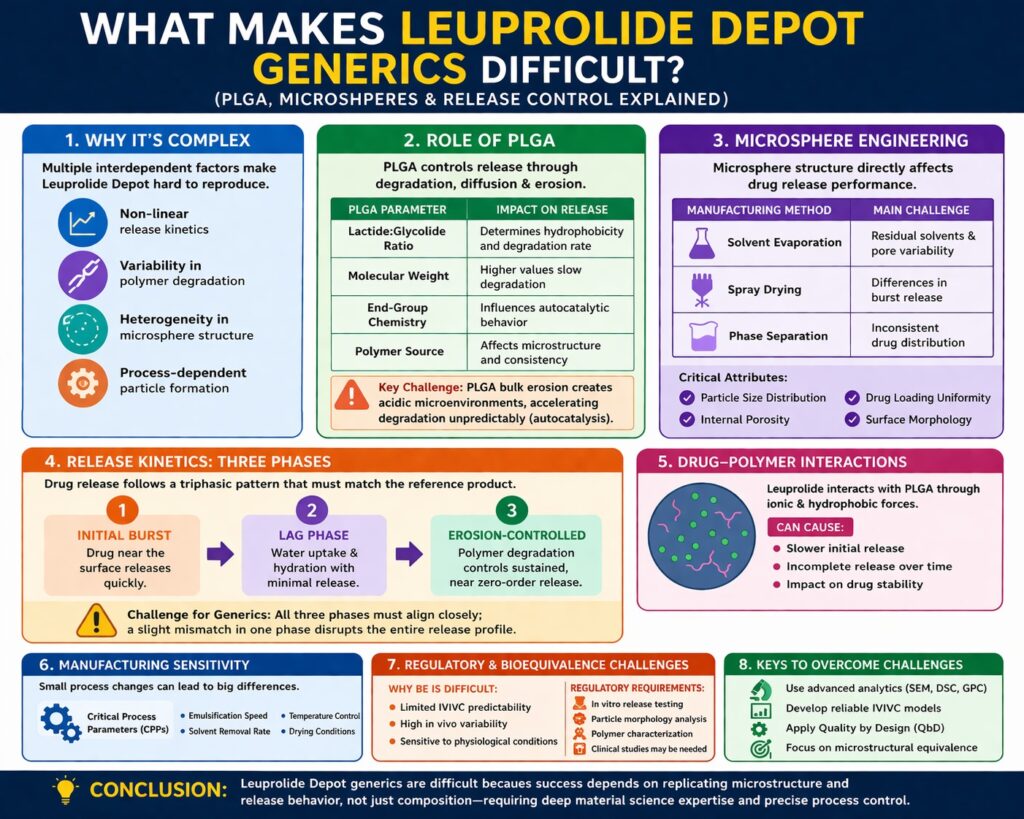
These systems are difficult because they are controlled by multiple interdependent variables involving polymer chemistry, particle structure, and drug-polymer interactions, all of which are highly sensitive to manufacturing conditions.
Key complexity drivers include:
- Non-linear release kinetics
- Variability in polymer degradation
- Heterogeneity in microsphere structure
- Process-dependent particle formation
Even when two formulations appear compositionally identical, they may behave very differently due to subtle differences in processing. This makes reproducibility a major hurdle for generic manufacturers. The system does not follow simple linear behavior, which adds further unpredictability. As a result, small deviations can lead to large differences in drug release profiles, complicating development and regulatory approval.
Overcome technical hurdles: Analytical Challenges in Leuprolide Depot Development
Role of PLGA in Leuprolide Depot Formulation Challenges
PLGA governs drug release through a combination of degradation, diffusion, and erosion mechanisms, but its behavior is extremely sensitive to small variations.
Critical PLGA Variables
| Parameter | Impact on Release |
|---|---|
| Lactide:Glycolide ratio | Determines hydrophobicity and degradation rate |
| Molecular weight | Higher values slow degradation |
| End-group chemistry | Influences autocatalytic behavior |
| Polymer source | Affects microstructure and consistency |
PLGA properties directly dictate how quickly the drug becomes available in the body. Even polymers with similar specifications can behave differently depending on their origin or processing history. This adds another layer of uncertainty during formulation development. In addition, environmental factors such as moisture and temperature can further influence polymer performance, making control even more challenging.
Optimize your supply chain: Pharmaceutical CDMO Services in the US and Canada
Key Challenge
PLGA undergoes bulk erosion, leading to the formation of acidic microenvironments within the microsphere. This accelerates degradation in an unpredictable manner through autocatalysis. As a result, maintaining consistent release profiles becomes difficult, especially when trying to replicate a reference product. This internal pH shift can also impact peptide stability, further complicating formulation design.
Microsphere Engineering: The Core of Leuprolide Depot Formulation Challenges
Microsphere design introduces variability in particle size, porosity, and drug distribution, all of which directly influence release behavior.
Manufacturing Methods & Their Impact
| Method | Challenge |
|---|---|
| Solvent evaporation | Residual solvents and pore variability |
| Spray drying | Differences in burst release |
| Phase separation | Inconsistent drug distribution |
The internal structure of microspheres is highly dependent on the manufacturing process used. Even small changes in process parameters can alter particle morphology significantly. This makes it difficult to reproduce the same product consistently across batches. Additionally, scaling up from laboratory to commercial production often introduces further variability that must be carefully managed.
Critical Attributes
- Particle size distribution (PSD)
- Internal porosity
- Uniformity of drug loading
- Surface morphology
Minor differences in these attributes can result in:
- Increased initial burst release
- Extended lag phases
- Changes in sustained release patterns
These variations can ultimately affect therapeutic performance and patient outcomes. Therefore, precise control of microsphere characteristics is essential for both efficacy and safety.
Accelerate your timeline: How a CDMO Accelerates Generic Drug Development
Release Kinetics Complexity in Leuprolide Depot Formulation Challenges
Drug release follows a triphasic pattern, and each phase must be carefully controlled to match the reference product.
Three Phases of Release
Initial Burst Release
This phase occurs due to drug located near the microsphere surface. It is highly sensitive to formulation and processing conditions. Even slight differences in surface characteristics can significantly alter the magnitude of the burst. Controlling this phase is critical to avoid potential safety issues.
Lag Phase
During this stage, minimal drug release occurs while the polymer absorbs water and begins to hydrate. The duration of this phase depends on polymer properties such as glass transition temperature and water uptake behavior. Small variations can shift the timing of drug availability.
Erosion-Controlled Release
In this phase, drug release is driven by polymer degradation and often follows near zero-order kinetics. The rate of degradation determines how consistently the drug is delivered over time. Maintaining this phase is essential for long-term therapeutic effectiveness.
Why This Is a Problem for Generics
Matching all three phases simultaneously is extremely difficult. A slight mismatch in one phase can disrupt the overall release profile. Regulatory agencies require close alignment in pharmacokinetic profiles, not just total drug release. This makes development both time-consuming and resource-intensive.
Step-by-step guidance: How to Develop Generic Leuprolide Depot
Drug-Polymer Interactions: Hidden Complexity
Leuprolide interacts with PLGA through ionic and hydrophobic forces, which significantly affect drug encapsulation and release.
These interactions can:
- Slow initial drug release
- Lead to incomplete drug release over time
- Affect stability within the microsphere
The strength of these interactions depends on factors such as polymer end groups, internal pH, and moisture content. Changes in these conditions can alter how the drug behaves داخل the polymer matrix. This adds another layer of variability that must be understood and controlled during formulation development.
Recent studies emphasize that these interactions play a critical role in determining both loading efficiency and reproducibility. Ignoring them can lead to inconsistent product performance. Therefore, a detailed understanding of molecular interactions is essential for successful formulation design.
Manufacturing Sensitivity: Why Process Matters More Than Formula
Even when formulations are identical, differences in manufacturing conditions can lead to significant variations in product performance.
Critical Process Parameters (CPPs)
- Emulsification speed
- Solvent removal rate
- Temperature control
- Drying conditions
Each of these parameters influences microsphere formation and internal structure. Small deviations during processing can lead to measurable differences in release kinetics. This makes process control just as important as formulation design.
Implication
Generic development cannot rely solely on matching composition (Q1/Q2). Instead, achieving microstructural equivalence (Q3) is essential. This requires advanced process understanding and tight control strategies. Without this, consistent replication of the reference product is unlikely.
Assess your development strategy: CRO vs. In-House ANDA Development
Bioequivalence Challenges in Leuprolide Depot Formulation Challenges
Traditional bioequivalence approaches are not sufficient due to the complex relationship between drug release and pharmacokinetics.
Key Issues
- Limited predictability of IVIVC models
- High variability in in vivo release
- Sensitivity to physiological conditions
Even when in vitro data appears similar, in vivo performance may differ significantly. This disconnect makes it difficult to rely on standard testing methods. Additionally, patient-specific factors can further influence drug release behavior.
Although Level A IVIVC has been demonstrated in some cases, it is often formulation-specific and not easily generalized. This limits its usefulness in broader applications. As a result, developers must use multiple approaches to establish equivalence.
Regulatory Perspective: Why Approval Is Difficult
Regulatory agencies classify these products as complex generics, requiring extensive and detailed characterization.
Requirements Often Include:
- In vitro release testing
- Particle morphology analysis
- Polymer characterization
- Clinical studies in certain cases
Regulators expect a deep understanding of both formulation and process. Simple compositional matching is not considered sufficient. Developers must demonstrate consistent performance through multiple lines of evidence.
Ensure compliance: Requirements for ANDA Submission for Generic Drugs
This increases the time, cost, and technical demands of development. However, it ensures that patients receive safe and effective products. The regulatory pathway reflects the inherent complexity of these systems.
Mitigate safety risks: Nitrosamine Risk Assessment in Generic Drugs
Practical Strategies to Overcome Leuprolide Depot Formulation Challenges
Success requires a combination of advanced analytical techniques, robust process control, and mechanistic understanding.
Recommended Approaches
- Use multiple analytical methods such as SEM, DSC, and GPC
- Develop reliable IVIVC models where possible
- Apply Quality by Design (QbD) principles
- Focus on achieving microstructural equivalence
These strategies help identify critical variables and control them effectively. They also support a more systematic approach to development. By integrating these methods, developers can improve the likelihood of success.
Continuous monitoring and optimization are also important. Iterative testing allows for better understanding and refinement of the formulation. This approach reduces risk and enhances reproducibility.
Conclusion
Leuprolide Depot Formulation Challenges arise from the complex interaction between PLGA chemistry, microsphere structure, and multi-phase release kinetics. The primary difficulty in developing generics lies not in matching the formulation composition, but in replicating the exact microstructure and release behavior.
Achieving this requires a deep understanding of material science, process engineering, and drug delivery mechanisms. Advanced analytical tools and strict process control are essential to ensure consistency. Compared to conventional generics, these systems demand a significantly higher level of technical expertise. Ultimately, success depends on the ability to manage complexity at every stage of development.
Partner with the experts: Leuprolide Depot Generic Drug Development Services
👉 Contact our experts for formulation support: Contact us
Frequently Asked Questions:
Variations in PLGA properties can significantly influence how quickly the polymer breaks down, which directly controls the drug release profile. Even slight differences in molecular weight or composition may alter release behavior. These inconsistencies make it challenging to achieve uniform performance. External factors such as processing conditions and storage environment can further intensify this variability.
The initial burst effect is mainly due to drug molecules located close to or on the surface of the microspheres. Factors like particle size, internal porosity, and preparation technique strongly impact this phenomenon. Even minimal changes during formulation can lead to noticeable differences in early drug release. Managing this rapid release phase is essential to ensure patient safety.
Establishing bioequivalence is complex because drug release extends over a long duration and depends on multiple interacting variables. Blood concentration levels are influenced not only by composition but also by formulation structure and processing. Conventional pharmacokinetic methods may not fully capture these dynamics. As a result, proving equivalence becomes more complicated.
The size of microspheres plays a key role in determining how the drug is released over time. Smaller particles provide a larger surface area, which can accelerate release and increase the initial burst. In contrast, larger microspheres tend to release the drug more gradually. Maintaining a consistent size distribution is critical for predictable performance.
In vitro–in vivo correlation (IVIVC) is used to connect laboratory release data with actual biological performance. For PLGA-based systems, building a reliable correlation is particularly challenging due to their complex release patterns. Multiple phases of drug release make prediction difficult. Despite these challenges, IVIVC remains an important tool in formulation development.
PLGA depot systems are regarded as complex because their behavior depends on both the formulation components and their internal architecture. Processing conditions have a major impact on the final product characteristics. This complexity often necessitates advanced analytical techniques and, in some cases, clinical studies. Ensuring consistency requires a high level of control and understanding.
A variety of analytical methods are used to evaluate microsphere properties. Scanning electron microscopy (SEM) helps visualize surface structure, while differential scanning calorimetry (DSC) assesses thermal behavior. Gel permeation chromatography (GPC) is used to determine polymer molecular weight. Combining these techniques provides a more comprehensive understanding of the system.
Reference:
- Zhang, Y., Liu, Y., & Chen, Y. (2023). Advances in poly(lactic-co-glycolic acid) (PLGA)-based drug delivery systems. Pharmaceutics, 15(6), 1624. https://doi.org/10.3390/pharmaceutics15061624
- Klein, K. O., Mauras, N., Nayak, S., et al. (2023). Efficacy and safety of leuprolide acetate 6-month depot for the treatment of central precocious puberty: A phase 3 study. Journal of the Endocrine Society, 7(7), bvad071. https://doi.org/10.1210/jendso/bvad071
- U.S. Food and Drug Administration. (2011). Signatory authority review: Lupron Depot (leuprolide acetate) NDA 020517/S-030. https://www.accessdata.fda.gov/drugsatfda_docs/nda/2011/020517orig1s025s030s032Review.pdf
- Zhang, L., Li, X., & Wang, Y. (2024). Recent advances in biodegradable polymer-based depot drug delivery systems: Focus on PLGA microspheres. Pharmaceutics, 16(5), 654. https://doi.org/10.3390/pharmaceutics16050654
Get In Touch With Us
About The Author


