

Introduction:
The Liraglutide Sameness Study for ANDA submission is a critical regulatory requirement when filing a generic version of liraglutide under the Abbreviated New Drug Application (ANDA) pathway with the U.S. Food and Drug Administration. Demonstrating analytical sameness ensures that the generic product contains the same active pharmaceutical ingredient (API) with identical structure, composition, and impurity profile as the reference listed drug (RLD).
Liraglutide is a long-acting GLP-1 receptor agonist originally marketed as Victoza and Saxenda. Due to its complex peptide backbone and lipid modification, sameness evaluation requires advanced mass spectrometry-based characterization beyond conventional small-molecule analysis.
This case study outlines how ResolveMass Laboratories Inc. executed a comprehensive Liraglutide Sameness Study for ANDA submission, aligned with official FDA peptide sameness study requirements and regulatory expectations.
Share via:
Summary:
- Liraglutide Sameness Study for ANDA submission requires comprehensive analytical characterization aligned with USFDA expectations.
- Synthetic GLP-1 peptide analogs demand advanced peptide characterization in drug development.
- USFDA evaluates sameness under the 505(j) pathway, requiring proof of identical active ingredient and impurity comparability.
- ResolveMass conducted a full analytical comparability package using LC-HRMS, LC-MS/MS, and advanced peptide sameness testing methods.
- The study supported regulatory-ready documentation, ensuring audit preparedness and minimizing peptide sameness study deficiencies.
1: What Does USFDA Require in a Liraglutide Sameness Study for ANDA Submission?
The U.S. Food and Drug Administration requires comprehensive analytical evidence proving that the generic liraglutide is structurally identical to the Reference Listed Drug (RLD) when filing under the 505(j) ANDA pathway.
For a Liraglutide Sameness Study for ANDA submission, the agency expects confirmation of:
- Identical active ingredient
- Exact primary amino acid sequence
- Correct fatty acid conjugation (palmitoyl chain)
- Comparable impurity profile
- Matching degradation pathways
Because liraglutide is a modified peptide, USFDA scrutiny goes beyond routine assay testing and focuses on molecular-level structural precision supported by orthogonal analytical techniques.
These expectations align with broader guidance on characterization of peptides for FDA and detailed FDA requirements for peptide characterization.
Advanced tools such as peptide sequencing and mapping for sameness study and peptide mapping for PTM analysis are essential to meet these standards.
Regulatory Expectations Under 505(j) Pathway
Under the ANDA framework, the applicant must scientifically demonstrate the following:
| Requirement | USFDA Regulatory Expectation |
|---|---|
| Active Ingredient Identity | Exact amino acid sequence match with RLD |
| Molecular Weight | Accurate intact mass confirmation (HRMS) |
| Lipid Side Chain | Correct C16 palmitoyl attachment at Lys26 via γ-Glu spacer |
| Impurity Profile | Comparable qualitative and quantitative impurity levels |
| Peptide Mapping | Complete sequence coverage with MS/MS confirmation |
| Stability Profile | Comparable forced degradation pathways |
Why These Requirements Are Critical
Liraglutide contains:
- A 31-amino acid GLP-1 analog backbone
- A site-specific fatty acid modification
- Potential degradation hotspots (oxidation, deamidation)
Therefore, the USFDA expects:
- High-resolution mass spectrometry (HRMS) for intact mass accuracy
- LC-MS/MS peptide mapping for sequence confirmation
- Impurity characterization studies for structural identification
- Forced degradation studies to compare stability behavior
Any discrepancy in structure, modification site, or impurity pattern may trigger regulatory deficiencies.
Key Takeaway
In a Liraglutide Sameness Study for ANDA submission, the USFDA does not rely on superficial similarity. The agency requires scientifically defensible proof that the generic liraglutide is molecularly identical and analytically comparable to the RLD, supported by validated, regulatory-grade data packages.
2: Why Is Liraglutide Sameness Study for ANDA Submission Technically Challenging?
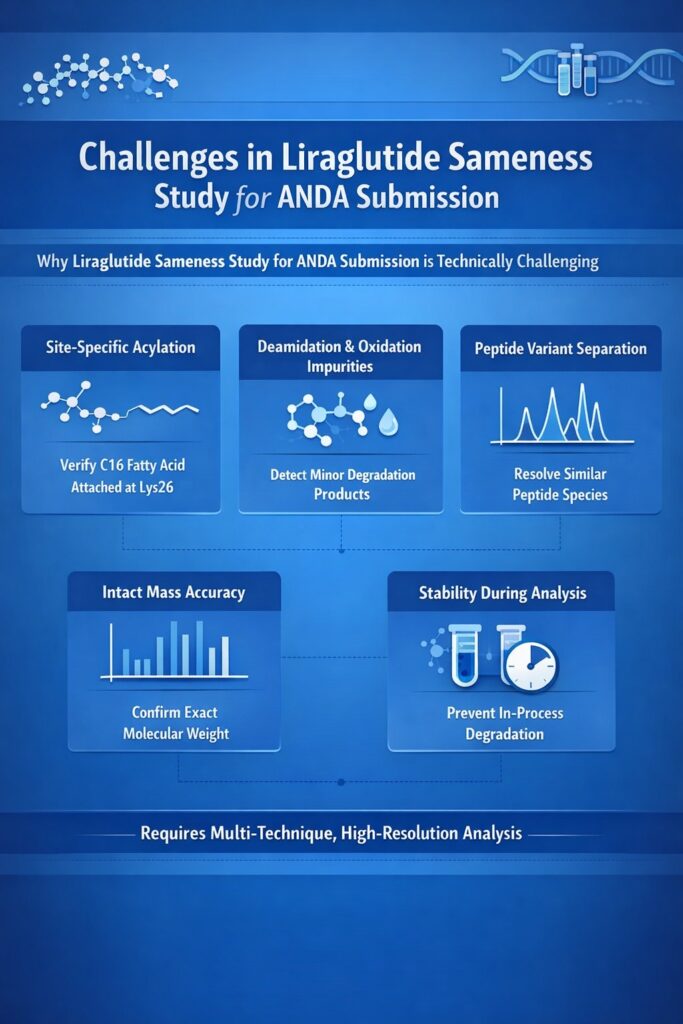
The Liraglutide Sameness Study for ANDA submission is technically challenging because liraglutide is not a simple small molecule — it is a structurally modified peptide with a 31-amino acid backbone and a C16 palmitoyl fatty acid side chain attached via a γ-glutamic acid spacer. This structural complexity requires high-precision analytical confirmation at multiple levels.
When filing under the 505(j) pathway with the U.S. Food and Drug Administration, minor structural differences can trigger regulatory deficiencies. Therefore, analytical ambiguity is not acceptable.
Key Scientific Challenges in Liraglutide Sameness Study for ANDA Submission
1. Confirming Site-Specific Acylation
The fatty acid must be precisely attached at Lys26 via a glutamic acid spacer.
Challenges include:
- Differentiating positional isomers
- Confirming exact attachment site using MS/MS fragmentation
- Excluding alternative acylation variants
Even slight mis-acylation alters pharmacokinetics and albumin binding.
Requires high-resolution MS/MS confirmation and expertise in peptide mass spectrometry experts.
2. Detecting Deamidation and Oxidation Impurities
Peptides are inherently prone to chemical modifications:
- Deamidation at asparagine residues
- Oxidation (especially methionine residues)
- Hydrolytic degradation
These impurities often differ by very small mass changes, requiring high-resolution mass spectrometry (HRMS) for accurate detection.
Impurities must be identified through advanced impurity profiling in peptides – why it matters in drug development and peptide degradation product characterization.
3. Separating Closely Related Peptide Variants
Liraglutide may generate:
- Sequence-related impurities
- Truncated forms
- Isobaric variants
Because these species have nearly identical molecular weights, advanced chromatographic resolution and tandem MS confirmation are essential.
Requires optimized LC separation and understanding of peptide characterization techniques and applications.
4. Ensuring Accurate Intact Mass Detection
The intact molecular mass must match the Reference Listed Drug (RLD) within tight ppm tolerance.
Analytical challenges include:
- Ion suppression
- Adduct formation
- Charge state deconvolution errors
High-resolution LC-HRMS with proper calibration is critical for defensible results.
HRMS confirmation is critical for demonstrating sameness in line with peptide sameness study for ANDA.
5. Maintaining Peptide Stability During Analysis
Peptides can degrade during:
- Sample preparation
- Digestion steps
- Storage conditions
Improper handling may artificially create degradants, complicating impurity comparison studies required by the U.S. Food and Drug Administration.
Why Orthogonal Techniques Are Mandatory
Unlike small molecules, liraglutide cannot be confirmed by a single analytical method. A scientifically sound Liraglutide Sameness Study for ANDA submission typically requires:
- Intact mass analysis (LC-HRMS)
- Peptide mapping (LC-MS/MS)
- Orthogonal chromatographic separation
- Forced degradation studies
- Impurity structural identification
Each method confirms a different structural dimension, eliminating regulatory uncertainty.
Final Perspective
The complexity of lipid modification, susceptibility to degradation, and structural similarity between variants makes the Liraglutide Sameness Study for ANDA submission scientifically demanding. Only a multi-technique, high-resolution analytical strategy can generate the level of structural certainty expected by the U.S. Food and Drug Administration for ANDA approval.
3: Overview of the Generic Project: Liraglutide Sameness Study for ANDA Submission
In this Liraglutide Sameness Study for ANDA submission, a generic pharmaceutical company partnered with ResolveMass Laboratories Inc. to generate a complete analytical package prior to filing an ANDA with the U.S. Food and Drug Administration.
The objective was to scientifically demonstrate that the generic liraglutide is structurally and analytically comparable to the Reference Listed Drug (RLD), meeting 505(j) regulatory expectations.
This approach reflects best practices outlined in:
Project Objectives
- Confirm complete primary structure (100% amino acid sequence match)
- Verify lipid modification at Lys26 (correct C16 fatty acid attachment)
- Compare impurity profiles vs RLD (qualitative and quantitative alignment)
- Demonstrate intact mass equivalence (accurate molecular weight confirmation)
- Generate ANDA-ready documentation (CTD-compliant analytical reports)
This focused analytical strategy ensured regulatory readiness and minimized potential deficiency risks prior to submission.
4: Analytical Strategy for Liraglutide Sameness Study for ANDA Submission
A multi-technique analytical workflow was implemented, similar to approaches used in other case studies such as:
- Peptide characterization of Ganirelix generic project
- Peptide characterization of Lanreotide generic project
- Semaglutide sameness evaluation for Health Canada
Key Techniques Used
- LC-HRMS intact mass analysis
- LC-MS/MS peptide mapping
- Forced degradation studies
- Quantitative impurity comparison
These strategies align with the principles discussed in peptide mapping vs peptide sequencing – key differences.
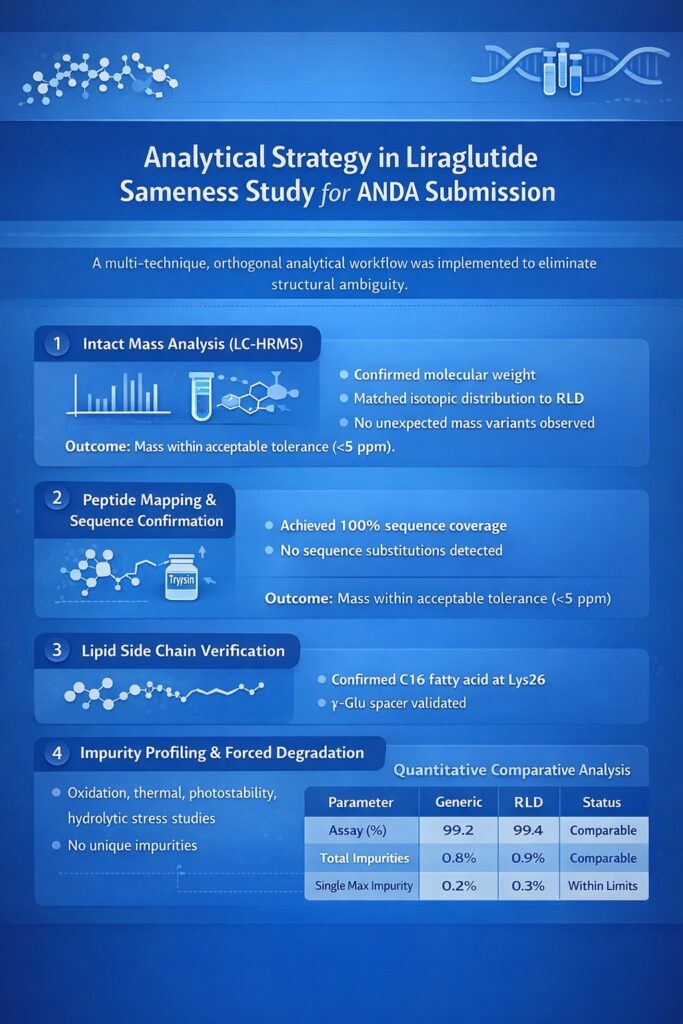
1. Intact Mass Analysis (LC-HRMS)
- High-resolution mass spectrometry confirmed molecular weight.
- Isotopic distribution patterns matched RLD.
- No unexpected mass variants observed.
Outcome: Molecular mass within acceptable tolerance (<5 ppm).
2. Peptide Mapping & Sequence Confirmation
Purpose: Confirm 100% amino acid sequence identity.
Methodology:
- Enzymatic digestion (Trypsin & alternative proteases)
- LC-MS/MS fragmentation
- Sequence coverage validation
Results:
- 100% sequence coverage achieved
- Fragment ion matching consistent with RLD
- No sequence substitutions detected
3. Lipid Side Chain Verification
Why Important? Liraglutide contains a palmitic acid chain critical for pharmacokinetics.
- MS/MS confirmed C16 fatty acid
- Verified attachment at Lys26
- Spacer (γ-Glu) validated
This step is critical in any Liraglutide Sameness Study for ANDA submission.
4. Impurity Profiling & Forced Degradation
Answer: Impurity comparison ensures similar degradation pathways and safety profile.
Evaluations Performed:
- Oxidation studies
- Thermal stress
- Photostability
- Hydrolytic degradation
Observations:
- Comparable oxidation at methionine residue
- Similar deamidation trends
- No unique degradants in generic sample
5. Quantitative Comparative Analysis
| Parameter | Generic | RLD | Status |
|---|---|---|---|
| Assay (%) | 99.2 | 99.4 | Comparable |
| Total Impurities | 0.8% | 0.9% | Comparable |
| Single Max Impurity | 0.2% | 0.3% | Within Limits |
5: Regulatory Documentation: Preparing Liraglutide Sameness Study for ANDA Submission
The study was documented in CTD-compliant format suitable for Module 3 submission.
All documentation was prepared in CTD format consistent with:
- Peptide characterization for IND and NDA
- Peptide purity testing in United States
- What is peptide purity by HPLC and why it matters
Data integrity followed ALCOA+ principles and 21 CFR Part 11 compliance.
Deliverables included:
- Method validation reports
- Raw chromatographic data
- Spectral interpretation reports
- Comparative impurity justification
- Stability trend analysis
All data followed:
- ALCOA+ principles
- 21 CFR Part 11 compliance
- Audit-ready formatting
6: Key Scientific Learnings from Liraglutide Sameness Study for ANDA Submission
The Liraglutide Sameness Study for ANDA submission highlighted several critical scientific insights that are essential for regulatory success with the U.S. Food and Drug Administration.
The project reinforced best practices aligned with:
Scientific conclusions:
- Lipid conjugation must be confirmed by MS/MS
- Orthogonal techniques eliminate regulatory uncertainty
- Early forced degradation reduces deficiency risk
- Impurity alignment is as critical as sequence identity
1. Lipid Conjugation Must Be Confirmed by MS/MS
Intact mass alone is not sufficient. Site-specific fatty acid attachment at Lys26 requires targeted MS/MS fragmentation to confirm correct acylation and exclude positional variants.
2. Orthogonal Techniques Eliminate Regulatory Uncertainty
No single method can establish peptide sameness. Combining LC-HRMS, peptide mapping, impurity profiling, and stress studies ensures structural confirmation from multiple analytical angles.
3. Early Forced Degradation Studies Reduce Deficiency Risk
Conducting oxidation, thermal, hydrolytic, and photostability studies early helps identify degradation pathways and align impurity trends with the RLD before submission.
4. Impurity Alignment Is as Important as Sequence Identity
Matching the amino acid sequence is necessary—but not sufficient. Comparable qualitative and quantitative impurity profiles are equally critical to demonstrate full analytical sameness.
These learnings reinforce that a successful Liraglutide Sameness Study for ANDA submission depends on scientific depth, analytical precision, and proactive regulatory strategy.
7: How ResolveMass Laboratories Inc. Ensures Regulatory Confidence
ResolveMass Laboratories Inc. specializes in complex peptide characterization supporting ANDA and regulatory filings.
Core Capabilities
- High-resolution mass spectrometry
- Advanced LC-MS/MS peptide mapping
- Structural impurity identification
- Regulatory-ready reporting
- USFDA-compliant analytical documentation
ResolveMass provides end-to-end support including:
- Analytical support in peptide synthesis – why it’s essential
- Solid vs liquid phase peptide synthesis – which method is better
- Peptide synthesis service – how to choose the right CRO partner
- How to identify unknown peptides by LCMS testing
- Top 5 things to look for in a peptide testing laboratory
- Peptide testing services for pharmaceutical R&D
- Best CRO for peptide sameness study
Our scientific team includes experienced mass spectrometrists and regulatory-focused analysts who understand peptide sameness expectations in depth.
Conclusion:
The Liraglutide Sameness Study for ANDA submission is a scientifically rigorous process requiring precise structural confirmation, impurity comparability, and regulatory-grade documentation. In this case study, ResolveMass Laboratories Inc. successfully demonstrated complete analytical equivalence between the generic liraglutide and the reference product, aligning fully with U.S. Food and Drug Administration expectations.
Through orthogonal analytical techniques, validated methodologies, and regulatory-compliant reporting, the project achieved a robust ANDA-ready package minimizing the risk of deficiencies.
For companies developing GLP-1 peptide generics, investing in a scientifically strong Liraglutide Sameness Study for ANDA submission is not optional — it is foundational to regulatory success.
Frequently Asked Questions:
A Liraglutide sameness study is a comprehensive analytical evaluation required under the 505(j) pathway to demonstrate that the generic product is structurally and analytically identical to the Reference Listed Drug (RLD). It includes confirmation of amino acid sequence, lipid modification, molecular weight, impurity profile, and degradation behavior in alignment with expectations from the U.S. Food and Drug Administration.
Liraglutide contains a C16 palmitic acid attached at Lys26 via a γ-glutamic acid spacer. This lipid modification directly impacts pharmacokinetics and albumin binding. Regulatory authorities require site-specific confirmation using MS/MS to ensure correct attachment and eliminate positional isomers.
No. While high-resolution mass spectrometry confirms molecular weight accuracy, it does not verify sequence order or site-specific modifications. Orthogonal techniques such as peptide mapping and fragmentation analysis are required to establish full structural identity.
Common impurities include oxidation (particularly at methionine), deamidation variants, truncated peptides, and acylation-related variants. Both qualitative and quantitative impurity comparability with the RLD are essential for regulatory acceptance.
Forced degradation studies help demonstrate comparable stability pathways between the generic and RLD. Matching degradation trends reduces the likelihood of regulatory deficiencies and strengthens the overall analytical package.
Unlike small molecules, liraglutide is a structurally complex peptide with post-synthetic lipid modification. This complexity demands advanced analytical depth and multiple orthogonal techniques to eliminate structural ambiguity.
Reference
- Recommendation for Clarifying FDA Policy in Evaluating “Sameness” of Higher Order Structure for Generic Peptide Therapeutics.https://link.springer.com/article/10.1208/s12248-024-00994-8
- Gary Oderda. Bringing Liraglutide to Market: A CER Case Study.https://www.jmcp.org/doi/abs/10.18553/jmcp.2012.18.s5-a.S12
- Jimmy Wen BA, Adam Razick BS. An exploratory analysis of glucagon-like peptide-1 (GLP-1) agonists and biosimilars: A literature review.https://dom-pubs.onlinelibrary.wiley.com/doi/abs/10.1111/dom.16110
- Manfredi Rizzo ,Francesco Cosentino &Christos Mantzoros. Biosimilar and generic formulations of novel antidiabetic drugs: the role of liraglutide in clinical pharmacology of type 2 diabetes.https://www.tandfonline.com/doi/full/10.1080/17512433.2022.2108400
- Santos, Beatriz Rodrigues dos. Mapping the Scientific Landscape of GLP-1 and Dual GLP-1/GIP Receptor Agonists in Obesity Treatment.https://www.proquest.com/openview/607b6ea83e81fcea95319323ce3d6dc4/1?pq-origsite=gscholar&cbl=2026366&diss=y
- GLP-1 Receptor Agonists in the Pharmaceutical Landscape: An Analysis of Current Applications, Market Barriers, and Future Developments.https://thesis.unipd.it/handle/20.500.12608/76821
About the Author


