
Introduction:
Long-Acting Injectable Bioanalysis is the discipline of measuring drug concentrations in biological samples after a depot or extended-release injection, and it is harder than conventional bioanalysis because the drug is released slowly, stays at very low circulating levels and must be tracked for weeks or months. Sponsors developing PLGA microspheres, drug-polymer implants, nanocrystal suspensions and oil depots rely on these data to prove that release is controlled, steady and safe.
Unlike immediate-release products, LAIs release their active pharmaceutical ingredient gradually from an injection site or polymer-based delivery system, and measurable drug may persist for several weeks or months depending on the drug, formulation composition, administration route and release mechanism. That behavior creates several analytical challenges:
- Quantifying concentrations near the assay’s lower limit of quantification (LLOQ).
- Maintaining sensitivity across prolonged pharmacokinetic sampling windows.
- Managing complex absorption and elimination profiles.
- Ensuring sample stability during extended studies.
- Distinguishing the parent drug from metabolites and interfering substances.
- Generating reliable pharmacokinetic data for regulatory evaluation.
The stakes are high. A long-acting injectable (LAI) cannot be recalled once it is administered, so pharmacokinetic (PK) data must be accurate across the whole release profile, including the early burst, the plateau and the long terminal tail. Small analytical errors at the lowest concentrations can distort apparent half-life, bioavailability and in vitro-in vivo correlation (IVIVC).
ResolveMass Laboratories Inc. is a Canadian analytical CRO/CDMO with working depth in mass spectrometry, PLGA-based drug delivery, biosimilar characterization and nitrosamine testing. This article reflects how scientists in that environment plan, validate and run bioanalytical programs for depot products. It covers what makes these studies different, how to choose a platform, how to protect sample integrity over long timelines and how to avoid the pitfalls that most often delay submissions.
Summary:
Long-Acting Injectable Bioanalysis measures drug levels in biological samples from products that release drug over weeks to months, so labs must detect very low concentrations and keep samples reliable across long sampling windows.
- What it is: Quantifying drug (and often metabolites) in plasma, serum or tissue after a depot, microsphere, implant or suspension injection.
- Why LAIs are different: They release drug gradually to cut dosing frequency and improve adherence, which creates extended pharmacokinetic profiles, low circulating levels and complex absorption patterns that conventional methods may not handle.
- Core challenge 1, low concentrations: Slow release keeps circulating drug low and flat, so assays often need pg/mL to low ng/mL sensitivity and a carefully chosen LLOQ.
- Core challenge 2, extended windows: Studies can run for months, which raises sample stability, storage and batch-consistency risks.
- Best-fit platforms: LC-MS/MS for small molecules and selected peptides, ligand-binding or hybrid LC-MS/MS for large molecules.
- Key analytical risks: LLOQ selection, matrix effects, carryover, protein binding, metabolite interference and long-term sample storage.
- Regulatory anchor: Validate to ICH M10 and applicable FDA bioanalytical guidance, with long-term stability, incurred sample reanalysis and cross-batch monitoring.
- Best practice: Define the target LLOQ and sampling plan before dosing, and validate the method for the full study duration.
- Why it matters: Dependable PK data support formulation development, clinical studies and regulatory submissions.
1: What Is Long-Acting Injectable Bioanalysis?
Long-Acting Injectable Bioanalysis is the validated quantification of an active ingredient, and sometimes its metabolites or released components, in plasma, serum, tissue or other matrices after administration of an extended-release injectable. The goal is to describe the full absorption, distribution and elimination profile of a product designed to act for days, weeks or months.
Liposomal and other sustained-release injectable systems follow the same principle: a delivery technology controls the rate at which the active ingredient enters systemic circulation, sometimes for several weeks or months.
Why bioanalysis matters for long-acting formulations
Bioanalysis gives quantitative evidence of whether a formulation delivers the intended exposure over the intended period. Its main applications are:
- Pharmacokinetic characterization: Measuring concentrations at different time points to build the concentration-time profile.
- Formulation performance evaluation: Checking that release is sustained and consistent.
- Dose optimization: Understanding exposure differences across dose levels.
- Bioequivalence assessment: Comparing generic and reference long-acting formulations where applicable.
- Safety evaluation: Identifying prolonged systemic exposure and potential accumulation.
- Regulatory submissions: Supporting clinical and formulation development with reliable analytical data.
For the formulation side of this work, see ResolveMass’s page on the analysis of long-acting injectable formulations. Polymer systems are also used in animal health, as covered in PLGA and PLA veterinary long-acting injectables.
Common long-acting and depot formulation types
| Formulation type | Release mechanism | Typical bioanalytical concern |
|---|---|---|
| PLGA microspheres | Polymer erosion and diffusion | Burst release, long tail, polymer interference |
| Aqueous nanocrystal suspensions | Slow dissolution at the injection site | Very low plateau levels, particle-related variability |
| Oil-based depots | Partitioning from oil into tissue fluid | Lipid matrix effects, ester prodrug conversion |
| In situ forming implants | Solvent exchange then polymer matrix release | Solvent residues, injection-site depot behavior |
| Drug-eluting implants | Diffusion from a solid matrix | Months-long sampling, very low exposure |
Why it differs from standard PK bioanalysis
In a conventional oral study, concentrations rise and fall within hours. In an LAI study, absorption is the slow step, a pattern known as flip-flop kinetics, so the apparent half-life reflects release rather than elimination. Bioanalytical data therefore have to be precise at the low end, where the profile is defined.
2: Why Do Long-Acting Injectables Require Specialized Bioanalytical Methods?
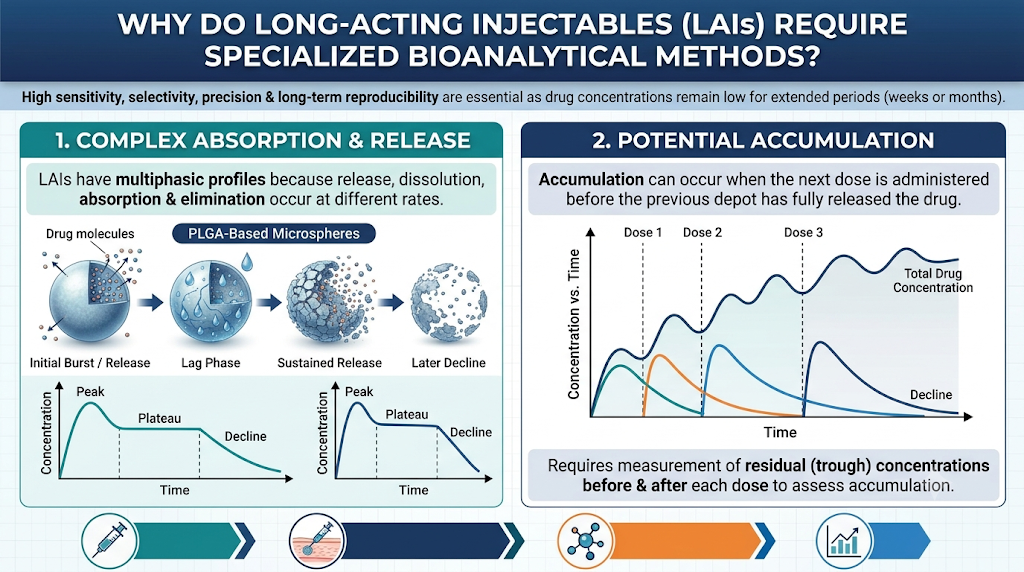
Long-acting injectables require specialized methods because drug concentrations may remain low for extended periods while sampling continues for weeks or months, so methods must combine high sensitivity, selectivity, precision and long-term reproducibility.
Complex absorption and release mechanisms
LAIs can show multiphasic profiles because release, dissolution, absorption and elimination occur at different rates. PLGA-based microspheres, for example, may show:
- An initial release of drug near the microsphere surface.
- A lag phase linked to water penetration and polymer degradation.
- Sustained release during polymer erosion.
- A later decline in circulating drug concentrations.
These phases complicate PK interpretation and call for a sampling strategy designed around them.
Potential accumulation during repeated administration
Repeated dosing can cause accumulation when the next dose is given before the previous depot has fully released its drug. Methods must therefore measure residual concentrations before and after each administration to support accumulation assessment and steady-state characterization.
3: Why Low Concentrations Make Long-Acting Injectable Bioanalysis Difficult
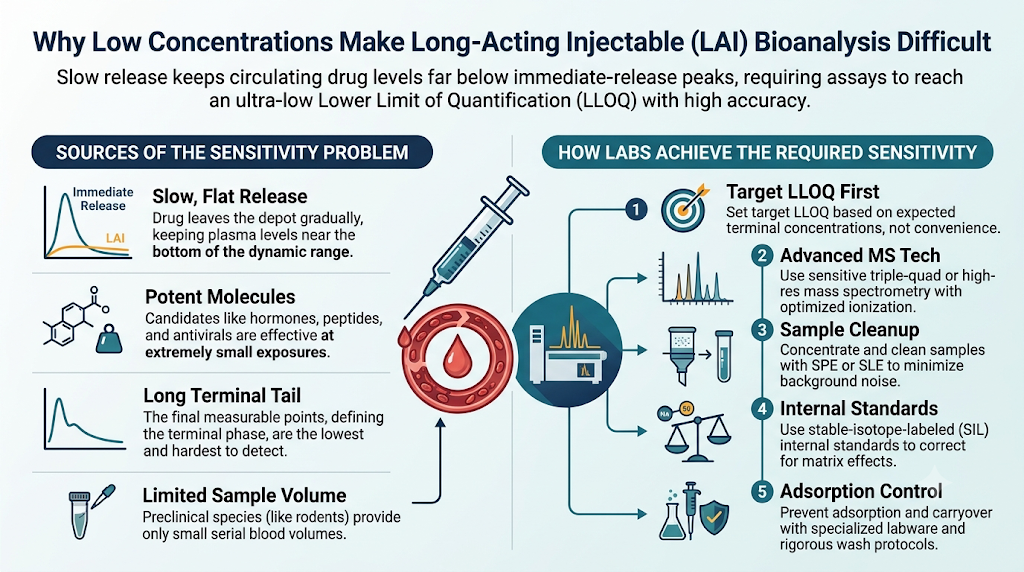
Low concentrations make Long-Acting Injectable Bioanalysis difficult because slow release keeps circulating drug far below the peaks seen with immediate-release products, so the assay must reach a low lower limit of quantification (LLOQ) while staying accurate and free of interference.
Sources of the sensitivity problem
- Slow, flat release: Drug leaves the depot gradually, so plasma levels sit near the bottom of the dynamic range for most of the study.
- Potent molecules: Many LAI candidates, including hormones, peptides and antivirals, are effective at very small exposures.
- Long terminal tail: The last measurable points, which define terminal phase and washout, are the lowest.
- Limited sample volume: Preclinical species, especially rodents, supply only small serial blood volumes.
How labs achieve the required sensitivity
- Set the target LLOQ from the expected terminal concentrations and the clinical or toxicological question, not from convenience.
- Use sensitive triple-quadrupole or high-resolution mass spectrometry with optimized ionization and fragmentation.
- Concentrate and clean the sample with solid-phase or supported liquid extraction to reduce background.
- Use a stable-isotope-labeled internal standard to correct for matrix effects and recovery variation.
- Control adsorption and carryover with suitable labware, wash solvents and injection sequences.
| Parameter | Why it matters for LAIs | Practical approach |
|---|---|---|
| LLOQ | Defines how much of the tail is measurable | Set before dosing; confirm signal-to-noise and precision at LLOQ |
| Selectivity | Low signals are easily masked | Test at least six individual matrix lots and lipemic or hemolyzed samples |
| Carryover | High early samples can contaminate low late samples | Order the run and test blanks after the highest standard |
| Dilution integrity | Burst-phase samples may exceed the range | Validate dilution so high samples need no repeat of the full run |
4: Extended Sampling Windows: Keeping Long-Acting Injectable Bioanalysis Reliable for Months
Extended sampling windows are managed by planning the sampling schedule around the release profile, proving that the analyte is stable for the entire storage period, and controlling run-to-run consistency so that results from month one and month six can be compared directly.
Designing the sampling schedule
- Early dense sampling to capture the initial burst, which often occurs within hours to days.
- Sparse mid-study sampling across the plateau, matched to the expected release duration.
- Dense terminal sampling to define the elimination tail and washout.
- Injection-site or tissue sampling where regulators or sponsors need depot residence data.
Protecting sample integrity over time
| Risk over a long study | Control |
|---|---|
| Analyte degradation in storage | Long-term stability covering the longest storage time at the actual storage temperature |
| Freeze-thaw damage | Freeze-thaw stability and single-use aliquots |
| Ester or prodrug conversion in matrix | Stabilizers, controlled temperature and esterase inhibition where needed |
| Reagent, column or reference lot changes | Bridging experiments, lot tracking and consistent QC acceptance |
| Chain-of-custody gaps | Barcoded tracking, temperature logs and documented transfers |
Because analysis often happens in batches over many months, quality control (QC) trends should be monitored across batches, not only within each run. Drift in QC accuracy is an early warning of reagent, instrument or stability problems.
5: Choosing the Right Platform for Long-Acting Injectable Bioanalysis
LC-MS/MS is usually the best platform for small-molecule and peptide LAIs because it offers high selectivity and sensitivity, while ligand-binding assays or hybrid LC-MS/MS workflows suit large molecules such as antibodies and protein therapeutics.
| Platform | Best suited for | Strengths | Limitations |
|---|---|---|---|
| LC-MS/MS | Small molecules, peptides, prodrugs, metabolites | High selectivity, wide dynamic range, multiplexing | Matrix effects, method development time |
| Ligand-binding assay (ELISA, MSD) | Antibodies, large proteins | Very high sensitivity, high throughput | Reagent dependence, cross-reactivity, lot variability |
| Hybrid (immunocapture + LC-MS/MS) | Biologics needing specificity plus sensitivity | Selective enrichment, specific detection | More complex workflow |
Questions that guide platform choice
- What is the expected terminal-phase concentration relative to the achievable LLOQ?
- Must the assay separate parent drug from metabolites, free from conjugated forms, or intact from degraded drug?
- Will reagents or reference lots stay consistent for the entire study duration?
- How many samples, and over how many months, will the method need to run?
For long studies, reagent supply is a frequent hidden risk. A platform that depends on a single antibody lot may require re-qualification mid-study, whereas a well-characterized LC-MS/MS method with a stable-isotope internal standard tends to travel more cleanly across months.
6: Sample Preparation and Matrix Challenges in Depot Formulation Bioanalysis
Depot formulations complicate sample preparation because polymers, lipids, surfactants and residual solvents can co-extract with the analyte, suppress ionization and contaminate the instrument, so extraction and chromatography must be designed around the formulation as well as the drug.
Typical matrix problems
- Polymer and oligomer interference: Degradation products of polymers such as PLGA can appear in plasma or tissue and affect detection.
- Phospholipid and lipid effects: Oil depots and lipid-rich samples change ionization efficiency.
- Non-specific binding: Hydrophobic or peptide analytes adsorb to plastics and glass at low concentrations.
- Tissue homogenization: Injection-site tissue needs reproducible homogenization and a validated recovery approach.
Mitigation strategies
- Compare protein precipitation, liquid-liquid extraction and solid-phase extraction on recovery and matrix factor.
- Use chromatographic separation that moves the analyte away from phospholipids and polymer-derived peaks.
- Add diverters, wash cycles and column care to protect the instrument across large sample batches.
- Confirm carryover with blanks after high-concentration samples, which matters because burst-phase samples can be very concentrated.
- Assess stability in whole blood and in processed samples to cover real handling delays.
7: Method Validation and Regulatory Expectations for Long-Acting Injectable Bioanalysis
Long-Acting Injectable Bioanalysis methods should be validated to the harmonized ICH M10 guideline on bioanalytical method validation and study sample analysis, which FDA and other major regulators follow, with extra attention to long-term stability and cross-batch consistency.
| Validation element | What to demonstrate | LAI-specific focus |
|---|---|---|
| Accuracy and precision | Within-run and between-run performance at LLOQ, low, mid and high QC | Tight control at LLOQ, where most late samples fall |
| Selectivity and specificity | No interference from matrix, formulation components or related compounds | Polymer and excipient degradants |
| Matrix effect and recovery | Consistent response across individual lots | Lipemic and hemolyzed samples |
| Carryover | Blank response within acceptance after the highest standard | Burst-phase samples |
| Dilution integrity | Accurate results for samples above the range | Early high-concentration samples |
| Stability | Bench-top, freeze-thaw, processed and long-term storage | Storage time must cover the full study length |
| Incurred sample reanalysis (ISR) | Reproducibility of real study samples | Include samples from the tail and from the plateau |
Documentation that supports trust
- A written method and validation report with raw data traceability.
- Pre-defined acceptance criteria and a documented handling process for deviations and repeats.
- Audit trails on instrument and data systems, plus controlled reference standards and certificates of analysis.
- Clear reporting of how out-of-range and below-LLOQ samples were treated.
Sponsors should confirm current expectations with the relevant regulatory agency early, since study design and the applicable guidance can differ by product type, region and phase of development.
8: Common Pitfalls in Long-Acting Injectable Bioanalysis and How to Avoid Them
The most common pitfalls are setting the LLOQ too high, under-testing long-term stability and ignoring formulation-derived interference, and each can be avoided by planning the bioanalytical strategy at the same time as the study design.
| Pitfall | Consequence | How to avoid it |
|---|---|---|
| LLOQ chosen after dosing | Terminal-phase samples fall below the limit and the tail is lost | Estimate terminal concentrations first and set the LLOQ to match |
| Stability data shorter than the study | Late samples cannot be defended | Run long-term stability beyond the final planned analysis date |
| Testing only blank plasma | Polymer or excipient interference is missed | Test with formulation components and incurred samples |
| One reagent or reference lot | Mid-study re-qualification | Secure sufficient lots or plan bridging |
| Ignoring carryover | False positives in late samples | Place blanks after high samples and verify in validation |
| Poor batch planning | Cross-batch drift goes unnoticed | Track QC trends and keep subjects’ samples in the same run where possible |
How ResolveMass Laboratories Approaches Long-Acting Injectable Bioanalysis
ResolveMass Laboratories Inc. approaches Long-Acting Injectable Bioanalysis as a science-led, documented process that starts with the formulation, defines the sensitivity target up front and keeps every result traceable from sample receipt to final report.
- Formulation-aware method design: Our work in PLGA-based drug delivery and complex analytical characterization informs how we anticipate polymer, lipid and excipient interference before it becomes a validation failure.
- Mass spectrometry depth: Our mass spectrometry experience, which also supports biosimilar characterization and trace-level nitrosamine testing, translates directly to low-concentration quantification.
- Early strategy alignment: We review dose, release duration and sampling plan with sponsors so the LLOQ, range and stability coverage match the real study.
- Transparent reporting: Clear methods, acceptance criteria, deviations and raw-data traceability so sponsors and reviewers can follow every decision.
- Canadian-based, collaborative service: Direct access to the scientists who develop and run the methods, with realistic timelines and open communication.
Every program is different, so we recommend a scoping conversation before method development begins. Talk to the ResolveMass team about your LAI program.
Conclusion:
Successful Long-Acting Injectable Bioanalysis comes down to three decisions made early: a sensitivity target (LLOQ) tied to the real terminal concentrations, a method that is selective against formulation components, and stability and quality controls that hold for the full length of the study. Teams that settle these before dosing avoid lost tail data, repeat runs and difficult regulatory questions.
Frequently Asked Questions:
LLOQ stands for Lower Limit of Quantification. It represents the lowest analyte concentration that can be quantified with acceptable accuracy and precision under the validated analytical conditions. Selecting an appropriate LLOQ is particularly important for measuring drug concentrations during the terminal phase of long-acting injectable studies.
Sampling duration depends on the drug’s release mechanism, formulation characteristics, elimination half-life, and expected pharmacokinetic profile. Some depot formulations require sampling over several weeks or months to adequately characterize prolonged drug exposure and the terminal phase.
Common sample preparation techniques include:
– Protein precipitation (PPT).
– Liquid-liquid extraction (LLE).
– Solid-phase extraction (SPE).
The selection depends on analyte properties, biological matrix, required sensitivity, and interference levels.
Repeated administration may lead to drug accumulation when the previous dose continues releasing drug before the next injection. Bioanalytical methods must measure residual concentrations and support evaluation of accumulation, steady-state exposure, and potential changes in pharmacokinetic behavior.
Terminal-phase sampling helps characterize declining drug concentrations and estimate relevant pharmacokinetic parameters. Inadequate sampling during this phase may lead to unreliable terminal-phase estimates and incomplete assessment of prolonged systemic exposure.
Sensitivity requirements depend on the drug’s expected plasma concentration, elimination characteristics, formulation release rate, sampling duration, and therapeutic exposure range. The analytical method should have an LLOQ low enough to quantify relevant concentrations throughout the intended pharmacokinetic study.
Polymer degradation can influence how quickly the encapsulated drug becomes available for absorption. In biodegradable PLGA systems, changes in polymer molecular weight, composition, and degradation behavior may affect drug release and systemic exposure.
Reference
- Noppari P. Formulation development of a biodegradable silica depot for long-acting injectable delivery of small molecules to biologics.https://aaltodoc.aalto.fi/items/5468756e-3038-47a8-a95d-9e2cfdedc703
- Jain KM, Ho T, Hoe S, Wan B, Muthal A, Subramanian R, Foti C. Accelerated and biopredictive in vitro release testing strategy for single agent and combination long-acting injectables. Journal of Pharmaceutical Sciences. 2024 Jul 1;113(7):1885-97.https://www.sciencedirect.com/science/article/pii/S0022354924000571
- Gautam N, McMillan JM, Kumar D, Bade AN, Pan Q, Kulkarni TA, Li W, Sillman B, Smith NA, Shetty BL, Szlachetka A. Lipophilic nanocrystal prodrug-release defines the extended pharmacokinetic profiles of a year-long cabotegravir. Nature Communications. 2021 Jun 8;12(1):3453.https://www.nature.com/articles/s41467-021-23668-x
- Ho DK, LeGuyader C, Srinivasan S, Roy D, Vlaskin V, Chavas TE, Lopez CL, Snyder JM, Postma A, Chiefari J, Stayton PS. Fully synthetic injectable depots with high drug content and tunable pharmacokinetics for long-acting drug delivery. Journal of Controlled Release. 2021 Jan 10;329:257-69.https://www.sciencedirect.com/science/article/pii/S0168365920306805
- Gupta AK, Eliasen AM, Andahazy W, Zhou F, Henson K, Chi V, Woods AK, Joseph SB, Kuhen KL, Wisler J, Ramachandruni H. A prodrug strategy to reposition atovaquone as a long-acting injectable for malaria chemoprotection. BioRxiv. 2024 Feb 12:2024-02.https://www.biorxiv.org/content/10.1101/2024.02.08.579395.abstract
- Bauer A, Berben P, Chakravarthi SS, Chattorraj S, Garg A, Gourdon B, Heimbach T, Huang Y, Morrison C, Mundhra D, Palaparthy R. Current State and Opportunities with Long-acting Injectables: Industry Perspectives from the Innovation and Quality Consortium “Long-Acting Injectables” Working Group: Andrea et al. Pharmaceutical research. 2023 Jul;40(7):1601-31.https://link.springer.com/article/10.1007/s11095-022-03391-y
- Shah JC, Hong J. Model for long acting injectables (depot formulation) based on pharmacokinetics and physical chemical properties. The AAPS Journal. 2022 Mar 16;24(3):44.https://link.springer.com/article/10.1208/s12248-022-00695-0
About the Author