

Introduction
Long-Acting Semaglutide Depot Development involves designing a sustained-release delivery system capable of providing subcutaneous drug release over approximately one month (28 days), while preserving the integrity of an acylated 31-amino acid peptide against chemical degradation, fibrillation, and covalent modification caused by polymer interactions. Unlike depot formulations containing small-molecule drugs, extending semaglutide’s approximately 170-hour elimination half-life to support once-monthly administration creates significant interfacial and microenvironmental challenges within polymeric or lipid-based matrices. Since modifications to the dosage form, release kinetics, and inactive excipient composition do not meet the requirements for an Abbreviated New Drug Application (ANDA) under Section 505(j), sponsors must pursue a hybrid Section 505(b)(2) New Drug Application (NDA). This pathway requires a scientific bridge demonstrating comparable systemic exposure to an approved Reference Listed Drug (RLD), alongside compliance with stringent Chemistry, Manufacturing, and Controls (CMC) requirements.
With major semaglutide patents expected to expire across markets such as Canada, India, China, Brazil, and Turkey beginning in 2026, the development of monthly formulations has gained considerable attention. Candidates such as Camurus’s CAM2056, which entered Phase 2b in November 2026, are progressing alongside G2GBio’s GB-7001, Inventage Lab’s IVL3021, and Peptron’s PT403. Achieving differentiation through monthly administration and consistent drug exposure has become an important objective for biopharmaceutical developers. However, regulatory and commercial success depends on coordinating depot architecture, five-tier stability-indicating analytical strategies, and early FDA Pre-IND discussions throughout the development process, from initial formulation feasibility to aseptic manufacturing scale-up.
Explore specialized semaglutide and peptide development capabilities for complex sustained-release formulation projects.
Share via:
Quick Summary:
- The goal and why it’s hard: Stretching semaglutide from weekly to once-monthly means holding an acylated 31-amino-acid peptide inside a hydrated, densely packed subcutaneous depot for 28 days — conditions far harsher than an aqueous pen, where the C18 diacid side chain drives self-association, surface adsorption and aggregation.
- Degradation inside the depot: PLGA matrices generate acidic oligomers that drop the internal microclimate pH, acylating the free N-terminal amine (leuprolide, which lacks a free primary amine, showed no acylation at 28 days). Low pH also pushes semaglutide into β-sheet fibrils, alongside hydrolytic clipping, Gln deamidation, Asp isomerisation, Trp25 oxidation and aldehyde adducts.
- Platform choice is a trade-off: PLGA microspheres bring an established LAI safety record but acidic microclimate pH and emulsion stress; lipid liquid crystals (CAM2056/FluidCrystal) avoid polyester hydrolysis entirely; ISFIs and thermogels are simpler but burst badly — over 25% of model protein released in 30 minutes, cut to ≤5% by pre-encapsulating in microparticles.
- Burst and scale-up control the clinic: The first 24 hours matter most for GLP-1 tolerability, and moving microsphere manufacture from pilot to commercial vessels changes solvent evaporation, porosity and release. Consistent power-to-volume ratios, CFD modelling, SEM porosity checks and validated aseptic processing (terminal sterilisation is off the table) are what keep batches alike.
- Cumulative release testing isn’t enough: A depot can show near-zero-order release while delivering degraded peptide, so IVRT must be paired with five-tier integrity testing — chemical, physical/colloidal, structural (CD, NMR), functional (receptor binding) and therapeutic (PK/PD) — plus PCS-C18 columns with Orbitrap/Q-TOF HRAM and multi-mode CID/HCD/ETD fragmentation to map the lipidated, Aib8-containing sequence.
- Regulatory route is 505(b)(2), not ANDA: Changed dosage form, release kinetics and non-Q1/Q2 excipients rule out 505(j), while a standalone 505(b)(1) needlessly duplicates GLP-1 safety data. The strategy is a literature gap analysis, an early Pre-IND meeting, and a PK bridge on AUC, trough and Cmax against the weekly RLD — potentially yielding 3-year exclusivity, and with patents and pediatric extension, roughly 8–12 years of protection.
- CMC is where files stall: Complete Response Letters on long-acting injectables come from qualification thresholds for peptide–polymer adducts, unvalidated stability-indicating methods, E&L, nitrosamine and residual solvent gaps — not from the peptide’s pharmacology. Meanwhile the competitive bar is set by CAM2056 (Phase 2b LUNAR-2 dosed its first patient on 3 November 2026, 10 mg and 20 mg vs placebo, results expected H1 2028), with GB-7001, IVL3021 and PT403 behind it.

Physicochemical Constraints in Long-Acting Semaglutide Depot Development
Developing semaglutide formulations capable of remaining in the subcutaneous environment for several weeks increases the importance of managing structural vulnerabilities associated with its amphiphilic backbone and C18 fatty diacid side chain. Regardless of the selected delivery platform, whether an eroding polyester microsphere, an in situ precipitating polymer, or a lipid liquid crystal, the depot environment exposes the peptide to extended hydration, concentrated molecular packing, and reactive degradation products generated by the carrier. These conditions differ substantially from those encountered in conventional aqueous pen formulations.
Sequence Architecture and Aggregation Propensity
Semaglutide ([Aib8, Arg34]GLP-1-(7-37); molecular formula C187H291N45O59; molecular weight 4113.58 g/mol) demonstrates pH-dependent self-association. At neutral-to-basic pH, it can form functional oligomers and micelles, whereas acidic conditions promote the formation of insoluble β-sheet fibrils. Its primary sequence contains α-aminoisobutyric acid (Aib) at position 8, which prevents dipeptidyl peptidase-4 (DPP-4) cleavage, arginine at position 34, and a C18 fatty diacid-γ-Glu-(AEEA)2 moiety linked to Lys26 (position 20 in 1–31 numbering). Although the hydrophobic diacid linker supports prolonged serum albumin binding in circulation, it also increases the likelihood of hydrophobic self-association, adsorption onto manufacturing surfaces, and non-covalent aggregation when the peptide is incorporated at high concentrations into depot formulations.
Physical instability becomes more pronounced when manufacturing involves mechanical shear, organic-aqueous emulsion interfaces, or acidic microenvironments. Cryo-based structural investigations have shown that semaglutide in solutions at pH 2.4 forms β-sheet fibrils rather than the oligomeric and micellar structures observed at higher pH. This behavior is consistent with established observations of glucagon-like peptide aggregation under acidic conditions. Within a sustained-release matrix, conformational unfolding and fibril nucleation can decrease the recovery of bioavailable monomeric peptide, modify pore diffusion characteristics, and increase potential immunogenicity concerns.
Advanced mass spectrometry-based characterization can help evaluate molecular integrity and identify structural changes in complex peptide formulations.
Microclimate pH and Polymer Acylation in Long-Acting Semaglutide Depot Development
When semaglutide is incorporated into biodegradable poly(lactic-co-glycolic acid) (PLGA) depots, water penetration into the polymer matrix promotes the accumulation of acidic oligomers and monomers. These degradation products reduce the internal microclimate pH (μpH) and can initiate covalent acylation of the peptide. A degrading polyester matrix does not behave like an inert spherical particle releasing drug into an unlimited physiological sink. Instead, it develops localized and spatially variable acidic μpH gradients within aqueous pores that have limited exchange with the surrounding environment. This phenomenon is particularly pronounced with lower-molecular-weight PLGA and polymers containing lower lactic-to-glycolic acid ratios.
Experimental investigations have established a direct relationship between changes in the depot microenvironment and covalent modification of peptide cargo. In rat subcutaneous implantation studies involving exenatide-loaded 50:50 PLGA microspheres monitored for up to 6 weeks, mass spectrometric analysis of the retained drug demonstrated progressive degradation, primarily through pH-dependent acylation. Changes in μpH under in vivo conditions also showed greater similarity to low-microsphere-concentration in vitro environments than to conventional concentrated sample-and-separate release experiments.
Additional comparative studies involving different peptides demonstrated that acylation susceptibility is associated with the availability of primary amino groups. Salmon calcitonin and human parathyroid hormone 1–34 produced covalent glycolic-acid adducts during PLGA degradation. In contrast, leuprolide, which does not contain a free primary amine, showed no evidence of acylation after 28 days. Semaglutide contains an unmodified N-terminal histidine primary amine, even though Lys26 is lipidated and Lys34 is substituted with arginine. Consequently, polyester-based approaches used in Long-Acting Semaglutide Depot Development must evaluate the formation of N-terminal glycolic and lactic acid adducts throughout the complete 28-day drug-release period.
Evaluate post-translational modifications and structural changes to better understand potential peptide alterations during extended depot exposure.
Chemical Degradation Pathways During Extended Residence
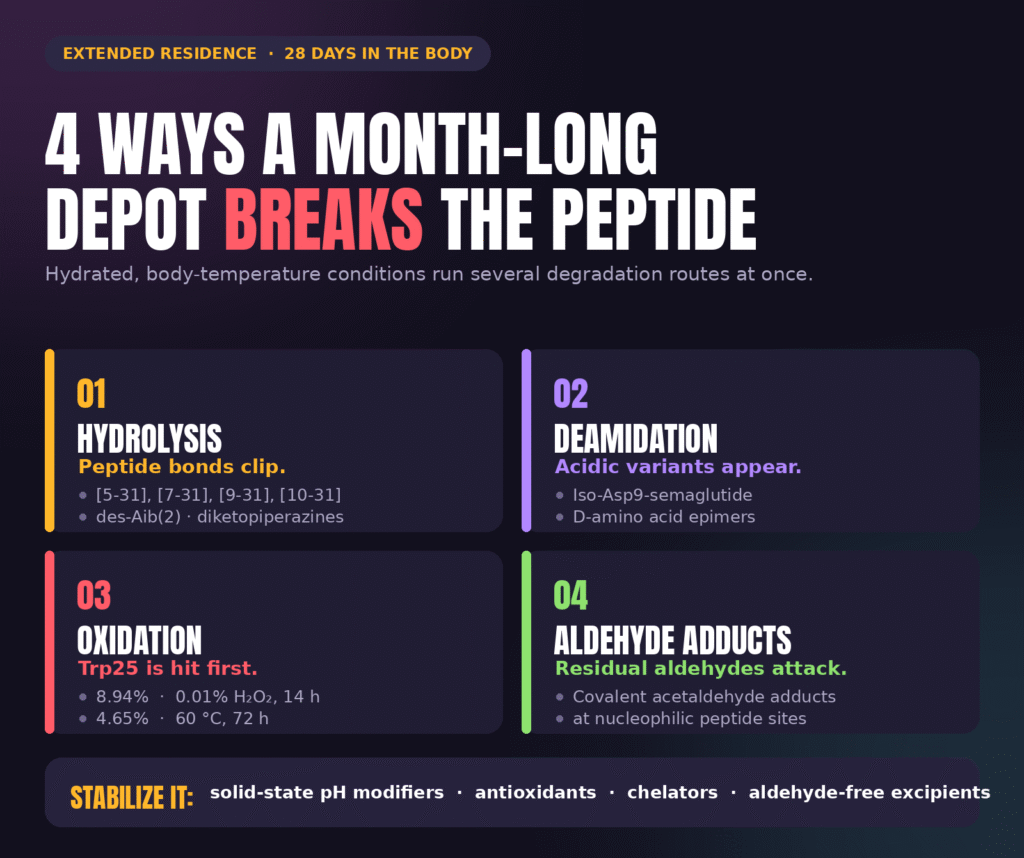
Extended exposure to physiological temperatures and hydrated conditions within a depot can accelerate several degradation reactions simultaneously, including hydrolysis, oxidation, deamidation, and epimerization. These reactions may generate closely related impurities, many of which can be isobaric and difficult to distinguish analytically. Addressing these degradation pathways requires targeted stabilization strategies involving solid-state pH modifiers, such as magnesium hydroxide or zinc carbonate in polymeric matrices, antioxidants, chelating agents, and aldehyde-free excipients.
The major degradation pathways include:
- Hydrolysis and Peptide Clipping: Acid- or base-catalyzed cleavage of peptide bonds can produce inactive truncated fragments, including [5-31]-, [7-31]-, [9-31]-, and [10-31]-semaglutide, des-Aib(2)-semaglutide, and thermal 2,5-diketopiperazines.
- Deamidation and Isomerization: Glutamine deamidation and aspartate isomerization can produce acidic variants, including Iso-Asp9-semaglutide, as well as D-amino acid epimers. These modifications may affect peptide stability and receptor pharmacokinetics.
- Oxidation: Tryptophan, tyrosine, and histidine residues are vulnerable to oxidative degradation caused by exposure to light, dissolved oxygen, or trace metals. A vendor UHPLC-HRAM-MS forced-degradation study reported 8.94% degradation following exposure to 0.01% H2O2 for 14 hours and 4.65% degradation under thermal stress at 60 °C for 72 hours. The findings highlighted single oxidation at Trp25.
- Aldehyde Adduct Formation: Residual aldehyde reagents or polymer-associated impurities can react with nucleophilic peptide sites, resulting in the formation of covalent acetaldehyde adducts.
Use forced-degradation testing approaches to investigate degradation pathways and develop appropriate stability-indicating analytical methods.
Depot Platform Selection and Burst Release Engineering
Selecting an appropriate delivery platform for monthly semaglutide administration requires careful consideration of drug-loading capacity, initial burst suppression, chemical stability, and injection feasibility. Established biodegradable microsphere technologies compete with alternative approaches, including non-aqueous lipid liquid crystals, in situ forming implants (ISFIs), and hierarchical composite hydrogels. These alternative systems are being investigated to minimize exposure to acidic polyester degradation products and reduce the challenges associated with organic emulsion interfaces.
| Depot Platform | Primary Release Mechanism | Representative Monthly Semaglutide Programs | Key Formulation Advantages | Critical Stability and Release Risks |
|---|---|---|---|---|
| PLGA Microspheres | Water penetration, pore diffusion, and bulk polyester erosion | GB-7001 (G2GBio), IVL3021 (Inventage Lab), PT403 (Peptron) | Established FDA safety history for approved LAIs; sponsor-reported sustained exposure over 28 days | Acidic μpH, peptide acylation adducts, multiphasic burst/lag, and emulsion solvent stress |
| Lipid Liquid Crystals | In situ phase transition into a structured liquid-crystalline matrix following contact with tissue fluids | CAM2056 (Camurus FluidCrystal®) | Clear liquid injection; avoids polyester hydrolysis and acidic μpH; commercial precedent in Buvidal® and Oczyesa® | Solvent diffusion dynamics during depot formation and mild-to-transient injection-site reactions |
| In Situ Forming Implants (ISFIs) | Solvent exchange causes polymer precipitation, producing a solid subcutaneous matrix | Preclinical / platform exploration | Simpler manufacturing than microspheres and adjustable phase-inversion kinetics | High initial burst before polymer solidification and potential solvent-peptide incompatibility |
| Thermoresponsive / Shear-Thinning Hydrogels | Mesh-restricted solute diffusion and reversible physical crosslinks | Preclinical / platform exploration | Aqueous processing avoids organic-solvent denaturation and supports soft tissue compatibility | Significant burst release (>25% within 30 minutes in directly loaded thermogels) for soluble biologics |
| Hierarchical / Composite Depots | Pre-encapsulation within inner microparticles dispersed throughout an outer hydrogel matrix | Preclinical / platform exploration | Separates peptide stabilization from external transport control; reduces burst to ≤5% while maintaining ≥90% bioactivity in model systems | Greater manufacturing complexity and potential incompatibility between individual components |
Mitigating Initial Burst and Manufacturing Scale-Up Variability
Managing the initial 24-hour burst release is particularly important for GLP-1 receptor agonists because rapid increases in systemic drug exposure can negatively affect tolerability and elevate the risk of adverse events. In ISFIs, an initial burst may occur when a water-miscible organic solvent moves into surrounding tissue more rapidly than the polymer can precipitate. This process allows unentrapped peptide to escape from the developing matrix and enter systemic circulation. Adjusting polymer concentration, molecular weight, and solvent affinity can promote faster phase inversion and reduce the amount of drug released prematurely.
Similar retention challenges occur in hydrated matrices such as PLGA–PEG–PLGA thermogels. Directly incorporating soluble biologics into these systems provides insufficient protection against early drug release. Studies involving model proteins such as G-CSF, GM-CSF, and BSA demonstrated that more than 25% of the loaded protein could be released within 30 minutes. Factor VIII also showed an initial release exceeding 20% on day one. However, pre-encapsulating these biologics in dextran microparticles before dispersing them throughout the hydrogel substantially improved retention. This approach reduced the 30-minute burst release to ≤5% and lowered day-one Factor VIII release to <1%, while preserving at least 90% biological activity.
In addition to controlling drug release during laboratory development, manufacturers must address the physical changes that occur when polymeric microsphere production moves from pilot-scale reactors to commercial manufacturing vessels. Larger equipment geometries can alter solvent evaporation rates, resulting in changes to internal particle porosity, surface morphology, and drug distribution. Microspheres with excessive porosity may absorb water rapidly and undergo accelerated acid-catalyzed erosion. Conversely, overly dense particles can produce extended release lag phases.
Maintaining consistent power-to-volume ratios and impeller tip speeds is therefore essential during scale-up. Computational fluid dynamics (CFD) modeling, combined with scanning electron microscopy (SEM) assessments of particle porosity, can help preserve particle size distribution and structural consistency between manufacturing batches. Since terminal sterilization may compromise peptide integrity or alter the thermal characteristics of the polymer, sponsors commonly depend on validated aseptic manufacturing processes to maintain product quality.
Improve process consistency through manufacturing scale-up support when transitioning complex injectable formulations from pilot to commercial production.
Stability-Indicating Analytics and IVRT/IVIVC for Long-Acting Semaglutide Depot Development
Conventional cumulative mass-recovery In Vitro Release Testing (IVRT) cannot independently establish the performance of Long-Acting Semaglutide Depot Development. A formulation may demonstrate nearly zero-order total drug release while simultaneously delivering semaglutide that has undergone acylation, deamidation, oxidation, or fibrillation. Therefore, evaluating actual release performance requires combining biorelevant dissolution methods, including flow-through cell configurations designed to reproduce in vivo μpH changes, with multiple orthogonal stability-indicating analytical techniques.
Five-Tier Integrity Testing and Trace Impurity Profiling
Developing a reliable In Vitro–In Vivo Correlation (IVIVC) requires demonstrating that semaglutide released from the depot retains its native structural and biological properties. This assessment should cover five sequential analytical tiers:
- Chemical Integrity: Measurement of covalent modifications, including PLGA-derived acylation adducts, Gln deamidation, Trp25 oxidation, Asp isomerization, and hydrolytic peptide clipping.
- Physical and Colloidal Integrity: Evaluation of soluble oligomers, insoluble β-sheet fibrils, and concentration-dependent self-association to identify changes in the physical state of the released peptide.
- Structural Integrity: Verification of higher-order secondary conformation using complementary biophysical methods, including circular dichroism (CD) spectroscopy and Nuclear Magnetic Resonance (NMR).
- Functional Integrity: Assessment of GLP-1 receptor binding affinity or cell-based bioactivity against an unmodified reference standard to establish whether the released peptide retains its biological function.
- Therapeutic Integrity: Establishment of a relationship between the release rate of intact active peptide and in vivo pharmacokinetic (PK) exposure, together with pharmacodynamic (PD) indicators such as HbA1c and body weight reduction.
Detecting trace-level impurities that co-elute or possess similar masses requires specialized reversed-phase chromatography combined with high-resolution accurate mass (HRAM) spectrometry. Conventional C18 columns using weak ion-pairing modifiers, such as formic acid, may produce substantial peak broadening and inadequate separation when analyzing highly lipophilic semaglutide.
Positively charged surface (PCS) C18 stationary phases and narrow-bore peptide columns with dimensions of 50–250 mm × 2.1 mm, pore sizes of 100–150 Å, and sub-2 μm particles can improve chromatographic peak sharpness while maintaining electrospray ionization sensitivity when used with formic acid mobile phases. When these separation methods are coupled with Orbitrap or Q-TOF HRAM systems operating in data-dependent MS/MS (ddMS2) mode, they support detailed characterization of degradation products. A vendor application note demonstrates confident identification and localization of semaglutide degradation products at relative abundances as low as 0.005%.
Specialized peptide CROs such as ResolveMass Laboratories Inc. combine LC-MS/MS and HRMS analytical workflows with polymer characterization techniques. These include gel permeation chromatography (GPC) for determining molecular weight distribution, differential scanning calorimetry (DSC) for measuring glass transition temperature (Tg), and thermogravimetric analysis (TGA) for evaluating residual moisture. Integrating these analytical approaches helps establish a direct relationship between polymer matrix degradation and the formation of peptide-related impurities.
Identify and characterize low-level peptide-related impurities through specialized impurity profiling services.
Overcoming Peptide Mapping Challenges for Acylated Analogs
Enzymatic peptide mapping of semaglutide recovered from depot formulations can present several analytical difficulties. These include incomplete tryptic digestion, steric interference near the C18 fatty diacid-γ-Glu-(AEEA)2 chain, and overlapping multi-charge MS/MS spectra. The presence of a bulky lipidated lysine residue and the non-natural Aib8 substitution can modify protease cleavage behavior. Consequently, missed-cleavage fragments may be generated, potentially concealing low-abundance post-translational modifications.
To obtain comprehensive sequence coverage and accurately identify modification sites in stressed depot samples, analytical laboratories should combine carefully controlled sample preparation with complementary gas-phase fragmentation techniques.
- Matrix Cleanup and Desalting: Removing formulation polymers, buffer salts, and surfactants before enzymatic digestion minimizes ion suppression and improves digestion efficiency.
- Controlled Digestion Protocols: Adjusting enzyme-to-substrate ratios and maintaining protection against light, heat, and oxygen help prevent artificial oxidation and deamidation during sample preparation.
- Multi-Mode Fragmentation: Combining Collision-Induced Dissociation (CID), Higher-energy Collisional Dissociation (HCD), and Electron Transfer Dissociation (ETD) helps identify labile covalent adducts and isobaric isomers while preserving accurate modification-site localization.
Explore peptide mapping techniques for assessing sequence coverage and identifying structural modifications in complex peptide samples.
505(b)(2) Regulatory Strategy for Monthly Semaglutide Injections
Transforming an approved weekly semaglutide product, such as Ozempic® or Wegovy®, into a once-monthly depot formulation places the development program within the FDA Section 505(b)(2) hybrid NDA pathway. A depot formulation changes several important product characteristics, including dosage form, administration frequency, release kinetics, and inactive excipient composition. As a result, it cannot meet the pharmaceutical equivalence and sameness requirements necessary for a 505(j) ANDA.
Alternatively, pursuing an independent 505(b)(1) NDA would require substantially duplicating established safety and pharmacology information for GLP-1 receptor agonists. This approach could increase development expenses and extend regulatory timelines without providing a corresponding scientific advantage when an appropriate approved RLD is available.
| Regulatory Attribute | 505(b)(1) Stand-Alone NDA | 505(b)(2) Hybrid NDA (Monthly Depot Strategy) | 505(j) Generic ANDA |
|---|---|---|---|
| Eligibility for Monthly Semaglutide Depot | Eligible, but commercially inefficient for an approved active moiety | Most appropriate pathway for a new dosage form, release mechanism, and dosing regimen | Ineligible because of modified release kinetics, dosage form, and non-Q1/Q2 polymer/lipid excipients |
| Reliance on Prior FDA Findings | None; the applicant owns or obtains the right of reference to all safety and efficacy data | Relies on FDA findings for an Orange Book RLD and relevant published scientific literature | Relies entirely on the RLD’s established safety and efficacy data |
| Required Clinical / Bridging Package | Complete nonclinical and Phase 1–3 clinical development programs | Scientific bridge involving comparative PK/BE studies, supplemented by targeted safety, tolerability, or efficacy investigations | Bioequivalence demonstration and sameness characterization |
| First-Cycle FDA Approval Benchmark | Approximately 50% (based on industry consultancy analysis) | Approximately 60% (based on industry consultancy analysis) | Not applicable (ANDA review pathway) |
| Potential Regulatory Exclusivity | 5-year NCE exclusivity plus patents | 3-year exclusivity for new clinical investigations essential to approval, alongside formulation patents and a 6-month pediatric extension | 180-day exclusivity for the first Paragraph IV filer only |
| Relative Cost and Development Timeline | Industry estimates place complete NDA development costs in the billions | Industry estimates place 505(b)(2) development programs in the tens of millions, with potential Phase 2 waivers and parallel bridging activities | Lowest development cost, primarily driven by CMC and bioequivalence requirements |
Get support with regulatory planning and submission requirements for complex generic and hybrid drug development programs.
Establishing the Scientific and Pharmacokinetic Bridge
Unlike 505(b)(1) development programs that typically begin with formulation screening and extensive independent investigations, an effective 505(b)(2) strategy starts with a structured literature gap analysis. This should be followed by an early FDA Pre-IND meeting to establish the scientific approach for bridging the proposed product to the RLD.
The primary purpose of this bridge is to demonstrate that systemic exposure following monthly depot administration remains within the established therapeutic window of weekly semaglutide. Particular attention must be given to total area under the curve (AUC), steady-state trough concentrations, and peak Cmax. These parameters must be evaluated to establish whether the extended-release formulation provides suitable exposure without introducing additional toxicity concerns.
For monthly GLP-1 depot products, demonstrating single-dose PK bioequivalence is rarely sufficient to address all clinical and commercial considerations. Regulatory and commercial teams should establish early agreement on multi-arm bridging studies that compare the proposed formulation with the RLD through PK and bioavailability assessments. Depending on the development strategy, these studies may also incorporate patient-oriented tolerability assessments, HbA1c measurements, weight-reduction endpoints, and monitoring of injection-site inflammation.
Conducting new clinical investigations that are essential to regulatory approval may qualify the product for 3-year market exclusivity. An intellectual property strategy analysis further indicates that combining regulatory exclusivity with patents covering the new depot formulation and a 6-month pediatric exclusivity extension may provide approximately 8 to 12 years of effective market protection.
CMC Execution and Complete Response Letter Prevention
For 505(b)(2) applications involving long-acting injectable formulations, Chemistry, Manufacturing, and Controls (CMC) deficiencies remain an important source of Complete Response Letters (CRLs) and regulatory review delays. Although the pharmacological characteristics of the active peptide may already be established, FDA reviewers must determine whether the newly introduced polymer or lipid delivery system creates previously uncharacterized impurities, compromises product stability, or causes inconsistent drug-release behavior between batches.
Preventing CMC-related CRLs requires a comprehensive regulatory dossier addressing multiple quality considerations. These include qualification thresholds for peptide-polymer adducts and degradation variants, validated stability-indicating analytical methods, and extractables and leachables (E&L) assessments across the proposed container-closure systems.
The submission should also contain appropriate nitrosamine evaluations and residual solvent testing that complies with USP / ICH Q3C requirements. Analytical techniques such as GC-FID or GC-MS can support the assessment of residual organic solvents and related process impurities. In addition, early collaboration with commercialization specialists regarding J-code strategy and payer differentiation can help ensure that regulatory approval is supported by a sustainable market-access plan.
Strengthen analytical characterization and comparative testing against reference products to support the quality evaluation of complex drug products.
Clinical Pipeline Benchmarks for Monthly Semaglutide Depots
As of November 2026, several biopharmaceutical companies are advancing monthly semaglutide depot candidates, creating important clinical and manufacturing benchmarks for both lipid liquid-crystal and PLGA microsphere delivery technologies.
| Candidate | Sponsor / Platform | Dosing Interval & Formulation Type | Latest Clinical / Development Milestone (as of Nov 2026) | Reported PK / PD and Safety Benchmarks |
|---|---|---|---|---|
| CAM2056 | Camurus AB (FluidCrystal® lipid liquid crystal) | Monthly subcutaneous clear solution (10 mg/mL and 20 mg/mL) | Phase 2b LUNAR-2 (EUCT 2026-526951-79-00) administered its first patient in November 2026. The 36-week study evaluates 5 mg and 20 mg doses against placebo. | Sponsor-reported Phase 1b results (n=80): monthly 10 mg administration achieved 9.3% weight loss compared with 5.2% for weekly semaglutide at Day 85. HbA1c reductions were 0.44% and 0.12%, respectively. Mild or transient injection-site reactions were reported. |
| GB-7001 | G2GBio (Biodegradable microspheres) | Once-monthly sustained-release microsphere injection | The sponsor reported a pilot manufacturing facility with a capacity of up to 20 kg per batch, equivalent to approximately 400,000 vials. | Sponsor-reported ADA 2023 findings indicated maintenance of active drug concentrations for 28 days and improved injection-site inflammation. |
| IVL3021 | Inventage Lab (Microsphere platform) | Once-monthly sustained-release peptide injectable | Preclinical / translational development for diabetes and obesity. | Designed to replace conventional once-weekly semaglutide treatment regimens. |
| PT403 | Peptron (SmartDepot™) | Once-monthly sustained-release semaglutide | Pipeline development alongside SR-tirzepatide (PT404). | Intended to provide stable monthly therapeutic efficacy and improve patient adherence. |
In Camurus’s Phase 1b trial, as described in a sponsor press release published in November 2025, the CAM2056 treatment regimen began with two biweekly doses of up to 5 mg, followed by two monthly doses of up to 15 mg. After three months, participants achieved weight reduction comparable to that observed after five months of standard weekly Wegovy® administration. The reported safety and tolerability profile was consistent with that of weekly semaglutide.
Although these Phase 1b findings require further validation through the ongoing 36-week Phase 2b LUNAR-2 study, they highlight an important consideration for monthly depot development. Competitive performance depends not simply on extending the duration of drug release but also on optimizing treatment initiation kinetics and maintaining consistent exposure during the steady-state phase.
Conclusion
Progressing Long-Acting Semaglutide Depot Development from initial laboratory feasibility to FDA approval requires the coordinated integration of polymer or lipid matrix engineering, five-tier stability-indicating analytical characterization, and a well-defined 505(b)(2) regulatory bridging strategy. Formulation scientists must address several critical challenges before finalizing the delivery system and manufacturing process. These include controlling acidic microclimate pH, preventing N-terminal polymer acylation, limiting β-sheet fibrillation, and minimizing trace oxidative and deamidative degradation products.
At the same time, establishing reproducible aseptic manufacturing and maintaining consistent release characteristics during scale-up are essential for product quality. Early FDA Pre-IND discussions should define the pharmacokinetic bridging strategy and clarify the clinical evidence required to support the proposed monthly dosing regimen. A comprehensive CMC package covering impurity characterization, stability-indicating methods, polymer degradation, and in vitro release performance is equally important for reducing the likelihood of costly Complete Response Letters.
Ultimately, successful development depends on demonstrating that the depot formulation provides reliable monthly drug delivery while preserving semaglutide’s chemical integrity, structural characteristics, and biological activity. Combining appropriate analytical controls, scientifically justified formulation decisions, and a clearly established regulatory strategy can also support meaningful regulatory exclusivity and patent protection.
For specialized peptide characterization, HRAM impurity profiling, polymer GPC/DSC/TGA testing, stability-indicating IVRT method development, or CMC support for complex 505(b)(2) injectable applications, contact the scientific team at ResolveMass Laboratories Inc. – Contact us.
Frequently Asked Questions
As PLGA degrades, it produces acidic oligomers and monomers that can accumulate within the matrix’s poorly exchanging aqueous pores. This decreases the internal microclimate pH and promotes semaglutide fibrillation, chemical degradation, and loss of structural integrity. Incorporating solid-state basic salts or considering alternative lipid-based delivery systems can help reduce these acid-associated stability challenges.
Yes, semaglutide may be susceptible to polymer-mediated acylation when incorporated into degrading PLGA matrices because its structure contains an accessible N-terminal histidine primary amine. Although Lys26 is lipidated and Lys34 is substituted with arginine, the unmodified N-terminal amino group can still react with polymer degradation products. Targeted LC-MS analysis is therefore important for identifying and monitoring potential glycolic-acid adducts throughout the drug-release period.
Conventional cumulative mass-recovery IVRT measures the overall quantity of drug released but does not establish whether the recovered semaglutide retains its original chemical structure and biological activity. The released material may contain acylated, oxidized, deamidated, or aggregated peptide species despite showing an acceptable release profile. Stability-indicating IVRT should therefore incorporate chemical, physical, structural, and functional assessments at different release intervals.
Camurus reported Phase 1b results in November 2025 showing that monthly CAM2056 at 10 mg achieved 9.3% weight loss and a 0.44% reduction in HbA1c at Day 85. The corresponding results for weekly semaglutide were 5.2% weight loss and a 0.12% HbA1c reduction. Further evaluation is underway through the 36-week Phase 2b LUNAR-2 study, which administered its first dose to a participant in November 2026.
Hierarchical composite delivery systems protect sensitive biologics by incorporating them into inner microparticles before dispersing those particles throughout an outer hydrogel matrix. This arrangement provides an additional diffusion barrier and separates peptide protection from the release-controlling function of the hydrogel. In PLGA–PEG–PLGA thermogel model studies, dextran-microparticle pre-encapsulation reduced the initial 30-minute burst release from above 25% to ≤5%, while retaining at least 90% biological activity.
Incomplete digestion can result from structural features that interfere with normal enzymatic cleavage, particularly the bulky C18 fatty diacid-γ-Glu-(AEEA)2 modification associated with Lys26 and the non-natural Aib8 substitution. These features can affect trypsin accessibility and produce missed-cleavage fragments, complicating sequence coverage and impurity identification. Optimized digestion conditions combined with CID, HCD, and ETD fragmentation help improve peptide mapping and locate modifications more accurately.
A 505(b)(2) development program generally requires comparative pharmacokinetic and bioavailability studies to demonstrate how the proposed depot performs against the approved Reference Listed Drug. Important parameters include total AUC, peak Cmax, and steady-state drug exposure. Depending on FDA feedback and the formulation’s characteristics, additional investigations may evaluate safety, injection-site tolerability, HbA1c, and weight reduction, with the overall study design discussed during the Pre-IND meeting.
CMC-related Complete Response Letters can arise when sponsors fail to adequately characterize degradation products, peptide-polymer adducts, or other formulation-associated impurities. Insufficient stability data, incomplete extractables and leachables assessments, and residual solvent levels outside acceptable limits can also create regulatory concerns. Inconsistent particle morphology, inadequate process validation, and uncontrolled batch-to-batch release characteristics further increase the risk of FDA deficiencies.
The anticipated expiration of important semaglutide patents in markets such as Canada, India, China, Brazil, and Turkey beginning in 2026 creates additional opportunities for generic and differentiated formulation development. As competition increases for conventional weekly products, monthly depot technologies may offer an alternative through less frequent administration and potentially improved treatment adherence. A 505(b)(2) development strategy can also provide opportunities for 3-year regulatory exclusivity, where applicable, alongside new formulation patents.
Reference:
- CHOE, H., Kim, Y., Lee, H., Lee, J., Na, Y., Seol, E., & Won, D. (2022). Pharmaceutical composition comprising sustained-release microspheres including GLP-1 analogue or pharmaceutically acceptable salt thereof (Australian Patent No. AU2021219556A1). Google Patents. https://patents.google.com/patent/AU2021219556A1/en
- DewAR, C. T., McCormack, P., Gaffney, P., Ramaswamy, K., Elati, R. R. C., Komaravolu, Y. K. K., & Bhupathiraju, R. (2023). Improved purification process of semaglutide (European Patent No. EP4181946A1). European Patent Office. https://patents.google.com/patent/EP4181946A1/en
- Ding, A. G., & Schwendeman, S. P. (2008). Acidic microclimate pH distribution in PLGA microspheres monitored by confocal laser scanning microscopy. Pharmaceutical Research, 25(9), 2041–2052. https://doi.org/10.1007/s11095-008-9594-3
- Butreddy, A., Gaddam, R. P., Kommineni, N., Dudhipala, N., & Voshavar, C. (2021). PLGA/PLA-based long-acting injectable depot microspheres in clinical use: Production and characterization overview for protein/peptide delivery. International Journal of Molecular Sciences, 22(16), 8884. https://doi.org/10.3390/ijms22168884
- Goldstein, B. (n.d.). Overview of the 505(b)(2) regulatory pathway for new drug applications [PowerPoint presentation]. U.S. Food and Drug Administration (FDA). https://www.fda.gov/media/156350/download
- European Medicines Agency. (n.d.). Clinical trial 2026-526951-79-00. Clinical Trials Information System (CTIS). https://euclinicaltrials.eu/ctis-public/view/2026-526951-79-00
Get In Touch With Us
About The Author