


Introduction
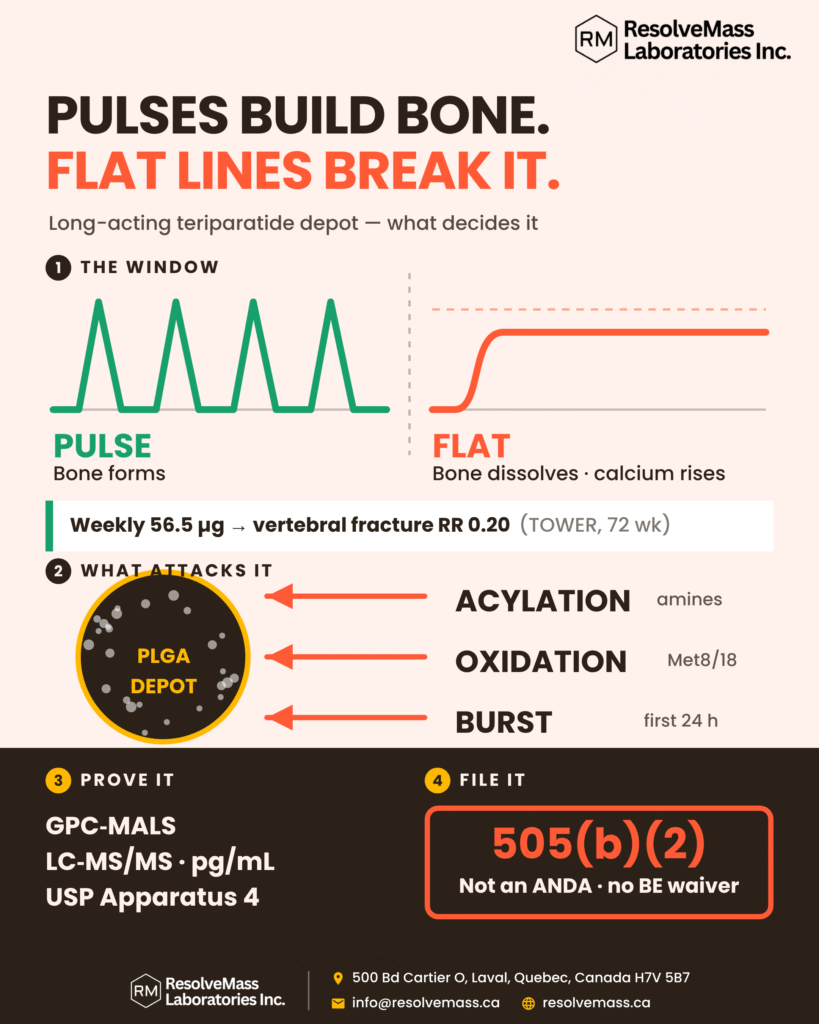
Long-Acting Teriparatide Depot Development requires balancing a narrow osteoanabolic pharmacokinetic window with the chemical instability of recombinant human parathyroid hormone (1–34), rhPTH(1–34), within biodegradable polymer matrices, while also navigating the FDA’s 505(b)(2) New Drug Application (NDA) pathway. Unlike small-molecule parenteral depots, in which monotonic zero-order release is generally preferred, extended-release teriparatide formulations must prevent continuous receptor overstimulation. Such overstimulation can shift skeletal remodeling away from bone formation toward catabolic bone resorption, potentially resulting in hypercalcemia.
For formulation and Chemistry, Manufacturing, and Controls (CMC) teams, encapsulating a basic 34-amino-acid peptide (molecular weight 4,117.7 Da; isoelectric point approximately 8.0) within poly(lactic-co-glycolic acid) (PLGA) microspheres or hydrogel composites introduces several critical challenges, including peptide acylation, methionine oxidation, and uncontrolled initial burst release. At the same time, the FDA’s July 28, 2026 withdrawal of its 2021 synthetic peptide Abbreviated New Drug Application (ANDA) guidance, accompanied by the publication of 17 revised draft Product-Specific Guidances (PSGs), has reinforced expectations concerning impurity identification, higher-order structure (HOS), and immunogenicity risk assessment. Although these guidances primarily address generic peptide programs, their scientific principles also inform CMC expectations for 505(b)(2) candidates referencing recombinant Forteo.
A well-defined regulatory strategy is essential when developing complex peptide formulations and modified-release products.
Explore regulatory support for generic drug development
Share via:
Quick Summary:
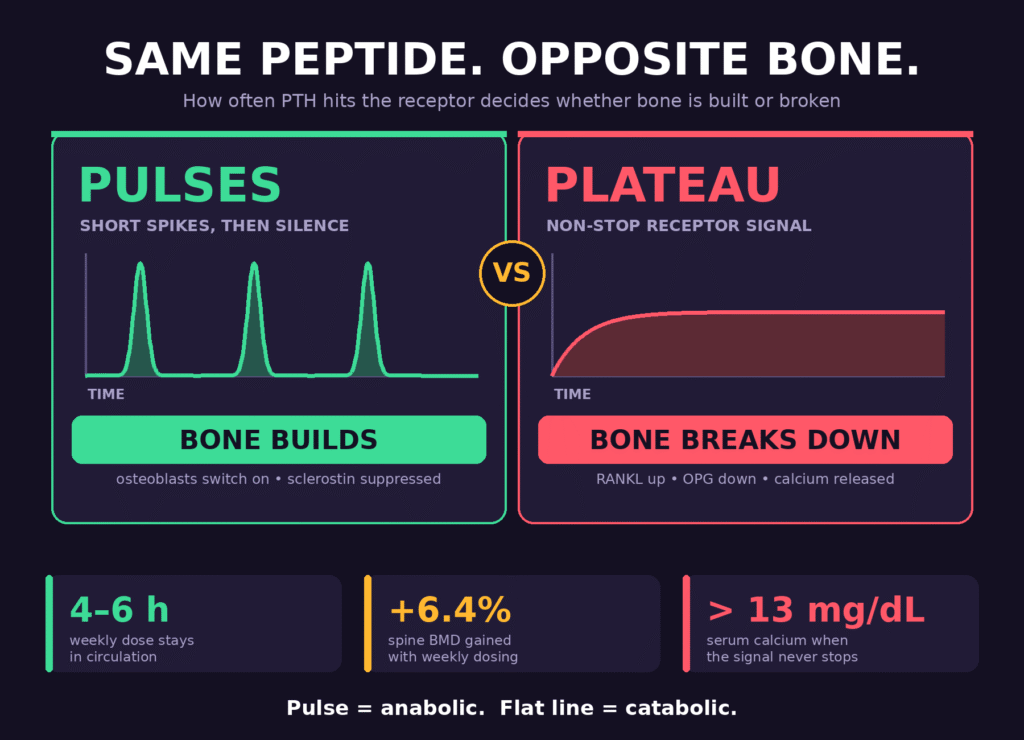
- The core design constraint is pulsatile exposure. Short, transient PTH(1–34) peaks drive osteoblast activity and suppress sclerostin; continuous elevation raises RANKL, suppresses OPG, and tips the balance toward resorption and hypercalcemia. A depot for osteoporosis must therefore reduce injection frequency without flattening the curve — unlike palopegteriparatide, where 24-hour continuous release is the goal for chronic hypoparathyroidism.
- Less frequent dosing preserves the anabolic effect. In TOWER, once-weekly 56.5 µg stayed in circulation only 4–6 hours per injection yet raised lumbar spine BMD 6.4%, total hip 3.0%, and femoral neck 2.3%, with a relative risk of 0.20 (95% CI 0.09–0.45) for new vertebral fractures over 72 weeks, and without a sustained rise in resorption markers.
- PLGA chemistry attacks the peptide. Teriparatide’s four primary amines and basic pI (~8.0) make it prone to acylation by hydrolyzing lactic/glycolic oligomers, preceded by electrostatic adsorption onto acid-terminated PLGA. Controlling internal microclimate pH is a trade-off: acylation is suppressed below pH 5 but excessive acidity accelerates autocatalysis, chain cleavage, and deamidation.
- Oxidation and burst release are the other two failure modes. Met8 and Met18 convert to sulfoxide (+16 Da) and sulfone (+32 Da), with Met8 oxidation disrupting folding and PTH1R binding. High drug loading (>20–30% w/w), porous surfaces, and low-MW PLGA drive a first-24-hour burst that can cause acute hypercalcemia. Countermeasures include ester-capped and higher-MW PLGA, divalent cation buffering, hydrophobic ion pairing, and microsphere-in-hydrogel designs.
- Control requires orthogonal analytics, not one compendial method. Multi-detector GPC-MALS for polymer CQAs; RP-HPLC, IEX, SE-HPLC, LC/ESI-HRMS, Glu-C peptide mapping, CD and NMR for peptide impurities and higher-order structure; USP Apparatus 4 in open-loop mode for burst fraction and IVIVC; and pg/mL LC-MS/MS for PK, since sandwich immunoassays cannot separate active hormone from oxidized species.
- The regulatory route is 505(b)(2), not an ANDA. A modified-release depot is intentionally not Q1/Q2 same as Forteo, so the 21 CFR 320.22(b)(1) bioequivalence waiver is unavailable. Bonsity’s PK-only bridge to Forteo shows the baseline; a depot additionally needs PK/PD bridging on P1NP, CTX/NTX, serum calcium and BMD, plus polymer-specific nonclinical tolerability and E&L work.
- The 2026 FDA peptide reset raises the CMC bar. On July 28, 2026 the agency withdrew the 2021 synthetic-peptide ANDA guidance and issued 17 revised draft PSGs, including teriparatide. Expect tighter impurity reporting and identification thresholds, ≤0.5% total Met oxidation per USP, and immunogenicity assessment (IVISIA, ADA assays) specifically covering PLGA-derived acylated adducts that have no counterpart in the RLD.
The Pharmacokinetic Paradox: Intermittent Anabolism vs. Continuous Catabolism
A clinically effective teriparatide depot must be designed around the pharmacokinetic requirements of its intended indication. Pulsatile or transient systemic exposure is essential for osteoporosis treatment, whereas continuous 24-hour physiological hormone exposure is appropriate for replacement therapy in chronic hypoparathyroidism. If systemic exposure is not aligned with PTH1R receptor biology, the formulation may either fail to produce a net increase in bone mass or cause disturbances in mineral homeostasis.
Daily subcutaneous teriparatide administration (20 µg/day; 140 µg/week) has an approximately 1-hour half-life and produces rapid, short-lived systemic concentration peaks. These transient exposures promote osteoblast differentiation, stimulate immediate-early gene expression, and suppress sclerostin. Conversely, sustained systemic PTH elevation increases RANKL expression and suppresses osteoprotegerin (OPG), thereby stimulating bone resorption to a greater extent than bone formation and increasing calcium mobilization into the bloodstream. Clinically, prolonged PTH1R stimulation may result in severe hypercalcemia, with serum calcium levels exceeding 13 mg/dL. Case reports have also described delayed and persistent hypercalcemia associated with a self-perpetuating cycle of acute kidney injury (AKI), which may continue for several weeks even after treatment discontinuation.
Clinical evidence suggests that reducing administration frequency, rather than maintaining a flattened systemic drug concentration, can preserve osteoanabolic activity in osteoporosis treatment. In the Phase 3 TOWER trial, once-weekly subcutaneous teriparatide (56.5 µg/week) remained detectable in circulating blood for only 4–6 hours following each injection. Despite this limited exposure period, treatment increased lumbar spine bone mineral density (BMD) by 6.4%, total hip BMD by 3.0%, and femoral neck BMD by 2.3%. It also demonstrated a relative risk of 0.20 (95% CI: 0.09–0.45) for new vertebral fractures over 72 weeks. Unlike daily administration, which increases both bone formation (P1NP) and bone resorption (CTX) markers for at least one year and has been associated with increased cortical porosity in preclinical and clinical studies, once-weekly administration produced a transient elevation in P1NP without a sustained increase in NTX resorption markers. Preclinical findings also suggest that less frequent administration may reduce cortical porosity, although corresponding human cortical porosity data for once-weekly teriparatide are not yet available.
In contrast, chronic hypoparathyroidism requires continuous physiological hormone replacement. Palopegteriparatide (Yorvipath) addresses this requirement through a transiently conjugated inactive prodrug that undergoes cleavage under physiological conditions, releasing active PTH(1–34) over 24 hours. According to sponsor-reported two-year Phase 3 PaTHway trial results, 97% of treated participants achieved independence from conventional active vitamin D and calcium supplementation by Week 104.
| Modality / Delivery Architecture | Dosing Regimen and Exposure Profile | Primary Indication | Key Clinical PD and Safety Trade-Offs |
|---|---|---|---|
| Immediate-Release Daily SC (Forteo / Bonsity) | 20 µg/day (140 µg/week); median Tmax 0.167 h; t1/2 approximately 1 h | Osteoporosis at high fracture risk | Sustained P1NP and CTX elevation within the anabolic window; transient hypercalcemia 4–6 hours after dosing; increased cortical porosity reported in preclinical and clinical studies. |
| Once-Weekly Bolus SC (TOWER Regimen) | 56.5 µg/week; circulating exposure for 4–6 hours after administration | Primary osteoporosis | Transient P1NP elevation without a sustained NTX/CTX resorption increase; 3.1% versus 14.5% cumulative vertebral fracture incidence at 72 weeks. |
| Pulsatile / Multi-Pulse Biodegradable Depot | Discrete intermittent release bursts separated by drug-free intervals | Investigational osteoporosis | Maintains intermittent osteoblast signaling while reducing injection frequency; highly sensitive to peptide degradation during the lag phase and overlapping release bursts. |
| Transiently Conjugated Prodrug (Palopegteriparatide) | 6–30 µg/day SC (18 µg/day starting dose); continuous 24-hour release of active PTH(1–34) | Adult chronic hypoparathyroidism | Maintains serum calcium and phosphate levels and demonstrated a mean eGFR change of +9.0 mL/min/1.73 m² at Week 104 in sponsor-reported PaTHway data; unsuitable for intermittent osteoporosis treatment. |
Formulation Challenges in Long-Acting Teriparatide Depot Development
Developing Long-Acting Teriparatide Depot formulations using biodegradable polymers exposes rhPTH(1–34) to four interconnected degradation and delivery challenges: covalent peptide acylation, methionine oxidation, inadequate encapsulation efficiency during double-emulsion processing, and excessive initial burst release that may cause hypercalcemia. Successful depot stabilization requires simultaneous optimization of polymer hydrophilicity, internal microclimate pH (µpH), and particle morphology.
Effective scale-up strategies must account for polymer selection, formulation reproducibility, and the control of critical manufacturing parameters.
Explore manufacturing scale-up for generic drugs
Microclimate Acylation and Methionine Oxidation in Biodegradable Matrices
Peptide acylation within degrading PLGA depots occurs when primary amine groups on teriparatide undergo nucleophilic attacks on the electrophilic ester carbonyl groups of hydrolyzing lactic and glycolic acid oligomers. Human PTH(1–34) contains four primary amines, comprising N-terminal and lysine amino groups, and has a basic isoelectric point of approximately 8.0. As water penetrates the polymer matrix, ester hydrolysis produces soluble oligomers that become increasingly accessible for chemical interactions and lowers the internal µpH. At the same time, electrostatic adsorption of positively charged peptide molecules onto carboxylic acid-terminated PLGA (PLGA-COOH) can serve as a direct kinetic precursor to covalent adduct formation.
Controlling the internal µpH involves a complex mechanistic trade-off. Static-pH model experiments involving octreotide acetate and PLGA demonstrated that the nucleophilic acylation reaction was negligible at pH 2.0 and substantially inhibited below pH 5.0, where amine groups remain protonated. However, the reaction increased considerably as the pH approached neutral conditions, with 73.83% peptide acylation observed after 48 days at pH 7.4 in the presence of reactive oligomers.
Within dynamic PLGA microspheres, however, uncontrolled acidification creates additional degradation concerns. It accelerates polymer autocatalysis and oligomer release while promoting acid-catalyzed peptide bond cleavage and deamidation. These degradation pathways have been specifically observed for rhPTH(1–34) during storage, including under pH 4.0 acetate buffer conditions.
Simultaneously, oxidative stress and metal-catalyzed reactions can convert Met8 and Met18 into methionine sulfoxide (+16 Da, reversible) and methionine sulfone (+32 Da, irreversible). Secondary oxidation may also occur at Trp23, producing a total mass shift of +80 Da, while site-specific metal-catalyzed oxidation has been reported at Met8 and His9. Since Met8 plays an important role in hormone folding, its oxidation can disrupt the peptide’s three-dimensional conformation and reduce PTH1R receptor-binding activity. The resulting variants may exhibit substantially different biological activity, with residual bioactivity following the reported order: Met18(ox) > Met8(ox) > Met8,18(di-ox).
Characterizing peptide modifications and post-translational changes is important for understanding their effects on structural integrity and biological activity.
Learn more about post-translational modifications in biosimilars
Encapsulation Efficiency and Burst Release in Long-Acting Teriparatide Depot Development
Water-in-oil-in-water (W/O/W) double-emulsion encapsulation of hPTH(1–34) frequently results in inadequate encapsulation efficiency and excessive Phase 1 burst release because of the peptide’s high aqueous solubility and its influence on formulation rheology. Unlike smaller cyclic peptides such as octreotide, hPTH(1–34) substantially increases organic-phase viscosity during emulsification. Consequently, higher stabilizer concentrations, such as 3% polyvinyl alcohol (PVA) instead of 1%, may be necessary to produce microspheres within the injectable 10–100 µm particle-size range.
Furthermore, development benchmarks compiled by ResolveMass Laboratories Inc. indicate that drug loadings exceeding 20–30% w/w, open surface pores, and low-molecular-weight (<20 kDa) or hydrophilic acid-terminated PLGA can accelerate the dissolution of surface-associated drug during the first 1–24 hours. In teriparatide formulations, an uncontrolled initial burst can produce acute systemic concentration spikes associated with nausea, orthostatic hypotension, and prolonged hypercalcemia.
Addressing peptide acylation, inadequate loading, and excessive burst release requires carefully selected polymer grades and excipient engineering strategies.
Polymer Grade and End-Group Tuning: Vendor and literature evaluations indicate that ester-capped PLGA, including 50:50 compositions for 1–2-month release profiles and 75:25 compositions for 3–6-month profiles, can reduce water penetration and initial burst release compared with uncapped acid-terminated polymers. Higher-molecular-weight grades (>75 kDa) may provide additional control over degradation and release kinetics. However, controlled-release literature also identifies a competing mechanism for basic peptides: carboxylate end-groups may retard peptide release through electrostatic retention, whereas ester end-groups have a weaker affinity for positively charged peptides. Therefore, empirical polymer screening is necessary to establish an appropriate balance between release kinetics and sorption-associated acylation.
Divalent Cations and Microclimate Buffering: Incorporating water-soluble divalent salts, such as CaCl2 and MnCl2, or poorly soluble basic calcium compounds, including Ca3(PO4)2 and Ca(OH)2, can competitively inhibit peptide adsorption onto PLGA and neutralize acidic µpH conditions. However, excipient interactions are highly dependent on the peptide being formulated. For example, combining divalent cations with carboxymethyl chitosan (CMCS) increased salmon calcitonin encapsulation efficiency from approximately 30% to 75%. The same CMCS-salt combination, however, did not improve hPTH encapsulation efficiency.
Reversible Hydrophobic Ion Pairing (HIP): Hydrophobic ion pairing involves complexing amine-containing peptides with anionic counter-ions, including dextran sulfate and sodium dodecyl sulfate. Studies involving octreotide-PLGA formulations have demonstrated that this approach can temporarily mask nucleophilic amine groups within acidic microsphere cores. Following drug release, the complexes can dissociate under physiological counter-ion concentrations, allowing the peptide to become available.
Microsphere-in-Hydrogel and Layered Pulsatile Designs: Incorporating PLGA microspheres into thermosensitive poloxamer or PEG hydrogels introduces an additional diffusion barrier that can limit initial burst release. Similarly, physically combining polymeric and hydrogel compacts provides a structural approach for developing biphasic or pulsatile teriparatide delivery systems.
| Formulation Challenge | Root Mechanism in Teriparatide Depots | Primary Analytical Indicator | Engineering Countermeasure |
|---|---|---|---|
| Peptide Acylation | Nucleophilic attack by N-terminal and lysine amines on degrading PLGA oligomers following electrostatic adsorption | Mass-shifted adducts detected using LC-MS, CE, and MALDI-TOF MS | Ester-capped PLGA; divalent cations (Ca2+, Mn2+); Ca3(PO4)2 or Ca(OH)2 buffering; HIP complexation, demonstrated in model basic peptides |
| Methionine Oxidation | Oxidative stress or metal catalysis converting Met8 and Met18 into sulfoxides (+16 Da) and sulfones (+32 Da) | RP-HPLC hydrophobicity variants; LC/ESI-HRMS; Glu-C peptide mapping | Antioxidant and buffer optimization; minimizing metal catalysts; appropriate solvent selection, such as ethyl acetate for lower toxicity |
| Low W/O/W Encapsulation Efficiency | Aqueous partitioning and hPTH-induced increases in organic-phase viscosity | Total peptide assay using RP-HPLC following extraction | Increased emulsifier concentration (3% PVA); phase-volume optimization; spray drying or coacervation |
| Hypercalcemic Burst Release | Surface-localized drug, porous particle morphology, >20–30% w/w drug loading, and low-MW (<20 kDa) PLGA | USP Apparatus 4 burst fraction measurements at t = 1, 4, and 24 hours | High-MW (>75 kDa) PLGA; post-formation surface coating using PLGA/PEG; microsphere-in-hydrogel composites |
Analytical and Bioanalytical Controls for Long-Acting Teriparatide Depot Development
A scientifically defensible Long-Acting Teriparatide Depot Development program requires an orthogonal analytical framework that connects polymer critical quality attributes (CQAs), intact peptide stability, flow-through release kinetics, and oxidation-selective bioanalysis. Depending on a single compendial analytical method may conceal changes in low-molecular-weight oligomers, trace oxidation products, and conformational properties that influence in vivo drug release and immunogenicity.
For biodegradable polymer characterization, the FDA expects GMP-grade PLGA supported by a Type IV Drug Master File (DMF) or comprehensive CMC documentation consistent with ICH Q1A and Q3C requirements. Multi-lot numerical specifications, rather than nominal polymer grade descriptions, should establish control over absolute molecular weight (Mn, Mw, Mz) and polydispersity index (PDI) using multi-detector GPC-MALS-Viscometry. The lactide:glycolide ratio should be characterized using 1H- and 13C-NMR, while end-group composition must also be established. Additional characterization parameters include glass transition temperature (Tg) using DSC, residual monomers and solvents using GC-MS in accordance with the applicable USP requirements, and moisture content through Karl Fischer titration. Parenteral depot manufacturing also requires ISO Class 7 or better cleanroom conditions, supported by validated aseptic filtration or gamma irradiation procedures. Polymer molecular weight must be monitored throughout stability testing to identify degradation-related changes.
Peptide characterization during formulation development and stability assessment requires stability-indicating analytical methods capable of distinguishing closely related peptide variants. Published teriparatide characterization studies support the use of a multi-tiered analytical approach.
Impurity and Hydrophobicity Profiling: Gradient RP-HPLC using sub-2 µm C18 columns at 60–75 °C with UV detection at 215 nm can separate oxidized, cleaved, and hydrophobic degradation products.
Detailed impurity assessment helps identify peptide-related degradation products and evaluate their impact on product quality.
Explore impurity profiling of biosimilars
Charge Heterogeneity: Strong cation-exchange IEX-HPLC with fluorescence detection, using 280 nm excitation and 360 nm emission, enables the quantification of deamidation products and age-dependent charge variants.
Aggregation Assessment: Isocratic SE-HPLC, combined with non-reducing Tris-tricine SDS-PAGE, provides an orthogonal approach for identifying high-molecular-weight aggregates, with detection sensitivity reaching 0.05%.
Primary and Higher-Order Structure (HOS): LC/ESI-HRMS confirms intact monoisotopic mass within approximately 20 ppm. Glu-C enzymatic peptide mapping combined with LC-MS/MS identifies specific modification sites. Far-UV Circular Dichroism (195–260 nm) and two-dimensional SoFAST 1H-15N-HMQC NMR provide additional information about secondary helix propensity and tertiary folding.
Combining intact-mass measurements with orthogonal structural characterization supports a more comprehensive assessment of peptide integrity.
Explore intact mass analysis for biosimilars
Specialized peptide CDMOs and analytical laboratories, including ResolveMass Laboratories Inc., combine GPC-MALS polymer characterization, high-resolution mass spectrometry, NMR, and GLP/ISO-aligned bioanalytical workflows. These integrated capabilities help establish direct relationships between excipient CQAs and regulatory-ready peptide characterization dossiers.
For in vitro release testing (IVRT) and clinical pharmacokinetic assessments, specialized analytical methodologies are necessary to prevent assay-related artifacts. Conventional agitated dissolution vessels can cause microsphere aggregation and sink-condition limitations. Therefore, USP Apparatus 4 (flow-through dissolution) operated in open-loop mode is recommended for maintaining sink conditions without requiring excessive surfactant concentrations. This approach supports accurate quantification of early burst fractions and the development of in vitro–in vivo correlations (IVIVC).
For in vivo pharmacokinetic assessments, teriparatide quantification requires GLP-validated LC-MS/MS or hybrid immunoaffinity–LC-MS/MS assays. These methods can achieve an LLoQ of 10 pg/mL and an LLoD of 2.1 pg/mL, with an inter-assay coefficient of variation (CV) below 9.8%. Their performance also depends on using non-stick, low-adsorption surfaces and validated sample collection and stabilization procedures.
An important analytical limitation is that conventional two-site sandwich immunoassays may not distinguish intact, biologically active hormone from inactive Met8/Met18-oxidized PTH species. Consequently, combining affinity-based depletion of oxidized PTH variants with mass-selective MS/MS detection can improve analytical specificity and ensure that pharmacokinetic profiles accurately represent active, unoxidized PTH(1–34).
Peptide mapping provides additional site-specific information about structural modifications and degradation pathways.
Learn more about peptide mapping in biosimilars
505(b)(2) Regulatory Strategy and FDA’s 2026 Peptide Guidance Landscape
A long-acting teriparatide depot is not eligible for a 505(j) ANDA bioequivalence waiver and must instead follow the 505(b)(2) NDA pathway. This regulatory route allows the applicant to rely on the FDA’s previous safety and efficacy findings for Forteo (NDA 021318), while generating additional evidence covering clinical PK/PD, immunogenicity, and polymer-related CMC requirements. Under the FDA’s July 2026 draft Teriparatide PSG and May 2026 draft Palopegteriparatide PSG, bioequivalence waivers under 21 CFR 320.22(b)(1) apply exclusively to subcutaneous aqueous solutions that are qualitatively (Q1) and quantitatively (Q2, within ±5%) identical to the Reference Listed Drug (RLD).
The approval of Pfenex’s Bonsity (PF708, NDA 211939) establishes an important reference point for the 505(b)(2) teriparatide bridging strategy and demonstrates the additional requirements associated with sustained-release modifications. Since Bonsity is an immediate-release solution, Pfenex established its bridge to Forteo through a single-dose 20 µg crossover study involving 70 healthy subjects (PF708-101). The study demonstrated overlapping pharmacokinetic profiles, including a median Tmax of 0.167 hours and mean Cmax values of 80.77 versus 83.83 pg/mL. The 90% confidence intervals for the geometric mean ratios remained within the 80–125% acceptance range.
The submission was additionally supported by a four-week comparative rat toxicity study (PTLG-0011) and validated anti-drug antibody (ADA) assays. This evidence allowed the FDA to waive a formal BMD efficacy review. However, a sustained-release teriparatide depot intentionally changes Tmax, half-life, and dosing frequency. Therefore, it cannot rely on conventional PK bioequivalence and must establish a more comprehensive bridging strategy.
Clinical PK/PD and Efficacy Bridging: Sponsors must demonstrate a relationship between depot release kinetics and bone turnover biomarkers, particularly P1NP for bone formation and CTX/NTX for bone resorption. BMD endpoints must also be evaluated alongside serum calcium concentrations and kidney function to confirm that the formulation produces the intended anabolic response without causing persistent hypercalcemia.
Nonclinical Polymer and Matrix Bridging: Local injection-site tolerability, extractables/leachables assessments, and repeat-dose toxicology studies must address the complete polymer degradation timeline. These investigations should establish the local and systemic safety of the formulation throughout drug release and polymer erosion.
Updated 2026 Labeling and Combination Device Controls: Regulatory submissions must account for the August 2026 teriparatide labeling updates addressing serious hypersensitivity reactions, including anaphylaxis and angioedema, osteosarcoma risk exclusions, and revised lifetime treatment-duration language. The updated language permits treatment beyond two years only when a patient remains at or returns to a high fracture risk. Additionally, formulations packaged in pen injectors or other delivery devices require appropriate human factors evaluations.
Developers must also consider the FDA’s regulatory changes introduced on July 28, 2026. On this date, the agency withdrew its 2021 guidance for synthetic peptide ANDAs referencing recombinant DNA (rDNA)-origin RLDs and issued 17 revised draft PSGs, including the Teriparatide PSG.
Although PSGs primarily establish requirements for generic ANDA submissions, FDA review practices documented in synthetic peptide and 505(b)(2) CMC assessments indicate that similar scientific scrutiny may apply when synthetic or modified teriparatide products reference recombinant Forteo. Bonsity’s comparison against three Forteo lots using RP-HPLC, CEX-HPLC, SE-HPLC, and SDS-PAGE provides an example of this analytical approach.
Comparative analytical testing against the reference product is an important part of establishing product quality and supporting the scientific basis of a regulatory submission.
Explore comparative testing between generic and reference listed drugs
Under the 2026 draft Teriparatide PSG and recent FDA immunogenicity guidance, development teams should prepare for increased expectations concerning impurity reporting (>0.1%) and identification (>0.5%). Industry analyses indicate that the 2026 draft PSGs have shifted from the 2021 guidance’s 0.5% hard ceiling toward a 0.5% identification threshold and a target of less than 1.0% for new impurities. In addition, applicable USP limits specify ≤0.5% total Met8/Met18/Met8,18 oxidation.
A particularly important consideration is the formation of non-RLD peptide adducts through PLGA-mediated acylation. Since these modified species may introduce additional immunogenicity risks, sponsors should implement an In Vitro / In Silico Immunogenicity Assessment (IVISIA) strategy. This approach should combine computational MHC/T-cell epitope screening with in vitro T-cell activation studies, including ELISpot, dendritic cell–T-cell assays, and MHC-associated peptide proteomics. Innate immune response modulating impurity (IIRMI) assays should also be considered to characterize potential immune responses associated with formulation-derived impurities.
Forced degradation studies can further support the identification of degradation pathways and the evaluation of formulation stability under controlled stress conditions.
Explore forced degradation studies for biosimilars
| Regulatory Dimension | 505(j) Peptide ANDA (July 2026 Draft PSG) | 505(b)(2) Long-Acting Teriparatide Depot NDA |
|---|---|---|
| Formulation and Q1/Q2 Sameness | Mandatory Q1/Q2 (±5%) sameness for eligibility for a subcutaneous solution bioequivalence waiver | Intentionally non-Q1/Q2 formulation containing PLGA/hydrogel excipients and modified release kinetics |
| PK and Clinical Efficacy Bridge | In vivo BE may be waived when Q1/Q2 sameness and other applicable criteria are satisfied | Clinical PK/PD bridging involving P1NP, CTX/NTX, serum Ca2+, BMD, and safety assessments is required |
| Impurity and Oxidation Thresholds | Report >0.1%, identify >0.5%, and target <1.0%; USP total Met oxidation ≤0.5% | Depot-specific impurities, including acylated and oxidized peptide adducts, require appropriate justification through nonclinical and IVISIA data |
| Immunogenicity Expectations | IVISIA, including in silico MHC analysis, in vitro T-cell assays, and IIRMI testing for new impurities | Validated clinical ADA assays combined with IVISIA profiling of polymer-modified peptide adducts |
| Excipient and Device CMC | Standard parenteral inactive ingredient controls and alignment with the RLD device, where applicable | Type IV DMF or comprehensive GMP PLGA dossier covering molecular weight, L:G ratio, Tg, ICH Q3C, and E&L requirements, together with device human factors assessments |
Conclusion
Successful Long-Acting Teriparatide Depot Development requires the integration of three major engineering and regulatory priorities. First, formulation scientists must establish pulsatile or strictly controlled release profiles that preserve osteoanabolic PTH1R signaling without causing continuous receptor overstimulation. Second, formulation development must minimize PLGA-induced peptide acylation and Met8/Met18 oxidation throughout encapsulation, storage, and polymer degradation. Third, sponsors must implement a comprehensive 505(b)(2) CMC and clinical bridging strategy that addresses the FDA’s 2026 peptide impurity and immunogenicity expectations.
Development programs that incorporate multi-detector polymer characterization, USP Apparatus 4 IVIVC testing, and oxidation-selective pg/mL LC-MS/MS bioanalysis from the early preclinical stages can reduce hypercalcemic safety risks and minimize the likelihood of late-stage regulatory deficiencies. Integrating these analytical and formulation strategies into the development process also provides a stronger scientific foundation for demonstrating product quality, stability, safety, and clinical performance.
To advance your sustained-release peptide development program with regulatory-ready GPC-MALS polymer characterization, high-resolution peptide mapping, and GLP-compliant LC-MS/MS bioanalysis, collaborate with the scientific team at ResolveMass Laboratories Inc.
Frequently Asked Questions (FAQs)
As PLGA undergoes hydrolysis, its ester bonds break down and generate lactic and glycolic acid oligomers, which influence the internal microclimate pH (µpH). Basic teriparatide, with an isoelectric point of approximately 8.0 and four primary amine groups, can interact electrostatically with carboxylic acid-terminated PLGA. These interactions facilitate nucleophilic reactions between peptide amines and oligomer carbonyl groups, resulting in covalent peptide-polymer adduct formation.
Oxidative modification of Met8 and Met18 produces methionine sulfoxide (+16 Da) and methionine sulfone (+32 Da) variants. These chemical changes can interfere with the peptide’s three-dimensional structure and reduce its ability to interact effectively with PTH1R. Consequently, oxidized teriparatide may exhibit substantially diminished biological activity, with the reported residual activity decreasing in the following order: Met18(ox) > Met8(ox) > Met8,18(di-ox).
Teriparatide stability can be improved by selecting appropriate PLGA grades, particularly ester-capped, high-molecular-weight polymers (>75 kDa) and higher-lactide compositions such as 75:25. These polymers can help restrict water penetration and control premature drug release. Additionally, incorporating divalent salts such as CaCl2 and MnCl2, or basic buffering agents such as Ca3(PO4)2 and Ca(OH)2, can reduce peptide adsorption and counteract acidic microclimate conditions.
USP Apparatus 4 provides a continuous flow of fresh dissolution medium through a flow-through cell, helping maintain sink conditions during release testing. Its open-loop configuration also reduces the need for excessive surfactants and helps minimize microsphere aggregation associated with conventional dissolution methods. This approach enables more reliable measurement of early burst release over the first 1–24 hours and supports the development of in vitro–in vivo correlations (IVIVC).
A sustained-release teriparatide depot is generally not suitable for the 505(j) ANDA pathway because its formulation composition, delivery mechanism, and pharmacokinetic characteristics differ from those of immediate-release Forteo. The FDA’s 2026 draft PSG framework limits applicable bioequivalence waivers to qualifying Q1/Q2-identical subcutaneous aqueous solutions. Consequently, a depot formulation with modified release characteristics must pursue an appropriate regulatory pathway, typically a 505(b)(2) NDA, supported by additional clinical and CMC evidence.
Pfenex developed Bonsity (PF708) as an immediate-release teriparatide solution and established its relationship to Forteo through a comparative pharmacokinetic study. The formulation demonstrated comparable exposure, including a median Tmax of 0.167 hours, with the relevant bioequivalence parameters meeting the 80–125% acceptance limits. A long-acting depot has a fundamentally different release profile and cannot depend on the same bridging approach alone. It requires additional PK/PD and clinical assessments involving P1NP, CTX/NTX, BMD, serum calcium, and other relevant safety parameters.
On July 28, 2026, the FDA withdrew its 2021 guidance concerning synthetic peptide ANDAs referencing recombinant DNA-origin products and introduced 17 revised draft Product-Specific Guidances (PSGs), including Teriparatide. These revisions strengthened the scientific expectations for peptide impurity characterization, structural comparability, biological activity, and immunogenicity assessment. The updated framework also emphasizes impurity reporting above 0.1% and identification above 0.5%, increasing the importance of comprehensive analytical characterization during peptide development.
New peptide-related impurities, particularly PLGA-derived acylated peptide adducts, require careful evaluation for potential immunogenicity risks. Sponsors should combine validated clinical anti-drug antibody (ADA) assays with an In Vitro / In Silico Immunogenicity Assessment (IVISIA) strategy. This approach includes computational MHC/T-cell epitope screening and laboratory-based immune response investigations, such as ELISpot and dendritic cell–T-cell activation assays. Innate immune response modulating impurity (IIRMI) testing can provide additional information about potential immune activation.
GMP-grade PLGA qualification requires comprehensive, multi-lot characterization supported by a Type IV Drug Master File (DMF) or an appropriate CMC documentation package. Molecular weight distribution and polydispersity index (PDI) should be assessed using GPC-MALS-Viscometry, while 1H- and 13C-NMR establish the lactide:glycolide ratio and end-group composition. Additional testing includes glass transition temperature (Tg) by DSC, residual monomer and solvent analysis by GC-MS in accordance with applicable USP and ICH Q3C requirements, and moisture determination using Karl Fischer titration. Validated sterility assurance and appropriate manufacturing controls are also necessary for parenteral depot formulations.
Reference:
- Kothari, R., Kumar, V., Jena, R., Tunga, R., & Tunga, B. S. (2011). Modes of degradation and impurity characterization in rhPTH (1-34) during stability studies. PDA Journal of Pharmaceutical Science and Technology, 65(4), 348–362. https://doi.org/10.5731/pdajpst.2011.00745
- U.S. Food and Drug Administration. (2019). Multi-discipline review: Bonsity (teriparatide injection), NDA 211939. Center for Drug Evaluation and Research. https://www.accessdata.fda.gov/drugsatfda_docs/nda/2019/211939Orig1s000MultidisciplineR.pdf
- Zhang, Y., & Schwendeman, S. P. (2012). Minimizing acylation of peptides in PLGA microspheres. Journal of Controlled Release, 162(1), 119–126. https://doi.org/10.1016/j.jconrel.2012.04.022
- U.S. Food and Drug Administration. (2026). Teriparatide injection: Prescribing information (Revised August 2026). https://www.accessdata.fda.gov/drugsatfda_docs/label/2026/218771s002lbl.pdf
- Chu, J.-W., Yin, J., Wang, D. I. C., & Trout, B. L. (2004). A structural and mechanistic study of the oxidation of methionine residues in hPTH(1-34) via experiments and simulations. Biochemistry, 43(44), 14139–14148. https://doi.org/10.1021/bi049151v
- U.S. Food and Drug Administration. (2026, July 28). FDA publishes revised draft product-specific guidances for certain generic peptide products. https://www.fda.gov/drugs/drug-alerts-and-statements/fda-publishes-revised-draft-product-specific-guidances-certain-generic-peptide-products
- U.S. Food and Drug Administration. (2026, July). Draft guidance on teriparatide (Product-Specific Guidance, PSG 021318). Center for Drug Evaluation and Research. https://www.accessdata.fda.gov/drugsatfda_docs/psg/PSG_021318.pdf
- Takeuchi, Y. (2019). How different is the once-weekly teriparatide from the daily one or the same? Osteoporosis and Sarcopenia, 5(2), 27–28. https://doi.org/10.1016/j.afos.2019.06.004
Get In Touch With Us
About The Author