Introduction:
Mass Spectrometry Service in Canada: A Comprehensive Solution for Advanced Analysis has become an essential component of modern scientific research and pharmaceutical development. Mass spectrometry (MS) enables highly accurate identification, quantification, and characterization of compounds across a wide range of applications, including pharmaceuticals, biotechnology, environmental testing, food safety, and clinical diagnostics.
As industries demand increasingly sensitive and reliable analytical methods, Canadian laboratories are emerging as trusted partners for advanced mass spectrometry services. Equipped with state-of-the-art instrumentation and experienced scientific teams, these laboratories provide comprehensive analytical support that helps organizations meet regulatory requirements, accelerate research timelines, and improve product quality.
Summary:
- Mass spectrometry services in Canada provide advanced analytical solutions for pharmaceutical, biotechnology, environmental, food, and clinical research industries.
- These services support drug development, biomarker discovery, impurity profiling, metabolomics, proteomics, and quality control testing.
- Canadian laboratories offer modern instrumentation, regulatory expertise, and scientifically validated workflows for accurate and reproducible results.
- Advanced mass spectrometry technologies improve analytical sensitivity, specificity, and speed for complex sample analysis.
- Partnering with an experienced analytical laboratory helps organizations accelerate research, ensure compliance, and improve product quality.
1: What Is Mass Spectrometry?
Mass spectrometry is an analytical technique used to measure the mass-to-charge ratio (m/z) of ions. It helps scientists identify unknown compounds, determine molecular structures, quantify analytes, and evaluate sample purity with exceptional precision and sensitivity.
Basic Workflow of Mass Spectrometry
| Step | Description |
|---|---|
| Ionization | Converts molecules into charged ions |
| Mass Analysis | Separates ions based on mass-to-charge ratio |
| Detection | Measures ion abundance |
| Data Interpretation | Generates qualitative and quantitative insights |
Mass spectrometry is often combined with chromatographic techniques to enhance analytical performance:
- Liquid Chromatography-Mass Spectrometry (LC-MS)
- Gas Chromatography-Mass Spectrometry (GC-MS)
- Ultra-Performance Liquid Chromatography (UPLC-MS)
- High-Resolution Mass Spectrometry (HRMS)
These integrated systems provide highly detailed information for complex samples and trace-level compounds.
2: Why Mass Spectrometry Is Important in Modern Research
Mass spectrometry is critical because it delivers highly accurate, sensitive, and reproducible analytical data. Researchers and manufacturers rely on MS technology to support innovation, quality assurance, and regulatory compliance.
Key Advantages of Mass Spectrometry:
- High analytical sensitivity
- Exceptional specificity
- Rapid compound identification
- Accurate molecular weight determination
- Structural characterization capabilities
- Quantitative and qualitative analysis
- Broad applicability across industries
The ability to detect compounds at extremely low concentrations makes mass spectrometry one of the most powerful analytical technologies available today.
3: Applications of Mass Spectrometry Services in Canada
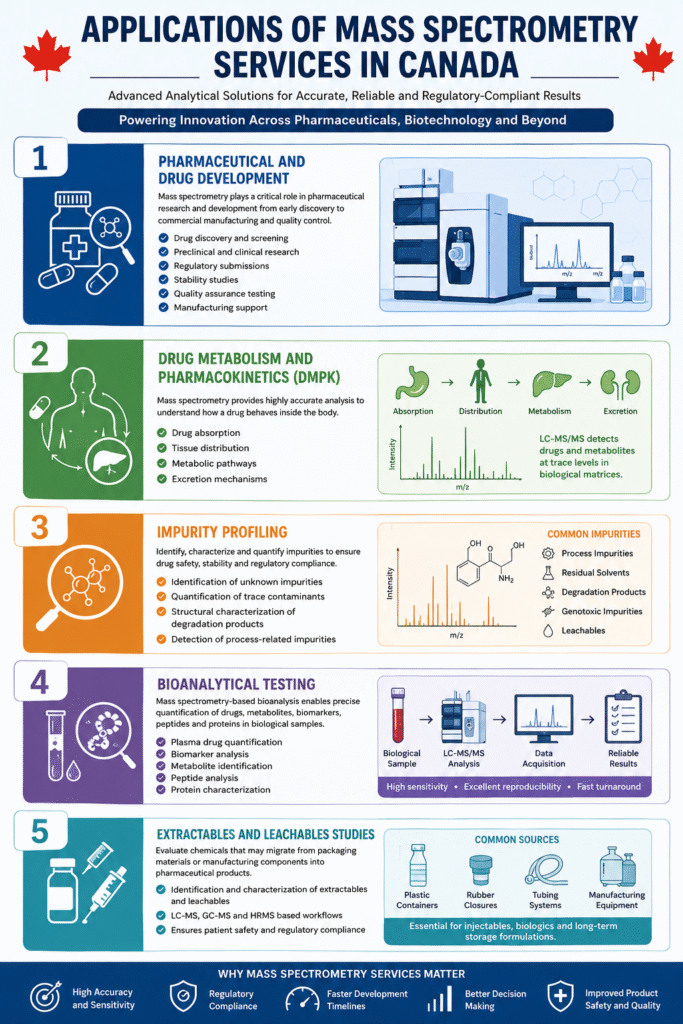
Mass spectrometry services in Canada support a wide range of industries, with pharmaceutical and biotechnology applications being among the most significant. These analytical services help researchers generate accurate, reliable, and regulatory-compliant data throughout the product development lifecycle.
1. Pharmaceutical and Drug Development
Mass spectrometry plays a critical role in pharmaceutical research and development, from early-stage drug discovery to commercial manufacturing and quality control. Its high sensitivity and specificity allow scientists to analyze complex compounds, detect trace impurities, and evaluate drug behavior within biological systems.
Canadian analytical laboratories use advanced mass spectrometry platforms to support:
- Drug discovery and screening
- Preclinical and clinical research
- Regulatory submissions
- Stability studies
- Quality assurance testing
- Manufacturing support
These analytical capabilities help pharmaceutical companies accelerate development timelines while maintaining compliance with global regulatory standards.
2. Drug Metabolism and Pharmacokinetics (DMPK)
Drug Metabolism and Pharmacokinetics (DMPK) studies are essential for understanding how a drug behaves inside the body. Mass spectrometry provides highly accurate quantitative and qualitative analysis for evaluating drug safety, efficacy, and bioavailability.
Mass spectrometry helps researchers assess:
- Drug absorption
- Tissue distribution
- Metabolic pathways
- Excretion mechanisms
LC-MS/MS techniques are widely used in DMPK studies because they can detect drugs and metabolites at extremely low concentrations in biological matrices such as plasma, serum, urine, and tissues.
3. Impurity Profiling
Impurity profiling is one of the most important applications of mass spectrometry in pharmaceutical analysis. Even trace-level impurities can affect drug safety, stability, and regulatory acceptance.
Advanced mass spectrometry methods enable:
- Identification of unknown impurities
- Quantification of trace contaminants
- Structural characterization of degradation products
- Detection of process-related impurities
High-resolution mass spectrometry (HRMS) and LC-MS/MS systems provide exceptional analytical sensitivity for impurity characterization in complex formulations.
4. Bioanalytical Testing
Bioanalytical testing is essential for pharmaceutical and clinical research. Mass spectrometry-based bioanalysis provides precise quantification of drugs, metabolites, biomarkers, peptides, and proteins in biological samples.
LC-MS/MS techniques are widely used for:
- Plasma drug quantification
- Biomarker analysis
- Metabolite identification
- Peptide analysis
- Protein characterization
These methods deliver high sensitivity, reproducibility, and fast turnaround times for complex biological matrices.
5. Extractables and Leachables Studies
Extractables and leachables (E&L) studies evaluate chemicals that may migrate from packaging materials, medical devices, or manufacturing components into pharmaceutical products.
Mass spectrometry plays a key role in identifying and characterizing these compounds to ensure product safety and regulatory compliance.
4: Types of Mass Spectrometry Techniques
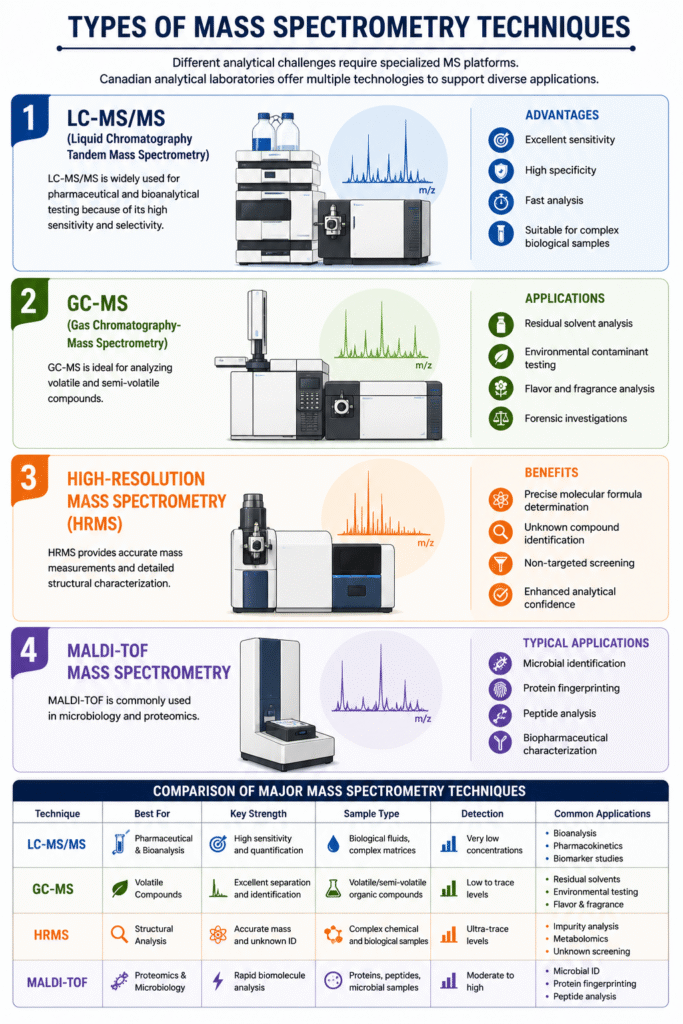
Different analytical challenges require specialized mass spectrometry (MS) platforms. Canadian analytical laboratories often utilize multiple MS technologies to support pharmaceutical, biotechnology, environmental, food, and clinical research applications. Each technique offers unique analytical advantages depending on sample type, sensitivity requirements, and research objectives.
1. LC-MS/MS (Liquid Chromatography Tandem Mass Spectrometry)
LC-MS/MS is one of the most widely used analytical techniques in pharmaceutical and bioanalytical testing because of its exceptional sensitivity, specificity, and quantitative accuracy. By combining liquid chromatography with tandem mass spectrometry, this technique enables precise analysis of complex biological and chemical samples.
Advantages
- Excellent sensitivity
- High specificity
- Fast analysis
- Suitable for complex biological samples
2. GC-MS (Gas Chromatography-Mass Spectrometry)
GC-MS is ideal for analyzing volatile and semi-volatile compounds. This technique combines the separation power of gas chromatography with the identification capabilities of mass spectrometry, making it highly effective for chemical characterization and contaminant detection.
Applications
- Residual solvent analysis
- Environmental contaminant testing
- Flavor and fragrance analysis
- Forensic investigations
3. High-Resolution Mass Spectrometry (HRMS)
High-Resolution Mass Spectrometry (HRMS) provides highly accurate mass measurements and detailed structural characterization of compounds. It is commonly used for advanced analytical research and unknown compound identification.
Benefits
- Precise molecular formula determination
- Unknown compound identification
- Non-targeted screening
- Enhanced analytical confidence
4. MALDI-TOF Mass Spectrometry
Matrix-Assisted Laser Desorption/Ionization Time-of-Flight (MALDI-TOF) mass spectrometry is commonly used in microbiology, proteomics, and biopharmaceutical analysis. This technique enables rapid analysis of large biomolecules with minimal sample preparation.
Typical Applications
- Microbial identification
- Protein fingerprinting
- Peptide analysis
- Biopharmaceutical characterization
5: Key Factors to Consider When Selecting a Mass Spectrometry Laboratory
Choosing the right analytical partner is essential for successful project execution.
Technical Expertise
Evaluate whether the laboratory offers:
- Appropriate instrumentation
- Specialized analytical methods
- Industry-specific expertise
- High-resolution analytical capabilities
Industry Experience
Laboratories with industry-specific experience can better support:
- Pharmaceutical development
- Biotechnology research
- Environmental analysis
- Food safety testing
- Clinical studies
Method Development Capabilities
Complex analytical projects often require custom methods. Strong method development expertise is critical for accurate and reproducible results.
Data Integrity and Quality Assurance
Reliable laboratories maintain:
- Validated analytical workflows
- Secure data systems
- Detailed documentation practices
- Robust quality control procedures
Data integrity is particularly important in regulated industries.
6: Future Trends in Mass Spectrometry Services
The future of mass spectrometry is being driven by technological innovation and increasing demand for precision analysis.
Emerging Trends:
- Artificial intelligence-assisted data analysis
- High-throughput analytical workflows
- Multi-omics integration
- Single-cell analysis
- Advanced biomarker discovery
- Real-time analytical monitoring
Canadian analytical laboratories continue to expand capabilities to support evolving scientific and regulatory demands.
7: How ResolveMass Laboratories Inc. Supports Advanced Analytical Research
ResolveMass Laboratories Inc. provides comprehensive analytical and mass spectrometry solutions for pharmaceutical, biotechnology, and research organizations. The laboratory combines scientific expertise, advanced instrumentation, and regulatory-focused workflows to deliver high-quality analytical support.
Core Service Areas:
- LC-MS/MS analysis
- Method development and validation
- Impurity characterization
- Biomarker analysis
- Metabolomics support
- Regulatory analytical services
ResolveMass Laboratories Inc. focuses on delivering reliable, accurate, and scientifically rigorous analytical data that supports research innovation and compliance.
Conclusion:
Mass Spectrometry Service in Canada: A Comprehensive Solution for Advanced Analysis continues to play a critical role in pharmaceutical development, biotechnology research, environmental testing, food safety analysis, and clinical applications. The technology provides unmatched sensitivity, specificity, and analytical versatility for identifying and quantifying complex compounds.
Canadian analytical laboratories offer advanced instrumentation, experienced scientific teams, and strong quality systems that help organizations achieve reliable and reproducible analytical outcomes. As scientific research and regulatory expectations continue to evolve, mass spectrometry services will remain essential for innovation, quality assurance, and advanced analytical research.
Organizations seeking dependable analytical support can benefit significantly from partnering with experienced Canadian laboratories that provide customized, regulatory-compliant, and scientifically advanced mass spectrometry solutions.
Frequently Asked Questions:
Mass spectrometry is an advanced analytical technique used to identify, characterize, and quantify compounds based on their mass-to-charge ratio. The process involves ionizing molecules, separating the ions, and detecting them with highly sensitive instruments. It is widely used in pharmaceuticals, biotechnology, environmental analysis, and food testing due to its accuracy and sensitivity. Mass spectrometry can analyze complex samples at trace levels and generate reliable qualitative and quantitative data.
Mass spectrometry services are essential in pharmaceutical research because they help scientists evaluate drug safety, efficacy, stability, and purity. These analytical techniques support drug discovery, pharmacokinetic studies, impurity profiling, and regulatory submissions. Mass spectrometry also enables precise quantification of drugs and metabolites in biological samples. Its high sensitivity and reproducibility make it a critical technology for modern pharmaceutical development.
Mass spectrometry supports bioanalytical testing by enabling precise quantification of drugs, metabolites, biomarkers, peptides, and proteins in biological samples such as plasma, serum, and urine. LC-MS/MS methods provide high sensitivity, reproducibility, and fast turnaround times for clinical and pharmaceutical research. Bioanalytical testing is essential for pharmacokinetic studies, clinical trials, toxicology research, and therapeutic drug monitoring.
Canadian mass spectrometry laboratories are known for their advanced instrumentation, experienced scientific teams, and strong regulatory compliance standards. Many laboratories operate under GLP, GMP, and ISO quality systems while supporting FDA and Health Canada regulatory requirements. These laboratories offer customized analytical solutions, high-quality data generation, and comprehensive scientific support for pharmaceutical, biotechnology, and research organizations.
Mass spectrometry can analyze a wide range of sample types, including biological fluids, pharmaceutical formulations, environmental samples, food products, chemical compounds, proteins, peptides, and metabolites. Depending on the analytical objective, laboratories may use LC-MS/MS, GC-MS, HRMS, or MALDI-TOF platforms to obtain accurate and sensitive analytical results. The versatility of mass spectrometry makes it suitable for diverse scientific applications.
Choosing the right mass spectrometry service provider depends on several factors, including technical expertise, instrumentation capabilities, regulatory compliance, industry experience, and turnaround time. It is important to select a laboratory that offers validated analytical methods, experienced scientific support, and customized solutions tailored to your project requirements. Laboratories with strong quality systems and advanced MS technologies are better equipped to deliver reliable and reproducible analytical data.
Reference
- Perreault P, Robert E, Patience GS. Experimental methods in chemical engineering: mass spectrometry—MS. The Canadian Journal of Chemical Engineering. 2019 May;97(5):1036-42.https://onlinelibrary.wiley.com/doi/abs/10.1002/cjce.23466
- Lebedev AT. Environmental mass spectrometry. Annual review of analytical chemistry. 2013 Jun 12;6(1):163-89.https://www.annualreviews.org/content/journals/10.1146/annurev-anchem-062012-092604
- Workman Jr J. Advancements and Emerging Techniques in Mass Spectrometry: A Comprehensive Review. LCGC Supplements. 2024 Nov 7:22-7.https://www.chromatographyonline.com/view/advancements-and-emerging-techniques-in-mass-spectrometry-a-comprehensive-review
- Richardson SD. Environmental mass spectrometry: emerging contaminants and current issues. Analytical chemistry. 2008 Jun 15;80(12):4373-402.https://pubs.acs.org/doi/full/10.1021/ac800660d