

Summary – Key Takeaways
- The qualitative estimation of microplastic in cosmetics by FTIR – Method 623.1 ensures precise identification of polymeric contaminants in cosmetic formulations.
- FTIR spectroscopy (Fourier Transform Infrared Spectroscopy) under Method 623.1 helps detect, classify, and confirm the type of microplastics in both rinse-off and leave-on cosmetic products.
- The method aligns with the Canadian Environmental Protection Act (CEPA) 2023 Microbead regulations, ensuring compliance with environmental and product safety standards.
- A reliable FTIR-based workflow involves sample digestion, filtration, isolation, and polymer identification—critical steps to confirm microplastic presence in the cosmetic matrix.
- Accurate detection and documentation through Method 623.1 strengthen environmental accountability and corporate transparency in cosmetic manufacturing.
Introduction
The qualitative estimation of Microplastic in Cosmetics by FTIR – Method 623.1 is a standardized testing approach developed to identify polymer-based micro-particles in cosmetic products. It enables laboratories and manufacturers to detect even very small traces of microplastics that may not be visible using basic screening techniques. This level of accuracy is critical for regulatory compliance and environmentally responsible product development.
Compared to general spectroscopic methods, Method 623.1 offers higher precision and repeatability. If you are looking to identify unknown substances or quantify complex mixtures with similar precision, you might explore our high-resolution mass spectrometry (HRMS) analysis services to complement your spectroscopic data. It is especially useful for separating synthetic polymers from naturally occurring particles found in cosmetic ingredients. This ensures reliable and consistent results across different testing laboratories.
The presence of Microplastic in Cosmetics has become a growing environmental concern due to its long-lasting impact on aquatic ecosystems. In Canada, Environment and Climate Change Canada (ECCC) strictly regulates microbeads under CEPA 2023. For detailed information on these standards, you can review the official Canadian environmental protection guidelines on microbeads in toiletries. Because of this, FTIR-based Method 623.1 is now a trusted solution for compliance testing and environmental protection.
Understanding Method 623.1 for Microplastic Identification in Cosmetics
Method 623.1 provides a structured analytical process for the qualitative estimation of Microplastic in Cosmetics using FTIR technology. It is specifically designed to handle complex cosmetic matrices such as scrubs, creams, gels, and exfoliating products that often contain oils, waxes, and surfactants.
The method focuses on carefully isolating polymer particles before FTIR analysis. This step removes interfering substances and ensures that the infrared spectra are clean and easy to interpret. For manufacturers dealing with polymers of varying molecular weights, utilizing gel permeation chromatography (GPC) analysis can provide further insights into the polymer’s physical properties. As a result, laboratories can accurately classify polymer types with minimal uncertainty.
Method 623.1 can be applied to a wide variety of cosmetic products, including both solid and semi-solid formulations. Its adaptability makes it a practical and effective tool for routine microplastic monitoring in cosmetics.
Key Analytical Steps of Method 623.1 for Microplastic in Cosmetics
| Step | Description | Objective |
|---|---|---|
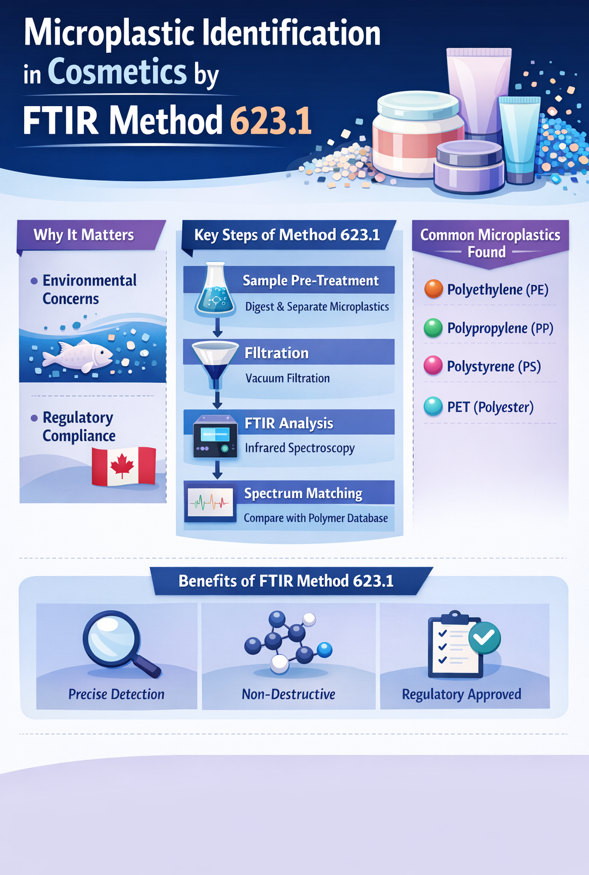
| Sample Pre-Treatment | Digestion of organic matter using oxidative reagents | Isolate microplastic from organic-rich matrix |
| Filtration | Vacuum-assisted filtration using membrane filters | Concentrate potential polymeric residues |
| Visual Screening | Microscopic observation of retained particles | Initial selection for FTIR analysis |
| FTIR Spectroscopy | Infrared scanning in the range 4000–400 cm⁻¹ | Identify polymer type based on characteristic peaks |
| Spectrum Matching | Comparison with reference polymer database | Confirm polymer identity (e.g., PE, PP, PET, PS) |
This systematic approach ensures repeatable results and minimizes the risk of incorrect identification.
Sample Preparation for FTIR Analysis of Microplastic in Cosmetics
Accurate qualitative estimation of Microplastic in Cosmetics by FTIR – Method 623.1 depends greatly on proper sample preparation. Cosmetic products often contain ingredients that can interfere with infrared analysis if they are not removed correctly.
Chemical digestion helps break down organic materials while keeping polymer particles intact. However, in cases where you need to identify specific small-molecule contaminants or additives, you may benefit from our expert NMR analysis for small molecules to ensure full structural characterization. This step is essential for exposing microplastics that may be trapped within cosmetic formulations. Density separation further improves isolation by separating particles based on weight differences.
Standard preparation steps include:
- Chemical digestion: Use of 30% hydrogen peroxide (H₂O₂) under controlled temperature to remove organic matter without damaging polymers.
- Density separation: Use of saturated NaCl or ZnCl₂ solutions to separate lighter microplastics from heavier residues.
- Filtration: Polycarbonate membrane filters (0.45 µm) are used to capture microplastic particles while reducing background noise.
- Microscopic selection: Particles larger than 5 µm are selected to ensure reliable FTIR signal strength and accurate analysis.
Careful preparation improves spectral clarity and increases confidence in the identification of Microplastic in Cosmetics.
FTIR Spectral Analysis – The Core of Method 623.1 for Microplastic in Cosmetics
FTIR spectroscopy is the main analytical tool used in Method 623.1. It identifies Microplastic in Cosmetics by detecting molecular vibrations that produce unique infrared absorption patterns. While FTIR is excellent for polymers, complex formulations may also require impurity profiling using LCMS to detect trace-level chemical impurities that could affect product safety.
Each polymer has a distinct spectral fingerprint based on its chemical structure. By analyzing these peaks, analysts can differentiate polymers that may look similar under a microscope. This molecular-level detail makes FTIR a powerful technique for qualitative microplastic analysis.
Spectral Markers for Common Cosmetic Microplastics
| Polymer | Key FTIR Peaks (cm⁻¹) | Functional Group |
|---|---|---|
| Polyethylene (PE) | 2916, 2848, 1465 | CH₂ stretching |
| Polypropylene (PP) | 2950, 1375, 1166 | CH₃ bending |
| Polystyrene (PS) | 3025, 1601, 1492 | Aromatic ring |
| Polyethylene Terephthalate (PET) | 1715, 1240, 1100 | C=O and C–O stretching |
| Nylon (PA) | 3300, 1630, 1536 | Amide bands |
Matching unknown spectra with reference libraries confirms the polymer type with high confidence.
Quality Assurance and Method Validation
The qualitative estimation of Microplastic in Cosmetics by FTIR – Method 623.1 follows strict quality assurance and validation procedures. For brands looking to go beyond microplastics and ensure total product safety, it is vital to conduct extractables and leachables testing to identify any chemicals migrating from packaging into the formula. These checks ensure consistent and dependable results regardless of the laboratory or analyst.
Under CEPA 2023, manufacturers must demonstrate compliance through proper testing. In addition to microplastic monitoring, some ingredients may require specialized safety screenings; for instance, you can access comprehensive nitrosamine analysis to ensure your products meet stringent toxicological standards.
Quality control is applied throughout the analytical process, including instrument performance, spectral accuracy, and sample handling. This helps maintain data integrity and reliability.
Key validation parameters include:
- Reproducibility: Repeat tests produce similar FTIR spectra.
- Limit of Detection (LOD): Reliable identification of particles ≥5 µm.
- Spectral resolution: Standard resolution of 4 cm⁻¹ for clear peak separation.
- Instrument calibration: Regular checks using polystyrene film standards.
These measures ensure results are suitable for regulatory and compliance reporting.
Regulatory Relevance under CEPA 2023
The Canadian Environmental Protection Act (CEPA) places strong restrictions on Microplastic in Cosmetics, particularly microbeads. Manufacturers must demonstrate compliance through proper testing and documentation.
According to the 2023 Government of Canada update, FTIR analysis using Method 623.1 provides traceable and standardized data for regulatory submissions. This supports consistent enforcement and accountability across the cosmetic industry.
Compliance helps improve product trust, supports environmental goals, and aligns brands with national sustainability initiatives. It also strengthens eco-friendly product positioning.
Advantages of Using FTIR for Microplastic in Cosmetics
FTIR offers several benefits for the qualitative estimation of Microplastic in Cosmetics. It is a non-destructive method, meaning particles can be stored and reanalyzed if needed.
The technique provides fast analysis, often completing scans within seconds. Its extensive polymer libraries allow identification of many materials commonly found in cosmetic products.
FTIR also offers strong chemical specificity, making it easier to differentiate between similar polymers. This makes it a preferred choice for quality control and environmental testing laboratories.
Challenges and Considerations
Although Method 623.1 is highly effective, strict laboratory control is necessary. Ingredients like waxes, pigments, and emulsifiers can interfere with digestion and filtration if not handled properly.
Common challenges include incomplete digestion, contamination from filters, and difficulty detecting particles smaller than 5 µm. These issues must be managed carefully.
Best practices include clean-air sample preparation, use of procedural blanks, and strict lab hygiene. These steps help ensure trustworthy results when analyzing Microplastic in Cosmetics.
Future Developments in Microplastic Analysis
Advanced tools such as µFTIR mapping and Raman spectroscopy are increasingly used alongside Method 623.1. These methods allow detection of smaller particles and improved spatial analysis.
Automation and AI-based spectral interpretation are also improving accuracy and efficiency. In the future, smarter polymer databases will support global standardization of microplastic testing.
Conclusion
The qualitative estimation of Microplastic in Cosmetics by FTIR – Method 623.1 is a dependable, validated, and regulation-aligned method for identifying polymer contaminants in cosmetic products. While FTIR handles the polymers, we recommend that you leverage our HPLC analysis services for a complete breakdown of your cosmetic active ingredients. Its structured process and reproducible results make it essential for compliance and environmental monitoring.
Using this method shows a strong commitment to quality, transparency, and sustainability. It also builds consumer confidence by ensuring products meet modern regulatory expectations.
For analytical consultation or customized FTIR testing support, reach out to ResolveMass Laboratories Inc. through our contact pages below:
👉 Contact ResolveMass
FAQs on “Qualitative Estimation of Microplastic in Cosmetics by FTIR – Method 623.1”
Method 623.1 is used to identify the presence of microplastic polymers in cosmetic products. It focuses on qualitative analysis rather than quantity, helping laboratories confirm whether microplastics exist in a formulation. The method is widely accepted for regulatory and environmental testing. It is especially useful for compliance-driven cosmetic analysis.
FTIR is preferred because it identifies polymers based on their unique molecular structure. It is a non-destructive technique, meaning particles remain intact after testing. FTIR also provides fast and reliable results, even in complex cosmetic matrices. This makes it ideal for routine microplastic screening.
Yes, Method 623.1 aligns with the requirements of CEPA 2023 related to microbeads and microplastics. It supports standardized testing and proper documentation for regulatory submissions. Canadian authorities recognize this approach for compliance verification. It helps manufacturers meet environmental obligations.
FTIR can identify most common cosmetic polymers that are 5 microns or larger. These include polyethylene, polypropylene, and polystyrene. Very small particles below this size may require advanced techniques such as µFTIR or Raman spectroscopy. For routine analysis, FTIR remains highly effective.
The method is highly accurate when proper sample preparation and quality controls are followed. Polymer identification is confirmed by matching spectra with validated reference libraries. Repeat testing produces consistent results across laboratories. This reliability makes it suitable for regulatory and quality assurance use.
Reference
- Environment and Climate Change Canada. (2023). Microbeads in toiletries – Method 623.1. Government of Canada. https://www.canada.ca/en/environment-climate-change/services/canadian-environmental-protection-act-registry/publications/microbeads-in-toiletries-2023.html
- Zarus, G. M., Muianga, C., Hunter, C., & Pappas, R. S. (2020). A review of data for quantifying human exposures to micro and nanoplastics and potential health risks. Science of the Total Environment, 756, 144010. https://doi.org/10.1016/j.scitotenv.2020.144010
- Ivleva, N. P., et al. (2021). Chemical analysis of microplastics and nanoplastics: Challenges, advanced methods, and perspectives. Chemical Reviews, 121(in press). https://doi.org/10.1021/acs.chemrev.1c00178
- Al-Kelani, M., & Buthelezi, N. (2024). Advancements in medical research: Exploring Fourier Transform Infrared (FTIR) spectroscopy for tissue, cell, and hair sample analysis. Skin Research and Technology, 30(6), e13733. https://doi.org/10.1111/srt.13733
Get In Touch With Us
About The Author


