
Introduction
Native Chemical Ligation provides a chemo- and regioselective chemical approach for joining unprotected synthetic peptide segments to produce full-length small proteins containing native peptide bonds. By conducting the reaction in aqueous buffers under mild, physiological conditions, this ligation method overcomes the typical length restrictions of automated solid-phase peptide synthesis (SPPS), which generally accommodates approximately 30–50 amino acid residues, while maintaining complete atomic-level control over the target primary structure.
Unlike biological recombinant expression systems, Native Chemical Ligation enables the site-specific incorporation of unnatural amino acids, post-translational modifications (PTMs), including O-GlcNAcylation and phosphorylation, isotopic labels, and biophysical probes at virtually any position within a polypeptide chain. At ResolveMass Laboratories Inc., advanced mass spectrometric characterization and high-throughput peptide synthesis platforms apply these chemical principles to achieve total chemical protein synthesis with precise quality control.
Explore comprehensive peptide physicochemical characterization approaches to support the structural and analytical evaluation of synthetic peptides and proteins.
Share via:
Quick Summary:
- What it does: joins two unprotected synthetic peptide segments in aqueous buffer near neutral pH to make a native amide bond, pushing past the ~50-residue ceiling of solid-phase peptide synthesis while keeping full atomic control of the sequence — including PTMs, unnatural residues, isotopes and probes anywhere in the chain.
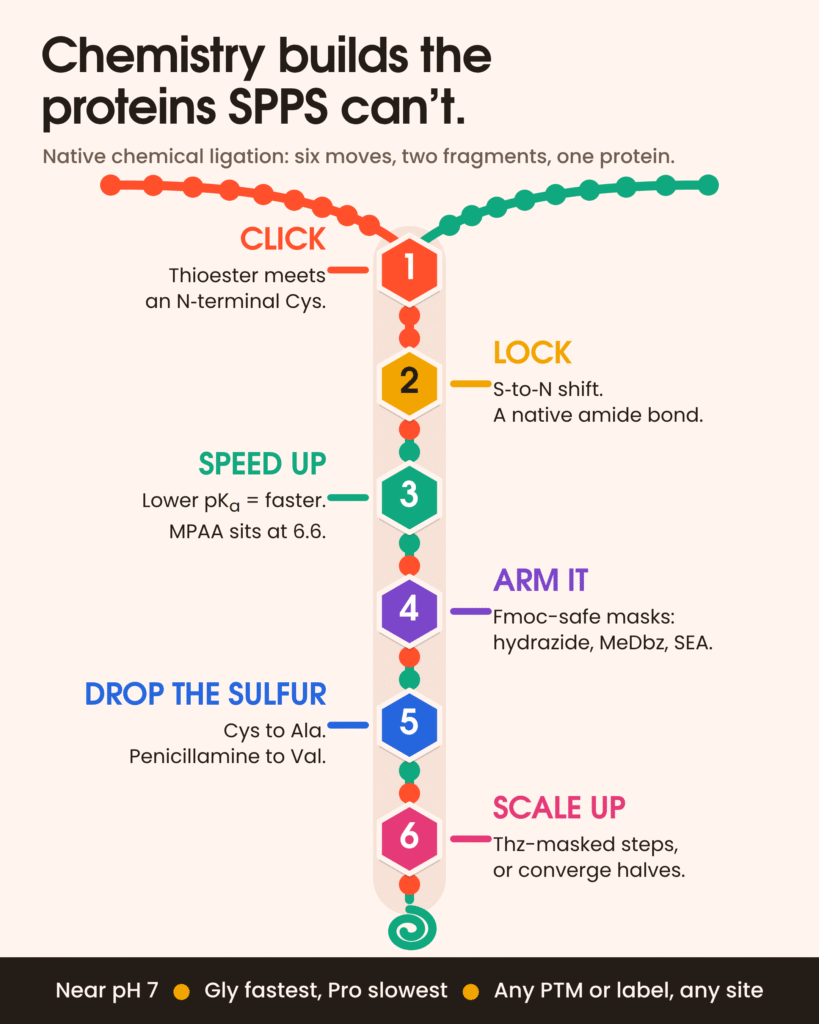
- How it works: a C-terminal peptide α-thioester and an N-terminal cysteine undergo transthioesterification (the slow, reversible step), then a fast intramolecular S→N acyl shift through a five-membered transition state locks in a stable, effectively irreversible peptide bond.
- What sets the speed: the pKa of the leaving thiol and steric bulk at the C-terminal residue. Glycine ligates fastest; alanine and histidine are quick; β-branched valine and isoleucine are slow; proline is nearly inert because an n→π* interaction drains electrophilicity from its thioester carbonyl.
- Catalysts: thiol additives swap sluggish alkyl thioesters (pKa ~8.5–9.5) for more reactive low-pKa species. MPAA (pKa 6.6) is the workhorse but scavenges radicals, so it blocks one-pot desulfurization; thiocholine, TFET, MESNa, selenol catalysts like SeESNa, and ferricyanide activation of hydrazides are the desulfurization-compatible alternatives.
- Getting the thioester from Fmoc-SPPS: piperidine destroys thioesters during synthesis, so latent surrogates are used instead — peptide hydrazides (oxidized to the acyl azide, then thiolysed), MeDbz/MeNbz N-acylureas activated with p-nitrophenyl chloroformate, and SEA linkers that switch on via an N→S acyl shift.
- Ligating away from cysteine: since Cys is rare in natural sequences, post-ligation radical desulfurization (VA-044 + TCEP + a thiol donor) converts the new Cys to Ala. Engineered thiol or selenol amino acids extend this to valine (penicillamine), proline (mercaptoproline), Asp/Glu, and selenocysteine, which deselenizes selectively while leaving real cysteines and disulfides intact.
- Building bigger, and what goes wrong: proteins beyond 100 residues are assembled sequentially — Thz-masked N-terminal cysteines unmasked with methoxyamine between cycles, optionally on a His6/Ni-NTA solid support — or convergently for better yield and purity. The main side reactions to control are thioester hydrolysis, Cα epimerization at high pH or long reaction times, and cyclization of Asp/Glu/Asn/Gln thioesters into anhydrides or imides.
Mechanistic Principles and Kinetic Drivers of Native Chemical Ligation
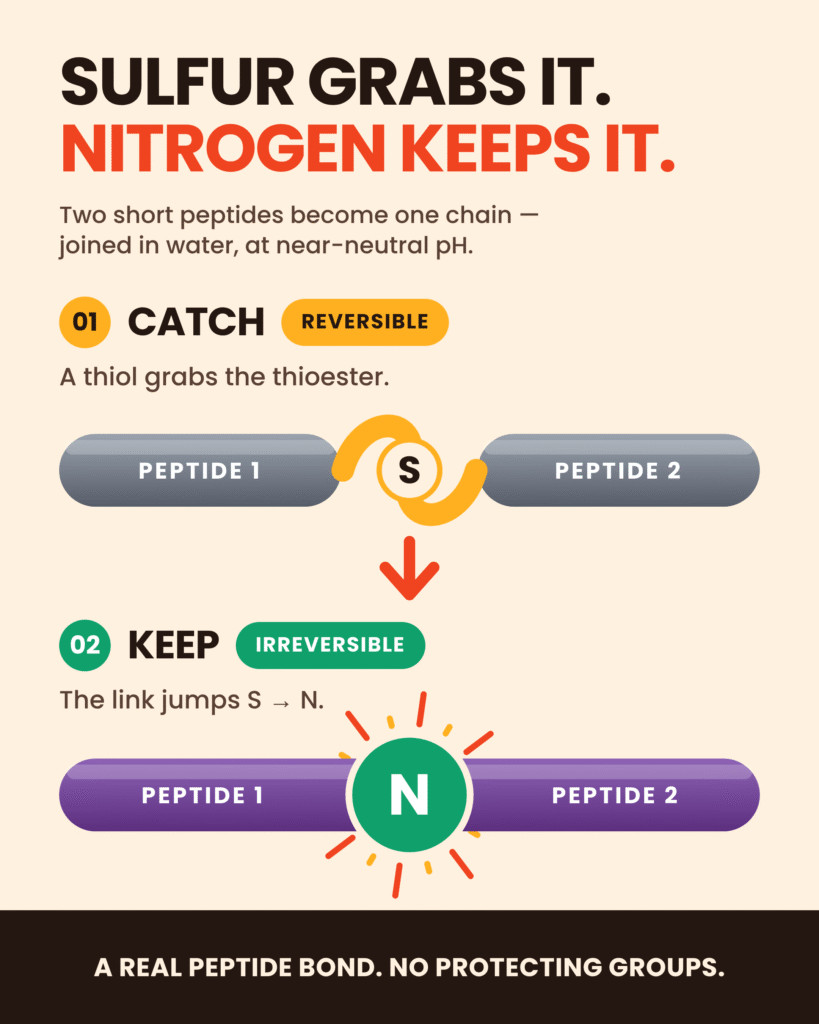
Native Chemical Ligation proceeds through a rate-limiting, chemoselective transthioesterification reaction between a C-terminal peptide α-thioester and an N-terminal cysteinyl peptide. This initial reaction is followed by a rapid and spontaneous intramolecular S-to-N acyl shift. The thermodynamic driving force behind this coupled process is the transformation of a transient, high-energy thioester intermediate into a stable amide (native peptide) bond through a five-membered cyclic transition state.
The reaction starts when the nucleophilic thiolate group of an N-terminal cysteine attacks the electrophilic C-terminal α-thioester carbon of an adjacent peptide segment:
Transthioesterification reaction:
Peptide1-C(=O)-SR + HS-CH2-CH(NH2)-C(=O)-Peptide2
⇄
Peptide1-C(=O)-S-CH2-CH(NH2)-C(=O)-Peptide2 + RSH
This initial transthioesterification step produces an S-acyl intermediate. In the subsequent reaction, the free α-amino group of the N-terminal cysteine performs an intramolecular nucleophilic attack on the thioester carbonyl:
Intramolecular S-to-N acyl shift:
Peptide1-C(=O)-S-CH2-CH(NH2)-C(=O)-Peptide2
↓
Peptide1-C(=O)-NH-CH(CH2SH)-C(=O)-Peptide2
Since the resulting native amide bond is thermodynamically stable, the second reaction is virtually irreversible under standard neutral aqueous reaction conditions (pH 6.8–7.2).
The overall reaction velocity depends primarily on the pKa of the leaving thiol group and the steric environment surrounding the C-terminal electrophilic center. The second-order rate constant (k1) for transthioesterification increases when leaving groups with lower pKa values are employed. Alkyl thioesters (pKa ≈ 8.5–9.5) generally exhibit slower reaction kinetics than aryl thioesters (pKa ≈ 5.5–7.0), making exogenous thiol catalyst additives necessary for achieving efficient conversion. Steric hindrance at the Cα position also influences the relative rates of transthioesterification and the S-to-N acyl shift.
| C-Terminal Junction Residue | Relative Ligation Velocity | Kinetic Bottleneck Step | Mechanistic Cause |
|---|---|---|---|
| Glycine (Gly) | Extremely Fast | None | The unhindered Cα center allows rapid nucleophilic attack. |
| Alanine / Histidine | Fast | Transthioesterification | Minimal steric bulk surrounding the carbonyl carbon. |
| Valine / Isoleucine | Very Slow | S-to-N Acyl Shift | Steric interference caused by β-branching slows the cyclic rearrangement. |
| Proline (Pro) | Inert to Very Slow | Transthioesterification | The n → π* orbital interaction decreases carbonyl electrophilicity. |
Learn how advanced 2D NMR techniques support peptide structural characterization and help investigate molecular environments, residue interactions, and structural features.
Catalyst Optimization and Thiol Exchange Dynamics in Native Chemical Ligation
Catalyst additives in Native Chemical Ligation accelerate transthioesterification by participating in rapid, in situ thiol-thioester exchange reactions with relatively unreactive peptide thioesters. This process generates more reactive intermediates containing leaving groups with lower pKa values. Selecting an appropriate catalyst requires balancing reaction rate enhancement, pH compatibility, and downstream integration with radical desulfurization processes.
4-Mercaptophenylacetic acid (MPAA) is a commonly employed aryl thiol catalyst because of its relatively low pKa (≈ 6.6) and excellent aqueous solubility at neutral pH. MPAA converts less reactive alkyl thioesters into more reactive phenyl thioester species in situ, improving ligation efficiency at sterically challenging junctions. However, MPAA can also function as a radical scavenger during subsequent radical-initiated desulfurization reactions, which convert Cys to Ala. This interference can prevent direct one-pot transformations.
To minimize catalyst-related inhibition during one-pot desulfurization, low-pKa alkyl thiols and selenium-based catalysts offer suitable alternatives. Thiocholine (pKa ≈ 7.8) and trifluoroethanethiol (TFET, pKa ≈ 7.3) provide effective ligation activity while maintaining compatibility with radical desulfurization conditions. Furthermore, water-soluble diselenide catalysts, including sodium 2-selenoethanesulfonate (SeESNa), generate intermediate selenoesters (pKa ≈ 4.6). These intermediates can produce ligation rates up to ten times faster than those achieved with conventional aryl thiols while reducing side reactions involving internal cysteine residues.
| Catalyst System | pKa Value | Primary Mechanism / Advantage | Compatibility with One-Pot Desulfurization |
|---|---|---|---|
| 4-Mercaptophenylacetic acid (MPAA) | ≈ 6.6 | High in situ aryl thioester exchange rate. | Incompatible (traps radical species). |
| 2-Mercaptoethanesulfonate (MESNa) | ≈ 9.2 | High storage stability and excellent aqueous solubility. | Compatible. |
| Thiocholine | ≈ 7.8 | Odorless, low-pKa alkyl thiol with fast reaction kinetics. | Fully Compatible. |
| Sodium 2-selenoethanesulfonate (SeESNa) | ≈ 4.6 | Rapid selenol-thioester exchange that eliminates branched byproducts. | Compatible. |
| Potassium Ferricyanide (K3[Fe(CN)6]) | N/A (Oxidative) | Direct activation of peptide hydrazides in neutral water. | Compatible (eliminates organic thiols). |
Discover how native mass spectrometry for therapeutic peptide characterization can help investigate noncovalent interactions, molecular complexes, and peptide assembly characteristics.
Latent C-Terminal Thioester Surrogates for Fmoc-SPPS
Latent C-terminal thioester surrogates facilitate the preparation of thioester precursors through conventional Fmoc solid-phase peptide synthesis without premature cleavage or base-catalyzed epimerization. These protected functional groups remain stable throughout repeated piperidine deprotection cycles and acid cleavage. They can subsequently be selectively activated to generate reactive acyl donors immediately before the ligation reaction.
The direct synthesis of peptide α-thioesters through traditional Boc-SPPS requires cleavage using hazardous hydrogen fluoride (HF). In contrast, preparing thioesters directly through Fmoc-SPPS presents challenges because piperidine can attack the thioester linkage through a nucleophilic mechanism during peptide synthesis. Modern synthetic approaches overcome these limitations by employing specialized latent thioester surrogates.
Peptide hydrazides are a versatile class of these surrogates. Prepared on hydrazide resins using standard Fmoc protocols, C-terminal peptide hydrazides undergo chemoselective oxidation with sodium nitrite (NaNO2) at pH 3.0 and −10 °C, producing a reactive peptide acyl azide. When the reaction mixture is subsequently adjusted to pH 6.8–7.0 in the presence of an aryl thiol, such as MPAA, the acyl azide is converted in situ into a peptide thioester capable of participating in Native Chemical Ligation. More recent ferricyanide-mediated protocols simplify this process further by allowing direct hydrazide activation in neutral water without requiring intermediate sub-zero oxidation steps.
Another approach involves N-acylurea linkers derived from o-amino(methyl)aniline (MeDbz). Incorporated at the C-terminus during Fmoc-SPPS, the MeDbz moiety remains resistant to acylation throughout peptide sequence elongation. After cleavage, treatment with p-nitrophenyl chloroformate activates the linker and converts it into a reactive N-acyl-N’-methylurea (MeNbz) group. This intermediate readily undergoes thiolysis when exposed to thiol catalysts in the ligation buffer.
Bis(2-sulfanylethyl)amido (SEA) linkers function through a redox-controlled activation mechanism involving an SEAon/SEAoff switch. In its reduced thiolate form (SEAon), the linker undergoes an intramolecular N-to-S acyl shift, producing a transient thioester. This intermediate subsequently enables chemoselective ligation with cysteinyl peptides under mild aqueous reaction conditions.
Review sequence confirmation strategies for synthetic therapeutic peptides to understand how analytical methods verify peptide identity and sequence integrity following synthesis.
Desulfurization and Deselenization Strategies for Native Chemical Ligation at Non-Cysteine Sites
Post-ligation desulfurization and deselenization expand the applicability of Native Chemical Ligation beyond native cysteine residues. These processes convert thiol- or selenol-containing auxiliary amino acids directly into alanine, valine, proline, or acidic residues. This chemical modification removes sequence-related restrictions and makes it possible to perform ligations at non-cysteine positions throughout the target protein.
Since cysteine is among the least abundant amino acids in naturally occurring protein sequences, depending exclusively on native Cys residues significantly restricts the selection of suitable ligation sites. Free-radical desulfurization addresses this limitation through phosphite-mediated sulfur abstraction. Water-soluble radical initiators, such as 2,2′-azobis[2-(2-imidazolin-2-yl)propane]dihydrochloride (VA-044), are used alongside tris(2-carboxyethyl)phosphine (TCEP) and an alkyl thiol donor. Together, these reagents selectively break the carbon-sulfur bond of the newly formed cysteine residue, converting it into an alanine residue.
Engineered thiol-containing non-canonical amino acids further extend this approach to additional ligation junctions:
- Penicillamine (β-Mercaptovaline): Undergoes homolytic desulfurization to produce Valine at the ligation junction.
- Mercaptoproline: Facilitates ligation at Proline positions and is subsequently converted into native Proline after ligation.
- β-Mercaptoaspartate and γ-Mercaptoglutamate: Enable ligation at acidic Aspartate and Glutamate positions, respectively.
- Selenocysteine (Sec): Supports selective deselenization under mild reaction conditions using phosphites, while preserving native disulfides and internal cysteine residues.
Explore chiral analysis of therapeutic peptide APIs to understand how stereochemical assessment helps identify and monitor amino acid configuration changes during peptide synthesis and modification.
Multi-Fragment Protein Assembly: Sequential vs. Convergent Native Chemical Ligation Strategies
The assembly of multi-fragment proteins through Native Chemical Ligation requires carefully designed orthogonal protecting group strategies or chemoselective activation switches to connect three or more synthetic peptide segments through a single directional or convergent pathway. Proper fragment planning helps reduce handling losses and the accumulation of unwanted byproducts during complex protein assembly.
When synthesizing small proteins containing more than 100 amino acids, linear sequential assembly involves joining peptide fragments one at a time, progressing in either the C-to-N or N-to-C direction. Internal peptide fragments must contain a temporarily protected N-terminal cysteine together with a latent C-terminal thioester surrogate. These modifications prevent premature self-condensation during the assembly process.
The 1,3-thiazolidine-4-carboxylic acid (Thz) protecting group is frequently employed to temporarily protect N-terminal cysteine residues. Thz masks the N-terminal thiolate during the initial ligation reactions. Subsequent treatment with methoxyamine hydrochloride at pH 4.0 removes this protecting group and restores the reactive cysteine required for the next ligation cycle.
To reduce purification-related losses between successive assembly steps, solid-phase Native Chemical Ligation immobilizes the C-terminal fragment onto a solid support. One example involves a His6-tag bound to Ni2+-NTA resin. Excess unreacted peptide thioesters and other reagents can then be eliminated through filtration and washing, allowing efficient stepwise protein assembly.
| Ligation Strategy | Workflow Mechanism | Primary Advantage | Major Limitation |
|---|---|---|---|
| Sequential One-Pot | Directional C-to-N assembly using Thz protection. | Eliminates intermediate HPLC purification steps. | Byproduct accumulation across multiple steps. |
| Solid-Phase (His6-Tag) | Resin-supported ligation using Ni-NTA media. | Rapid washing and straightforward intermediate control. | Mass-transfer limitations on solid supports. |
| Convergent Assembly | Parallel synthesis of two-fragment pairs followed by final coupling. | Higher overall yield and superior purity profiles. | Requires strict chemoselective orthogonality. |
Examine the 2D NMR-based structural elucidation approach to learn how spectroscopic techniques can help confirm molecular connectivity and investigate complex synthetic protein structures.
Side Reactions, Kinetic Bottlenecks, and Mitigation Protocols in Native Chemical Ligation
Controlling competitive thioester hydrolysis, C-terminal epimerization, and intramolecular cyclization during Native Chemical Ligation requires careful regulation of reaction pH, temperature, and thiol catalyst concentrations. Understanding the kinetic limitations associated with individual amino acid sequences is essential for establishing suitable reaction conditions, particularly when working with challenging sequence motifs.
Proline C-terminal thioesters present a significant kinetic challenge during ligation. The intrinsic n → π* orbital interaction between the nitrogen lone pair and adjacent carbonyl orbitals reduces the electrophilicity of the Pro thioester carbon. This effect slows the transthioesterification reaction. Increasing the reaction temperature or introducing highly reactive selenoester intermediates can help overcome this kinetic limitation and improve ligation efficiency.
Intramolecular cyclization is another recognized side reaction involving C-terminal Aspartate, Glutamate, Asparagine, and Glutamine thioesters. C-terminal Asp and Glu thioesters can undergo cyclization to produce cyclic anhydrides. This reaction may generate a mixture of the desired native peptide bonds and unwanted isopeptide linkages. Similarly, C-terminal Asn and Gln thioesters are susceptible to cyclic imide formation. Employing latent hydrazide surrogates or temporary side-chain protection can help minimize the formation of these cyclic byproducts.
Epimerization at the C-terminal Cα stereocenter may occur when ligation reactions are conducted for extended periods under elevated pH conditions. Maintaining the reaction pH strictly between 6.8 and 7.2 and avoiding strongly basic environments helps prevent racemization. Competitive thioester hydrolysis caused by hydroxide ions can also be reduced by maintaining relatively high reactant concentrations (≥2 mM) and incorporating phosphine reducing agents (TCEP) to prevent oxidative inactivation.
Understand how CD spectroscopy supports peptide secondary structure characterization and helps evaluate conformational changes that may affect the structural integrity of synthetic peptides.
Conclusion
Native Chemical Ligation continues to serve as a fundamental technology in synthetic protein chemistry, providing an effective approach for constructing custom small proteins and post-translationally modified targets from synthetic peptide fragments. Recent developments involving latent thioester surrogates, low-pKa exchange catalysts, and post-ligation desulfurization techniques have considerably broadened the range of sequences and junctions that can be addressed through Native Chemical Ligation.
By combining Fmoc-compatible surrogates, including peptide hydrazides and MeDbz linkers, with radical desulfurization methods, researchers can develop efficient synthetic pathways for producing complex target proteins. Careful optimization of reaction parameters, catalyst selection, and peptide fragment assembly strategies remains essential for achieving high synthetic yields and maintaining product purity. At ResolveMass Laboratories Inc., specialized expertise in custom peptide synthesis, advanced ligation techniques, and mass spectrometry characterization supports a wide range of chemical biology and therapeutic discovery programs.
Discover the full characterization data package for a GLP-1 receptor agonist ANDA to explore the analytical characterization requirements involved in supporting complex synthetic peptide drug development and regulatory submissions.
To discuss custom peptide synthesis, thioester surrogate preparation, or protein assembly strategies for your research, connect with our technical team through the ResolveMass Contact Page.
Frequently Asked Questions
TCEP functions as a non-nucleophilic reducing agent that preserves cysteine residues in their reduced and chemically reactive thiol form. Unlike dithiothreitol (DTT), it does not contain free thiol groups that could interfere with peptide thioesters. This makes TCEP particularly useful for maintaining suitable reducing conditions throughout the ligation reaction.
MPAA accelerates Native Chemical Ligation by exchanging with relatively unreactive alkyl peptide thioesters to produce more reactive phenyl thioester intermediates. Its relatively low pKa (≈ 6.6) allows efficient thiol-thioester exchange under near-neutral conditions. This catalytic activity improves transthioesterification rates and supports efficient peptide coupling.
Yes, Native Chemical Ligation can be adapted to synthesize proteins without native cysteine residues by introducing auxiliary thiol-containing amino acids at selected ligation sites. Following peptide coupling, post-ligation radical desulfurization removes the auxiliary sulfur group. This process converts suitable modified residues into native amino acids, such as alanine or valine.
Peptide hydrazides provide chemically stable alternatives to conventional peptide thioesters during standard Fmoc-SPPS and subsequent acid cleavage. They can be selectively activated when required through controlled oxidation under aqueous conditions. The resulting peptide acyl azides can undergo conversion into active thioesters in situ, making them useful intermediates for Native Chemical Ligation.
C-terminal Valine and Isoleucine residues create steric challenges because their side chains contain bulky β-branched structures. These groups restrict access to the electrophilic carbonyl carbon, making nucleophilic attack more difficult. Consequently, both transthioesterification and the subsequent S-to-N acyl shift can proceed at considerably slower rates.
Expressed Protein Ligation combines recombinant protein technology with the chemical principles of Native Chemical Ligation. Engineered intein splicing systems generate protein fragments containing reactive C-terminal thioesters, which can be coupled with synthetic peptides carrying N-terminal cysteine residues. This approach supports the assembly of larger protein structures while allowing chemically modified synthetic segments to be incorporated at specific positions.
Competitive thioester hydrolysis can be controlled by maintaining the reaction pH between 6.8 and 7.2 and using sufficiently high peptide concentrations (≥2 mM). Appropriate thiol catalyst concentrations also help accelerate ligation, allowing the desired coupling reaction to compete more effectively with hydrolysis. Maintaining suitable reaction conditions is essential for improving product formation and overall yield.
1,3-Thiazolidine-4-carboxylic acid (Thz) temporarily protects the N-terminal cysteine residue of an intermediate peptide fragment. This modification prevents unwanted ligation reactions during sequential multi-fragment protein assembly. Treatment with methoxyamine removes the Thz protecting group and restores the reactive N-terminal cysteine, allowing the next Native Chemical Ligation step to proceed.
Guanidine Hydrochloride (Gn·HCl), commonly used at concentrations of approximately 6 M, acts as a chaotropic denaturant in Native Chemical Ligation buffers. It helps solubilize unprotected peptide fragments that may otherwise aggregate under aqueous reaction conditions. By maintaining peptide solubility and reducing intermolecular aggregation, it supports more consistent and efficient ligation reactions.
Reference:
- Hard, E. R., Javed, A., & Pratt, M. R. (2026). Native chemical ligation to install chemical protein modifications. In Methods in Molecular Biology (Vol. 3009, pp. 65–80). Humana. https://doi.org/10.1007/978-1-0716-5112-4_5
- Thapa, P., Zhang, R.-Y., Menon, V., & Bingham, J.-P. (2014). Native chemical ligation: A boon to peptide chemistry. Molecules, 19(9), 14461–14483. https://doi.org/10.3390/molecules190914461
- Seraydarian, M. R., Connolly, M. D., Zuckermann, R. N., & Kirshenbaum, K. (2026). Native chemical ligation of peptoid oligomers. Biochemistry, 65(7), 975–984. https://doi.org/10.1021/acs.biochem.5c00833
- Sánchez-Campillo, I., Gratacòs-Batlle, E., Pérez-García, S., Nguyen, H. S., Triola, G., Mootz, H. D., & Blanco-Canosa, J. B. (2025). Catalysis of native chemical ligation and expressed protein ligation by alkylselenols. JACS Au, 5(12), 5948–5964. https://doi.org/10.1021/jacsau.5c00793
- Cistrone, P. A., Bird, M. J., Flood, D. T., Silvestri, A. P., Hintzen, J. C. J., Thompson, D. A., & Dawson, P. E. (2019). Native chemical ligation of peptides and proteins. Current Protocols in Chemical Biology, 11(1), e61. https://doi.org/10.1002/cpch.61
- Suzuki, S., Nakajima, Y., Kamo, N., Osakabe, A., Okamoto, A., Hayashi, G., & Murakami, H. (2023). Thiocholine-mediated one-pot peptide ligation and desulfurization. Molecules, 28(9), 3655. https://doi.org/10.3390/molecules28093655
Get In Touch With Us
About The Author