
Introduction:
Nitrite Quantification in Pharmaceutical Excipients is the analytical measurement of trace nitrite (NO₂⁻) in the inactive ingredients of a medicine, usually at low parts-per-million (µg/g) levels, so that manufacturers can judge the risk of nitrosamine formation in the finished drug product.
Over the last several years, regulators including the U.S. FDA, the European Medicines Agency, and Health Canada have asked sponsors to evaluate and control nitrosamine impurities, including the NDSRIs that can form from a drug’s own amine groups. Nitrite is the most common nitrosating agent in that chemistry, and it arrives as a trace contaminant in many common excipients. That makes a fit-for-purpose, validated nitrite method one of the most practical tools a formulation or quality team can have.
This guide compares the three approaches we see most often in analytical laboratories: ion chromatography, LC-MS/MS, and derivatization-based methods. At ResolveMass Laboratories Inc., a Canadian analytical CRO/CDMO with deep experience in mass spectrometry and nitrosamine testing, these decisions come up every week, and the sections below reflect how we approach them.
Nitrite data is one input to a wider nitrosamine analysis program. Measuring nitrite and measuring the nitrosamines themselves are different analytical objectives, and the second is covered by dedicated nitrosamine impurity analysis.
Summary:
- Why it matters: Trace nitrite in excipients can react with amines in a formulation to form nitrosamine drug substance-related impurities (NDSRIs), so measuring it is a core part of nitrosamine risk control.
- Ion chromatography (IC): The robust, matrix-tolerant workhorse for routine excipient and drug product screening, with simple sample preparation and no derivatization.
- LC-MS/MS: Delivers the highest selectivity and sensitivity, but nitrite is small and poorly retained, so it is usually measured after derivatization.
- Derivatization methods: Griess (colorimetric) and fluorogenic reagents such as 2,3-diaminonaphthalene (DAN) extend sensitivity on widely available instruments, but need tight control of pH, timing, and interferences.
- Best practice: Choose the method from the matrix, the required reporting level, and the intended use of the data, then validate it to ICH Q2(R2) principles.
- Typical workflow: Screen excipient lots with IC, confirm or push to lower levels with derivatization LC-MS/MS where needed, and feed the results into the nitrosamine risk assessment.
Important: Nitrite detection does not automatically mean a drug product contains nitrosamines. Nitrite is a potential nitrosating source that must be evaluated alongside the drug substance, formulation, manufacturing process, and degradation pathways.
1: Why Does Nitrite in Excipients Create a Nitrosamine Risk?
Nitrite in excipients creates a nitrosamine risk because, under acidic or favorable conditions, it can nitrosate secondary or tertiary amines present in the active ingredient, a degradant, or another component, forming N-nitroso compounds that are classed as probable human carcinogens.
The risk is a function of three things: how much nitrite the excipients bring in, how reactive the amine is, and the conditions the product sees during manufacture and shelf life, such as moisture, pH, and temperature. Because excipients often make up most of a tablet by mass, even low nitrite levels per gram can add up to a meaningful amount of nitrite in each dosage unit.
Where does nitrite come from in excipients?
Nitrite is typically introduced through raw materials, processing aids, water, and cross-contamination during excipient manufacture. Levels vary widely between excipient types and, importantly, between suppliers and lots of the same excipient. Excipients that are often examined in risk assessments include:
- Microcrystalline cellulose, lactose, and starches
- Crospovidone, povidone, and croscarmellose sodium
- Hydroxypropyl cellulose and hypromellose
- Magnesium stearate, talc, and colorants
Because of this lot-to-lot variability, a single certificate of analysis or published value is rarely enough. Sponsors are expected to understand their own materials, and many generate their own data.
How do regulators expect nitrite data to be used?
Regulators expect nitrite data to support a documented, science-based nitrosamine risk assessment, and to be generated with methods that are suitable for the intended purpose. Current guidance from the FDA, EMA, and Health Canada, together with ICH M7 on mutagenic impurities and ICH Q2(R2) on analytical validation, frames how that work is planned and reported. Always confirm requirements against the latest published guidance for your target markets, as expectations continue to evolve.
How does nitrite lead to nitrosamine formation?
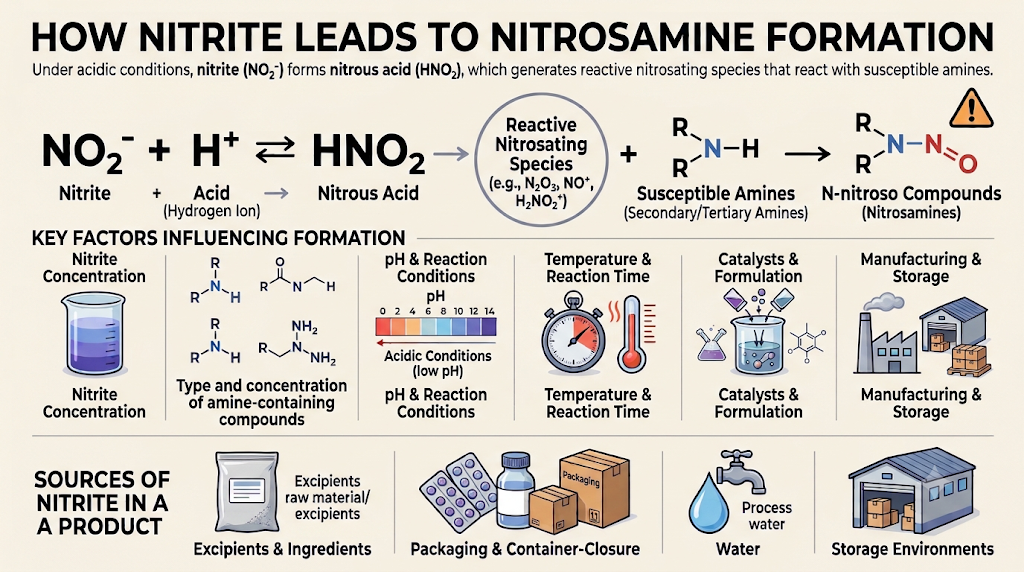
Under acidic conditions, nitrite forms nitrous acid (HNO₂), which generates reactive nitrosating species that can convert susceptible amines into N-nitroso compounds. A simplified representation is:
NO₂⁻ + H⁺ ⇌ HNO₂
Whether this happens in a real product depends on several factors:
- Nitrite concentration
- Type and concentration of amine-containing compounds
- pH and reaction conditions
- Temperature and reaction time
- Catalysts or other formulation components
- Manufacturing and storage conditions
Nitrite can also enter a product from packaging, water, and storage environments, not only from the excipients themselves. For container-closure and packaging-related questions, see our nitrosamine and leachables testing.
What is the difference between nitrite testing and nitrosamine testing?
Nitrite testing measures inorganic nitrite ions, while nitrosamine testing measures specific N-nitroso compounds. Nitrite analysis supports a risk assessment but does not replace direct nitrosamine testing.
Which frameworks support nitrite risk assessment?
Nitrite results are interpreted within the following frameworks:
- FDA nitrosamine guidance: Recommendations for identifying, assessing, and controlling nitrosamine impurities in human drugs.
- ICH Q9(R1): Principles of quality risk management.
- ICH Q2(R2): Validation of analytical procedures.
- ICH Q14: Analytical procedure development.
- ICH M7(R2): Assessment and control of DNA-reactive (mutagenic) impurities.
A comprehensive nitrosamine risk assessment should weigh nitrite sources, vulnerable amines, process conditions, formulation and storage interactions, and the need for confirmatory nitrosamine testing.
2: Which Methods Are Used for Nitrite Quantification in Pharmaceutical Excipients?
Three approaches dominate: ion chromatography (direct, robust), derivatization with colorimetric or fluorescent detection (accessible, sensitive), and LC-MS/MS, usually of a derivatized nitrite product (most selective and sensitive). Each solves a different problem, so the right choice depends on the matrix and the decision the data must support.
How does ion chromatography measure nitrite?
Ion chromatography separates nitrite from other anions on an ion-exchange column and detects it, most often by suppressed conductivity or UV absorbance at low wavelength. It is well suited to aqueous extracts of excipients and drug products.
- Strengths: Direct measurement with no derivatization, simple sample preparation (dissolve or extract, filter, inject), and good robustness for routine lot release or screening.
- Limitations: Large chloride, sulfate, or phosphate peaks can mask nitrite at trace level, and nitrite can oxidize to nitrate or be lost in unstable extracts, so extraction conditions and sample hold times matter.
A typical IC workflow runs as follows:
- Sample preparation: Extract nitrite from the excipient with an aqueous extraction procedure.
- Filtration: Remove insoluble particles with a compatible membrane filter.
- Separation: Inject onto an anion-exchange column, which resolves nitrite from chloride, nitrate, sulfate, phosphate, and fluoride.
- Detection: Measure the nitrite peak, commonly by suppressed conductivity, which lowers eluent background and improves sensitivity.
- Quantification: Compare the response with a calibration curve from nitrite reference standards.
- Evaluation: Calculate concentration and confirm suitability using recovery, precision, and specificity data.
IC is especially useful for supplier qualification, incoming raw material testing, and batch-to-batch comparison across excipient lots.
How does LC-MS/MS support nitrite quantification?
LC-MS/MS offers the highest selectivity and sensitivity, but nitrite itself is a small, polar, low-mass ion that retains poorly on common LC columns and ionizes weakly. In practice, laboratories convert nitrite into a larger, more detectable product first and then quantify that product by LC-MS/MS, often with an isotope-labeled internal standard.
- Strengths: Very low reporting levels, strong specificity in complex matrices, and confirmatory power when IC results are ambiguous.
- Limitations: Higher instrument and expertise requirements, careful control of matrix effects, and the need to prove the derivatization is reproducible.
LC-MS is particularly valuable when:
- Very low nitrite concentrations must be investigated
- Complex formulations challenge conventional detection
- High analytical selectivity is required
- A derivatization-based result needs molecular confirmation
- A broader investigation covers nitrite and related impurities
Its main watch-points are ion suppression or enhancement from co-extracted matrix, background contamination from solvents and reagents, and the added complexity of any derivatization step.
What are derivatization methods for nitrite?
Derivatization converts nitrite into a species that is easy to detect. Two families are common:
- Griess-type reactions: Nitrite reacts under acidic conditions with an aromatic amine and a coupling agent to form a colored azo dye, read by UV-Vis. It is simple and inexpensive, but its sensitivity is moderate and colored or turbid excipient extracts can interfere.
- Fluorogenic reagents such as 2,3-diaminonaphthalene (DAN): Nitrite reacts with DAN under acid conditions to form a highly fluorescent product, which can be read by fluorescence or by LC-MS/MS. Sensitivity is high, but pH, reaction time, and reagent purity must be tightly controlled.
A key practical point: derivatization conditions can themselves create or destroy nitrite if the sample contains reactive amines or reducing agents, so method development should test for these artifacts.
The Griess reaction works in two stages. First, nitrite reacts with an aromatic primary amine under acidic conditions to form a diazonium intermediate. Second, that intermediate couples with another aromatic compound to form a colored azo dye. Absorbance, read by UV-visible spectrophotometry at a wavelength set during method development, is proportional to nitrite within the validated working range.
Typical derivatization limitations include reagent purity and stability, reactive compounds that interfere with color development, sample coloration that distorts absorbance, and added variability from the extra reaction steps.
How do the three approaches compare side by side?
| Factor | Ion chromatography | Derivatization (Griess / DAN) | LC-MS/MS (typically after derivatization) |
|---|---|---|---|
| Sample preparation | Simple extraction and filtration | Moderate: controlled reaction step | Moderate to high: reaction plus cleanup |
| Sensitivity | Good for screening | Moderate (Griess) to high (DAN) | Highest |
| Selectivity | Good, but anion crowding can interfere | Variable, reagent-dependent | Highest, mass-based confirmation |
| Matrix tolerance | Strong for aqueous extracts | Sensitive to color, pH, and reducing agents | Strong with an isotope-labeled standard |
| Throughput | High | High | Moderate |
| Best used for | Routine excipient and product screening | Accessible, cost-conscious testing | Low-level, confirmatory, or complex-matrix work |
Reporting levels depend on the matrix, the extraction ratio, and the validated method, so confirm them through method-specific validation rather than from a generic table.
3: How Should You Choose a Method for Nitrite Quantification in Pharmaceutical Excipients?
Choose the method by working backward from the decision the data supports: start with the matrix and the required reporting level, then pick the simplest technique that meets them with margin. Over-engineering costs time, while under-engineering risks unreliable data in a regulatory file.
| If your situation is… | Start with… |
|---|---|
| Routine screening of excipient lots with a clean aqueous extract | Ion chromatography |
| Need very low reporting levels or confirmation of a borderline result | Derivatization with LC-MS/MS |
| Limited instrumentation, moderate sensitivity acceptable | Griess or DAN derivatization with UV-Vis or fluorescence |
| Colored, oily, or highly ionic matrix that interferes with detection | LC-MS/MS with an isotope-labeled internal standard |
What should a validated nitrite method demonstrate?
A validated nitrite method should demonstrate specificity, accuracy, precision, linearity, range, and a reporting limit appropriate to the intended use, following ICH Q2(R2) principles. For nitrite specifically, the following deserve extra attention:
- Spike recovery in the real matrix: Recovery in each excipient or product, not just in clean solvent, because matrix effects differ widely.
- Sample stability: Nitrite can change during extraction and storage, so hold times and temperature should be defined and tested.
- No artifact formation: Evidence that the sample preparation does not generate or consume nitrite.
- Blank control: Low and well-characterized blanks, since water, reagents, and glassware can contribute nitrite at trace level.
| Validation parameter | Purpose |
|---|---|
| Specificity | Shows nitrite can be distinguished from interfering components |
| Accuracy | Closeness of measured results to accepted reference values |
| Precision | Repeatability and intermediate precision |
| Linearity and range | Concentration interval where the method performs acceptably |
| LOD and LOQ | Lowest level detected and reliably quantified |
| Robustness | Effect of deliberate variations in analytical conditions |
Recovery studies are especially important for excipients: known amounts of nitrite are added to representative samples and the measured values are compared with expected ones. Acceptance criteria should be scientifically justified by the method’s intended use and range, rather than taken from an arbitrary universal limit.
What are the most common pitfalls?
- Relying on a supplier certificate or literature value instead of lot-specific data
- Using a method validated in one excipient for a different one without re-checking recovery
- Ignoring nitrate, which can interconvert or co-elute and confuse the nitrite result
- Reporting a result without stating the extraction ratio and the limit of quantitation
What factors most affect nitrite accuracy?
Accuracy depends on sample preparation, nitrite stability, matrix effects, and calibration, so a sensitive instrument cannot rescue poor sample handling.
- Sample preparation and extraction: Solvent choice, extraction time and temperature, sample-to-solvent ratio, homogenization, filter compatibility, and contamination control all change recovery. See our guidance on sample preparation and extraction.
- Nitrite stability: pH, temperature, and storage time can alter nitrite before analysis, so define handling and storage procedures.
- Matrix effects: High salt can disturb IC separation, and co-extracted organics can suppress LC-MS signal. Matrix-matched calibration, standard addition, and cleanup help.
- Calibration and standards: Use reference standards with documented purity and traceability, plus blanks, system suitability checks, independent QC samples, and internal standards where applicable.
How Does ResolveMass Laboratories Approach Nitrite and Nitrosamine Testing?
ResolveMass Laboratories Inc. approaches nitrite testing as part of a complete nitrosamine control strategy, not as a standalone number. As a Canadian analytical CRO/CDMO specializing in mass spectrometry, biosimilar characterization, PLGA-based drug delivery, and nitrosamine testing, our scientists combine method development, matrix-specific validation, and clear reporting so that results stand up to regulatory scrutiny.
In practice, that means selecting the technique with the client’s matrix and decision in mind, documenting the rationale, and delivering data packages that a quality or regulatory reviewer can follow without guesswork. If you are building or refreshing a nitrosamine risk assessment, our team can help you decide which excipients to test, which method fits, and how to interpret the results. You can contact ResolveMass Laboratories to discuss your project.
Analytical support can include:
- Method development, optimization, validation, verification, and transfer
- Trace-level impurity investigations and impurity profiling
- LC-MS and LC-MS/MS investigations
- Excipient and raw material characterization
- Analytical troubleshooting and support for CMC documentation and quality investigations
The same mass spectrometry expertise supports related characterization work, including peptide assay discrepancy investigations and PTM and glycosylation analysis.
Conclusion:
Nitrite Quantification in Pharmaceutical Excipients is now a standard part of managing nitrosamine risk. Ion chromatography offers a dependable, low-complexity route for screening, derivatization methods extend access and sensitivity, and LC-MS/MS provides the selectivity needed for the hardest questions. The strongest programs match the method to the matrix, validate it in the real formulation, and use lot-specific data to support their risk assessments.
Frequently Asked Questions:
Nitrite testing helps identify potential sources of nitrosating agents that may react with susceptible amines to form nitrosamine impurities. It supports pharmaceutical impurity control and nitrosamine risk assessments.
Yes. Ion chromatography with suppressed conductivity detection can provide sensitive nitrite analysis. Its performance depends on column selection, eluent composition, sample preparation, and matrix interference.
The Griess assay is a colorimetric method that converts nitrite into a colored azo compound through a chemical reaction. The resulting absorbance is measured using UV-visible spectrophotometry to determine nitrite concentration.
Yes. Under suitable chemical conditions, nitrite can generate reactive nitrosating species that react with susceptible amines to form N-nitroso compounds. However, nitrite presence alone does not confirm nitrosamine formation.
Nitrite is commonly extracted using an appropriate aqueous extraction procedure. The sample may then be homogenized, filtered, and analyzed using ion chromatography or another validated analytical technique.
Direct LC-MS analysis may be possible with suitable chromatographic and ionization conditions. However, because nitrite is a small inorganic ion, derivatization may be used to improve analytical compatibility and detection.
Reference
- Hickert S, Näf K, Zheng J, Balogh T, Smith CD, Pallicer JM, van Wijk T, Akkermans R, Thonne S, Blom G, Sabatowski J. Nitrite testing in excipients–Industry best practices. European Journal of Pharmaceutical Sciences. 2025 Aug 12:107236.https://www.sciencedirect.com/science/article/pii/S0928098725002350
- Ahn I, Lee S, Jung MJ, Jeong Y, Kim JY, Kim M, Kim PS, Lee BH, Lee YM, Son KH. Development and Application of Analytical Methods to Quantitate Nitrite in Excipients and Secondary Amines in Metformin API at Trace Levels Using Liquid Chromatography–Tandem Mass Spectrometry. Chemosensors. 2025 Aug 13;13(8):307.https://www.mdpi.com/2227-9040/13/8/307
- Manchuri KM, Kuril AK, Shaik MA, Gopireddy VS, Sultana N. An update on latest regulatory guidelines and analytical methodologies for N-nitrosamine impurities in pharmaceutical products–2024. Medical Gas Research. 2025 Apr 29;15(4):535.https://pmc.ncbi.nlm.nih.gov/articles/PMC12124699/
- Jireš J, Douša M. Nitrites as precursors of N-nitrosation in pharmaceutical samples–A trace level analysis. Journal of pharmaceutical and biomedical analysis. 2022 May 10;213:114677.https://www.sciencedirect.com/science/article/pii/S073170852200098X
- Pratiwi R, Shalima AD, Mutakin, Hasanah AN. Recent Analytical Methods for N-Nitrosamine Analysis as Impurities in Drug Substances and Drug Products. Journal of Analytical Methods in Chemistry. 2026;2026(1):9550913.https://onlinelibrary.wiley.com/doi/abs/10.1155/jamc/9550913
- Zhu K, Kerry M, Serr B, Mintert M. Parts per billion of nitrite in microcrystalline cellulose by ion chromatography mass spectrometry with isotope labeled internal standard. Journal of Pharmaceutical and Biomedical Analysis. 2023 Oct 25;235:115648.https://www.sciencedirect.com/science/article/pii/S073170852300417X
About the Author