Introduction
In recent years, the presence of nitrosamine impurities in pharmaceuticals has become a significant concern for regulatory agencies and the pharmaceutical industry. Nitrosamines are potent carcinogens that can form during the manufacturing process of certain drugs, posing serious health risks to patients. To address this issue, rigorous testing for nitrosamine impurities is essential to ensure the safety and efficacy of pharmaceutical products. Resolvemass Laboratories, a leading Contract Research Organization (CRO) specializing in custom synthesis and analytical services, offers advanced mass spectrometry testing services to detect and quantify nitrosamine impurities with unparalleled accuracy and precision.
Article Highlights
- Nitrosamines are harmful impurities that can form during drug manufacturing and must be strictly controlled.
- Regulatory agencies require sensitive testing and risk assessment to ensure pharmaceutical safety.
- Mass spectrometry is the most reliable method for detecting nitrosamines at very low levels.
- Proper testing, monitoring, and prevention strategies help manufacturers maintain compliance and protect patients.
- Resolvemass Laboratories provides advanced testing solutions to accurately detect and manage nitrosamine risks.
Understanding Nitrosamine Impurities
Nitrosamines are a class of chemical compounds that can form under specific conditions during the production of pharmaceuticals, particularly in drugs containing amine groups or those manufactured with certain solvents. Common nitrosamines include N-nitrosodimethylamine (NDMA), N-nitrosodiethylamine (NDEA), and N-nitrosodiisopropylamine (NDIPA). These impurities can be introduced through various pathways, such as:
- Contaminated Raw Materials: Impurities in raw materials used during drug synthesis can lead to the formation of nitrosamines.
- Manufacturing Processes: Certain chemical reactions and conditions, such as high temperatures and acidic environments, can promote nitrosamine formation.
- Storage and Packaging: Degradation of drug products during storage and interactions with packaging materials can also result in nitrosamine contamination.
Due to their carcinogenic nature, regulatory agencies such as the U.S. Food and Drug Administration (FDA) and the European Medicines Agency (EMA) have set strict limits on acceptable levels of nitrosamine impurities in pharmaceutical products. Compliance with these regulations requires accurate and sensitive analytical methods for nitrosamine detection and quantification.
Learn more about how regulatory updates impact your strategy: Explore the Impact of ICH M7(R2) Updates on Nitrosamine Risk Assessment
Sources of Nitrosamine Formation in Pharmaceutical Supply Chains
Nitrosamine contamination is not always limited to the final stages of drug manufacturing; it can originate anywhere within the pharmaceutical supply chain. Raw material suppliers, intermediate manufacturers, and even excipient vendors can unintentionally introduce nitrosamine precursors into the production process. For example, the use of recycled solvents, contaminated reagents, or improperly purified intermediates may create favorable conditions for nitrosamine formation. These risks highlight the importance of thoroughly qualifying suppliers and implementing strict incoming material testing protocols to minimize contamination risks from external sources.
In addition, cross-contamination within manufacturing facilities can contribute to nitrosamine presence if proper cleaning validation procedures are not followed. Shared equipment used for multiple products may retain trace residues capable of forming nitrosamines under subsequent processing conditions. Environmental factors such as airborne contaminants, water quality, and process utilities may also play a role. Therefore, pharmaceutical companies must implement a holistic risk-based approach that evaluates the entire supply chain, ensuring that preventive controls are applied at every stage to reduce the likelihood of nitrosamine formation.
Compare international safety standards for your products: View our Nitrosamine AI Limits Comparison Guide
Mass Spectrometry in nitrosamine-impurities-testing
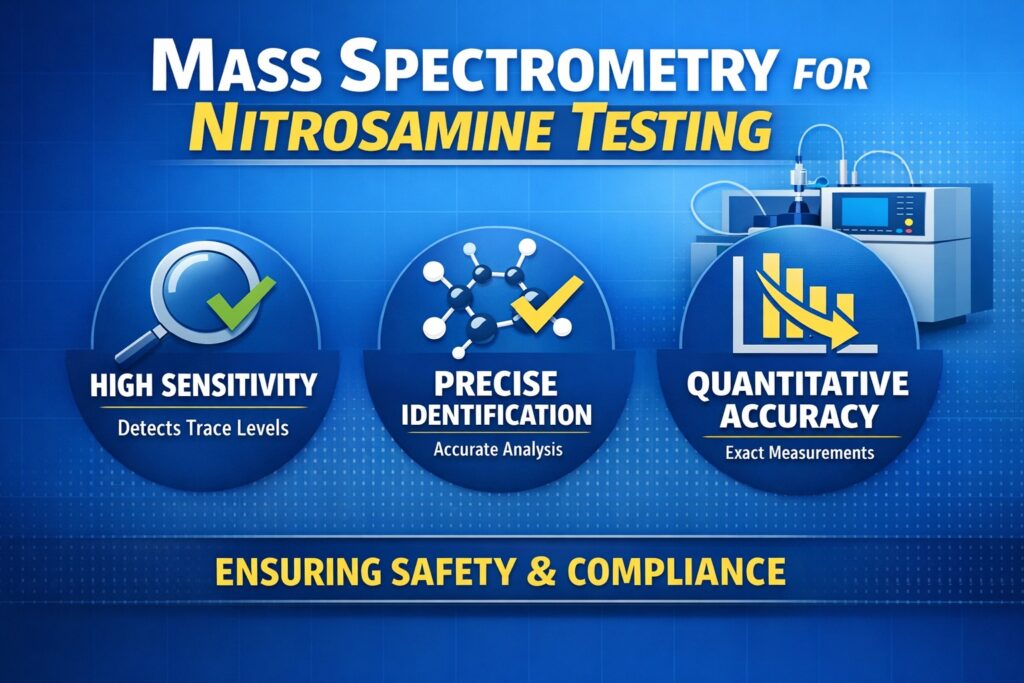
Mass spectrometry (MS) is a powerful analytical technique that has become the gold standard for detecting and quantifying nitrosamine impurities in pharmaceuticals. The technique offers several advantages:
- High Sensitivity: MS can detect trace levels of nitrosamines, often in the parts-per-billion (ppb) range, ensuring that even minute quantities are accurately measured.
- Specificity: MS provides precise identification of nitrosamine compounds, differentiating them from other substances in complex mixtures.
- Quantitative Accuracy: MS allows for accurate quantification of nitrosamine levels, supporting regulatory compliance and risk assessment.
At Resolvemass Laboratories, we leverage cutting-edge mass spectrometry technologies to deliver reliable and comprehensive nitrosamine testing services. Our state-of-the-art instrumentation and expert team of scientists ensure that we meet the highest standards of quality and precision.
Importance of Risk Assessment for Nitrosamine Control
Risk assessment plays a crucial role in identifying and controlling potential nitrosamine impurities before they impact product safety. Pharmaceutical manufacturers must conduct comprehensive evaluations of their processes, including reviewing chemical structures, reagents, solvents, and manufacturing conditions that may contribute to nitrosamine formation. This proactive approach enables companies to identify vulnerable points in the process and implement preventive strategies early, reducing the chances of costly product recalls or regulatory actions.
Furthermore, regulatory agencies encourage the use of scientifically justified risk assessment frameworks to prioritize testing and mitigation efforts. By categorizing products based on their risk level, manufacturers can allocate resources more efficiently and focus analytical testing where it is most needed. Continuous monitoring, combined with periodic reassessment, ensures that any changes in raw materials, suppliers, or production processes do not introduce new nitrosamine risks. This ongoing vigilance strengthens product safety and enhances regulatory confidence.
Understand complex structural risk assessments: Read about the Nitrosamine CPCA Approach for NDSRIs
Our Mass Spectrometry Testing Services
Resolvemass Laboratories offers a comprehensive suite of mass spectrometry testing services tailored to the detection and quantification of nitrosamine impurities. Our process includes the following steps:
Accurate nitrosamine analysis begins with meticulous sample preparation. Our scientists employ advanced techniques to extract nitrosamines from pharmaceutical samples, ensuring that the analytes are isolated and concentrated for analysis. Depending on the sample matrix and the specific nitrosamines being tested, we may use methods such as solid-phase extraction (SPE), liquid-liquid extraction (LLE), or QuEChERS (Quick, Easy, Cheap, Effective, Rugged, and Safe) to prepare the samples.
Prior to mass spectrometric analysis, the nitrosamines are separated from other components in the sample using high-performance liquid chromatography (HPLC) or gas chromatography (GC). This step is crucial for reducing matrix interferences and enhancing the specificity of the analysis. Our advanced chromatographic systems are optimized for high-resolution separation, ensuring that each nitrosamine is clearly resolved from other substances.
3. Mass Spectrometric Analysis
The separated nitrosamines are then analyzed using high-resolution mass spectrometry (HRMS) or tandem mass spectrometry (MS/MS). These techniques offer unparalleled sensitivity and specificity, allowing for the precise identification and quantification of nitrosamine impurities. Our laboratory is equipped with state-of-the-art instruments, including triple quadrupole MS, quadrupole time-of-flight (Q-TOF) MS, and Orbitrap MS, which enable us to detect nitrosamines at trace levels.
4. Data Analysis and Reporting
The data obtained from the mass spectrometric analysis is meticulously processed and interpreted by our team of experts. We use advanced software tools and algorithms to ensure accurate identification and quantification of nitrosamines. Comprehensive reports are generated, detailing the levels of nitrosamine impurities detected in the samples, along with relevant regulatory guidelines and recommendations for corrective actions if necessary.
Technical Insight: Calculate carryover risks effectively: Learn how to perform Nitrosamine Purge Factor Calculations
Emerging Analytical Technologies for Nitrosamine Detection
In addition to traditional mass spectrometry methods, newer analytical technologies are being explored to enhance nitrosamine detection capabilities. Advanced hybrid systems combining ultra-high-performance liquid chromatography (UHPLC) with high-resolution mass spectrometry offer improved separation efficiency and faster analysis times. These innovations enable laboratories to detect multiple nitrosamines simultaneously while maintaining excellent sensitivity and accuracy. As pharmaceutical products become more complex, these enhanced technologies play a critical role in ensuring comprehensive impurity profiling.
Automation and digital integration are also transforming the analytical testing landscape. Modern laboratory systems incorporate automated sample handling, real-time monitoring, and advanced data processing tools that improve efficiency and reduce human error. These technological advancements allow laboratories to process larger sample volumes while maintaining consistent quality standards. As a result, pharmaceutical companies benefit from faster turnaround times, improved reproducibility, and greater confidence in their nitrosamine testing results.
At Resolvemass Laboratories, we adhere to stringent quality control and assurance protocols to ensure the reliability and accuracy of our nitrosamine testing services. Our laboratory is equipped with state-of-the-art instrumentation, and our scientists are highly trained in the latest analytical techniques and regulatory requirements. Key aspects of our quality control program include:
- Method Validation: All analytical methods used for nitrosamine testing are thoroughly validated according to international guidelines. This includes assessing parameters such as accuracy, precision, specificity, sensitivity, linearity, and robustness to ensure the methods are fit for purpose.
- Instrument Calibration and Maintenance: Regular calibration and maintenance of our mass spectrometry instruments are performed to ensure optimal performance and accuracy. We use certified reference materials and standards to calibrate our instruments and verify their performance.
- Proficiency Testing: Our laboratory participates in external proficiency testing programs to benchmark our performance against industry standards and ensure the accuracy and reliability of our results.
- Internal Audits and Training: Routine internal audits are conducted to review our processes and identify areas for improvement. Our scientists undergo continuous training to stay updated on the latest advancements in mass spectrometry and regulatory requirements.
Stay compliant with the latest reporting standards: Guide to Nitrosamine Specification Setting
Global Regulatory Expectations and Compliance Trends
Regulatory authorities worldwide have increased their focus on nitrosamine control in recent years, requiring pharmaceutical companies to adopt more stringent monitoring and reporting practices. Agencies now expect manufacturers to perform detailed risk evaluations, implement validated analytical methods, and maintain thorough documentation of their nitrosamine control strategies. Failure to meet these expectations can result in product recalls, import restrictions, or delays in regulatory approvals, which may significantly impact business operations and patient access to essential medications.
In response, pharmaceutical companies are strengthening their compliance frameworks by integrating advanced analytical testing and continuous quality improvement initiatives. Regulatory expectations continue to evolve as scientific understanding of nitrosamines improves, making it essential for manufacturers to stay informed about the latest guidance. Proactive compliance not only ensures regulatory approval but also reinforces public trust in pharmaceutical products by demonstrating a strong commitment to safety and quality.
Case Study: nitrosamine-impurities-testing for a Pharmaceutical Client
A leading pharmaceutical company approached Resolvemass Laboratories for nitrosamine testing services for one of their drug products. The company needed to ensure compliance with the latest regulatory guidelines on nitrosamine impurities. Here’s how we addressed their needs:
Challenges
- Complex Matrix: The drug product had a complex formulation, making the extraction and analysis of nitrosamines challenging.
- Low Detection Limits: The required detection limits for nitrosamines were in the parts-per-billion (ppb) range, necessitating highly sensitive and specific analytical methods.
- Regulatory Compliance: The company needed to comply with stringent regulatory guidelines from both the FDA and EMA.
Evaluate risk for products with multiple impurities: Understanding Acceptable Intake for Multiple Nitrosamines
Solution
- Optimized Sample Preparation: We developed a customized sample preparation method to effectively extract nitrosamines from the complex matrix. This involved using a combination of SPE and LLE techniques to achieve high recovery rates.
- Advanced Chromatography and MS Techniques: Our team employed high-resolution GC-MS/MS to achieve the required sensitivity and specificity for detecting nitrosamines at trace levels. The method was validated to ensure it met all regulatory requirements.
- Comprehensive Reporting and Guidance: We provided the client with detailed reports on the levels of nitrosamine impurities detected, along with expert guidance on regulatory compliance and recommendations for mitigating the presence of nitrosamines in their product.
Outcome
The successful detection and quantification of nitrosamine impurities enabled the pharmaceutical company to comply with regulatory guidelines and ensure the safety of their drug product. Our comprehensive testing and expert guidance helped them address potential risks and implement corrective measures in their manufacturing process.
Preventive Strategies to Minimize Nitrosamine Impurities
Preventing nitrosamine formation is more effective than relying solely on final product testing. Manufacturers can implement preventive measures such as selecting high-purity raw materials, avoiding nitrosating agents, and optimizing reaction conditions to reduce impurity formation. Careful control of process parameters, including temperature, pH, and reaction time, can significantly minimize the risk of nitrosamine generation. Additionally, evaluating alternative synthetic routes may help eliminate the need for reagents that contribute to nitrosamine formation.
Another important preventive strategy involves implementing robust process monitoring and change control systems. Any modifications to manufacturing processes, suppliers, or materials should be carefully evaluated for their potential impact on nitrosamine risk. Regular training of personnel and maintaining strong quality management systems further ensure that preventive practices are consistently followed. These proactive measures help pharmaceutical companies maintain compliance, protect patient safety, and ensure long-term product quality.
Discover effective mitigation techniques: How to use Secondary Amine Scavengers to prevent Nitrosamine formation
Conclusion
Mass spectrometry testing for nitrosamine impurities is essential for ensuring the safety and efficacy of pharmaceutical products. At Resolvemass Laboratories, we offer advanced mass spectrometry testing services that deliver accurate and reliable results, helping our clients meet regulatory requirements and safeguard patient health. Our commitment to quality, precision, and innovation makes us a trusted partner for nitrosamine testing and other analytical services.
ResolveMass Laboratories Inc.: Experience, Expertise, and Trust You Can Count On
ResolveMass Laboratories Inc. has established itself as a trusted name in the domain of nitrosamine testing services in Canada. With over a decade of dedicated experience, we have completed hundreds of successful nitrosamine testing and risk assessment projects for both domestic and international clients. Our scientists possess advanced degrees in analytical chemistry and pharmaceutical sciences, bringing a wealth of expertise to every project.
We are one of the few Canadian CROs to offer a complete in-house nitrosamine testing solution—from risk assessment to confirmatory analysis, regulatory documentation, and expert consultation. We continually invest in cutting-edge technologies and method development, keeping pace with evolving regulations and industry demands.
Our clients trust us because we not only deliver accurate results but also help them understand and resolve complex impurity challenges. Choose ResolveMass Laboratories for your nitrosamine testing services in Canada—where precision meets reliability.
Ready to Get Started?
📩 Contact our expert team
📞 Request a quote for method development
📅 Book a consultation with our scientists
🧪 Submit your sample for testing
Frequently Asked Questions:
Nitrosamine impurities are unwanted chemical compounds that may form during the manufacturing, storage, or packaging of certain medicines. These compounds are considered harmful because many of them are classified as probable cancer-causing substances. Even very small quantities can pose long-term health concerns. Therefore, pharmaceutical companies must carefully monitor and control their presence.
Nitrosamines can form when certain chemical ingredients, especially amines, react with nitrosating agents under specific conditions like high temperature or acidic environments. They may also originate from contaminated raw materials, recycled solvents, or process residues. Improper storage or interaction with packaging materials can further contribute to their formation. This makes process control essential throughout production.
Global regulatory authorities require pharmaceutical companies to evaluate the risk of nitrosamine formation and perform validated analytical testing. They must also maintain proper documentation and implement preventive strategies. These measures ensure medicines meet safety standards before reaching patients. Failure to comply can result in product recalls or regulatory action.
Manufacturers can reduce risk by using high-quality raw materials and avoiding chemicals that promote nitrosamine formation. Careful control of process conditions such as temperature and pH is also important. Regular testing and supplier qualification help identify potential risks early. Preventive planning is more effective than relying only on final product testing.
Risk assessment helps identify stages in the manufacturing process where nitrosamines are most likely to form. This allows companies to apply targeted controls and testing where needed. It also supports efficient use of resources and ensures compliance with regulations. Continuous review helps maintain long-term product safety and quality.
Reference:
- Shaikh, T. (2020, January 1). Nitrosamine impurities in drug substances and drug products. SSRN. https://doi.org/10.5281/zenodo.3629095
- Dobo, K. L., Kenyon, M. O., Dirat, O., Zann, V., White, A., Ponting, D. J., & Thomas, R. (2022). Practical and science-based strategy for establishing acceptable intakes for drug product N-nitrosamine impurities. Chemical Research in Toxicology, 35(3), 475–489. https://doi.org/10.1021/acs.chemrestox.1c00369
- Sedlo, I., Kolonić, T., & Tomić, S. (2021). Presence of nitrosamine impurities in medicinal products. Archives of Industrial Hygiene and Toxicology, 72(1), 1–5. https://doi.org/10.2478/aiht-2021-72-3491
GET IN TOUCH WITH US
For more information about our mass spectrometry testing services and how we can assist with nitrosamine impurities testing, please visit Resolvemass laboratories

Analytical Testing Services for Peptide-Oligonucleotide Conjugates
Introduction: Why Specialized Peptide Oligonucleotide Conjugate Analysis Is Essential Peptide Oligonucleotide Conjugate Analysis is critical…
NDA vs ANDA Nitrosamine Data Requirements: What Sponsors Must Submit
Introduction: The global pharmaceutical industry is facing strict regulatory control for mutagenic impurities, especially nitrosamines….
How to Prepare a Complete Nitrosamine Risk Assessment Report for ANDA Submission
Introduction A comprehensive Nitrosamine Risk Assessment for ANDA Submission requires a structured and scientific evaluation…

Nitrosamine Testing in Stability Studies: Designing Long-Term Monitoring Programs
Introduction Nitrosamine Testing in Stability Studies is no longer limited to initial risk mitigation. It…

Analytical Techniques Used in Peptide Sameness Testing
Introduction: Peptide Sameness Testing Methods are advanced analytical strategies used to demonstrate that a generic…
What Makes a CRO Reliable for Complex Generic Molecules?
Introduction Selecting a Reliable CRO for Generic Drugs becomes more challenging when dealing with advanced…