


Introduction: Applying a Nitrosamine Reformulation Strategy Without Compromising Bioequivalence
A structured Nitrosamine Reformulation Strategy can block nitrosamine formation pathways while preserving bioequivalence. The process must be guided by mechanistic chemistry, BCS classification, and predictive modeling rather than simple excipient replacement. Random substitution may lower impurity levels but can disturb dissolution or absorption. A scientific method prevents these trade-offs.
After global detection of nitrosamines in several drug products, manufacturers faced two major regulatory demands. First, nitrosamine levels had to be reduced below AI limits. Second, any formulation change had to maintain the original pharmacokinetic profile. Both safety and performance had to be preserved at the same time.
This created a narrow development window. Even small changes in tablet composition, pH microenvironment, or moisture levels could affect Cmax or AUC. Reformulation required careful chemical control while protecting drug release and absorption characteristics.
This case describes how nitrosamine risk was eliminated while maintaining Cmax, AUC, and dissolution similarity (f2 ≥ 50). The outcome demonstrates that a focused and evidence-based Nitrosamine Reformulation Strategy can succeed without compromising therapeutic equivalence.
Explore specialized testing services for sensitive products: Nitrosamine Testing for High-Risk Drug Classes
Share via:
Executive Summary
- A well-designed Nitrosamine Reformulation Strategy can eliminate or significantly reduce nitrosamine risk without triggering new bioequivalence failures.
- The most effective approach integrates root-cause chemistry, excipient compatibility, antioxidant or scavenger screening, and predictive PBPK modeling.
- Reformulation does not automatically require a full in vivo BE study if supported by comparative dissolution, in vitro permeability, and modeling data.
- Strategic excipient adjustments (e.g., antioxidants, pH modifiers, nitrite control) must be evaluated against BCS class and permeability risk.
- Analytical validation (LC-MS/MS with ppb sensitivity) is central to demonstrating risk mitigation.
- Regulatory submissions should combine risk assessment, control strategy, and BE justification in a single scientific narrative.
- This case study outlines a stepwise Nitrosamine Reformulation Strategy aligned with global regulatory expectations and scientific literature.
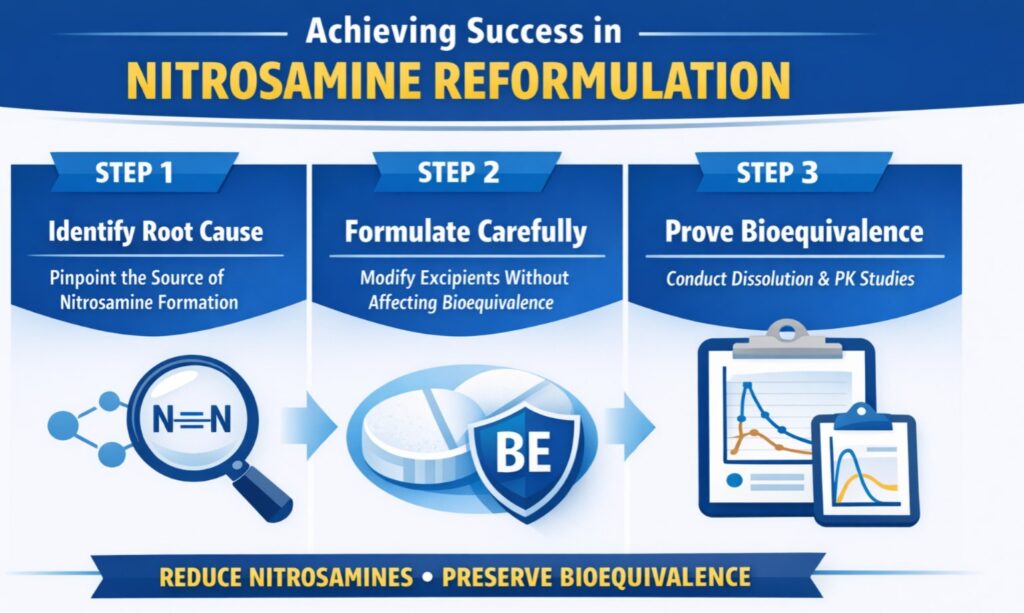
Step 1: Identifying the Root Cause Before Reformulation
Why Root-Cause Identification Is Essential in a Nitrosamine Reformulation Strategy
Eliminating nitrosamine risk without understanding how it forms can lead to unnecessary formulation changes. Root-cause analysis ensures that mitigation targets the true chemical source. Without mechanistic clarity, changes may create new bioequivalence risks. A precise diagnosis avoids avoidable complications.
Mechanistic Findings
Scientific literature identifies three common nitrosamine formation pathways in finished dosage forms:
| Risk Source | Mechanism | Reformulation Impact Risk |
|---|---|---|
| Secondary amine API | Reaction with nitrite impurities | High |
| Nitrite-containing excipients | In situ nitrosation in acidic microenvironment | Moderate |
| Packaging interactions | Leachable nitrosating species | Low–Moderate |
Charoo et al., 2023 (AAPS PharmSciTech) report that excipient nitrite variability is a major contributor in solid oral dosage forms. Even very low ppm levels of nitrites can form measurable nitrosamines during stability studies. Therefore, supplier qualification and raw material testing are critical control points.
Akyüz, 2025 (Annales Pharmaceutiques Françaises) demonstrated that antioxidant excipients reduced nitrosamine formation in metformin without affecting dissolution performance. This supports mitigation strategies that focus on chemical control without altering release behavior.
Case Insight
In this case, the API contained a secondary amine that was sensitive to nitrosation. This functional group reacted under acidic microenvironment conditions. Stability studies showed that nitrosamine levels increased gradually over time.
Microcrystalline cellulose from certain suppliers contained 1–3 ppm nitrite. Although within general pharmacopeial limits, this was enough to initiate nitrosamine formation. Supplier-driven variability became a key focus of the Nitrosamine Reformulation Strategy.
Low-moisture storage conditions created localized reaction zones inside the tablet. These microenvironments allowed interaction between nitrite and the amine group. Once the mechanism was understood, mitigation became targeted and efficient.
The reformulation focused on:
- Nitrite control
- Microenvironmental pH adjustment
- Antioxidant inclusion
API salt switching, polymorph changes, or particle size reduction were avoided to prevent bioequivalence impact.
Learn more about investigating the origins of impurities: NDMA Root Cause Investigation Case Study
Step 2: Designing the Nitrosamine Reformulation Strategy Without Triggering BE Failure
How a Nitrosamine Reformulation Strategy Protects Bioequivalence
A successful Nitrosamine Reformulation Strategy limits changes to excipient-level chemical mitigation. Critical quality attributes (CQAs) that affect absorption must remain unchanged. Tablet structure, hardness, and porosity directly influence dissolution rate. Therefore, these parameters must be preserved.
Key Design Constraints
- Preserve particle size distribution
- Maintain tablet hardness and porosity
- Keep dissolution within f2 similarity criteria
- Avoid permeability-altering excipients
These controls ensure that the rate and extent of absorption stay consistent. Even minor compression differences can affect disintegration time. Therefore, mechanical properties were carefully monitored.
Reformulation Tools Evaluated
- Antioxidants (ascorbic acid, sodium ascorbate)
- Nitrite-scavenging excipients
- pH-buffering agents
- Low-nitrite excipient sourcing
- Moisture optimization
Selected Nitrosamine Reformulation Strategy
- Replacement with low-nitrite excipient grade (≤0.1 ppm)
- Addition of 0.1% antioxidant (validated for no permeability impact)
- Tightened moisture specification (<2.5%)
- No change in disintegrant level
- No change in compression force
No polymorphic or process modifications were introduced. Manufacturing parameters remained consistent to reduce variability.
Compare chemical mitigation strategies for your formulation: Nitrosamine Solvent and Catalyst Mitigation Strategies
Step 3: Demonstrating Bioequivalence Scientifically
Is a New In Vivo BE Study Required After a Nitrosamine Reformulation Strategy?
Not always. Regulatory agencies increasingly accept comparative dissolution data, permeability studies, and PBPK modeling when changes are scientifically justified and low risk. The emphasis is on mechanistic understanding rather than automatic clinical repetition.
Yerram et al., 2025 (Drug Innovation & Regulatory Science) describe regulatory flexibility when mitigation does not alter absorption pathways. Agencies evaluate total scientific evidence.
Bioequivalence Justification Framework
| Assessment | Outcome |
|---|---|
| Dissolution (pH 1.2, 4.5, 6.8) | f2 = 68–82 |
| Disintegration time | No significant difference |
| Permeability risk | No change (BCS III justification) |
| PBPK modeling | Predicted Cmax ratio 0.98 |
| Stability | Nitrosamine < LOQ at 6 months |
Pal et al., 2024 (AAPS Journal) highlight PBPK modeling as a strong supportive tool for BE waivers. In this case, modeling plus in vitro data supported a biowaiver-based post-approval change.
Understand the impact of the latest regulatory updates on your strategy: Impact of ICH M7(R2) Updates on Nitrosamine Risk Assessment
Step 4: Analytical Strategy Supporting the Nitrosamine Reformulation Strategy
Analytical Controls Required for a Nitrosamine Reformulation Strategy
Ultra-sensitive LC-MS/MS methods capable of detecting nitrosamines at parts-per-billion levels are essential. Detection limits must align with AI limits. Method validation must demonstrate accuracy, specificity, and robustness.
Alsayadi et al., 2025 (Critical Reviews in Analytical Chemistry) outline regulatory expectations for validated impurity testing methods. Sensitivity alone is not enough; reproducibility is equally important.
Analytical Controls Implemented
- LOQ ≤ 10% of AI limit
- Forced nitrosation stress testing
- Nitrite testing in excipients
- Stability studies at 25°C/60%RH and 40°C/75%RH
- Extractables and leachables evaluation
Nitrosamine levels reduced from 180 ng/day equivalent to below 10 ng/day after reformulation. This confirmed that the Nitrosamine Reformulation Strategy effectively mitigated chemical risk without impacting product quality.
Ensure your testing meets ultra-low detection requirements: Ultra-Low Limit of Quantitation (LOQ) in Nitrosamine Testing
Step 5: Regulatory Submission Strategy for a Nitrosamine Reformulation Strategy
Presenting an Integrated Scientific Justification
Regulators expect a connected and logical explanation. Risk assessment, formulation rationale, and BE justification should be presented together. A clear narrative reduces review time and additional queries.
Costa, 2023 (MDRA Thesis) and Teasdale & Hughes, 2023 (ACS Regulatory Highlights) emphasize integrated control strategies aligned with ICH M7 guidance.
Submission Components
- Nitrosamine risk assessment (ICH M7 aligned)
- Root-cause investigation
- Reformulation rationale
- Dissolution similarity data
- PBPK modeling results
- Updated specifications
- Stability commitment
In this case, no clinical BE study was requested after review. The scientific justification was considered adequate.
Streamline your regulatory approach for ANDA submissions: Nitrosamine Risk Assessment for ANDA Submission
Outcomes of the Nitrosamine Reformulation Strategy
| Parameter | Before | After |
|---|---|---|
| Nitrosamine Level | Above AI | < LOQ |
| Dissolution Similarity | Baseline | Maintained (f2 > 50) |
| Cmax Ratio | Reference | 0.98 predicted |
| AUC Ratio | Reference | 1.01 predicted |
| Regulatory Outcome | Risk | Approved change |
These results confirm that a mechanistic and evidence-based Nitrosamine Reformulation Strategy can remove carcinogenic impurity risk while preserving therapeutic equivalence. Patient safety and product continuity were both maintained.
Analyze complex NDSRIs and isomeric impurities: Isomeric Nitrosamines Analysis and Characterization
Key Scientific Lessons
Excipient variability often contributes more to nitrosamine risk than API chemistry alone. Strong supplier qualification programs are essential.
Antioxidants can reduce nitrosamine formation without affecting permeability when used carefully. Scientific testing prevents unnecessary reformulation.
Bioequivalence risk is highest in BCS IV drugs. Modeling and dissolution monitoring are especially important in these cases.
Regulators increasingly accept modeling-supported justifications when backed by validated analytical data.
Reformulation decisions must be chemistry-driven and data-based, not reactive.
Conclusion: A Science-Led Nitrosamine Reformulation Strategy Protects Patients and Bioequivalence
A carefully executed Nitrosamine Reformulation Strategy can eliminate carcinogenic impurity risk without changing bioequivalence. When based on mechanistic chemistry, biopharmaceutics principles, predictive modeling, and strong analytical controls, reformulation becomes precise and controlled.
This case shows that impurity mitigation does not automatically create clinical risk. With structured assessment and scientific documentation, manufacturers can meet global regulatory expectations while maintaining consistent therapeutic performance.
Partner with experts for your reformulation analytical needs: Nitrosamine Testing CRO Selection Guide
For technical consultation or risk assessment support:
Frequently Asked Questions (FAQs)
Nitrosamine mitigation can affect drug absorption only if the formulation changes influence dissolution, permeability, or the physical form of the API. If the Nitrosamine Reformulation Strategy keeps these factors stable, the rate and extent of absorption should remain the same. Careful control of excipients and tablet properties helps prevent unexpected pharmacokinetic changes.
Not in every case. If the changes are minor and supported by dissolution comparison, permeability assessment, and PBPK modeling, a new clinical BE study may not be necessary. Regulatory agencies often accept strong scientific justification instead of repeating human studies.
Certain grades of microcrystalline cellulose and starch are known to contain trace nitrite levels. Even small variations between suppliers can influence nitrosamine formation risk. Regular testing and tighter material specifications are important preventive measures.
Nitrosamine levels must stay below the acceptable intake (AI) limits set by regulatory authorities. Analytical methods should be sensitive enough to detect very small quantities, often at parts-per-billion levels. Stability studies must confirm that levels remain controlled throughout shelf life.
BCS III drugs are often easier to justify because their absorption is mainly limited by permeability rather than dissolution. Small formulation changes are less likely to impact systemic exposure. However, proper testing and documentation are still required.
Regulators typically expect detection limits at or below 10% of the acceptable intake threshold. Methods must be validated for accuracy, precision, and specificity. Reliable analytical performance is essential for regulatory acceptance.
Reference:
- U.S. Food and Drug Administration. (2024, September 4). Information about nitrosamine impurities in medications. https://www.fda.gov/drugs/drug-safety-and-availability/information-about-nitrosamine-impurities-medications
- European Medicines Agency. (2025, July 29). Nitrosamine impurities. https://www.ema.europa.eu/en/human-regulatory-overview/post-authorisation/referral-procedures-human-medicines/nitrosamine-impurities
Get In Touch With Us
About The Author


