

Introduction:
Nitrosamine Risk Assessment in Generic Drugs is now a key scientific process used to control harmful impurities in medicines. It gained global attention after the detection of NDMA in valsartan in 2018. Since then, the approach has changed from reactive checks to a proactive and lifecycle-based strategy. Today, generic drug companies must treat this assessment as a core scientific responsibility during ANDA submission. It requires a clear understanding of API chemistry, excipient behavior, and controlled manufacturing systems.
Over time, regulators have increased their expectations and now require strong scientific evidence instead of assumptions. The discovery that nitrosamines can form during degradation or through excipient interaction has further strengthened these requirements. This shift has brought focus to Nitrosamine Drug Substance-Related Impurities (NDSRIs), which are harder to detect due to their structural similarity to APIs. As a result, companies must adopt more advanced testing and risk control strategies.
Modern ANDA submissions must clearly connect API structure, formulation design, and storage conditions with nitrosamine risks. This ensures that products are not only effective but also safe over their full lifecycle. Regulatory agencies now closely review how well risks are identified and controlled. Therefore, collaboration across development, quality, and regulatory teams is essential.
Learn more about our specialized Nitrosamine Analysis services for regulatory compliance.
Share via:
Summary:
- Nitrosamine risk assessment is now a critical and mandatory part of generic drug development, evolving into a proactive, lifecycle-based approach after the 2018 NDMA incident.
- Regulatory agencies require strong scientific evidence, including detailed evaluation of API chemistry, excipients, manufacturing processes, and storage conditions.
- Nitrosamine formation can arise from multiple sources such as amine precursors, nitrosating agents, manufacturing conditions, cross-contamination, and packaging materials.
- Advanced tools like CPCA, QSAR modeling, and the Enhanced Ames Test (EAT) are essential for evaluating toxicity, especially for complex NDSRIs.
- Highly sensitive analytical techniques such as LC-MS/MS and HRMS are required to detect nitrosamines at trace levels and meet strict regulatory limits.
- Effective mitigation strategies—including formulation optimization, antioxidant use, pH control, raw material selection, and process changes—help minimize nitrosamine risks.
- Continuous lifecycle management is essential, with reassessment required after any post-approval changes to ensure long-term safety and compliance.
Technical Execution of Nitrosamine Risk Assessment in Generic Drugs within ANDA Frameworks
The technical side of Nitrosamine Risk Assessment in Generic Drugs involves studying how chemical reactions may lead to impurity formation. The main goal is to identify whether amines can react with nitrosating agents under certain conditions. These conditions include heat, moisture, and acidic environments, which are common during manufacturing and storage. A structured and step-by-step evaluation helps ensure that no risk is missed.
Within the ANDA framework, this process must be supported by real data. It includes reviewing API synthesis, solvent quality, and excipient composition. Special attention is given to recycled solvents and nitrite levels in excipients. In addition, contamination risks from equipment and packaging must be considered. When risks are identified, laboratory testing is expected to confirm findings.
Complex products require deeper analysis due to multiple processing steps. Some packaging materials may also introduce hidden sources of nitrites. These factors can lead to impurity formation over time, even if initial conditions are controlled. Therefore, the assessment must cover manufacturing, storage, and distribution stages.
Explore the specific Analytical Requirements for ANDA Submissions to ensure your data meets current standards.
| Risk Factor | Source in Generic Drug Development | Mechanism of Nitrosamine Formation |
| Amine Precursors | API, Degradants, Intermediates, Solvents | Direct nitrosation of secondary or tertiary amines |
| Nitrosating Agents | Reagents ($NaNO_2$), Excipients, Water | Generation of nitrosonium ion ($NO^+$) or $N_2O_3$ |
| Manufacturing Conditions | High Temperature, Low pH, Wet Granulation | Kinetic acceleration of the nitrosation reaction |
| Cross-Contamination | Multi-purpose equipment, Recycled Solvents | Carry-over of impurities from previous batches |
| Packaging Leachates | Blister lidding (Nitrocellulose), Adhesives | Migration of nitrites or nitrosamines into the product |
Structural Vulnerability and Precursor Identification in Generic Drug Substances
Identifying chemical structures that may form nitrosamines is a critical step in Nitrosamine Risk Assessment in Generic Drugs. This involves checking for amine groups within APIs and intermediates. Secondary amines are highly reactive, while tertiary amines may also pose risks under certain conditions. Understanding these structures helps in early risk prevention.
Generic APIs are often sourced from different suppliers, each using different synthesis methods. This creates variability in impurity risks. Common reagents like dimethylamine can act as direct precursors for nitrosamines. Therefore, supplier control and process transparency are very important.
APIs may also degrade over time and form amine-related compounds. These compounds can later form NDSRIs, especially during storage. Stability studies are essential to understand these risks. Including degradation analysis strengthens the overall risk control plan.
Discover how Impurity Identification for ANDA Submission can strengthen your risk control plan.
Evaluating Nitrosating Potential and the “Nitrite Budget” of Excipients
The concept of a “nitrite budget” is important when evaluating excipients. Even though excipients are inactive, they may contain small amounts of nitrites. These small levels can still contribute to nitrosamine formation when combined with reactive APIs. This makes quantitative testing necessary rather than relying on assumptions.
Variability between suppliers adds complexity to this process. Different batches of the same excipient may contain different nitrite levels. Therefore, strong supplier qualification and regular testing are required. This helps in identifying worst-case scenarios and setting safe limits.
Environmental factors such as moisture and pH also affect nitrosation. High humidity and wet granulation processes can increase reaction chances. Some excipients may also change the pH and influence reaction rates. Careful selection of excipients is therefore essential.
Carcinogenic Potency Categorization Approach (CPCA) for NDSRIs
The CPCA method helps determine safe intake levels for nitrosamines without full toxicology data. It uses chemical structure analysis to estimate risk levels. This approach is widely used for managing NDSRIs. It provides a scientific and consistent way to classify impurities.
CPCA is based on how nitrosamines are activated in the body. Certain structural features increase their ability to damage DNA. These features are scored to assign potency categories. This allows regulators to set acceptable intake limits.
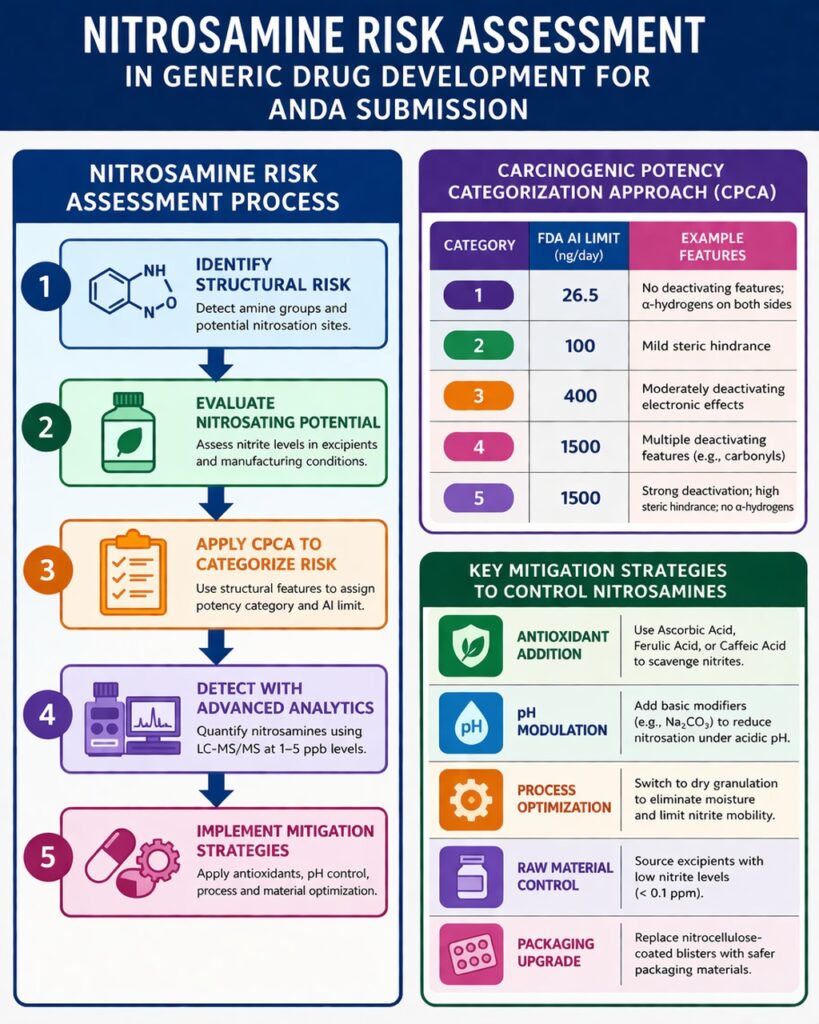
| Potency Category | FDA AI Limit (ng/day) | CPCA Scoring Criteria (Example Features) |
| Category 1 | 26.5 | No deactivating features; $\alpha$-hydrogens on both sides |
| Category 2 | 100 | Presence of mild steric hindrance |
| Category 3 | 400 | Presence of moderately deactivating electronic effects |
| Category 4 | 1500 | Presence of multiple deactivating features (e.g., carbonyls) |
| Category 5 | 1500 | Strong deactivation; high steric hindrance; no $\alpha$-hydrogens |
In some cases, read-across methods are used when CPCA results are too strict. This involves comparing with similar compounds that have known data. It provides flexibility while maintaining safety. Overall, CPCA supports a balanced regulatory approach.
Implementation of Advanced Analytical Techniques for Trace Detection
Advanced analytical techniques are critical for detecting nitrosamines at extremely low concentrations. Because these impurities are highly potent, traditional analytical thresholds are insufficient. Techniques such as LC-MS/MS and HRMS provide the sensitivity and specificity required for accurate detection at parts-per-billion levels. Regulatory agencies now expect validated methods capable of reliably identifying trace impurities.
One major challenge in analysis is the matrix effect, where other components interfere with detection. To address this, laboratories use strategies such as isotope dilution, which improves accuracy by compensating for sample loss and ion suppression. Sample pre-concentration techniques further enhance detection by isolating nitrosamines from complex matrices. These methods collectively improve reliability and reproducibility.
High-resolution chromatographic separation is also essential to avoid interference from API peaks. Using advanced column technologies ensures clear differentiation between compounds. As analytical expectations continue to evolve, investment in high-performance instrumentation is becoming necessary for compliance. This also supports continuous improvement in impurity monitoring.
| Analytical Parameter | Requirement for Nitrosamine Testing | Rationale |
| Limit of Detection (LOD) | Typically 1–5 ppb or 5 pg/mL | Ensures presence can be detected below the safety limit |
| Limit of Quantitation (LOQ) | 10% of the AI limit (often < 10 ppb) | Provides confidence for routine monitoring |
| Linearity Range | 1 to 100 ppb (or commensurate with dose) | Covers full range from trace levels to specification |
| Recovery | 80% to 120% | Validates that extraction methods are efficient |
| Specificity | Baseline separation from API/Matrix | Prevents false positives and ion suppression |
Read more about our High-Resolution Mass Spectrometry (HRMS) Analysis for precise trace detection.
Toxicology and the Enhanced Ames Test (EAT) for NDSRIs
The Enhanced Ames Test (EAT) is specifically designed to evaluate the mutagenic potential of nitrosamines more accurately than conventional methods. Standard Ames tests may fail to detect certain nitrosamines due to limitations in metabolic activation. The enhanced version addresses this by incorporating conditions that better simulate biological processes. This makes it particularly useful for evaluating complex NDSRIs.
Key modifications include increased metabolic enzyme concentration and the use of sensitive bacterial strains. Pre-incubation steps further improve detection by allowing more interaction between test compounds and biological systems. These enhancements significantly improve the reliability of results. As a result, EAT has become an important tool in regulatory submissions.
If an impurity is found to be non-mutagenic, manufacturers may apply less stringent control limits. This provides a practical pathway to avoid unnecessary reformulation. However, results must be well-supported and validated to gain regulatory acceptance. Proper toxicological evaluation remains a critical component of risk management.
Find out how our Bioanalytical Services support complex toxicological and mutagenic evaluations.
Computational Toxicology and QSAR Modeling for Risk Prioritization
QSAR models help predict the toxicity of impurities based on their structure. These tools are useful in early-stage risk assessment. They allow companies to identify high-risk compounds before lab testing. This saves time and resources.
Regulators usually require more than one QSAR model for accuracy. Combining different models improves prediction quality. These tools also support CPCA evaluations. They are now widely used in regulatory submissions.
As technology improves, QSAR models are becoming more reliable. They are especially useful for new and complex impurities. Continuous updates ensure they remain effective. Their role in risk assessment will continue to grow.
Strategic Mitigation through Formulation and Process Optimization
Mitigation strategies focus on reducing or eliminating nitrosamine formation through formulation and process changes. One effective approach is the use of antioxidants, which act as nitrite scavengers. These compounds prevent nitrosation by reacting with nitrosating agents before they interact with APIs. Studies have shown significant reductions in impurity levels with this method.
pH adjustment is another important strategy. Since nitrosation is favored in acidic conditions, increasing pH can reduce reaction rates. However, such changes must be carefully balanced to maintain drug performance. Process modifications, such as switching to dry granulation, can also reduce moisture-related risks.
Control of raw materials and packaging is equally important. Using low-nitrite excipients and avoiding nitrocellulose-containing packaging materials can significantly lower risk. These combined strategies create a comprehensive mitigation plan. Continuous monitoring ensures long-term effectiveness.
Access our expert Nitrosamine Testing in ANDA Submissions to streamline your mitigation strategy.
| Mitigation Strategy | Technical Implementation | Impact on Nitrosamine Levels |
| Antioxidant Addition | Use of Ascorbic Acid, Ferulic Acid, or Caffeic Acid | Rapidly scavenges nitrites and $N_2O_3$ |
| pH Modulation | Addition of basic modifiers (e.g., $Na_2CO_3$) | Shifts equilibrium away from nitrosating species |
| Process Change | Switching from wet granulation to dry granulation | Removes the moisture needed for nitrite mobility |
| Raw Material Control | Sourcing low-nitrite excipients (< 0.1 ppm) | Reduces the total “nitrosation budget” |
| Packaging Update | Replacing nitrocellulose-coated blister foils | Eliminates a secondary source of nitrites |
Bioequivalence and Reformulation Challenges for Generic Products
Reformulating drugs to control nitrosamines can affect bioequivalence. Changes in excipients may alter drug release and absorption. This is especially important for poorly soluble drugs. Careful testing is needed to maintain performance.
Regulatory pathways allow some flexibility in reformulation. Tools like dissolution testing and PBPK modeling can support changes. These methods reduce the need for clinical studies. However, strong validation is still required.
Stability studies are also important after reformulation. They confirm that impurity levels remain controlled over time. They also ensure the drug remains effective. Proper planning helps overcome these challenges.
Lifecycle Management and Post-Approval Changes
Nitrosamine Risk Assessment in Generic Drugs does not end after approval. Any change in process, supplier, or formulation requires reassessment. This ensures new risks are properly managed. Lifecycle management is essential for long-term safety.
Different types of changes require different reporting methods. Major changes need prior approval, while minor ones may be reported later. Understanding these rules helps maintain compliance. Proper documentation is always important.
Continuous improvement should also be part of the strategy. As new knowledge becomes available, updates should be made. This keeps products safe and compliant over time.
Common Regulatory Deficiencies in Nitrosamine Submissions
Many submissions face delays due to common mistakes. One major issue is lack of confirmatory testing. Regulators now expect real data instead of theoretical analysis. Analytical methods must also be sensitive enough.
Missing stability data is another common problem. Long-term studies are needed to prove control. Root cause analysis is also important when impurities are found. Simply reporting results is not enough.
Clear and consistent documentation improves success rates. Addressing these issues early helps avoid delays. A proactive approach is always beneficial.
Review our guide on ANDA Analytical Deficiencies to avoid common regulatory pitfalls.
GDUFA III Research and the Future of Nitrosamine Regulation
Research under GDUFA III is helping improve nitrosamine control. It focuses on better risk assessment tools and faster development processes. Areas like analytical methods and exposure modeling are being improved. This supports more efficient regulation.
New technologies may reduce testing complexity. Improved models may also reduce the need for clinical studies. These changes benefit both industry and regulators. They also improve patient safety.
Companies must stay updated with new guidelines. Adapting to changes is important for compliance. Collaboration will continue to drive progress in this area.
Conclusion: Achieving Excellence in Nitrosamine Risk Assessment in Generic Drugs
Nitrosamine Risk Assessment in Generic Drugs is now a critical part of pharmaceutical development. It requires strong scientific knowledge, advanced tools, and careful planning. Companies must go beyond basic compliance and focus on complete risk management. This ensures both safety and regulatory success.
Using tools like CPCA, QSAR, and advanced analytics improves control strategies. Managing excipients and optimizing formulations further reduces risks. These combined efforts improve product quality. They also build trust with regulators and patients.
As regulations continue to evolve, staying prepared is essential. Meeting deadlines and maintaining high standards will ensure long-term success. Effective control of nitrosamines supports safe and affordable medicines worldwide.
Contact ResolveMass Laboratories Inc. For specialized support in Nitrosamine Risk Assessment and high-sensitivity testing, please reach out via our contact page.
FAQs on Nitrosamine Risk Assessment
Small-molecule nitrosamines like NDMA and NDEA are relatively simple compounds that typically arise as impurities during manufacturing and may appear across different drug products. In contrast, NDSRIs are structurally linked to the API, often incorporating the whole molecule or a portion of it. This close structural relationship makes them unique to specific drugs and more challenging to identify and control. Their complexity also requires more advanced analytical techniques for accurate detection.
The CPCA system classifies nitrosamines into categories based on structural features that influence their carcinogenic potential. Impurities with features that reduce reactivity are assigned to lower-risk categories, allowing higher acceptable intake limits. On the other hand, structurally active compounds with fewer protective features fall into higher-risk groups with stricter limits. This classification directly determines how tightly the impurity must be controlled in the final product.
A bioequivalence study is not always mandatory when making formulation changes such as adding an antioxidant. For drugs with high solubility, in vitro dissolution testing may be enough to demonstrate equivalence if performance remains unchanged. However, for drugs with lower solubility or more complex absorption profiles, additional studies may be required. The decision depends on how significantly the formulation change could impact drug release and absorption.
Nitrosamines can originate from unexpected sources within the manufacturing environment. Recycled solvents, if not properly purified, may carry over contaminants from previous processes. Shared equipment can also introduce impurities if cleaning procedures are inadequate. Even water systems and certain packaging materials may contribute trace nitrites that lead to nitrosamine formation over time.
Read-across analysis is a scientific method used when direct toxicological data for an impurity is unavailable. It involves comparing the impurity to a structurally similar compound with known safety data. If the similarity is well justified, the known data can be used to estimate the risk of the new impurity. This approach is especially useful when default limits are overly restrictive and need further scientific justification.
A standard Ames test is generally not considered sufficient for evaluating nitrosamines because it may not detect their true mutagenic potential. Regulatory agencies recommend using the Enhanced Ames Test, which is specifically adapted for these compounds. This version includes modifications that improve sensitivity and metabolic activation. A negative result from this enhanced method provides stronger scientific support for considering less restrictive impurity limits.
Reference:
- U.S. Food and Drug Administration. (2023, August). Recommended acceptable intake limits for nitrosamine drug substance-related impurities (NDSRIs): Guidance for industry. Center for Drug Evaluation and Research. https://www.fda.gov/regulatory-information/search-fda-guidance-documents/cder-nitrosamine-impurity-acceptable-intake-limits
- U.S. Food and Drug Administration. (2024). Nitrosamine related guidance [PDF]. Center for Drug Evaluation and Research. https://www.fda.gov/media/187315/download
- U.S. Food and Drug Administration. (2024, September). Control of nitrosamine impurities in human drugs: Guidance for industry [PDF]. Center for Drug Evaluation and Research. https://www.fda.gov/media/191686/download
- National Center for Biotechnology Information. (2025). Genotoxicity evaluation of ten nitrosamine drug substance-related impurities using 2D and 3D HepaRG cell models. Regulatory Toxicology and Pharmacology. https://pmc.ncbi.nlm.nih.gov/articles/PMC12442021/
- Vikram, H. P. R., Kumar, T. P., Kumar, G., Beeraka, N. M., Deka, R., Suhail, S. M., Jat, S., Bannimath, N., Padmanabhan, G., Chandan, R. S., Kumar, P., & Gurupadayya, B. (2024). Nitrosamines crisis in pharmaceuticals: Insights on toxicological implications, root causes and risk assessment: A systematic review. Journal of Pharmaceutical Analysis, 14(5), 100919. https://pmc.ncbi.nlm.nih.gov/articles/PMC11126534/
Get In Touch With Us
About The Author


