
Introduction
Qualifying active pharmaceutical ingredient (API) vendors and contract manufacturing organizations (CMOs) requires Nitrosamine Risk Assessment Services for API Suppliers that go beyond generic vendor declarations. These services should incorporate mechanistic route-of-synthesis audits, purge-factor verification, and trace-level analytical evidence. Supplier compliance letters alone are no longer sufficient to meet regulatory expectations, as health authorities hold the marketing authorization holder (MAH) directly accountable for maintaining documented chemical justifications, process evaluations, and confirmatory testing. These assessments must cover synthetic pathways, recovered solvents, process water, and shared manufacturing lines.
Multi-sourced generic APIs, outsourced intermediate manufacturing steps, and multi-product contract manufacturing facilities introduce different amine precursors, variable nitrite contamination, and potential cross-contamination pathways. If these risks are not identified before regulatory submission, they can result in Complete Response Letters (CRLs), Refuse to File (RTF) actions, clinical holds, or expensive product recalls. Specialists at ResolveMass Laboratories Inc. assist pharmaceutical sponsors and API manufacturers through integrated route-of-synthesis evaluations, custom nitrosamine drug substance-related impurity (NDSRI) reference standard synthesis, and Good Manufacturing Practice (GMP)-validated trace-level testing. These integrated services are designed to address gaps in supplier qualification and strengthen regulatory compliance.
Understand the fundamentals of nitrosamine impurities and the risks they present throughout pharmaceutical manufacturing.
Learn about nitrosamines and their formation
Share via:
Quick Summary:
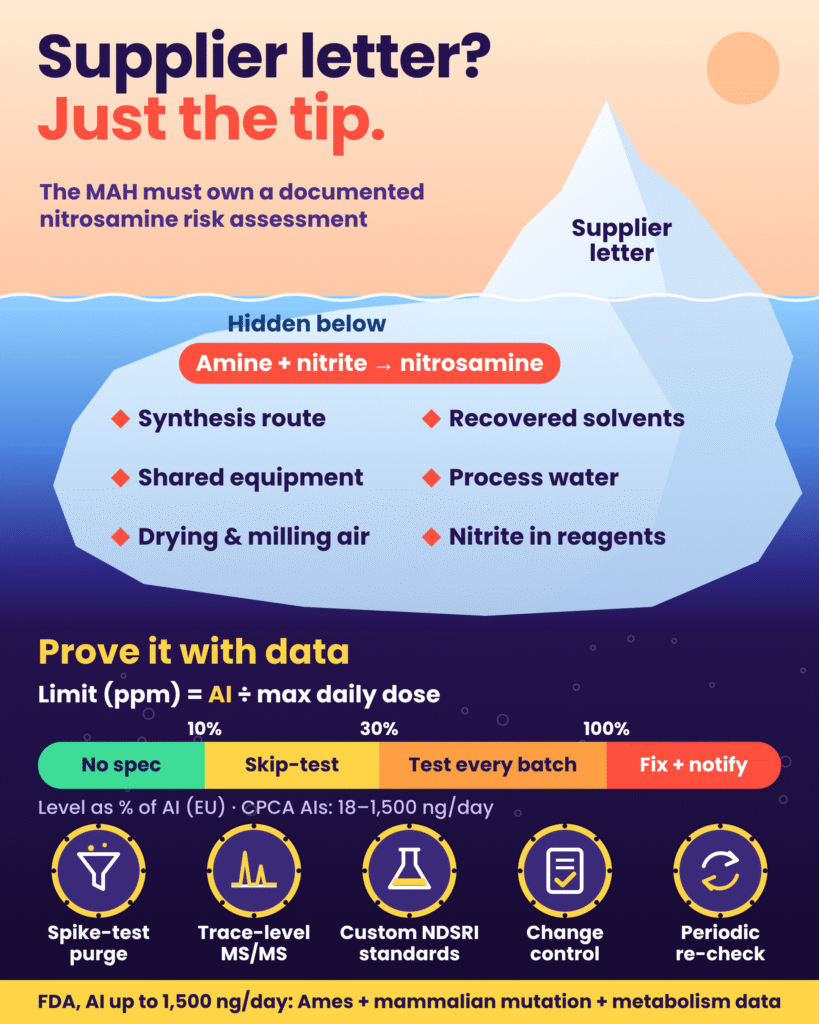
- Supplier letters aren’t enough. Regulators (Health Canada, EMA, FDA) hold the marketing authorization holder responsible for a documented nitrosamine risk assessment. Vendor declarations are only supporting evidence.
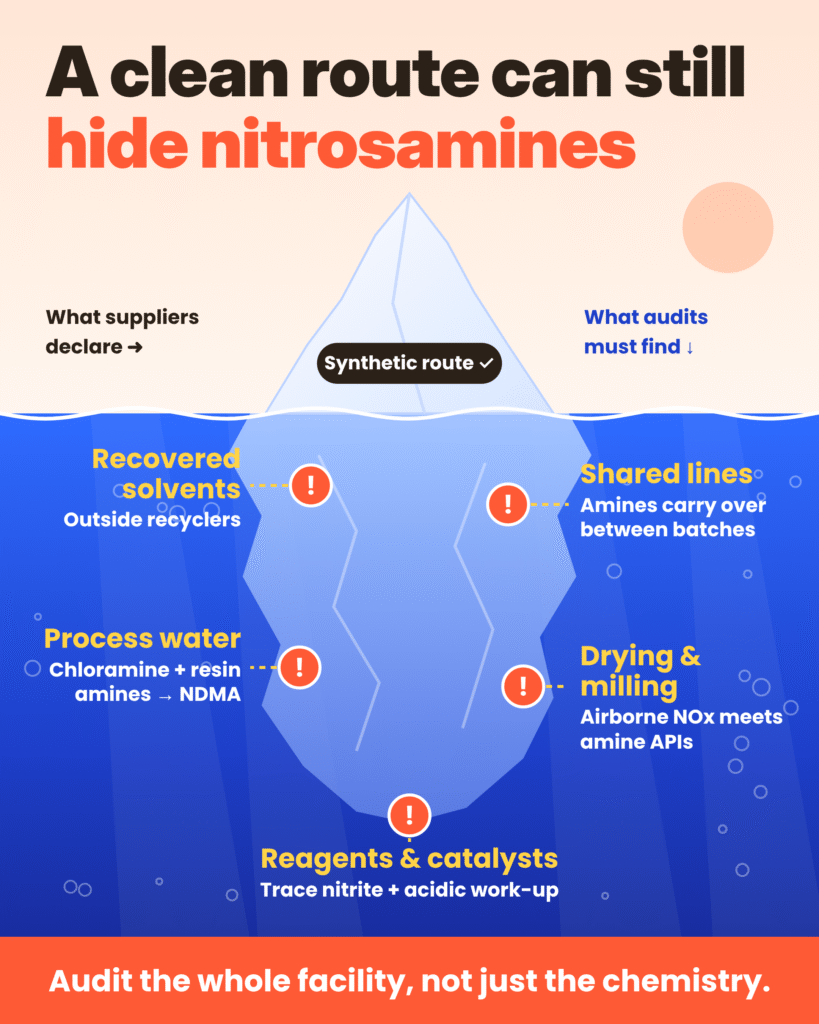
- Risks often hide upstream. Nitrosamines can form wherever amines meet nitrosating agents. The sources include the synthesis route and intermediates (e.g., DMF-derived dimethylamine plus nitrite quench → NDMA), recovered solvents, shared equipment, process water, NOx in drying and milling air, and nitrite traces in reagents.
- Qualification should be quantitative. FMEA risk scoring, CPCA acceptable intakes (18–1,500 ng/day) and the formula Limit (ppm) = AI ÷ max daily dose decide where testing is really needed. In the EU, levels consistently ≤10% of the AI can omit a specification, ≤30% can justify skip-testing, and anything above the AI requires corrective action.
- Purge calculations must be conservative. Don’t double-count extractions or isolation steps. NDSRIs resemble their APIs and purge poorly, so theoretical purge factors should be backed by spike-and-purge or chemical destruction studies.
- Supplier onboarding needs built-in controls. Require full route and recovered-material disclosure, audit facilities and utilities, establish multi-lot test baselines, add nitrosamine change control to Quality Agreements, and set periodic reassessment triggers.
- Analytical methods must be fit for each matrix. Use headspace GC-MS/MS for volatile nitrosamines and LC-MS/MS for NDSRIs, add nitrosation scavengers to avoid false positives, and validate each supplier matrix under ICH Q2(R2). Custom NDSRI reference standards fill gaps where commercial ones don’t exist.
- Higher limits need toxicology data. To justify an AI above the CPCA limit, the FDA expects an enhanced Ames test plus an in vitro mammalian mutation assay and metabolism data for up to 1,500 ng/day, and in vivo data beyond that. EMA and Health Canada accept a negative enhanced Ames test alone for 1,500 ng/day.
Why Supplier Declarations Alone Fail Regulatory Supplier Qualification Audits
Supplier attestations cannot replace a comprehensive, documented nitrosamine risk assessment because international regulatory authorities hold the MAH directly responsible for evaluating upstream synthetic routes, raw materials, processing aids, and potential cross-contamination within manufacturing facilities. Regulatory frameworks updated through late 2026 consider vendor-provided information supporting evidence rather than an independent or complete justification of compliance.
Health Canada’s Guidance on Nitrosamine Impurities in Medications (PDF edition updated November 2026; Step 3 effective August 1, 2025) addresses this requirement in Item 8. It explicitly clarifies that statements or declarations supplied by manufacturers and vendors cannot replace a robust, comprehensive, and documented risk assessment conducted by the MAH. Since Health Canada’s Step 1, Step 2, and Step 3 implementation timelines, including August 1, 2025 for market authorization changes, have passed, extension requests are no longer being considered. MAHs may receive a Corrective and Preventive Action (CAPA) implementation period of up to three years only for nitrosamines whose Acceptable Intake (AI) limits were first published in Appendix 1 on August 1, 2025, or later. Nevertheless, appropriate mitigation measures are expected to be implemented as soon as possible. Health Canada also classifies the addition of a nitrosamine test and its corresponding acceptance criteria to a drug substance specification, when supported by a valid European Directorate for the Quality of Medicines & HealthCare (EDQM) Certificate of Suitability (CEP), as a Level III Annual Notification under its Post-Notice of Compliance (NOC) Quality framework. This requirement directly connects European API certification with Canadian product lifecycle management.
In Europe, Revision 24 of the European Medicines Agency (EMA) Questions and Answers document, dated November 3, 2026, retains Q&A 16. This question was previously updated in Revision 21 to clarify the respective responsibilities of MAHs and API manufacturers when referencing Active Substance Master Files (ASMFs) and CEPs. The revision also maintains Q&A 4, which addresses root causes associated with active substances and finished pharmaceutical products. At the same time, European Pharmacopoeia (Ph. Eur.) General Monographs 2034 (Substances for pharmaceutical use) and 2619 (Pharmaceutical preparations) establish expectations for active substance and medicinal product manufacturers to assess N-nitrosamine formation and contamination throughout manufacturing and storage. Manufacturers are expected to mitigate identified risks through appropriate process modifications and establish control strategies supported by analytical procedures described in Ph. Eur. General Chapter 2.5.42.
In the United States, the U.S. Food and Drug Administration (FDA) guidance, Control of Nitrosamine Impurities in Human Drugs Revision 2 (September 2024), provides recommendations covering chemically synthesized APIs, drug products containing chemically synthesized APIs or fragments (including biological products), and susceptible semisynthetic or fermentation-derived products. Although the FDA’s June 23, 2025 timeline update provided additional time beyond August 1, 2025 for applicants implementing complex NDSRI control or reformulation strategies, this flexibility required the submission of a progress update containing forced-degradation findings, detected NDSRIs, validated analytical methods, and evaluated batch data. Meanwhile, the FDA’s Center for Drug Evaluation and Research (CDER) continues to expand its published AI limits. As of September 24, 2026, its listings included 285 Carcinogenic Potency Categorization Approach (CPCA) entries and 9 compound-specific or surrogate read-across entries. At the international level, the World Health Organization (WHO) issued GMP guidance through Technical Report Series (TRS) 1060 Annex 2, finalized in April 2025, addressing cross-contamination risks in shared manufacturing facilities and the importance of periodic risk reassessment.
| Regulatory Authority or Body | Primary Document and Vintage | API Supplier and CMO Qualification Scope | Key Implication for Vendor Audits |
|---|---|---|---|
| U.S. FDA (CDER / CDRH) | Guidance Rev. 2 (Sept 2024); AI Webpage (Sept 24, 2026); Combination Product Letter (April 16, 2026) | Recommends evaluating chemically synthesized APIs, intermediates, recovered solvents, shared equipment, and CDRH-led device-drug assembly and sterilization pathways. | Generic APIs sourced from competing vendors require matrix-specific validation and traceability of NDSRI progress updates. |
| EMA / EDQM | EMA Q&A Rev. 24 (Nov 3, 2026); Ph. Eur. 2034, 2619, and 2.5.42 | Q&A 16 clarifies MAH and API manufacturer responsibilities involving ASMFs/CEPs; Q&A 24 addresses ICH M7 LTL applicability; Ph. Eur. 2.5.42 identifies LC-MS/MS, GC-MS, and GC-MS/MS methods. | Active substance manufacturers and CEP/ASMF stakeholders must assess Q&A 4 root causes and maintain documented control strategies. |
| Health Canada | Guidance on Nitrosamine Impurities in Medications (PDF Nov 2026; Step 3 Aug 1, 2025) | Item 8 prohibits exclusive reliance on supplier letters; DEL holders must meet nitrosamine-related conditions; CEP-based drug substance specifications qualify as Level III Annual Notifications. | MAHs must maintain supplier-linked risk documentation and include detailed summaries in CTD Module 2 and section 3.2.P.2. |
| WHO | TRS 1060 Annex 2 (April 2025) | International GMP guidance covering cross-contamination in shared facilities and periodic risk reassessment. | Contract manufacturers must verify campaign cleaning controls and conduct lifecycle reassessments. |
| APIC (CEFIC) | Nitrosamine Risk Management: Guidance for API Manufacturers (May 2025) | Integrates nitrosamine risk management into the QMS (Chapter 10) and supplier qualification through a three-outcome assessment model. | API and intermediate suppliers must evaluate amine/nitrite pathways, recovered materials, and QMS integration. |
How Nitrosamine Risk Assessment Services for API Suppliers Uncover Hidden Route and Facility Hazards
Effective Nitrosamine Risk Assessment Services for API Suppliers examine synthetic chemistry at every manufacturing stage while also evaluating solvent recovery systems, utility infrastructure, and multi-product equipment where trace-level nitrosating agents may encounter susceptible amines. An API manufacturing process that appears chemically safe in its documented synthesis route may still contain contamination risks introduced several processing steps earlier by an intermediate supplier or an external solvent recovery facility.
Synthetic Route, Intermediate Carryover, and Reagent Contamination
Nitrosamine formation risks can originate from upstream synthetic chemistry whenever nitrosating agents coexist, either intentionally or as trace impurities, with secondary, tertiary, or quaternary amines or oxidizable hydrazine derivatives. According to FDA Revision 2 and EMA Q&A 4, direct risk scenarios include diazotization reactions, the quenching of residual sodium azide with nitrous acid directly in the main reaction vessel, and the use of nitrite salts, alkyl nitrites, nitroso halides, nitrogen oxides, nitroalkanes, or Fremy’s salt during processing steps involving susceptible amines. In addition to intentionally introduced nitrosating reagents, polar aprotic amide solvents, including N,N-dimethylformamide (DMF), dimethylacetamide (DMAc), and N-methyl-2-pyrrolidone (NMP), may introduce or generate secondary amine impurities. For example, dimethylamine (DMA), which may be present as a degradation impurity in DMF, can react with sodium nitrite used during quenching to produce NDMA. This mechanism was identified in historical valsartan contamination cases.
Intermediate qualification requires the same level of attention because pharmaceutical intermediates may retain the secondary or tertiary amine functionality found in the final API. When an intermediate manufacturer introduces nitrosated precursors or oxidizes 1,1-disubstituted hydrazines, confirmed formation mechanisms can produce 1-methyl-4-nitrosopiperazine (MNP) and 1-cyclopentyl-4-nitrosopiperazine. These impurities may persist through subsequent manufacturing stages and ultimately contaminate the finished drug substance. Generic drug manufacturers obtaining the same API from different suppliers may therefore face different impurity risks because each vendor can follow a distinct synthesis route and use raw materials with different impurity profiles. Furthermore, FDA inspections have identified considerable variation in reaction temperature, pH, and reagent, intermediate, or solvent addition sequences across batches. Such differences may also occur between processing equipment within the same API manufacturing facility.
Evaluate how different synthetic routes and processing conditions can contribute to nitrosamine formation.
Explore nitrosamine formation pathways in API synthesis
Recovered Solvents, Shared Equipment, and Process Water Systems
Even when the primary API synthesis does not involve nitrosating reagents, nitrosamine contamination can enter the manufacturing process through outsourced solvent recovery, multi-purpose equipment, sequential campaigns on shared production lines, and inadequately monitored facility utilities. Third-party solvent recovery facilities that use shared equipment to process unrelated chemical streams can create substantial cross-contamination risks. Consequently, an API manufacturing process with an otherwise low-risk synthetic route may become a potential source of nitrosamine contamination. Industry recommendations and European GMP principles favor conducting solvent recovery in-house using dedicated equipment associated with the same synthesis step. These operations should be supported by validated cleaning procedures, documented in cleaning batch records, and verified through the dual-control principle. Recovered materials must also undergo formal risk evaluation in accordance with APIC’s May 2025 guidance.
Multi-product contract manufacturing operations must also consider utility-related and environmental contamination pathways that may not be identified through standard Certificates of Analysis (CoAs). Important examples include:
- Shared-line cross-contamination: Sequential manufacturing campaigns involving multi-purpose reactors, centrifuges, and dryers may introduce residual amines or nitrosating agents into subsequent batches. This risk can be controlled only when equipment cleaning procedures specifically demonstrate the validated removal of trace-level precursors.
- Airborne nitrogen oxides (NOx) during unit operations: Fluid-bed drying at elevated temperatures, air-jet milling, and open clean-room sifting can expose amine-containing APIs to ambient NOx present in drying or room air. For vulnerable compounds, nitrogen-inerted processing is therefore an important preventive measure.
- Process water chloramination and resin leaching: Chloramine-based water disinfection may react with dimethylamine released from anion-exchange resins, resulting in NDMA formation in Water for Injection. In addition, inadequately monitored potable water systems outside Europe may introduce trace nitrites unless appropriate purification and carbon-treatment procedures are applied. This is particularly relevant because European potable water limits are 0.5 mg/L, compared with the WHO guideline of 3 mg/L.
- Inorganic reagent and catalyst nitrite carry-in: Purchased reagents, catalysts, and solvents may contain trace nitrite impurities. Under acidic work-up conditions, these impurities can generate nitrous acid (HNO2), which may subsequently react with residual amines and produce nitrosamines.
Assess potential contamination introduced through packaging, processing materials, and manufacturing-related contact surfaces.
Learn about nitrosamine leachables testing
Designing a Quantitative Qualification Framework Using FMEA, CPCA, and Purge Factors
A scientifically defensible supplier qualification dossier should combine Failure Mode and Effects Analysis (FMEA) risk scoring, CPCA limits, and conservative purge factor calculations. This integrated approach helps identify where analytical testing is genuinely necessary based on the chemistry and manufacturing risks involved. Rather than testing every batch for numerous hypothetical impurities without considering their likelihood of formation, technical teams evaluate Severity, which is associated with nitrosamine potency categories; Occurrence, which reflects the possibility of precursor coexistence; and Detection, which considers analytical sensitivity and existing monitoring controls. These parameters are used to calculate Risk Priority Numbers (RPNs) and estimate potential exposure relative to the drug’s Maximum Daily Dose (MDD).
To convert a daily Acceptable Intake (AI) into a supplier specification expressed in parts per million (ppm), the following standard calculation is applied:
Specification Limit (ppm) = AI (ng/day) / MDD (mg/day)
For example, a Category 1 impurity with an FDA AI of 26.5 ng/day in a drug administered at an MDD of 500 mg/day produces a specification limit of 0.053 ppm (53 ppb). The corresponding 10% negligible-risk threshold is 0.0053 ppm (5.3 ppb). Under the EMA’s more conservative Category 1 class limit of 18 ng/day, the same 500 mg/day MDD results in a specification limit of 0.036 ppm (36 ppb), with a 10% threshold of 3.6 ppb. For NDMA, which has an AI of 96 ng/day under both FDA and EMA approaches, the concentration limit at an MDD of 500 mg/day is 0.192 ppm (192 ppb).
When multiple nitrosamines are present simultaneously, FDA and EMA approaches, as summarized in industry guidance reviews, restrict combined exposure either to the AI of the most potent impurity identified or through a flexible fractional-percentage calculation. The latter approach is intended to ensure that cumulative lifetime excess cancer risk remains within 1 in 100,000. Industry summaries also indicate that the FDA accepts this flexible calculation for up to three nitrosamines without requiring prior consultation.
On September 24, 2026, the FDA revised its CDER AI webpage and confirmed that ICH M7(R2) Less-Than-Lifetime (LTL) adjustment factors may be applied to lifetime AI limits when evaluating therapies intended for shorter treatment durations. The EMA also introduced Q&A 24 in Revision 24, published November 3, 2026, to address the applicability of the ICH M7 LTL framework. In contrast, Health Canada maintains that the AI limits listed in Appendix 1 remain appropriate for both lifetime and LTL administration of drug products.
| CPCA Potency Category | FDA AI Limit (ng/day) | EMA AI Limit (ng/day) | 10% Negligible-Risk Trigger (ng/day) | Structural Potency Context |
|---|---|---|---|---|
| Category 1 | 26.5 | 18 | 2.65 (FDA) / 1.8 (EMA) | Highest predicted α-hydroxylation activation potential without deactivating features. |
| Category 2 | 100 | 100 | 10.0 | High-potency structural category aligned with NDMA (96 ng/day) and NNK. |
| Category 3 | 400 | 400 | 40.0 | Intermediate structural potency tier. |
| Category 4 | 1,500 | 1,500 | 150.0 | Lower-potency structural features aligned with standard ICH M7 TTC. |
| Category 5 | 1,500 | 1,500 | 150.0 | Highly deactivating structural features, severe steric hindrance, or 0,0 / 0,1 / 1,1 / tertiary α-carbon. |
Across all five CPCA categories, analytical testing and specification requirements are determined by the measured concentration relative to the applicable AI. When a nitrosamine is detected at or below 10% of its AI, routine batch specifications are generally not required once the underlying root causes have been identified and the relevant process controls have been validated. However, EMA Q&A 9 requires the analytical method’s LOQ to be at or below 10% of the applicable limit to support omission of the specification. When concentrations fall between 10% and 30% of the AI, routine release specifications are applicable, although skip-testing may be justified when the validated LOQ is ≤30% of the limit. Concentrations between 30% and less than 100% of the AI require mandatory lot-by-lot release and stability testing. Any result at or above 100% of the AI requires batch rejection, manufacturing holds, process or formulation redesign, and appropriate regulatory notification.
Understand how acceptable intake limits are calculated and applied when establishing nitrosamine specifications.
Review acceptable intake limits and nitrosamine calculations
Avoiding Over-Application Pitfalls in API and Intermediate Purge Calculations
Purge factor calculations can support ICH M7 Option 4 process-based control without routine release testing only when chemists conservatively evaluate reactivity, solubility, and volatility and experimentally verify uncertain or borderline clearance results. Under the semi-quantitative Teasdale and Burns framework, which is implemented in tools such as Mirabilis, each synthetic step is assigned conservative numerical multipliers. Reactivity receives a score of 100 for highly reactive compounds, 10 for moderately reactive compounds, and 1 for low-reactivity or unreactive compounds. Solubility is assigned a score of 10 for freely soluble compounds, 3 for moderately soluble compounds, and 1 for sparingly soluble compounds, with ionization differences incorporated into the 3–10 solubility range. Volatility receives a score of 10 when the boiling point is more than 20 °C below that of the process solvent, 3 when it falls within ±20 °C, and 1 when it is more than 20 °C above the process solvent’s boiling point. Physical separation operations receive scores of 10–100 for chromatography or 3–100 individually for scavenger resins.
In analytical purge documentation, removal at individual manufacturing stages and across the complete process is commonly represented as a logarithmic reduction:
Purge Factor (log) = log10 (Input Amount / Output Amount)
Paper-only purge justifications may lose regulatory credibility when they contain two technical errors highlighted in Organic Process Research & Development best-practice guidance published in October 2023.
First, chemists must avoid the practice of “over-application.” This occurs when repeated liquid-liquid extractions are counted as separate additive purge operations or when crystallization, filtration, and cake washing are treated as independent purge multipliers rather than as components of one interconnected isolation process.
Second, although small, volatile nitrosamines can often be removed effectively through washing and distillation, NDSRIs have structural characteristics that closely resemble those of their associated APIs. Their similar polarity, molecular structure, and hydrogen-bonding properties can increase the likelihood of incorporation into the crystal lattice, making their removal more difficult.
For structurally homologous NDSRIs or impurities introduced during late-stage intermediate manufacturing, regulators increasingly favor a hybrid validation strategy. This approach combines theoretical purge modeling with experimental spike-and-purge analytical data or chemical destruction studies. One example involves sodium dithionite treatment in aqueous sodium hydroxide to demonstrate the effectiveness of chemical destruction under appropriate conditions.
Distinguish between simple nitrosamines and drug substance-related nitrosamine impurities when selecting an appropriate control strategy.
Compare NDSRIs with simple nitrosamines
Onboarding API Vendors and Contract Manufacturers Without Supply Chain Blind Spots
Effective supplier qualification incorporates nitrosamine chemistry assessments directly into vendor onboarding procedures, technical questionnaires, and formal quality agreements before commercial manufacturing activities begin. API manufacturers and excipient suppliers follow different industry standards. For example, APIC’s May 2025 Chapter 10 framework addresses the Quality Management System (QMS) requirements applicable to API manufacturers, whereas the International Pharmaceutical Excipients Council (IPEC) Version 2 Questionnaire, updated October 22, 2025, provides a framework for excipient supplier evaluation. Consequently, sponsor quality teams must coordinate and harmonize upstream supplier disclosures across all relevant material categories.
Integrating Nitrosamine Risk Assessment Services for API Suppliers into Quality Agreements and Questionnaires
Incorporating Nitrosamine Risk Assessment Services for API Suppliers into vendor onboarding processes transforms general supplier questionnaires into measurable and verifiable technical controls. Under APIC’s proportional three-outcome assessment model, confirmatory testing is unnecessary when the manufacturing process for an intermediate or API contains neither susceptible amine centers nor direct or indirect sources of nitrosating agents. Similarly, Health Canada does not generally expect confirmatory testing when the documented assessment identifies no potential for nitrosamine formation.
However, when a potential risk is confirmed, analytical quantification must be performed across representative manufacturing lots. APIC’s 2020 framework specifies testing of at least three consecutive commercial API batches. For finished-product NDSRI assessments, the October 2025 IPEC Questionnaire emphasizes that excipient manufacturers are not responsible for performing the finished-product risk assessment. It also specifically highlights that excipient nitrite testing has not been harmonized. As a result, the measured nitrite concentration in the same excipient may differ between suppliers depending on the analytical method used. Therefore, CMOs and drug manufacturers should conduct comparative trace-level nitrite testing across potential excipient and raw-material suppliers instead of depending exclusively on vendor CoAs.
To establish a consistent supplier qualification process across API manufacturers and CMOs, quality assurance (QA) and procurement teams should implement the following five-step onboarding protocol:
- Require complete synthetic route and recovered-material disclosure under NDA: API manufacturers and critical intermediate suppliers should be required to provide detailed information about every reagent, catalyst, solvent, quenching operation, and external recycling stream used throughout the manufacturing process, extending back to the starting materials.
- Evaluate facility, utility, and campaign controls: Conduct manufacturing facility audits to examine multi-purpose equipment cleaning validations, nitrogen-blanketing procedures during milling and drying, and water-system disinfection practices. Particular attention should be given to chloramine-based treatment and the presence of unmonitored nitrite in potable water systems.
- Establish an empirical baseline through multi-lot testing: Independently screen API batches, critical intermediates, and excipient lots using consistent trace-level analytical methods. This approach helps identify variations in nitrite contamination between different suppliers and individual manufacturing lots.
- Include nitrosamine-related change-control requirements in Quality Agreements: Quality Agreements should prohibit unapproved changes involving raw-material sub-suppliers, solvent recovery vendors, reaction pH or temperature, and equipment trains unless advance notification and a corresponding risk reassessment have been completed.
- Implement periodic lifecycle reassessment triggers: Coordinate annual product reviews with WHO TRS 1060 Annex 2 recommendations and updates to FDA and EMA AI webpages. Newly identified NDSRIs and revised CPCA limits should automatically trigger supplier requalification and reassessment of existing control strategies.
A documented control strategy can help connect supplier qualification findings with practical manufacturing and quality-system controls.
Explore nitrosamine control strategy development
Analytical Validation, Custom NDSRI Standards, and Toxicological Qualification for Qualified Suppliers
Qualifying an API supplier or contract manufacturer at parts-per-billion sensitivity requires careful selection of the appropriate chromatographic platform, prevention of extraction-related artifacts, and analytical method validation under ICH Q2(R2) for each individual sample matrix. It is also important to understand the FDA’s regulatory expectations and limitations concerning toxicological safety testing. Regulatory authorities emphasize that an analytical method validated for one product or supplier matrix cannot automatically be considered suitable for another. Differences in salt forms, synthesis-related impurities, and excipient compositions can significantly affect extraction recovery and matrix interference, making additional validation necessary.
The selection of an analytical platform depends primarily on analyte volatility and potential matrix interference. Headspace Gas Chromatography–Tandem Mass Spectrometry (GC-MS/MS) is particularly suitable for volatile, low-molecular-weight nitrosamines, including NDMA, NDEA, NDBA, and NPYR. This technique allows non-volatile APIs and salts to remain inside the sample vial, protecting the analytical column and mass spectrometry source while supporting automated, high-throughput analysis.
In comparison, Liquid Chromatography–Tandem Mass Spectrometry (LC-MS/MS) operated in Multiple Reaction Monitoring (MRM) mode provides the selectivity required for complex and thermally labile NDSRIs. High-Resolution Mass Spectrometry platforms, including UHPLC-QTOF and Orbitrap, are also useful for untargeted screening during investigations involving multiple suppliers and potential root causes.
During sample preparation, nitrosation scavengers such as sulfamic acid, cysteine, ascorbate, BHT, and tocopherols can be added under neutral-pH and low-temperature conditions. These substances help prevent residual nitrites from reacting with amine-containing APIs during extraction and generating false-positive analytical results. Another important consideration comes from published studies involving cyclophosphamide-related nitrosamines. These studies demonstrate that deuterated internal standards, including d6-NDMA and d10-NDEA, may not adequately compensate for electrospray ion suppression when they fail to co-elute precisely with the target analyte. Even a difference of a few seconds in retention time can introduce systematic analytical bias.
ResolveMass Laboratories Inc. applies nitrosamine-specific GMP validation targets aligned with ICH Q2(R2), ICH M7(R2), FDA, EMA, and Health Canada expectations across eight essential analytical validation parameters:
| ICH Q2(R2) Validation Parameter | Nitrosamine-Specific Validation Target | Supplier Qualification Significance |
|---|---|---|
| Specificity and Selectivity | No interference from blanks, placebo matrices, related substances, or reagents at LOQ. | Prevents false-positive results arising from DMF, amine reagents, or co-eluting process impurities. |
| Limit of Quantitation (LOQ) | ≤ AI limit (target ≤30% AI for skip testing; ≤10% AI to omit specification), with S/N ≥ 10:1. | Demonstrates that analytical sensitivity meets regional Category 1 thresholds of 18 or 26.5 ng/day. |
| Limit of Detection (LOD) | ≤ one-third of LOQ; S/N ≥ 3:1. | Supports sub-specification concentration monitoring and trend analysis across commercial API batches. |
| Linearity | R2 ≥ 0.990 from LOQ to 120–150% of the specification limit; y-intercept ≤2% of the response at 100% specification. | Establishes proportional quantification across a broad range of trace-level concentrations. |
| Accuracy (Recovery) | 70–130% at LOQ; 80–120% at low, medium, and high concentration levels (≥5 replicates per level). | Confirms extraction efficiency across different supplier-specific salt forms and sample matrices. |
| Repeatability and Intermediate Precision | Repeatability ≤25% RSD at LOQ (≤15% at higher concentrations); Intermediate precision ≤25–30% RSD at LOQ (≤20% at higher concentrations). | Demonstrates reproducible method performance during analytical method transfer between API supplier QC laboratories and CMO facilities. |
| Matrix Effect (LC-MS/MS) | Internal-standard-corrected matrix factor between 0.85 and 1.15. | Evaluates supplier-specific ion suppression or enhancement in electrospray ionization (ESI) workflows. |
| Robustness | Analytical response remains within ±5% when important method parameters are intentionally varied. | Confirms consistent GMP performance during routine, high-throughput batch release testing. |
Select an analytical approach that matches the impurity profile, sample matrix, and required detection sensitivity.
Learn about nitrosamine method development and validation
When confirmatory testing identifies an NDSRI above its applicable CPCA limit and process modification is not practical, sponsors may pursue higher alternative AI limits through additional toxicological studies. However, this process requires careful attention because FDA reviewers frequently identify deficiencies in toxicological justifications.
At the April 2026 CDER Office of Generic Drugs Generic Drug Forum, FDA safety assessors identified exclusive reliance on a negative Enhanced Ames Test (EAT) as a common deficiency. To justify an alternative AI limit of ≤1,500 ng/day, a negative EAT result must be supported by an in vitro mammalian mutation assay and an in vitro metabolism study evaluating α-hydroxylation. For an AI limit above 1,500 ng/day, the toxicological package must additionally include a negative in vivo transgenic rodent gene mutation assay.
To address these analytical and synthetic challenges while maintaining continuity across multiple contractors, ResolveMass Laboratories Inc. integrates organic synthesis, formulation development, polymer characterization, and mass spectrometry at its facility in Laval, Québec, Canada. The organization operates as a Health Canada GMP-compliant Drug Establishment Licence holder, an FDA-registered establishment (ID 3042696771), and an ISO 9001:2015 certified laboratory. Its PhD bench scientists provide scientific support to pharmaceutical sponsors across more than nine countries under default confidentiality arrangements.
When commercial reference materials are unavailable for a predicted NDSRI, the laboratory offers custom NDSRI synthesis, typically completed within 15–20 business days. The synthesized standards are characterized using NMR, HRMS, and HPLC and supplied with a GMP-compliant CoA.
The laboratory also provides several supporting services within defined turnaround periods. These include risk assessment and protocol design within 1–3 business days, standard analytical method development within 5–10 business days, ICH Q2(R2) method validation within 5–10 business days with sensitivity reaching sub-5 to 10 ppb, and confirmatory testing within 3–7 business days.
In an internal ResolveMass case study, the implementation of a structured risk-assessment template combined with targeted LC-MS/MS testing helped identify a high-risk secondary amine intermediate. The resulting modification to the synthesis process reduced regulatory feedback cycles by 60% and accelerated NDA submission by 18 days.
Conclusion
Moving away from paper-based supplier declarations toward data-driven Nitrosamine Risk Assessment Services for API Suppliers is essential for protecting clinical development timelines, maintaining regulatory approvals, and ensuring the continuity of commercial drug supplies. By systematically evaluating amine and nitrite chemistry throughout the synthetic route, investigating external solvent recovery and shared-equipment cleaning procedures, validating conservative purge calculations through experimental spike-and-purge studies, and incorporating appropriate change-control requirements into formal quality agreements, pharmaceutical manufacturers and CMOs can substantially reduce the likelihood of late-stage CRLs, RTF rejections, and unexpected disruptions caused by supplier changes.
Whether your organization is qualifying an alternative generic API manufacturer, preparing an ASMF, CEP, NDA, or ANDA impurity dossier, or developing ICH Q2(R2)-validated LC-MS/MS and GC-MS/MS trace-level analytical methods, working directly with experienced synthetic and analytical chemists can help streamline regulatory assessments and strengthen supplier qualification strategies.
Strengthen your supplier qualification process with a documented, scientifically supported nitrosamine assessment and fit-for-purpose analytical testing.
Explore nitrosamine testing and CRO support
Connect with the scientific team at ResolveMass Laboratories Inc. to arrange a technical consultation or request assistance with supplier qualification and nitrosamine risk assessment requirements through the Contact Us page:
Contact ResolveMass Laboratories Inc.
Frequently Asked Questions
ASMF and CEP holders, together with API manufacturers and MAHs, must ensure that potential nitrosamine formation and contamination risks are properly evaluated. EMA Q&A Revision 24 (Q&A 16) clarifies the responsibilities associated with ASMFs and CEPs, while Ph. Eur. General Monograph 2034 addresses risk evaluation throughout manufacturing and storage. Confirmed risks must be controlled through appropriate process modifications and validated analytical strategies. In Canada, qualifying drug substance specification changes supported by a valid EDQM CEP may follow the Level III Annual Notification pathway.
Confirmatory testing may not be necessary when an intermediate manufacturing process has no susceptible amine groups and does not involve direct or indirect nitrosating agents, according to APIC’s May 2025 risk-management framework. However, testing becomes important when the process involves vulnerable amines, nitrite-containing materials, amide solvents, or potentially contaminated recovered streams. These risks should be investigated to establish whether nitrosamine impurities can survive downstream processing. APIC’s 2020 framework recommends testing at least three consecutive commercial API batches when a risk has been identified.
External solvent recovery can introduce contamination when recovery facilities process different chemical streams using shared equipment. Residual secondary amines, including DMA originating from DMF, or traces of nitrosating agents may remain in recovered solvents and enter subsequent API manufacturing steps. To minimize this possibility, manufacturers should prioritize dedicated in-house recovery systems where feasible. Validated cleaning procedures, documented batch records, dual-control verification, and audits of third-party recovery facilities are also important safeguards.
The FDA’s June 23, 2025 timeline update provided additional implementation time to applicants facing difficulties completing complex NDSRI-related changes by August 1, 2025. Applicants seeking this flexibility were expected to submit progress information covering forced-degradation studies, identified NDSRIs, validated analytical methods, and evaluated batch results. Later, on September 24, 2026, the FDA updated its CDER AI webpage to clarify that ICH M7(R2) Less-Than-Lifetime (LTL) adjustment factors can be applied to recommended lifetime AI limits when evaluating shorter-duration treatments.
Theoretical purge calculations may overestimate NDSRI removal because these impurities often have structural and physicochemical properties similar to those of the parent API. Their comparable polarity and hydrogen-bonding characteristics can promote retention within the crystal lattice, making removal more difficult than for small, volatile nitrosamines. Another limitation occurs when multiple stages of a single isolation operation are incorrectly counted as separate purge steps. Therefore, theoretical models should be supported by experimental spike-and-purge studies to establish reliable impurity clearance.
Completing the IPEC questionnaire does not eliminate the need for independent excipient risk evaluation. The October 2025 Version 2 IPEC Excipient Nitrosamines Risk Evaluation Questionnaire clarifies that excipient manufacturers are not responsible for conducting finished-product risk assessments. It also highlights the lack of harmonization in nitrite testing methods, which can produce different reported concentrations for the same excipient. Independent testing across suppliers and manufacturing lots helps identify actual nitrite variability and supports more reliable NDSRI risk management.
No. A negative Enhanced Ames Test (EAT) result alone is insufficient to establish a higher alternative AI limit. According to FDA CDER safety assessors at the April 2026 Generic Drug Forum, an alternative AI of up to 1,500 ng/day requires additional evidence from an in vitro mammalian mutation assay and an in vitro metabolism study evaluating α-hydroxylation. For an alternative AI exceeding 1,500 ng/day, a negative in vivo transgenic rodent gene mutation assay is also required. These complementary studies provide a more comprehensive assessment of potential genotoxicity.
No. An analytical method validated for one API supplier’s material should not automatically be considered suitable for another vendor’s product. Differences in salt forms, residual reagents, synthesis-related impurities, and matrix composition can influence extraction recovery, selectivity, and matrix effects. Therefore, changing API suppliers or manufacturing routes requires appropriate matrix-specific method revalidation or verification under ICH Q2(R2). This helps ensure that trace-level nitrosamine measurements remain accurate and reliable.
False-positive results may occur when residual nitrites react with susceptible amines during sample extraction, particularly under acidic or elevated-temperature conditions. Laboratories can reduce this risk by maintaining neutral-pH extraction conditions, controlling sample preparation temperatures, and incorporating suitable nitrosation scavengers. Commonly used scavengers include sulfamic acid, cysteine, ascorbate, BHT, and tocopherols. Carefully selected deuterated internal standards with appropriate co-elution characteristics also help improve quantification accuracy and compensate for matrix-related analytical effects.
Reference:
- Health Canada. (2024). Guidance on nitrosamine impurities in medications: Evaluating and managing the risks of N-nitrosamine impurities in human pharmaceutical, biological and radiopharmaceutical products. Government of Canada. https://www.canada.ca/content/dam/hc-sc/documents/services/drugs-health-products/compliance-enforcement/information-health-product/drugs/nitrosamine-impurities/medications-guidance/guidance-nitrosamine%20impurities-medications.pdf
- United States Pharmacopeia. (2022). Health Canada nitrosamine guidance effective Sep 2022. USP Knowledge Exchange. https://knowledgeexchange.usp.org/nitrosamines/t/health-canada-nitrosamine-guidance-effective-sep-2022/3596
- European Medicines Agency. (2026, November 3). Questions and answers for marketing authorisation holders/applicants on the CHMP Opinion for the Article 5(3) of Regulation (EC) No 726/2004 referral on nitrosamine impurities in human medicinal products (EMA/409815/2020 Rev. 24). https://www.ema.europa.eu/en/documents/opinion-any-scientific-matter/nitrosamines-emea-h-a53-1490-questions-answers-marketing-authorisation-holders-applicants-chmp-opinion-article-53-regulation-ec-no-726-2004-referral-nitrosamine-impurities-human-medicinal-products_en.pdf
- Health Canada. (2026, November). Guidance on nitrosamine impurities in medications: Evaluating and managing the risks of N-nitrosamine impurities in human pharmaceutical, biological and radiopharmaceutical products. Government of Canada. https://www.canada.ca/content/dam/hc-sc/documents/services/drugs-health-products/compliance-enforcement/information-health-product/drugs/nitrosamine-impurities/medications-guidance/nitrosamine-impurities-medications-guidance-nov-2026.pdf
- Health Canada. (n.d.). Guidance on nitrosamine impurities in medications: Evaluating and managing the risks of N-nitrosamine impurities in human pharmaceutical, biological and radiopharmaceutical products. Government of Canada. https://www.canada.ca/content/dam/hc-sc/documents/services/drugs-health-products/compliance-enforcement/information-health-product/drugs/nitrosamine-impurities/medications-guidance/medications-guidance.pdf
- U.S. Food and Drug Administration. (2024). Control of nitrosamine impurities in human drugs: Guidance for industry (Revision 2). U.S. Department of Health and Human Services. https://www.fda.gov/regulatory-information/search-fda-guidance-documents/control-nitrosamine-impurities-human-drugs
Get In Touch With Us
About The Author