

Introduction:
Nitrosamine risk assessment and Nitrosamine Testing in ANDA Submissions refer to the regulatory process used to identify, measure, and control mutagenic N-nitrosamine impurities in pharmaceutical products. These evaluations are essential for protecting patient safety and meeting regulatory requirements. Health authorities now require pharmaceutical companies to assess whether nitrosamines can form during manufacturing, formulation, packaging, or storage. If present, these impurities must remain within safe and acceptable limits.
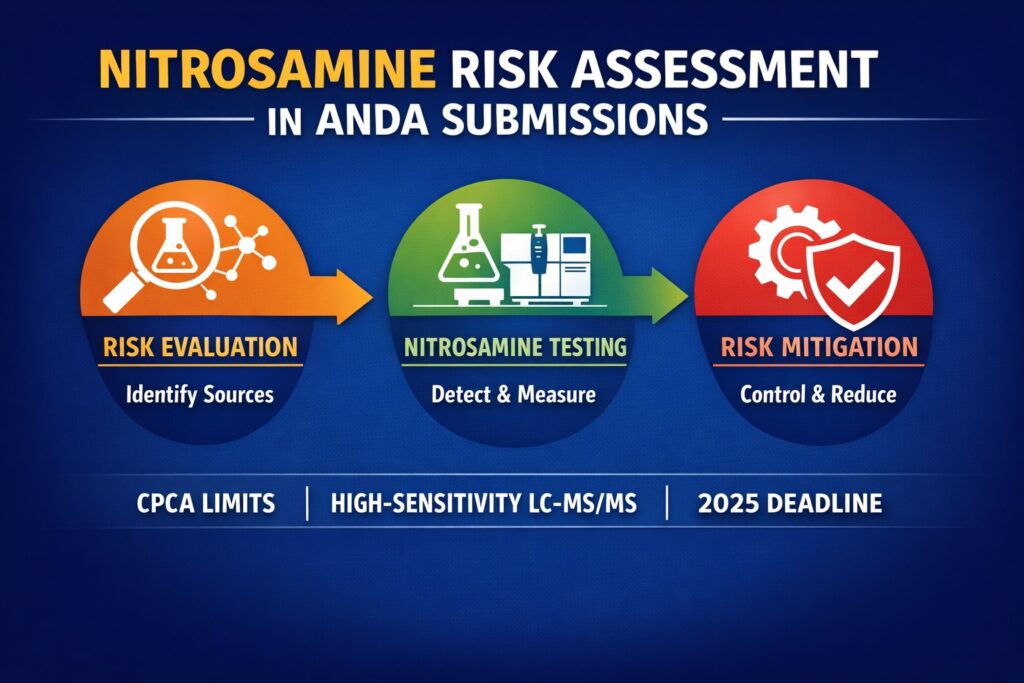
Current expectations are mainly based on the FDA’s 2024 Control of Nitrosamine Impurities in Human Drugs (Revision 2) guidance and the August 2023 RAIL guidance. Together, these documents describe a mandatory three-step mitigation strategy that must be documented for both drug substances and finished drug products in regulatory submissions.
In practice, effective Nitrosamine Testing in ANDA Submissions requires a detailed scientific evaluation of potential impurity sources throughout the product lifecycle. Manufacturers must assess the risk of Nitrosamine Drug Substance-Related Impurities (NDSRIs) and determine acceptable intake limits using the Carcinogenic Potency Categorization Approach (CPCA). In addition, confirmatory testing must be completed and any required regulatory updates submitted before the important August 1, 2025 deadline. Companies must also maintain complete analytical documentation to demonstrate compliance during regulatory review.
Nitrosamine risk evaluation has become one of the most closely examined areas in generic drug regulation. Authorities expect strong scientific justification for impurity control strategies and analytical methods. As a result, pharmaceutical companies must combine expertise in toxicology, chemistry, and manufacturing to ensure full regulatory compliance. A proactive approach to nitrosamine control not only improves patient safety but also increases the chances of successful regulatory approval.
Partner with experts to navigate the complex regulatory landscape of NDSRIs. Nitrosamine Analysis Services
Share via:
Key Highlights
- Nitrosamine Testing in ANDA Submissions is essential to identify and control carcinogenic impurities and ensure patient safety.
- Regulatory expectations are driven by FDA (2024) guidance and require a mandatory three-step approach: risk assessment, testing, and mitigation.
- Companies must evaluate nitrosamine risks across the entire product lifecycle, including API, excipients, manufacturing, and packaging.
- The August 1, 2025 deadline requires completion of confirmatory testing and submission of regulatory updates.
- The CPCA framework is used to determine acceptable intake limits for NDSRIs based on structural analysis.
- Advanced analytical techniques like LC-MS/MS, HRMS, and GC-MS/MS are required for high-sensitivity detection.
- A proactive, well-documented strategy helps avoid regulatory delays, rejections, and product recalls.
The Regulatory Landscape of Nitrosamine Testing in ANDA Submissions
The regulatory framework for controlling nitrosamines in generic drug applications has developed rapidly in recent years. Earlier regulatory attention mainly focused on traditional small-molecule process impurities that formed during the synthesis of Active Pharmaceutical Ingredients (APIs). However, newer guidance recognizes that complex Nitrosamine Drug Substance-Related Impurities (NDSRIs) can also form within finished drug products.
This expanded understanding means that risk assessments must now examine the full pharmaceutical system. Manufacturers must understand how APIs, excipients, manufacturing conditions, and packaging materials may interact and contribute to nitrosamine formation.
The FDA’s Revision 2 guidance (September 2024) highlights the importance of understanding chemical pathways responsible for nitrosamine formation. Companies must provide comprehensive risk assessments supported by validated analytical data and scientifically justified testing methods.
For the generic drug industry, this requirement means reviewing every stage of pharmaceutical development—from API synthesis to formulation design and packaging compatibility. By adopting a lifecycle-based evaluation approach, manufacturers can identify risks earlier and maintain product quality throughout the product lifecycle.
Ensure your Abbreviated New Drug Application meets all current FDA expectations. Analytical Requirements for ANDA Submissions
Evolution of FDA Guidance and the 2025 Compliance Deadline
Regulatory control of nitrosamines has evolved from a reactive response to a structured and predictive regulatory framework. The initial concern began after the 2018 sartan contamination crisis, when carcinogenic nitrosamines were detected in several widely used medications. Since then, global regulators have introduced stricter requirements for impurity evaluation.
A key milestone in this regulatory evolution is the August 1, 2025 compliance deadline. By this date, manufacturers with approved or pending ANDAs must complete confirmatory testing for NDSRIs and submit necessary regulatory amendments or supplements.
In some cases, the FDA allows companies to submit an interim NDSRI progress update if reformulation or mitigation strategies require additional time. However, companies must show clear progress and documented efforts toward compliance.
Earlier regulatory guidance from 2020 mainly focused on known nitrosamines such as N-nitrosodimethylamine (NDMA) and N-nitrosodiethylamine (NDEA). These impurities were often linked to contaminated solvents used during API synthesis. Later investigations showed that NDSRIs could form directly from APIs during manufacturing or storage, expanding the regulatory focus.
Excipients have also gained attention in nitrosamine risk assessments. Materials such as povidone, crospovidone, and microcrystalline cellulose may contain small amounts of nitrites that can react with APIs. Even very low concentrations can trigger nitrosamine formation under suitable environmental conditions.
To address the lack of toxicological data for many NDSRIs, regulators introduced the Carcinogenic Potency Categorization Approach (CPCA). This structure-based model predicts acceptable intake limits based on molecular features. CPCA allows regulators to estimate carcinogenic risk even when long-term animal data are not available.
Validate your methods ahead of the 2025 deadline to avoid regulatory delays. ANDA Method Validation Requirements
Strategic Importance of Nitrosamine Testing in ANDA Submissions
Maintaining a strong program for Nitrosamine Testing in ANDA Submissions is essential for both regulatory compliance and commercial success. As regulatory expectations continue to evolve, nitrosamine risk assessments play a significant role in determining the approval timeline of generic drug applications.
A well-prepared submission that includes detailed testing data significantly increases the chances of first-cycle approval. Comprehensive nitrosamine evaluations also help prevent regulatory delays such as Refuse-to-Receive (RTF) actions.
When submissions lack sufficient risk assessments or confirmatory testing data, regulators may reject the application before the formal review begins. Such delays can postpone product launch and reduce market competitiveness.
Understanding the chemistry behind nitrosamine formation is also critical. Nitrosamines typically form when amine compounds react with nitrosating agents, such as nitrite salts, under certain temperature and pH conditions. In pharmaceutical manufacturing, the amine source often comes from the API or a synthetic intermediate, while nitrosating agents may originate from contaminated solvents or excipients.
Risk management must also continue after product approval. Changes in suppliers, process conditions, or manufacturing equipment can affect impurity formation. Continuous monitoring and documentation throughout the product lifecycle are necessary to maintain regulatory compliance.
Streamline your submission process by leveraging expert analytical support. Outsourcing Analytical Testing for ANDA Submissions
Implementing the Three-Step Strategy for Nitrosamine Testing in ANDA Submissions
Regulatory agencies require pharmaceutical companies to follow a structured three-step strategy for nitrosamine control. This approach begins with theoretical risk evaluation and continues through laboratory testing and mitigation when necessary.
Each step must be supported by detailed scientific documentation within Module 3 of the electronic Common Technical Document (eCTD).
The framework promotes proactive risk management across the pharmaceutical supply chain. By identifying risks early and implementing mitigation strategies, manufacturers can minimize regulatory complications and maintain product quality.
Step 1: Comprehensive Risk Evaluation for API and Drug Product
The first step involves a detailed risk assessment to determine whether nitrosamines could form during manufacturing or storage.
This assessment evaluates:
- API chemical structure
- Formulation composition
- Manufacturing conditions
- Environmental factors in production facilities
Particular attention is given to APIs containing secondary or tertiary amine groups, which are more susceptible to nitrosation reactions.
Manufacturers must also review upstream materials such as:
- Starting reagents
- Solvents
- Intermediates
- Recovered solvents
Recovered solvents may contain residual contaminants capable of forming nitrosamines under certain conditions.
Packaging materials must also be evaluated. Some adhesives or foil materials may release compounds that generate nitrosating agents during storage.
If the risk assessment determines that nitrosamine formation is unlikely, the reasoning must be clearly documented. If any risk is identified, the process must proceed to confirmatory testing in Step 2.
Step 2: Methodological Rigor for Nitrosamine Testing in ANDA Submissions
Step 2 focuses on confirmatory analytical testing to determine whether nitrosamines are actually present in the drug product.
Highly sensitive analytical techniques are required because regulatory limits are extremely low. Testing usually involves multiple product batches to evaluate variability caused by manufacturing conditions or raw material differences.
Most laboratories rely on Liquid Chromatography–Tandem Mass Spectrometry (LC-MS/MS) because it can detect impurities at parts-per-billion levels.
Analytical methods must be validated according to ICH Q2 guidelines, including evaluation of:
- Specificity
- Accuracy
- Precision
- Linearity
Once testing is complete, results must be compared with regulatory acceptable intake limits. If levels remain below limits, routine monitoring may be sufficient. If limits are exceeded, mitigation strategies must be implemented.
Utilize state-of-the-art LC-MS/MS for precise impurity quantification. Impurity Profiling Using LC-MS
Step 3: Reporting and Mitigation of Nitrosamine Impurities
Step 3 focuses on reducing or eliminating nitrosamine impurities when testing shows unacceptable levels.
Mitigation strategies may include:
- Process optimization
- Reformulation
- Improved raw material quality
- Enhanced purification procedures
Adjusting manufacturing conditions such as temperature, pH, and purification steps can significantly reduce impurity formation.
In some cases, reformulation may be necessary. This might involve replacing excipients that contain trace nitrites or adding antioxidants that inhibit nitrosation reactions.
Regulatory authorities must be informed of mitigation actions through the appropriate submission pathway:
- Prior Approval Supplement (PAS) for major changes
- Changes Being Effected in 30 Days (CBE-30) for moderate changes
- Annual reports for minor updates
The Carcinogenic Potency Categorization Approach (CPCA) for NDSRIs
The Carcinogenic Potency Categorization Approach (CPCA) is a scientific model used to estimate acceptable intake limits for NDSRIs.
Because toxicological data are unavailable for many potential nitrosamines, regulators rely on structural analysis to estimate carcinogenic risk. CPCA assigns a potency score based on molecular features near the N-nitroso functional group.
Structural characteristics influence whether the compound can become metabolically activated and interact with DNA.
The CPCA framework evaluates:
- Substituent groups near the nitrosamine group
- Alpha and beta carbon structures
- Electronic and steric properties
Based on these characteristics, impurities are categorized into potency classes that determine acceptable intake limits.
Scoring Structural Features and Determining AI Limits
CPCA evaluates structural features that affect metabolic activation in the human body.
For example, the presence of alpha hydrogens near the nitrosamine group is often required for metabolic activation. If these hydrogens are absent, carcinogenic potential may be lower.
Certain features can increase potency, such as:
- Small linear alkyl groups
- Reactive ring structures
Other features may reduce potency, including bulky substituents or electron-withdrawing groups.
Acceptable intake values are expressed in nanograms per day and converted into concentration limits using the following formula:
| Calculation | Formula |
|---|---|
| Nitrosamine Limit | Limit (ppm) = AI (ng/day) ÷ Maximum Daily Dose (mg/day) |
This calculation ensures that patient exposure remains within safe limits regardless of dosage strength.
Refinement and Challenges of the CPCA Framework
Although CPCA has improved nitrosamine risk prediction, the framework continues to evolve. As new toxicological data become available, regulators may revise acceptable intake limits.
These updates can create challenges for pharmaceutical companies because limits established during development may change during regulatory review.
In some situations, manufacturers may perform additional toxicological studies to justify higher limits. One example is the Enhanced Ames Test, which evaluates mutagenic potential under optimized experimental conditions.
This evolving regulatory landscape highlights the importance of continuous monitoring and scientific evaluation.
Analytical Methodologies for High-Sensitivity Nitrosamine Testing in ANDA Submissions
Detecting trace levels of nitrosamines requires highly sensitive analytical technologies. Complex pharmaceutical formulations often contain many interfering compounds, making accurate detection challenging.
Among available techniques, LC-MS/MS is considered the most effective for routine testing.
Other important analytical tools include:
- High-Resolution Mass Spectrometry (HRMS)
- Gas Chromatography–Mass Spectrometry (GC-MS/MS)
Each technique is selected based on the chemical properties of the target impurity, including volatility, polarity, and thermal stability.
Advanced Mass Spectrometry Platforms: LC-MS/MS and HRMS
Triple-quadrupole LC-MS/MS instruments are widely used in pharmaceutical laboratories for routine nitrosamine testing.
These systems operate using Multiple Reaction Monitoring (MRM), which provides high selectivity and sensitivity for trace compounds.
High-resolution mass spectrometry instruments such as Orbitrap or time-of-flight (TOF) systems allow accurate mass measurements. These tools help identify unknown impurities and confirm molecular structures.
GC-MS/MS is particularly useful for analyzing volatile nitrosamines such as NDMA and NDEA.
Together, these analytical technologies allow laboratories to detect impurities at extremely low levels and support regulatory compliance.
Identify and confirm unknown impurities with high-resolution accuracy. High-Resolution Mass Spectrometry (HRMS) Analysis
Analytical Optimization for Nitrosamine Testing in ANDA Submissions
Even with advanced instrumentation, analytical methods must be carefully optimized.
One major challenge is matrix effects, where excipients or other components interfere with mass spectrometry signals.
Common solutions include:
- Isotope-dilution mass spectrometry using labeled internal standards
- Solid phase extraction (SPE) to remove interfering substances
- Matrix-matched calibration for accurate quantification
These techniques improve measurement accuracy and reliability.
Mitigating Artifactual Formation and Matrix Interferences
Another challenge in nitrosamine analysis is artifactual formation during sample preparation.
Certain extraction conditions—such as heat, acidity, or reactive components—can unintentionally create nitrosamines in the laboratory sample.
To prevent this issue, laboratories may add nitrite scavengers such as:
- Sulfamic acid
- Ascorbic acid
Maintaining controlled extraction conditions, including low temperatures and neutral pH, further reduces the risk of artificial impurity formation.
These precautions ensure analytical results accurately reflect the true impurity levels in the drug product.
Toxicological Qualification via the Enhanced Ames Test (EAT)
The Ames test is a widely used bacterial assay for detecting mutagenic activity in chemical compounds.
However, standard Ames test conditions may not always detect nitrosamine-related mutations. To improve sensitivity, scientists developed the Enhanced Ames Test (EAT).
The EAT increases detection capability by modifying the experimental protocol.
Key modifications include:
- Higher metabolic activation enzyme concentrations
- Additional incubation steps
- Optimized testing conditions
A negative result in a validated EAT study can support the conclusion that a specific NDSRI has low mutagenic potential.
Optimized Protocols and Metabolic Activation Systems
Nitrosamines require metabolic activation to form DNA-reactive intermediates.
The Enhanced Ames Test increases the concentration of liver S9 fraction, which contains metabolic enzymes such as cytochrome P450.
Researchers sometimes use hamster liver S9 extracts in addition to rat liver extracts to improve activation efficiency.
Pre-incubation steps allow the test compound to interact with metabolic enzymes before bacterial exposure, increasing the likelihood of detecting mutagenic activity.
EMA Appendix 3 Checklist and Compliance
The European Medicines Agency (EMA) provides detailed guidance for performing the Enhanced Ames Test in Appendix 3 of the Nitrosamine Q&A document (March 2024).
Laboratories must report parameters such as:
- Enzyme sources
- Incubation times
- Solvent concentrations
- Positive control compounds
One challenge is the limited availability of reference standards for many newly identified NDSRIs. In practice, well-characterized nitrosamines such as NDMA or N-nitrosomorpholine are often used as surrogate controls.
Following EMA guidance is considered best practice even for U.S. regulatory submissions.
Reformulation Strategies and Bioequivalence Impact
If nitrosamine levels cannot be adequately controlled through process optimization, reformulation may be required.
For generic manufacturers, reformulation must maintain bioequivalence with the reference listed drug.
Changes in formulation can affect drug absorption, so manufacturers must carefully evaluate:
- Dissolution behavior
- Physicochemical properties
- Pharmacokinetic performance
Regulatory pathways allow certain mitigation strategies without requiring extensive new clinical studies when equivalence can be demonstrated.
Ensure your reformulated products remain compliant and bioequivalent. Bioanalytical Services for Drug Development
Utilizing Nitrite Scavengers and pH Modifiers for Mitigation
One effective mitigation approach is adding nitrite scavengers to the formulation.
Common examples include:
- Ascorbic acid
- Sodium ascorbate
- α-Tocopherol
Even small concentrations (0.1–0.5%) can significantly reduce nitrosamine formation.
Another strategy is adjusting microenvironmental pH within the formulation. Nitrosation reactions occur more easily in acidic environments, so raising pH can slow the reaction rate.
Using low-nitrite excipient grades from qualified suppliers also helps reduce impurity risk.
Regulatory Pathways for BE Waivers in Reformulated Products
When reformulation is necessary, manufacturers often pursue regulatory pathways that reduce the need for additional in vivo bioequivalence studies.
Drugs classified as BCS Class I or Class III are most likely to qualify for bioequivalence waivers. If dissolution profiles remain comparable, regulators may accept in vitro data instead of human studies.
For BCS Class II and IV drugs, obtaining a waiver is more difficult due to lower solubility.
Complex dosage forms require additional evaluation to ensure physicochemical properties remain consistent with the reference drug.
Compliance Outcomes: CRLs, Warning Letters, and Recalls
The quality of Nitrosamine Testing in ANDA Submissions can directly influence regulatory outcomes.
Incomplete risk assessments or insufficient analytical data may result in Complete Response Letters (CRLs) from regulators.
Such outcomes delay product approval and increase development costs.
Post-market issues may also occur if nitrosamines are discovered in marketed products. Regulators may issue warning letters or initiate product recalls, which can damage company reputation and disrupt the supply chain.
A strong, proactive testing program helps prevent these outcomes.
Identifying Common Deficiencies in Nitrosamine Testing in ANDA Submissions
Regulatory reviews often reveal recurring deficiencies, including:
- Incomplete evaluation of nitrite sources
- Lack of confirmatory testing after risk identification
- Analytical methods with insufficient sensitivity
- Missing stability data for long-term storage
Addressing these issues early during development significantly improves the chances of regulatory success.
Lessons from High-Profile Recalls and Enforcement
Several pharmaceutical recalls have influenced current regulatory expectations.
One well-known example is ranitidine, where the drug molecule degraded into NDMA during storage. Because the impurity formed under normal conditions, the product was eventually removed from the market.
Another case involved rifampin, where nitrosamine contamination occurred during manufacturing. Regulators temporarily allowed higher limits to prevent drug shortages while manufacturers implemented corrective measures.
Unexpected sources of nitrosating agents have also been identified in packaging materials, including blister pack adhesives.
These cases highlight the importance of comprehensive risk assessments and continuous monitoring.
Detect and identify impurities early to prevent costly recalls. Impurity Identification for ANDA Submission
Future Outlook and Technical Advancements in Nitrosamine Testing in ANDA Submissions
As the pharmaceutical industry approaches the 2025 compliance deadline, focus is shifting toward long-term lifecycle management of nitrosamine risks.
New technologies are expected to improve impurity prediction and monitoring.
Artificial intelligence tools are increasingly being used to predict impurity formation pathways based on chemical structures and manufacturing conditions.
Automation is also transforming analytical laboratories. Automated sample preparation systems reduce human error and improve reproducibility, while high-throughput LC-MS/MS platforms allow faster analysis of large sample volumes.
These innovations will help pharmaceutical companies maintain continuous monitoring and regulatory compliance throughout the product lifecycle.
Conclusion: The Future of Nitrosamine Control and Safety
Nitrosamine impurity management has become a critical component of pharmaceutical quality and regulatory compliance. What began as a contamination issue has developed into a comprehensive global regulatory framework.
For generic drug manufacturers, Nitrosamine Testing in ANDA Submissions requires a structured and science-based strategy. Implementing the three-step mitigation approach, applying the CPCA framework, and using high-sensitivity analytical methods are essential for meeting regulatory expectations.
Continuous monitoring and proactive risk management will remain vital for long-term product safety.
Looking ahead, advanced analytical technologies and predictive modeling tools will help the industry detect and control impurities more efficiently. Ultimately, the goal remains clear: ensuring that patients receive safe and effective medicines free from unacceptable carcinogenic risks.
For comprehensive support with nitrosamine testing—including risk assessment, high-sensitivity LC-MS/MS analysis, and regulatory documentation—partner with the experts at ResolveMass Laboratories Inc.
Ensure your ANDA submission is robust, compliant, and ready for first-cycle approval by visiting:
Frequently Asked Questions
Small-molecule nitrosamines, such as NDMA or NDEA, are relatively simple chemical structures. They are often introduced unintentionally during API synthesis through contaminated reagents, solvents, or processing steps.
In contrast, Nitrosamine Drug Substance-Related Impurities (NDSRIs) are more complex compounds. These impurities form when the drug substance itself undergoes nitrosation. NDSRIs often develop within the finished drug product due to interactions between the API and formulation components like excipients or residual nitrites.
To determine the concentration limit in parts per million (ppm), divide the acceptable intake (AI) value expressed in nanograms per day by the maximum daily dose (MDD) of the drug in milligrams per day.
Example:
If the AI is 100 ng/day and the maximum daily dose is 500 mg/day, the calculation would be:
100 ÷ 500 = 0.2 ppm
This value represents the maximum allowable concentration of the nitrosamine impurity in the drug product.
If testing results show nitrosamine levels exceeding the acceptable intake limit, the manufacturer must investigate the root cause and implement corrective measures. This typically involves adjusting the manufacturing process, improving raw material quality, or reformulating the product to reduce impurity formation. For pending ANDA submissions, the updated control strategy must be submitted to the FDA through the appropriate regulatory pathway.
The traditional Ames test may not always detect the mutagenic potential of nitrosamines because it uses relatively low levels of metabolic activation enzymes. The Enhanced Ames Test improves detection by increasing the concentration of metabolic enzymes and introducing a pre-incubation step. These modifications allow the test system to better simulate metabolic processes that activate nitrosamines into DNA-reactive compounds.
In certain situations, regulatory authorities may permit a temporary interim limit if the product is medically important or if supply shortages could impact patient care. This temporary allowance is granted only when the manufacturer presents a clear plan to reduce nitrosamine levels within a defined timeframe. Companies must continue working toward permanent mitigation and demonstrate ongoing progress to regulators.
The August 1, 2025 deadline mainly applies to products that are already approved or currently under regulatory review. However, any new ANDA submitted after this date is expected to include full nitrosamine risk evaluation and confirmatory testing. Applicants must demonstrate that potential nitrosamine risks have already been assessed and controlled before submission.
Reference:
- Cantave, R. (2025, April 10). Nitrosamine related guidance [Presentation slides]. U.S. Food and Drug Administration. https://www.fda.gov/media/187315/download
- U.S. Food and Drug Administration. (2023, August). Recommended acceptable intake limits for nitrosamine drug substance-related impurities (NDSRIs): Guidance for industry. https://www.fda.gov/media/170794/download
- Luch, A., Ponting, D. J., Johnson, G. E., & colleagues. (2024). An enhanced metabolization protocol for in vitro genotoxicity assessment of N-nitrosamines in mammalian cells. Environmental and Molecular Mutagenesis. https://pmc.ncbi.nlm.nih.gov/articles/PMC12087714/
- Tarafder, A., Vega, E., Beck, H. P., Mundal, D., Tilala, M., & Wang, S. (2025). Nitrosamine control: From risk assessment to analytical testing with emphasis on sample preparation and phase-appropriate method validation. Organic Process Research & Development. https://doi.org/10.1021/acs.oprd.5c00158
- Health Canada. (n.d.). Nitrosamine impurities in medications: Test methods and test results. Government of Canada. https://www.canada.ca/en/health-canada/services/drugs-health-products/compliance-enforcement/information-health-product/drugs/nitrosamine-impurities/test-results.html
Get In Touch With Us
About The Author


