
Introduction
Selecting a qualified Nitrosamine Testing Laboratory in Canada requires verification of active Drug Establishment Licence (DEL) compliance, highly sensitive quantitative testing capabilities at trace levels, and alignment with Health Canada’s 2025–2026 nitrosamine guidance. All three stages of Health Canada’s original call for review have now elapsed, while the three-year Corrective and Preventive Action (CAPA) implementation periods extend through August 2028. Consequently, pharmaceutical, biological, and radiopharmaceutical sponsors have no remaining extension allowance for incomplete risk assessments or inadequately validated analytical methods.
Drug sponsors preparing New Drug Submissions (NDS), Abbreviated New Drug Submissions (ANDS), or Post-Notice of Compliance (Post-NOC) updates in Canada must produce quantitative analytical data validated in accordance with ICH Q2(R2). These methods must demonstrate the capability to quantify both volatile small-molecule nitrosamines and Nitrosamine Drug Substance-Related Impurities (NDSRIs) at single-digit parts-per-billion (ppb) concentrations. Health Canada applies an 18 ng/day Category 1 Acceptable Intake (AI) limit under the Carcinogenic Potency Categorization Approach (CPCA) and revised its guidance on May 29 and November 5, 2026, addressing recall notifications, risk-based Post-NOC submissions, and Less-Than-Lifetime (LTL) limit adjustments. Operating from Laval, Québec, ResolveMass Laboratories Inc. (Health Canada DEL 3-002945-A) offers GMP-compliant mass spectrometry, custom NDSRI reference standard synthesis, and integrated risk assessments designed to address these Canadian regulatory requirements.
Understand the fundamentals of nitrosamine contamination and the regulatory concerns associated with these impurities through our comprehensive guide to nitrosamines.
Share via:
Quick Summary:
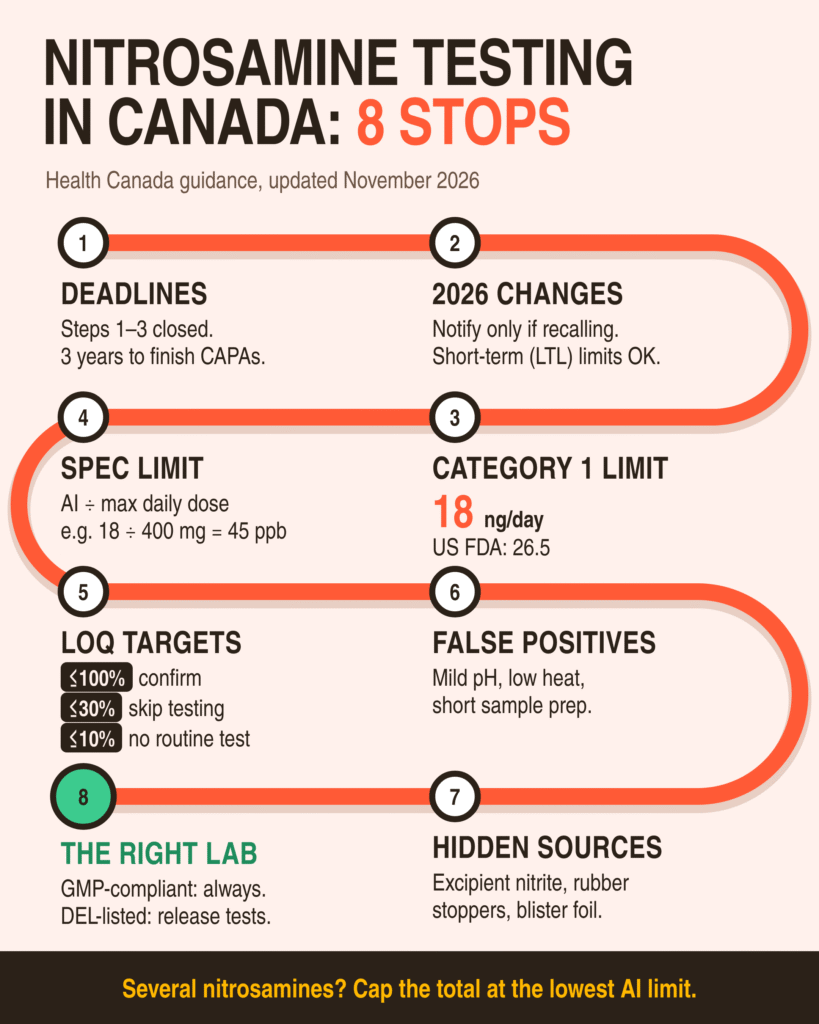
- Deadlines have passed: Health Canada’s three-step nitrosamine review (risk assessment, confirmatory testing, market authorization changes) is closed, and no extensions are being granted. Sponsors have up to three years to complete CAPAs: until August 1, 2028 for older AI limits, and three years from publication for newer ones.
- 2026 rule changes: Since May 2026, Health Canada needs to be notified only when a recall is initiated. Risk-mitigation changes are no longer filed as Level I supplements by default. The November 2026 update allows less-than-lifetime (LTL) limit adjustments for shorter treatments.
- Stricter Category 1 limit: Canada and the EU set the CPCA Category 1 limit at 18 ng/day, versus 26.5 ng/day at the US FDA. Categories 2 to 5 match across regions (100, 400, 1,500 and 1,500 ng/day). Methods validated only to FDA limits may fall short in Canada.
- Setting specifications: The ppm limit equals the AI limit divided by the maximum daily dose. When several nitrosamines are present, total exposure is capped at the lowest AI limit among them. Sponsors without a published AI can justify one through read-across, an enhanced Ames test or in vivo data.
- LOQ drives the testing burden: Confirmatory testing needs an LOQ at or below 100% of the AI limit. Skip testing needs 30% or below. Dropping routine testing needs 10% or below, and only when the root cause is understood and controlled.
- Analytical pitfalls: Matrix effects, signal overlap with the parent API and nitrosamines formed during sample preparation can produce false results. Mild pH, low heat, short prep times, custom NDSRI standards and isotope-labelled internal standards help prevent this. Excipient nitrites and packaging materials are also common hidden sources.
- Choosing a lab: Confirmatory testing must use validated, quantitative methods at a GMP-compliant facility. Labs doing release or specification testing must also be DEL-listed. Sponsors should also check Category 1 sensitivity, custom NDSRI synthesis, extractables and leachables (E&L) capability, and audit-ready data packages.
Health Canada 2025–2026 Nitrosamine Regulatory Expectations for Drug Sponsors
Health Canada requires Market Authorization Holders (MAHs) and applicants seeking new drug approvals to maintain documented nitrosamine control strategies throughout their product portfolios. The deadlines for Step 1 (risk assessments), Step 2 (confirmatory testing), and Step 3 (market authorization changes) have all passed, and extensions are no longer being considered. Sponsors must therefore implement CAPA-based mitigation measures within the prescribed three-year periods while adjusting their regulatory submissions to reflect Health Canada’s May and November 2026 policy revisions.
The regulatory requirements extend across almost all human medicinal products marketed or intended for use in Canada. They include prescription and non-prescription Drug Identification Number (DIN) products containing chemically synthesized or semi-synthetic active pharmaceutical ingredients (APIs), including topical antiseptics, personal hygiene products, and sunscreens. The requirements also apply to approved but unmarketed products, dormant DINs, biologicals, radiopharmaceuticals, chemically synthesized excipients, Special Access Program (SAP) imports, and APIs procured for compounding. For new NDS, ANDS, and Post-NOC submissions, nitrosamine risk assessments must be incorporated into the regulatory submission package from the beginning rather than addressed as a subsequent consideration.
Although the August 1, 2025, Step 3 deadline has passed, Health Canada has established specific CAPA implementation periods alongside substantial procedural changes introduced during 2026. For nitrosamines with an AI limit published in Appendix 1 before August 1, 2025, MAHs have a maximum of three years from that date, extending until August 1, 2028, to implement CAPAs. For AI limits published on or after August 1, 2025, the three-year implementation period starts from the corresponding Appendix 1 publication date. Nevertheless, Health Canada expects sponsors to introduce risk-reduction measures and bring impurity concentrations below the applicable AI limits as early as reasonably possible rather than postponing corrective actions until the CAPA period expires.
| Regulatory Milestone or Update | Effective / Publication Date | Key Requirement or Change for Canadian Drug Sponsors | Source |
|---|---|---|---|
| Step 1: Risk Assessments | March 31, 2021 (Chemical APIs); November 30, 2021 (Biologics/Radiopharmaceuticals) | Deadline elapsed. Extensions are not considered, and sponsors cannot bypass Step 1 in favor of proceeding directly to confirmatory testing. | Health Canada Guidance |
| Step 2: Confirmatory Testing | October 1, 2022 (Chemical APIs); November 30, 2023 (Biologics/Radiopharmaceuticals) | Deadline elapsed. Quantitative, validated GMP testing is required whenever Step 1 identifies a potential nitrosamine risk. | Health Canada Guidance |
| Step 3: Market Authorization Changes & Appendix 5 | August 1, 2025 | Deadline elapsed and three-year CAPA implementation period commenced. Seventeen CPCA AI limits were introduced, and Appendix 5 established bioequivalence expectations for reformulations containing nitrosamine-suppressing agents. | Health Canada Guidance |
| Appendix 1 AI List Revisions | December 17, 2025, and March 11, 2026 | Seven AI limits were added in December 2025, followed by the addition of N-nitroso-dabigatran etexilate imide in March 2026. Twelve limits were revised across the two updates, including a reduction in the N-nitroso-meglumine limit from 1,500 to 100 ng/day. | Health Canada Guidance |
| Recall Reporting & Post-NOC Filing Reform | May 29, 2026 | Section 15 was revised so that MAHs notify Health Canada only when initiating a recall, in accordance with GUI-0039. Section 13 and Appendix 2 introduced risk-based classifications for mitigation-related changes, allowing Level I or Level III submissions. | Health Canada Guidance |
| Less-Than-Lifetime (LTL) Guidance Revision | November 5, 2026 | Sections 2 and 28 were revised to permit LTL AI adjustments consistent with ICH M7 principles for therapies involving shorter treatment durations. | Health Canada Guidance |
These procedural changes introduced during 2026 have important implications for pharmaceutical compliance and regulatory submission workflows. Previously, every elevated confirmatory testing result required notification to Health Canada, while changes introduced to mitigate nitrosamine contamination were generally submitted as mandatory Level I Supplements. Following the May 29, 2026, revision, MAHs must continue performing a health risk assessment, medical necessity evaluation, and root-cause investigation whenever confirmatory testing identifies a nitrosamine concentration above its established or CPCA-derived AI limit. However, notification under Section 15 is now required only when the MAH makes the decision to initiate a recall under the Drug, natural health product and biocide recall guide (GUI-0039).
Similarly, regulatory submissions involving risk-mitigation activities, including the introduction of additional specification tests or the implementation of Appendix 1 AI limits, are now classified according to Health Canada’s Post-Notice of Compliance (NOC) Changes – Quality Guidance. Depending on the associated risk, these changes may qualify for Level III Annual Notifications rather than automatically requiring a Level I Supplement. The November 5, 2026, revision also updated Sections 2 and 28 to incorporate ICH M7-aligned LTL adjustments for shorter treatment regimens. This represents a significant departure from the August 2025 policy, which prohibited the application of LTL-based AI limits during or after the CAPA implementation period. Sponsors must also account for continuing post-market enforcement activities, as demonstrated by Canadian lot recalls issued on March 31, 2025, involving amitriptyline, betahistine, cinacalcet, folic acid, quetiapine, and sitagliptin.
Examine previous contamination-related enforcement actions and their implications for pharmaceutical quality management in our analysis of nitrosamine-related drug recalls.
Acceptable Intake Limits, CPCA Divergence, and NDSRI Risk Assessment
When an N-nitrosamine or NDSRI does not have an established AI limit in Health Canada’s Appendix 1, sponsors must establish and scientifically justify an appropriate limit using CPCA, Structure-Activity Relationship (SAR) read-across, or GLP-compliant mutagenicity testing. Analytical methods must be validated against Health Canada’s Category 1 threshold of 18 ng/day rather than relying exclusively on the US FDA’s higher limit of 26.5 ng/day.
Review the differences between conventional nitrosamines and drug substance-related impurities to support appropriate impurity identification and characterization. Explore our comparison of NDSRIs and simple nitrosamines.
Health Canada and EMA vs. US FDA CPCA Category 1 Limits
Health Canada and the European Medicines Agency (EMA) apply an AI limit of 18 ng/day to CPCA Category 1 nitrosamines, whereas the US FDA uses a limit of 26.5 ng/day. Therefore, the Category 1 analytical requirements established by Canada and Europe are approximately 32% more stringent than those applied by the US FDA. For Categories 2 through 5, the three regulatory authorities follow identical AI limits of 100, 400, 1,500, and 1,500 ng/day, respectively.
The CPCA evaluates the number of alpha-hydrogens adjacent to the N-nitroso moiety, which influence metabolic activation through CYP2E1 and the subsequent formation of DNA-alkylating diazonium ions. The assessment also considers structural deactivating features, including carboxylic acids and specific ring architectures. To translate a daily AI limit into an analytical specification limit, sponsors use the following standard calculation:
ppm = AI (ng/day) ÷ Maximum Daily Dose (mg/day)
For example, consider a drug product with a Maximum Daily Dose (MDD) of 400 mg/day containing a Category 1 NDSRI. Under the US FDA requirements, the specification limit would be 26.5 ÷ 400 = 0.066 ppm (66 ppb). In comparison, Health Canada and the EMA require a more stringent limit of 18 ÷ 400 = 0.045 ppm (45 ppb). Consequently, validating analytical procedures exclusively against US FDA limits can expose sponsors to Canadian regulatory deficiencies or costly method re-validation during NDS, ANDS, or Post-NOC assessments.
| CPCA Potency Category | Health Canada & EMA AI Limit (ng/day) | US FDA AI Limit (ng/day) | Mechanistic & Structural Basis | Example Specification at 400 mg/day MDD (Canada / EU) |
|---|---|---|---|---|
| Category 1 | 18 | 26.5 | Highest predicted potency; class-specific TTC for Canada/EMA compared with the NDEA potency baseline for the US FDA. | 0.045 ppm (45 ppb) |
| Category 2 | 100 | 100 | Intermediate activation risk, represented by NDMA (96 ng/day) and NNK (100 ng/day). | 0.250 ppm (250 ppb) |
| Category 3 | 400 | 400 | Four-fold lower predicted potency associated with weakly deactivating structural features. | 1.000 ppm (1,000 ppb) |
| Category 4 | 1,500 | 1,500 | Alpha-hydroxylation is possible but considered unfavorable; the ICH M7(R2) TTC is applied. | 3.750 ppm (3,750 ppb) |
| Category 5 | 1,500 | 1,500 | Alpha-hydroxylation is not predicted to occur; the ICH M7(R2) TTC is applied. | 3.750 ppm (3,750 ppb) |
Note: Health Canada Appendix 4 describes five CPCA categories covering AI limits from 18 to 1,500 ng/day. However, the exact Appendix 4 scoring flowcharts were unavailable in the summarized Health Canada extraction. The category-specific limits and structural explanations presented above are supported by secondary regulatory guidance summarizing the alignment between EMA, FDA, and Canadian requirements.
Sponsors must additionally assess cumulative exposure under Section 27 whenever multiple nitrosamines are detected in the same API or finished drug product. For example, Health Canada’s guidance indicates that when a medication contains both NDMA, with an individual AI limit of 96 ng/day, and NDEA, with an individual AI limit of 26.5 ng/day, the total combined daily exposure must not exceed 26.5 ng/day. Since the complete mathematical calculation methods described in Section 27 were unavailable in the summarized guidance extraction, sponsors identifying multiple nitrosamines should evaluate both individual and cumulative exposure limits during the early stages of analytical method development.
Calculate product-specific nitrosamine acceptance criteria using appropriate daily exposure and dosage information. Refer to our guide to acceptable intake limits and nitrosamine calculations.
Establishing Limits Beyond Appendix 1 via Read-Across and Enhanced Ames Testing
When default CPCA assessments result in an AI limit of 18 ng/day or 100 ng/day, or when a nitrosamine structure falls outside the scope of CPCA, sponsors may establish higher AI limits through scientifically supported SAR read-across using mass-based TD50 calculations. Other acceptable approaches include a negative GLP-compliant Enhanced Ames Test supporting an AI limit of 1,500 ng/day or negative in vivo mutagenicity results that allow the impurity to be controlled under ICH Q3A/Q3B requirements.
A scientifically defensible SAR read-across assessment must examine overall structural similarity, steric and electronic reactivity surrounding the alpha-hydroxylation site, physicochemical characteristics, and metabolite stability in comparison with a suitable surrogate. The selected surrogate must have a reliable carcinogenicity study supported by adequate dose groups, appropriate study duration, and sufficient histopathological evaluation. Health Canada specifically requires mass-based rather than molar-based calculations when establishing AI limits through read-across.
Another available approach involves conducting a GLP-compliant Enhanced Ames Test under the pre-incubation conditions specified in Appendix 3, with methodology informed by research conducted by the FDA National Center for Toxicological Research (NCTR). A negative result can support an AI limit of 1,500 ng/day (1.5 µg/day). Similarly, generating negative in vivo mutagenicity results, such as those obtained through an OECD Test Guideline No. 488 study, may allow sponsors to classify and control the impurity as non-mutagenic under ICH Q3A and Q3B guidelines. In such circumstances, confirmatory testing is generally unnecessary once the associated risk has been scientifically addressed. Nevertheless, Sections 8 and 9 prohibit sponsors from bypassing Step 1 risk assessments and moving directly to confirmatory testing. Generic declarations from suppliers also cannot replace documented investigations into manufacturing-related root causes.
Strengthen impurity characterization and toxicological evaluation with a structured approach to genotoxic impurity testing under ICH M7, including nitrosamines.
Analytical Method Validation, LOQ Thresholds, and Specification Triggers
Under Section 32 of Health Canada’s guidance, confirmatory nitrosamine testing must use quantitative, fully validated analytical procedures performed at a GMP-compliant facility. Testing must involve the drug product authorized for use in Canada. Analytical method validation must meet the requirements of ICH Q2(R2), including specificity, linearity, accuracy, precision, and robustness. In most cases, laboratories employ one of the four chromatographic mass spectrometry techniques recognized under USP: LC-MS/MS, LC-HRMS, GC-MS/MS, or GC-headspace-MS/MS.
Health Canada permits sponsors to adopt previously published analytical methods developed by Health Canada, Europe’s Official Medicines Control Laboratories (OMCLs), or the US FDA. Alternatively, sponsors may develop and validate customized analytical procedures without obtaining prior agency verification. However, limit-based testing is permitted only when the risk assessment contains a scientifically justified explanation demonstrating that the method remains valid at or below the applicable AI limit and that impurity concentrations will not increase throughout the product’s shelf life. When a product is available in multiple strengths, validation conducted using one strength must be supported by a documented scientific rationale explaining how the method applies to the remaining strengths.
Develop sensitive, matrix-specific analytical procedures and establish reliable quantitative performance through our nitrosamine method development and validation services.
Health Canada LOQ Thresholds for Routine, Skip, and Confirmatory Testing
Section 33 establishes analytical sensitivity requirements based on the sponsor’s proposed nitrosamine control strategy. Confirmatory testing requires a Limit of Quantitation (LOQ) at or below 100% of the applicable AI limit. Periodic skip testing requires an LOQ at or below 30%, while a proposal to exclude routine drug product testing requires an LOQ at or below 10% of the AI limit. Section 34 further requires routine release and shelf-life testing when a nitrosamine is detected at less than 10% of the AI limit and its root cause remains unidentified.
Developing an analytical method that only achieves an LOQ equivalent to 100% of the AI limit may leave sponsors with limited flexibility when establishing an effective long-term control strategy. Achieving an LOQ at or below 10% of the AI limit provides greater analytical sensitivity and may support a proposal to exclude routine nitrosamine testing from finished-product specifications when the underlying root cause has been identified and adequately controlled. For example, a Category 1 impurity in a drug product with a 400 mg/day MDD would require an LOQ of 4.5 ppb (0.045 ppm × 0.10) to satisfy the 10% threshold.
For APIs, Section 34 requires the inclusion of an appropriate test and acceptance criterion in the API specification whenever a nitrosamine reaches a significant concentration during confirmatory testing, such as a result exceeding 30% of the applicable AI limit. Where several nitrosamines are present, cumulative acceptance limits must also be considered. In situations where extremely high maximum daily doses combined with very low AI limits approach or exceed the practical detection capabilities of available instruments, Health Canada permits scientifically justified exceptions supported by appropriate technical documentation.
| Testing & Control Objective (Health Canada Sections 33 & 34) | Required Analytical LOQ Threshold | Resulting Specification & Lifecycle Impact | Source |
|---|---|---|---|
| Standard Confirmatory Testing (Marketed & Submission Batches) | LOQ ≤ 100% of the applicable AI limit (or ICH Q3A/Q3B threshold if non-mutagenic). | Establishes the presence and concentration of impurities against Appendix 1 or CPCA limits. However, this sensitivity alone does not establish eligibility for skip testing or specification omission. | Health Canada Guidance |
| Proposal for Periodic (Skip) Testing | LOQ ≤ 30% of the individual AI limit. | Supports periodic skip-lot testing arrangements after process capability and root-cause controls have been adequately established. | Health Canada Guidance |
| Proposal to Omit Routine Drug Product Testing | LOQ ≤ 10% of the individual AI limit. | May justify excluding routine drug product specification testing when the root cause has been identified and effectively controlled. | Health Canada Guidance |
| API Specification Trigger | Quantitative validated method covering detections exceeding 30% of the AI limit. | Requires a formal test and acceptance criteria in the API specification, together with cumulative limits when multiple nitrosamines are present. | Health Canada Guidance |
| Drug Product Specification Trigger (Unknown Root Cause) | Quantitative validated method with sensitivity below 10% of the AI limit. | Any detection below 10% of the AI limit without an identified root cause requires routine release and shelf-life specification testing. | Health Canada Guidance |
Overcoming Matrix Effects, Artifactual Nitrosation, and NDSRI Complexity
Trace-level nitrosamine analysis frequently encounters challenges arising from complex sample matrix effects, mass spectral interference with the parent API, and artifactual in situ nitrosation during laboratory sample preparation. These problems can affect analytical accuracy more significantly than ordinary instrument baseline noise. Addressing such interferences is essential for preventing false-positive regulatory investigations and false-negative decisions during batch release.
For NDSRIs, nitrosation generally increases the molecular weight of the parent API by approximately 29 Da through the incorporation of the -N=O group. Since parent API concentrations are substantially higher than the corresponding trace-level NDSRI concentrations, triple quadrupole LC-MS/MS methods can experience overlapping multiple reaction monitoring (MRM) transitions originating from API fragments or isotopic peaks. Resolving these interferences requires efficient chromatographic separation before mass spectrometric detection. High-Resolution Accurate Mass Spectrometry (LC-HRMS), including Q-Exactive Orbitrap platforms, can further differentiate exact-mass ions and structural fragments.
In addition, authentic NDSRI reference standards are rarely available through conventional commercial suppliers. Custom synthesis of appropriate reference materials, combined with stable isotopically labeled (deuterated) internal standards, helps compensate for extraction losses, ion suppression, and instrument drift during extended GMP analytical sequences. These materials are particularly important for maintaining reliable quantitative performance when analyzing impurities at extremely low concentrations.
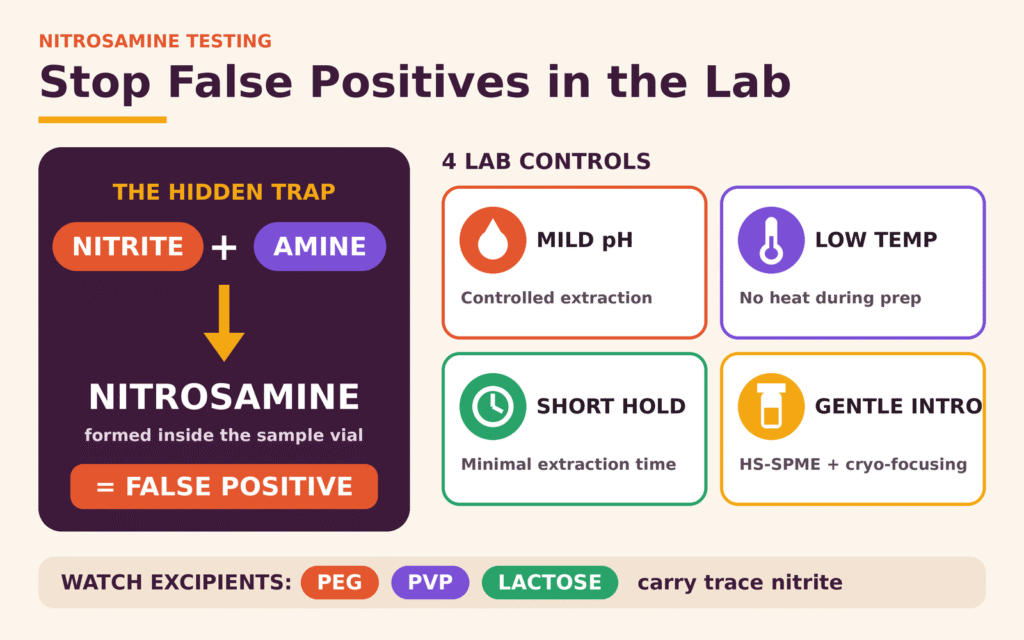
Sample extraction can also produce misleading positive results when artifactual nitrosation occurs because trace nitrites and residual amine precursors are simultaneously present in the drug product matrix. Inappropriate extraction pH, elevated temperatures, and extended extraction periods can accelerate nitrosation reactions in solution. To minimize this risk, validated laboratory procedures must maintain a controlled, mild extraction pH, use low processing temperatures, limit sample extraction hold times, and apply suitable sample introduction techniques. Specialized approaches, including headspace solid-phase microextraction (HS-SPME) coupled with cryo-focusing, can help protect thermally sensitive volatile nitrosamines during sample preparation and instrumental analysis.
Risk assessments must also account for the possibility of nitrosamine formation and migration across excipients, container closure systems, and long-term stability storage conditions. Vendor technical reviews identify typical trace nitrite concentrations of 0.20–1.50 ppm in polyethylene glycol (PEG), where oxidative degradation can generate reactive aldehydes and organic peroxides; 0.50–2.00 ppm in polyvinylpyrrolidone (PVP), which may retain residual amine polymerization catalysts; and 0.10–0.50 ppm in lactose monohydrate.
Packaging-related extractables and leachables introduce additional formulation risks. Elastomeric stoppers and plungers may release thiuram and dithiocarbamate vulcanization accelerators, which can decompose into secondary amines. Similarly, thermal sealing of nitrocellulose-primed infusion bag overwraps can generate nitrogen oxides (NOx). These compounds may react with dialkylamines present in printing inks, resulting in the formation of volatile N-nitrosodibutylamine (NDBA). This compound can subsequently migrate through primary polymer bags.
Transdermal patches present another analytical and formulation challenge because adhesive polymers may physically retain lipophilic NDSRIs across cross-linked production lots. At the same time, release liners and backing films can contribute to impurity migration throughout shelf lives extending from 24 to 36 months. When sponsors introduce formulation modifications, such as antioxidants including ascorbic acid or pH-modifying agents, to reduce nitrosation, they must also consider the bioequivalence requirements described in Health Canada’s Appendix 5, alongside the necessary stability re-validation.
Evaluate packaging-related contamination and migration risks with dedicated nitrosamine leachables testing.
| Analytical Platform | Primary Target Analytes | Performance & Regulatory Strengths | Technical Limitations & Analytical Controls | Source |
|---|---|---|---|---|
| Triple Quadrupole LC-MS/MS (QqQ) | Non-volatile, thermally labile small-molecule nitrosamines, such as NDMA and NMBA, and NDSRIs. | Inter-laboratory mass spectrometry studies demonstrate quantitative performance at 10% of acceptance levels, with 85%–115% recovery. Vendor OTC protocols report NDMA sensitivity reaching 10 ppt. | Overlapping MRM transitions arising from the approximately 29 Da mass increase associated with the parent API and matrix-related ion suppression can affect quantitation. Strong chromatographic separation and deuterated internal standards help minimize these effects. | Analytical Method Performance |
| High-Resolution LC-MS/MS (LC-HRMS / Orbitrap) | Complex NDSRIs, unidentified nitrosamines, and high-molecular-weight peptide and polymer formulations. | Exact-mass differentiation helps distinguish co-eluting API degradants and isotopic interferences from genuine NDSRI signals. | Greater instrument complexity and increased data-review requirements. Particularly suitable for method development, structural characterization, and analysis of complex matrices. | Analytical Method Performance |
| GC-MS/MS & HRAM-GC-MS (with HS-SPME / Cryo-Focusing) | Volatile small-molecule nitrosamines, including NDMA, NDEA, NDBA, NEIPA, and NDIPA. | Provides effective chromatographic separation of volatile compounds while avoiding the direct introduction of non-volatile matrix components. Vendor validation protocols report LOD ≤ 0.03 ng/mL, LOQ ≤ 0.1 ng/mL, and linearity R² ≥ 0.999. | Heated injection ports may cause degradation of sensitive analytes or promote thermal artifact formation. Cryo-focusing and headspace-SPME can help reduce these risks. | Analytical Method Performance |
Choosing a Health Canada-Compliant Nitrosamine Testing Laboratory in Canada
Choosing an appropriate Nitrosamine Testing Laboratory in Canada involves more than evaluating instrument availability or advertised detection limits. Sponsors must verify active Health Canada GMP compliance, eligibility under the applicable DEL requirements, validated Category 1 analytical sensitivity, access to in-house NDSRI reference standard synthesis, and documentation suitable for regulatory submissions across multiple jurisdictions. Selecting an unaccredited facility or a laboratory operating exclusively for research and development purposes can expose sponsors to submission deficiencies, additional validation requirements, and disruptive analytical method transfers during critical CAPA implementation periods.
Drug Establishment Licence Requirements for a Nitrosamine Testing Laboratory in Canada
Under Sections 32 and 37 of Health Canada’s guidance, facilities performing confirmatory, release, or stability nitrosamine testing for Canadian medicinal products must operate in compliance with GMP requirements and be appropriately identified under the relevant Drug Establishment Licence (DEL).
Analytical results produced outside a GMP-compliant and DEL-listed laboratory may not be acceptable for Canadian commercial batch release, formal Step 2 or Step 3 confirmatory submissions, or continuing stability commitments, even when research and development screening methods demonstrate sufficient analytical sensitivity. Although the complete text of Section 37 and the detailed Section 38 batch-testing tables were unavailable in the summarized Health Canada extraction, Sections 32, 37, and 38 establish the importance of validated quantitative testing, appropriate DEL status, and confirmatory batch requirements for both marketed medicines and new regulatory submissions. For sponsors preparing submissions across North America, maintaining dual US FDA registration can also help prevent unnecessary analytical method transfers between Canadian and US regulatory dossiers.
Before selecting a contract analytical laboratory, pharmaceutical sponsors should evaluate the following six technical and compliance criteria:
1. Active DEL & GMP Status: Verify that the laboratory maintains active Health Canada GMP compliance and has the appropriate DEL eligibility for mass spectrometric testing under Section 37. Sponsors should review the relevant licensing documentation before transferring samples or initiating confirmatory studies.
2. Category 1 & Skip-Testing LOQs: Confirm that validated analytical methods can achieve the sensitivity required for Health Canada’s 18 ng/day Category 1 AI limit. The laboratory should also demonstrate the ability to meet LOQ requirements of ≤ 10% of the AI limit when the sponsor intends to justify omitting routine drug product testing.
3. Custom NDSRI & Isotope Synthesis: Select a laboratory with access to integrated organic synthesis capabilities for preparing NDSRI reference materials that are not commercially available. The availability of stable isotope-labeled internal standards is equally important for correcting extraction-related losses and matrix-dependent analytical variations.
4. Artifact & Matrix Verification: Evaluate whether the laboratory can optimize sample extraction under controlled mild-pH and low-temperature conditions. Its analytical workflow should also include trace nitrite profiling across critical excipients, including PEG, PVP, and lactose, as part of ICH Q2(R2) method validation.
5. Integrated E&L Migration Capability: Confirm that the laboratory can evaluate volatile nitrosamines and associated amine/NOx precursors originating from packaging materials. This includes the assessment of potential leachables from elastomeric stoppers, tubing, adhesives, and printed overwraps.
6. Audit-Ready Data Packages: Ensure that the laboratory provides complete raw chromatograms, instrument audit trails, quality-assurance-verified validation reports, and traceable Standard Operating Procedures (SOPs). All analytical documentation should support the requirements of Section 32 and ICH Q2(R2).
Compare laboratory outsourcing considerations, analytical capabilities, and quality-system requirements before selecting a contract testing partner. Read our guide to outsourcing nitrosamine testing to a CRO.
Integrated Analytical, Custom Synthesis, and Regulatory Support at ResolveMass Laboratories
Situated at 500 Bd Cartier O in Laval, Québec (H7V 5B7), ResolveMass Laboratories Inc. combines Health Canada DEL-licensed GMP analytical testing with custom organic synthesis, formulation risk assessment, and extractables and leachables (E&L) evaluation within an integrated laboratory environment. Bringing custom NDSRI synthesis, forced-degradation profiling, and GMP confirmatory testing together under one scientific team can reduce delays associated with multiple laboratory transfers, repeated technical discussions, and the loss of analytical context during time-sensitive CAPA implementation.
ResolveMass operates under Health Canada GMP compliance through Drug Establishment Licence No. 3-002945-A and maintains registration with the US FDA under Establishment Identifier 3042696771. The company also holds an ISO 9001:2015-certified Quality Management System, while its service documentation states alignment with ISO/IEC 17025 testing standards and the use of accredited reference materials. With more than a decade of reported analytical chemistry experience supporting pharmaceutical and biotechnology organizations across over nine countries, its PhD-level chemists and toxicologists work with multiple advanced analytical platforms.
These capabilities include triple quadrupole LC-MS/MS (QqQ), with reported NDMA detection sensitivity down to 10 ppt in OTC matrices; Q-Exactive Orbitrap LC-HRMS; and GC-MS/MS incorporating headspace-SPME and cryo-focusing, with reported LOD ≤ 0.03 ng/mL, LOQ ≤ 0.1 ng/mL, and linearity R² ≥ 0.999. Additional analytical capabilities include quantitative NMR (qNMR), FTIR, and ICP-MS, supported by formulation and reformulation risk modeling.
Establish a scientifically justified, product-specific mitigation approach with our nitrosamine control strategy development services.
Conclusion
Working with a technically qualified and DEL-licensed Nitrosamine Testing Laboratory in Canada helps pharmaceutical sponsors minimize the risk of CAPA implementation delays, recall-related complications, and regulatory deficiencies during Health Canada reviews. As regulatory scrutiny continues to address NDSRIs, trace-level nitrite variability in excipients, packaging-related leachables, and the stringent Category 1 AI requirement of 18 ng/day, sponsors need reliable analytical strategies supported by appropriate laboratory infrastructure and regulatory expertise.
Integrating custom reference standard synthesis, extraction procedures that minimize artifactual nitrosation, ICH Q2(R2)-compliant analytical method validation, and GMP confirmatory and release testing within a single qualified quality system can improve analytical consistency and simplify compliance management throughout the product lifecycle.
For assistance with Health Canada-aligned nitrosamine risk assessments, customized NDSRI analytical method validation, or DEL-compliant confirmatory and release testing, pharmaceutical sponsors can connect with the scientific team at ResolveMass Laboratories Inc. in Laval, Québec.
Visit the Contact Us page to discuss your analytical and regulatory requirements:
Frequently Asked Questions
The deadlines for Step 1 (risk assessments), Step 2 (confirmatory testing), and Step 3 (market authorization changes) have all passed, with Step 3 concluding on August 1, 2025. Health Canada does not consider extension requests for these milestones. For Appendix 1 AI limits published before August 1, 2025, MAHs have until August 1, 2028, to complete CAPAs, while limits published afterward follow a separate three-year period beginning on their respective publication dates.
The May 29, 2026, revision changed Section 15, requiring MAHs to notify Health Canada when they decide to initiate a recall under GUI-0039. It also introduced risk-based classifications for mitigation-related Post-NOC submissions, allowing Level I or Level III pathways where appropriate. The November 5, 2026, update revised Sections 2 and 28 to accommodate ICH M7-aligned Less-Than-Lifetime (LTL) AI adjustments for shorter treatment durations.
Health Canada establishes different analytical sensitivity requirements depending on the proposed testing strategy. Under Section 33, confirmatory methods must achieve an LOQ of ≤ 100% of the applicable AI limit, while periodic skip testing requires ≤ 30%. To support the omission of routine drug product testing, the validated method must demonstrate an LOQ of ≤ 10% of the individual AI limit.
Health Canada and the EMA apply an AI limit of 18 ng/day to CPCA Category 1 nitrosamines, whereas the US FDA uses 26.5 ng/day based on NDEA potency. This difference makes the Canadian and European requirements more stringent for Category 1 impurities. Since Categories 2–5 have identical limits across these regulatory authorities, sponsors operating internationally must pay particular attention to the stricter Canadian Category 1 analytical requirements.
No. Health Canada requires sponsors to complete Step 1 before moving to confirmatory testing because the initial assessment identifies potential nitrosamine formation pathways and contamination sources. These investigations must consider manufacturing processes, raw materials, excipients, and packaging components. Supplier declarations alone cannot replace a documented scientific evaluation of potential risks and their underlying root causes.
When an NDSRI does not have an established Appendix 1 limit, sponsors can develop a scientifically supported AI through CPCA or SAR read-across using mass-based TD50 calculations from an appropriate carcinogenicity study. Another option is a negative GLP-compliant Enhanced Ames Test under Appendix 3, which can support an AI of 1,500 ng/day. Negative in vivo mutagenicity findings, including OECD Test Guideline No. 488 results, may also support non-mutagenic impurity control under ICH Q3A and Q3B.
Under Section 34, an API specification must include an appropriate analytical test and acceptance criterion when confirmatory testing identifies a nitrosamine at a significant level, such as above 30% of its applicable AI limit. When multiple impurities are present, cumulative exposure limits must also be considered. For finished drug products, routine release and shelf-life testing is required when a nitrosamine is detected below 10% of its AI limit and its root cause has not been established.
Health Canada requires sponsors to assess both individual impurity concentrations and their combined daily exposure when multiple nitrosamines are detected in an API or finished product. Section 27 addresses the evaluation of cumulative nitrosamine exposure to ensure that the overall intake remains within the applicable safety limit. For example, when NDMA and NDEA occur together, the combined daily exposure must not exceed 26.5 ng/day under the example provided in the guidance.
The four principal analytical approaches recognized under USP include LC-MS/MS, LC-HRMS, GC-MS/MS, and GC-headspace-MS/MS. Triple quadrupole LC-MS/MS and Orbitrap LC-HRMS are particularly useful for analyzing non-volatile, thermally sensitive NDSRIs and distinguishing overlapping MRM transitions associated with the approximately 29 Da mass increase in parent APIs. For volatile small-molecule nitrosamines, GC-MS/MS combined with HS-SPME and cryo-focusing provides effective separation while minimizing thermal degradation and artifactual nitrosation.
Reference:
- Health Canada. Guidance on nitrosamine impurities in medications: Evaluating and managing the risks of N-nitrosamine impurities in human pharmaceutical, biological and radiopharmaceutical products (August 2025 and November 2026 editions). https://www.canada.ca/en/health-canada/services/drugs-health-products/compliance-enforcement/information-health-product/drugs/nitrosamine-impurities/medications-guidance.html
, https://www.canada.ca/content/dam/hc-sc/documents/services/drugs-health-products/compliance-enforcement/information-health-product/drugs/nitrosamine-impurities/medications-guidance/medications-guidance.pdf
, and https://www.canada.ca/content/dam/hc-sc/documents/services/drugs-health-products/compliance-enforcement/information-health-product/drugs/nitrosamine-impurities/medications-guidance/nitrosamine-impurities-medications-guidance-nov-2026.pdf - Health Canada. Nitrosamine impurities in medications: Overview, Recalls, and 2025–2026 Updates. https://www.canada.ca/en/health-canada/services/drugs-health-products/compliance-enforcement/information-health-product/drugs/nitrosamine-impurities.html
- Health Canada. Appendix 1: Established acceptable intake (AI) limits for N-nitrosamine impurities (Version 2026-03-11). https://www.canada.ca/en/health-canada/services/drugs-health-products/compliance-enforcement/information-health-product/drugs/nitrosamine-impurities/established-acceptable-intake-limits.html
- European Medicines Agency (EMA). Appendix 3: Enhanced Ames Test Conditions for N-nitrosamines. https://www.ema.europa.eu/en/documents/other/appendix-3-enhanced-ames-test-conditions-n-nitrosamines_en.pdf
- International Journal of Pharmaceutical Sciences (IJPS). Nitrosamine Impurities: Analytical Detection and Risk Assessment. https://www.ijpsjournal.com/article/nitrosamine-impurities-analytical-detection-and-risk-assessment
- ResearchGate. Performance Characteristics of Mass Spectrometry-Based Analytical Procedures for Quantitation of Nitrosamines in Pharmaceuticals: Insights from an Inter-laboratory Study. https://www.researchgate.net/publication/372759157_Performance_Characteristics_of_Mass_Spectrometry-Based_Analytical_Procedures_for_Quantitation_of_Nitrosamines_in_Pharmaceuticals_Insights_from_an_Inter-laboratory_Study
Get In Touch With Us
About The Author