
Introduction
Developing follow-on therapeutics across Peptide Biosimilars and rDNA-Derived Peptides requires a Contract Development and Manufacturing Organization (CDMO) with expertise in both chemical synthesis and recombinant biologics. This is because global regulatory authorities now enforce hybrid evidentiary standards that encompass both disciplines. A partner focused exclusively on small-molecule synthetic generics may lack the higher-order structure, biological potency, and immunogenicity assessment capabilities required when referencing a recombinant DNA (rDNA) originator. Conversely, a traditional biologics CDMO may not possess the expertise needed to address solid-phase synthesis deletions, diastereomers, and trifluoroacetate (TFA) counter-ion salts.
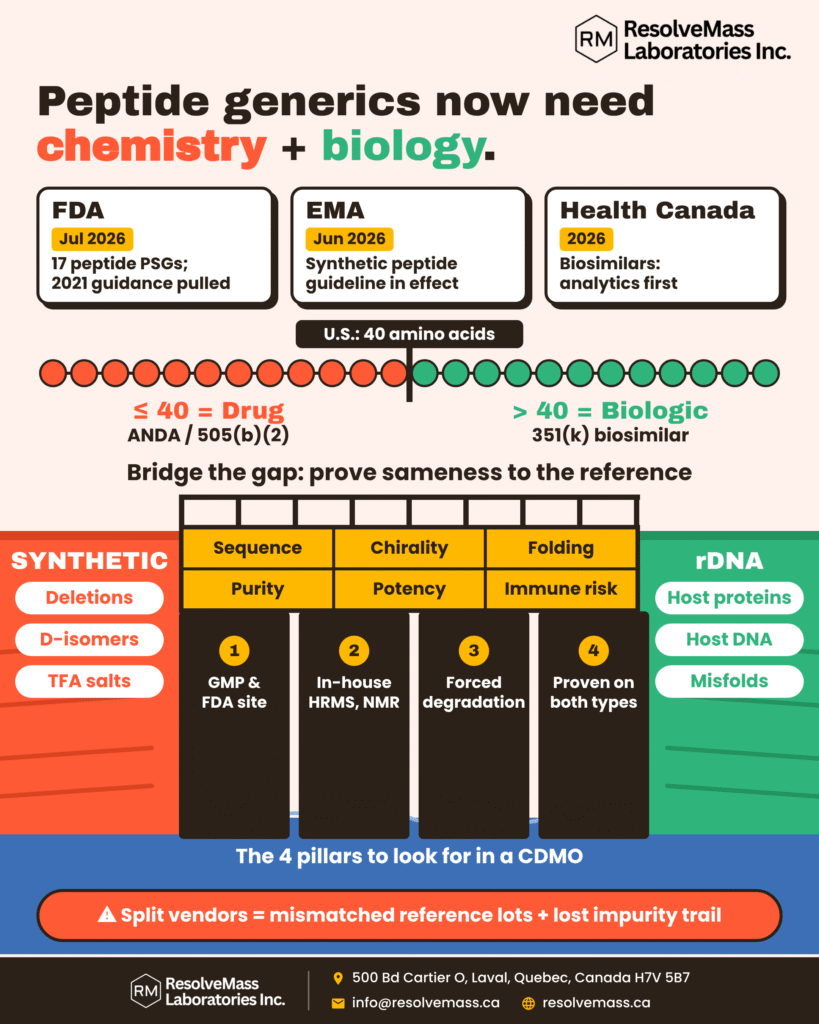
In 2026, this dual-domain expertise evolved from a strategic advantage into a fundamental regulatory expectation. On July 28, 2026, the U.S. Food and Drug Administration (FDA) formally withdrew its May 2021 guidance on synthetic peptide Abbreviated New Drug Applications (ANDAs) referencing rDNA-origin drugs, stating that it no longer reflects current scientific thinking. At the same time, the FDA issued 17 revised draft product-specific guidances (PSGs) covering synthetic, recombinant, and semi-synthetic peptide sources. Earlier, on June 1, 2026, the European Medicines Agency (EMA) brought its Guideline on the development and manufacture of synthetic peptides (EMA/CHMP/CVMP/QWP/367182/2025) into legal effect. This guideline requires the application of biosimilarity comparability principles whenever a chemically synthesized peptide references a biological medicinal product. Alongside Health Canada’s 2026 Biosimilar Guidance, which shifts the primary burden of proof toward Module 3 multi-attribute analytical concordance, drug developers face an unmistakable reality: regulatory pathways no longer allow synthetic chemistry and recombinant biology to function independently.
Share via:
Quick Summary:
- Dual expertise is now expected. Peptide follow-ons that reference rDNA products need a CDMO skilled in both chemical synthesis and recombinant biologics, because regulators now apply evidence standards from both fields.
- Regulators changed course in 2026.
- FDA: On July 28, 2026, FDA withdrew its May 2021 guidance on synthetic peptide ANDAs referencing rDNA drugs. It also issued 17 revised draft product-specific guidances covering nine peptides, including semaglutide, liraglutide and tirzepatide.
- EMA: Its synthetic peptide guideline came into effect on June 1, 2026.
- Health Canada: Its revised biosimilar guidance puts analytical data first, and comparative efficacy trials are no longer typically required.
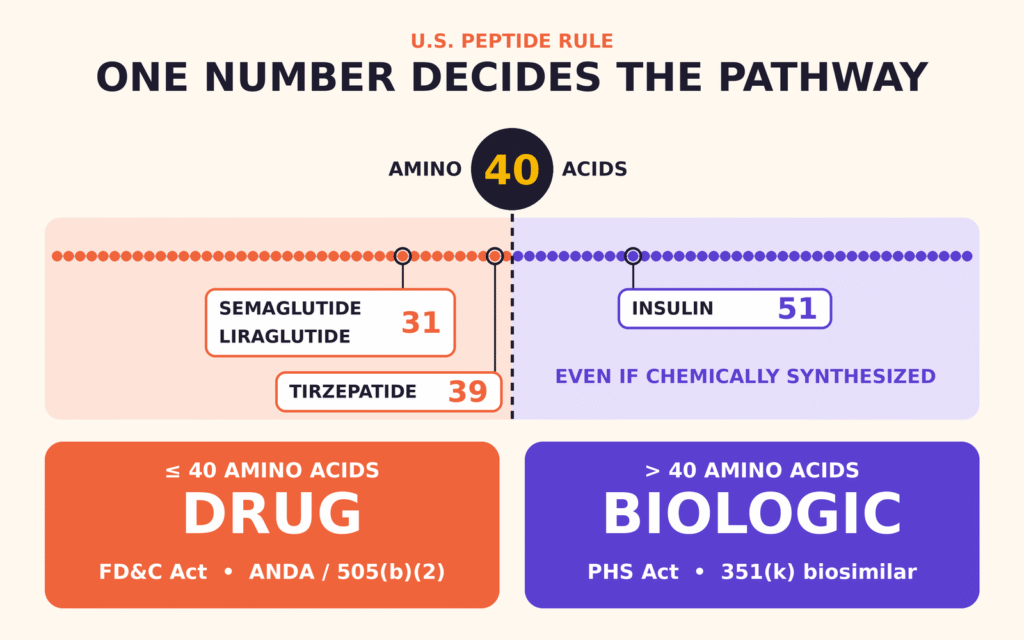
- The U.S. pathway depends on the 40-amino-acid line. Peptides of 40 or fewer amino acids are regulated as drugs and go through an ANDA or 505(b)(2). Above 40, they are biologics under the 351(k) pathway, even if chemically synthesized. The EU and Canada classify these products differently, but they still expect biosimilarity-style comparability when the reference product is biological.
- The manufacturing route sets the impurity profile.
- Synthesis (SPPS/LPPS): deletion sequences, D-isomers, TFA salts and residual coupling reagents.
- rDNA production: host cell proteins, host DNA, endotoxins and misfolded disulfides.
- Semi-synthetic routes, such as oral semaglutide, carry both sets of risks.
- Comparability needs orthogonal testing. Sequence, stereochemistry, higher-order structure, aggregation, purity, potency and immunogenicity all have to be shown, using aged stability samples as well as fresh batches. HPLC purity alone can miss fibrillation or stereoisomer problems.
- Splitting work across vendors creates risk. Mismatched reference lots, broken impurity tracking and late method validation can lead to extra FDA and EMA review cycles and delay commercial scale-up.
- Choose a CDMO with four pillars: GMP and FDA standing, in-house orthogonal analytics, early forced-degradation and method development, and proven work on both peptide classes. ResolveMass is presented as an integrated single-site example of this model.
Why Do Peptide Biosimilars and rDNA-Derived Peptides Overlap in 2026 Regulation?
Regulatory frameworks for Peptide Biosimilars and rDNA-Derived Peptides overlap because molecular chain length, manufacturing origin, and three-dimensional folding position modern therapeutic peptides at the statutory boundary between chemically synthesized generic drugs and 351(k) biological products. Rather than providing exemptions solely on the basis of chemical synthesis, the FDA, EMA, and Health Canada assess follow-on candidates through converging requirements involving structural sameness, comparative impurity profiling, and functional equivalence.
In the United States, the statutory distinction is based on a threshold of 40 amino acids. Peptides containing 40 or fewer amino acids, including high-value GLP-1 receptor agonists such as semaglutide (31 residues), liraglutide (31 residues), and tirzepatide (39 residues), are regulated as drugs under the Federal Food, Drug, and Cosmetic Act (FD&C Act), rather than as biologics under the Public Health Service (PHS) Act. Consequently, chemically synthesized versions referencing an rDNA-derived listed drug follow the 505(j) ANDA or 505(b)(2) pathway. In contrast, polypeptides containing more than 40 amino acids qualify as biological products under the PHS Act, even when manufactured entirely through chemical synthesis. This makes them eligible for the 351(k) biosimilar pathway against a recombinant reference biologic.
The FDA’s July 28, 2026, update further emphasized the close regulatory relationship between these modalities. The 17 revised draft PSGs cover nine active peptide molecules across 17 reference NDAs: calcitonin salmon, dasiglucagon hydrochloride, glucagon, liraglutide, pegcetacoplan, semaglutide, teriparatide, tirzepatide, and vosoritide. These guidances apply to drug substances manufactured through recombinant, synthetic, and semi-synthetic processes. Ahead of a planned replacement framework later in 2026 and the inclusion of Considerations for Peptide Drug Products in ANDAs on the CDER 2026 Guidance Agenda, the revised draft PSGs strengthen expectations across five technical areas:
- Manufacturing-source documentation: Explicit submission requirements for peptides manufactured through recombinant expression, chemical synthesis, or semi-synthetic hybrid processes.
- Innate immune response testing: Revised in vitro immunogenicity screening protocols to assess immune activation associated with trace sequence variants or aggregates.
- Impurity thresholds: More stringent identification, reporting, and justification requirements for peptide-related impurities compared with the reference product.
- Higher-order structure (HOS) assessment: Expanded biophysical characterization to demonstrate comparability in secondary, tertiary, and self-association states.
- Biological activity assessment: Refined functional bioassays to establish equivalent receptor engagement and downstream signaling potency.
European and Canadian regulators demonstrate similar analytical convergence, even when their statutory classifications differ. The EMA explicitly excludes chemically synthesized peptides from the legal biosimilar pathway because they do not fall within the definition of a biological substance. However, when a synthetic peptide references a biological European Reference Medicinal Product, the EMA expects sponsors to apply biosimilarity principles, quantify all structural differences, establish predefined comparability acceptance criteria, and perform functional cell-based bioassays. Similarly, Health Canada’s 2026 Biosimilar Guidance directs qualifying chemically synthesized polypeptides toward pharmaceutical Abbreviated New Drug Submissions (ANDS). At the same time, it replaces routine Phase III clinical efficacy trials for biologics with extensive Module 3 mass spectrometry and HOS concordance assessments, supported by comparative PK/PD studies.
A well-defined comparability strategy helps demonstrate that analytical differences do not affect product quality, safety, or efficacy. Review the key considerations in biosimilar comparability studies.
How Does Manufacturing Route Dictate Analytical and Impurity Footprints?
Manufacturing route determines a peptide’s analytical and impurity profile because chemical synthesis, rDNA fermentation, and semi-synthetic hybrid processes produce fundamentally different process reagents, stereochemical errors, post-translational modifications, and aggregation risks. Therefore, a CDMO must evaluate how a proposed synthetic or hybrid manufacturing process compares with an rDNA reference listed drug (RLD), ensuring that no gaps remain in residual impurity clearance or structural comparability assessments.
Chemical synthesis involves assembling peptide chains on a solid resin through Solid-Phase Peptide Synthesis (SPPS), in solution through Liquid-Phase Peptide Synthesis (LPPS), or through hybrid approaches that combine SPPS-produced fragments in solution. According to a market analysis by SNS Insider, LPPS accounted for approximately 46.2% of the peptide synthesis technology share in 2025, primarily because of its scalability for bulk production of multi-kilogram to multi-ton commercial APIs. Meanwhile, hybrid and recombinant platforms represent the fastest-growing segment. Chemical assembly eliminates biological contaminants such as host cell proteins (HCPs), host DNA, and viral particles. The EMA confirms that these contaminants do not require testing in comparability studies involving synthetic copies of rDNA originators. However, chemical manufacturing introduces other potential impurities, including deletion and insertion sequences, N-acetylated capped truncations, D-amino acid racemization and diastereomers (particularly during fragment condensation), residual coupling reagents (such as HBTU, HATU, and DIC), TFA counter-ions, and residual fluoride when hydrogen fluoride cleavage is employed.
Recombinant and semi-synthetic manufacturing processes create a different analytical burden. In rDNA manufacturing, processes such as E. coli BL21(DE3) fed-batch inclusion body fermentation followed by guanidine hydrochloride solubilization, enterokinase cleavage, and RP-HPLC purification, or yeast fermentation, can introduce risks associated with HCPs, residual DNA, bacterial endotoxins, heterogeneous glycosylation or enzymatic post-translational modifications, and scrambled disulfide bonds. Semi-synthetic approaches directly combine both manufacturing disciplines. For example, in oral semaglutide tablets, the peptide backbone is produced through yeast fermentation and subsequently conjugated chemically to a fatty di-acid side chain. Managing this transition requires expertise in biological purification, chemical conjugation, residual solvent clearance under ICH Q3C and USP, and elemental impurity controls.
Understanding manufacturing differences is essential when establishing appropriate process controls and selecting a suitable production platform. Review the analytical and operational distinctions in biosimilar and biologic manufacturing.
Quality and Regulatory Attribute Comparison
| Quality and Regulatory Attribute | Synthetic Peptides (40 or Fewer Amino Acids) | Synthetic Polypeptides (More Than 40 Amino Acids) | rDNA Biosimilars (More Than 40 Amino Acids) |
|---|---|---|---|
| Primary US Statutory Pathway | FD&C Act 505(j) ANDA or 505(b)(2) | PHS Act 351(k) Biosimilar | PHS Act 351(k) Biosimilar |
| EU Pathway When Referencing rDNA RLD | Article 10(3) hybrid or Article 10(1) generic applying biosimilarity principles (ineligible for the legal biosimilar route) | Assessed according to substance origin; biosimilar pathway reserved for biological substances | Biosimilar Marketing Authorization Application |
| Dominant Process-Related Impurities | Coupling reagents, protecting groups, residual solvents, TFA counter-ions, residual fluoride | Coupling reagents, residual solvents, linker and fragment condensation by-products | Host cell proteins (HCPs), host cell DNA, media antibiotics, viral contaminants, endotoxins |
| Dominant Product-Related Impurities | Deletion/insertion peptides, N-acetylated truncations, D-amino acid stereoisomers, oxidation, deamidation | Higher-order structural variants, stereoisomers, deletion peptides, HMW aggregates | Glycoforms, charge variants, misfolded disulfide bridges, biological aggregates |
| Benchmark Impurity Action Thresholds | Historically, 0.10% identification and a greater than 0.5% ceiling under the withdrawn May 2021 FDA guidance (tightened in July 2026 PSGs); EU 0.1% report / 0.5% identify / 1.0% qualify | Product-specific comparative similarity against the reference product; ICH Q3A/B excluded or adapted | Multi-tiered statistical equivalence (Tier 1) and reference quality ranges (Tier 2) under ICH Q6B |
Bridging Immunogenicity, Higher-Order Structure, and Bioactivity in Peptide Biosimilars and rDNA-Derived Peptides
Establishing comparability in immunogenicity, higher-order structure, and bioactivity across Peptide Biosimilars and rDNA-Derived Peptides requires orthogonal biophysical, mass-spectrometric, and cell-based assays. Primary sequence verification alone cannot reliably predict fibrillation, self-association, or immune activation caused by neo-epitopes. Depending exclusively on reversed-phase HPLC purity measurements can leave significant structural differences undetected because mass spectrometry cannot distinguish stereoisomers, while individual chromatographic methods cannot adequately resolve conformational polymorphism.
European regulatory precedent highlights the commercial consequences of underestimating higher-order physical behavior. In December 2022, the Danish Medicines Agency refused marketing authorization for Viatide, a synthetic generic liraglutide referencing rDNA Victoza under Article 10(1). The decision involved major objections concerning insufficient chemical-pharmaceutical documentation and unresolved fibrillation characteristics. In contrast, Ogluo, a synthetic follow-on glucagon referencing recombinant Glucagen in pre-filled pens and syringes, received EMA approval in February 2021 through an Article 10(3) hybrid application after demonstrating active substance equivalence despite formulation differences.
To minimize the risk of fibrillation-related or stereochemical regulatory rejections, an analytical comparability package must incorporate primary structure, higher-order folding, physical aggregation, and functional potency assessments against qualified RLD batches.
A comprehensive analytical program should connect critical quality attributes with suitable characterization methods and predefined acceptance criteria. Learn how to identify and assess critical quality attributes (CQAs) in biosimilars.
Analytical Comparability Assessment
| Analytical Dimension | Core Orthogonal Instrumentation | Specific Structural or Risk Target Resolved |
|---|---|---|
| Primary Sequence and PTMs | LC-HRMS (Orbitrap), LC-MS/MS peptide mapping (greater than 95% coverage), non-reducing mapping, AAA, Edman degradation | Intact mass, N-/C-terminal integrity, oxidation (+16 Da), deamidation (+1 Da), acetylation (+42 Da), disulfide bridge architecture |
| Stereochemistry and Counter-Ions | Chiral chromatography, 1,5-difluoro-2,4-dinitrobenzene derivatization, 2D-NMR (NOE correlations), Ion Chromatography | D-amino acid racemization, proline cis/trans isomerism, counter-ion stoichiometry (e.g., TFA vs. acetate), salt form verification |
| Higher-Order Structure and Aggregation | HDX-MS, Native MS, Far-UV CD, FTIR, SEC, SV-AUC | Secondary α-helix/β-sheet content, tertiary folding, fragile non-covalent oligomers, and fibrillation in native solution (through matrix-free SV-AUC) |
| Charge Variants and Purity | RP-HPLC/UHPLC, IEX (CEX-MS/AEX), HIC, cIEF, CZE | Main-peak retention equivalence, hydrophobic impurities, charge heterogeneity, deamidation, and sequence variants |
| Immunogenicity and Bioactivity | In silico MHC/T-cell epitope modeling, in vitro IIRA (IL-6, TNF-α), Bystander Assays (for Treg-modulating peptides), cell-based EC50/IC50 bioassays | Innate PRR stimulation, adaptive T-cell epitope risk associated with new peptide impurities, receptor-binding affinity, and downstream functional potency |
Mass spectrometry-based structural characterization provides complementary information about peptide sequence integrity, post-translational modifications, and molecular heterogeneity. Explore proteomics approaches for biosimilars to understand how orthogonal techniques support comparative assessment.
Regulatory reviewers also expect immunogenicity risk assessments to incorporate aged stability samples rather than relying exclusively on freshly synthesized batches. Deamidation products, oxidized species, and high-molecular-weight (HMW) aggregates can accumulate toward the end of a product’s shelf life in ways that cannot be accurately predicted using newly manufactured batches alone. By implementing a systematic control strategy, CDMOs should combine forced degradation studies with long-term stability samples to identify impurities that differ from the RLD. In silico T-cell epitope ranking and in vitro innate immune response assays (IIRAs) should focus on variants that cannot be adequately eliminated through upstream process optimization.
Forced degradation experiments can reveal degradation pathways and help establish stability-indicating analytical procedures. Learn how forced degradation studies of biosimilars support impurity identification and comparative stability assessments.
In addition to chemical degradation, aggregation can affect peptide stability, biological activity, and potential immunogenicity. A suitable analytical strategy should therefore include complementary techniques to detect soluble and insoluble aggregates. Review the approaches used in aggregation analysis of biosimilars.
What Happens When Sponsors Split Synthesis, Analytics, and Biosimilar Comparability Across Vendors?
Dividing peptide synthesis, analytical method validation, and biosimilar-grade comparability activities among disconnected vendors can compromise regulatory submissions by disrupting impurity traceability, creating inconsistent RLD baselines, and delaying the validation of stability-indicating methods. When chemical synthesis takes place at one facility, mass spectrometry characterization is performed by a second CRO, and bioassay or formulation development is assigned to a third partner, sponsors frequently encounter avoidable FDA and EMA review cycles.
Three operational challenges commonly arise in fragmented outsourcing arrangements:
- Mismatched RLD baselines across studies: Regulatory reviewers may question comparability packages when different RLD lots are evaluated across separate laboratories for RP-HPLC, chiral profiling, and HOS analyses. Such inconsistencies make it difficult to determine whether minor analytical variations result from natural RLD lot variability or differences in the manufacturing process.
- Disconnected impurity fate-and-purge tracking: During SPPS/LPPS scale-up or semi-synthetic conjugation, even minor changes in coupling temperature, cleavage kinetics, or chromatographic gradients can modify trace diastereomer and truncation profiles. If the team responsible for validating stability-indicating methods under an Analytical Target Profile (ATP) and Design of Experiments (DoE) framework operates independently of synthesis chemists, essential resolution parameters may be established too late. This can result in expensive analytical rework as development programs adjust to the revised July 2026 PSGs.
- Commercial capacity and tech-transfer bottlenecks: Commercial GLP-1 manufacturing requires multi-kilogram to multi-ton reactor infrastructure. This requirement is reflected in an October 2026 industry capacity tracker reporting 9 billion committed by Eli Lilly toward tirzepatide API manufacturing. Transferring unvalidated analytical procedures or insufficiently characterized intermediates between clinical synthesizers and commercial CDMOs can delay Drug Master File (DMF) reviews and jeopardize narrow patent-cliff launch timelines.
An integrated analytical strategy helps maintain consistency across reference-product characterization, impurity assessment, and structural comparison. Sponsors can review the technical requirements of a complete biosimilar analytical characterization service when evaluating external development support.
How Should Sponsors Evaluate a Dual-Capable Peptide CDMO?
Selecting a CDMO for complex synthetic or recombinant peptide follow-on development requires a thorough assessment of its quality systems, biologics-grade orthogonal instrumentation, synthetic chemistry capabilities, and regulatory CMC execution. These functions should operate within one integrated quality system. Procurement and CMC teams evaluating potential partners should consider four essential technical criteria:
- Verified Multi-Jurisdictional Regulatory Standing: Confirm active FDA facility registration, GMP compliance (such as a Health Canada Drug Establishment Licence or an equivalent FDA/EMA inspection record), and ISO 9001:2015 or GLP quality systems capable of supporting and defending Module 3 and CMC submissions.
- Single-Site Orthogonal Analytical Depth: Confirm in-house access to high-resolution Orbitrap MS, triple quadrupole LC-MS/MS, MALDI-TOF, 2D-NMR, FTIR, chiral chromatography, CE/cIEF, SEC, IEX, and GC-MS/GC-FID (for USP and ICH Q3C residual solvents). The facility should also provide NDSRI nitrosamine testing and USP extractables and leachables (E&L) studies for drug-device combination pens.
- Lifecycle Method Development and Forced Degradation Expertise: Prioritize teams that develop stability-indicating procedures using risk assessments and DoE during the early stages of development. They should also have the capability to synthesize forced-degradation impurities directly and conduct side-by-side stress comparisons against qualified RLD batches.
- Demonstrated Experience Across Both Peptide Classes: Evaluate the CDMO’s established experience with complex synthetic generics referencing rDNA RLDs, including semaglutide, liraglutide, tirzepatide, and lanreotide. Additional experience with conjugated modalities, such as peptide-oligonucleotide conjugates, and biosimilar analytical similarity assessments is also important.
ResolveMass Laboratories Inc., headquartered in Laval, Quebec, Canada, represents this integrated single-site approach. Instead of distributing complex projects among separate synthesis, formulation, and analytical vendors or communicating technical requirements through non-scientist account managers, ResolveMass assigns PhD-level chemists and analytical scientists directly to laboratory work. This approach brings custom synthesis, polymer and formulation science, and advanced mass spectrometry together within one internal team. The facility operates with ISO 9001:2015 certification, holds a Health Canada GMP-compliant Drug Establishment Licence, maintains FDA registration (Establishment ID: 3042696771), and provides GLP-compliant bioanalytical operations. Across vendor-reported programs involving complex generic peptides, including semaglutide, liraglutide, tirzepatide, and lanreotide, as well as peptide-oligonucleotide conjugates (such as nusinersen) and biosimilar analytical similarity studies, this integrated structure has supported the development of IND-ready synthetic peptides achieving 99.3% purity. It has also provided regulatory-ready CMC documentation for sponsors operating across more than nine countries.
For sponsors requiring coordinated analytical testing, comparability assessments, and regulatory documentation, an integrated service package can reduce the complexity of managing multiple external providers. Consider an end-to-end biosimilar analytical package for regulatory submissions to support the preparation of a comprehensive analytical evidence package.
Conclusion
Successfully navigating the convergence of Peptide Biosimilars and rDNA-Derived Peptides requires an integrated development strategy without isolated technical operations. With the FDA revising 17 peptide PSGs and replacing its 2021 guidance, the EMA implementing its synthetic peptide guideline across biological reference programs, and Health Canada placing greater emphasis on Module 3 analytical concordance instead of routine Phase III trials, commercial success increasingly depends on partnering with a CDMO experienced in both chemical synthesis and biologics-grade comparability. Bringing synthesis, forced degradation, orthogonal structural elucidation, and regulatory CMC execution together under one roof minimizes gaps caused by vendor handoffs and supports the preparation of submission packages designed to withstand regulatory scrutiny across global markets.
To discuss your synthetic peptide ANDA, semi-synthetic GLP-1 program, or biosimilar analytical similarity strategy with PhD-level scientists, connect directly with ResolveMass Laboratories Inc. through its contact page.
Frequently Asked Questions
The FDA uses a 40-amino-acid threshold to distinguish drug products regulated under the FD&C Act from biological products covered by the PHS Act. Peptides containing 40 or fewer amino acids, including semaglutide (31 residues), liraglutide (31 residues), and tirzepatide (39 residues), generally follow the ANDA or 505(b)(2) pathway. Molecules exceeding 40 amino acids are classified as biological products and may qualify for the 351(k) biosimilar pathway, even when manufactured through SPPS or fragment condensation.
On July 28, 2026, the FDA withdrew its May 2021 guidance, ANDAs for Certain Highly Purified Synthetic Peptide Drug Products That Refer to Listed Drugs of rDNA Origin, because the document no longer represented its current scientific position. The agency also released 17 revised draft product-specific guidances (PSGs) and indicated plans for a replacement framework later in 2026. These updates address manufacturing-source documentation, innate immune response testing, impurity controls, higher-order structure, and biological activity assessments.
No. Under EMA regulations, chemically synthesized peptides do not qualify for the formal European biosimilar pathway because they are not legally classified as biological substances. However, when such peptides reference a biological originator, sponsors must still follow relevant biosimilarity comparability principles under the EMA’s Guideline on the development and manufacture of synthetic peptides, effective June 1, 2026. These expectations include comprehensive impurity characterization, predefined acceptance limits, and functional bioassays.
Innate immune response assays (IIRAs) help identify potential immune reactions caused by synthesis-related sequence variants, oxidation products, and non-native aggregates that may not be present in the original rDNA-derived product. Such impurities can activate pattern-recognition receptors, increase inflammatory cytokines such as IL-6 and TNF-α, or introduce previously absent T-cell epitopes. Combining in silico MHC-binding predictions with in vitro innate and adaptive immune assessments helps determine whether these impurities present additional immunogenicity risks.
Under the withdrawn May 2021 FDA guidance, peptide-related impurities at or above 0.10% required identification, while new impurities exceeding 0.5% and absent from the reference listed drug required particular justification. EMA follows thresholds associated with European Pharmacopoeia Monograph 2034, including 0.1% for reporting, 0.5% for identification, and 1.0% for qualification. Following the July 2026 FDA revisions, sponsors should consult the applicable product-specific draft guidance or seek Office of Generic Drugs (OGD) controlled correspondence to confirm current impurity requirements.
Higher-order structure (HOS) characterization requires multiple complementary techniques to evaluate peptide folding, conformational stability, and aggregation behavior. Common methods include Hydrogen-Deuterium Exchange Mass Spectrometry (HDX-MS), Native Mass Spectrometry, Far-UV Circular Dichroism (CD), Fourier-Transform Infrared (FTIR) spectroscopy, Size-Exclusion Chromatography (SEC), and Sedimentation Velocity Analytical Ultracentrifugation (SV-AUC). Native MS and matrix-free SV-AUC are particularly useful for examining fragile non-covalent oligomers and early fibrillation intermediates without introducing column-related disruption.
No. When a follow-on peptide is produced entirely through chemical synthesis, biological manufacturing contaminants such as host cell proteins (HCPs), residual host DNA, media antibiotics, and viral contaminants are not expected to be present, and EMA does not require their inclusion in the relevant comparability studies. Instead, manufacturers must demonstrate appropriate control and clearance of chemistry-related impurities. These include residual coupling reagents, protecting groups, solvents, elemental impurities, and counter-ions generated during synthesis and purification.
An interchangeability designation in the United States may require a switching study involving multiple alternations between the reference product and proposed biosimilar, generally including at least two switches, unless scientific justification supports another approach. For certain short-half-life peptides with lower immunogenicity risks, a PK crossover design may be appropriate. Health Canada’s 2026 Biosimilar Guidance also moves away from routinely requiring Phase III clinical efficacy trials, emphasizing extensive Module 3 analytical similarity and comparative PK/PD evidence, including the specified 90% confidence interval acceptance range of 80.0%–125.0%.
Semi-synthetic GLP-1 therapies, such as oral semaglutide, involve manufacturing steps that combine recombinant or fermentation-based peptide production with chemical modification. For example, the peptide backbone is produced through yeast fermentation before a fatty di-acid side chain is chemically attached. This combination introduces both biological process-related impurities and chemical conjugation by-products. A capable CDMO must therefore integrate fermentation, enzymatic or chemical cleavage, chromatographic purification, chemical lipidation, and analytical comparability within a unified quality system.
Reference:
- U.S. Food and Drug Administration. (2026, July 28). FDA publishes revised draft product-specific guidances for certain generic peptide products. https://www.fda.gov/drugs/drug-alerts-and-statements/fda-publishes-revised-draft-product-specific-guidances-certain-generic-peptide-products
- European Medicines Agency. (2025). Guideline on the development and manufacture of synthetic peptides (EMA/CHMP/CVMP/QWP/367182/2025). https://www.ema.europa.eu/en/scientific-guidelines/development-manufacture-synthetic-peptides
- Thurmer, R. (n.d.). European quality guidelines. United States Pharmacopeia (USP). https://www.usp.org/sites/default/files/usp/document/our-work/biologics/documents/Rene%20Thurmer_European%20quality%20guidelines.pdf
- Qi, Q., Gao, G., Li, G., & Bian, X. (2026). High-yield recombinant production of the semaglutide main chain P29 intermediate using SNAC-tagged enterokinase-cleavable fusion peptides. PLOS ONE, 21(6), e0348509. https://doi.org/10.1371/journal.pone.0348509
- Klein, K., Heisterberg, J., & Stolk, P. (2024). Synthetic polypeptides using a biologic as a reference medicinal product – the European landscape of regulatory approvals. Frontiers in Medicine, 11, 1335928. https://doi.org/10.3389/fmed.2024.1335928
- European Medicines Agency. (2026). Guideline on the development and manufacture of synthetic peptides. https://www.ema.europa.eu/en/documents/scientific-guideline/guideline-development-manufacture-synthetic-peptides_en.pdf
- Puig, M., & Shubow, S. (2025). Immunogenicity of therapeutic peptide products: Bridging the gaps regarding the role of product-related risk factors. Frontiers in Immunology, 16, 1608401. https://doi.org/10.3389/fimmu.2025.1608401
Get In Touch With Us
About The Author