
Introduction
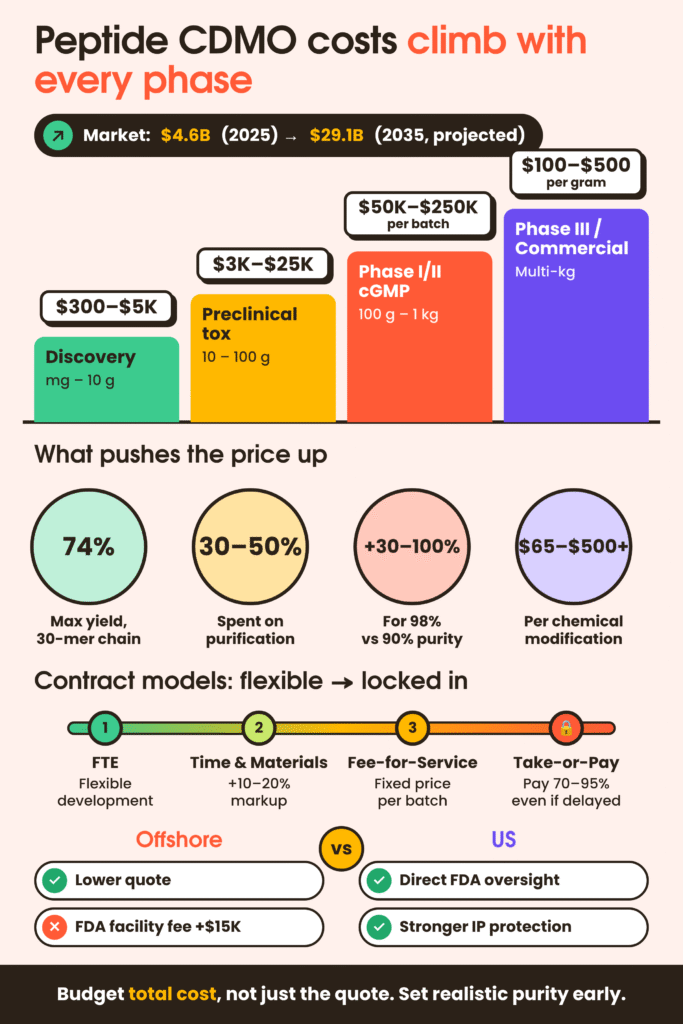
Understanding Peptide CDMO Cost / Pricing in the United States involves examining a complex financial landscape in which preclinical research batches typically cost between $3,000 and $25,000, clinical cGMP manufacturing campaigns range from $50,000 to $250,000 or more, and commercial multi-kilogram supply generally reaches between $104 and $500 per gross gram. A US-based Contract Development and Manufacturing Organization (CDMO) establishes its pricing by considering several technical and operational factors, including amino acid sequence length, chemical synthesis technology, required purity levels, quality assurance standards, and regulatory submission expenses. Biopharmaceutical sponsors must understand these cost components to develop accurate manufacturing budgets and prevent unforeseen financial commitments during clinical scale-up.
The global peptide CDMO services market is experiencing substantial growth and is projected to expand from $4.59 billion in 2025 to $29.12 billion by 2035, representing a Compound Annual Growth Rate (CAGR) of 20.3%. This expansion is primarily supported by the commercial success of glucagon-like peptide-1 (GLP-1) receptor agonists, multi-target metabolic therapies, cyclic peptide scaffolds, and complex peptide-drug conjugates (PDCs). As manufacturing requirements increase from milligram-scale research materials to multi-ton commercial production, biopharmaceutical sponsors must make increasingly complicated financial and operational decisions involving technology selection, cleanroom allocation, manufacturing capacity reservations, and domestic versus offshore production.
Through comprehensive mass spectrometry characterization, impurity profiling, and analytical method verification, ResolveMass Laboratories Inc. supports biopharmaceutical organizations in reducing manufacturing scale-up risks and developing transparent total-cost-of-ownership strategies. This report examines the technical and financial considerations associated with peptide CDMO pricing in the United States, including phase-specific manufacturing expenses, chemical cost determinants, contractual arrangements, and regulatory expenditures.
Share via:
Quick Summary:
- Costs rise sharply at each stage. Preclinical research batches cost about $3,000–$25,000 and Phase I/II cGMP batches $50,000–$250,000 or more. Commercial supply falls to roughly $100–$500 per gram as scale increases.
- The market is growing fast. Peptide CDMO services are projected to grow from $4.59 billion in 2025 to $29.12 billion by 2035 (20.3% CAGR), driven largely by GLP-1 and other metabolic therapies.
- Longer sequences cost more to make. Synthesis yield drops with every coupling step, so long peptides often need specialized building blocks or hybrid SPPS-LPPS methods.
- Purification is a major expense. It accounts for about 30–50% of total cost, and raising purity from 90% to 98% can increase cost per gram by 30–100%.
- Chemical modifications add cost. Lipidation, cyclization, D- or unnatural amino acids, PEGylation and conjugation linkers each add expense, from about $65 to more than $500 per step.
- The contract model shapes financial risk. FTE offers flexibility, fee-for-service offers predictable pricing, and time and materials offers transparency with a 10–20% markup. Take-or-pay capacity reservations can require 70–95% of batch fees even if a project is delayed.
- Total cost matters more than the quote. Offshore CDMOs may quote lower, but higher FDA facility fees, inspection risk, IP concerns and cold-chain logistics can erase the savings. US CDMOs offer direct FDA oversight and simpler supply chains.
Phase-by-Phase Breakdown of Peptide CDMO Cost / Pricing
The financial requirements associated with peptide manufacturing increase considerably throughout the drug development lifecycle, progressing from small-scale discovery research costing less than $5,000 to commercial manufacturing with production costs ranging from $104 to $500 per gross gram. This increase in expenditure is primarily associated with stricter regulatory supervision, cleanroom operating requirements, process validation obligations, and comprehensive quality control (QC) release testing.
Preclinical Discovery and Non-cGMP Synthesis Costs
Non-cGMP preclinical peptide synthesis generally costs between $3.50 and $35.00 per amino acid residue for small research quantities, while gram-scale non-GLP toxicology manufacturing campaigns typically require investments ranging from $3,000 to $25,000. During the initial discovery stage, manufacturing activities primarily involve sequence optimization, target screening, and preliminary pharmacokinetic assessments. Since these activities are generally conducted before formal clinical development, the applicable regulatory compliance requirements are comparatively limited.
Microgram to Milligram Scale: Standard linear peptide sequences containing 10 to 30 amino acids, manufactured at crude or moderate purity levels (≥70% to ≥85%), generally cost between $2.00 and $10.00 per residue. Depending on the sequence and required quantity, the overall batch expenditure typically falls between $300 and $1,500. When higher-purity research materials are required (≥95% to ≥98%), the price increases considerably, reaching approximately $15.00–$35.00 per residue.
Gram-Scale Non-cGMP Supply: Non-cGMP manufacturing campaigns producing approximately 10 grams to 100 grams of peptide material for non-GLP toxicology assessments or formulation development studies generally cost between $3,000 and $25,000 per campaign.
Primary Cost Factors: Non-cGMP peptide manufacturing expenses are largely influenced by starting material costs, particularly Fmoc-protected amino acid building blocks and coupling reagents such as HATU or HBTU. Additional expenses arise from standard High-Performance Liquid Chromatography (HPLC) purification and Mass Spectrometry (MS) release characterization.
Explore custom peptide synthesis services to understand available synthesis approaches and manufacturing capabilities.
Phase I and Phase II Clinical cGMP Manufacturing Expenses
Manufacturing peptides under cGMP conditions for Phase I and Phase II clinical trials generally costs between $50,000 and $250,000 per batch. These expenses reflect the requirements for controlled cleanroom operations, comprehensive regulatory documentation, and extensive analytical release testing. Moving from preclinical development into human clinical trials requires manufacturers to comply with current Good Manufacturing Practice standards established under FDA 21 CFR 210/211 and ICH Q7 guidelines.
Batch Economics: A typical Phase I/II cGMP manufacturing campaign producing approximately 100 grams to 1 kilogram of active pharmaceutical ingredient (API) can cost anywhere from $50,000 to more than $250,000 per batch, depending on manufacturing complexity, required purity, and analytical specifications.
Quality and Analytical Overhead: Manufacturing expenses increase because of the additional documentation and quality requirements associated with cGMP production. These include Master Batch Record (MBR) preparation, supplier qualification, formal analytical method transfer, stability testing under ICH Q1A/Q5C guidelines, and release testing for identity, purity, bioburden, endotoxins, heavy metals, and residual solvents.
Counter-Ion Exchange: Converting crude trifluoroacetic acid (TFA) salts into pharmaceutically acceptable acetate or chloride counter-ions can add approximately $5,000 to $15,000 to the overall campaign expenditure. This additional cost results from the requirement for further ion-exchange chromatography cycles and associated processing activities.
Read more about the differences between peptide CDMO and CMO services to understand how service scope and development responsibilities can influence manufacturing budgets.
Phase III and Commercial-Scale Peptide CDMO Pricing
Commercial-scale peptide manufacturing offers substantial opportunities to reduce production costs per unit. Gross API manufacturing expenses can decrease from approximately $456 per gram at 500-liter reactor scales to $104 per gram at 6,000-liter commercial scales. At this stage, biopharmaceutical sponsors generally transition from milestone-based development pricing toward unit-cost arrangements established through long-term supply agreements.
Unit Cost Metrics: Financial modeling of bioprocess manufacturing indicates that gross API production costs decline from approximately $456 per gram at 500-liter scales (Phase I/II) to $272 per gram at 2,000-liter scales. At 6,000-liter commercial manufacturing scales, these costs can decrease further to approximately $104 per gram. Catalogue-grade cosmetic or diagnostic peptides may achieve prices below $500 per gram because their manufacturing processes generally involve less stringent regulatory oversight and more standardized production pathways.
Capital and Reservation Commitments: Reserving dedicated commercial kilo-labs or negotiating long-term manufacturing supply agreements with major US CDMO facilities can require substantial financial commitments, frequently ranging from $10 million to $50 million.
Process Validation Mandates: Preparing for commercial manufacturing requires comprehensive process characterization based on Design of Experiments (DoE) and Quality by Design (QbD) principles. Manufacturers must also demonstrate process consistency through validation across three consecutive commercial-scale batches and complete the necessary Drug Master File (DMF) documentation.
Explore peptide CDMO scale-up services to understand the considerations involved in transitioning peptide manufacturing toward larger production volumes.
| Development Phase | Typical Batch Output | Target Purity | Regulatory Standard | Representative Cost Range (USD) | Primary Cost Drivers |
|---|---|---|---|---|---|
| Discovery / Research | 1 mg – 10 g | Crude to ≥95% | Non-cGMP / Research Grade | $300 – $5,000 | Coupling reagents, amino acids, basic LC-MS. |
| Preclinical / Tox | 10 g – 100 g | ≥85% to ≥95% | Non-cGMP / GLP Tox | $3,000 – $25,000 | Raw materials, analytical purity profiling. |
| Phase I/II Clinical | 100 g – 1 kg | ≥95% to ≥98% | cGMP (ICH Q7, Grade A/C) | $50,000 – $250,000 | Cleanroom time, MBR execution, stability, QC release. |
| Phase III / Commercial | Multi-kg to Tons | ≥98%+ | cGMP Validated / Commercial | $104 – $500 per gram | Capacity utilization, solvent recovery, process validation. |
Primary Technical Factors Driving Peptide CDMO Cost / Pricing
Peptide CDMO Cost / Pricing is primarily influenced by amino acid sequence length, structural aggregation tendencies, purification-related yield losses, and the incorporation of expensive non-natural chemical modifications. These characteristics directly affect coupling reaction efficiency, downstream purification requirements, and the handling and disposal of hazardous manufacturing waste.
Sequence Length and Synthesis Yield Limitations
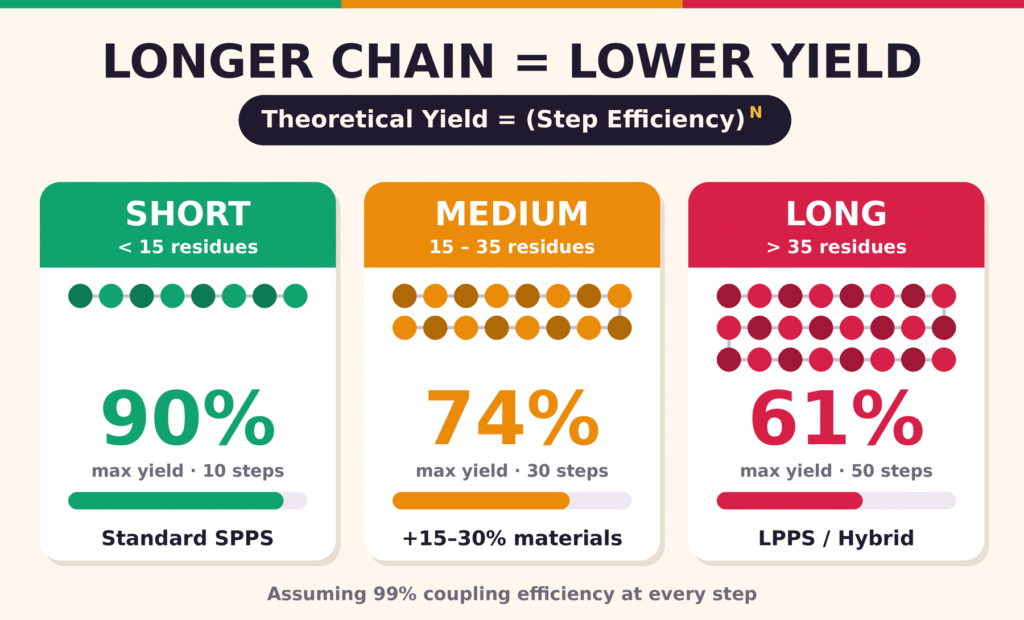
Amino acid sequence length has a significant influence on overall peptide synthesis efficiency. During Solid-Phase Peptide Synthesis (SPPS), cumulative yield losses at individual reaction steps can cause crude product purity to decrease exponentially as the peptide chain becomes longer. The efficiency of each coupling reaction directly influences the maximum theoretical yield, which can be calculated using the following mathematical relationship:
Theoretical Yield = (Average Stepwise Coupling Efficiency)N
In this equation, N represents the total number of amino acid coupling steps in the linear peptide chain.
Short Peptides (<15 residues): Short peptide sequences generally demonstrate favorable synthesis performance because stepwise coupling efficiencies exceeding 99% can be achieved. These sequences are relatively straightforward to manufacture using conventional SPPS methods, with fewer side-product formation issues and comparatively lower production expenses.
Medium Peptides (15–35 residues): Medium-length peptide sequences have a greater tendency to undergo hydrophobic on-resin aggregation and beta-sheet formation during synthesis. Managing these structural challenges may require specialized amino acid building blocks, including pseudoproline dipeptides, or advanced manufacturing technologies such as microwave-assisted SPPS platforms. Incorporating these approaches can increase raw material expenditures by approximately 15% to 30%.
Long Peptides (>35–50+ residues): Longer peptide sequences present substantial manufacturing challenges because of steric hindrance and chain aggregation, which can result in incomplete coupling reactions and deletion sequences. To overcome these limitations, CDMOs may use Liquid-Phase Peptide Synthesis (LPPS) or hybrid SPPS-LPPS fragment condensation strategies. These methods involve synthesizing protected peptide fragments separately and subsequently assembling them in solution. Although hybrid approaches can improve manufacturing economics at multi-kilogram commercial scales by reducing per-gram production expenses, they generally require significant initial investment in process development and optimization.
Learn more about the difference between a peptide and a small-molecule drug and the characteristics that distinguish these therapeutic molecules.
Purification Yields and Solvent Intensity
Preparative HPLC purification can account for approximately 30% to 50% of total peptide manufacturing expenditure. This substantial cost contribution is primarily associated with extensive solvent consumption and the compromises between product recovery and the achievement of stringent purity specifications.
Purity vs. Yield Trade-Off: Increasing the required purity specification, such as moving from ≥90% to ≥98%, can substantially decrease preparative HPLC recovery yields. When excessively stringent purity requirements are imposed, manufacturers must collect narrower chromatographic fractions to exclude unwanted impurities. This process can result in the loss of considerable product quantities, increasing the amount of starting material needed to obtain the required final peptide mass.
Solvent Intensity and Waste Disposal: Both SPPS and preparative HPLC depend on substantial quantities of hazardous organic solvents, including Dimethylformamide (DMF), N-Methyl-2-pyrrolidone (NMP), and Acetonitrile. Managing these chemicals requires appropriate solvent recovery systems, environmental controls, and hazardous waste disposal procedures. Meeting applicable US environmental standards for solvent handling and waste management further increases CDMO facility operating expenses.
Complex Modifications and Non-Natural Residues
Introducing chemical modifications such as lipidation, cyclization, and PEGylation can increase peptide manufacturing costs by approximately $65 to more than $500 per modification step. These additional expenses are associated with expensive precursor materials, specialized reaction conditions, and more complicated downstream processing requirements.
Lipidation and Fatty Acid Conjugation: Attaching lipid chains, including Palmitic acid (C16), Myristic acid (C14), or customized diacids used in long-acting GLP-1 therapeutics, can improve peptide half-life. However, incorporating these modifications increases raw material expenditure by approximately $65 to $207 per modified residue.
Head-to-Tail and Disulfide Cyclization: Introducing intramolecular disulfide bonds or amide-backbone cyclization requires carefully controlled reaction conditions. High-dilution solution-phase reactions are frequently necessary to minimize unwanted polymerization. These conditions increase reactor volume requirements, extend processing durations, and can raise overall batch manufacturing expenses by approximately 20% to 40%.
D-Amino Acids and Unnatural Amino Acids: Incorporating D-amino acid isomers, which can cost approximately $26 to $65 per residue, or unnatural N-methylated amino acids, which may cost as much as $495 per residue, can significantly increase raw material budgets. These specialized amino acid building blocks are often incorporated to improve resistance to enzymatic degradation compared with conventional L-amino acids.
PEGylation and ADC Linkers: Attaching Polyethylene Glycol chains (PEG1900 to PEG5000) or maleimide linkers used in Antibody-Drug Conjugates (ADCs) introduces additional synthesis complexity. Depending on the coupling chemistry and specialized reagent requirements, these modifications can increase manufacturing expenses by approximately $148 to $514 per coupling step.
| Modification Type | Representative Cost Impact (USD) | Technical Rationale |
|---|---|---|
| Purity Increase (90% to 98%) | +30% to +100% cost per gram | Narrower prep-HPLC fraction collection; lower purification recovery yields. |
| Fatty Acid Lipidation (C14–C18) | +$65 – $207 per residue | Multi-step linker synthesis; specialized hydrophobic handling. |
| Intramolecular Cyclization | +20% – +40% per batch | High-dilution reaction parameters; extended processing times. |
| D-Amino Acid Substitution | +$26 – $65 per residue | Higher cost for stereoisomerically pure amino acid precursors. |
| Maleimide / ADC Conjugation | +$514 per coupling step | High reagent unit pricing; specialized bioconjugation chemistry. |
| TFA to Acetate Salt Exchange | +$5,000 – $15,000 per campaign | Additional ion-exchange chromatography and equilibration steps. |
CDMO Contract Structures and Financial Engagement Models
Biopharmaceutical sponsors can manage financial exposure associated with peptide CDMO services through several contractual arrangements, including Full-Time Equivalent (FTE), Fee-for-Service (FFS), Time and Materials (T&M), and capacity reservation agreements with take-or-pay guarantees. Selecting an appropriate commercial structure depends on the development stage, clarity of the technical requirements, project complexity, and the level of financial risk the sponsor is prepared to accept.
Full-Time Equivalent (FTE) vs. Fee-for-Service (FFS) Models
Full-Time Equivalent (FTE) agreements involve fixed payments for dedicated scientific personnel who perform ongoing development activities. In comparison, Fee-for-Service (FFS) contracts establish predetermined charges for specific manufacturing deliverables or production batches.
Full-Time Equivalent (FTE) Model: Under this arrangement, the sponsor pays an agreed monthly or annual fee for each dedicated CDMO scientist assigned to the project. FTE contracts are particularly suitable for early-stage process development, peptide sequence optimization, and synthesis route scouting. This structure provides considerable technical flexibility because scientific teams can modify or refine synthetic routes as development progresses without having to renegotiate the entire contractual arrangement.
Fee-for-Service (FFS) / Fixed Batch Model: In an FFS arrangement, the CDMO establishes a fixed price for a clearly defined manufacturing deliverable. For example, a 500-gram cGMP Phase I manufacturing campaign may be quoted at $180,000. This model is generally appropriate for routine production activities involving established and validated manufacturing procedures. However, unexpected synthesis delays, process deviations, or out-of-specification (OOS) investigations may require formal change orders, resulting in additional costs beyond the original quotation.
Time and Materials (T&M): Under a T&M agreement, the sponsor pays for the actual direct labor hours consumed during the project, together with pass-through raw material expenses that include an agreed CDMO markup. This markup generally ranges from 10% to 20%, depending on the contractual terms and project requirements.
Capacity Reservations and Take-or-Pay Liabilities
Capacity reservation agreements require biopharmaceutical sponsors to secure manufacturing slots in advance. These arrangements frequently contain take-or-pay provisions that obligate sponsors to pay approximately 70% to 95% of the agreed batch fees, even when manufacturing campaigns are subsequently canceled or postponed. Given the increasing demand for peptide manufacturing capacity, reserving appropriate CDMO production space has become an important strategic and financial consideration.
Take-or-Pay Provisions: Manufacturing agreements frequently include take-or-pay clauses requiring sponsors to pay between 70% and 95% of the total batch fees associated with reserved production capacity. Consequently, when clinical trial delays, regulatory restrictions, or other development setbacks interrupt a project, the sponsor may still be required to cover most of the manufacturing suite reservation expenses.
Financial Risk Mitigation: Major pharmaceutical organizations have entered into multi-year supply and manufacturing capacity agreements involving commitments ranging from $12.2 million to $492 million. Sponsors can potentially reduce cancellation-related financial exposure by negotiating resale credit provisions. These clauses require the CDMO to make reasonable efforts to reallocate canceled manufacturing capacity to another customer. Depending on the contractual arrangement, such provisions may reduce cancellation penalties by approximately 25% to 70%.
Pass-Through Expenses and FDA Regulatory User Fees
Regulatory pass-through expenses can contribute substantially to domestic CDMO manufacturing costs. These expenditures include FDA FY2027 Drug Master File (DMF) fees of $109,899 and domestic CMO facility fees of $55,208. Sponsors should account for these regulatory charges when preparing comprehensive manufacturing and regulatory budgets.
FDA User Fees (GDUFA & PDUFA): Pharmaceutical developers submitting regulatory documentation associated with CDMO manufacturing facilities may incur direct FDA user fees. Under the FY2027 Generic Drug User Fee Amendments (GDUFA), the Drug Master File (DMF) fee is $109,899, while the domestic CMO facility fee is $55,208.
Foreign vs. Domestic CMO Facility Fee Differential: The FDA applies higher facility user fees to foreign manufacturing facilities than to domestic facilities. For FY2027, the foreign CMO facility fee is $70,208, which represents an additional $15,000, or approximately 27.2%, compared with the fee applicable to domestic US facilities. This difference can reduce some of the apparent financial advantages associated with offshore manufacturing.
Material and Testing Pass-Throughs: Additional project expenses may arise from specialized chromatographic resins, certified reference standards, and external analytical testing services. Examples include viral clearance assessments and high-field NMR structural elucidation. These services and materials are generally charged separately as direct pass-through expenses under the applicable CDMO contract.
| Contract Model | Billing Structure | Recommended Use Case | Primary Financial Advantage | Key Financial Risk |
|---|---|---|---|---|
| Full-Time Equivalent (FTE) | Fixed monthly rate per dedicated scientist. | Process optimization, difficult sequences, method development. | Maximum development agility; continuous effort. | Total batch output volume is not guaranteed. |
| Fee-for-Service (FFS) | Fixed price per batch or defined milestone. | Standard cGMP clinical and commercial campaigns. | Clear cost predictability for fixed project scopes. | Unforeseen deviations trigger change orders. |
| Time & Materials (T&M) | Direct labor hours plus marked-up raw materials. | Pilot scale-up, exploratory chemistry. | Full transparency into direct material spending. | Budget overruns if synthesis requires iteration. |
| Take-or-Pay Slot | Upfront slot fee with 70%–95% committed payment. | Reserving commercial-scale kilo-lab capacity. | Guaranteed manufacturing slot and timeline. | Significant financial loss if clinical trial delays occur. |
Evaluating Total Cost of Ownership: US CDMO vs. Offshore Options
Assessing the total cost of ownership requires biopharmaceutical sponsors to evaluate more than the initial manufacturing quotation or direct labor expenses. A comprehensive financial assessment must also consider regulatory compliance risks, supply chain reliability, intellectual property protection, and the potential consequences of manufacturing disruptions. Although offshore CDMOs operating in emerging markets may initially offer lower manufacturing quotations, technical limitations and regulatory challenges can reduce or eliminate the expected savings.
Total Cost of Ownership Comparison
| US-Based CDMO Facilities | Offshore CDMO Facilities |
|---|---|
| Direct FDA Compliance Alignment | Lower Initial Quote (20%-40%) |
| Higher Domestic User Fee Benefit | Higher Foreign CMO Facility Fee |
| Robust Intellectual Property Protection | Freight & Cold-Chain Exposure |
| Reduced Logistics & Import Risks | Risk of PAI / Inspection Delays |
Compare the United States and overseas peptide CDMOs to better understand the differences in manufacturing costs, regulatory considerations, and supply chain requirements.
Regulatory Compliance and Inspection Oversight
US-based CDMO facilities operate under direct FDA regulatory oversight, which can simplify compliance management during Investigational New Drug (IND) and New Drug Application (NDA) submissions. FDA regulatory tracking indicates that cGMP warning letters increased by approximately 25% to nearly 120 in recent evaluations. If an offshore manufacturing facility experiences a Pre-Approval Inspection (PAI) hold or becomes subject to an import alert, the resulting regulatory complications may postpone product commercialization and lead to substantial losses in anticipated commercial revenue.
Intellectual Property Protection and Legal Recourse
Conducting the manufacture of proprietary peptide structures, cyclic mimetics, and sophisticated conjugation chemistries within domestic US facilities can provide sponsors with stronger legal protection and more straightforward contractual enforcement mechanisms. The US legal framework supports enforceable non-disclosure agreements and clearly defined intellectual property ownership arrangements. These protections can reduce the potential risks associated with unauthorized disclosure of proprietary manufacturing processes, process leaks, and unapproved replication of specialized technologies.
Supply Chain Resilience and Cold-Chain Logistics
Peptide APIs can be particularly sensitive to temperature fluctuations, moisture absorption, and mechanical stress during storage and transportation. Consequently, these materials may require temperature-controlled shipping conditions, such as -20°C or -80°C, along with specialized protective packaging systems such as ArgonShield. Manufacturing peptides through domestic US CDMOs can simplify transportation arrangements by reducing dependence on international shipping routes and minimizing exposure to customs clearance delays, air-freight disruptions, and import tariffs.
Explore the Canadian vs. US peptide CDMO comparison to evaluate the differences between these manufacturing locations.
ResolveMass Laboratories Inc. supports biopharmaceutical sponsors in evaluating and verifying product quality through independent mass spectrometry analysis, impurity characterization, and batch equivalence testing. These analytical services are particularly valuable during manufacturing site transfers and process scale-up activities, helping organizations assess product consistency and maintain appropriate quality standards.
Conclusion: Strategic Optimization of Peptide CDMO Cost / Pricing
Managing Peptide CDMO Cost / Pricing effectively requires biopharmaceutical sponsors to balance initial manufacturing expenses with long-term supply reliability, regulatory compliance obligations, and overall total cost of ownership. Although early-stage non-cGMP discovery batches may require investments of only a few thousand dollars, clinical and commercial manufacturing campaigns involve considerably larger financial commitments. These expenses are influenced by several interconnected factors, including peptide sequence length, purification recovery yields, take-or-pay contractual obligations, and applicable FDA user fees. By assessing synthetic feasibility during the early development stages, establishing realistic purity specifications, and implementing comprehensive analytical validation strategies, sponsors can improve manufacturing cost control and reduce financial and technical risks associated with commercial scale-up.
Discover peptide CDMO services in the United States to assess manufacturing capabilities and identify an appropriate development and production partner.
For additional information about advanced mass spectrometry analysis, impurity profiling, and independent quality verification for peptide development and manufacturing programs, contact ResolveMass Laboratories Inc. to discuss your analytical requirements with an expert.
Contact ResolveMass Laboratories Inc.
Frequently Asked Questions
Increasing peptide sequence length generally makes synthesis more challenging because coupling inefficiencies accumulate with every additional amino acid residue. This can reduce overall product yield, increase raw material consumption, and extend manufacturing timelines. Peptides exceeding 30 to 40 residues may require liquid-phase fragment condensation or hybrid SPPS-LPPS approaches to achieve commercially acceptable production yields.
Research-grade peptide synthesis is considerably less expensive, typically costing between $3.50 and $50 per gram, whereas cGMP manufacturing can range from $500 to more than $5,000 per gram. The difference reflects the additional requirements for regulatory documentation, controlled manufacturing environments, qualified raw materials, and quality assurance. cGMP production also involves Master Batch Records, environmental monitoring, and validated analytical testing.
Chemical modifications such as PEGylation, fatty acid lipidation, and fluorescent labeling increase manufacturing expenses because they require specialized reagents, additional synthesis steps, and more complicated purification procedures. Depending on the modification, these additional costs can range from $65 to more than $500 per step. Such modifications may also affect synthesis recovery, resulting in longer processing times and increased overall campaign costs.
Take-or-pay clauses are contractual arrangements under which biopharmaceutical sponsors must pay a predetermined portion of reserved manufacturing fees, even when production is canceled or postponed. These commitments commonly represent 70% to 95% of the agreed slot fees. Although they help CDMOs maintain predictable revenue and allocate manufacturing capacity, they can create considerable financial exposure for sponsors experiencing clinical or regulatory delays.
Peptide purification using preparative HPLC can account for approximately 30% to 50% of overall API manufacturing expenditure. High solvent consumption, expensive purification materials, and reduced product recovery during stringent purity separation contribute significantly to these costs. Additional expenses arise from hazardous solvent disposal, environmental compliance, and solvent recovery operations.
FDA regulatory user fees represent an additional financial responsibility for biopharmaceutical sponsors using CDMO manufacturing facilities. For FY2027, the Drug Master File (DMF) fee is $109,899, while the domestic CMO facility fee is $55,208. Foreign CMO facilities are subject to a higher facility fee of $70,208, creating a $15,000 difference compared with domestic manufacturing sites.
Full-Time Equivalent (FTE) pricing involves paying a fixed monthly or annual amount for dedicated CDMO scientists working on specific development activities. This arrangement is particularly useful when projects require continuous process optimization, experimental adjustments, or synthesis route development. In contrast, Fee-for-Service (FFS) pricing establishes a predetermined charge for a specific manufacturing batch or deliverable, making it more suitable for clearly defined production requirements.
Companies may consider transitioning from Solid-Phase Peptide Synthesis (SPPS) to Liquid-Phase Peptide Synthesis (LPPS) or hybrid synthesis when manufacturing long, structurally complex peptides or preparing for larger production volumes. These approaches allow manufacturers to assemble protected peptide fragments and potentially improve production efficiency. Although they require additional process development and optimization initially, they can provide better manufacturing economics and lower unit costs at multi-kilogram commercial scales.
Biopharmaceutical companies can control total manufacturing expenditure by assessing peptide sequence feasibility early, establishing appropriate purity specifications, and selecting synthesis technologies according to production requirements. Independent analytical characterization and impurity profiling can also help identify potential quality issues before they result in expensive batch failures. Collaborating with specialized analytical organizations such as ResolveMass Laboratories Inc. supports manufacturing quality verification and helps reduce technical uncertainties, unnecessary expenses, and regulatory delays.
Reference:
- Orchard Therapeutics (Europe) Limited, & Pharming Technologies B.V. (2021, July 1). Research collaboration and licence agreement. U.S. Securities and Exchange Commission. https://www.sec.gov/Archives/edgar/data/1828316/000162828023010793/exhibitorcharda01.htm
- Generex Biotechnology Corporation. (2019). Annual report on Form 10-K for the fiscal year ended July 31, 2019. U.S. Securities and Exchange Commission. https://www.sec.gov/Archives/edgar/data/1059784/000160706219000429/gnbt073119form10k.htm
- Yu, D., Han, N., Son, H., Kim, S. J., & Kweon, S. (2026). Functional peptide-based biomaterials for pharmaceutical application: Sequences, mechanisms, and optimization strategies. Journal of Functional Biomaterials, 17(1), 37. https://doi.org/10.3390/jfb17010037
Get In Touch With Us
About The Author