
Introduction
No independent, multi-vendor benchmark currently tracks average delivery times exclusively across US-based peptide contract development and manufacturing organizations (CDMOs). However, vendor disclosures and industry sourcing guides indicate that a realistic sequence-to-First-in-Human (FIH) Phase I clinical delivery timeline is approximately 11 to 18 months when reactor capacity is available. This period can extend to 18 to 24 months at capacity-constrained Tier-1 facilities. Shorter vendor estimates of 3 to 6 months generally refer only to cGMP active pharmaceutical ingredient (API) batch execution and exclude partner qualification, custom raw material procurement, and sterile injectable fill-finish activities. Therefore, evaluating US peptide CDMO lead time / timelines requires distinguishing individual synthesis execution periods from the complete critical path, which extends from initial onboarding through analytical batch release.
These variations in delivery timelines result from specific technical and regulatory factors rather than inconsistent vendor marketing. A straightforward linear peptide entering an available manufacturing suite with stocked Fmoc amino acids can progress quickly through automated solid-phase peptide synthesis (SPPS). In contrast, a construct containing more than 30 residues, lipidation, or multiple disulfide bonds may require unnatural building blocks, multiple chromatography passes, and separate sterile vialing, extending the overall development period by several months. As of late 2026, two structural pressures have further reduced US clinical manufacturing suite availability: commercial metric-ton production of GLP-1 incretin therapies, which occupies upstream reactors and aseptic fill-finish lines, and US biopharma reshoring initiatives accelerated by the December 2025 BIOSECURE Act. Clinical sponsors planning Investigational New Drug (IND) submissions or late-stage clinical trial milestones must therefore account for every sequential and parallel dependency throughout the supply chain.
For a clearer understanding of the manufacturing capabilities and development support involved in peptide production, review the available services.
Peptide CDMO Services
Share via:
Quick Summary:
- Realistic clock: A US peptide program runs about 11–18 months from sequence to first-in-human supply, stretching to 18–24 months at capacity-constrained Tier-1 CDMOs. The commonly quoted 3–6 months covers only the cGMP API batch itself.
- Timelines by stage: Non-GMP tox material in weeks; GMP purification-to-vial in roughly 9–10 weeks; Phase II/III process development and NDA CMC readiness adds 12–24 months; generic peptide ANDA programs span 24–42 months.
- Phase I gets regulatory relief, not a free pass: Phase I investigational drugs are exempt from 21 CFR Part 211 (under 21 CFR 210.2(c)), but statutory cGMP under FD&C §501(a)(2)(B) still applies, and stability work runs concurrently with the IND.
- Capacity is the biggest external constraint: Commercial GLP-1 manufacturing occupies reactors and aseptic fill-finish lines, and reshoring pressure after the BIOSECURE Act has added demand. New CDMO qualification alone takes 6–12 months; announced US expansions (CordenPharma, Bachem, Cambrex) will not relieve 2026–27 queues until those suites are qualified.
- Raw materials delay projects before synthesis starts: Specialty and unnatural amino acids, pseudo-proline dipeptides and lipidation reagents are often single-source and not interchangeable between suppliers; shortages reportedly add 9–14 weeks on average, so supplier qualification belongs pre-IND.
- Complexity compounds downstream: Beyond ~30 residues, or with cyclization, disulfides or lipidation, SPPS gives way to hybrid, ligation or flow platforms, and purification needs multiple chromatography passes plus TFA counter-ion exchange and lyophilization before sterile filling.
- Generic peptides carry an immunogenicity burden: FDA’s May 2021 guidance requires identifying every peptide-related impurity at ≥0.10%, no new impurity above 0.5%, and individual justification in between — driving in silico epitope screening, T-cell assays and multi-batch IIRMI testing.
- Where time is recovered: Choose an integrated drug-substance-to-drug-product CDMO under one quality system (about 3 months saved), lock manufacturing slots in writing, and run tox batches, analytical development and impurity characterization in parallel so release methods are ready before the batch is.
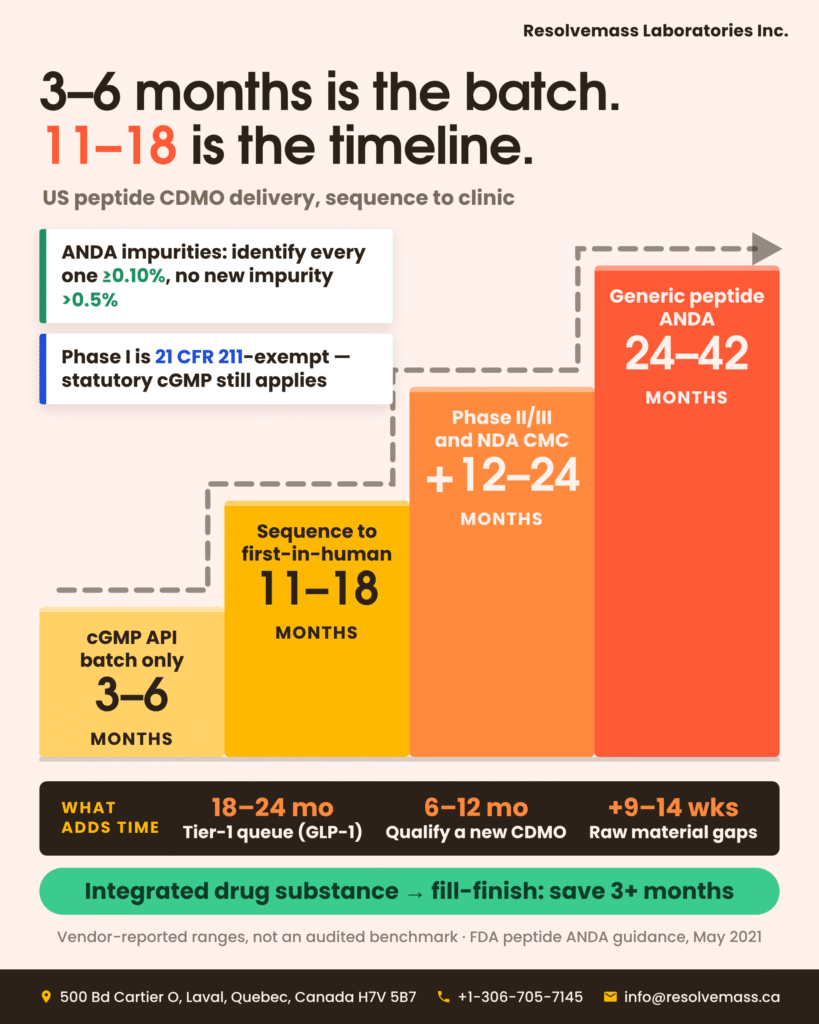
Clinical Material Timeline Benchmarks Across Development Phases
Throughout the US clinical development lifecycle, vendor-reported timelines increase from 11–18 months for Phase I FIH clinical supply to 12–24 months for Phase II/III API process development and New Drug Application (NDA) readiness. Complex generic peptide Abbreviated New Drug Applications (ANDAs) may require 24–42 months. Since these benchmarks are based on individual CDMO capability disclosures and industry sourcing analyses rather than audited federal datasets, sponsors should evaluate each estimate in the context of its stated scope, assumptions, and exclusions.
| Clinical Stage or Scope | Vendor-Reported Duration | Key Inclusions and Exclusions | Attribution and Operational Caveats |
|---|---|---|---|
| Small-Scale Custom / Non-GMP Tox | 2–6 weeks (small scale); 1–3 months (~1,000 g non-GMP) | Research synthesis, feasibility screening, or approximately 1 kg of non-GMP toxicology supply. | Vendor catalogs (Thermo Fisher, Nagase, Pengting); Nagase’s 1–3 month estimate explicitly excludes raw material lead time. |
| GMP Purification to Vial Release (Crude-In) | 9–10 weeks | RP-HPLC method development, 20 g purification, lyophilization, ISO 5 aseptic vialing (1,000 vials at 1 mg/vial), and QC release. | Creative Biogene vendor case study involving a 28-mer peptide; the timeline begins after crude synthesis has been completed. |
| cGMP Phase I API Batch Execution Only | 3–6 months | GMP synthesis, purification, lyophilization, and API release after the process and materials are ready. | Nagase quotes 3–4 months (excluding raw materials), while Asymchem quotes 3–6 months for “Peptide to IND” GMP batch delivery. |
| Sequence-to-FIH Integrated Clinical Supply | Approximately 11–18 months | Parallel API drug substance (DS) and sterile injectable drug product (DP) manufacturing, IND CMC package preparation, and clinical release. | CordenPharma quotes approximately 11 months for integrated PepCellerate™ FIH supply, while Neuland reports 12–18 months from a new sequence to clinical material. |
| New GMP CDMO Sourcing & Qualification | 6–12 months | Initial assessment, site audit, technical evaluation, quality agreement negotiation, and technology transfer. | Neuland’s 2026 sourcing guide; these activities occur before or overlap with early clinical preparation. |
| Tier-1 CDMO Capacity Lead Times | 18–24 months | Queue waiting periods for GMP manufacturing slots resulting from commercial GLP-1 capacity saturation. | Neuland’s June 2026 sourcing report; reflects constrained global and US reactor and fill-finish availability. |
| Phase II/III Process Development & NDA CMC | 12–24 months | API route optimization, ICH Q2(R2) method validation, multi-kilogram scale-up, stability studies, and NDA filing package preparation. | Aurigene quotes 12–24 months for API process development, while Asymchem quotes 12–18 months for an NDA filing package. |
| Generic Peptide ANDA Program | 24–42 months | RLD reverse engineering, formulation development, multi-batch testing, ICH validation, stability studies, and immunogenicity assays. | ResolveMass generic CDMO timeline benchmark reflecting FDA’s May 2021 peptide ANDA requirements. |
Sponsors evaluating potential manufacturing partners should compare their technical expertise, production capacity, and development experience before selecting a provider.
Explore the Best Peptide CDMO Options
Phase I IND Supply Under FDA Phase-Appropriate cGMP
Delivering US Phase I clinical peptide material typically requires 11 to 18 months from initial development to clinical supply. In comparison, executing an individual cGMP API manufacturing campaign generally takes 3 to 6 months once raw materials and synthetic parameters have been finalized. US regulatory policy supports this relatively compressed early-stage development schedule by adjusting manufacturing and validation requirements according to clinical risk instead of imposing full commercial manufacturing standards before human safety has been established.
Under the FDA’s CGMP for Phase 1 Investigational Drugs guidance (July 2008)—and reaffirmed in FDA combination product guidance under 21 CFR Part 4—investigational drugs manufactured for Phase I clinical trials are generally exempt from full compliance with 21 CFR Parts 210 and 211. Nevertheless, sponsors and CDMOs remain legally obligated under the statutory CGMP requirements of 21 U.S.C. 351(a)(2)(B) to use appropriate manufacturing methods, facilities, and controls for investigational products. Avoiding the complete validation overhead associated with later development stages can preserve several months on the Phase I schedule. Stability expectations under 21 CFR Part 312 follow a similarly progressive approach. Sponsors submit short-term stability protocols and initial data generated using the clinical container closure system to support IND clearance, while longer-term shelf-life studies continue simultaneously. When a CDMO performs API manufacturing and sterile injectable fill-finish in parallel under a unified quality system instead of transferring the product between separate contractors, integrated teams report schedule savings of at least 3 months, bringing sequence-to-FIH delivery closer to CordenPharma’s 11-month benchmark.
An integrated development and manufacturing approach can help sponsors coordinate early clinical supply requirements more efficiently.
Peptide Drug Development CDMO Services
Phase II, Phase III, and NDA Scale-Up Timelines
Moving a peptide candidate from Phase I into Phase II, Phase III, and NDA registration generally adds another 12 to 24 months for route redesign, engineering scale-up, analytical validation, and CMC documentation. Phase I clinical trials typically depend on gram-scale to single-digit-kilogram batches. In comparison, Phase III clinical manufacturing campaigns require multi-kilogram quantities, with production potentially scaling toward multi-ton commercial volumes for high-demand therapies such as GLP-1 receptor agonists. These activities must be supported by Drug Master Files (DMFs) and comprehensive Phase III/NDA CMC dossiers.
Scaling synthetic peptides from benchtop reactors to industrial vessels ranging from 100 to more than 3,000 liters changes mixing hydrodynamics, heat dissipation, and impurity formation. Process-related and peptide-related impurities that remain negligible at the milligram scale can increase substantially during multi-kilogram production. This often requires process chemists to re-optimize solvent ratios, resin loading, cleavage temperatures, and preparative chromatography gradients. At the same time, analytical procedures must progress from Phase I qualification to complete validation under ICH Q2(R2), issued as final FDA guidance in March 2024 alongside ICH Q14. This validation must establish specificity, linearity, precision, accuracy, and appropriate impurity limits. Stability protocols also expand to include formal ICH Q1A(R2) testing, covering temperature, humidity, photostability, hygroscopicity, and container-closure leachables. Vendor disclosures indicate that NDA filing package preparation takes approximately 12 to 18 months (Asymchem), while complete API process development requires 12 to 24 months, depending on molecular complexity (Aurigene).
Explore the technical considerations involved in moving peptide APIs from laboratory development to larger manufacturing volumes.
Peptide API Scale-Up
Complex Generic Peptide ANDA Programs
Developing clinical, bioequivalence, or registration batches for a generic peptide intended for the US ANDA pathway generally takes 24 to 42 months, according to ResolveMass generic CDMO benchmarks. Although generic sponsors begin with an established peptide sequence, FDA requirements concerning impurity sameness and immunogenicity introduce extensive analytical assessments and multi-batch manufacturing cycles that are not typically encountered in conventional small-molecule generic development.
Since ICH Q3A and Q3B guidelines explicitly exclude peptides, synthetic generic candidates referencing recombinant DNA-origin Reference Listed Drugs (RLDs) are subject to the FDA’s May 2021 guidance, ANDAs for Certain Highly Purified Synthetic Peptide Drug Products That Refer to Listed Drugs of rDNA Origin. Supported by landmark approvals, including synthetic teriparatide (November 2023) and the first generic GLP-1 liraglutide (December 2024), this framework requires the identification of every peptide-related impurity present at ≥0.10%, limits any new impurity to ≤0.5%, and requires justification of new or elevated impurities between 0.10% and 0.5% through comparative immunogenicity risk assessments.
As demonstrated in published FDA-aligned teriparatide case work, meeting these requirements involves using orthogonal in silico T-cell epitope prediction tools, including EpiMatrix, ClustiMer, and JanusMatrix, alongside in vitro class II HLA binding and PBMC T-cell assays. Additionally, FDA expectations for innate immune response modulating impurity (IIRMI) assays require testing at least three drug product batches manufactured using different drug substance lots and manufacturing campaigns, both at release and at the end of shelf life. When the individual development activities are sequenced—including RLD reverse engineering (1–3 months), formulation development (3–8 months), analytical validation (2–5 months), process scale-up (2–4 months), pilot batches (1–2 months), and bioequivalence studies (4–8 months)—most generic peptide programs follow an overall development trajectory of approximately two to three-and-a-half years.
For complex generic peptide programs, coordinated analytical and manufacturing support is important for meeting regulatory expectations and maintaining product quality.
One-Stop CDMO Analytical Services for ANDA
Key Factors Driving US Peptide CDMO Lead Time / Timelines
US peptide CDMO lead time / timelines depend on six interconnected bottlenecks: domestic manufacturing suite congestion, partner qualification duration, upstream amino acid availability, chemical synthesis complexity, downstream purification and fill-finish integration, and analytical readiness. Delays in any of these interconnected activities can shift clinical dosing schedules by several months rather than just a few weeks.
Sponsors should also understand the respective responsibilities of contract development and manufacturing organizations and contract research organizations when planning their outsourcing strategy.
Peptide CDMO vs CRO: Key Differences
US Capacity Constraints, GLP-1 Demand, and the BIOSECURE Act
Manufacturing slot availability currently represents the most significant external factor influencing US clinical delivery schedules. Neuland’s June 2026 sourcing report identifies 18 to 24 month lead times at major CDMOs, alongside 6 to 12 months required to qualify a new GMP supplier. Even sponsors developing non-metabolic oncology, cardiovascular, or rare-disease peptides encounter extended manufacturing queues because commercial GLP-1 receptor agonists, including semaglutide and tirzepatide, occupy substantial portions of global synthesis reactor capacity and sterile injectable manufacturing lines.
Geopolitical supply chain changes have further increased demand for US-based manufacturing suites. Signed into US law in December 2025, the BIOSECURE Act establishes a 2032 deadline for US-funded biopharma companies to transition away from five specified Chinese biotechnology firms. According to Neuland’s June 2026 industry analysis, 79% of biopharma companies maintain at least one contract with an affected Chinese CDMO. Additionally, approximately 75% of API intermediates used by Indian manufacturers originate in China, encouraging sponsors to establish domestic or allied-nation supply chains.
Several major CDMOs have responded by announcing substantial US manufacturing investments and capacity expansions:
CordenPharma: Building on a multi-year peptide expansion valued at €900 million to more than €1 billion, which added a reported 3,000-liter SPPS reactor in Boulder, Colorado, CordenPharma completed its acquisition of AmbioPharm on August 3, 2026. This acquisition added FDA-inspected purification and lyophilization capacity in North Augusta, South Carolina. On September 22, 2026, the company also broke ground on a 200 million, 68,000-square-foot expansion in North Augusta.
Bachem: In October 2025, Bachem announced plans to invest approximately 250 million between 2026 and 2030 to expand its Vista, California facility toward nearly one metric ton of annual peptide manufacturing capacity while modernizing its Torrance, California site.
Cambrex and Peer US Alliances: Cambrex announced a 120 million investment to expand its US API and peptide manufacturing capabilities. Meanwhile, Lifecore and PolyPeptide established an integrated US end-to-end peptide manufacturing partnership.
Although these projects are expected to increase long-term US manufacturing capacity, newly constructed cleanrooms must undergo equipment qualification and achieve regulatory readiness before they can reduce the immediate clinical manufacturing queues expected during 2026–2027.
Understanding the domestic manufacturing landscape can help sponsors assess supplier availability, facility capabilities, and regional production advantages.
Peptide CDMO Manufacturing in the United States
Raw Material Bottlenecks Extending Peptide CDMO Lead Time / Timelines
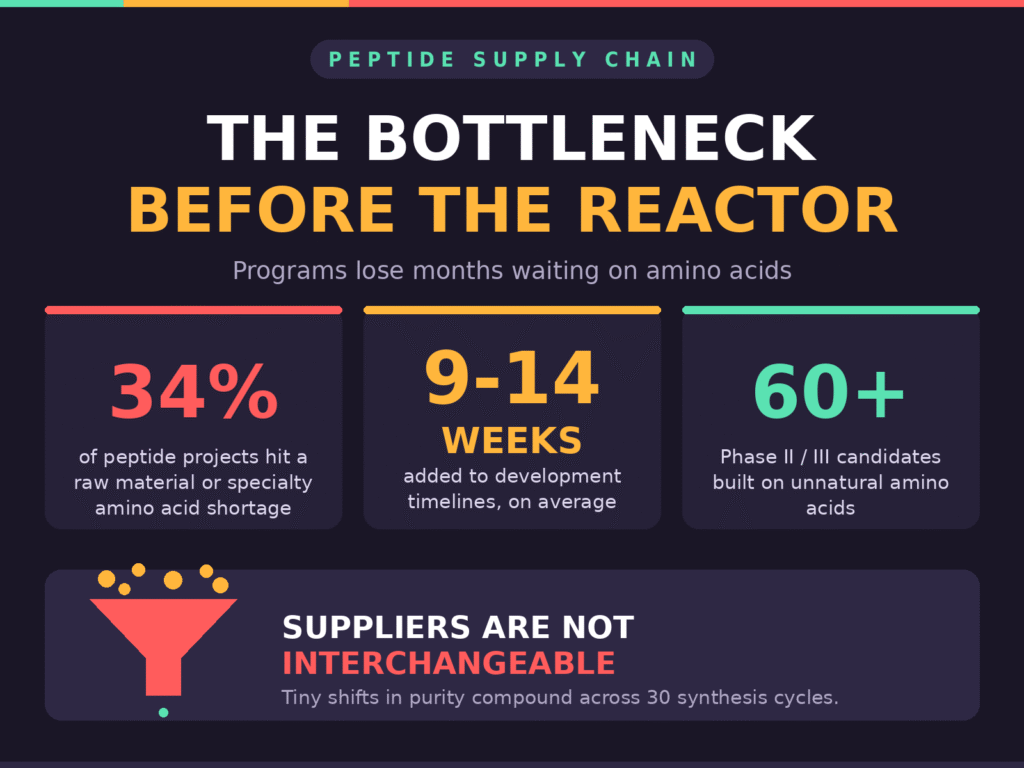
Upstream supply chain limitations frequently extend US peptide CDMO lead time / timelines before a synthesis campaign even enters a manufacturing reactor. An industry report from Market Reports World found that raw material and specialty amino acid shortages affected 34% of peptide projects during a recent 24-month period, increasing development timelines by an average of 9 to 14 weeks. Although conventional Fmoc-protected amino acids are generally available as commodity materials, modern clinical peptide candidates increasingly depend on specialized and customized chemical building blocks.
According to a Dataintelo market analysis, more than 60 peptide candidates in Phase II or Phase III clinical trials as of early 2026 incorporated unnatural or non-proteinogenic amino acids. Examples include D-isoforms, alpha-methylated Aib residues, bioorthogonal click linkers, and orthogonally protected side chains such as ivDde and Mtt. These modifications help prevent enzymatic degradation and extend peptide half-life. Many specialized side-chain derivatives, pseudo-proline dipeptides, and fatty-acid or PEG lipidation reagents depend on single-source manufacturers and are not maintained in standard commercial inventories.
Furthermore, protected amino acids obtained from different suppliers are rarely directly interchangeable. Minor variations in enantiomeric purity, trace inorganic salts, or residual solvents can propagate through 30-step SPPS cycles, resulting in deletion sequences, epimers, and co-eluting byproducts. Establishing an ICH Q11 starting-material justification and qualifying alternative suppliers through assessments extending beyond basic Certificates of Analysis should therefore occur before IND submission. Completing these activities early helps prevent manufacturing interruptions that could otherwise delay production by several months.
Sponsors evaluating domestic and international supply options should consider the differences in sourcing, manufacturing availability, and regulatory oversight.
Canadian vs US Peptide CDMOs
Synthesis Complexity, Purification, and Counter-Ion Exchange
Chemical assembly and downstream purification timelines increase nonlinearly with peptide chain length and structural complexity. Routine small-scale purification activities that generally take 2 to 4 weeks can extend into 9-week GMP purification-to-vialing campaigns or 3 to 6 month cGMP batch executions when sequences contain more than 30 residues or include cyclization, disulfide bridges, or conjugation. Since every coupling cycle during sequential SPPS carries a risk of incomplete conversion or racemization, impurities can accumulate rapidly throughout synthesis. This establishes a practical upper limit for conventional linear SPPS at approximately 50–70 amino acids. Longer, hydrophobic, or aggregation-prone constructs consequently require specialized synthesis platforms with different equipment requirements and manufacturing cycle-time considerations.
| Synthesis Platform | Typical Sequence Fit | Scale Capability | Yield, Purity, and Operational Trade-Offs | Impact on Clinical Delivery Timeline |
|---|---|---|---|---|
| Solid-Phase Peptide Synthesis (SPPS) | 5–50 amino acids (practical ceiling approximately 50–70 AA) | 100 g–100 kg (Asymchem identifies cost-effective production up to approximately 30 kg for sequences exceeding 10 AA) | Typical crude purity of 70–85%; automated synthesis cycles; high organic solvent consumption. | Fastest route to Phase I cGMP API manufacturing for linear sequences. |
| Liquid-Phase Peptide Synthesis (LPPS) | Short chains (2–15 AA; fewer than 10 AA according to Asymchem) | 100 kg to more than 1,000 kg (metric-ton scale) | Purity can reach 98.5%; considerably lower solvent consumption; reduced dependence on HPLC. | Early development may take longer because intermediate purification is required after individual steps; preferred for high-volume commercial production of short chains. |
| Hybrid SPPS–LPPS / Fragment Condensation | Long or complex chains (more than 50–70 AA; up to 120+ AA in industry briefs) | Kilogram to multi-kilogram scale | Prevents cumulative step-yield losses by synthesizing individual segments separately before solution ligation. | Extends initial route scouting but helps prevent yield-related failures during Phase II/III scale-up. |
| NCL and Chemo-Enzymatic (CEPS / Enzymatic) | More than 30–80 amino acids and small proteins | 100 g–10 kg (enzymatic) | Uses aqueous, unprotected fragment ligation; reduces racemization; improves the solubility of hydrophobic sequences. | Requires specialized development during the initial stages but can reduce downstream purification challenges for complex targets. |
| Microwave and Continuous-Flow SPPS | Rapid screening up to 84 AA with PTMs | Laboratory/R&D to modular flow scale-up | Coupling/deprotection cycles take less than 15 minutes in flow systems or approximately 5 minutes at 60 °C using microwave technology; overnight chain assembly takes approximately 7.4–8.6 hours. | Accelerates early sequence optimization through real-time UV coupling feedback. |
Downstream isolation frequently determines the overall manufacturing timeline. Preparative reversed-phase HPLC (RP-HPLC using C18 or C8 columns), ion-exchange chromatography, and size-exclusion chromatography must remove single-deletion impurities and diastereomers to achieve therapeutic purity specifications exceeding 95% to 98.5%. Reaching these specifications at kilogram scale may require multiple chromatography passes unless the CDMO employs continuous Multicolumn Countercurrent Solvent Gradient Purification (MCSGP).
Following chromatography, residual acidic trifluoroacetic acid (TFA) must be exchanged for pharmaceutically acceptable acetate or hydrochloride salts. This step helps avoid cellular toxicity and standardizes the net peptide content. The purified material then undergoes lyophilization to produce stable solid cakes, which are typically stored at -20 °C to -80 °C. Under industry GMP standards, facility scheduling must also accommodate progressively stricter cleanroom classifications. These include ISO 8 (Class 100,000) for synthesis, ISO 7 (Class 10,000) for purification and lyophilization, and ISO 5 (Class 100) laminar flow environments within ISO 7 backgrounds for sterile fill-finish operations.
Optimizing these processes during development can improve manufacturing consistency and support efficient movement toward commercial production.
Peptide CDMO Scale-Up Services
Analytical Characterization, Impurity Profiling, and Sterile Fill-Finish Handoffs
Separating API manufacturing from sterile injectable fill-finish can eliminate at least 3 months of potential schedule savings that integrated drug-substance-to-drug-product CDMOs achieve through parallel execution. Working with separate vendors introduces additional sequential activities, including QA audits, validated cold-chain transportation, stability coordination, and inter-laboratory analytical method transfers. These handoffs represent a major source of late-stage delays, particularly when analytical methods developed during early stages lack sufficient sensitivity.
Unlike small molecules, which are often released primarily through HPLC assay and purity testing, peptide clinical batches require extensive orthogonal characterization. This includes LC-MS/MS and High-Resolution Mass Spectrometry (HRMS) for sequence identity, amino acid analysis (AAA) for net content, chiral testing for L/D epimers, ion chromatography for counter-ions, quantitative NMR (qNMR), residual solvent testing under USP and ICH Q3C, nitrosamine screening under ICH M7/Q7, and compendial sterility and endotoxin assays.
Rapid identification and characterization of unknown impurities before GMP batch release are essential for protecting IND submission timelines. In one documented IND-enabling engagement managed by ResolveMass Laboratories Inc., drawing on more than 15 years of PhD-led peptide characterization experience, a CDMO encountered an unidentified degradant that threatened its FDA submission schedule.
Using Orbitrap and Q-TOF HRMS, LC-MS/MS peptide mapping, NMR chemical-shift analysis, and forced degradation studies, ResolveMass identified the impurity as a C-terminal cleavage product associated with a shifted isoelectric point (pI), which affected solubility. With the degradation mechanism established, the CDMO adjusted storage conditions, improved formulation stability, and satisfied FDA IND requirements without requiring additional data or delaying its filing deadline. Incorporating orthogonal characterization, including sequencing and mapping turnaround times of 5–10 business days, before cGMP manufacturing campaigns helps prevent out-of-specification holds during clinical batch release.
A comprehensive analytical strategy is essential for confirming peptide identity, purity, structural integrity, and impurity profiles throughout development and manufacturing.
Peptide Analytical Characterization Services
Practical Strategies to Compress US Clinical Peptide Delivery Timelines
Sponsors can realistically protect at least 3 months on Phase I manufacturing schedules while avoiding the average 9 to 14 weeks of raw material-related delays and 6 to 12 months of potential supplier requalification. Achieving these improvements requires replacing sequential vendor handoffs with coordinated parallel workflows. The following operational strategies address the primary bottlenecks affecting US clinical peptide manufacturing and delivery:
Select an integrated DS-to-DP US CDMO early: Consolidating peptide synthesis, purification, lyophilization, and ISO 5 aseptic fill-finish under a single quality system eliminates inter-company analytical method transfers and can save at least 3 months before FIH dosing.
Build a pre-IND Protected Amino Acid Control Strategy: Identify single-source unnatural or orthogonally protected residues during discovery, qualify alternative suppliers at an early stage, and establish chiral and trace-impurity testing requirements beyond basic Certificates of Analysis.
Lock manufacturing slots with written reservation terms: Since GMP supplier qualification can take 6–12 months and Tier-1 manufacturing queues can extend to 18–24 months because of GLP-1 demand, sponsors should conduct QA audits early and secure binding written manufacturing suite reservations instead of relying on verbal capacity estimates.
Apply aggregation-suppressing chemistry and modern hardware: Use pseudo-proline dipeptides to improve coupling across the subsequent 6–8 amino acids, combine microwave or continuous-flow SPPS with in-line UV monitoring, and implement MCSGP continuous chromatography to reduce the number of purification passes.
Leverage FDA Phase I cGMP flexibility and concurrent stability: Align analytical qualification and manufacturing controls with Phase I statutory exemptions under 21 U.S.C. 351(a)(2)(B), rather than pursuing premature commercial validation under 21 CFR 210/211. At the same time, initiate container-closure stability studies and forced degradation assessments concurrently.
Run non-GMP toxicology and analytical development in parallel: Perform route scouting, excipient compatibility studies under ICH Q8(R2), and impurity characterization using early engineering batches. This ensures that analytical release methods are ready before the cGMP batch completes lyophilization.
Selecting a US manufacturing partner with appropriate technical capabilities, regulatory experience, and available production capacity can help minimize avoidable development delays.
How to Choose a Peptide CDMO in the US
Conclusion
Managing US peptide CDMO lead time / timelines requires planning beyond isolated 3 to 6 month cGMP synthesis estimates. Sponsors should budget for a realistic sequence-to-Phase I clinical delivery period of 11 to 18 months, which may increase to 18 to 24 months when onboarding capacity-constrained Tier-1 facilities amid GLP-1 demand and BIOSECURE-driven supply chain reshoring. Phase II/III scale-up and NDA CMC readiness require an additional 12 to 24 months, while generic peptide ANDA programs subject to FDA immunogenicity requirements and multi-batch RLD comparability assessments can extend across 24 to 42 months. Biopharma teams that combine integrated US drug substance and sterile fill-finish manufacturing capacity with pre-IND protected amino acid controls and comprehensive orthogonal analytical characterization are better positioned to move clinical peptides from sequence development to patient dosing according to schedule.
To address analytical, impurity-related, or IND/NDA/ANDA CMC bottlenecks in your North American or global peptide development program, connect with ResolveMass Laboratories Inc. (500 Bd Cartier O, Laval, QC H7V 5B7). The company offers 24/7 client support and direct weekday consultations with scientists from 9:00 AM to 11:00 AM EST. Contact the team through the ResolveMass Contact Us page.
Frequently Asked Questions
Major peptide manufacturers are experiencing increased demand because commercial GLP-1 therapies, including semaglutide and tirzepatide, require substantial manufacturing capacity. Additional pressure from US supply chain reshoring following the December 2025 BIOSECURE Act has intensified competition for available domestic production slots.
Selecting and qualifying a GMP peptide manufacturing partner generally takes 6 to 12 months. The process involves reviewing manufacturing capabilities, conducting facility and quality audits, assessing technical suitability, finalizing quality agreements, and transferring manufacturing knowledge and processes when necessary.
Small research-scale peptide synthesis can usually be completed within 2 to 6 weeks, while larger non-GMP toxicology batches may require 1 to 3 months. cGMP clinical production takes considerably longer because it involves controlled manufacturing, purification, lyophilization, validated analytical testing, sterile filling, and formal quality assurance release.
Limited availability of specialized peptide building blocks can disrupt manufacturing schedules, particularly when projects depend on customized or single-source materials. Industry estimates indicate that these shortages have affected 34% of peptide projects, adding approximately 9 to 14 weeks to development timelines through additional procurement, supplier qualification, and material testing requirements.
Phase I investigational peptide products generally do not require the same level of compliance with 21 CFR Parts 210 and 211 as commercial products. However, manufacturers must still follow appropriate statutory CGMP requirements under 21 U.S.C. 351(a)(2)(B). More extensive analytical validation and manufacturing controls are introduced as the product advances into later clinical and commercial development stages.
Using one CDMO for both drug substance (DS) manufacturing and drug product (DP) fill-finish can save at least 3 months compared with coordinating separate suppliers. An integrated arrangement reduces repeated technical transfers, additional quality reviews, analytical method coordination, and transportation-related activities while allowing manufacturing operations to proceed simultaneously.
Longer and structurally modified peptides require additional manufacturing controls because incomplete synthesis reactions, aggregation, and structural modifications can generate difficult-to-remove impurities. Disulfide bond formation, cyclization, lipidation, and PEGylation introduce further processing and purification requirements, often involving specialized synthesis methods and multiple preparative chromatography steps.
Generic peptide development for an FDA ANDA submission can take approximately 24 to 42 months, depending on molecular complexity and regulatory requirements. Sponsors must establish comparability with the reference listed drug, characterize peptide-related impurities, demonstrate appropriate immunogenicity risk assessment, and complete formulation, manufacturing, analytical, and stability studies.
Clinical peptide batch release can be delayed by unidentified degradation products, inadequate impurity characterization, analytical method transfer failures, and unexpected changes in peptide purity or structural integrity. Techniques such as HRMS, LC-MS/MS peptide mapping, NMR, and forced degradation testing help identify these issues early and provide the analytical evidence needed to support reliable batch release and regulatory submissions.
Reference:
- U.S. Food and Drug Administration. (2024, March). Q2(R2) validation of analytical procedures: Guidance for industry. U.S. Department of Health and Human Services. https://www.fda.gov/regulatory-information/search-fda-guidance-documents/q2r2-validation-analytical-procedures
- Pang, E. (2022, September 20). Assessing immunogenicity risk of peptides: The synthetic peptide guidance and PSGs [Presentation]. U.S. Food and Drug Administration. https://www.fda.gov/media/166571/download
- Verthelyi, D. (2022, September 20). Assessing impurities to inform peptide immunogenicity risk: Developing informative studies [Presentation]. U.S. Food and Drug Administration. https://www.fda.gov/media/166573/download
- Li, Y. (2022, September 20). Common deficiencies associated with comparative peptide impurity profile studies and qualification of impurity levels and proposed limits [Presentation]. U.S. Food and Drug Administration. https://www.fda.gov/media/166572/download
- U.S. Food and Drug Administration. (2017, January). Current good manufacturing practice requirements for combination products: Guidance for industry and FDA staff. U.S. Department of Health and Human Services. https://www.fda.gov/media/90425/download
- U.S. Food and Drug Administration. (2021, December). IND submissions for individualized antisense oligonucleotide drug products for severely debilitating or life-threatening diseases: Chemistry, manufacturing, and controls recommendations: Guidance for sponsor-investigators (Draft guidance). U.S. Department of Health and Human Services. https://www.fda.gov/media/154664/download
- Pang, E. (2025). Immunogenicity assessments in peptides: Progress and remaining challenges [Presentation]. U.S. Food and Drug Administration. https://www.fda.gov/media/188008/download
Get In Touch With Us
About The Author