

Introduction:
Peptide Characterization Case Study of Semaglutide is essential to ensure the safety, quality, and efficacy of this complex peptide drug. ResolveMass Laboratories Inc. applied advanced analytical techniques, including expertise in peptide characterization in drug development, to fully characterize semaglutide, a long-acting GLP-1 analog used in diabetes management.
Due to its structural complexity and susceptibility to degradation, semaglutide requires highly specialized analytical methods. As a peptide drug development CDMO, ResolveMass delivered a comprehensive characterization strategy aligned with regulatory expectations.
Share via:
Summary:
- This case study explains how ResolveMass performed Peptide Characterization Case Study of Semaglutide using advanced analytical tools.
- Demonstrates expertise in mass spectrometry experts in drug development.
- Covers techniques like LC-MS, HRMS, peptide mapping, and impurity profiling.
- Highlights challenges in semaglutide analysis and their solutions.
- Establishes ResolveMass as a reliable peptide CDMO services provider.
1: What Makes Semaglutide a Complex Peptide Drug?
Semaglutide is considered a complex peptide drug because of its large molecular size, lipid modification, and structural variability, all of which make its analytical characterization challenging and require advanced techniques.
Semaglutide is considered complex due to its structural variability, requiring expertise in GLP-1 peptide analytical characterization.
Key Complexity Factors:
- Large molecular weight (~4 kDa): Increases difficulty in accurate mass analysis and separation
- Fatty acid conjugation: Presence of a lipid chain complicates structural identification and behavior
- Multiple degradation pathways: Susceptible to oxidation, deamidation, and other chemical changes
- Structural heterogeneity: Existence of closely related variants and isoforms
- Sensitivity to environmental conditions: Affected by temperature, pH, light, and oxidation
Analytical Challenges:
| Challenge | Impact |
|---|---|
| Structural complexity | Difficult identification of variants |
| Impurities | Requires high-resolution detection methods |
| Stability issues | Requires forced degradation and stability studies |
| Conjugation analysis | Needs advanced mass spectrometry techniques |
2: Peptide Characterization Case Study of Semaglutide: Objectives
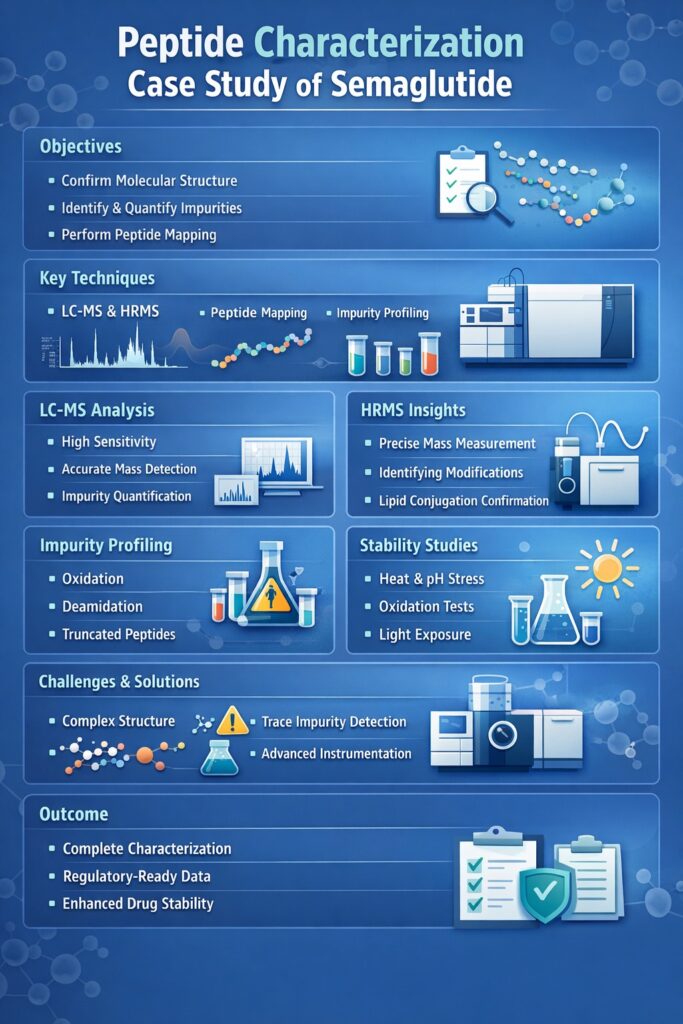
The primary goal of this Peptide Characterization Case Study of Semaglutide was to develop a comprehensive analytical profile to ensure the drug’s quality, safety, and regulatory readiness.
The goal aligns with advanced bioanalytical strategy in drug development to ensure quality and compliance.
Key Objectives:
- Confirm molecular structure: Verify the exact chemical structure and molecular integrity of semaglutide
- Identify and quantify impurities: Detect process-related and degradation impurities at trace levels
- Perform peptide mapping: Validate amino acid sequence and identify any structural modifications
- Study degradation pathways: Understand how the molecule degrades under various stress conditions
- Ensure regulatory compliance: Generate accurate and reliable data aligned with FDA and ICH guidelines
3: Analytical Strategy Used by ResolveMass
ResolveMass adopted a multi-technique analytical strategy to ensure accurate and comprehensive characterization of semaglutide. This integrated approach allows precise identification, quantification, and structural confirmation of complex peptide molecules.
ResolveMass applied a multi-technique approach supported by peptide analytical characterization services.
Additionally, expertise in analytical method development for generic drugs ensured robustness and reproducibility.
Techniques Used:
- LC-MS (Liquid Chromatography–Mass Spectrometry): For molecular weight confirmation and impurity detection
- High-Resolution Mass Spectrometry (HRMS): For exact mass measurement and structural elucidation
- Peptide Mapping: To confirm amino acid sequence and detect modifications
- Impurity Profiling: To identify and quantify process-related and degradation impurities
- Forced Degradation Studies: To evaluate stability and identify degradation pathways under stress conditions
This combination of advanced analytical techniques ensures reliable, reproducible, and regulatory-compliant results for complex peptide characterization.
4: How LC-MS Enabled Peptide Characterization Case Study of Semaglutide
LC-MS was a cornerstone technique in this Peptide Characterization Case Study of Semaglutide, enabling highly accurate molecular characterization, impurity profiling, and structural confirmation of this complex peptide. Its ability to combine separation (LC) with sensitive detection (MS) makes it indispensable for peptide analysis.
LC-MS capabilities are backed by ResolveMass expertise in bioanalysis in Canada and advanced instrumentation.
How LC-MS Works in This Context
In this study, Liquid Chromatography (LC) first separates semaglutide and its related impurities, and then Mass Spectrometry (MS) detects and analyzes each component based on mass-to-charge ratio (m/z). This dual approach ensures precise identification even in highly complex mixtures.
Expanded Key Benefits:
- High Sensitivity:
LC-MS can detect impurities at very low concentrations (ppm to ppb levels), which is critical for regulatory compliance and patient safety. - Accurate Mass Detection:
Provides exact molecular weight of semaglutide and its variants, ensuring correct structural identification. - Separation of Closely Related Compounds:
Effectively resolves structurally similar impurities such as oxidized or deamidated forms. - Quantitative Analysis:
Enables accurate quantification of impurities and degradation products. - Reproducibility:
Delivers consistent and reliable results across multiple runs, essential for validation studies.
Applications of LC-MS in This Case Study
- Molecular Weight Confirmation:
Verified the intact mass of semaglutide, ensuring correct synthesis. - Impurity Detection and Profiling:
Identified process-related impurities and degradation products. - Degradation Analysis:
Monitored changes under stress conditions such as oxidation and heat. - Batch Consistency Evaluation:
Compared multiple batches to ensure uniformity in production.
Example: Types of Impurities Detected by LC-MS
| Impurity Type | Description |
|---|---|
| Oxidation products | Result from exposure to oxygen |
| Deamidation products | Chemical modification of amino acids |
| Truncated peptides | Incomplete synthesis products |
| Isomeric variants | Structurally similar forms |
Why LC-MS is Essential for Semaglutide
Semaglutide contains a lipid-modified peptide chain, which increases analytical complexity. LC-MS helps in:
- Differentiating lipidated vs non-lipidated forms
- Detecting minor structural changes
- Ensuring overall product purity and integrity
5: Role of High-Resolution Mass Spectrometry (HRMS)
High-Resolution Mass Spectrometry (HRMS) played a vital role in this Peptide Characterization Case Study of Semaglutide by providing precise structural insights and confirming subtle molecular modifications that cannot be resolved by conventional techniques.
HRMS analysis is strengthened by ResolveMass’s position as mass spectrometry experts in drug development.
How HRMS Contributed
HRMS offers ultra-high mass accuracy and resolution, allowing differentiation between compounds with very small mass differences. This is especially important for semaglutide, where minor changes like oxidation or deamidation can significantly impact drug performance.
Key Outcomes:
- Accurate Mass Determination:
HRMS enabled exact measurement of the molecular mass of semaglutide and its variants with very low error (ppm level), ensuring correct structural confirmation. - Identification of Oxidation and Deamidation:
Detected small mass shifts associated with chemical modifications, helping identify degradation pathways and stability concerns. - Confirmation of Lipid Conjugation:
Precisely verified the presence and integrity of the fatty acid side chain attached to the peptide, which is critical for its pharmacokinetic properties.
Additional Advantages of HRMS:
- High Selectivity: Differentiates closely related peptide species and isomers
- Structural Elucidation: Supports fragmentation analysis (MS/MS) to understand peptide sequence and modifications
- Detection of Low-Level Impurities: Identifies trace impurities that may not be visible with lower-resolution techniques
- Support for Regulatory Submissions: Provides high-confidence data required for compliance with FDA and ICH guidelines
Application in This Case Study
- Confirmed the intact mass of semaglutide
- Characterized degradation products formed under stress conditions
- Verified structural integrity during different stages of analysis
- Supported peptide mapping and impurity profiling workflows
6: Peptide Mapping in Semaglutide Characterization
Peptide mapping was a critical technique in this Peptide Characterization Case Study of Semaglutide, as it confirmed the amino acid sequence and detected any structural modifications or variants within the molecule.
Peptide mapping is a core offering under peptide testing service, ensuring sequence confirmation and regulatory compliance.
Steps Involved:
- Enzymatic Digestion:
Semaglutide was digested using specific proteolytic enzymes (e.g., trypsin) to break it into smaller peptide fragments. - Fragment Separation:
The resulting peptide fragments were separated using high-performance liquid chromatography (HPLC) to resolve complex mixtures. - Mass Analysis:
Each fragment was analyzed using mass spectrometry to determine its mass and sequence information.
Importance of Peptide Mapping:
- Confirms Amino Acid Sequence:
Ensures the primary structure of semaglutide matches the intended design. - Detects Structural Variants:
Identifies modifications such as oxidation, deamidation, or sequence errors. - Supports Regulatory Submissions:
Provides critical data required by regulatory agencies (FDA, ICH) for drug approval.
Additional Insights from Peptide Mapping:
- Helps locate the exact position of modifications within the peptide chain
- Differentiates between closely related isoforms
- Verifies the integrity of the lipid-modified region
- Ensures batch-to-batch consistency in manufacturing
7: Impurity Profiling in Peptide Characterization Case Study of Semaglutide
Impurity profiling was a crucial component of this Peptide Characterization Case Study of Semaglutide, as it enabled the identification, characterization, and quantification of both process-related and degradation impurities to ensure product safety and quality.
Impurity profiling aligns with advanced analytical development for generic drugs Canada capabilities.
Additionally, related case insights can be found in generic peptide drug analytical characterization case study.
Types of Impurities Identified:
- Oxidation Products:
Formed due to exposure to oxygen, affecting amino acids like methionine and impacting stability. - Deamidation Variants:
Result from chemical changes in asparagine or glutamine residues, leading to structural alterations. - Truncated Peptides:
Generated during incomplete synthesis, resulting in shorter peptide chains. - Aggregates:
Formed due to peptide self-association, potentially affecting efficacy and immunogenicity.
Impurity Classification:
| Impurity Type | Source |
|---|---|
| Process-related | Manufacturing process |
| Degradation-related | Storage and environmental conditions |
| Structural variants | Synthesis errors or modifications |
Importance of Impurity Profiling:
- Ensures drug safety and efficacy by controlling unwanted substances
- Supports regulatory compliance with ICH guidelines (e.g., Q3A, Q3B)
- Helps in process optimization and impurity reduction
- Enables stability-indicating method development
Analytical Techniques Used:
- LC-MS for impurity detection and quantification
- HRMS for accurate mass and structural identification
- Chromatographic methods for separation of closely related impurities
8: Stability Studies and Forced Degradation
Stability studies and forced degradation were essential in this Peptide Characterization Case Study of Semaglutide, as they determined how the molecule behaves under various stress conditions and helped establish its stability profile.
These studies support regulatory expectations through regulatory support for generic drugs US and Canada CDMO.
Conditions Tested:
- Heat (Thermal Stress):
Evaluated the effect of elevated temperatures on peptide integrity and degradation rate - pH Changes:
Assessed stability under acidic and basic conditions to understand hydrolytic degradation - Oxidation:
Studied susceptibility to oxidative stress, especially at sensitive amino acid residues - Light Exposure (Photolysis):
Determined the impact of UV and visible light on structural stability
Key Findings:
- Identified Degradation Pathways:
Revealed common degradation routes such as oxidation, deamidation, and peptide bond cleavage - Developed Stability-Indicating Methods:
Established analytical methods capable of distinguishing the intact drug from its degradation products - Supported Shelf-Life Prediction:
Generated data to estimate product shelf life and recommend storage conditions
Importance of Stability Studies:
- Ensures drug safety and efficacy over time
- Helps define optimal storage and handling conditions
- Supports regulatory submissions (ICH Q1 guidelines)
- Aids in formulation development and optimization
9: Challenges Faced and Solutions Provided
In this Peptide Characterization Case Study of Semaglutide, several analytical challenges were encountered due to the molecule’s complexity. ResolveMass addressed these challenges using advanced technologies and scientific expertise.
ResolveMass overcame challenges using outsourced chemistry in drug discovery and advanced analytical infrastructure.
Challenges:
- Complex Structure:
Semaglutide’s large size, peptide sequence, and lipid conjugation made structural characterization highly challenging. - Low-Level Impurity Detection:
Detecting trace-level impurities required highly sensitive and selective analytical techniques. - Data Interpretation:
The complexity of mass spectral data and multiple variants made accurate interpretation difficult.
Solutions Provided by ResolveMass:
- Advanced Instrumentation:
Utilized state-of-the-art LC-MS and HRMS systems for high sensitivity and accurate analysis. - Expert Scientists:
A team of experienced analytical scientists ensured precise method development and data interpretation. - Robust Analytical Methods:
Developed validated and reproducible methods for reliable characterization and impurity profiling. - Data-Driven Analysis:
Applied systematic and scientific approaches to extract meaningful insights from complex datasets.
Outcome
By effectively addressing these challenges, ResolveMass successfully delivered a comprehensive and regulatory-compliant analytical characterization in this Peptide Characterization Case Study of Semaglutide, reinforcing its capability as a trusted CDMO partner.
10: Why ResolveMass is the Ideal CDMO Partner
ResolveMass stands out as a best peptide CDMO and trusted pharmaceutical CDMO US and Canada.
For comparison insights, refer to peptide CDMO vs CRO and CDMO vs CRO for generic drug development.
Strengths:
- Specialized Peptide Analysis:
ResolveMass focuses on complex peptide and oligonucleotide characterization, ensuring high-quality, reliable results even for challenging molecules like semaglutide. - Advanced Technologies:
Equipped with cutting-edge platforms such as LC-MS and HRMS, enabling precise structural elucidation and impurity profiling. - Regulatory Compliance (FDA, ICH):
All analytical workflows are aligned with global regulatory standards, supporting smooth submissions and approvals. - Customized Solutions:
Tailored analytical strategies are developed based on client needs, molecule complexity, and project requirements.
Additional Advantages:
- Strong track record in handling complex analytical challenges
- High reproducibility and data integrity
- Client-centric approach with transparent communication
- Ability to deliver fast, accurate, and scalable solutions
11: Peptide Characterization Case Study of Semaglutide: Key Outcomes
The Peptide Characterization Case Study of Semaglutide delivered a comprehensive set of outcomes that ensured the drug’s quality, safety, and regulatory readiness.
The success of this study reflects strong capabilities in peptide sameness study services in Canada and complex characterization.
You may also explore a related project:
peptide characterization of ganirelix generic project
Key Outcomes:
- Complete Structural Confirmation:
Verified the full molecular structure of semaglutide, including peptide sequence and lipid conjugation. - Accurate Impurity Profiling:
Identified and quantified process-related and degradation impurities with high sensitivity. - Robust Method Development:
Established reliable, reproducible, and stability-indicating analytical methods. - Regulatory-Ready Data:
Generated high-quality data aligned with FDA and ICH guidelines for submission support. - Improved Stability Understanding:
Gained detailed insights into degradation pathways and stability behavior under stress conditions.
Overall Impact
These outcomes highlight the success of this Peptide Characterization Case Study of Semaglutide, demonstrating ResolveMass’s ability to deliver comprehensive analytical solutions for complex peptide drugs with precision and regulatory confidence.
12: Future Implications of This Case Study
This Peptide Characterization Case Study of Semaglutide highlights the critical role of expert analytical partners in advancing complex peptide drug development. It demonstrates how robust analytical strategies can significantly improve development efficiency and regulatory outcomes.
This study highlights the importance of outsourcing generic drug development Canada and strategic CDMO partnerships.
It also reinforces the role of CDMO for generic drug development in Canada and
CDMO accelerate generic drug development US and Canada.
Industry Impact:
- Faster Drug Development:
Comprehensive analytical characterization reduces delays by quickly identifying structural issues, impurities, and stability concerns. - Better Regulatory Success:
High-quality, well-documented analytical data supports smoother submissions and increases the likelihood of approval from regulatory authorities. - Improved Product Quality:
Detailed understanding of structure and degradation pathways ensures consistent manufacturing and enhanced drug safety.
Broader Significance:
- Encourages adoption of advanced analytical technologies like LC-MS and HRMS
- Promotes data-driven decision-making in pharmaceutical development
- Strengthens the importance of CDMO partnerships for complex molecules
Conclusion:
The Peptide Characterization Case Study of Semaglutide demonstrates ResolveMass Laboratories Inc.’s strong analytical expertise. By leveraging advanced technologies and deep scientific knowledge, including capabilities in outsource peptide manufacturing to CDMO, the company successfully characterized a complex peptide drug and ensured compliance with global standards.
This reinforces ResolveMass as a trusted partner for peptide characterization and complex analytical challenges.
Frequently Asked Questions:
Peptide characterization of semaglutide involves a detailed analytical process to evaluate its molecular structure, sequence, purity, and stability. Techniques like LC-MS and HRMS are used to confirm its identity and detect impurities. It ensures that the drug meets required quality standards. This process is essential for regulatory approval and patient safety. It also helps in understanding degradation pathways. Overall, it ensures consistency in drug performance.
Semaglutide is complex due to its large molecular size and lipid conjugation, which influence its behavior and stability. It also exhibits structural heterogeneity with closely related variants. The molecule is sensitive to environmental conditions like heat, pH, and oxidation. Multiple degradation pathways further increase complexity. These factors make analysis challenging and require advanced analytical techniques. Hence, specialized expertise is essential.
LC-MS plays a critical role in separating and identifying different components of semaglutide. It enables accurate molecular weight confirmation and detection of low-level impurities. The technique is highly sensitive and can distinguish closely related peptide variants. It also supports quantitative analysis of degradation products. LC-MS ensures reliable and reproducible results across batches. It is a foundational tool in peptide characterization.
HRMS provides extremely accurate mass measurements with high resolution. It helps identify small structural changes such as oxidation and deamidation. This technique is crucial for confirming lipid conjugation in semaglutide. HRMS also supports structural elucidation through fragmentation analysis. It can detect trace impurities that lower-resolution methods may miss. Overall, it enhances confidence in analytical results.
Peptide mapping involves enzymatic digestion of the peptide into smaller fragments for analysis. These fragments are then separated and analyzed using mass spectrometry. It confirms the amino acid sequence and detects any modifications. This technique is essential for verifying structural integrity. It also supports regulatory submissions by providing detailed characterization data. Peptide mapping ensures consistency and quality of the drug.
Semaglutide may contain several types of impurities formed during manufacturing or storage. Common impurities include oxidation products and deamidation variants. Truncated peptides may arise due to incomplete synthesis. Aggregates can form due to peptide interactions. These impurities can impact drug safety and efficacy. Identifying and controlling them is crucial for regulatory compliance.
Stability studies evaluate how semaglutide behaves under different environmental conditions. These include heat, pH changes, oxidation, and light exposure. The studies help identify degradation pathways and potential risks. They are essential for developing stability-indicating analytical methods. Stability data supports shelf-life determination and storage recommendations. This ensures long-term safety and effectiveness of the drug.
One major challenge is the complex molecular structure of semaglutide. Detecting low-level impurities requires highly sensitive instruments. Data interpretation can be difficult due to multiple variants and modifications. The presence of lipid conjugation adds another layer of complexity. Ensuring reproducibility across analyses is also challenging. Advanced expertise and instrumentation are needed to overcome these issues.
Reference
- Vollmer AC, Wagmann L, Weber AA, Meyer MR. Simultaneous analysis of antihyperglycemic small molecule drugs and peptide drugs by means of dual liquid chromatography high-resolution mass spectrometry. Clinical Chemistry and Laboratory Medicine (CCLM). 2023 Jun 27;61(7):1300-8.https://www.degruyterbrill.com/document/doi/10.1515/cclm-2022-1316/html
- Hach M, Engelund DK, Mysling S, Mogensen JE, Schelde O, Haselmann KF, Lamberth K, Vilhelmsen TK, Malmstrøm J, Højlys-Larsen KB, Rasmussen TS. Impact of manufacturing process and compounding on properties and quality of follow-On GLP-1 polypeptide drugs. Pharmaceutical Research. 2024 Oct;41(10):1991-2014.https://link.springer.com/article/10.1007/s11095-024-03771-6
- Diab H. Application of chromatography and mass spectrometry in One Health: Detecting therapeutic analytes and drug residues in complex biological and food matrices (Doctoral dissertation).https://ttu-ir.tdl.org/items/9dd9174e-107c-4cd6-9242-283c0f288ae3
- Staby A, Steensgaard DB, Haselmann KF, Marino JS, Bartholdy C, Videbæk N, Schelde O, Bosch-Traberg H, Spang LT, Asgreen DJ. Influence of Production Process and Scale on Quality of Polypeptide Drugs: a Case Study on GLP-1 Analogs: Staby et al. Pharmaceutical Research. 2020 Jul;37(7):120.https://link.springer.com/article/10.1007/s11095-020-02817-9
- Parisis V, da Gama Ferreira R, Misailidis N, Petrides D. Production of Semaglutide.https://www.researchgate.net/profile/Demetri-Petrides/publication/392573822_Semaglutide_Ozempic_and_Wegovy_Manufacturing_-_Process_Modeling_and_Techno-Economic_Assessment_TEA_using_SuperPro_Designer/links/68493bb0c33afe388acb4d95/Semaglutide-Ozempic-and-Wegovy-Manufacturing-Process-Modeling-and-Techno-Economic-Assessment-TEA-using-SuperPro-Designer.pdf
About the Author


