
Introduction
Contract development and manufacturing organizations (CDMOs) that initially specialized in synthetic peptides have expanded their capabilities into nucleic acid therapeutics because both modalities depend on iterative, solid-phase chemical assembly platforms. Driven by the rapid clinical development of antisense oligonucleotides (ASOs), small interfering RNAs (siRNAs), and targeted conjugates, peptide manufacturers moved into oligonucleotides to maximize their existing chemical synthesis capabilities, repurpose automated solid-phase equipment, and capitalize on growing market demand across the broader TIDES therapeutic landscape.
Although peptides and oligonucleotides belong to distinct biomolecular families—amino acid chains connected through amide bonds versus nucleotide chains linked through phosphodiester or phosphorothioate backbones—their industrial manufacturing processes rely on similar chemical engineering principles. Both Solid-Phase Peptide Synthesis (SPPS) and Solid-Phase Oligonucleotide Synthesis (SPOS) involve sequential, resin-bound reaction cycles that assemble complex biopolymers through stepwise chemical reactions. However, expanding from peptide production into high-purity oligonucleotide manufacturing introduces different chemical environments, unique side reactions such as depurination, complex backbone chirality, and distinct downstream purification requirements. High-quality analytical characterization services, such as those provided by ResolveMass Laboratories Inc., play an essential role in evaluating critical quality attributes, verifying sequence integrity, and identifying complex impurity profiles across both modalities.
Accurate evaluation of peptide quality requires examining molecular structure and physicochemical properties through comprehensive peptide characterization techniques.
Share via:
Quick Summary:
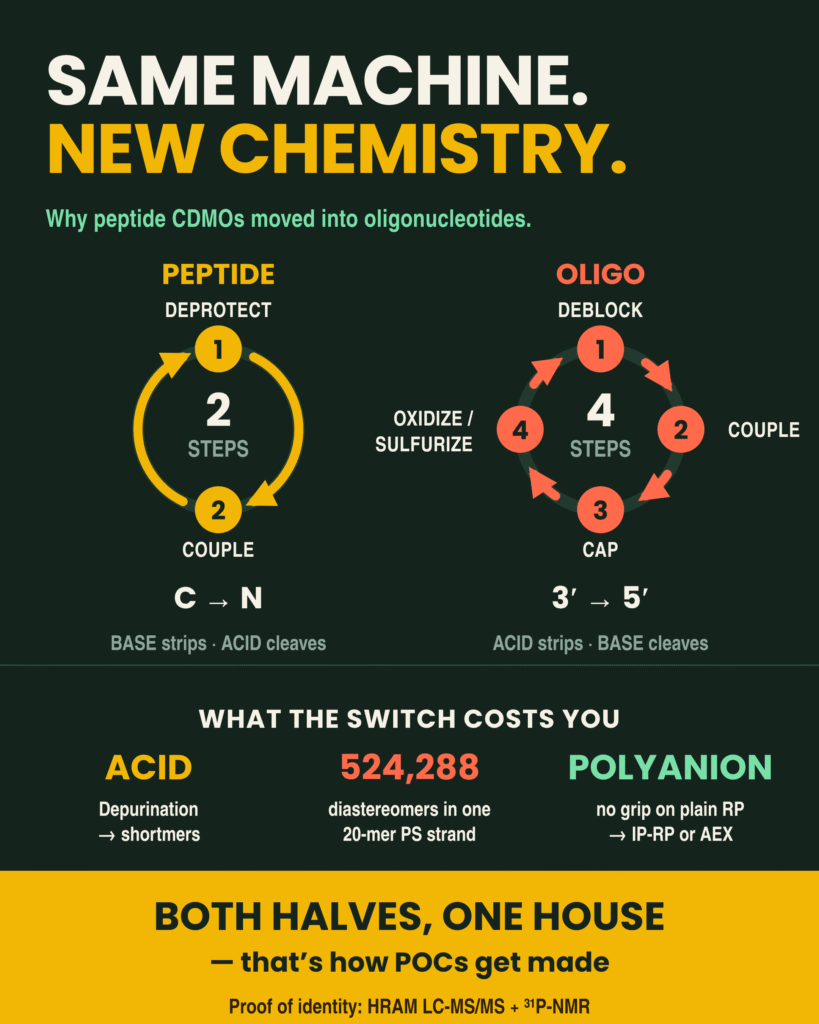
- Why the move happened: CDMOs built for synthetic peptides expanded into oligonucleotides because both run on the same idea — sequential, resin-bound assembly on automated solid-phase equipment, under the same GxP frameworks. GLP-1 demand paid for the reactors; ASOs and siRNAs gave them a second use.
- Same skeleton, different cycle: SPPS builds C→N in two core steps (deprotect, couple); SPOS builds 3’→5′ in four (deblock, couple, cap, oxidize or sulfurize). Capping is optional in peptides but mandatory in oligos, or deletion sequences accumulate.
- The protection logic inverts: peptides use base-labile Fmoc with a strong-acid TFA cleavage at the end; oligos use acid-labile DMT with a strongly basic ammonium hydroxide or methylamine deprotection. Infrastructure and materials have to tolerate both regimes.
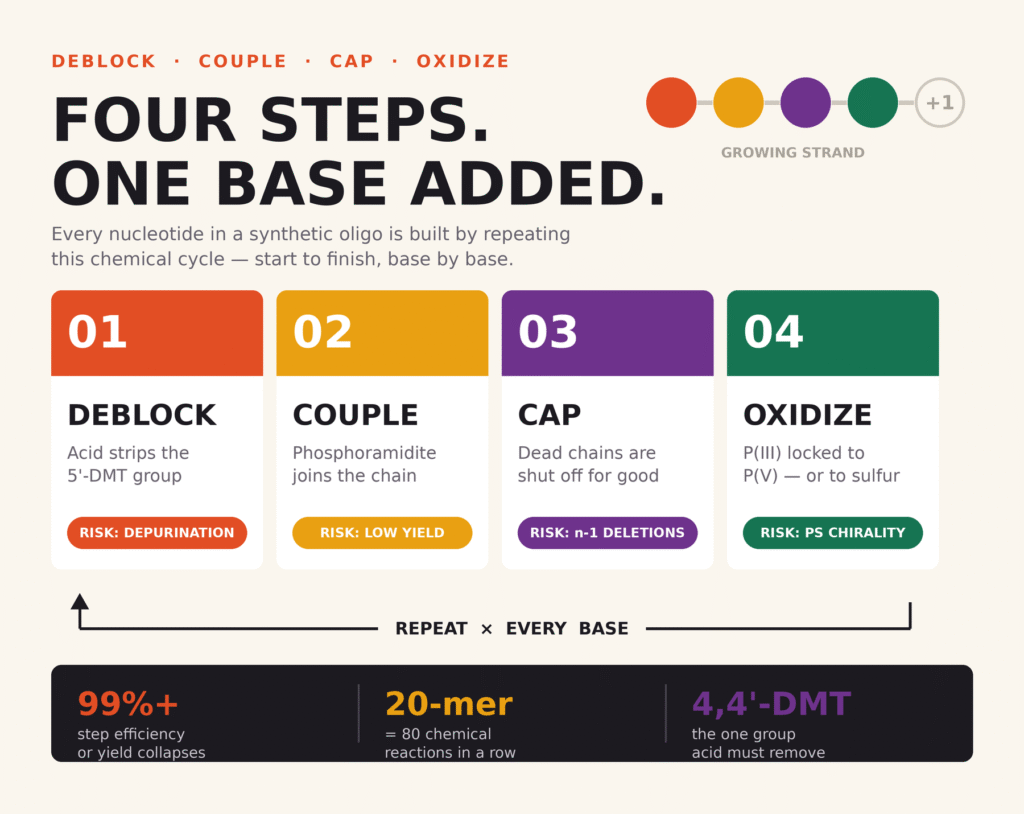
- Step efficiency is unforgiving: yield is step efficiency raised to chain length, so across 15–45 cycles anything below ~99% per step collapses the yield and loads the product with closely related impurities.
- New failure modes appear: acid exposure during deblocking causes depurination and n−1 shortmers, and sulfurizing the backbone creates a stereocentre at every phosphorus — a 20-mer phosphorothioate has 19 of them, or 524,288 possible diastereomers to keep batch-to-batch consistent.
- Downstream is a different lab: polyanionic oligos barely retain on conventional C8/C18 RP-HPLC, so purification shifts to ion-pair RP (TEAA or TEA/HFIP) or anion exchange with high-salt gradients at pH 11–12, and characterization leans on high-resolution accurate-mass LC-MS/MS plus ³¹P-NMR to resolve isobaric and diastereomeric clusters.
- The commercial payoff is conjugates: a house that can make both halves can produce peptide-oligonucleotide conjugates — by sequential assembly on one support or, more practically at scale, by convergent click or maleimide-thiol coupling of separately purified fragments — without fragmenting the supply chain.
Strategic Rationale: Why Peptide Manufacturers Moved Into Oligonucleotides
Peptide manufacturers expanded into oligonucleotide manufacturing to capitalize on market synergies within the rapidly growing TIDES sector. This transition allows them to leverage overlapping client bases while repurposing existing high-capacity solid-phase synthesis infrastructure. By developing dual-modality manufacturing platforms, CDMOs can also reduce supply chain fragmentation for emerging hybrid therapeutics, including Peptide-Oligonucleotide Conjugates (POCs).
The rapid commercial expansion of GLP-1 receptor agonist peptides has driven substantial capital investment in large-scale solid-phase reactors, organic solvent management systems, and automated downstream purification platforms. Contract manufacturers recognized that this capital-intensive infrastructure could be adapted for therapeutic oligonucleotide production, which also requires automated fluid handling systems, resin management, and established GxP compliance frameworks. Both peptide and oligonucleotide drug candidates occupy an intermediate position between small molecules and biological proteins, combining high biological specificity with well-defined chemical manufacturing controls.
A structured analytical workflow helps CDMOs establish consistent testing and reporting practices, as explained in this peptide characterization deliverables checklist.
| Strategic Vector | Peptide Manufacturing Platform | Oligonucleotide Manufacturing Platform | Integrated TIDES Synergy |
|---|---|---|---|
| Primary Chemical Modality | Synthetic Amino Acid Chains (SPPS) | Synthetic Nucleotide Chains (SPOS) | Shared iterative solid-phase automation platforms |
| Dominant Target Class | Extracellular receptors, metabolic pathways | Intracellular mRNA, pre-mRNA, non-coding RNA | Extended target coverage across cell surfaces and the genome |
| Delivery Strategy | Direct receptor binding, lipid formulations | Conjugation (GalNAc, CPPs), LNPs | End-to-end manufacturing of targeted POCs |
| Scale Demands | Metric-ton scale for metabolic indications | Kilogram to metric-ton scale | High-capacity reactor and downstream equipment reuse |
| Regulatory Framework | CDER drug pathways, generic ANDAs (Ph. Eur.) | CDER drug pathways, emerging USP/FDA PSGs | Unified regulatory compliance and quality management |
Market Convergence and the Growth of Peptide-Oligonucleotide Conjugates (POCs)
Peptide-Oligonucleotide Conjugates (POCs) represent a therapeutic approach in which targeting peptides facilitate the delivery of nucleic acid payloads directly into specific target cells. Oligonucleotides frequently face biological delivery challenges, including poor cell membrane permeability and rapid systemic clearance. Conjugating oligonucleotides with cell-penetrating peptides (CPPs) or tissue-specific peptide ligands helps overcome these limitations and improves targeted intracellular delivery.
CDMOs with the capability to synthesize both the peptide targeting domain and the oligonucleotide payload have a significant competitive advantage. By managing both components within a single manufacturing organization, they can eliminate supply chain fragmentation, minimize complex technology transfers between independent suppliers, and streamline the development and manufacturing of advanced peptide-oligonucleotide therapeutics.
Reliable assessment of these hybrid molecules requires detailed molecular evaluation through structural characterization of peptide-oligonucleotide conjugates.
Shared Solid-Phase Roots: Methodological Synergies Between SPPS and SPOS
Solid-Phase Peptide Synthesis (SPPS) and Solid-Phase Oligonucleotide Synthesis (SPOS) follow the same fundamental operational principle: constructing biopolymers through sequential chemical reactions while the growing molecular chain remains attached to an insoluble solid support. This shared foundation enables CDMOs to transfer established manufacturing principles, including cycle optimization, reaction monitoring, and resin washing techniques, across both production platforms.
Both methodologies use protecting groups to control reactive functional groups and minimize unintended side reactions during chain elongation. In SPPS, chain assembly proceeds from the C-terminus toward the N-terminus. This process uses an Nα-protecting group, typically the base-labile Fmoc group, together with orthogonal side-chain protection, such as acid-labile tert-butyl groups. In SPOS, chain elongation proceeds from the 3′-terminus toward the 5′-terminus through phosphoramidite chemistry. During this process, the 5′-hydroxyl group is protected using acid-labile 4,4′-dimethoxytrityl (DMT), while exocyclic base amines are protected with acyl groups.
The mathematical relationship governing cumulative product yield is similar across both solid-phase synthesis platforms. The overall yield depends on the average efficiency of each individual reaction step (Ystep) and the total sequence length (n):
Overall Yield (%) = (Ystep)n × 100
Because therapeutic peptides typically contain 10 to 45 residues, while oligonucleotides generally consist of 15 to 30 nucleotides, both manufacturing processes involve numerous sequential chemical reactions. Maintaining individual step coupling efficiencies above 99% is therefore essential to prevent exponential reductions in overall yield and the accumulation of substantial downstream impurity burdens.
| Synthesis Parameter | Solid-Phase Peptide Synthesis (SPPS) | Solid-Phase Oligonucleotide Synthesis (SPOS) |
|---|---|---|
| Direction of Elongation | C-terminus to N-terminus (C → N) | 3′-end to 5′-end (3′ → 5′) |
| Monomer Building Block | Nα-Fmoc / Boc-protected Amino Acids | 5′-DMT nucleoside 3′-phosphoramidites |
| Solid Support Materials | Cross-linked Polystyrene, PEG-grafted resins | Controlled Pore Glass (CPG), Macroporous Polystyrene |
| Cycle Complexity | 2 Core Steps: Deprotection → Coupling | 4 Core Steps: Deblocking → Coupling → Capping → Oxidation/Thiolation |
| Temporary Protecting Group | Fmoc (base-labile, piperidine cleavage) | DMT (acid-labile, TCA/DCA cleavage) |
| Final Cleavage/Deprotection | Strong Acidic (Trifluoroacetic Acid – TFA) | Strongly Basic/Nucleophilic (NH4OH or methylamine) |
| Typical Step Efficiency | 98.0% – 99.5% | 99.0% – 99.7% |
Technical Divergence: Chemical and Operational Challenges in Oligonucleotide Synthesis
Transitioning from peptide manufacturing to oligonucleotide production introduces several technical challenges for CDMOs, including opposing chemical protection strategies, more complex synthesis cycles, and distinct chemical degradation pathways. While SPPS primarily relies on basic temporary deprotection followed by acidic final cleavage, SPOS involves acidic temporary deblocking and strongly basic final deprotection. Understanding these differences is essential for adapting manufacturing infrastructure, optimizing reaction conditions, and maintaining product quality across both modalities.
Chemical Mechanisms and Structural Degradation Drivers
The standard SPOS phosphoramidite workflow consists of four sequential steps for every nucleotide addition. Each step introduces specific operational and chemical risks that are not typically encountered in conventional two-step SPPS workflows.
Deblocking (DMT Removal): The 5′-DMT protecting group is removed using dilute organic acids, such as 3% trichloroacetic acid (TCA) or dichloroacetic acid (DCA) in dichloromethane. However, excessive acid exposure or prolonged contact can trigger depurination. This reaction involves cleavage of the glycosidic bond connecting purine bases, specifically adenine or guanine, to the ribose ring. As a result, depurinated n-1 species may form, negatively affecting the purity and structural integrity of the final oligonucleotide product.
Coupling: Following DMT removal, the exposed 5′-hydroxyl group reacts with a 5′-DMT-nucleoside phosphoramidite monomer in the presence of an acidic azole activator, such as 5-ethylthiotetrazole. This reaction produces an unstable phosphite triester linkage, which serves as an intermediate in the formation of the final oligonucleotide backbone.
Capping: Unlike SPPS, where capping of unreacted amines may be optional depending on the synthesis strategy, SPOS requires a capping step after every coupling reaction. During this process, unreacted 5′-hydroxyl groups are acylated using acetic anhydride and N-methylimidazole. This prevents these unreacted sites from participating in subsequent synthesis cycles and generating deletion sequences (n-1, n-2) that may closely resemble the intended target strand.
Oxidation or Thiolation: The trivalent phosphite triester (P(III)) intermediate must undergo oxidation to form a stable pentavalent phosphate (P(V)) backbone. For conventional RNA and DNA synthesis, aqueous iodine is commonly used as the oxidizing agent. However, therapeutic antisense oligonucleotides often require additional resistance to nuclease degradation. In such cases, thiolation reagents, including xanthane hydride or Beaucage reagent, are introduced to replace a non-bridging oxygen atom with sulfur, resulting in the formation of phosphorothioate (PS) backbones.
Phosphorothioate backbone modifications introduce additional complexity because of the formation of chiral centers. Replacing a non-bridging oxygen atom with a sulfur atom creates a stereogenic center at each phosphorus position, resulting in either RP or SP configurations. A typical 20-mer phosphorothioate ASO contains 19 chiral phosphorus centers, theoretically producing 219 = 524,288 distinct diastereomers. Controlling this structural complexity requires specialized process analytical technology and carefully optimized reaction conditions to maintain consistent diastereomeric profiles and minimize batch-to-batch variability.
Downstream Processing and Analytical Disparities: RP-HPLC vs. IP-RP and AEX
Oligonucleotide downstream processing requires specialized Ion-Pair Reversed-Phase (IP-RP) HPLC or Anion Exchange (AEX) chromatography because the highly polyanionic nucleotide backbones do not exhibit suitable retention on conventional reversed-phase HPLC columns commonly used for peptide purification. Characterizing complex oligonucleotide impurity profiles also requires advanced analytical techniques, including High-Resolution Accurate Mass LC-MS (HRAM LC-MS) and 31P-NMR spectroscopy. These techniques help distinguish isobaric species, depurinated shortmers, and complex diastereomeric mixtures.
In synthetic peptide purification, conventional Reversed-Phase HPLC using C8 or C18 stationary phases and acidic mobile phases containing water/acetonitrile with 0.1% TFA can effectively separate target compounds according to the hydrophobicity of their amino acid side chains. In contrast, oligonucleotides contain negatively charged phosphate backbones, which generally result in poor retention and rapid elution when conventional reversed-phase columns are used without appropriate ion-pairing agents.
To achieve effective retention and high-resolution separation, CDMOs employ specialized chromatographic methods:
Ion-Pair Reversed-Phase (IP-RP) Chromatography: This technique uses volatile alkylammonium salts, such as triethylammonium acetate (TEAA) or triethylamine/hexafluoroisopropanol (TEA/HFIP), in the mobile phase. The hydrophobic alkyl chains of the ion-pairing agents interact with the C18 stationary phase, while their positively charged ammonium head groups associate with the negatively charged polyanionic backbone. This interaction improves oligonucleotide retention and enables separation according to chain length and chemical modifications.
Anion Exchange (AEX) Chromatography: AEX separates oligonucleotides primarily according to their charge density. Strong anion exchange resins containing quaternary ammonium functional groups are commonly used for this purpose. Elution is achieved through high-salt gradients, such as sodium perchlorate, under elevated pH conditions (pH 11–12). The alkaline environment helps denature secondary structures, allowing full-length target strands to be separated from truncated failure sequences and other product-related impurities.
| Analytical / Purification Vector | Peptide API Characterization | Oligonucleotide API Characterization |
|---|---|---|
| Primary Separation Mode | Standard RP-HPLC (C8/C18 with 0.1% TFA) | IP-RP HPLC (TEAA or TEA/HFIP) / AEX |
| Mass Spectrometry Platform | ESI-QTOF / LC-MS (Charge-state envelope) | HRAM LC-MS/MS (Negative ESI, ion-paired) |
| Structural Identification | Amino Acid Analysis, MS/MS sequencing | 31P-NMR, HRAM-MS2 fragment coverage |
| Process Impurity Testing | GC-HS for residual DMF/piperidine | GC-HS for residual acetonitrile/DCM/toluene |
| Elemental Contaminants | ICP-MS per USP / ICH Q3D | ICP-MS per USP / ICH Q3D |
Under regulatory frameworks established by the US FDA and USP, the characterization of oligonucleotide impurities involves several distinct analytical challenges. Unlike peptides, where individual product-related impurities above 0.10% are routinely isolated and characterized under ICH Q3A/B guidelines, oligonucleotides may exhibit complex impurity clusters containing n-1 shortmers, depurinated species, and phosphorothioate isomers. These impurities can have closely related structural and physicochemical properties, making their separation and identification particularly challenging.
Analytical testing strategies, such as those implemented by ResolveMass Laboratories Inc., incorporate High-Resolution Accurate Mass Tandem Mass Spectrometry (LC-HRAM-MS/MS) and 31P-NMR spectroscopy to verify sequence integrity, investigate fragmentation patterns, and quantify trace-level process impurities. These advanced analytical approaches support the identification of product-related impurities and provide valuable information for evaluating the overall quality and consistency of peptide and oligonucleotide drug substances.
Multi-Attribute Monitoring can further support peptide quality assessment by tracking molecular modifications and critical quality attributes through advanced MAM characterization approaches.
Facility Design, Green Chemistry, and Synthesis Hybrids
Modern TIDES manufacturing facilities are increasingly adopting modular plant designs, environmentally sustainable solvent technologies, and advanced conjugation strategies to manufacture high-purity biopolymers while reducing their environmental impact. Integrating peptide and oligonucleotide manufacturing workflows requires flexible facilities capable of accommodating different chemical environments, managing specialized process requirements, and maintaining strict contamination control.
When manufacturing complex Peptide-Oligonucleotide Conjugates (POCs), CDMOs generally employ two primary assembly strategies:
Sequential Solid-Phase Assembly: In this approach, the complete conjugate is constructed step-by-step on a single solid support. The oligonucleotide segment is generally synthesized first using phosphoramidite chemistry, followed by the sequential addition of amino acids. However, implementing this strategy requires carefully selected protecting groups that remain compatible with both basic Fmoc deprotection conditions and the acid-labile conditions used during phosphoramidite synthesis. Maintaining this chemical compatibility is essential to prevent unwanted degradation or deprotection of previously assembled molecular segments.
Convergent Solution-Phase Conjugation: Under this strategy, peptide and oligonucleotide fragments are synthesized and purified independently using their respective optimized solid-phase synthesis platforms. Each fragment is subsequently functionalized with complementary bio-orthogonal chemical handles, such as an alkyne and an azide for copper-free click chemistry or a maleimide and a thiol group. These functionalized fragments are then linked together through solution-phase conjugation. By manufacturing and purifying the two components separately, convergent assembly minimizes cross-compatibility challenges and provides greater flexibility during process optimization. Consequently, it is an important approach for large-scale commercial POC manufacturing.
Appropriate specification setting helps ensure that complex conjugates meet predefined quality requirements throughout development and manufacturing, including those discussed in POC specification-setting strategies.
Environmental sustainability represents another important operational priority for modern TIDES manufacturing facilities. Both SPPS and SPOS consume substantial quantities of hazardous organic solvents, including dimethylformamide (DMF), N-methylpyrrolidone (NMP), and dichloromethane (DCM). To reduce solvent-related environmental impacts, modern manufacturing facilities are exploring greener solvent alternatives, such as Cyrene and 2-methyltetrahydrofuran, alongside continuous-flow solid-phase reactors and Process Analytical Technology (PAT).
The integration of advanced process monitoring systems further improves manufacturing efficiency. Real-time inline UV monitoring and automated peak collection allow manufacturers to monitor reaction performance, improve process consistency, and optimize individual synthesis steps. These technologies can enhance step yields, reduce unnecessary solvent consumption, and minimize the overall environmental footprint of peptide and oligonucleotide manufacturing operations.
Maintaining conjugate integrity also requires suitable storage conditions and handling procedures to minimize degradation during the product lifecycle, as discussed in POC storage and handling considerations.
Conclusion: Adapting CDMO Capabilities When Peptide Manufacturers Moved Into Oligonucleotides
The industry trend in which peptide manufacturers moved into oligonucleotides reflects a strategic shift driven by shared solid-phase engineering principles, overlapping pharmaceutical client bases, and expanding therapeutic development pipelines. Although both modalities rely on similar solid-phase assembly concepts, transitioning from peptide synthesis to commercial oligonucleotide manufacturing requires CDMOs to address several specialized technical challenges. These include acid-catalyzed depurination, phosphorothioate stereocenter management, ion-pair-based downstream purification, and advanced high-resolution mass spectrometry characterization.
As multi-modal therapeutic pipelines and complex Peptide-Oligonucleotide Conjugates (POCs) progress into late-stage clinical development, manufacturing success increasingly depends on reliable analytical method development, accurate impurity identification, and stringent quality control. Biopharmaceutical manufacturers must establish robust characterization strategies to verify molecular structures, monitor critical quality attributes, and ensure consistent product quality throughout development and commercial production.
Operating at the forefront of bioanalytical chemistry, ResolveMass Laboratories Inc. provides advanced mass spectrometry, structural elucidation, and regulatory compliance testing services to support biopharmaceutical innovators. These capabilities help manufacturers verify product quality, investigate complex impurity profiles, and generate essential analytical data to support the progression of candidate molecules from development through commercial release.
To discuss customized analytical method development or impurity characterization strategies for your peptide and oligonucleotide manufacturing pipelines, visit the ResolveMass Contact Portal.
Frequently Asked Questions (FAQs)
Solid-Phase Peptide Synthesis (SPPS) generally follows a two-step process involving temporary protecting group removal through deprotection, followed by amino acid coupling. In comparison, Solid-Phase Oligonucleotide Synthesis (SPOS) involves four stages: acidic deblocking, phosphoramidite coupling, capping, and oxidation or thiolation. The additional steps in SPOS are necessary to prevent deletion sequences and establish a chemically stable phosphate or phosphorothioate backbone.
Peptide and oligonucleotide synthesis use different protecting group strategies because their chemical structures and reaction conditions are distinct. In Fmoc-SPPS, temporary protecting groups are base-labile and removed using piperidine, while final cleavage generally involves strong acid, such as TFA. Conversely, SPOS uses acid-labile 5′-DMT groups for temporary protection and strongly basic or nucleophilic conditions, such as ammonium hydroxide or methylamine, for final cleavage and deprotection. Amino acid side chains typically use acid-labile groups such as tBu and Trt, whereas nucleotide exocyclic amines are commonly protected using acyl groups such as benzoyl and isobutyryl.
Conventional Reversed-Phase HPLC is generally unsuitable for direct oligonucleotide purification because their negatively charged phosphodiester backbones are highly hydrophilic and exhibit limited retention on standard C8 or C18 columns. Ion-Pair Reversed-Phase (IP-RP) HPLC addresses this limitation by incorporating alkylammonium additives, such as TEAA, that facilitate oligonucleotide retention through ion-pair formation. Alternatively, Anion Exchange (AEX) chromatography separates oligonucleotides according to differences in their negative charge characteristics.
Depurination is an acid-induced degradation reaction that occurs when the glycosidic bond connecting a purine base, such as adenine or guanine, to its ribose sugar is broken. This reaction can occur during the acidic DMT deblocking stage of SPOS and generate unwanted depurinated oligonucleotide impurities. Manufacturers minimize this degradation by carefully controlling acid concentration, exposure duration, and reaction temperature. Optimizing TCA or DCA treatment conditions also helps preserve sequence integrity throughout synthesis.
Phosphorothioate modification involves replacing a non-bridging oxygen atom in the phosphate backbone with sulfur, creating a chiral center at each modified phosphorus position. Consequently, an oligonucleotide containing multiple phosphorothioate linkages can exist as a complex mixture of different diastereomers. This structural variation complicates chromatographic separation and analytical characterization. Techniques such as ³¹P-NMR and High-Resolution Accurate Mass LC-MS help investigate backbone modifications, confirm structural characteristics, and assess batch-to-batch consistency.
Peptide-Oligonucleotide Conjugates (POCs) are hybrid therapeutic molecules that combine a peptide component with a nucleic acid payload to improve targeted cellular delivery. The peptide portion may function as a cell-penetrating peptide or a tissue-specific targeting ligand, helping the oligonucleotide reach its intended biological target. These conjugates can be manufactured through sequential solid-phase assembly on a common resin support or by independently synthesizing both components before joining them through solution-phase conjugation. Bio-orthogonal reactions, including azide-alkyne click chemistry and maleimide-thiol coupling, are commonly used for convergent assembly.
Oligonucleotide impurity characterization requires multiple complementary analytical techniques to evaluate molecular structure, sequence integrity, and manufacturing-related contaminants. LC-HRAM-MS/MS supports molecular mass confirmation, sequence analysis, and shortmer identification, while ³¹P-NMR provides information about phosphate backbone structures and phosphorothioate modifications. ICP-MS is used to assess trace elemental impurities in accordance with USP and ICH Q3D requirements, whereas Headspace GC-MS helps determine residual organic solvents. Combining these methods provides a more comprehensive assessment of oligonucleotide purity and quality.
SPPS commonly uses polymeric solid supports, including cross-linked polystyrene and PEG-grafted resins such as TentaGel, which swell in suitable organic solvents and allow reagents to access growing peptide chains. In contrast, SPOS generally employs rigid supports with controlled pore structures, particularly Controlled Pore Glass (CPG) and macroporous polystyrene. These materials provide suitable surface accessibility for phosphoramidite coupling reactions and support efficient reagent movement through the synthesis column. Their different physical properties reflect the specific chemical and operational requirements of peptide and oligonucleotide manufacturing.
Synthetic peptides are generally evaluated using established impurity assessment principles under ICH Q3A/B, where reporting, identification, and qualification thresholds depend on factors such as the maximum daily dose and the applicable guideline. Therapeutic oligonucleotides, however, present different characterization challenges because of their sequence-related impurities, degradation products, and backbone modifications. Their regulatory assessment therefore requires product-specific, risk-based impurity evaluation supported by appropriate analytical methods and reference standards. Manufacturers must demonstrate adequate impurity identification, control, and consistency to support product safety, quality, and efficacy.
Reference:
- Ferrazzano, L., Corbisiero, D., Tolomelli, A., & Cabri, W. (2023). From green innovations in oligopeptide to oligonucleotide sustainable synthesis: Differences and synergies in TIDES chemistry. Green Chemistry, 25, 1217–1236. https://doi.org/10.1039/D2GC04547H
- United States Pharmacopeial Convention. (n.d.). Oligonucleotides. https://www.usp.org/biologics/oligonucleotides
- Pack, B., Cornwell, P., Siegel, R., May, S., Malherbe, L., Ferrante, A., Roepke, D., Carfagna, M., Tiwari, R., & Wolf, A. (n.d.). Toxicity and immunogenicity considerations for oligonucleotide-related impurities: The impact on control strategy development. United States Pharmacopeial Convention. https://www.usp.org/sites/default/files/usp/document/our-work/biologics/documents/brian%20pack_Toxicity%20and%20Immunogenicity%20Considerations.pdf
- Klabenkova, K., Fokina, A., & Stetsenko, D. (2021). Chemistry of peptide-oligonucleotide conjugates: A review. Molecules, 26(17), 5420. https://doi.org/10.3390/molecules26175420
Get In Touch With Us
About The Author