

Introduction:
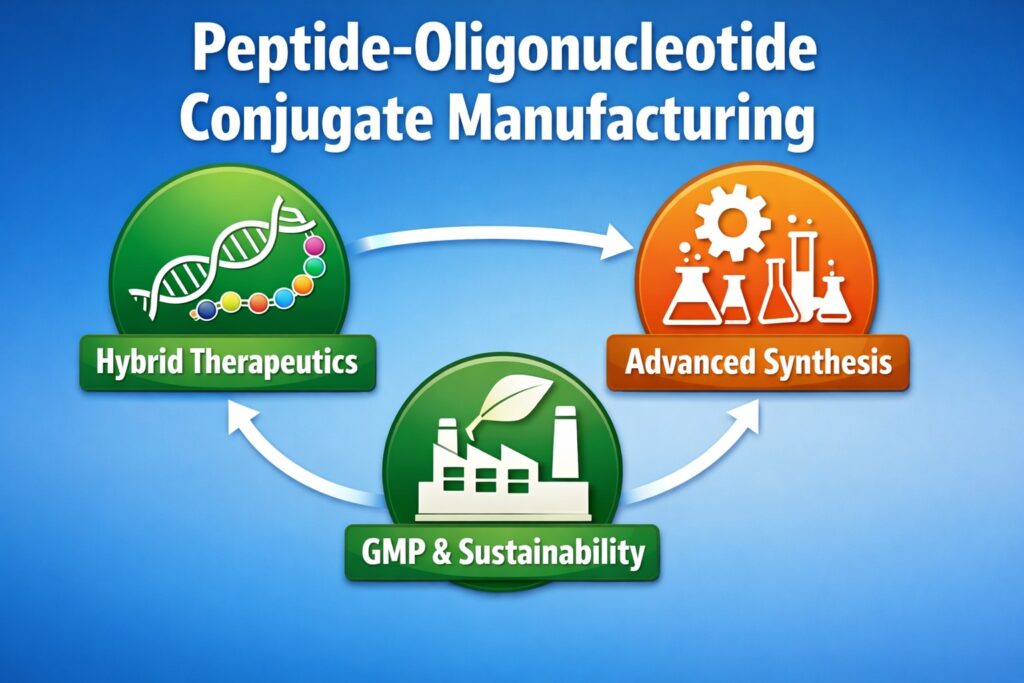
Peptide Oligonucleotide Conjugate Manufacturing is a highly specialized process that combines peptide chemistry with nucleic acid technology to create powerful hybrid therapeutics. These conjugates are formed by linking specific amino acid sequences to carefully designed DNA or RNA strands. The goal is to improve targeted delivery and precise gene regulation inside the body. As demand for advanced genetic therapies continues to grow, reliable and scalable manufacturing approaches are essential. This article provides a detailed overview of the synthesis, purification, analytical validation, and GMP strategies required for successful commercial production.
Contract manufacturing of peptide-oligonucleotide conjugates (POCs) focuses on building stable and reproducible processes that can move from research scale to full GMP production. These hybrid molecules combine the targeting power of peptides with the gene-silencing or gene-modulating function of oligonucleotides. To ensure commercial success, manufacturers must carefully control scalability, reproducibility, and regulatory compliance. Strong process design and analytical control are critical at every stage.
Explore our specialized manufacturing capabilities: Peptide Oligonucleotide Conjugates (POCs) Synthesis Services
Article Highlights
- Peptide Oligonucleotide Conjugate (POC) Manufacturing integrates peptide chemistry and nucleic acid synthesis to create hybrid therapeutics with improved cellular delivery, targeting, and gene regulation.
- Scalable and reproducible GMP processes are essential, combining optimized synthesis routes, site-specific ligation strategies, and strict analytical control to ensure quality and regulatory compliance.
- Flexible synthetic architectures—including SPPS, phosphoramidite chemistry, and post-synthetic ligation—enable efficient assembly while minimizing cross-reactivity and maximizing yield.
- Advanced conjugation and purification technologies, such as click chemistry, native chemical ligation, and continuous chromatography (MCSGP), improve purity, recovery, and manufacturing efficiency.
- Comprehensive analytical validation (LC-MS/MS, NMR, SEC-MALS, and related methods) ensures identity, stability, and consistency of complex hybrid molecules.
- Sustainability and CMC strategies, including solvent recycling, greener chemistries, enzymatic ligation, and phase-appropriate GMP implementation, support cost-effective, environmentally responsible commercial production.
Strategic Synthetic Architectures in Peptide Oligonucleotide Conjugate Manufacturing
Peptide Oligonucleotide Conjugate Manufacturing relies on the careful integration of solid-phase and liquid-phase synthesis methods. These approaches are used to build hybrid molecules that can overcome common delivery barriers such as poor cellular uptake or rapid degradation. By attaching peptides, oligonucleotides gain better membrane penetration and tissue targeting properties.
Manufacturers typically choose between sequential on-support conjugation or fragment-based assembly followed by ligation. Each method has its own technical challenges, including protecting group compatibility, yield control, and impurity management. The selected synthetic pathway strongly influences purification efficiency and overall process reliability. Careful planning at this stage improves both product quality and manufacturing consistency.
Need a partner for your therapeutic development? Peptide Oligonucleotide Conjugates CRO
Linear Stepwise Synthesis vs. Post-Synthetic Parallel Ligation in Peptide Oligonucleotide Conjugate Manufacturing
The choice of synthetic strategy depends on peptide length, sequence complexity, and sensitivity of oligonucleotide modifications. In linear synthesis, the peptide chain is directly extended from a resin-bound oligonucleotide. This requires strict reaction control because nucleic acids are sensitive to base, while peptide deprotection often uses acidic conditions. Any imbalance can damage the backbone or reduce yield. Therefore, orthogonal protecting groups must be carefully optimized.
In contrast, post-synthetic parallel ligation involves producing the peptide and oligonucleotide separately before coupling them. This approach is widely used in industrial Peptide Oligonucleotide Conjugate Manufacturing because it allows full optimization of each component. It minimizes cross-reactivity and improves reproducibility. Fragment-based assembly also simplifies troubleshooting and supports smoother GMP scale-up.
Learn more about our synthesis and characterization workflows: POC Synthesis and Characterization
Solid-Phase Peptide Synthesis (SPPS) and Phosphoramidite Convergence
The peptide segment is usually produced using Fmoc-based Solid-Phase Peptide Synthesis (SPPS) on polystyrene or PEG-based resins. This method allows automated, high-throughput assembly of complex amino acid sequences. Oligonucleotides are synthesized using phosphoramidite chemistry on controlled-pore glass (CPG) or high-load polymer supports. These systems ensure strong coupling efficiency and accurate sequence formation.
To combine these two platforms, stable linkers must withstand both acidic and basic deprotection conditions. Linker stability is essential to prevent premature cleavage or degradation. Advanced SPPS strategies often include orthogonal protecting groups that allow selective activation. These improvements increase flexibility and support precise conjugation design.
Synthesis Modality Table
| Synthesis Modality | Support Material | Coupling Mechanism | Key Advantage |
|---|---|---|---|
| SPPS (Peptide) | Polystyrene/PEG resins | Fmoc/tBu amidation | High-throughput assembly of 40+ amino acids |
| SPOS (Oligo) | CPG / High-load polymer | Phosphoramidite chemistry | Reliable, automated, standard for ASOs/siRNA |
| LPOS (Liquid) | Soluble anchors | Homogeneous solution | Reduced solvent use (60%), scalable in standard reactors |
| Enzymatic | Aqueous solution | Ligase / TdT-mediated | Metal-free, green chemistry, avoids truncated impurities |
Looking for custom drug discovery solutions? Custom Synthesis for Drug Discovery
Chemical Ligation and Site-Specific Peptide Oligonucleotide Conjugate Manufacturing
Site-specific ligation is essential in Peptide Oligonucleotide Conjugate Manufacturing to ensure correct orientation and 1:1 stoichiometry. Controlled attachment directly affects biological performance and receptor binding. Reactions must be efficient, selective, and compatible with aqueous or mixed solvent systems. This is important because peptides and oligonucleotides often have different solubility properties.
Scalability and reproducibility are critical for GMP compliance. Minimizing hydrolysis and unwanted side reactions helps maintain high purity. Careful reaction design ensures that the final product meets clinical standards.
High-Efficiency Click Chemistry and Triazole Linkage
Click chemistry, especially copper-catalyzed azide-alkyne cycloaddition (CuAAC), is widely used for conjugation. It provides fast reactions, high yields, and stable triazole linkages. This method supports complex architectures and works well with different functional groups. Predictable kinetics make it attractive for industrial use.
However, copper residues must be removed because they may cause toxicity or oxidative damage. To avoid this issue, many manufacturers now use strain-promoted azide-alkyne cycloaddition (SPAAC). SPAAC eliminates metal catalysts and simplifies purification, which is beneficial for clinical-grade materials.
Thiol-Based Ligation: Maleimide and Thioether Formation
Thiol-maleimide chemistry is popular due to its speed and simplicity. Cysteine residues are easily introduced into peptides, allowing efficient thioether bond formation. This approach is well understood and suitable for both small and large-scale production.
One limitation is possible instability due to thiol exchange reactions in the bloodstream. To improve stability, alternative linkers such as phenyloxadiazole sulfones are being developed. These options provide stronger resistance to biological conditions and improve therapeutic durability.
Access our full suite of conjugation services: Peptide Oligonucleotide Conjugation Services
Amide Coupling and Native Chemical Ligation (NCL)
Amide bond formation offers excellent chemical stability. Native Chemical Ligation (NCL) enables coupling between a peptide thioester and a cysteine-functionalized oligonucleotide under mild aqueous conditions. This method does not require extensive protecting groups and supports high selectivity.
For GMP-scale Peptide Oligonucleotide Conjugate Manufacturing, NCL reduces process complexity and enhances structural reliability. Its long-term stability makes it ideal for therapeutic applications.
Advanced Purification Engineering for Peptide Oligonucleotide Conjugate Manufacturing
Purification is one of the most challenging stages in Peptide Oligonucleotide Conjugate Manufacturing. Because POCs contain both peptide and nucleic acid elements, separation requires high-resolution chromatography. Removing truncated sequences, deletion variants, and byproducts is essential to achieve ≥95% purity for clinical use.
Strong purification strategies improve batch consistency and reduce immunogenic risk. Manufacturers rely on orthogonal chromatographic methods to ensure thorough impurity removal.
Continuous Chromatography and the MCSGP Breakthrough
Multi-Column Solvent Gradient Purification (MCSGP) is an advanced continuous chromatography system. It recycles overlapping fractions and improves product recovery compared to traditional batch methods. This approach increases yield while reducing solvent usage.
Commercial-scale applications have shown over 20% improvement in recovery and up to 75% reduction in solvent consumption. These benefits lower operational costs and support sustainability goals.
Integrated Column Selectivity: IPRP, IEX, and HILIC
Combining Ion-Pair Reversed-Phase (IPRP) and Ion Exchange (IEX) chromatography enhances impurity separation. IPRP separates based on hydrophobic interactions, while IEX focuses on charge differences. This orthogonal combination improves resolution of similar species.
Hydrophilic Interaction Liquid Chromatography (HILIC) provides additional separation of highly polar impurities. Together, these methods create a robust and reliable purification workflow.
Purification Mode Table
| Purification Mode | Principle | Targeted Impurities | Industrial Context |
|---|---|---|---|
| IPRP-HPLC | Hydrophobic interaction | Chemically modified fragments | Primary separation mode for POCs |
| Ion Exchange (IEX) | Electrostatic charge | n-1 deletions, truncated species | Critical for oligo-heavy conjugates |
| HILIC | Partitioning/Polarity | Highly polar impurities, isomers | Used when RP-HPLC resolution is insufficient |
| SEC-MALS | Hydrodynamic volume | Aggregates, dimers, oligomers | Quality control for stability/aggregation |
Desalting, Concentration, and Final Isolation
After purification, buffer exchange removes residual reagents like TEAA or HFIP. Tangential Flow Filtration (TFF) is commonly used because it protects molecular integrity and supports scale-up. TFF allows efficient concentration and diafiltration without excessive shear stress.
The final API is typically freeze-dried through lyophilization. This produces a stable powder suitable for long-term storage. Proper cycle optimization ensures structural stability and prevents aggregation.
Analytical Validation Frameworks in Peptide Oligonucleotide Conjugate Manufacturing
Comprehensive analytical testing confirms identity, purity, structure, and stability. Because POCs combine two biomolecular systems, multiple analytical platforms are required. Regulatory authorities expect validated and sensitive assays.
LC-MS/MS plays a central role in confirming molecular weight and conjugation sites. Advanced 2D-LC-MS methods detect minor degradation products. NMR spectroscopy provides structural insight into higher-order conformations. Techniques such as CD, FT-IR, AUC, and SEC-MALS evaluate aggregation and secondary structure.
Robust analytical control ensures consistent product performance and regulatory compliance.
Ensure the quality of your peptides: Peptide Characterization Service
Sustainability Metrics in Peptide Oligonucleotide Conjugate Manufacturing
Sustainability is measured using Process Mass Intensity (PMI) and atom economy. Solid-phase synthesis can generate significant solvent waste, especially at commercial scale. Reducing environmental impact is both an economic and corporate priority.
The Process Mass Intensity (PMI) Challenge
PMI values for POC production may range from 4,000 to 13,000 kg of raw materials per 1 kg of API. This is largely due to repeated washing cycles and solvent use. Strategies such as solvent recycling and optimized coupling conditions reduce waste and cost.
| Component | Standard PMI Contribution | Green Mitigation Strategy |
|---|---|---|
| Synthesis (SPPS/SPOS) | ~80% of total PMI | Solvent recycling, LPOS, Enzymatic ligation |
| Purification | ~15% of total PMI | Continuous chromatography (MCSGP), Aqueous modes |
| Isolation | ~5% of total PMI | TFF/Diafiltration, Spray drying (vs. Lyophilization) |
DMF Recycling and Greener Solvent Alternatives
Recycling DMF or replacing it with greener options like Cyrene or γ-valerolactone lowers toxicity and environmental impact. These steps align manufacturing with sustainability targets and regulatory expectations.
Enzymatic Ligation as a Sustainable Future
Enzymatic ligation uses biocatalysts in water-based systems at room temperature. It reduces organic solvent use and can achieve high purity levels. Continued development in enzyme engineering will likely expand its role in future manufacturing platforms.
View our comprehensive service list: Our Services
CMC Development and GMP Compliance Strategies
CMC development ensures safe and consistent production across all clinical phases. Early stages focus on reproducibility and impurity profiling. Later stages require validated processes and detailed regulatory documentation.
Phase-Appropriate GMP Implementation
- Early Phase: Establish reproducible synthesis and baseline impurity data.
- Late Phase: Complete analytical validation (ICH Q2) and stability studies (ICH Q1).
- Commercial Phase: Implement validated processes and full CMC documentation for NDA/BLA submission.
Each phase builds on previous knowledge and strengthens regulatory alignment.
Critical Quality Attributes (CQAs) and Specifications
Release testing includes identity (LC-MS), purity (≥95%), related substances, residual solvents (ICH Q3C), heavy metals (ICH Q3D), and microbial limits. Clear specifications ensure consistent quality and patient safety.
The Role of Technology Transfer in CDMO Success
Effective technology transfer requires detailed documentation, risk assessment, and process parameter control. Defining Critical Process Parameters (CPPs) ensures smooth scale-up and reproducibility. Strong collaboration between sponsor and CDMO supports commercial readiness.
Conclusion
Peptide Oligonucleotide Conjugate Manufacturing is a complex and highly specialized field that combines advanced chemistry, purification science, and regulatory expertise. By applying efficient ligation techniques such as click chemistry and amide coupling, along with modern purification systems like MCSGP, manufacturers can achieve scalable and high-purity production. Sustainability improvements, including solvent recycling and enzymatic ligation, are shaping the future of the industry.
With strong analytical validation and structured GMP development, peptide-oligonucleotide conjugates are positioned to play a major role in next-generation genetic therapies. ResolveMass Laboratories provides technical expertise and GMP-ready solutions to support your hybrid therapeutic programs from early development to commercial scale.
For professional consultation regarding technical optimization and GMP scale-up of your hybrid therapeutic programs, please contact our expert team.
Reference
- Klabenkova, K., Fokina, A., & Stetsenko, D. (2021). Chemistry of peptide-oligonucleotide conjugates: A review. Molecules, 26(17), 5420. https://doi.org/10.3390/molecules26175420
- Henderson, T. J. (2024). The scale-up singularity: Manufacturing innovations in oligonucleotide synthesis. Drug Discovery News. https://www.drugdiscoverynews.com/the-scale-up-singularity-manufacturing-innovations-in-oligonucleotide-synthesis-16856
- Zhou, S., Tang, H., Gao, L., Li, W., Liao, J., Yang, X., Pan, Y., & Feng, H. (2025). Identification of oligonucleotide drug impurities using heart-cutting two-dimensional liquid chromatography-tandem mass spectrometry (2D-LC-MS/MS). Analytica Chimica Acta, 1371, 344431. https://doi.org/10.1016/j.aca.2025.344431
- Jensen, O. N., Kulkarni, S., Aldrich, J. V., & Barofsky, D. F. (1996). Characterization of peptide-oligonucleotide heteroconjugates by mass spectrometry. Nucleic Acids Research, 24(19), 3866–3872. https://doi.org/10.1093/nar/24.19.3866
- **Kekessie, I., Wegner, K., Martinez, I., Kopach, M. E., White, T. D., Tom, J. K., Kenworthy, M. N., Gallou, F., Lopez, J., Koenig, S. G., Payne, P. R., Eissler, S., Arumugam, B., Li, C., Mukherjee, S., Isidro-Llobet, A., Ludemann-Hombourger, O., Richardson, P., Kittelmann, J., … van den Bos, L. J. (2024). Process mass intensity (PMI): A holistic analysis of current peptide manufacturing processes informs sustainability in peptide synthesis. The Journal of Organic Chemistry, 89(7), 4261–4282. https://doi.org/10.1021/acs.joc.3c01494
Get In Touch With Us
About The Author


