

Introduction:
Peptide-Oligonucleotide Conjugates Impurity Profiling plays a critical role in the development of next-generation therapeutics such as antisense oligonucleotides, RNA delivery systems, and targeted peptide-drug conjugates. These hybrid molecules combine the complexity of both peptides and oligonucleotides, making impurity identification significantly more challenging than traditional small-molecule drug development.
Modern pharmaceutical companies increasingly rely on specialized analytical laboratories with deep expertise in mass spectrometry-based characterization of complex biomolecules. Accurate impurity profiling not only supports regulatory approval but also improves product quality, safety, and long-term stability.
Share via:
Summary:
- Peptide-Oligonucleotide Conjugates Impurity Profiling is essential to ensure safety, efficacy, and regulatory compliance in modern RNA and peptide-based therapeutics.
- Impurities in peptide-oligonucleotide conjugates originate mainly from peptide synthesis, oligonucleotide synthesis, conjugation chemistry, and degradation during storage.
- The most reliable approach combines high-resolution LC-MS, HRMS structural confirmation, orthogonal chromatography, and stability studies.
- Regulatory agencies expect complete impurity identification, toxicological risk assessment, and robust control strategies before clinical development.
- Advanced analytical laboratories with expertise in complex biomolecules play a critical role in identifying trace-level impurities.
1: Why Peptide-Oligonucleotide Conjugates Impurity Profiling Is So Important
Peptide-Oligonucleotide Conjugates Impurity Profiling is essential because it directly impacts regulatory approval, patient safety, and long-term product quality. Since these conjugates combine two complex molecular systems, even trace-level impurities can significantly affect drug stability, therapeutic performance, and clinical safety.
Peptide-oligonucleotide conjugates contain multiple chemical components, linkers, and functional groups. As a result, regulatory agencies expect a complete structural understanding of all relevant impurities before clinical trials begin. Without proper impurity profiling, companies may face delays in regulatory submissions and increased development risks.
Key reasons why impurity profiling is essential
- Ensures patient safety by identifying toxic, reactive, or unstable impurities
- Supports regulatory submissions (IND, NDA, ANDA) with strong analytical data
- Helps maintain batch-to-batch consistency during manufacturing
- Improves product stability and shelf life
- Confirms successful peptide-oligonucleotide conjugation chemistry
- Reduces risk of late-stage development failures
2: What Types of Impurities Are Found in Peptide-Oligonucleotide Conjugates?
Most impurities in peptide-oligonucleotide conjugates originate from peptide synthesis, oligonucleotide synthesis, conjugation chemistry, and degradation during storage. Because these molecules combine two highly complex molecular systems, their impurity profiles are significantly more complicated than traditional small-molecule APIs.
Major impurity categories in peptide-oligonucleotide conjugates
| Impurity Type | Source | Impact |
|---|---|---|
| Truncated peptide fragments | Incomplete peptide synthesis | Reduced therapeutic activity and lower binding efficiency |
| Short or long oligonucleotide sequences | Solid-phase oligonucleotide synthesis | Loss of target specificity and reduced efficacy |
| Conjugation side-products | Inefficient or incomplete coupling reactions | Reduced product yield and poor stability |
| Oxidation products | Storage conditions, oxygen exposure, and environmental factors | Reduced potency and increased degradation risk |
| Degradation fragments | Hydrolysis, enzymatic breakdown, or long-term storage | Potential safety concerns and reduced shelf life |
Because peptide-oligonucleotide conjugates combine peptide chemistry with oligonucleotide technology, even small structural changes can create highly similar impurities that are difficult to identify without advanced analytical techniques.
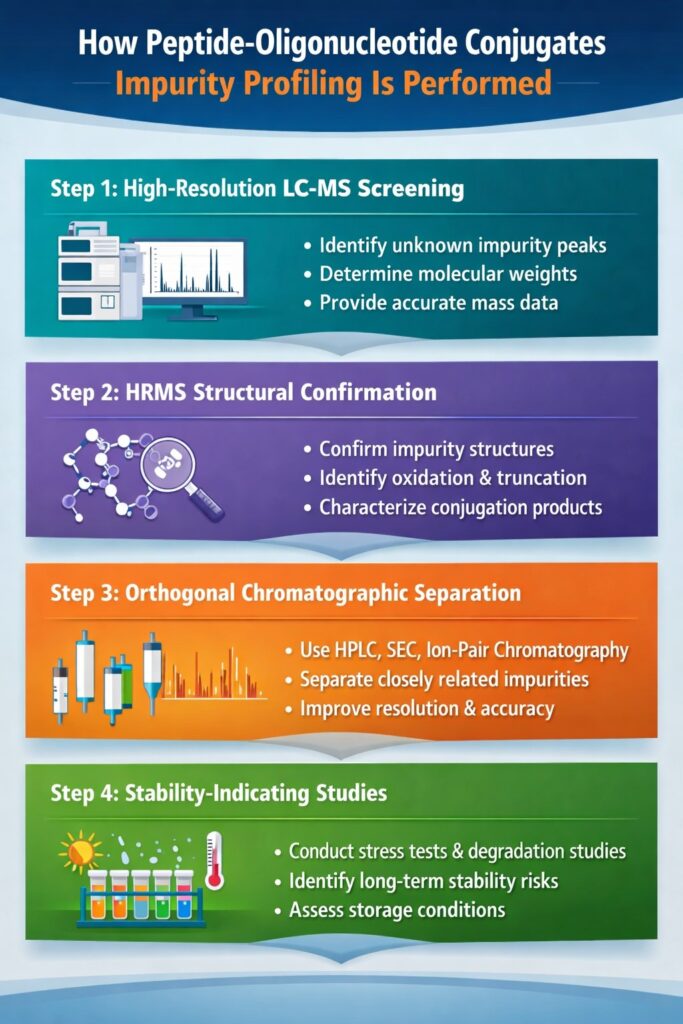
3: How Peptide-Oligonucleotide Conjugates Impurity Profiling Is Performed
Peptide-Oligonucleotide Conjugates Impurity Profiling is performed using a combination of orthogonal analytical techniques that enable both structural identification and quantitative analysis. Because these conjugates contain both peptide and oligonucleotide components, a single analytical method is not sufficient to identify all impurities accurately.
In most advanced analytical laboratories, impurity profiling follows a structured multi-step workflow designed to detect, identify, confirm, and control impurities throughout the development lifecycle.
Step-by-step analytical workflow
Step 1: High-resolution LC-MS screening
The first step focuses on detecting unknown impurity peaks and understanding their molecular differences.
- Identifies unknown impurity peaks
- Determines molecular weight differences
- Provides accurate mass for structural prediction
- Helps detect low-level impurities early in development
Step 2: HRMS structural confirmation
Once impurities are detected, high-resolution mass spectrometry is used to confirm their chemical structure.
- Confirms impurity structures with high accuracy
- Identifies oxidation, truncation, and conjugation-related products
- Differentiates closely related molecular structures
- Supports regulatory documentation with strong analytical evidence
Step 3: Orthogonal chromatographic separation
Because many impurities are structurally similar, additional separation techniques are required.
- Uses HPLC, SEC, and ion-pair chromatography
- Improves separation of closely related impurities
- Enhances identification accuracy
- Supports reliable quantitative analysis
Step 4: Stability-indicating studies
The final step focuses on understanding how impurities form over time.
- Evaluates degradation under stress conditions (temperature, light, pH, and oxidation)
- Identifies long-term stability risks
- Helps improve formulation and storage conditions
- Supports stability studies for regulatory submissions
4: Analytical Techniques Used in Peptide-Oligonucleotide Conjugates Impurity Profiling
Peptide-Oligonucleotide Conjugates Impurity Profiling relies on a combination of advanced analytical techniques to ensure accurate impurity identification, structural confirmation, and reliable quantification. Because these conjugates contain both peptide and oligonucleotide components, a single analytical technique is not sufficient to fully characterize all impurity types.
A well-designed impurity profiling strategy uses multiple orthogonal techniques that work together to deliver high sensitivity, high accuracy, and strong regulatory confidence.
Most important analytical techniques
LC-HRMS (High-Resolution Mass Spectrometry)
This is one of the most powerful tools for impurity profiling in peptide-oligonucleotide conjugates.
- Provides accurate mass measurement
- Helps identify unknown impurity structures
- Detects trace-level impurities
- Supports regulatory submissions with high-confidence data
LC-MS/MS (Triple Quadrupole Systems)
This technique is mainly used for highly sensitive detection and quantitative analysis.
- Enables targeted impurity quantification
- Detects low-level degradation products
- Improves method sensitivity and reliability
- Supports stability and release testing
NMR Spectroscopy for Structural Confirmation
NMR is essential when structural confirmation is required for unknown impurities.
- Confirms molecular structure with high confidence
- Differentiates closely related impurities
- Supports regulatory documentation
- Useful for complex conjugation-related impurities
Size-Exclusion Chromatography (SEC)
SEC is widely used to detect high-molecular-weight impurities and aggregation.
- Identifies aggregates and degradation fragments
- Helps evaluate molecular size distribution
- Supports stability studies
- Improves overall impurity profiling accuracy
Ion-Pair Reversed-Phase HPLC
This technique is particularly useful for separating oligonucleotide-related impurities.
- Improves separation of closely related sequences
- Enhances peak resolution
- Supports reliable quantitative analysis
- Helps detect truncated oligonucleotide impurities
These advanced analytical techniques allow scientists to identify even trace-level impurities in highly complex biomolecular systems, ensuring reliable results and strong regulatory acceptance.
5: Common Challenges in Peptide-Oligonucleotide Conjugates Impurity Profiling
Peptide-Oligonucleotide Conjugates Impurity Profiling is challenging mainly because of the extremely high structural complexity of these molecules. Since these conjugates combine peptide chemistry with oligonucleotide technology, even very small structural changes can create entirely new impurities that are difficult to detect and identify.
Unlike traditional small-molecule drugs, peptide-oligonucleotide conjugates contain multiple functional groups, variable chain lengths, and highly sensitive linkers. As a result, impurity profiling requires not only advanced analytical techniques but also deep scientific expertise in interpreting complex analytical data.
Main challenges faced by pharmaceutical companies
- Detection of very low-level impurities at trace concentrations
- Identification of highly similar molecular structures
- Difficult chromatographic peak separation due to structural similarity
- Limited availability of reference standards for unknown impurities
- Complex degradation pathways during stability studies
- Risk of misidentification without advanced mass spectrometry expertise
Because of these challenges, successful impurity profiling in peptide-oligonucleotide conjugates requires a combination of high-resolution analytical instrumentation, orthogonal techniques, and experienced analytical scientists who specialize in complex biomolecules.
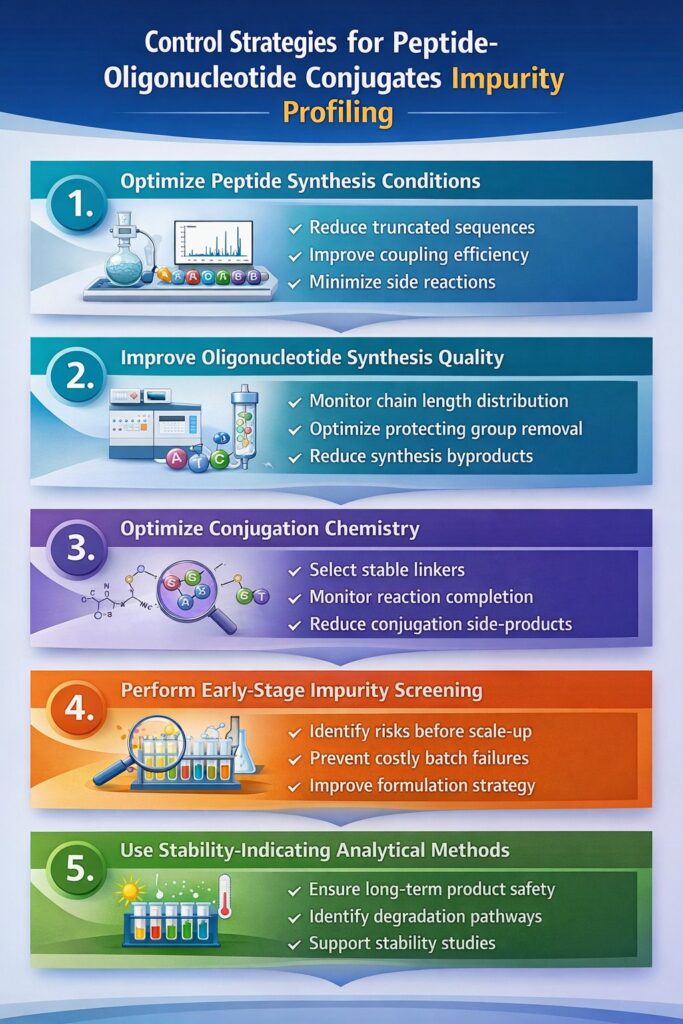
6: Control Strategies for Peptide-Oligonucleotide Conjugates Impurity Profiling
Effective control in Peptide-Oligonucleotide Conjugates Impurity Profiling starts with prevention and is followed by strong analytical monitoring. Since these conjugates involve complex peptide synthesis, oligonucleotide chemistry, and conjugation reactions, controlling impurities early in development is far more effective than trying to remove them later.
A well-designed impurity control strategy helps pharmaceutical companies improve product quality, reduce development risks, and support regulatory approval.
Practical impurity control strategies
1. Optimize peptide synthesis conditions
Controlling impurities at the peptide synthesis stage can significantly reduce downstream impurity risks.
- Reduce formation of truncated peptide sequences
- Improve coupling efficiency during synthesis
- Optimize reaction conditions to minimize side reactions
- Improve overall product purity before conjugation
2. Improve oligonucleotide synthesis quality
Since oligonucleotides contribute significantly to impurity formation, careful process optimization is essential.
- Monitor chain length distribution
- Optimize protecting group removal
- Reduce synthesis-related side products
- Improve overall oligonucleotide purity
3. Optimize conjugation chemistry
Conjugation reactions are one of the major sources of impurities in peptide-oligonucleotide conjugates.
- Select chemically stable linkers
- Monitor reaction completion carefully
- Reduce formation of conjugation side-products
- Improve reaction efficiency and product consistency
4. Perform early-stage impurity screening
Identifying impurities early can prevent major development challenges later.
- Detect risks before scale-up
- Avoid expensive batch failures
- Improve formulation strategy early in development
- Support faster development timelines
5. Use stability-indicating analytical methods
Long-term product stability depends heavily on early impurity control.
- Ensure long-term product safety
- Improve formulation stability
- Identify degradation pathways early
- Support stability studies for regulatory submissions
7: Regulatory Expectations for Peptide-Oligonucleotide Conjugates Impurity Profiling
Peptide-Oligonucleotide Conjugates Impurity Profiling is a critical regulatory requirement before clinical approval. Regulatory agencies expect pharmaceutical companies to demonstrate a complete understanding of impurity profiles, including identification, characterization, and control of all relevant impurities.
Because peptide-oligonucleotide conjugates are complex biomolecules, regulatory authorities place even greater emphasis on robust analytical data and scientifically justified impurity control strategies.
What regulatory authorities typically require
- Structural identification of major impurities using advanced analytical techniques
- Toxicological risk assessment for impurities that may impact patient safety
- Validated analytical methods for reliable impurity detection and quantification
- Stability-indicating studies to understand degradation pathways
- Consistent impurity control strategies throughout development and manufacturing
- Strong scientific justification for impurity limits and acceptance criteria
Meeting these expectations requires both advanced analytical instrumentation and deep scientific expertise in complex biomolecule characterization. A well-designed impurity profiling strategy not only supports regulatory approval but also improves product quality, development efficiency, and long-term commercial success.
8: Why Expertise Matters in Peptide-Oligonucleotide Conjugates Impurity Profiling
Peptide-Oligonucleotide Conjugates Impurity Profiling requires deep scientific expertise because these molecules are far more complex than traditional APIs. The real challenge is not only detecting impurities but also accurately identifying and interpreting them using advanced analytical techniques.
Impurity profiling in peptide-oligonucleotide conjugates is not just about using sophisticated instruments such as LC-MS or HRMS. It also requires strong experience in interpreting complex mass spectra, distinguishing closely related molecular structures, and confirming unknown impurities with high confidence.
How an experienced analytical laboratory makes a difference
An experienced laboratory can:
- Identify unknown impurities faster using advanced analytical interpretation
- Reduce development delays by avoiding misidentification and re-analysis
- Improve regulatory submission success with reliable and scientifically justified data
- Support pharmaceutical companies from early development to commercialization
- Provide accurate structural confirmation for complex impurity profiles
- Deliver high-confidence analytical results required for regulatory acceptance
Because peptide-oligonucleotide conjugates involve both peptide chemistry and oligonucleotide technology, expertise in complex biomolecule characterization becomes one of the most important factors for successful impurity profiling.
Conclusion:
Peptide-Oligonucleotide Conjugates Impurity Profiling is one of the most critical analytical steps in modern drug development. Because these molecules combine peptide chemistry with oligonucleotide technology, impurity identification requires advanced instrumentation, expert interpretation, and a well-designed analytical strategy.
Pharmaceutical companies that invest in early-stage impurity profiling can significantly reduce development risks, improve product quality, and accelerate regulatory approval. A well-planned analytical approach ensures reliable impurity identification, better product stability, and long-term regulatory success.
Frequently Asked Questions:
Peptide-Oligonucleotide Conjugates Impurity Profiling is the process of identifying, characterizing, and controlling impurities formed during peptide synthesis, oligonucleotide synthesis, conjugation reactions, and storage. It ensures product safety, quality, and regulatory compliance.
Impurity profiling is important because these molecules are highly complex and even trace-level impurities can affect stability, safety, and therapeutic performance. Regulatory agencies also require complete impurity identification before clinical development.
The most common impurities include truncated peptide fragments, incomplete oligonucleotide sequences, conjugation-related side products, oxidation products, and degradation fragments formed during storage or stability studies.
The most widely used techniques include LC-HRMS, LC-MS/MS, NMR spectroscopy, size-exclusion chromatography (SEC), and ion-pair reversed-phase HPLC. These techniques help identify trace-level impurities in complex biomolecular systems.
The biggest challenges include very low-level impurities, highly similar molecular structures, difficult chromatographic separation, limited reference standards, and complex degradation pathways during stability studies.
Impurities can be controlled by optimizing peptide synthesis, improving oligonucleotide quality, optimizing conjugation chemistry, performing early-stage impurity screening, and using stability-indicating analytical methods.
Yes. Regulatory authorities require structural identification of major impurities, validated analytical methods, toxicological risk assessment, and stability-indicating studies before clinical approval.
Reference
- Klabenkova K, Fokina A, Stetsenko D. Chemistry of peptide-oligonucleotide conjugates: a review. Molecules. 2021 Sep 6;26(17):5420.https://www.mdpi.com/1420-3049/26/17/5420
- Sinha A. CMC Support for Peptide-Oligonucleotide Conjugates (POCs).https://resolvemass.ca/cmc-services-for-peptide-oligonucleotide-conjugates/
- Venkatesan N, Kim BH. Peptide conjugates of oligonucleotides: synthesis and applications. Chemical reviews. 2006 Sep 13;106(9):3712-61.https://pubs.acs.org/doi/full/10.1021/cr0502448
- Naganuma M, Tsuji G, Amiya M, Hirai R, Higuchi Y, Hata N, Nozawa S, Watanabe D, Nakajima T, Demizu Y. High-Resolution HPLC for Separating Peptide–Oligonucleotide Conjugates. ACS omega. 2025 Apr 30;10(20):20578-84.https://pubs.acs.org/doi/abs/10.1021/acsomega.5c01308
- Jora M, Manz C, Thunberg L, Hölttä M, Leek T, Czechtizky W. The complexities of oligonucleotide therapeutics: analytical challenges and opportunities within early drug discovery. Bioanalysis. 2025 Nov 17;17(22):1415-9.https://scholar.google.com/citations?user=mQvLBHUAAAAJ&hl=en&oi=sra
- Liang H, Hou D, Li S, Chen S, Ma Y, Liu H, Fan F, Wang Y, Qian C, Liu X. Impurities from Hydroxyproline Derivatives in the Synthesis of Modified Oligonucleotides. Organic Process Research & Development. 2024 Sep 23;28(10):3883-7.https://pubs.acs.org/doi/abs/10.1021/acs.oprd.4c00295
About the Author


