

Introduction:
A Peptide Sameness Study for ANDA is one of the most critical scientific requirements for generic peptide drug approval under the Abbreviated New Drug Application (ANDA) pathway. For peptide-based generics, demonstrating “sameness” goes far beyond matching molecular weight — it requires comprehensive structural and analytical comparability to the Reference Listed Drug (RLD).
As regulatory expectations for complex generics increase, companies must approach peptide sameness with deep scientific expertise, validated methodologies, and robust documentation. This guide explains everything you need to know about conducting a Peptide Sameness Study for ANDA submission, including regulatory expectations, analytical strategies, challenges, and best practices.
For deeper regulatory insight, see our detailed overview on FDA Requirements for Peptide Characterization.
Summary:
- Peptide Sameness Study for ANDA is a scientific comparability assessment proving that a generic peptide is the same as the Reference Listed Drug (RLD) in structure, composition, and critical quality attributes.
- FDA requires extensive analytical characterization, impurity profiling, and orthogonal methods to establish sameness.
- Advanced techniques like LC-MS/MS, HRMS, peptide mapping, amino acid analysis, and impurity profiling are essential.
- Minor differences in impurities, sequence variants, or higher-order structure can delay ANDA approval.
- A well-designed Peptide Sameness Study for ANDA significantly reduces regulatory risk and review cycles.
- Working with an experienced bioanalytical CRO ensures compliance, scientific rigor, and defensible data for submission.
Step-by-Step Video Explanation of Peptide Sameness Study
1: What is a Peptide Sameness Study for ANDA?
A Peptide Sameness Study for ANDA is a comprehensive analytical evaluation that proves a generic peptide drug is structurally and chemically identical to the RLD.
Unlike small molecules, peptides are larger, more complex, and sensitive to manufacturing conditions. The FDA requires sponsors to demonstrate:
- Identical amino acid sequence
- Same molecular weight
- Comparable impurity profile
- Equivalent physicochemical properties
- Similar higher-order structure (when applicable)
The goal is to ensure that the generic product will perform the same clinically as the innovator drug.
For a foundational overview of peptide characterization in development programs.
2: Why is Peptide Sameness Study for ANDA So Critical?
Because peptides are considered complex drug substances, analytical sameness forms the backbone of regulatory approval.
Failure to demonstrate adequate sameness may result in:
- Complete Response Letters (CRLs)
- Additional information requests
- Delayed approvals
- Costly repeat studies
Regulators scrutinize peptide generics closely due to:
- Susceptibility to degradation
- Isomer formation
- Sequence-related impurities
- Aggregation risks
- Manufacturing variability
A scientifically robust Peptide Sameness Study for ANDA minimizes regulatory uncertainty.
For real-world peptide generic case insights, review:
3: Regulatory Expectations for Peptide Sameness Study for ANDA
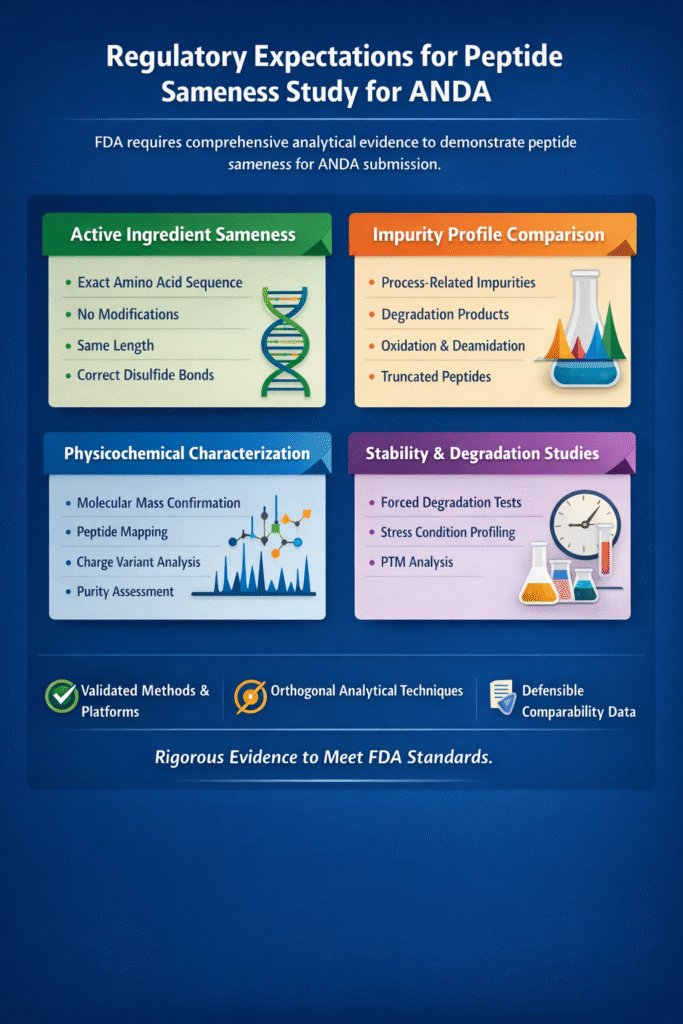
The FDA expects comprehensive, orthogonal, and validated analytical evidence demonstrating structural identity and impurity comparability.
For detailed regulatory-focused guidance, see:
https://resolvemass.ca/characterization-of-peptides-for-fda/
Key regulatory principles include:
1. Demonstration of Active Ingredient Sameness
Regulatory expectation: The generic peptide must be structurally identical to the RLD at the primary sequence level.
FDA requires clear proof of:
- Exact amino acid sequence
- Same peptide length
- No substitutions, deletions, insertions, or unintended modifications
- Correct disulfide bond connectivity (if applicable)
Even a single amino acid difference can disqualify ANDA eligibility under the sameness standard.
Understanding the analytical distinction between peptide mapping and full sequencing is critical for defensible submissions.
In a Peptide Sameness Study for ANDA, high-resolution LC-MS/MS fragmentation data must align 100% with the reference standard.
2. Impurity Profile Comparison
Regulatory expectation: The impurity profile of the generic must be highly comparable to that of the RLD, without new unidentified impurities above qualification thresholds.
Sponsors must evaluate:
- Process-related impurities
- Degradation products
- Truncated peptides
- Oxidation variants
- Deamidation products
- Isomeric impurities
Impurity assessment is often the most scrutinized section of a Peptide Sameness Study for ANDA, especially for synthetic peptides.
Analytical methods must demonstrate sensitivity sufficient to detect low-level variants (often <0.1%) using orthogonal techniques.
3. Physicochemical Characterization
Regulatory expectation: Physicochemical properties must be comparable across multiple analytical dimensions.
FDA expects evaluation of:
- Molecular mass confirmation (HRMS accuracy)
- Peptide mapping alignment
- Charge variant analysis
- Chromatographic purity assessment
- Structural conformation (if applicable)
- Advanced peptide characterization techniques explained.
- Purity testing considerations.
- For U.S.-focused purity standards.
A well-designed Peptide Sameness Study for ANDA integrates these analytical datasets into a coherent comparability narrative.
4. Stability & Degradation Evaluation
Regulatory expectation: Stability behavior under stress conditions must be comparable between the generic and RLD.
Sponsors should conduct:
- Forced degradation studies (acid/base, oxidation, heat, light)
- Stress condition impurity profiling
- Stability-indicating method validation
Stability comparability strengthens the argument that the generic product will perform equivalently throughout its shelf life.
Sponsors must use state-of-the-art analytical platforms to generate high-resolution, defensible data.
Final Regulatory Consideration
FDA reviewers expect a Peptide Sameness Study for ANDA to be:
- Scientifically rigorous
- Supported by validated methods
- Backed by orthogonal analytical techniques
- Clearly documented with comparative tables and chromatographic overlays
- Risk-assessed and well justified
Sponsors must use state-of-the-art analytical platforms, high-resolution mass spectrometry, and expert data interpretation to generate high-confidence, regulator-ready evidence.
A strategic, well-documented regulatory approach significantly reduces the risk of information requests, review delays, and Complete Response Letters.
4: Core Analytical Techniques Used in Peptide Sameness Study for ANDA
Multiple orthogonal analytical methods are required to establish peptide sameness conclusively.
Below is a simplified overview:
| Analytical Technique | Purpose in Sameness Study |
|---|---|
| LC-MS/MS | Molecular weight confirmation and impurity detection |
| High-Resolution Mass Spectrometry (HRMS) | Accurate mass determination |
| Peptide Mapping | Sequence confirmation |
| Amino Acid Analysis | Composition verification |
| RP-HPLC | Purity and impurity profiling |
| Ion-Exchange Chromatography | Charge variant analysis |
| Circular Dichroism (if needed) | Secondary structure confirmation |
- For expert LC-MS capabilities: https://resolvemass.ca/peptide-mass-spectrometry-experts/
- Identifying unknown peptides using LC-MS
Why Orthogonal Methods Matter
Regulators expect confirmation from multiple analytical angles. For example:
- Molecular weight confirmation alone is insufficient.
- Sequence mapping must align 100% with the RLD.
- Impurity comparison must show no new unknown peaks above qualification thresholds.
A strong Peptide Sameness Study for ANDA integrates all these techniques cohesively.
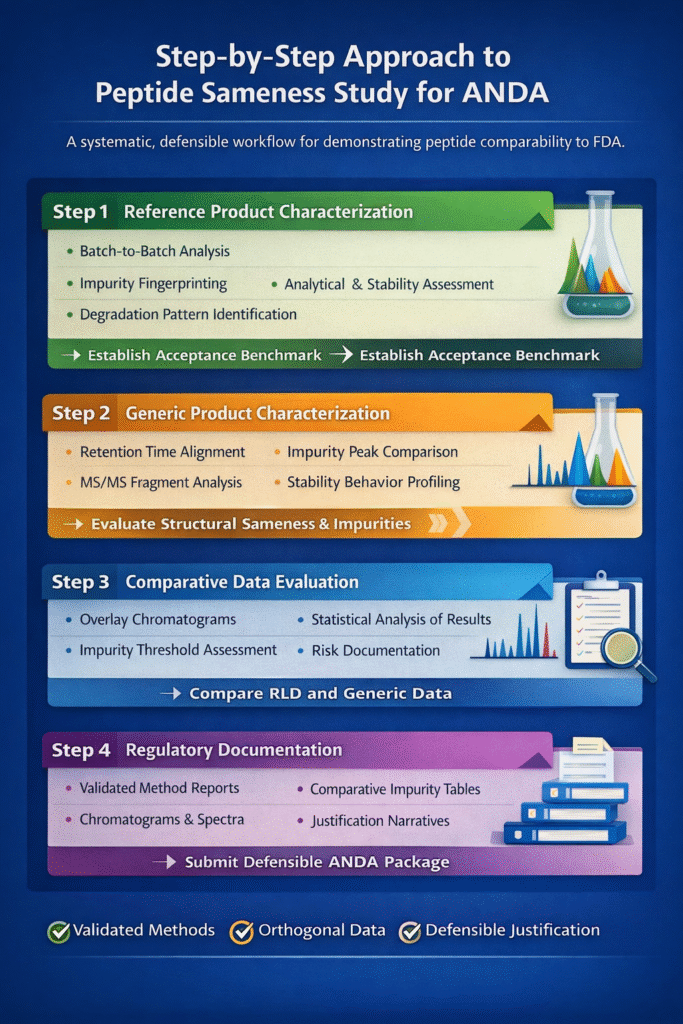
5: Step-by-Step Approach to Peptide Sameness Study for ANDA
Step 1: Reference Product Characterization
The first and most critical step in a Peptide Sameness Study for ANDA is comprehensive characterization of the Reference Listed Drug (RLD). This establishes the scientific benchmark against which the generic product will be compared.
This includes:
- Batch-to-batch analysis
- Impurity fingerprinting
- Identification of degradation patterns
- Analytical variability assessment
- Stability trend evaluation
The goal is to fully understand the natural variability range of the RLD before defining acceptance criteria.
For ANDA vs NDA considerations:
https://resolvemass.ca/peptide-characterization-for-ind-and-nda/
Understanding the RLD sets the acceptance benchmark and reduces regulatory ambiguity during review.
Step 2: Generic Product Characterization
The generic peptide must be characterized using identical, validated analytical conditions to ensure direct comparability.
Key comparisons include:
- Retention time alignment (chromatographic overlay)
- MS/MS fragmentation pattern consistency
- Molecular weight confirmation (HRMS accuracy)
- Impurity peak comparison
- Stress stability behavior under forced degradation
Minor analytical differences must be:
- Scientifically justified
- Within predefined qualification thresholds
- Supported by orthogonal confirmation
Minor differences must be scientifically justified.
- Manufacturing method influences impurity profile. Learn more:
https://resolvemass.ca/solid-vs-liquid-phase-peptide-synthesis-which-method-is-better/ - Analytical support in synthesis:
https://resolvemass.ca/analytical-support-in-peptide-synthesis-why-its-essential/
A rigorous analytical strategy at this stage strengthens the defensibility of the entire Peptide Sameness Study for ANDA.
Step 3: Comparative Data Evaluation
Side-by-side analytical comparison determines structural equivalence.
Important aspects:
- Overlay chromatograms
- Impurity threshold comparison
- Statistical analysis of results
- Risk assessment documentation
Data should be organized into structured comparative summaries to make FDA review efficient and transparent.
In a robust Peptide Sameness Study for ANDA, every observed difference must be either eliminated through optimization or justified through scientific rationale.
Step 4: Regulatory Documentation
Clear, defensible, and well-structured documentation is essential for ANDA success.
The submission must include:
- Fully validated method reports
- Chromatograms and high-resolution spectra
- Peptide mapping data
- Comparative impurity tables
- Statistical summaries
- Scientific justification narratives
- Stability study reports
Clear documentation significantly strengthens review efficiency and reduces the likelihood of information requests or Complete Response Letters.
Clear documentation strengthens review efficiency.
- Selecting the right CRO partner
- Top factors when selecting a peptide testing lab
- Outsourcing considerations
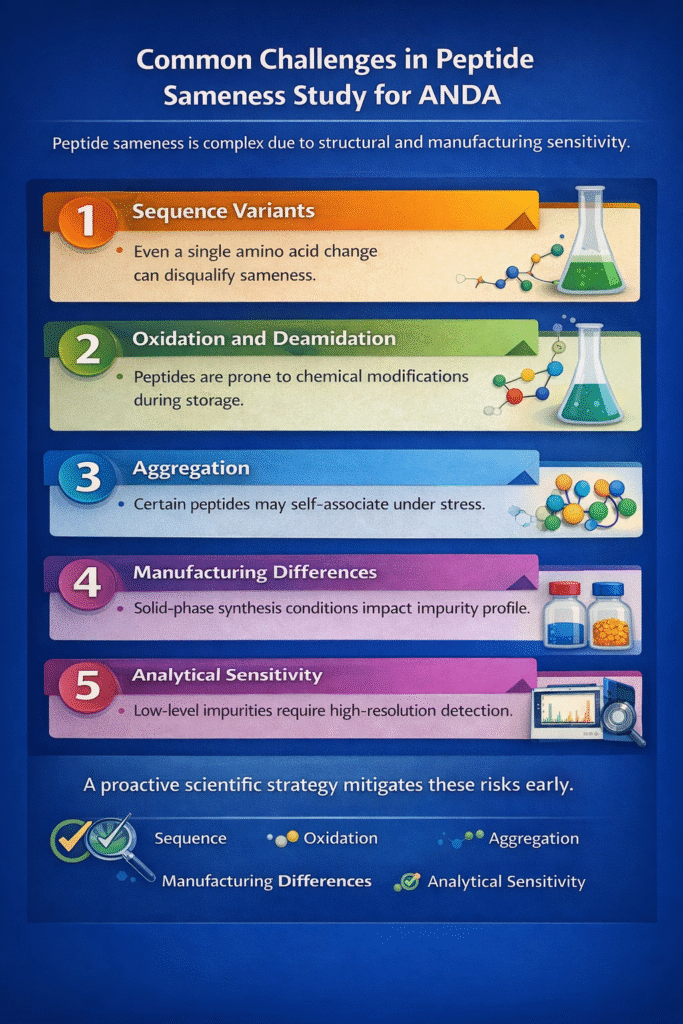
6: Common Challenges in Peptide Sameness Study for ANDA
Peptide sameness is complex due to structural and manufacturing sensitivity.
1. Sequence Variants
Even a single amino acid change can disqualify sameness.
2. Oxidation and Deamidation
Peptides are prone to chemical modifications during storage.
3. Aggregation
Certain peptides may self-associate under stress.
4. Manufacturing Differences
Solid-phase synthesis conditions impact impurity profile.
5. Analytical Sensitivity
Low-level impurities require high-resolution detection.
A proactive scientific strategy mitigates these risks early.
7: How to Optimize Peptide Sameness Study for ANDA Success
Early planning, regulatory alignment, and advanced analytical capabilities are essential for success.
Best practices include:
- Engage analytical experts early
- Conduct forced degradation studies
- Use high-resolution MS platforms
- Establish impurity qualification thresholds
- Perform multiple batch comparisons
- Document scientific rationale thoroughly
Early regulatory consultation can also reduce ambiguity.
8: Case Insight: Why Advanced LC-MS Expertise Matters
Peptide characterization demands:
- Accurate mass resolution
- Fragment ion analysis
- Detection of low-level impurities (<0.1%)
- Sequence confirmation under stress conditions
Advanced LC-MS laboratories with experience in peptide analysis can significantly reduce analytical uncertainty.
A comprehensive Peptide Sameness Study for ANDA must be designed not only for compliance — but for regulatory defensibility.
9: Why Partner with an Experienced Analytical CRO?
Peptide generics require:
- Advanced instrumentation
- Skilled mass spectrometry experts
- Regulatory documentation experience
- Method validation proficiency
An experienced bioanalytical laboratory ensures:
- Regulatory-compliant method development
- High-resolution impurity profiling
- Clear ANDA-ready documentation
- Reduced review cycles
At ResolveMass Laboratories Inc., our scientific team specializes in complex peptide characterization, high-resolution mass spectrometry, impurity profiling, and regulatory-ready analytical documentation tailored for ANDA submissions.
Conclusion
A scientifically rigorous Peptide Sameness Study for ANDA is the foundation of successful peptide generic approval. It requires precise structural confirmation, impurity comparability, orthogonal analytical methods, and regulatory-aligned documentation.
Companies that invest early in comprehensive analytical characterization significantly reduce approval risk, regulatory delays, and unexpected deficiencies.
If you are preparing for an ANDA submission involving peptide drugs, a well-designed Peptide Sameness Study for ANDA can make the difference between a smooth approval and prolonged review cycles.
Frequently Asked Questions:
The primary objective of a Peptide Sameness Study for ANDA is to demonstrate that the generic peptide drug is structurally identical to the Reference Listed Drug (RLD). This includes confirming the exact amino acid sequence, molecular weight, impurity profile, and physicochemical properties using comprehensive, orthogonal analytical methods. The goal is to provide scientifically defensible evidence of active ingredient sameness to satisfy regulatory requirements.
No. A bioequivalence study alone is not sufficient for peptide ANDA approval. Regulatory authorities require clear analytical evidence of structural sameness before evaluating bioequivalence. Because peptides are complex molecules, detailed characterization—such as sequence confirmation, impurity comparison, and degradation profiling—is essential prior to or alongside bioequivalence assessment.
Minor impurity differences may be accepted, but only if they are scientifically justified and remain within acceptable regulatory thresholds. Sponsors must demonstrate that any observed differences do not impact safety, efficacy, or quality. If new or higher-level impurities are detected, additional characterization and toxicological qualification may be required to support regulatory acceptance.
A Peptide Sameness Study for ANDA is a comprehensive analytical evaluation that demonstrates a generic peptide drug is structurally and chemically identical to the Reference Listed Drug (RLD). It includes sequence confirmation, impurity profiling, physicochemical characterization, and stability comparison to meet FDA requirements for generic approval.
A robust study typically includes:
-LC-MS/MS for molecular weight and fragmentation analysis
-High-resolution mass spectrometry (HRMS)
-Peptide mapping for sequence confirmation
-Amino acid analysis
-RP-HPLC for purity profiling
-Ion-exchange chromatography for charge variants
-Forced degradation studies for stability comparison
Orthogonal analytical methods are essential to establish defensible comparability.
Reference
- Chapter 1: Regulatory Considerations for Peptide Therapeutic.https://books.rsc.org/books/edited-volume/801/chapter/540098/Regulatory-Considerations-for-Peptide-Therapeutics
- Recommendation for Clarifying FDA Policy in Evaluating “Sameness” of Higher Order Structure for Generic Peptide Therapeutics.https://link.springer.com/article/10.1208/s12248-024-00994-8
- Immunogenicity risk assessment of synthetic peptide drugs and their impurities.https://www.sciencedirect.com/science/article/pii/S1359644623002301
About the Author


